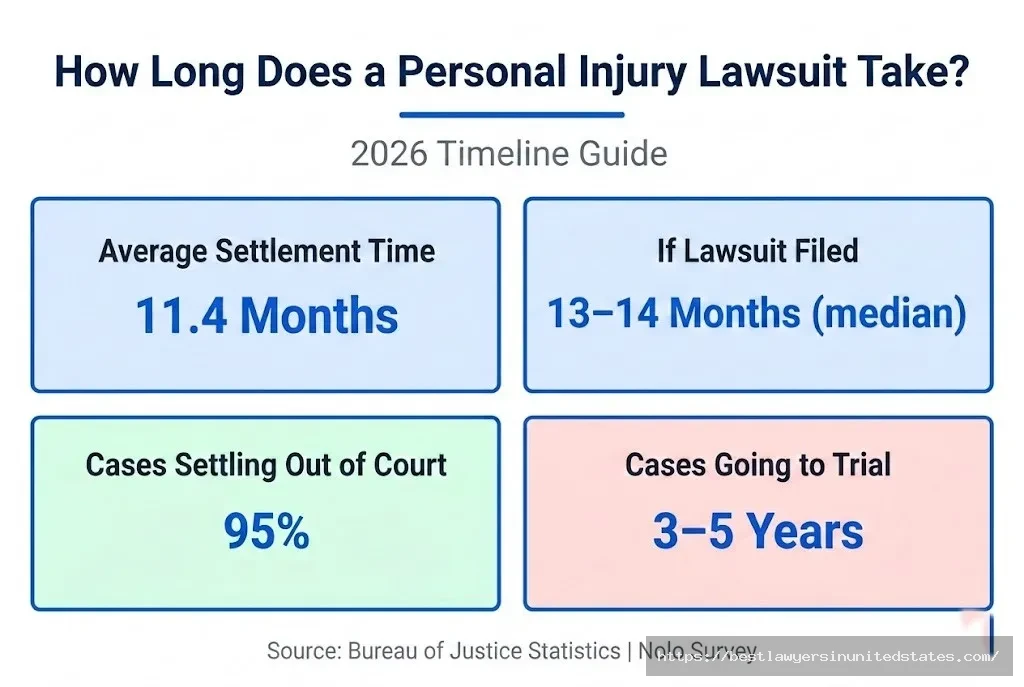
A personal injury lawsuit can take anywhere from a few months to several years, depending on how complex your case is and whether it settles or goes to trial. Most cases that settle before a lawsuit is filed resolve within 6 to 12 months. If you file a lawsuit, expect the process to take 1 to 3 years — and cases that go all the way to trial can stretch to 3 to 5 years or longer.
Quick Answer: Personal injury cases take 6 months to 5+ years to resolve. Simple cases with clear liability settle fastest — often under a year. Complex cases involving serious injuries, disputed fault, or multiple defendants take the longest. According to data from the Bureau of Justice Statistics, once a lawsuit is filed, the median time to resolution is approximately 13 to 14 months. Cases that go to trial average 22 to 23 months from filing to verdict.
The single biggest variable? Whether your case settles or goes to trial. About 95% of personal injury cases never reach a courtroom. But even settling takes time — medical recovery, insurance negotiations, and court scheduling all shape how long you’ll wait.
This guide walks you through every phase of a personal injury lawsuit, what slows things down, what speeds them up, and realistic timelines for your specific type of case. FanDuel Lawsuit 2026
What Is a Personal Injury Lawsuit?
The Basics of a Personal Injury Claim
A personal injury claim is a legal action that lets an injured person seek financial compensation from whoever caused their injury through negligence or wrongful conduct. These cases cover car accidents, slip and falls, medical malpractice, defective products, dog bites, workplace injuries, and wrongful death.
Here’s an important distinction people often miss: a claim and a lawsuit are not the same thing. A claim is filed with an insurance company. A lawsuit is filed in court. Most personal injury cases start as claims — and roughly 70% get resolved at the claim stage, without ever going to court.
When a claim gets rejected, stalls, or results in a lowball offer, your attorney files a formal lawsuit. That’s when the clock really starts ticking.
Why Timelines Vary So Widely
No two personal injury cases move at the same pace. Cases that involve serious injuries or are not settled and instead go to trial often take 2 to 5 years to receive compensation. Meanwhile, a straightforward fender bender with minor injuries and cooperative insurance companies can wrap up in 4 months.
The factors that matter most:
- Injury severity — Serious injuries require more medical documentation and longer recovery time before damages can be calculated
- Liability disputes — When fault is unclear, everything slows down
- Number of defendants — More parties means more complicated negotiations and discovery
- Insurance company tactics — Some insurers drag their feet as a strategy
- Court backlog — In busy urban courts, waiting for a trial date alone can take 12+ months
- Your state’s rules — Statutes of limitations and procedural deadlines vary by state
Personal Injury Lawsuit Timeline: Phase by Phase
Case Type Timeline Overview
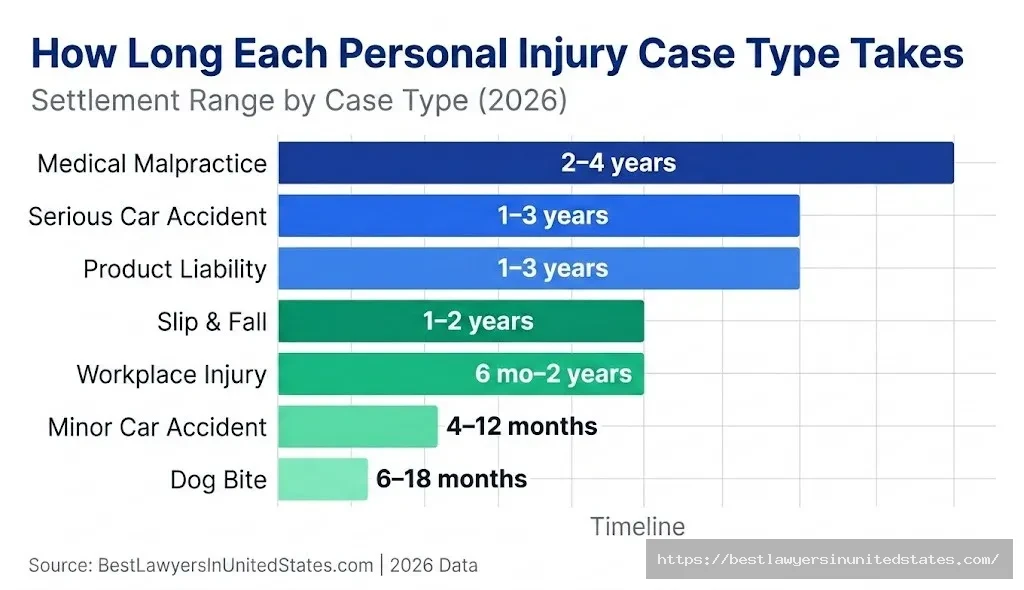
| Case Type | Typical Timeline | Notes |
|---|---|---|
| Car accident (minor injuries) | 4–12 months | Fastest category if liability is clear |
| Car accident (serious injuries) | 1–3 years | Longer recovery = longer timeline |
| Slip and fall | 1–2 years | Property disputes add complexity |
| Medical malpractice | 2–4 years | Expert witnesses required |
| Product liability | 1–3 years | Technical investigations needed |
| Workplace injury | 6 months–2 years | Workers’ comp adds layers |
| Dog bite | 6–18 months | Faster if liability is established |
| Wrongful death | 1–3 years | Emotional complexity + liability disputes |
Phase 1: Immediately After the Injury (Days to Weeks)
The clock starts the moment you’re injured. Your first job is to seek medical care — both for your health and because medical records become the backbone of your case.
In these early days and weeks, your attorney (if you’ve hired one) begins gathering evidence: police reports, incident reports, photos, witness statements, and surveillance footage. This phase itself doesn’t take long, but what happens here shapes everything that follows.
One warning: Every state has a statute of limitations — a hard deadline to file your lawsuit. In Florida, the general deadline for negligence-based matters is now 2 years from the date of injury, following changes to Florida Statutes §95.11 in 2023 that shortened the previous 4-year window. Ohio has long required you to file a personal injury claim within 2 years under Ohio Revised Code §2305.10. For context, 28 states use a 2-year deadline, 12 states allow 3 years, and a handful use other timeframes.
Miss the statute of limitations and you lose your right to compensation entirely. Talk to an attorney early.
Phase 2: Medical Treatment and Reaching MMI (Weeks to Months)
This phase has the most variation of any stage in the process — and it’s mostly outside your control. Your attorney will typically wait until you reach Maximum Medical Improvement (MMI) before calculating damages and making a demand.
MMI means your condition has stabilized. You’ve either fully recovered, or your doctors have determined that further significant improvement is unlikely. Cases involving catastrophic injuries usually take longer because the full impact on the victim’s life must be assessed before determining compensation. Medical improvement must reach a point called maximum medical improvement before finalizing damages.
Why does this matter so much? If you settle before reaching MMI, you might accept less than you’ll actually need. Future surgeries, long-term therapy, or permanent disability — none of that gets properly accounted for until your condition stabilizes.
Timeline impact:
- Minor injuries (soft tissue, broken bones): 2–6 months to reach MMI
- Moderate injuries (surgery required): 6–18 months
- Severe injuries (TBI, spinal cord, burns): 1–3+ years
Phase 3: Pre-Litigation Demand and Negotiation (1–6 Months)
Once you reach MMI, your attorney builds a demand package — a comprehensive document laying out your injuries, medical bills, lost wages, pain and suffering, and the compensation you’re requesting.
This gets sent to the at-fault party’s insurance company. Then negotiations begin.
Personal injury claims are settled before filing in roughly 70% of situations. Many cases wrap up right here. The insurer reviews your demand, makes a counter-offer, your attorney pushes back, and eventually you reach a number that works — or you don’t.
If you don’t, your attorney files a lawsuit.
How long does negotiation take? Anywhere from a few weeks to six months, depending on how reasonable the insurer is and how strong your evidence is.
Phase 4: Filing the Lawsuit (2–8 Weeks)
Filing a lawsuit means your attorney submits a formal complaint to the appropriate civil court, outlining your claims and the compensation sought. The defendant is then officially served and typically has 20–30 days to respond (exact timing varies by state and jurisdiction).
Filing a lawsuit doesn’t mean you’re going to trial. Filing a personal injury lawsuit doesn’t mean you’ll go to trial; it simply moves your claim into the litigation phase where formal discovery begins.
It also frequently shakes loose a settlement offer. Insurance companies often become more serious negotiators once real legal costs are on the table.
Phase 5: Discovery (3–12+ Months)
Discovery is the longest single phase for most lawsuits. Both sides are legally required to share evidence, answer written questions (interrogatories), produce documents, and sit for depositions.
The discovery phase takes between 6 months to 1 year and allows both parties to exchange evidence and gather information to support their claims.
What happens during discovery:
- Interrogatories — Written questions each side must answer under oath
- Document requests — Medical records, employment records, accident reports, insurance policies
- Depositions — In-person interviews under oath with parties and witnesses
- Expert witness reports — Medical experts, accident reconstructionists, economists
Complex cases (medical malpractice, product liability) can push discovery past a year. Simpler cases with clear facts might finish in 3 months.
Discovery Timeline Breakdown
| Discovery Activity | Typical Duration | What It Involves |
|---|---|---|
| Interrogatories | 1–2 months | Written Q&A between parties |
| Document exchange | 1–3 months | Medical records, reports, photos |
| Depositions | 2–4 months | Sworn testimony from parties and witnesses |
| Expert reports | 2–6 months | Medical, accident, economic experts |
| Total discovery | 3–12+ months | Varies by case complexity |
Phase 6: Mediation and Pre-Trial Negotiations (2–6 Months)
After discovery, most courts require the parties to attempt mediation before going to trial. Most courts require mediation before allowing parties to proceed to trial. This is where cases settle out of court most frequently. Many reach resolution at this stage, often around the 12 to 18 month mark.
Mediation is a structured negotiation with a neutral third-party mediator who facilitates discussion. The mediator doesn’t decide anything — they help both sides communicate and find a settlement both can live with. This stage can last anywhere from two to six months, depending on the case’s complexity and the availability of the mediator and attorneys.
The good news: by this point, both sides have seen all the evidence. That clarity often produces real movement. A large percentage of cases that don’t settle during negotiation do settle during or just after mediation.
Phase 7: Trial (If Settlement Fails)
If mediation fails and no settlement is reached, the case goes to trial. Getting there takes time — court schedules are crowded.
Only about 3 to 5% ever reach a jury. For those that do, federal court statistics indicate a median of roughly 22 to 23 months from filing to verdict. Complex matters like medical malpractice can extend beyond that, sometimes stretching to 30 months or more.
A personal injury trial itself might last one day or several weeks, depending on complexity. The length may be increased because, in many states, trials are held for only half a day instead of over a full day. That doubles the length of a trial, but also lets the lawyers and judges get other things done in the afternoon.
After a verdict, the losing party can appeal — which adds more time before any money changes hands. How Long Does a Nursing Home Lawsuit Take
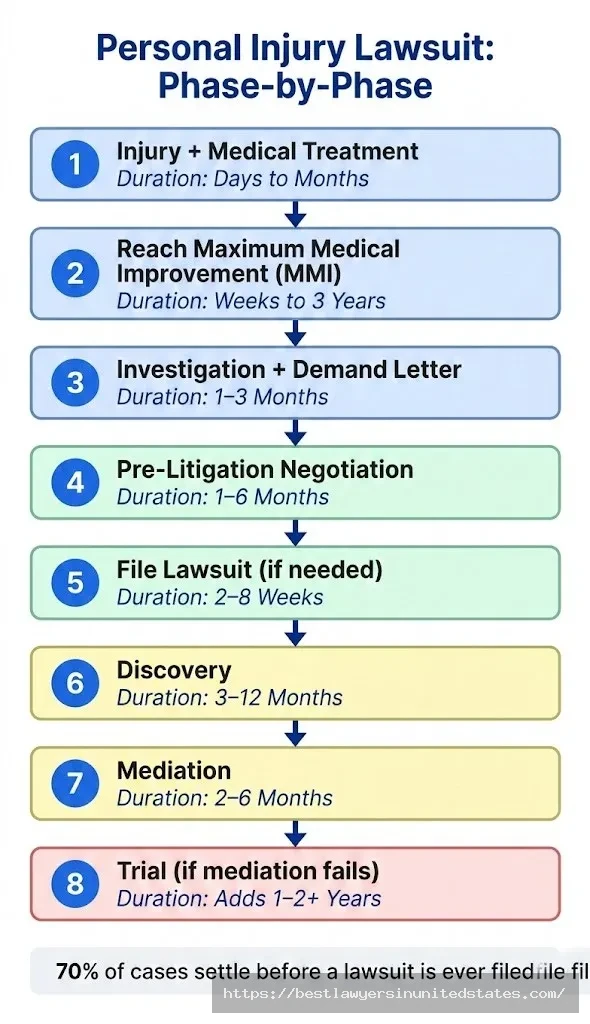
Complete Personal Injury Lawsuit Timeline
| Phase | Typical Duration | What Happens |
|---|---|---|
| Injury + medical treatment | Days to months | Seek care, document injuries, hire attorney |
| Reaching MMI | Weeks to 3 years | Condition stabilizes; true damages become clear |
| Investigation + demand | 1–3 months | Build case, send demand to insurer |
| Pre-litigation negotiation | 1–6 months | Settle or decide to file suit |
| Filing lawsuit | 2–8 weeks | Complaint filed, defendant served |
| Discovery | 3–12 months | Evidence exchanged, depositions taken |
| Mediation | 2–6 months | Structured negotiation with neutral mediator |
| Trial preparation | 1–2 months | Final prep if case doesn’t settle |
| Trial | Days to weeks | Jury decides if no settlement reached |
| Total (settlement) | 6 months – 2 years | Most common outcome |
| Total (trial) | 2–5+ years | Uncommon but possible for complex cases |
Settlement vs. Trial: How It Affects Your Timeline
Why Most Cases Settle
Settling is faster and carries less risk than going to trial. Here’s how the two paths compare:
| Factor | Settlement | Trial |
|---|---|---|
| Timeline | 6 months–2 years | 2–5+ years |
| Outcome certainty | Guaranteed amount | Jury decides |
| Attorney fees | Lower (less work) | Higher (extensive preparation) |
| Stress level | Lower | Higher |
| Privacy | Private agreement | Public record |
| Final decision-maker | You and your attorney | Jury |
When Going to Trial Makes Sense
Most personal injury attorneys will push for a settlement unless the insurer is genuinely undervaluing your claim. Filing suit often puts real pressure on the defense to take your case seriously and can lead to better offers during or after discovery and mediation. Your lawyer should talk frankly with you about the trade-offs: the potential increase in value vs. the added time and stress of litigation.
What Slows Down a Personal Injury Case?
Factors That Extend Your Timeline
Injury severity. Severe injuries often require extended recovery periods, delaying the legal process. For example, if you suffer a complex fracture or traumatic brain injury, your attorney may recommend waiting until your condition stabilizes before filing or finalizing the claim.
Disputed liability. When fault isn’t clear — multiple drivers, unclear accident scenes, conflicting witness statements — both sides dig in and discovery gets extensive.
Multiple defendants. Lawsuits involving a single defendant often move more quickly than those with multiple defendants or claims against large corporations. When multiple parties are named in a lawsuit, coordinating depositions, discovery, and negotiations becomes more complex and time-consuming.
Crowded court dockets. If your lawsuit is filed in a metropolitan area with a high volume of civil cases, you may face extended delays due to the sheer number of cases the court must process. Scheduling conflicts and resource limitations within the court system can further contribute to these delays.
Insurance company tactics. Large insurers sometimes delay as a strategy, betting that financially stressed plaintiffs will accept lower offers rather than wait.
Pre-existing conditions. If the defendant’s insurer argues your injuries aren’t new — that they’re pre-existing — expect more medical review, more depositions, and longer negotiations.
What Speeds Up a Personal Injury Case?
You can’t control everything, but these factors genuinely help:
| Action | Why It Helps |
|---|---|
| Hire an experienced attorney early | Attorneys who know the system move faster through each phase |
| Document everything immediately | Strong evidence from day one reduces disputes |
| Follow your doctor’s treatment plan | Consistent treatment records are harder to challenge |
| Respond quickly to attorney requests | Delays in getting your attorney documents slow the whole case |
| Stay off social media | Posts contradicting your injuries create disputes that add time |
| Be realistic about settlement offers | Holding out for maximum value is sometimes right; sometimes it adds years |
How Long Does Each Type of Personal Injury Case Take?
Car accident cases are among the most common personal injury claims. On average, these cases can take anywhere from 6 months to 2 years to resolve, depending on the severity of the injuries and whether the insurance company disputes liability. Slip-and-fall cases typically take 1 to 2 years to settle. Medical malpractice lawsuits are often very complex and can take 2 to 4 years or even longer, as they require expert testimony, a thorough investigation of medical records, and a deep dive into the standard of care. Product liability cases typically involve injuries caused by defective products and can take 1 to 3 years. Dog bite cases generally take 6 months to 18 months to settle, depending on the severity of the injuries and the liability of the dog owner. Wrongful death lawsuits can take 1 to 3 years to resolve, especially when proving liability and calculating damages for the loss of a loved one.
Case Type Comparison
| Case Type | Settlement Range | Trial Range | Key Delay Factor |
|---|---|---|---|
| Minor car accident | 4–12 months | 18–36 months | Insurance cooperation |
| Serious car accident | 1–3 years | 3–5 years | MMI, disputed damages |
| Slip and fall | 1–2 years | 2–4 years | Property owner disputes |
| Medical malpractice | 2–4 years | 3–6 years | Expert witnesses required |
| Product liability | 1–3 years | 2–5 years | Technical investigation |
| Workplace injury | 6 months–2 years | 2–4 years | Workers’ comp layers |
| Dog bite | 6–18 months | 18–36 months | Owner liability disputes |
| Wrongful death | 1–3 years | 2–5 years | Emotional + legal complexity |
When Will You Get Paid After a Settlement?
Once you sign a settlement agreement, you’re close — but not done. Here’s what happens next:
| Step | Typical Duration | What Happens |
|---|---|---|
| Sign settlement agreement | Day 1 | You and your attorney agree to terms |
| Insurer issues release paperwork | 1–2 weeks | Documents sent for signature |
| Sign and return release | 1 week | You return signed forms |
| Insurer processes payment | 2–4 weeks | Check issued to your attorney’s trust account |
| Lien resolution | 1–4 weeks | Medical liens, health insurance paid back |
| Attorney fees and costs deducted | 1 week | Typically 33% contingency fee |
| You receive your check | 30–45 days total | After all deductions |
Most settlements pay out within 30 to 45 days of signing the agreement. Cases with Medicaid or Medicare liens can take longer — those agencies have first-payment rights that must be sorted out. Uber Crash Lawsuit
Do You Need a Lawyer for a Personal Injury Case?
Quick Answer: You don’t legally need an attorney to file a personal injury claim. But statistics consistently show that people with attorneys recover significantly more money — even after attorney fees.
When to Hire an Attorney
Consider hiring a personal injury attorney if:
- Your injuries required hospitalization or surgery
- You missed more than a few days of work
- Liability is disputed or unclear
- Multiple parties are involved
- You’re dealing with a large corporation or commercial insurer
- The insurance company has already made a lowball offer
- Your injuries may have long-term consequences
How Attorney Fees Work
Personal injury attorneys typically work on contingency — meaning no upfront cost to you. They get paid a percentage of your recovery, usually 33% if the case settles before trial, and 40% or more if it goes to trial. You pay nothing if you lose.
Free Consultation Resources
Most personal injury attorneys offer free consultations. You can contact attorneys directly, or reach [email protected] for attorney referrals in your area.
Frequently Asked Questions
How long does a personal injury lawsuit take on average?
Quick Answer: Most personal injury cases settle within 6 months to 2 years. Cases that go to trial average 2 to 5 years from injury to verdict.
According to a survey by legal publisher Nolo, the average personal injury settlement takes about 11.4 months from accident to resolution. But averages can mislead — a serious injury case or one with disputed liability can take considerably longer.
How long does a car accident lawsuit take to settle?
Quick Answer: Car accident cases typically settle in 6 months to 2 years, depending on injury severity and whether fault is disputed.
Minor accidents with clear liability can resolve in 4 to 6 months. Serious accidents — especially those involving TBI, spinal injuries, or disputed fault — commonly take 1 to 3 years.
How long does the discovery phase take?
Quick Answer: Discovery typically takes 3 to 12 months, depending on case complexity.
Simple cases can finish discovery in 3 months. Complex cases involving medical malpractice or multiple defendants can stretch discovery past a year, particularly when expert witnesses are involved.
Can I speed up my personal injury case?
Quick Answer: Yes — to a degree. Some things are in your control; many aren’t.
Hire your attorney early, document everything thoroughly, follow your medical treatment plan, and respond quickly to document requests. What you can’t control: court scheduling, how fast the other side responds, and how long your medical recovery takes.
What happens if the other side doesn’t want to settle?
Quick Answer: The case proceeds through discovery and mediation. If still unresolved, it goes to trial.
Settlement is possible at almost any stage of a personal injury case timeline. Cases can settle before a lawsuit is filed, after suit is filed but before discovery is complete, during or after mediation, and sometimes cases even settle after a verdict, if both sides want to avoid appeals.
How long after a trial do you receive payment?
Quick Answer: If you win at trial, the losing party typically has 30 days to pay. Appeals can delay that significantly.
If the defendant appeals the verdict, payment may be delayed by 6 months to 2 years while the appeals court considers the case. An experienced attorney can advise on whether a post-trial settlement makes more sense than waiting.
What is MMI and why does it delay my case?
Quick Answer: MMI (Maximum Medical Improvement) means your condition has stabilized. Your attorney waits for MMI to make sure damages reflect your full injury — not just your current condition.
Settling before MMI is one of the biggest mistakes injured people make. If you settle early and your condition worsens, you typically can’t go back to get more money. Your attorney will advise when your treatment has stabilized enough to accurately calculate your total damages.
Does filing a lawsuit mean I’ll go to trial?
Quick Answer: No. Filing a lawsuit is usually a negotiating move. Most lawsuits settle before trial.
Only about 3 to 5% of personal injury lawsuits actually reach a jury. Filing a lawsuit formally begins the legal process and often motivates insurers to make better offers, especially once discovery reveals the strength of your case.
How long do I have to file a personal injury lawsuit?
Quick Answer: Most states give you 2 to 3 years from the date of injury. Missing this deadline permanently bars your claim.
Statutes of limitations vary: California, Texas, and Florida give 2 years; New York and Pennsylvania give 3 years. Some exceptions apply — minors, cases involving government entities, or injuries that weren’t immediately apparent have different rules. Don’t assume you have time. Consult an attorney as soon as possible after your injury.
What if my case involves a government entity (city, county, state)?
Quick Answer: Cases against government entities have much shorter notice requirements — often 30 to 180 days.
If you were injured due to a government employee or on government property, you must typically file a formal notice of claim before the regular lawsuit deadline. Miss that notice deadline and your case may be dismissed entirely, regardless of how strong your claim is.
What is the difference between a personal injury claim and a lawsuit?
Quick Answer: A claim is filed with an insurance company. A lawsuit is filed in court. Most personal injury cases start as claims and never become lawsuits.
A claim is the first step — you or your attorney presents your case to the at-fault party’s insurer and tries to negotiate a settlement. If negotiations fail, your attorney files a lawsuit in civil court, starting the formal litigation process.
Can a personal injury case be reopened after settlement?
Quick Answer: Generally no. When you sign a settlement agreement, you sign a release giving up your right to sue over that incident.
This is why timing matters so much. Settling before you reach MMI — before you know the full extent of your injuries — can mean accepting far less than your case is worth. Your attorney’s job is to help you recognize when the right time to settle has arrived.
What if I was partially at fault for the accident?
Quick Answer: You can still recover compensation in most states, but your award may be reduced based on your share of fault.
Most states follow comparative negligence rules. If you were 20% at fault, you recover 80% of your damages. A handful of states follow contributory negligence — if you were even 1% at fault, you get nothing. Your attorney will know which rules apply in your state.
How do attorney fees affect my actual payout?
Quick Answer: Attorney fees typically take 33% of a pre-trial settlement and 40% of a trial verdict, plus case expenses.
If you settle for $100,000 before trial, you might receive approximately $60,000–$65,000 after fees and case costs. If your case goes to trial and you win $200,000, you might receive approximately $110,000–$120,000 after higher fees and additional litigation costs. Your attorney will provide a detailed written breakdown before you sign anything.
What if my case is taking too long?
Quick Answer: Talk to your attorney about the cause of delays. Some are unavoidable; others aren’t.
If you haven’t heard anything in several weeks during an active phase, ask for an update. Watch for progress milestones: discovery completion, mediation scheduling, trial date setting. If things seem stuck without explanation, discuss it with your attorney. If you’re genuinely unhappy with the pace, you have the right to consult with another attorney or switch representation.
Will I have to go to court at all?
Quick Answer: Probably not. Most personal injury cases settle without a courtroom appearance.
Even in cases that are technically “filed” in court, the vast majority settle during discovery or mediation. You may have to give a deposition (a sworn statement outside of court), but full courtroom appearances are much less common than people expect.
How long does medical malpractice take?
Quick Answer: Medical malpractice cases typically take 2 to 4 years, sometimes longer.
Medical malpractice is the most complex category of personal injury law. These cases require expert medical witnesses, detailed review of treatment records, and extensive discovery. They’re also aggressively defended by medical malpractice insurers. If you have a malpractice case, expect the longer end of the timeline range.
What to Do Right Now If You’ve Been Injured
The steps you take in the first days and weeks after an injury have an outsized impact on how long your case takes — and how much you recover. Here’s what matters most:
- Get medical care immediately — Both for your health and to create official records
- Document everything — Photos, contact info of witnesses, your own written account of what happened
- Don’t give statements to insurance companies — The other side’s insurer does not have your interests in mind
- Consult a personal injury attorney — Most offer free consultations and work on contingency
- Follow your treatment plan — Gaps in medical care hurt your credibility and your case
- Track your losses — Keep records of missed work, out-of-pocket expenses, and how your injury affects daily life
- Watch what you post online — Social media posts can and do get used against personal injury plaintiffs
The personal injury lawsuit process takes time — often more time than you’d like. But understanding the phases, knowing what slows things down, and working with an experienced attorney gives you the best shot at fair compensation. Patience and good legal guidance are the two most important things you can bring to this process.