
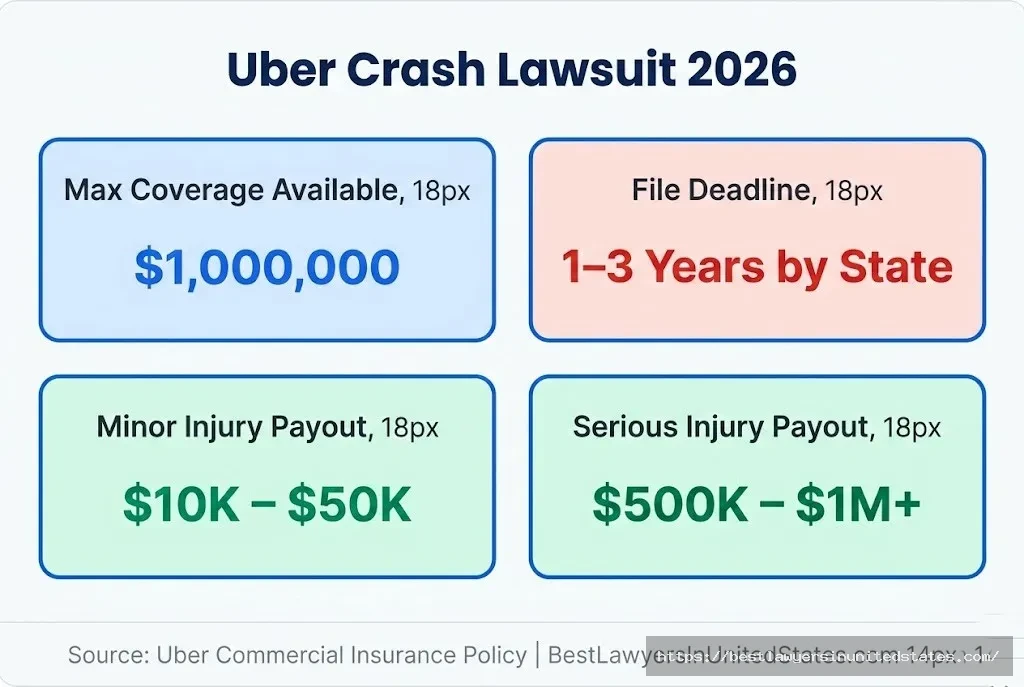
The Uber crash lawsuit process involves filing a personal injury claim against Uber’s insurance company (or the at-fault driver’s insurer) after being injured in a rideshare accident. Compensation can range from $10,000 for minor injuries to well over $1 million for severe or catastrophic harm. The deadline to file a lawsuit varies by state — as little as one year in Tennessee and two years in California, Florida, and Texas — so acting quickly is critical.
Quick Answer: If you were hurt in an Uber crash as a passenger, pedestrian, other driver, or cyclist, you likely have the right to seek compensation. Uber carries a $1 million commercial liability policy for active trips. Your window to file a lawsuit depends on your state, so don’t wait to find out your rights.
This guide covers who qualifies, how much you can get, how to file your claim step by step, and the latest 2026 updates that could affect your case. Homeowner Wins Lawsuit Against HOA
What Is an Uber Crash Lawsuit?
Background of Uber Crash Litigation
Uber crash lawsuits are personal injury (or wrongful death) claims filed by people who were hurt in accidents involving Uber drivers. These cases are different from ordinary car accident claims because of Uber’s complex insurance structure, the independent contractor status of drivers, and the involvement of a powerful corporation trying to limit its own liability.
Rideshare usage has exploded over the past decade. With millions of Uber trips completed every week in the U.S., the number of accidents — and resulting lawsuits — has grown steadily. Legal analysts report that rideshare-related injury claims are increasing nationwide, driven by heavier traffic, a growing driver pool, and the sheer volume of rides happening at all hours.
When a crash happens, figuring out who pays is rarely straightforward. Multiple insurance policies may be in play. Uber and its insurers are motivated to minimize what they pay out. And the driver’s status in the app at the exact moment of impact determines which policy even applies — making early legal action essential to preserving your rights.
Who Can File an Uber Crash Lawsuit?
You don’t have to be an Uber passenger to have a claim. People who can file include:
- Uber passengers injured during a ride
- Pedestrians struck by an Uber vehicle
- Cyclists hit by a rideshare driver
- Drivers or passengers in other vehicles involved in the crash
- Uber drivers themselves if they were injured by another at-fault driver while on the job
- Family members of someone killed in an Uber-related crash (wrongful death claim)
Key Events in U.S. Uber Crash Litigation
| Year | Event | Significance |
|---|---|---|
| 2014 | Uber launches commercial insurance framework | First attempt at tiered coverage for rideshare periods |
| 2018 | Self-driving Uber kills Elaine Herzberg in Arizona | Confidential wrongful death settlement; landmark autonomous vehicle case |
| 2022 | San Diego family receives $7M wrongful death settlement | One of California’s largest Uber wrongful death payouts |
| 2023 | LA Times reports $25M Uber wrongful death settlement | Largest publicly reported pedestrian crash settlement involving Uber |
| 2023 | Florida reduces statute of limitations from 4 to 2 years | Drastically shortens Florida victims’ filing window |
| 2024 | MDL No. 3084 consolidates 3,700+ Uber sexual assault cases in N.D. California | Largest multi-district rideshare litigation in U.S. history |
| Jan 2026 | First bellwether trial in Uber sexual assault MDL begins | Sets precedent for how juries value rideshare safety failures |
| Feb 2026 | Jury returns $8.5M verdict against Uber in sexual assault case | Landmark accountability ruling; next trial scheduled for April 2026 |
| 2026 | California SB 371 takes effect, modifying victim protections | Changes available insurance coverage for riders in CA |
| 2026 | Uber proposes California ballot initiative on crash settlement caps | Ongoing legal/political battle over how much crash victims can recover |
Who Qualifies for an Uber Crash Lawsuit?
Quick Answer: You likely qualify if you were injured in a crash involving an Uber vehicle — whether as a passenger, another driver, cyclist, or pedestrian. The key factors are: you suffered real injuries, the crash was at least partially someone else’s fault, and you’re within your state’s filing deadline.
Eligibility Requirements
| Requirement | Details | How to Prove It |
|---|---|---|
| You were involved in the crash | As a passenger, pedestrian, other motorist, or cyclist | Police report, Uber trip records, photos |
| You suffered injuries or losses | Physical injury, medical bills, lost wages, pain | Medical records, doctor’s notes, pay stubs |
| The Uber driver or another party was at fault | Negligence, recklessness, or distracted driving caused the crash | Police report, witness statements, dashcam footage |
| The crash happened during app activity | Driver was logged in OR actively transporting you | Uber app trip logs, timestamps |
| You’re within the statute of limitations | Varies by state (1–3 years from crash date) | Date of accident documentation |
You don’t need to have been a paying passenger. If an Uber driver ran a red light and hit your car, you have just as much right to file a claim as someone who was sitting in the backseat of that Uber.
Uber’s Insurance Coverage: The Three Periods
The most important thing to understand about your claim is which “period” the driver was in at the time of the crash. This single fact determines how much insurance coverage is available.
| App Period | Situation | Available Coverage |
|---|---|---|
| Period 0 — App Off | Driver not logged into Uber app | Driver’s personal auto insurance only; Uber’s policy does NOT apply |
| Period 1 — App On, No Ride Accepted | Driver logged in but waiting | Limited Uber coverage: $50K per person / $100K per accident for bodily injury; $25K property damage |
| Period 2 — Ride Accepted, En Route to Pickup | Driver heading to pick up a passenger | Uber’s full $1 million commercial liability policy |
| Period 3 — Passenger in Vehicle | Active trip in progress | Uber’s full $1 million commercial liability policy + UM/UIM coverage in most states |
If a third-party driver (not the Uber driver) caused the crash, coverage through Uber is capped at $250,000 for bodily injury.
Who Does NOT Qualify?
You may not have a viable claim against Uber’s insurance if:
- The Uber driver’s app was completely off at the time of the crash — your claim would go against the driver’s personal auto insurance only
- You were entirely at fault for the accident (note: in North Carolina, even being 1% at fault under contributory negligence rules can bar your claim)
- You waited past your state’s statute of limitations without filing
- You signed a full release of liability and accepted a prior settlement without legal review
- The incident didn’t involve physical injury or documentable financial harm
Required Documentation Checklist
| Document | Why You Need It | Where to Get It | If You Don’t Have It |
|---|---|---|---|
| Police report | Establishes official crash record and fault | Local police department or online portal | File a report ASAP; it’s not too late in many cases |
| Medical records | Links your injuries to the crash | Your treating doctor or hospital | Seek medical care immediately, even days later |
| Uber trip receipt or screenshot | Confirms the driver was on an active trip | Uber app trip history | Uber can retrieve trip logs; your attorney can subpoena them |
| Photos of the scene | Visual proof of damage, injuries, road conditions | Your phone from the day of the crash | Request any police/traffic camera footage quickly |
| Witness contact info | Corroborates your version of events | Gathered at the scene | Attorney can canvas the area or review police report |
| Pay stubs / employer letter | Proves lost wages claim | Your employer or payroll records | Tax returns, bank statements can substitute |
| Medical bills and receipts | Documents your financial losses | Hospitals, pharmacies, physical therapy | Request itemized bills from all providers |
How Much Money Can You Get from an Uber Crash Lawsuit?
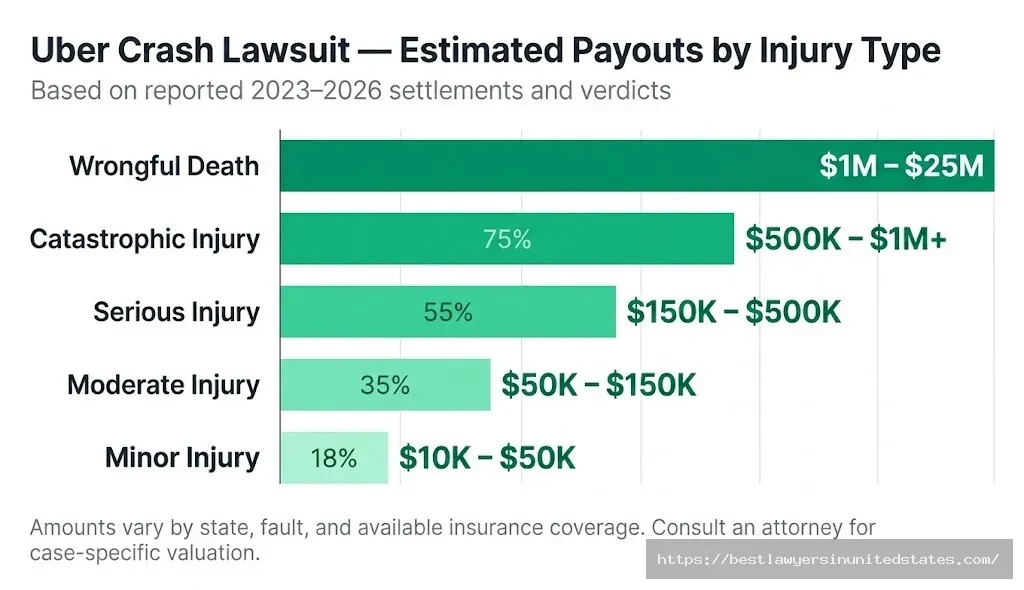
Quick Answer: Settlements range from roughly $10,000 for minor soft-tissue injuries to $1 million or more for serious or catastrophic harm. How much you actually get depends on your injuries, who was at fault, which insurance period applies, and how well your case is documented.
Insurance companies routinely offer $2,000 to $5,000 as initial settlements to get victims to sign away their rights before they know what their case is worth. Research from Martindale-Nolo found that accident victims who hired attorneys received nearly twice as much as those who handled their own claims. Red Bull Lawsuit: Health Injuries, Wrongful Death Claims & Your Legal Options (2026 Guide)
Estimated Payout Ranges by Injury Type
| Injury Category | Typical Settlement Range | Notes |
|---|---|---|
| Minor soft tissue (whiplash, bruising) | $10,000 – $50,000 | Short recovery, no surgery |
| Moderate injuries (fractures, concussion) | $50,000 – $150,000 | Some ongoing treatment, missed work |
| Serious injuries (spinal damage, TBI) | $150,000 – $500,000+ | Long-term impact on daily life |
| Catastrophic injuries (paralysis, severe TBI) | $500,000 – $1 million+ | Permanent disability, lifelong care costs |
| Wrongful death | $1 million – $25 million+ | Depends on age, income, family circumstances |
Notable Real-World Settlements and Verdicts
| Case | Amount | Details |
|---|---|---|
| California pedestrian wrongful death | $25 million | Settled 2023; reported by Los Angeles Times |
| San Diego wrongful death | $7 million | Family of crash victim; 2022 settlement |
| Miami-Dade Uber passenger (rear-end collision) | $3.5 million jury verdict | Passenger Olivia Oney; 2023 case |
| Uber passenger — spinal injuries, red light crash | $1.75 million | Florida settlement |
| Uber sexual assault — first MDL bellwether trial | $8.5 million | Federal jury verdict, February 2026 |
| Rideshare driver injured on the job | $500,000 | Florida settlement |
| PTSD from rideshare accident | $150,000 | Florida settlement |
What Factors Affect Your Payout?
Injury severity — The most important factor. Permanent injuries, surgeries, and long-term care needs push settlements dramatically higher.
App period at time of crash — Period 2 or 3 gives you access to Uber’s $1 million commercial policy. Period 0 or 1 severely limits available coverage.
Clear fault — The stronger the evidence against the Uber driver (or other at-fault party), the faster and larger the settlement tends to be.
Your comparative fault — If you’re partially at fault, your recovery may be reduced proportionally. In North Carolina, even 1% fault can eliminate your claim entirely.
State law — No-fault states like Florida require you to go through your own PIP coverage first, which affects how you pursue additional damages.
Medical documentation quality — Well-documented injuries with clear timelines and continuous treatment history produce stronger claims than gaps in care.
How Pain and Suffering Is Calculated
There’s no single formula, but attorneys typically use one of two methods:
- Multiplier method: Total economic damages (medical bills + lost wages) × a number between 1.5 and 5, based on injury severity and recovery time
- Per diem method: A daily dollar rate for your suffering × the number of days affected
For a victim with $80,000 in medical bills and lost wages and a multiplier of 3 (serious but not catastrophic injuries), pain and suffering could add another $240,000 to the claim.
How to File an Uber Crash Lawsuit — Step by Step
⚠️ DEADLINE WARNING: Your window to file a lawsuit is strictly limited by state law. Tennessee gives you just 1 year. Most states give 2 years. A few states give 3 years. Missing this deadline permanently bars your claim, no exceptions. Do not wait.

Step 1: Get Medical Attention — Even If You Feel “Fine”
Go to the emergency room, urgent care, or your doctor within 24–48 hours of the crash. This is the single most important step you can take. If you’re in a no-fault state like Florida, you must seek care within 14 days to qualify for PIP benefits. Gaps in medical care give insurance companies their best weapon to undervalue your claim.
Step 2: Call 911 and Get a Police Report
A police report is official documentation of what happened, when, and who was involved. It’s critical for establishing fault. Even if the crash seemed minor, always involve law enforcement.
Step 3: Document the Scene
While still at the crash site (if it’s safe), take photos of:
- All vehicles involved, including the Uber decal or plates
- Your injuries
- Road conditions, traffic signals, skid marks
- Any dashcam footage in the vehicle
Get the names and contact information of any witnesses. Ask the Uber driver for their insurance information and license. Symple Lending Lawsuit
Step 4: Report the Crash Through the Uber App
Open the Uber app and go to the Safety Toolkit (the blue shield symbol). Select “Report a crash.” This creates an official record with Uber and starts the insurance claims process. Uber’s support team will contact you within 2–3 business days. You can also report via uber.com/safety/what-to-do-in-a-crash.
Step 5: Do NOT Give a Recorded Statement to Insurers
Uber’s insurance adjusters may contact you quickly with what sounds like a helpful call. Don’t give a recorded statement without an attorney present. Anything you say can be used to minimize your claim. Don’t apologize or downplay your injuries. Don’t sign any documents or accept any settlement offers before speaking with a lawyer.
Step 6: Consult an Uber Accident Attorney (Free)
Most personal injury attorneys handle Uber crash cases on a contingency fee basis — meaning you pay nothing upfront and only owe a percentage (usually 33%) if you win. An attorney will determine which insurance policy applies, preserve Uber’s digital trip logs before they’re deleted, handle all insurer communications, and calculate the true value of your claim. Studies consistently show that represented victims recover significantly more than those who handle claims alone.
Step 7: Your Attorney Files the Insurance Claim
Your lawyer will send a demand letter to the appropriate insurer (Uber’s commercial carrier, the driver’s personal insurer, or both). This formally initiates negotiations.
Step 8: Negotiation and Settlement (or Lawsuit)
Most Uber crash cases settle out of court. The typical process:
- Demand letter reviewed: 1–3 months
- Counter-offers and negotiation: 1–6 months
- Most straightforward cases settle within 4–6 months
- Cases with serious injuries or disputed liability: 12–18+ months
If the insurer refuses to offer a fair amount, your attorney files a formal lawsuit.
Step 9: Discovery, Mediation, and Trial (If Needed)
If you file a lawsuit, both sides exchange evidence (discovery phase: 6–18 months). Most cases settle during or after discovery. Very few ever reach trial.
Step 10: Receive Your Settlement or Verdict
After settlement or judgment, attorney fees and litigation costs are deducted from the total. You receive the remainder by check or wire transfer, typically within a few weeks of settlement.
Critical Filing Deadlines by State
| State | Personal Injury Deadline | Notes |
|---|---|---|
| Tennessee | 1 year | Among the shortest in the U.S. |
| California | 2 years | 6 months if government vehicle involved |
| Florida | 2 years | Reduced from 4 years in 2023 |
| Texas | 2 years | From date of accident |
| New York | 3 years | Wrongful death: 2 years |
| North Carolina | 3 years | Contributory negligence applies |
| Colorado | 3 years | May vary if government vehicle |
| Illinois | 2 years | Personal injury standard |
Note: Minors, delayed injury discovery, and out-of-state defendants may toll (pause) these deadlines. Always confirm your specific deadline with an attorney.
Common Filing Mistakes to Avoid
- Waiting too long — Digital evidence (GPS logs, app data) disappears fast. Insurers track the statute of limitations clock.
- Giving a recorded statement — Never do this without legal counsel.
- Accepting the first offer — Initial offers of $2,000–$5,000 are almost always lowball figures.
- Posting on social media — Insurers actively monitor your accounts for photos or posts that contradict your injury claims.
- Delaying medical care — Even days without treatment can be used against you.
- Not saving your Uber receipt — Screenshots of your trip confirm the driver was on an active ride.
Current Status & Latest 2026 Updates
What’s Happening With Uber Crash Litigation Right Now
Several major developments in 2026 are directly affecting how Uber crash victims can pursue compensation:
The Uber Sexual Assault MDL (In re: Uber Technologies, MDL No. 3084): As of February 2026, more than 3,700 plaintiffs in 30 states have joined this massive multidistrict litigation. The first bellwether trial in January 2026 ended with an $8.5 million jury verdict against Uber. A second trial is scheduled for April 2026. These verdicts are shaping how Uber approaches all crash-related claims.
California’s SB 371 (Effective 2026): A new California law took effect in 2026 that modifies available victim protections in rideshare accidents. Critics say it reduces coverage available to injured passengers. This makes consulting an attorney even more important for California crash victims.
Uber’s California Ballot Initiative: Uber has spent approximately $32.5 million pushing a ballot measure that would cap attorney contingency fees and limit how much crash victims can recover for medical expenses. Opponents — including the Consumer Attorneys of California — have committed $55 million to fight it. If passed, this measure could significantly reduce compensation for future Uber crash victims in California.
Rising Claims Nationwide: Legal analysts and pre-settlement funding companies report a growing number of passenger injury claims across the country, driven by increased rideshare usage, more vehicles on the road, and higher medical costs. dr. daniel pompa lawsuit
What to Watch For
- April 2026: Second bellwether trial in the Uber sexual assault MDL. The outcome could pressure Uber toward a global settlement.
- November 2026 (potential): Uber’s California ballot initiative could appear on the November ballot, with sweeping implications for future crash victims in the state.
- Ongoing: More states may follow Florida and California in updating rideshare insurance laws, which affects available coverage.
Uber Crash Lawsuit vs. Similar Rideshare Litigation
How Uber Compares to Other Rideshare Accident Cases
| Case Type | Typical Settlement Range | Available Coverage | Status/Notes |
|---|---|---|---|
| Uber crash lawsuit (active trip) | $10K – $1M+ | Up to $1M Uber commercial policy | Ongoing; strong results for serious injuries |
| Lyft crash lawsuit (active trip) | $10K – $1M+ | Up to $1M Lyft commercial policy | Similar structure to Uber |
| Uber sexual assault MDL | $500K – $8.5M+ per plaintiff | Uber corporate liability | Active; 3,700+ plaintiffs; first verdict $8.5M (Feb 2026) |
| Traditional taxi accident | $25K – $500K | Varies; typically lower limits | Fewer cases; simpler insurance structure |
| Autonomous vehicle crash | Confidential – multi-million | Manufacturer + operator | Limited precedent; Uber’s AV case (Herzberg) settled confidentially |
| Drunk Uber driver crash | Often higher due to punitive damages | Personal + commercial policy | Punitive damages may be available |
What Makes Uber Crash Cases Unique
Uber crash lawsuits are more complex than ordinary car accident claims for three reasons. First, the tiered insurance system means the value of your claim can vary by millions of dollars depending on what the driver was doing the moment of impact. Second, Uber classifies its drivers as independent contractors, not employees, which limits direct corporate liability — but doesn’t eliminate access to Uber’s commercial insurance policies. Third, Uber has the resources to fight claims aggressively, making experienced legal representation essential rather than optional.
Do You Need a Lawyer to File an Uber Crash Claim?
Quick Answer: You’re not legally required to hire a lawyer. But research shows that victims who hire attorneys recover nearly double what unrepresented claimants get — and you don’t pay anything upfront since most attorneys work on contingency.
Filing Without a Lawyer
You can report the crash through the Uber app, file a claim with Uber’s insurer, and negotiate on your own. For very minor incidents with no significant injuries (under $5,000 in total damages), self-filing might make sense.
For anything beyond the most minor fender-bender, going it alone carries real risk. You may not know which insurance period applies, how to calculate pain and suffering, how to respond to delay tactics, or when an offer is below market value.
When Getting Legal Help Makes Sense
Talk to a lawyer if:
- You have injuries that required any medical treatment beyond the ER visit
- There’s any dispute about fault or which insurance policy applies
- The insurer has offered you a quick settlement and is pressuring you to sign
- Your injuries have kept you from working
- Multiple vehicles or parties were involved
- You’re not sure whether the driver’s app was on at the time of the crash
Attorney Fees — How It Works
Most Uber accident attorneys work on contingency. You pay zero upfront. The attorney advances all costs (filing fees, medical record requests, expert witnesses). If you win, the attorney’s fee — typically around 33% of the settlement — comes out of the recovery. If you don’t win, you owe nothing. Costs of litigation (separate from attorney fees) may also be deducted from your settlement.
Get Free Legal Help
For a free consultation on your Uber crash case, contact:
- [email protected] — for attorney referrals nationwide
- Most personal injury law firms offer free consultations by phone or online
Frequently Asked Questions
What is an Uber crash lawsuit?
It’s a personal injury claim filed by someone hurt in an accident involving an Uber vehicle. You can file against Uber’s commercial insurer, the driver’s personal insurer, or both, depending on the driver’s app status at the time of the crash.
Who is eligible to file an Uber crash lawsuit?
Anyone injured in a crash involving an Uber vehicle — passengers, pedestrians, cyclists, other drivers, or the Uber driver if another party caused the crash.
How much money can I get?
It depends entirely on your injuries and circumstances. Minor injury cases typically settle between $10,000 and $50,000. Serious or catastrophic injuries can exceed $500,000 or $1 million. Wrongful death cases have settled for as much as $25 million.
What’s the deadline to file an Uber crash lawsuit?
It varies by state: 1 year in Tennessee, 2 years in California, Florida, and Texas, and 3 years in North Carolina and Colorado. Missing this deadline permanently eliminates your right to sue.
How do I start the claims process?
Report the crash through the Uber app’s Safety Toolkit. Then consult an attorney before speaking to any insurance company.
Do I need a lawyer?
You’re not required to have one, but hiring an attorney significantly increases your settlement — research shows represented victims recover nearly twice as much. Most work for free unless you win.
What documents do I need?
Police report, medical records, Uber trip receipts, photos of the scene, witness contact info, and pay stubs for lost wages. Your attorney can help obtain anything you’re missing.
What if I don’t have my Uber receipt?
Your attorney can subpoena Uber’s trip logs, which include timestamps, GPS data, and driver app status at the time of the crash.
When will I receive payment?
Simple cases with clear liability can settle in 4–6 months. Complex cases with serious injuries can take 1–3 years. You receive payment within weeks of a final settlement.
How will I get paid?
Most settlements are paid by check or wire transfer. Some state-specific cases may involve structured payments over time.
What is the total insurance coverage available?
If the Uber driver was on an active trip (Period 2 or 3), Uber carries a $1 million commercial liability policy. If a third-party driver caused the crash, Uber’s coverage is capped at $250,000.
Has Uber ever been held directly responsible for crashes?
Uber is typically insulated from direct liability because its drivers are independent contractors, not employees. However, its commercial insurance policies cover injuries during active rides, and courts have found corporate liability in certain cases involving systemic safety failures (especially the ongoing sexual assault MDL).
Can I sue Uber directly?
Filing a lawsuit usually goes against the at-fault driver’s insurance (personal or Uber’s commercial policy). Suing Uber as a corporation is difficult but has been done in cases involving negligent hiring, inadequate background checks, or systemic safety failures.
What if the Uber driver’s app was off?
Uber’s commercial insurance doesn’t apply. Your claim goes against the driver’s personal auto insurance. If they’re underinsured, you may be able to file under your own uninsured/underinsured motorist coverage.
What if I was partially at fault?
Most states use comparative negligence — your recovery is reduced by your percentage of fault. If you’re 20% at fault, your $100,000 settlement becomes $80,000. North Carolina is the exception: any fault on your part can bar your entire claim.
Can I get compensation even if I was injured by a third-party driver while riding in an Uber?
Yes. The other driver’s insurance is the primary source. If they’re uninsured, Uber’s UM/UIM coverage (available in most states during Periods 2 and 3) may cover you.
What if the insurance company denies my claim?
Request a written explanation, submit additional evidence, and appeal the denial. If the insurer still refuses fair compensation, your attorney can file a personal injury lawsuit.
What happens to my claim if I was riding with other passengers?
Uber’s $1 million policy covers all injured parties in the crash, but it’s shared among them. Having your own attorney ensures you don’t get shortchanged when multiple claimants are involved. ancient nutrition lawsuit
Will my settlement be taxable?
Generally, compensation for physical injuries (medical bills, pain and suffering) is not taxable. Punitive damages and lost wages may be taxable. Ask a tax professional about your specific situation.
What if I waited months to seek medical treatment?
This can hurt your claim significantly. Insurers will argue the injury wasn’t caused by the crash. Still, you may have options — consult an attorney before giving up on your case.
Where can I report the crash to Uber officially?
Open the Uber app → Safety Toolkit (blue shield) → “Report a crash.” Alternatively, visit uber.com/safety/what-to-do-in-a-crash.
What if the Uber driver fled the scene?
This is a hit-and-run situation. Uber’s uninsured motorist coverage (available during active trips in most states) may apply. Call 911 immediately and preserve as much information as possible (partial plate, vehicle description, direction of travel).
Can passengers from different parties all file claims from the same crash?
Yes. Everyone injured in the crash can file. Uber’s $1 million policy is shared, which is why having your own legal representation matters — your attorney fights for your share of the available funds.
