
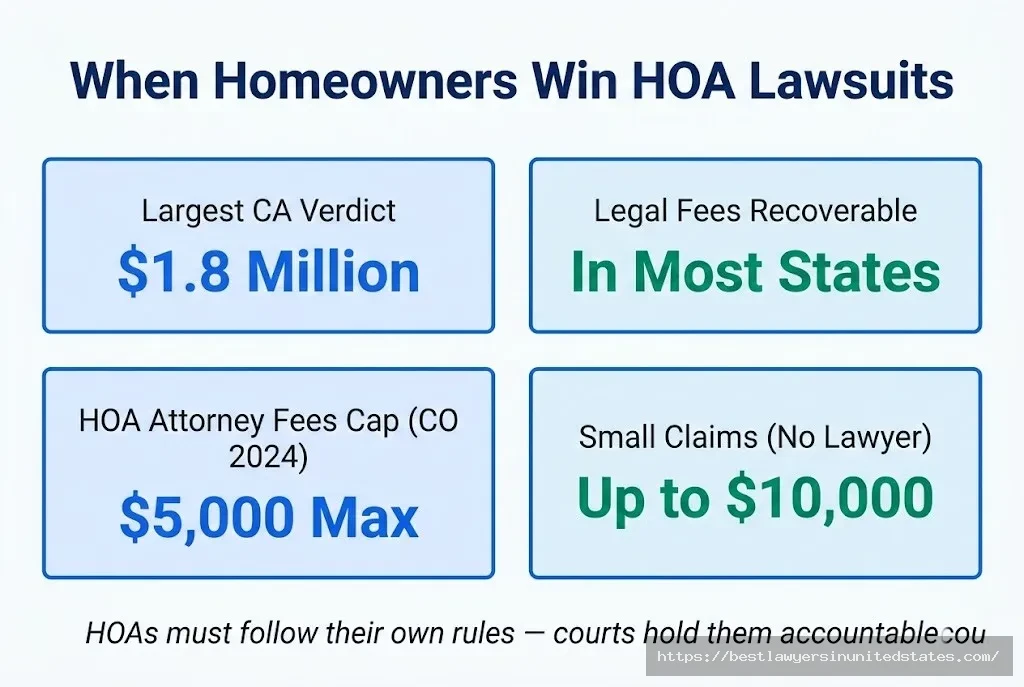
Homeowners across the country are winning lawsuits against their HOAs — and the results can be significant, from court-ordered repairs and reversed fines to five- and six-figure damage awards. In one landmark California case, a retired couple was awarded $1.8 million after their HOA committed fraud, negligence, and elder abuse. In another, a disabled veteran kept his wheelchair-accessible driveway after his HOA couldn’t prove the property line they were enforcing. These aren’t flukes. HOAs lose cases every day — and when they do, they often have to pay your legal fees too.
Quick Answer: Homeowners can and do win lawsuits against HOAs when the association has overstepped its authority, violated its own governing documents, discriminated against residents, or breached its fiduciary duties. Winning requires strong documentation, knowledge of your CC&Rs, and usually an experienced real estate attorney. In many states, if you win, the HOA must reimburse your attorney’s fees.
This guide covers everything you need to know: the most common reasons homeowners win, how to build a case, what evidence you need, how much it costs, when to sue versus settle, and what to expect in court. Red Bull Lawsuit
What It Actually Means When a Homeowner Wins a Lawsuit Against an HOA
The Power HOAs Have — and Where It Ends
Your HOA has real authority. It can fine you, place liens on your property, restrict what you build, and in extreme cases, even initiate foreclosure. That power comes from the community’s governing documents — the CC&Rs (Covenants, Conditions, and Restrictions), bylaws, rules and regulations, and state law.
But here’s the thing: that authority is not unlimited. HOAs must follow their own rules, act in good faith, enforce rules consistently, and comply with state and federal law. When they don’t, homeowners have legal recourse.
The courts have made this clear in case after case. When an HOA can’t prove what it’s alleging, the homeowner wins. When a board enforces rules against one homeowner but ignores identical violations by neighbors, that’s selective enforcement — and courts take it seriously. When an HOA misleads residents, hides information, or fails to maintain common areas, those are actionable breaches.
What Winning Actually Looks Like
Table: Possible Outcomes When a Homeowner Wins Against an HOA
| Outcome | What It Means | Common In |
|---|---|---|
| Injunctive relief | Court orders HOA to stop an action or reverse a decision | Rule enforcement disputes |
| Monetary damages | HOA pays you for financial harm caused | Negligence, fraud, failure to maintain |
| Punitive damages | Extra damages for egregious HOA conduct | Fraud, elder abuse, willful misconduct |
| Attorney’s fees awarded | HOA pays your legal costs | Most states with fee-shifting laws |
| Fine/lien reversal | HOA must remove improper fines or liens | Selective enforcement, procedural errors |
| Policy change | Court orders HOA to change how it operates | Systemic discrimination, due process violations |
| Frivolous lawsuit finding | HOA pays your fees because its own lawsuit was baseless | When HOA sues you improperly |
The Most Common Reasons Homeowners Win HOA Lawsuits
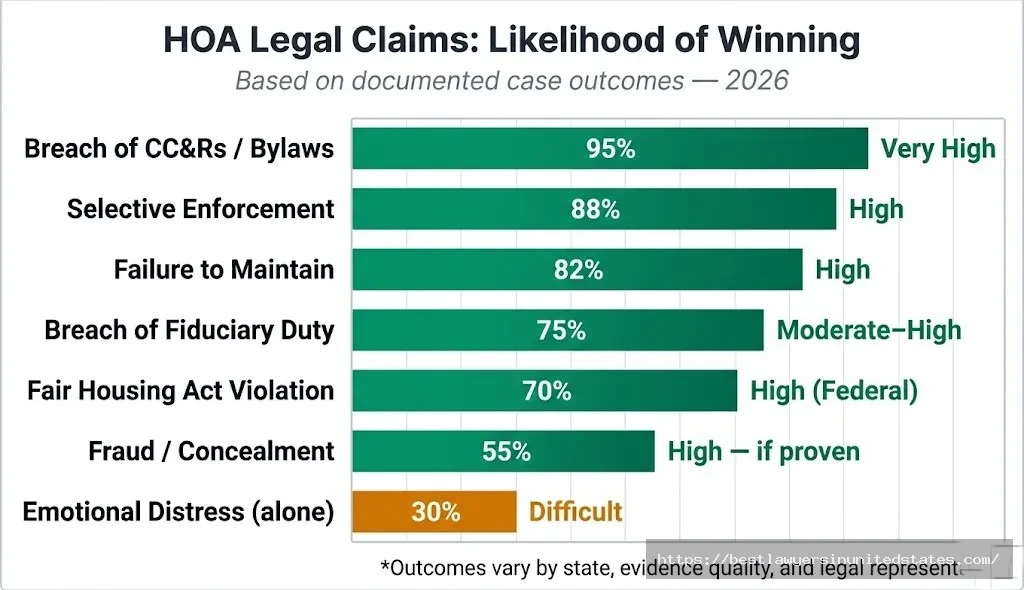
Understanding why homeowners win is the foundation of building your own case. Courts across the country have ruled in favor of homeowners on the following grounds consistently.
Failure to Follow Their Own Governing Documents
This is the single most common successful legal argument homeowners use. Both sides of an HOA relationship are bound by the CC&Rs, bylaws, and rules. The HOA doesn’t get to play by different rules than the ones it enforces.
If your HOA denied an architectural request without following the required review process, imposed a fine without proper notice, or made a decision that required a membership vote and didn’t hold one — those are violations of the governing documents. Courts regularly hold associations accountable for ignoring their own procedures.
Real example: A Robinson & Henry case involved a disabled veteran whose HOA approved his wheelchair-accessible driveway expansion — and then threatened to sue him afterward, claiming the driveway violated setback requirements. When the law firm challenged the HOA’s measurements, the HOA couldn’t establish where the property line even was. The trial court ruled in the veteran’s favor. The HOA appealed. The Court of Appeals upheld the ruling. The driveway stayed.
Breach of Fiduciary Duty
HOA board members have a legal responsibility to act in the best interests of all community members — not for personal gain, not out of personal animosity, not to benefit a few insiders. This is called a fiduciary duty.
A board that misuses funds, self-deals, makes decisions out of personal spite, or consistently acts against the community’s interests may be liable for breach of fiduciary duty. This includes:
- Misappropriating reserve funds for non-approved purposes
- Awarding contracts to board members’ companies without competitive bidding
- Withholding information from homeowners that affects their property rights
- Failing to budget adequately for known, necessary repairs
Selective Enforcement
HOAs must enforce their rules consistently. If the association ignores the same “violation” in other homes but goes after you specifically, that’s selective enforcement — and it’s one of the most winning arguments in HOA litigation.
To build a selective enforcement case, you’ll want documented examples of other homeowners with identical conditions who were never fined or cited. Photographs, dates, and addresses matter here. The more examples you have, the stronger the case.
Discrimination Under the Fair Housing Act
Federal law prohibits housing discrimination based on race, religion, sex, familial status, national origin, and disability. HOAs are bound by the Fair Housing Act (42 U.S.C. § 3604) just like any other housing entity.
A disabled homeowner denied a reasonable accommodation — like a wheelchair ramp, a reserved parking space, or a support animal exemption — has a potential federal discrimination claim. These cases can result in significant damages and are taken seriously by courts.
Fraud, Negligence, or Concealment
When an HOA actively misleads homeowners about conditions affecting their property, or knowingly conceals problems, the legal exposure can be enormous. The Santa Clara case mentioned above is a striking example: the HOA knew about a historic artesian well beneath a homeowner’s condo — a well that eventually caused a sinkhole — and repeatedly lied to authorities about it. The judgment came to $1.8 million, covering lost rent, emotional distress, and punitive damages.
Fraud cases are harder to prove but carry the highest potential recoveries. You’ll need to show the HOA made a false statement, knew it was false, intended for you to rely on it, and that you suffered harm as a result.
Failure to Maintain Common Areas
HOAs are responsible for maintaining common areas. When that maintenance failure causes property damage — flooding from clogged drainage, structural issues from deferred repairs, mold from roof leaks — the HOA may be liable for the cost of your repairs and any resulting damage.
Table: Common Legal Grounds for Winning HOA Lawsuits
| Legal Claim | What You Must Prove | Typical Outcome |
|---|---|---|
| Breach of governing documents | HOA violated its own CC&Rs or bylaws | Reversal of action + attorney’s fees |
| Breach of fiduciary duty | Board acted in bad faith or for personal gain | Monetary damages |
| Selective enforcement | HOA enforced rules against you but not others | Fine dismissal + injunction |
| Fair Housing Act violation | Discrimination based on protected class | Federal damages + attorneys’ fees |
| Negligence | HOA’s failure to act caused your property damage | Repair costs + consequential damages |
| Fraud/concealment | HOA lied about conditions affecting your property | Punitive damages possible |
| Frivolous HOA lawsuit | HOA sued you without proper basis | HOA pays your attorney’s fees |
How to Build a Case That Actually Wins
Step 1: Master Your Governing Documents Before You Do Anything Else
Your CC&Rs, bylaws, and rules are the blueprint of your dispute. Everything the HOA has authority to do is spelled out there — and anything it did that isn’t supported by those documents is potentially actionable.
Read them carefully. Look for the specific sections that apply to your situation. Is there a notice requirement before a fine is imposed? Is there a hearing process the HOA skipped? Does the architectural committee have a deadline to respond that it blew past? These procedural failures are often the path to winning.
One of the most effective litigation strategies is using the HOA’s own rules against it. When the HOA can’t show it followed its own procedures, its case falls apart. Symple Lending Lawsuit
Step 2: Document Everything From Day One
Courts decide cases on evidence. The homeowner who walks into court with organized, dated, timestamped documentation wins more often than the homeowner who relies on memory.
Start building your record immediately:
- Save every email, letter, and formal notice you receive
- Take timestamped photos and videos of conditions at issue
- Keep notes on every phone conversation and in-person exchange, including the date, time, who said what
- Attend board meetings and request copies of the minutes
- Request relevant financial statements and board communications in writing
- Keep copies of any payments you made, any portals you tried to log into, any responses you received
In one successful case handled by Robinson & Henry, the HOA sued a homeowner for unpaid assessments — but couldn’t produce the required notices proving it had properly notified the homeowner. The homeowner had documentation showing repeated attempts to pay. The court found the HOA’s lawsuit frivolous and groundless, dismissed all claims against the homeowner, and required the HOA to pay the homeowner’s attorney’s fees.
Step 3: Send a Formal Demand Letter First
Before filing suit, send a written demand letter to the HOA. This letter should:
- State the specific problem and the rule or law the HOA has violated
- Reference the section of the CC&Rs or bylaws at issue
- Demand a specific remedy (reverse the fine, complete the repair, stop the action)
- Set a reasonable deadline for response (typically 30 days)
- Put the HOA on notice that you’ll pursue legal action if the matter isn’t resolved
A demand letter does several things. It gives the HOA a chance to resolve the dispute without litigation. It demonstrates good faith if you do end up in court. And it often results in a settlement, because many HOA boards don’t want the expense and exposure of a lawsuit once they realize a homeowner is serious.
Many CC&Rs and state laws also require a good-faith attempt to resolve disputes before filing suit. In California, for example, the Davis-Stirling Act requires that parties attempt Alternative Dispute Resolution (ADR) before proceeding to court in many types of HOA disputes.
Step 4: Pursue Internal Remedies First
Most HOAs have an internal appeal process. If you’ve received a violation notice or been denied a request, request a formal hearing before the board. Attend. Present your evidence. Be professional and specific.
This step matters for a few reasons. Courts look more favorably on homeowners who demonstrated good faith by working through available processes. It also creates a record of the HOA’s decision-making, which may be useful as evidence later. And sometimes, internal appeals actually work — especially when you come prepared with documentation.
Step 5: Engage the Right Attorney
HOA law is a niche area of real estate law. The attorney you want is someone who regularly handles HOA disputes and knows your state’s specific statutes — not a general practice attorney who handles an occasional HOA case.
In California, that means someone fluent in the Davis-Stirling Act. In Florida, your attorney should know Chapter 720 (HOA statute) and Chapter 718 (Condominium Act). Many states have similar HOA-specific statutes that govern notice requirements, meeting procedures, fine limits, and legal remedies.
Table: What to Look for in an HOA Dispute Attorney
| Qualification | Why It Matters |
|---|---|
| Real estate or HOA specialization | HOA law has unique rules not covered by general practice |
| Experience with your state’s HOA statutes | State laws vary dramatically |
| Familiarity with Davis-Stirling (CA) or Ch. 720 (FL) | These are the primary governing frameworks |
| Track record in HOA litigation | Settlement vs. trial experience matters |
| Fee transparency | Know if it’s hourly, flat, or contingency |
| Availability for smaller disputes | Some firms only take large cases |
How Much Does It Cost to Sue Your HOA?
This is the question most homeowners have before anything else. The honest answer: it depends on the size and complexity of your dispute — but the fee picture is often better than you’d expect, especially in states with fee-shifting laws.
Attorney’s Fees
For a basic HOA dispute, attorney’s fees can run from $3,000 to $15,000. More complex cases involving trial, appeals, or expert witnesses can reach $30,000 to $100,000 or more.
Some attorneys handling HOA matters offer contingency fee arrangements for strong cases, meaning they take a percentage of any recovery rather than charging by the hour. Discuss payment options upfront.
Court Costs
Filing fees for civil court typically run $95 to $250, depending on the jurisdiction. Small claims court is cheaper and doesn’t require an attorney — it’s an option for disputes under $10,000 (amounts vary by state).
ADR (Mediation/Arbitration)
If your CC&Rs or state law require ADR before filing suit, mediation typically costs $1,000 to $5,000. Some community mediation centers offer this for free or at reduced cost.
The Good News: Fee-Shifting Laws
Here’s where HOA litigation is different from most civil lawsuits. In many states, if you win, the HOA must pay your attorney’s fees. California’s Civil Code § 5975 requires that the prevailing party in an action to enforce governing documents be awarded reasonable attorney’s fees and costs. Many other states have adopted similar fee-shifting provisions.
Additionally, most CC&Rs contain an attorney’s fees clause. Because CC&Rs are treated as binding contracts, this clause applies to both sides — even if it was written to favor the HOA.
The practical effect: winning a legitimate HOA case can result in full reimbursement of your legal costs, making litigation financially viable even for disputes over relatively modest amounts.
Important caveat: This cuts both ways. If the HOA wins, you may owe its attorney’s fees. This is why a careful pre-lawsuit assessment of your case strength is essential. A well-qualified HOA attorney will give you an honest evaluation before you commit to litigation.
Table: Estimated Costs and Recovery in HOA Lawsuits
| Cost Category | Typical Range | Recoverable if You Win? |
|---|---|---|
| Attorney’s fees (simple case) | $3,000–$15,000 | Yes, in most states |
| Attorney’s fees (complex/trial) | $30,000–$100,000+ | Yes, in most states |
| Court filing fees | $95–$250 | Yes, usually |
| Expert witnesses | $2,000–$10,000+ | Sometimes |
| ADR/mediation | $1,000–$5,000 | Depends on outcome |
| Small claims (no attorney) | Under $500 | No attorney, no recovery |
What Happens When the HOA Sues You First
Sometimes it’s not you filing the lawsuit — it’s the HOA coming after you. This is more common than most homeowners realize, and it happens most often over alleged unpaid assessments, claimed rule violations, or demands to reverse unauthorized modifications.
Don’t ignore an HOA lawsuit. Failing to respond will result in a default judgment against you, and the HOA will be entitled to the full amount it sought plus its attorney’s fees.
Your first move is to contact an attorney immediately. Even if you owe some amount to the HOA, the question of what you actually owe — once late fees, interest, and legal fees are properly scrutinized — may be significantly less than what the HOA claims. The Phoenix ED Device Lawsuit
When the HOA’s Lawsuit Is Frivolous
If the HOA sues you without a proper legal basis, or can’t produce the documentation required to support its claims, courts can and do find the lawsuit frivolous. In one case handled by Robinson & Henry, the court found the HOA’s lawsuit frivolous and groundless — and ordered the HOA to pay the homeowner’s attorney’s fees entirely.
To fight a frivolous HOA lawsuit, your attorney will typically request all documentation underlying the HOA’s claims. If the HOA can’t produce proper proof of notice sent, amounts owed, procedures followed, or authority exercised, its case falls apart.
The Discovery Process: Your Secret Weapon
Once litigation begins, you have the legal right to obtain the HOA’s documents, records, financial statements, and communications. This process is called discovery, and it’s often where HOA cases are won or lost.
Through discovery, your attorney can request:
- All board meeting minutes related to your dispute
- Financial records and reserve fund statements
- Correspondence between board members and HOA attorneys
- Records of how the same rule has been applied (or not applied) to other homeowners
- Evidence supporting the HOA’s factual claims (measurements, inspections, invoices)
- Communications with the HOA’s insurance company
HOAs often rely on informal decisions, loose documentation, and assumptions that no one will challenge. When those assumptions are tested under legal scrutiny — when the HOA has to produce the letter it claims to have sent, or prove the measurement it relied on — the case often shifts dramatically.
Depositions let your attorney question board members and HOA managers under oath. If their testimony contradicts their written communications, or if they can’t explain the basis for their actions, those contradictions can be devastating to the HOA’s case.
Table: Key Documents to Request in HOA Litigation Discovery
| Document | What It Can Reveal |
|---|---|
| Board meeting minutes | What board knew, when, and what it decided |
| HOA financial records | Fund misuse, reserve fund adequacy |
| Violation notice logs | Selective enforcement patterns |
| Correspondence with attorneys | HOA legal strategy, bad faith indicators |
| Prior inspection reports | Knowledge of defects HOA ignored |
| Contractor invoices | Whether claimed repair costs are accurate |
| Architectural committee records | How other applications were handled |
| Insurance correspondence | Whether HOA disclosed claims properly |
Before You Sue: Alternative Paths Worth Trying
Litigation is expensive, slow, and stressful. Before you file, consider these options — especially if the dispute is relatively modest.
Attend Board Meetings and Speak Up
Board meetings include time for homeowner comments. Put your concerns on the record. Ask questions. This often moves issues along, and it creates a record of when you raised the problem.
Request a Formal Hearing
Most HOAs allow homeowners to request a hearing before the board to dispute a violation or fine. Come prepared with your CC&Rs, your evidence, and a clear argument. Many fines are reduced or dismissed at this stage.
Write to State Regulatory Agencies
Several states have agencies that oversee HOA compliance. In Florida, the Department of Business and Professional Regulation handles many HOA complaints. In California, the Department of Real Estate has oversight over certain HOA disclosures. Filing a complaint costs nothing and can apply meaningful pressure.
Mediation
A neutral mediator helps both sides reach a resolution without going to court. It’s faster, cheaper, and often more satisfying than litigation. Many CC&Rs require it before you can sue anyway.
Organize Neighbors
If other homeowners are dealing with the same problems, collective action is more effective than individual complaints. A group of homeowners showing up to a board meeting or collectively threatening legal action carries more weight than one person acting alone. It also distributes litigation costs if you do eventually file. byte aligners company status 2026
Real HOA Lawsuit Examples: Homeowners Who Won
Case 1: The Disabled Veteran’s Driveway (Colorado)
A disabled veteran expanded his driveway for wheelchair accessibility after receiving HOA approval. After the project was complete, the HOA reversed course, claiming the driveway was too wide and too close to the property line. The veteran hired Robinson & Henry attorneys.
The legal team challenged one thing: the HOA’s measurement. Where exactly was the property line? The HOA couldn’t establish it. Without a reliable starting point for its measurements, the entire argument collapsed. The trial court ruled for the homeowner. The HOA appealed. The Court of Appeals upheld the ruling completely. The driveway stayed.
Case 2: The Frivolous Assessment Lawsuit (Colorado)
An HOA sued homeowners for unpaid assessments, claiming they failed to pay after proper notice. Robinson & Henry attorneys dug into the documentation — and found the HOA couldn’t prove it had sent the required notices. It couldn’t show who sent the letters, when they were sent, or to what address. Meanwhile, the homeowners had documented multiple attempts to pay, only to be repeatedly referred back to the HOA attorney and then locked out of the payment portal. The court found the lawsuit frivolous and groundless — and required the HOA to pay the homeowners’ attorney’s fees.
Case 3: The $1.8 Million California Verdict
A retired couple in Santa Clara discovered in 2018 that an abandoned artesian well sat beneath their condo. Rather than addressing it, the HOA ignored expert warnings, hired an attorney who falsely claimed no evidence of a well existed, and allowed the property to deteriorate into uninhabitability. The living room floor eventually collapsed into a sinkhole. Judge JoAnne McCracken found the HOA guilty of fraud, negligence, and elder abuse. The $1.8 million award covered lost rental income, punitive damages, and emotional distress — the largest known HOA verdict in California history.
State-by-State Highlights: HOA Laws That Help Homeowners
HOA law is primarily governed at the state level, and the protections available to you vary significantly depending on where you live.
Table: HOA Homeowner Protections by State (Key Examples)
| State | Key Law | Homeowner Protection |
|---|---|---|
| California | Davis-Stirling Act (Civil Code §4000–6150) | Prevailing party gets attorney’s fees in enforcement actions; strong due process requirements |
| Florida | Chapter 720 (HOA Act) | Mandatory dispute resolution before litigation; homeowner inspection rights; fine limits |
| Colorado | CCIOA (HB 1337, 2024) | New law caps HOA attorney’s fees at 50% of assessments owed or $5,000, whichever is less |
| Texas | HOA Dispute Resolution Certificate | State HOA dispute process; fines must be reasonable and properly noticed |
| Arizona | A.R.S. § 33-1803 | HOA must provide hearing before fining; fines limited without due process |
| Nevada | NRS Chapter 116 | Ombudsman program for HOA disputes; required internal dispute resolution |
Frequently Asked Questions
Can a homeowner really win a lawsuit against an HOA?
Yes, and it happens regularly. Homeowners win HOA lawsuits when the association has violated its own governing documents, acted in bad faith, failed to maintain common areas, enforced rules selectively, or discriminated against residents. Some homeowners have won hundreds of thousands — or even over a million dollars — in HOA disputes. The key is having solid documentation, clear legal grounds, and usually an experienced attorney.
What are the most common reasons homeowners win HOA lawsuits?
The most common successful claims involve the HOA failing to follow its own CC&Rs or bylaws, selective enforcement of rules, breach of fiduciary duty by board members, failure to maintain common areas, and violations of the Fair Housing Act. Courts are particularly skeptical of HOAs that can’t back up their claims with proper documentation or that enforced rules differently against different homeowners.
Do I need an attorney to sue my HOA?
Not always. For smaller disputes under your state’s small claims court limit (typically $5,000 to $10,000), you can file without an attorney. For larger or more complex claims, you’ll want a real estate attorney familiar with HOA law and your state’s specific statutes. In states with fee-shifting laws, your legal fees may be fully recoverable if you win — making attorney-assisted litigation financially viable even for moderate disputes.
If I win, does the HOA pay my attorney’s fees?
In many cases, yes. California’s Civil Code § 5975 requires the prevailing party in HOA enforcement actions to be awarded attorney’s fees. Many other states have similar fee-shifting statutes. Most CC&Rs also contain attorney’s fees provisions that are enforceable as contract terms. This is one of the most important reasons HOA litigation can be worth pursuing — the potential recovery often includes your full legal costs.
What if the HOA sues me?
Don’t ignore it. A default judgment can result in liens on your property and wage garnishment. Contact an HOA attorney immediately. Even if you owe some amount, the HOA’s claimed total — once fees and interest are scrutinized — may be much lower than stated. If the HOA’s suit lacks proper documentation or a valid legal basis, a court may find it frivolous and order the HOA to pay your legal fees.
What documents do I need to build a case against my HOA?
You’ll need your CC&Rs, bylaws, and any applicable rules and regulations; all written correspondence with the HOA including violation notices and formal letters; photos and videos documenting conditions at issue; board meeting minutes; financial records if financial mismanagement is at issue; and evidence of comparable situations involving other homeowners (to show selective enforcement). The more thorough your documentation, the stronger your position.
Can I sue the HOA board members personally?
Sometimes. Board members generally have protection from personal liability when acting in good faith within their authority. But when a board member acts outside their authority, fraudulently, or with malicious intent, personal liability can attach. In the Santa Clara case, for example, the court found HOA-level liability for fraud and negligence. Consult an attorney about whether individual board members can be named defendants in your specific situation.
How long does an HOA lawsuit take?
Small claims court cases can resolve in 30 to 90 days. Full civil litigation typically takes one to three years, depending on the court’s docket, whether the case goes to trial, and any appeals. Most cases settle before trial — sometimes during the discovery process, once the HOA realizes its documentation is weak or the homeowner’s case is stronger than expected.
What is selective enforcement and how do I prove it?
Selective enforcement is when an HOA applies rules against some homeowners but not others who have the same condition or violation. To prove it, you need documented evidence — typically photographs of other properties with the identical issue, along with proof the HOA has not cited those neighbors. Dates, addresses, and the history of enforcement against your property versus others are all important. The more examples you have, the stronger the selective enforcement argument. 100 day dream home lawsuit
Can I sue my HOA for emotional distress?
In some circumstances, yes. Emotional distress claims are harder to prove and typically require evidence that the HOA’s conduct was extreme, intentional, or negligent, and that the distress was severe and documented (e.g., medical records, therapy records, witness testimony). These claims are most successful when paired with stronger underlying claims like fraud or severe negligence.
What is the difference between mediation and arbitration in HOA disputes?
Mediation is voluntary and non-binding — a neutral third party helps both sides reach a resolution, but doesn’t decide the outcome. Arbitration is more like a private court — an arbitrator hears evidence and renders a decision that may be binding. Many CC&Rs require one or both before litigation. Check your governing documents and your state’s HOA statute to understand what’s required before filing a lawsuit.
What if my HOA refuses to let me see their financial records?
Most states give homeowners the right to inspect HOA financial records, meeting minutes, and other governing documents. If your HOA refuses, that refusal may itself be a violation of state law or the governing documents — and grounds for legal action. Start with a written request citing the specific section of your CC&Rs or state law granting inspection rights. If the HOA still refuses, a court can order them to comply.
Can the HOA foreclose on my home for unpaid fines?
In some states, yes — HOAs can place liens for unpaid fines and assessments, and in some cases pursue foreclosure. However, state laws vary significantly in what they allow and what procedures must be followed. Several states have enacted restrictions on HOA foreclosure in recent years. Colorado, for example, passed new laws in 2024 capping attorney’s fees in HOA collection cases. If you’re facing HOA foreclosure, contact an attorney immediately.
What is the Davis-Stirling Act?
The Davis-Stirling Common Interest Development Act is California’s primary legal framework governing HOAs (Civil Code § 4000–6150). It outlines formation, governance, dues, dispute resolution, and legal remedies. Critically, it includes the fee-shifting provision (§ 5975) requiring the prevailing party in HOA enforcement actions to be awarded attorney’s fees. If you’re in California dealing with an HOA dispute, any attorney you hire should be fluent in Davis-Stirling.
Should I try to settle before going to court?
In most cases, yes — at least initially. Litigation is expensive, slow, and unpredictable. A negotiated settlement that gives you most of what you need is often preferable to a trial. That said, some HOAs won’t settle in good faith unless they know you’re prepared to go to court. A credible litigation threat — backed by solid evidence and an experienced attorney — often produces better settlement offers than a polite request ever would.
What if I can’t afford a lawyer?
A few options: Small claims court doesn’t require an attorney and is designed for individuals to navigate alone. Some attorneys offer free initial consultations and can help you assess whether your case is worth pursuing. Some HOA attorneys work on contingency for strong cases. State bar associations often have lawyer referral services that connect people with attorneys for reduced-fee initial consultations. And some states have legal aid organizations that handle housing disputes.
When the HOA Is Right: Be Honest With Yourself
Not every HOA dispute is worth fighting. Sometimes the HOA is correctly enforcing a rule that you simply don’t like. Before you invest time and money into litigation, ask yourself honestly:
- Did you actually violate the CC&Rs?
- Did the HOA follow its required procedures (notice, hearing, etc.)?
- Is this worth the cost and stress of litigation?
- Have you exhausted internal remedies?
- Is there evidence the HOA treated you differently than comparable situations?
If the HOA followed its own rules and the violation is legitimate, the better path is usually compliance or working within the process. Save litigation for the situations where the HOA genuinely overstepped — because those cases are the ones that win.
Your Next Steps: What to Do Right Now
If you’re in a dispute with your HOA, here’s what to do today:
- Pull out your CC&Rs and bylaws — Read the sections that apply to your dispute. Look for procedural requirements the HOA must follow.
- Start documenting everything — Dates, photos, emails, notices. Build your record from this moment forward.
- Write a demand letter — Formally notify the HOA of your position and the specific remedy you want.
- Request a formal hearing — Use the HOA’s own internal process before escalating.
- Consult an HOA attorney — Many offer free initial consultations. Get an honest assessment of your case strength before you commit to litigation.
- Research your state’s HOA laws — Know your rights and the protections available to you.
HOAs have more power than most homeowners realize — but they are not above the law. When they overstep, courts have been willing to hold them accountable, award meaningful damages, and require them to pay the legal fees of the homeowners they wronged. You don’t have to accept an HOA that acts unfairly, selectively, or dishonestly.
For attorney referrals and legal help with your HOA dispute, contact: [email protected]
