
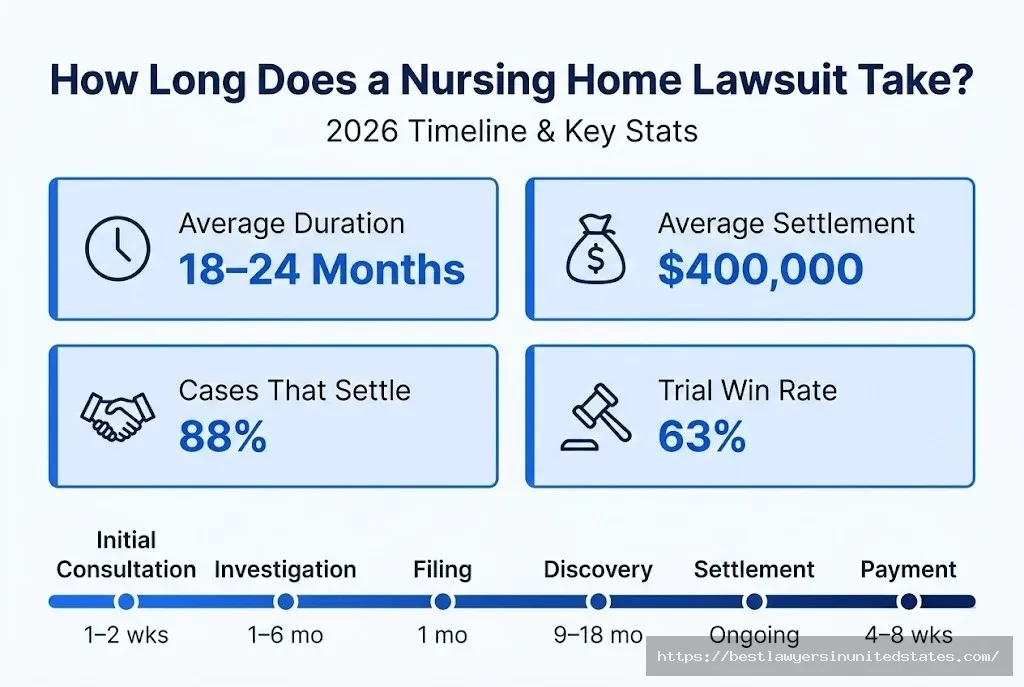
A nursing home lawsuit is a legal action filed when a resident suffers harm due to neglect, abuse, or mistreatment in a care facility — and the process takes longer than most families expect. Most cases take 18 to 24 months from your first call to an attorney through final payment, though complex cases can run three years or more. Knowing what drives that timeline helps you plan, protect your rights, and make smarter decisions for your loved one.
Quick Answer: Most nursing home lawsuits take 18–24 months from start to finish. Simple cases that settle early can close in 6–12 months. Cases that go to trial often take 3 years or more. The single biggest factor is whether the nursing home agrees to a fair settlement or forces the case all the way to a jury.
This guide walks you through every stage of the process, what makes cases move faster or slower, how much you might recover, and the deadlines you absolutely cannot miss. Uber Crash Lawsuit
What Is a Nursing Home Lawsuit?
Background
A nursing home lawsuit is a civil claim against a long-term care facility for failing to protect a resident from harm. These cases typically involve claims of negligence, abuse, or violations of a resident’s legally guaranteed rights.
The legal basis usually falls under personal injury law, elder abuse law, or medical malpractice — sometimes all three, depending on the state. Each category carries its own rules, deadlines, and damage caps, which is part of why these cases can get complicated quickly.
What Types of Harm Qualify?
Nursing home lawsuits are filed for a wide range of injuries and mistreatment, including:
- Bedsores (pressure ulcers) — one of the most common claims, often indicating prolonged neglect
- Falls and fractures — resulting from inadequate supervision or unsafe environments
- Malnutrition and dehydration — from failure to provide proper nutrition and hydration
- Medication errors — wrong dosages, missed medications, or unauthorized drugs
- Physical, sexual, or emotional abuse — by staff or other residents
- Wrongful death — when neglect or abuse leads to a resident’s passing
- Elopement — when a resident with dementia wanders off due to poor supervision
- Infections — including sepsis from untreated bedsores or catheter mismanagement
Who Files These Lawsuits?
The resident themselves can file if they’re mentally and physically capable. In most cases, though, it’s a family member, power of attorney holder, or estate representative who brings the claim — especially when the resident has passed away or suffers from dementia or another cognitive condition.
How Long Does a Nursing Home Lawsuit Take? The Full Timeline
Overview: Stage-by-Stage Timeline
| Stage | Typical Duration | What Happens |
|---|---|---|
| Initial Consultation | 1–2 weeks | Attorney reviews your case for free |
| Investigation & Evidence Gathering | 1–6 months | Medical records, expert review, facility reports |
| Pre-Litigation / Notice of Claim | 1–3 months | Required in many states before filing |
| Filing the Lawsuit | 2–4 weeks | Complaint submitted to court |
| Defendant’s Response | 30–60 days | Nursing home files its answer |
| Discovery Phase | 9–18 months | Both sides exchange evidence and depositions |
| Settlement Negotiations | Ongoing (weeks to months) | Back-and-forth offers and counteroffers |
| Mediation (if applicable) | 1–3 months | Neutral third party helps reach agreement |
| Trial (if no settlement) | Adds 6–18 months | Full courtroom proceedings |
| Disbursement | 4–8 weeks after settlement | Money distributed after liens paid |
| Total (Settlement) | 12–24 months | Most common outcome |
| Total (Trial) | 2–4+ years | Less common, higher risk/reward |
Stage 1: Initial Consultation (1–2 Weeks)
This is your free call or meeting with an attorney to describe what happened to your loved one. The lawyer gathers basic facts — the facility name, the type of harm, dates, and any documentation you have — then decides whether the case is worth pursuing.
Most reputable nursing home abuse law firms work on contingency, meaning you pay nothing upfront and the firm takes a percentage (typically 33–40%) only if you win.
Stage 2: Investigation (1–6 Months)
Before any lawsuit is filed, your attorney builds the factual foundation of your case. This means:
- Requesting and reviewing medical records, nursing notes, and incident reports
- Obtaining facility inspection and state survey records
- Interviewing witnesses — staff, other residents, family members
- Hiring a medical expert (often a doctor or legal nurse consultant) to evaluate whether the care fell below acceptable standards
- Analyzing billing records for discrepancies
This phase can take a few weeks if records are easy to get and the harm is clear-cut. It can stretch to six months if the facility is uncooperative, the injuries are complex, or finding the right expert takes time.
Stage 3: Pre-Litigation Requirements (1–3 Months)
Many states require specific steps before a nursing home lawsuit can be formally filed. In West Virginia and several other states, for example, plaintiffs must submit a Notice of Claim and a Screening Certificate of Merit — a sworn statement from a medical expert confirming the case has merit. This mandatory waiting period typically adds 60–90 days to the timeline.
Your attorney handles all of this. You just need to be aware that the clock starts ticking well before the lawsuit is officially on file.
Stage 4: Filing the Lawsuit (2–4 Weeks)
Once the investigation is complete and pre-litigation requirements are met, your attorney drafts and files a formal complaint with the court. This document names the defendants (usually the nursing home, its parent company, and sometimes individual staff members), lays out the facts, and specifies the damages being sought.
Filing officially begins the litigation process and puts the nursing home on notice that you mean business.
Stage 5: Discovery (9–18 Months)
Discovery is almost always the longest and most demanding phase of a nursing home lawsuit. Both sides have the legal right to demand information from each other. This includes:
- Interrogatories — written questions answered under oath
- Document requests — medical records, staffing logs, training records, incident reports
- Depositions — in-person sworn testimony from witnesses, experts, administrators, and your loved one (if able)
- Expert reports — formal opinions from medical professionals on both sides
Discovery can last anywhere from 9 to 18 months in a complex nursing home case, depending on how many defendants are named, how cooperative the nursing home is, and how packed the court’s docket is.
Stage 6: Settlement Negotiations (Weeks to Months)
Settlement talks can begin at any point — sometimes before the lawsuit is even filed, sometimes in the middle of discovery, and often right before trial. The nursing home’s insurance company almost always gets involved here.
Your attorney sends a demand letter stating what you’re asking for and why. The insurer responds with a counteroffer. This back-and-forth can be resolved in a few weeks, or it can drag on for months if the nursing home believes it can win at trial or wants to pressure you into accepting less.
According to data from the journal Health Affairs, 88% of nursing home lawsuits are resolved through settlements — which is nearly three times the settlement rate of medical malpractice cases overall. That’s good news for families, because settlements are faster, more predictable, and spare everyone the emotional toll of a jury trial.
Stage 7: Mediation (1–3 Months, If Needed)
If direct negotiations stall, both sides may agree to mediation — a structured negotiation session facilitated by a neutral third party. A mediator doesn’t decide who wins; they help both sides find common ground. Mediation is often mandatory in certain jurisdictions or required by the court before trial can proceed.
Stage 8: Trial (Adds 6–18 Months)
If no settlement is reached, the case goes before a judge or jury. Trials are rare in nursing home cases — most facilities would rather settle than face negative publicity and unpredictable jury verdicts. But when they do happen, they add substantial time to the process and carry real risk for both sides.
Interestingly, plaintiffs who do go to trial in nursing home cases win about 63% of the time, according to research from Jury Verdict Research — a higher win rate than most personal injury case types. Still, a trial loss means walking away with nothing, which is why most attorneys push hard for a fair settlement first.
Stage 9: Disbursement (4–8 Weeks After Settlement)
After a settlement is signed, the money doesn’t land in your account overnight. Your attorney must first:
- Pay off any outstanding medical liens (Medicare, Medicaid, private insurers)
- Negotiate those liens down when possible
- Deduct attorney fees and case expenses
- Distribute the remaining funds to you
This process typically takes 4–8 weeks after the settlement agreement is executed. Homeowner Wins Lawsuit Against HOA
What Affects How Long Your Case Takes?
Key Factors That Speed Up or Slow Down Resolution
| Factor | Impact on Timeline | Details |
|---|---|---|
| Strength of evidence | Speeds up | Clear documentation leads to faster settlement offers |
| Number of defendants | Slows down | Multiple parties = more complex negotiations |
| Severity of injuries | Mixed | Serious harm may push settlement higher but also draws more scrutiny |
| State pre-litigation requirements | Slows down | Some states add 60–90 days before filing |
| Court backlog | Slows down | Busy jurisdictions can push trial dates out by 1–2 years |
| Nursing home cooperation | Speeds up | Cooperative facilities settle faster |
| Expert availability | Slows down | Finding specialized experts in some fields takes months |
| Type of claim | Mixed | Medical malpractice claims often have stricter procedural rules |
| Whether victim is living | Speeds up | Elderly victims may not survive a prolonged case |
Does Going to Trial Always Mean a Longer Case?
Yes — almost always. A nursing home case that settles in mediation might wrap up in 12–18 months total. The same case going to a jury verdict could take 3–4 years when you factor in pre-trial motions, scheduling delays, and potential appeals.
That said, sometimes the threat of trial is exactly what gets the nursing home to offer a fair settlement. An experienced attorney knows how to use that leverage.
How Much Money Can You Get from a Nursing Home Lawsuit?
Average Settlement Amounts
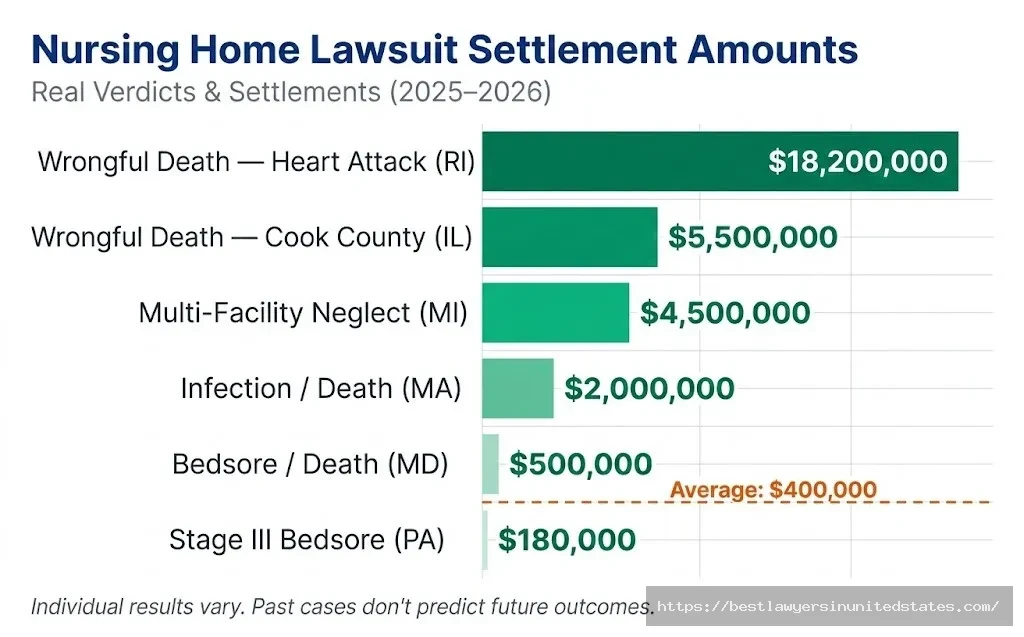
Quick Answer: The average nursing home lawsuit settles for approximately $400,000, though amounts range widely from $50,000 to several million dollars depending on the circumstances of the case.
| Source | Average Settlement Amount |
|---|---|
| Health Affairs journal study | ~$406,000 |
| Sokolove Law (2026 data) | ~$406,000 |
| ConsumerShield analysis (2026) | ~$251,296 |
| Brown & Crouppen (2021–2024 data) | ~$236,294 |
| Wrongful death cases (2021 data) | ~$248,000 |
The variation between these figures reflects different data sources, case types, and time periods. What matters most is the specific facts of your case — not the average.
What Affects Your Payout?
| Factor | How It Affects Your Settlement |
|---|---|
| Severity of injuries | More serious injuries = higher compensation |
| Whether the resident died | Wrongful death claims often carry additional damages |
| Evidence strength | Stronger evidence pushes the nursing home to settle higher |
| State damage caps | Some states cap non-economic damages |
| Nursing home’s financial resources | Larger chains can typically pay more |
| Punitive damages | About 17% of cases include punitive damages for egregious conduct |
| Attorney experience | More experienced firms tend to recover higher amounts |
Types of Compensation Available
A nursing home lawsuit can recover several categories of damages:
- Medical expenses — past and future care costs related to the abuse or neglect
- Pain and suffering — compensation for physical pain and emotional distress
- Loss of quality of life — when the resident’s enjoyment of life was diminished
- Wrongful death damages — burial costs, loss of companionship, and related expenses
- Punitive damages — extra compensation to punish particularly reckless behavior
- Lost wages — for family members who had to take time off to provide care
Real Settlement Examples
- $18.2 million — Rhode Island woman who suffered a heart attack while in care
- $5.5 million — Cook County wrongful death verdict (tied for largest in county history, 2025)
- $4.5 million — Michigan settlement covering six facilities for substandard care allegations (2025)
- $2 million — Massachusetts woman who died after her catheter went unchanged
- $500,000 — Maryland woman who developed fatal bedsores after spinal surgery (2025)
- $180,000 — Pennsylvania resident whose Stage II bedsore progressed to Stage III before death (2025)
The Statute of Limitations: Deadlines You Cannot Miss
What Is the Statute of Limitations?
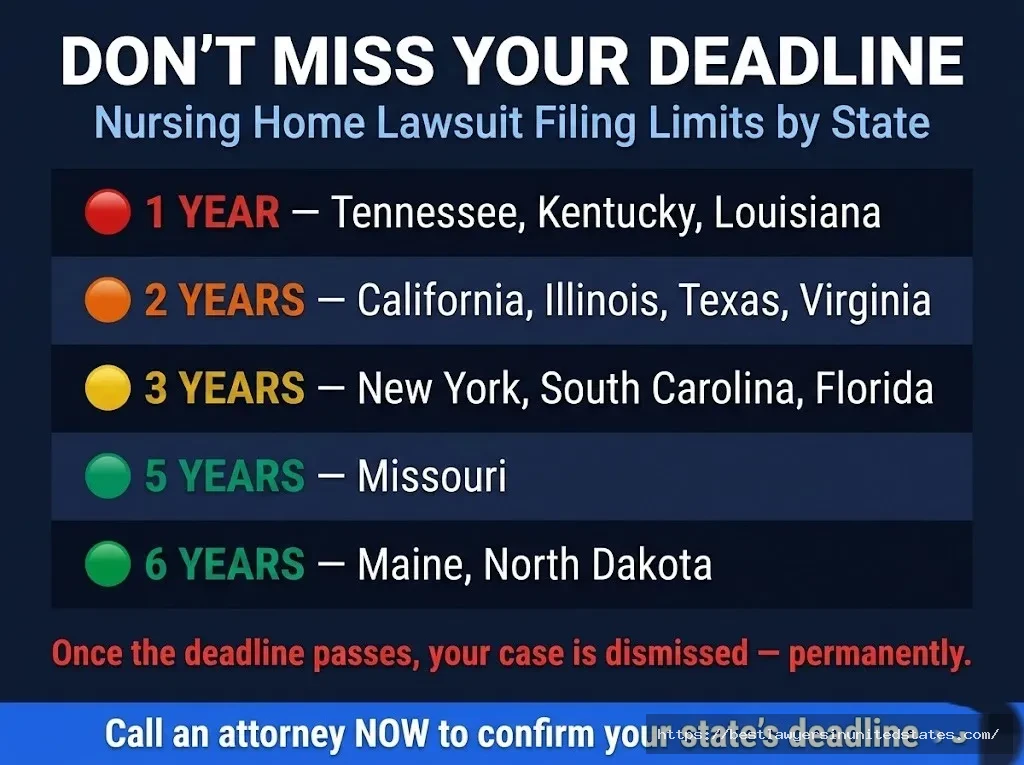
The statute of limitations is the legal deadline for filing a nursing home lawsuit. Miss it, and your case is dismissed — no matter how strong it is. This is the most important deadline in your entire case. Red Bull Lawsuit
⚠️ WARNING: In most states, you have 2–3 years from the date of harm (or when you discovered the harm) to file a nursing home lawsuit. In some states, the window is as short as 1 year. Once that deadline passes, you lose the right to sue — permanently.
Statute of Limitations by State (Selected Examples)
| State | Time Limit | Notes |
|---|---|---|
| Tennessee | 1 year | One of the shortest in the country |
| Kentucky | 1 year | Very strict — act immediately |
| Louisiana | 1 year | Same — consult attorney right away |
| California | 2 years | Standard personal injury deadline |
| Illinois | 2 years | Wrongful death: 2 years from date of death |
| Texas | 2 years | Expert report required within 120 days of filing |
| Virginia | 2 years | Wrongful death: 2 years from death |
| New York | 2.5–3 years | Depends on claim type |
| South Carolina | 3 years | From date of harm or discovery |
| Florida | 2 years | Changed from 4 years in 2023 — confirm with attorney |
| Missouri | 5 years | One of the longest for personal injury claims |
| Maine | 6 years | Longest in the country |
| North Dakota | 6 years | Tied for longest |
Always verify your state’s current deadline with a licensed attorney, as these laws change.
Exceptions That May Extend Your Deadline
Several circumstances can “toll” (pause) the statute of limitations and give you more time:
- Discovery rule — the clock starts when you discovered (or should have discovered) the harm, not necessarily when it occurred
- Mental incapacity — if the resident cannot file due to cognitive impairment, some states extend the deadline
- Fraud or concealment — if the nursing home actively hid evidence or lied about what happened
- Government-owned facility — different (often shorter) deadlines may apply; you may need to file a government claim first
Do not assume an exception applies to your case without talking to an attorney. And don’t wait to find out — consult a lawyer as soon as you suspect nursing home abuse or neglect.
How to Start a Nursing Home Lawsuit: Step by Step
Step 1: Document Everything Right Now
Start building your case before you even call an attorney. Save everything you have access to:
- Photos of injuries (bedsores, bruises, burns)
- Written notes of conversations with staff
- Any incident reports the facility gave you
- Your own observations during visits (dates, times, what you saw)
- The resident’s Medicare/Medicaid information and insurance cards
Step 2: Report the Abuse
Before or alongside filing a lawsuit, report suspected abuse to:
- The nursing home’s administration
- Your state’s Department of Health and Human Services
- Adult Protective Services (APS) in your area
- Local law enforcement if a crime was committed
- Your state’s Long-Term Care Ombudsman program
- Medicare/Medicaid if the facility receives federal funding
These reports create an official paper trail that can strengthen your legal case.
Step 3: Get a Free Legal Consultation
Nearly all nursing home abuse attorneys offer free consultations and work on contingency. You pay nothing unless you win. Call a law firm and describe what happened — they’ll tell you quickly whether you have a viable case.
Questions to ask during your consultation:
- Do you have experience with nursing home cases specifically?
- What’s your success rate in these cases?
- How do you charge fees?
- Have you handled cases in my state?
- What’s the realistic timeline for my case?
Step 4: Let Your Attorney Take Over
Once you hire an attorney, they handle the hard part — gathering records, hiring experts, filing paperwork, and negotiating with the nursing home’s insurers. Your job is to stay available, provide information when asked, and make major decisions with your attorney’s guidance.
Step 5: Respond Quickly to Any Requests
Your attorney may need additional documents, signatures, or your participation in a deposition. Respond quickly — delays on your end can slow down your case and potentially jeopardize it.
Step 6: Make an Informed Decision About Settlement
When a settlement offer comes, your attorney will explain whether it’s fair based on similar cases, the strength of your evidence, and the risks of going to trial. The decision is always yours.
Step 7: Receive Your Payment
After signing a settlement agreement, expect 4–8 weeks for disbursement. Your attorney will send you a closing statement showing all deductions (fees, liens, expenses) and the net amount going to you.
Do You Need a Lawyer to File a Nursing Home Lawsuit?
Quick Answer: You are not required to have a lawyer, but practically speaking, you should get one. Nursing home lawsuits are legally complex, involve expert witnesses, and go up against well-funded insurance companies. Families without attorneys almost always recover significantly less — or nothing at all.
Why an Attorney Makes a Difference
Nursing homes and their insurers have experienced legal teams whose job is to minimize payouts. Without your own attorney:
- You may not know what evidence to gather or how to preserve it
- You can’t compel the nursing home to hand over records
- You have no way to evaluate whether a settlement offer is fair
- You might miss procedural deadlines that end your case permanently
- You won’t have access to medical experts who can establish that negligence occurred
What If I Can’t Afford a Lawyer?
You don’t need to afford one upfront. Nursing home abuse attorneys work on contingency fees, meaning they only get paid when you win. Their fee — typically 33–40% of the recovery — comes out of the settlement, not your pocket. If you don’t win, you don’t owe attorney fees. money metals exchange lawsuit update.
When to Contact an Attorney Immediately
Don’t wait if:
- Your loved one has suffered serious, unexplained injuries
- A staff member has admitted fault
- Your loved one has passed away from suspected neglect
- The nursing home is being evasive or uncooperative
- You live in a state with a 1-year statute of limitations
Nursing Home Lawsuits vs. Similar Legal Actions
How These Cases Compare
| Type of Case | Avg. Settlement | Typical Duration | Success Rate | Settlement Rate |
|---|---|---|---|---|
| Nursing home abuse/neglect | ~$400,000 | 18–24 months | 88% (plaintiff gets something) | 88% |
| Medical malpractice (general) | ~$300,000–$500,000 | 2–4 years | ~30–35% | ~93% |
| Hospital negligence | $1.59M–$2.48M avg. | 2–5 years | Varies | ~90% |
| Personal injury (auto accident) | ~$50,000–$150,000 | 12–18 months | Varies | ~95% |
| Wrongful death (nursing home) | ~$248,000+ | 18–36 months | Varies | High |
Nursing home cases stand out because of their high plaintiff success rate at trial (63%) and their strong settlement rate. This is partly because juries have become increasingly intolerant of negligent care facilities — and nursing homes know it.
Frequently Asked Questions
How long does a nursing home lawsuit take?
Quick Answer: Most cases take 18–24 months. Simple cases that settle early can close in 6–12 months. Cases that go to trial typically take 3–4 years.
The range is wide because so many factors affect the timeline — how much evidence exists, how many defendants are named, how backed-up your local courts are, and whether the nursing home is willing to negotiate in good faith. The most accurate answer for your case comes from an attorney who can review your specific facts.
How long do nursing home settlements take?
Quick Answer: Once a settlement is agreed upon, expect 4–8 weeks for money to arrive in your hands.
That’s just the disbursement period. The time to actually reach a settlement agreement is anywhere from a few weeks (for early, straightforward cases) to more than a year (for complex cases where liability is disputed). The full case from first call to final check averages 18–24 months.
What is the statute of limitations for nursing home lawsuits?
Quick Answer: It’s 1–6 years depending on your state. Most states allow 2–3 years from the date of the harm or when you discovered it.
Tennessee, Kentucky, and Louisiana give you only one year. Maine and North Dakota give you six. Don’t guess — call an attorney in your state to confirm your deadline as soon as possible.
How much is a nursing home lawsuit worth?
Quick Answer: The average nursing home lawsuit settles for approximately $400,000, but amounts range from under $50,000 to over $18 million depending on the severity of harm and the quality of evidence.
Factors that push values higher include: permanent or fatal injuries, strong evidence of deliberate neglect, nursing homes with prior violations, and cases involving punitive damages. An attorney can give you a realistic estimate after reviewing your specific facts.
Do most nursing home lawsuits go to trial?
Quick Answer: No. About 88% settle before trial. Trial is relatively rare.
Nursing homes generally prefer settlement to avoid negative publicity, unpredictable jury verdicts, and the cost of litigation. That said, when nursing homes do fight cases to trial, plaintiffs still win about 63% of the time — a high rate compared to most civil case types.
What if I don’t have medical records or documentation?
Quick Answer: You can still file. Your attorney can subpoena records directly from the facility.
You don’t need to have any documents in hand before consulting an attorney. Lawyers have legal tools to compel nursing homes to produce records, and they know what to look for. What you can’t replace is time — the sooner you call, the more evidence is likely still intact.
Can the lawsuit be filed if my loved one passed away?
Quick Answer: Yes. A family member or estate representative can file a wrongful death claim.
This is actually one of the most common situations in nursing home lawsuits. Eligible filers typically include spouses, children, or other immediate family members, as well as whoever holds power of attorney or serves as the estate’s legal representative.
Can I sue if I signed an arbitration agreement at admission?
Quick Answer: Possibly. Arbitration agreements in nursing homes are legally contested in many states.
Some nursing home admission contracts include mandatory arbitration clauses that try to waive your right to sue. Federal regulations have limited when these clauses can be enforced for Medicare/Medicaid-funded facilities. An attorney can review the specific language of the agreement and advise whether it’s enforceable in your state. ancient nutrition lawsuit
Does filing a lawsuit remove my loved one from the nursing home?
Quick Answer: No. A lawsuit is a separate process from care decisions.
Filing a lawsuit doesn’t automatically remove your loved one from the facility, though you may absolutely transfer them to another facility at any time. If you believe they’re in immediate danger, contact the facility director, your state’s Adult Protective Services, or law enforcement right away — don’t wait for legal proceedings.
What if the nursing home goes bankrupt?
Quick Answer: You may still be able to recover through insurance, parent company assets, or bankruptcy proceedings.
Most nursing homes carry liability insurance that typically remains available even in bankruptcy. If a nursing home is part of a larger corporate chain, the parent company may also be named as a defendant. An attorney can help identify all potential sources of recovery.
Can I opt out of a class action against a nursing home?
Quick Answer: Yes, in most cases. Opting out lets you pursue an individual lawsuit instead.
If the nursing home you’re dealing with is part of a multi-facility class action, you’re usually given the right to opt out and file your own claim. Individual lawsuits often recover more for serious injuries than class action settlements, where funds are divided among many claimants. Talk to an attorney before making this decision.
What if the nursing home destroyed or altered records?
Quick Answer: This is called spoliation of evidence, and it can actually help your case.
When a nursing home destroys, alters, or hides evidence, courts can instruct juries to infer that the destroyed records would have been damaging to the facility. Your attorney can file motions to hold the nursing home accountable for evidence tampering, which often strengthens your negotiating position.
Will my nursing home lawsuit settlement be taxable?
Quick Answer: Generally, compensation for physical injuries is not taxable. Punitive damages usually are.
The IRS generally treats personal injury and wrongful death settlements as non-taxable if they compensate for physical harm. However, punitive damages, interest on the settlement, and any portion attributed to lost wages or emotional distress without physical injury may be taxable. Ask a tax professional about your specific settlement terms.
How do I find a good nursing home abuse attorney?
Quick Answer: Look for attorneys who specifically handle nursing home or elder abuse cases, work on contingency, and have documented results in your state.
Start by searching your state bar’s attorney directory or asking for referrals. Look for law firms with clear track records in nursing home cases specifically — not just general personal injury. Most offer free initial consultations. You can also contact [email protected] for attorney referrals in your area.
What should I bring to my first attorney consultation?
Quick Answer: As much as you have — but don’t delay because you don’t have everything. An attorney can help you get what’s missing.
Bring whatever you have access to:
- The name and address of the nursing home
- Your loved one’s Medicare/Medicaid or insurance information
- Any incident reports or documentation the facility gave you
- Photos of injuries
- Names of staff members involved (if known)
- Your own written notes of what you observed and when
What happens if I miss the statute of limitations deadline?
Quick Answer: In most cases, your lawsuit will be dismissed and you’ll lose the right to sue permanently.
This is why timing is so critical. Some exceptions may apply (see the section above on tolling), but you cannot count on them. If you think the deadline may be approaching — or even if you’re not sure — call an attorney immediately and let them assess your situation.
Final Thoughts: Why Acting Now Matters
Nursing home lawsuits take time — but the longer you wait to start, the harder your case becomes. Evidence disappears, witnesses move on, and statutes of limitations tick down relentlessly.
If you believe your loved one was harmed through neglect or abuse, the most important step is the first one: talking to an attorney who handles these cases. The consultation is free, the representation is on contingency, and the only thing you have to lose by waiting is time you can’t get back.
The average nursing home abuse case recovers around $400,000 — enough to cover medical expenses, provide for your loved one’s remaining care, and hold the facility accountable so other families don’t go through the same thing.
