
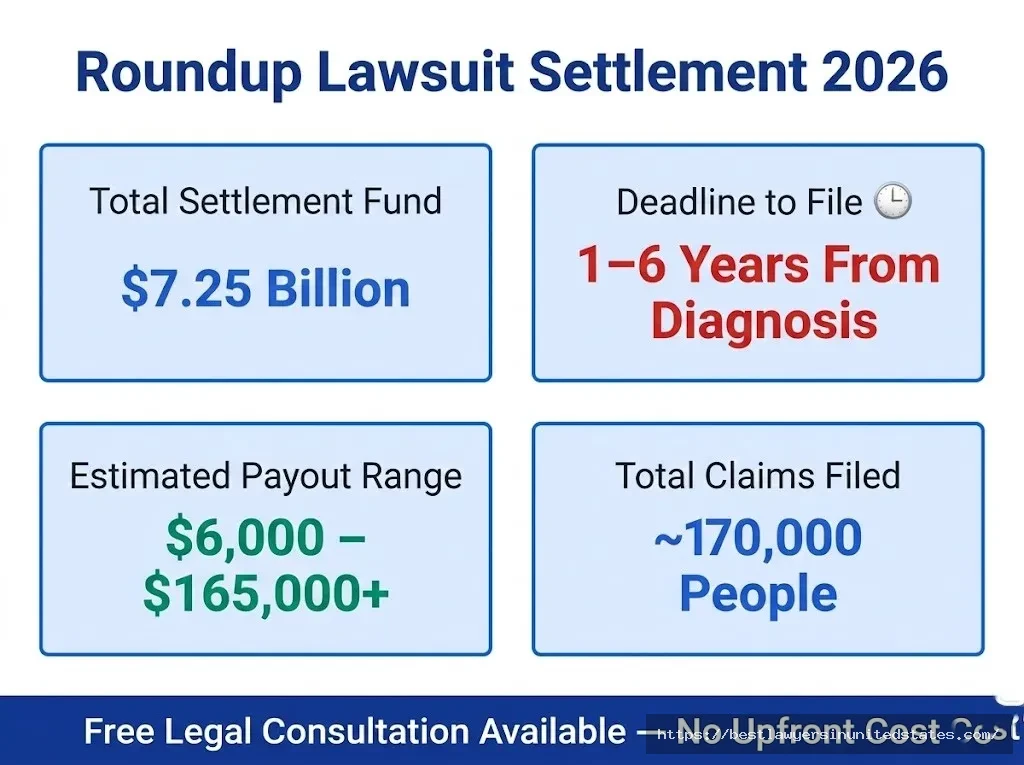
The Roundup lawsuit involves claims that Monsanto’s glyphosate-based weed killer causes non-Hodgkin lymphoma (NHL) and other blood cancers — and Bayer (which now owns Monsanto) has been ordered to pay billions in damages across thousands of cases. On February 17, 2026, Bayer announced a proposed $7.25 billion class settlement to resolve both existing and future NHL claims. To qualify, you’ll need specific medical records, exposure documentation, and other evidence that proves both your use of Roundup and your cancer diagnosis.
Quick Answer: To file a Roundup lawsuit, you need medical records confirming a qualifying cancer diagnosis (most commonly non-Hodgkin lymphoma), proof of Roundup exposure for at least 50 hours after 1974, and documentation of damages like medical bills and lost wages. You do NOT need a lawyer to get started — but most attorneys offer free consultations and work on contingency, meaning no upfront fees.
This guide walks you through exactly what proof you need, how to gather it, who qualifies under the 2026 settlement, and how to file before your state’s statute of limitations runs out.
What Is the Roundup Lawsuit About?
Background of the Case
Roundup is the world’s most widely used weed killer, produced by Monsanto (now owned by Bayer AG). Its active ingredient, glyphosate, was classified as “probably carcinogenic to humans” by the World Health Organization’s International Agency for Research on Cancer (IARC) in 2015. Since then, hundreds of thousands of people — farmers, landscapers, groundskeepers, and home gardeners — have filed lawsuits alleging that long-term Roundup exposure caused their non-Hodgkin lymphoma.
Plaintiffs argue that Monsanto knew about the cancer risks for decades but deliberately suppressed the science. Internal documents released during litigation (known as the “Monsanto Papers”) revealed that the company ghostwrote scientific articles claiming Roundup was safe, tried to build a shadow network of scientists to promote glyphosate, and worked to influence regulatory decisions at the EPA. A key study claiming glyphosate was safe was later retracted after the journal found it was based on unpublished company data.
Despite paying over $11 billion to settle roughly 100,000 claims, Bayer still faces approximately 60,000+ active lawsuits as of March 2026. The litigation is one of the largest mass tort actions in American history. Affordable Dentures Lawsuit
Roundup Lawsuit Timeline
| Date | Event | Details |
|---|---|---|
| 1974 | Roundup first sold | Monsanto introduces glyphosate herbicide |
| 2015 | WHO/IARC classification | Glyphosate classified as “probably carcinogenic” |
| July 2018 | Johnson v. Monsanto verdict | California jury awards $289 million to groundskeeper Dewayne Johnson |
| March 2019 | Hardeman v. Monsanto verdict | Federal jury awards $80 million |
| June 2020 | First global settlement | Bayer agrees to pay ~$10.9 billion to resolve ~100,000 claims |
| 2023 | Label lawsuit settled | Separate class action resolves claims over lack of cancer warnings on packaging |
| March 2025 | Georgia $2.1 billion verdict | Jury awards $2.1 billion to man with NHL after home/work Roundup use |
| January 2026 | Supreme Court agrees to hear case | Court accepts Monsanto Co. v. Durnell on federal preemption question |
| February 17, 2026 | New $7.25 billion settlement proposed | Bayer proposes class settlement for current and future NHL claims |
| March 2026 | Preliminary approval pending | Court has yet to formally approve; ~3,887 MDL cases still pending in federal court |
| Expected mid-2026 | Supreme Court ruling | Decision on whether federal law preempts state failure-to-warn claims |
| TBD (court-dependent) | Final approval hearing | Once approved, payment distribution timeline begins |
Who Filed the Lawsuit?
The Roundup litigation is not a single lawsuit — it’s a massive collection of individual lawsuits and multidistrict litigation (MDL). The original landmark case was filed by California groundskeeper Dewayne Johnson, represented by the law firm Baum Hedlund Aristei & Goldman. Thousands of state and federal cases have since been filed across the country, with heavy concentrations in Missouri, California, and Georgia. The federal cases were consolidated into MDL 2741 in the U.S. District Court for the Northern District of California. The named defendant is Monsanto Company, a wholly owned subsidiary of Bayer AG since 2018.
What Are the Core Allegations?
Plaintiffs in Roundup lawsuits typically allege several key claims:
- Failure to warn — Monsanto did not include any cancer risk warning on Roundup labels despite internal knowledge of the danger
- Defective product design — glyphosate-based formulations are unreasonably dangerous for the intended use
- Fraudulent misrepresentation — Monsanto actively promoted Roundup as safe while suppressing contrary research
- Negligence — the company failed to take reasonable steps to protect consumers and occupational users
- Conspiracy — internal documents show coordinated efforts to manipulate scientific literature and regulatory bodies
What Proof Do You Need for a Roundup Lawsuit?
This is the heart of building a winning claim. Your case rests on three pillars: proving you used Roundup, proving you have a qualifying cancer diagnosis, and linking the two. Here’s a breakdown of every type of evidence your attorney will help you gather.
Quick Answer: The most important proof is (1) medical records showing a qualifying cancer diagnosis and (2) documentation of long-term Roundup exposure. You do NOT need to have receipts — there are other ways to establish exposure history.
1. Medical Records (Your Most Critical Evidence)
Medical records are the foundation of any Roundup cancer claim. They confirm what you were diagnosed with, when, how it was treated, and how it has affected your life.
| Document Type | Why It’s Needed | Where to Find It | If You Don’t Have It |
|---|---|---|---|
| Pathology/biopsy report | Confirms exact cancer diagnosis and subtype | Hospital, treating oncologist | Request from hospital records department |
| Diagnosis records | Shows date of diagnosis for statute of limitations | Primary care doctor, oncologist | Healthcare provider or insurance records |
| Treatment records | Documents chemo, radiation, surgery, immunotherapy | Oncologist, hospital, infusion center | Medical records department |
| Ongoing treatment plan | Shows long-term care and prognosis | Current physician | Request from treating doctor |
| Remission/relapse notes | Documents disease progression | Oncologist | Medical records |
| Death certificate (if applicable) | Required for family members filing on behalf of deceased | County vital records office | State vital records office |
Qualifying cancer diagnoses include non-Hodgkin lymphoma (NHL) and its subtypes — diffuse large B-cell lymphoma (DLBCL), follicular lymphoma, mantle cell lymphoma, Burkitt lymphoma, chronic lymphocytic leukemia (CLL), peripheral T-cell lymphomas, and other related blood cancers. The proposed 2026 class settlement covers NHL only. If you have a different cancer diagnosis, consult an attorney — individual lawsuits have been filed for other glyphosate-linked conditions.
2. Proof of Roundup Exposure
You must show that you used Roundup (or another glyphosate-based product) and that exposure was substantial — typically 50 or more hours after 1974. This is where many people worry because they may not have saved receipts. Don’t panic. There are multiple ways to document exposure.
| Evidence Type | What It Proves | Where to Find It | Alternatives |
|---|---|---|---|
| Purchase receipts or invoices | You bought Roundup products | Personal records, email confirmations, bank statements | Credit card statements or store loyalty card history |
| Employment records | Occupational exposure — job duties included herbicide use | Former employer HR department, union records | Pay stubs, job descriptions, union grievances |
| Incident/accident reports | Documented spills or exposures at work | Employer safety officer, OSHA records | Workers’ comp filings |
| Payroll or job title records | Shows length of employment in Roundup-adjacent roles | Employer, state unemployment records | Tax returns showing employment history |
| Farm ownership records | Shows land use requiring herbicide application | County property records, farm bureau | USDA FSA records for farm program participants |
| Product containers (photos or actual) | Confirms use of specific glyphosate products | Home, garage, storage | Dated photos of label, product name, remaining contents |
| Usage logs or spray records | Documents frequency and duration of use | Personal records, farm records | Reconstructed timeline from employment or home records |
| Witness statements | Third parties who observed your Roundup use | Coworkers, neighbors, family members | Sworn affidavits arranged by your attorney |
Occupational exposure is the most common and easiest to document. If you worked as a farmer, landscaper, groundskeeper, golf course worker, parks employee, agricultural worker, nursery employee, or in any similar role, employment records alone may be sufficient to establish exposure.
Residential exposure is also valid. If you used Roundup regularly on your lawn, garden, or property, purchase history, photographs, and neighbor/family testimony can build a strong record.
Preserve what you have now. If you still have Roundup containers at home, don’t throw them away. Take clear dated photos of the label, product name, and batch number. Store containers in a safe, dry place. NetCredit Lawsuit
3. Expert Testimony and Scientific Evidence
You don’t gather this yourself — your attorney does. But it’s worth understanding what it includes, because it’s what ties your exposure to your diagnosis in a court’s eyes.
Your legal team will typically retain:
- Medical experts — oncologists or toxicologists who will testify that glyphosate can cause NHL and that your specific cancer is consistent with this exposure pathway
- Epidemiologists — experts who present population-level studies linking Roundup to NHL risk
- Corporate conduct experts — who analyze the Monsanto Papers to show the company’s knowledge of risks and deliberate concealment
Scientific backing is robust. Multiple peer-reviewed studies have established statistical associations between glyphosate exposure and NHL. A landmark 2019 meta-analysis found a 41% increased risk of developing NHL with glyphosate-based herbicide exposure. Courts have accepted this science in numerous verdicts.
4. Proof of Damages
Your damages documentation shows the courts (or settlement administrators) how much this illness has cost you — financially, physically, and personally.
| Damage Category | Evidence Needed | Where to Find It |
|---|---|---|
| Medical expenses | Bills, EOBs, receipts for all treatments | Providers, insurance company |
| Future medical costs | Expert projections from treating physician | Oncologist, life care planner |
| Lost wages | Pay stubs, W-2s, tax returns from before/during illness | Employer, IRS records |
| Loss of earning capacity | Employment history, vocational expert assessment | Employer, vocational rehab expert |
| Pain and suffering | Personal journals, statements, psychological records | Personal records, therapist |
| Loss of enjoyment of life | Medical records, personal testimony, family statements | Personal/family records |
| Wrongful death damages | Death certificate, funeral costs, dependent income loss | County records, financial records |
Who Qualifies for a Roundup Lawsuit in 2026?
Eligibility Requirements
The 2026 proposed class settlement has specific criteria. Meeting all of these puts you in the strongest position to file a claim.
| Requirement | Details | How to Prove It |
|---|---|---|
| Roundup exposure | Used Roundup or glyphosate product — occupationally or residentially | Employment records, receipts, witness testimony |
| Exposure duration | At least 50 hours of use after 1974 | Usage logs, employment history |
| Qualifying diagnosis | Non-Hodgkin lymphoma (NHL) or related blood cancer | Medical records, pathology report |
| Diagnosis timing | Diagnosed at least 2 years after first Roundup exposure | Medical records, exposure timeline |
| Diagnosis cutoff | Diagnosed before Feb. 17, 2026, OR within 16 years after final court approval | Medical records |
| No prior settlement | Have not already accepted a Roundup settlement or signed a release | Personal legal records |
| Statute of limitations | Filed within your state’s deadline (1–6 years from diagnosis or discovery) | Attorney can verify |
Who Is Most Likely to Qualify?
High-risk groups with the strongest exposure evidence include:
- Agricultural workers and farmers who applied herbicides regularly
- Landscapers and lawn care professionals
- Groundskeepers at schools, parks, golf courses, or sports facilities
- Nursery and garden center workers
- Home gardeners who used Roundup frequently over many years
- Anyone who mixed, prepared, or sprayed Roundup without protective equipment
Who Does NOT Qualify?
You may not be eligible if:
- You have NOT been diagnosed with NHL or a covered blood cancer subtype
- Your cancer diagnosis occurred less than 2 years after your first Roundup exposure
- You have already signed a release or accepted a prior Roundup settlement
- Your state’s statute of limitations has already passed AND you did not file in time
- Your Roundup use was minimal or occurred only once
- You are filing under the 2026 class settlement but were diagnosed more than 16 years after final approval
Note: Even if you don’t qualify for the 2026 class settlement, you may still have a strong individual lawsuit. Many individual Roundup plaintiffs have received jury awards far larger than settlement tiers — including verdicts of $289 million, $332 million, and $2.1 billion. Talk to an attorney to evaluate both paths.
How Much Money Can You Get?
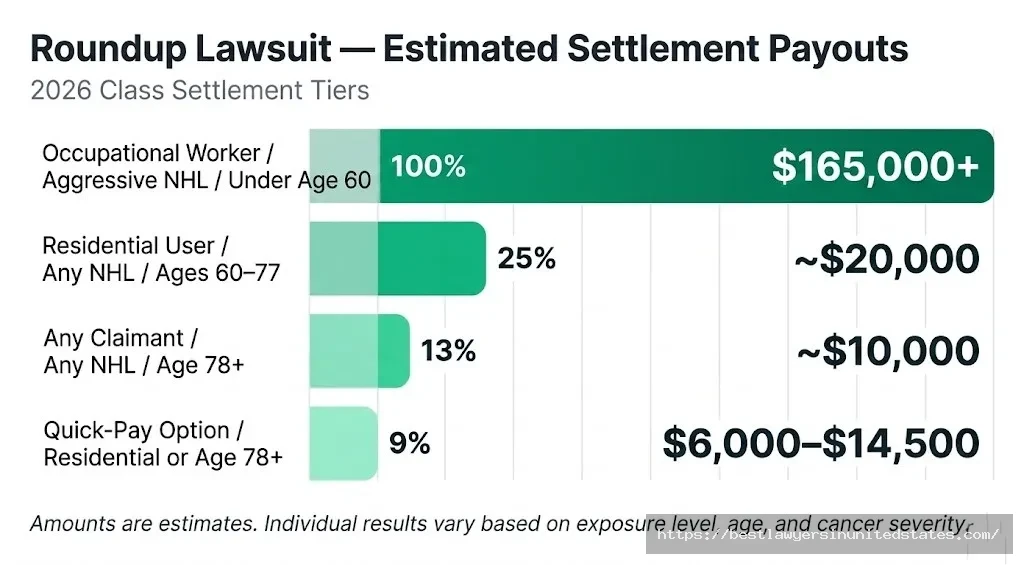
Quick Answer: Under the proposed $7.25 billion class settlement, payouts range from approximately $6,000 (Quick-Pay) to $165,000+ depending on your age at diagnosis, cancer subtype, and exposure level. Individual trial verdicts have reached into the billions.
Settlement Fund Overview
| Category | Amount | Notes |
|---|---|---|
| Total proposed class settlement | $7.25 billion | Paid over up to 21 years |
| Prior settlements (2020 global) | ~$10.9 billion | Roughly 100,000 claims resolved |
| Additional separate settlements (2026) | ~$3 billion | Confidential terms |
| Total Bayer litigation spend (all Roundup) | $11+ billion | Ongoing |
| Attorney fee structure | Contingency (~33-40%) | No upfront cost to claimants |
Estimated Payout Tiers
| Claimant Profile | Estimated Payout | Key Factors |
|---|---|---|
| Agricultural/industrial worker, aggressive NHL, diagnosed under 60 | Up to $165,000 | Highest-risk tier, long occupational exposure |
| Residential user, moderate NHL, diagnosed ages 60–77 | ~$20,000 | Mid-tier — less severe diagnosis, older |
| Any claimant, diagnosed at age 78+ | ~$10,000 | Base tier for older claimants |
| Quick-Pay (residential or age 78+, filed before Feb. 13, 2026) | $6,000–$14,500 | Faster, reduced payment option |
| Extraordinary Circumstances Fund | Additional 5% of annual payments | Death before 78, organ transplant, CAR-T therapy, Stage IV diagnosis |
What Affects Your Payout?
Several factors determine where your claim lands in the payout structure:
- Age at diagnosis — younger plaintiffs generally receive higher awards because they face longer-lasting health impacts
- Cancer subtype — aggressive forms like DLBCL typically score higher than indolent forms
- Exposure level and duration — occupational users who mixed and applied Roundup daily receive higher scores than occasional residential users
- Treatment intensity — those who underwent bone marrow transplants, CAR-T therapy, or intrathecal chemo may qualify for the Extraordinary Circumstances Fund
- Whether you opt for Quick-Pay or standard processing — Quick-Pay is faster but provides lower compensation
Individual Lawsuits vs. Class Settlement
The $7.25 billion class settlement is NOT your only option. You can opt out and pursue an individual lawsuit, which carries significantly higher risk but also significantly higher potential rewards. Recent trial verdicts include:
- $289 million — Johnson v. Monsanto (2018, reduced on appeal)
- $80 million — Hardeman v. Monsanto (2019)
- $332 million — verdict in separate case
- $2.1 billion — Barnes v. Monsanto (Georgia, 2025)
An attorney can evaluate whether the class settlement or an individual lawsuit is the better path for your specific situation.
How to File a Roundup Claim — Step by Step
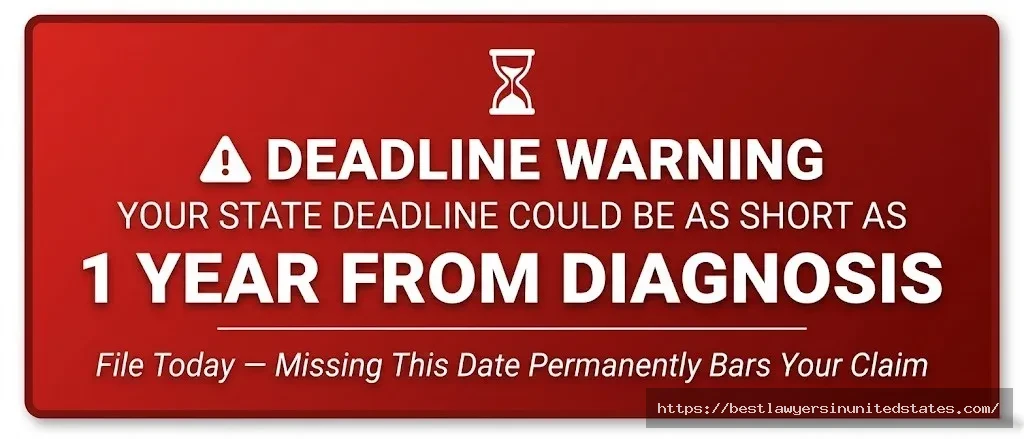
⚠️ DEADLINE WARNING: Roundup lawsuit deadlines are state-specific and can be as short as 1 year from your cancer diagnosis or discovery of the link between Roundup and your illness. If your state’s statute of limitations runs out, you lose your right to file permanently. Act now.
Step 1: Confirm You Meet Basic Eligibility
Before anything else, make sure you have:
- A confirmed NHL or related blood cancer diagnosis
- A history of Roundup use (at work or at home)
- A diagnosis that occurred at least 2 years after first exposure
- Not previously signed a Roundup release or settlement
Step 2: Consult a Roundup Attorney (Free)
This is the most important step. Roundup lawsuits are complex product liability cases involving scientific evidence, corporate misconduct, and intricate legal strategy. Most reputable Roundup attorneys offer:
- Free case evaluations — no cost to determine if you have a claim
- Contingency fee arrangements — you pay nothing unless you win; attorney fees are typically 33–40% of your award
- National representation — many firms handle clients in all 50 states
Contact an attorney as early as possible, because they will:
- Verify your state’s filing deadline
- Help you gather all required evidence
- Determine whether the class settlement or individual litigation is better for your case
- Handle all filings, discovery, and negotiations
Step 3: Gather Your Evidence
Work with your attorney to collect:
- All medical records related to your NHL diagnosis and treatment
- Employment records documenting occupational Roundup use
- Purchase receipts, bank statements, or any records of buying Roundup
- Photographs of any remaining product containers
- Contact information for coworkers, neighbors, or family who witnessed your use
- Financial records: medical bills, pay stubs, tax returns
If you don’t have receipts: Don’t assume your case is weak. Courts routinely accept employment records, witness testimony, and reconstructed exposure histories as sufficient proof of use.
Step 4: File Within Your State’s Deadline
| State Statute of Limitations | Range |
|---|---|
| Shortest deadline | 1 year (some states) |
| Most common range | 2–3 years |
| Longest deadline | Up to 6 years |
| Clock starts | Date of diagnosis, date of a loved one’s death, OR date you discovered the Roundup-cancer link |
The clock starts differently in each state. In some, it begins at diagnosis. In others, it begins when you reasonably could have discovered the connection between Roundup and your illness. An attorney will determine which rule applies to you. Emuaid Lawsuit
Step 5: Decide: Class Settlement or Individual Lawsuit?
Once the $7.25 billion class settlement receives final court approval, you’ll need to decide:
- Join the class settlement — faster resolution, guaranteed payment within the tier structure, less legal risk
- Opt out — pursue an individual trial, higher potential award, but slower process and no guarantee of outcome
Attorneys representing current MDL plaintiffs have requested additional time to review Bayer’s settlement terms before advising clients. This is still actively evolving.
Step 6: Track Your Claim
After filing, the claims administrator will review your documentation. You may be asked to provide additional records or clarifications. Keep copies of everything and respond promptly to any requests to avoid delays or denial.
Critical Deadlines Table
| Deadline Type | Timeframe | Notes |
|---|---|---|
| Individual lawsuit filing deadline | 1–6 years from diagnosis or discovery (varies by state) | Missing this bars your claim permanently |
| Class settlement opt-out deadline | TBD after court approval | You’ll have a window to opt out if you prefer individual litigation |
| Quick-Pay eligibility cutoff | Filed lawsuit or tolling agreement before Feb. 13, 2026 | Must already be an “Initial Claimant” |
| Supreme Court ruling (Monsanto v. Durnell) | Expected June 2026 | Could significantly affect state-court failure-to-warn claims |
| Final settlement approval hearing | TBD | Court has yet to schedule; preliminary filing was Feb. 17, 2026 |
Current Lawsuit Status — March 2026 Updates
Where Things Stand Right Now
As of March 2026, the Roundup litigation is at a pivotal crossroads. On February 17, 2026, Bayer filed its proposed $7.25 billion class settlement in the 22nd Judicial Circuit Court of the City of St. Louis, Missouri. The settlement awaits judicial approval — a process that typically takes several months and requires the court to assess whether it’s fair to class members.
Approximately 3,887 cases remain pending in the federal MDL in California as of early March 2026, and roughly 61,000 active lawsuits remain in total across state and federal courts. Bayer has signaled it will only move forward with the settlement if the vast majority of existing plaintiffs agree to participate. Attorneys for plaintiffs have asked for additional time to review the terms before advising their clients.
What the Supreme Court Review Means for You
The U.S. Supreme Court accepted Monsanto Co. v. Durnell in January 2026. This case will determine whether state-based failure-to-warn claims are “preempted” (blocked) by the Federal Insecticide, Fungicide, and Rodenticide Act (FIFRA), which governs EPA-approved pesticide labels. A ruling in Bayer’s favor could eliminate many state-court cases. A ruling against Bayer would preserve plaintiffs’ rights. The decision is expected by June 2026 and is one reason Bayer accelerated its settlement offer.
State-Level Legislative Threats
North Dakota passed a law in April 2025 shielding pesticide manufacturers from failure-to-warn lawsuits, effectively stating that EPA-approved labels meet state requirements. Similar bills are pending in Georgia, Missouri, and other states. If you live in a state where such legislation passes, your legal options could be significantly narrowed. This makes filing sooner — not later — a priority.
What to Expect Next
- April–June 2026: Court will begin review of the class settlement; plaintiff attorneys will decide whether to support or challenge the terms
- June 2026: Expected U.S. Supreme Court ruling in Monsanto v. Durnell — a potential game-changer
- Mid-to-late 2026: Possible final approval hearing, depending on court calendar and objections
- 2026–2047: If approved, settlement payments distributed over up to 21 years
Roundup Lawsuit vs. Similar Cases
How This Settlement Compares
| Lawsuit | Settlement Amount | Claims Resolved | Payout Range | Status |
|---|---|---|---|---|
| Roundup (2026 proposed class) | $7.25 billion | ~60,000+ pending | $6,000–$165,000+ | Awaiting court approval |
| Roundup (2020 global settlement) | ~$10.9 billion | ~100,000 | Average $150,000+ | Completed |
| 3M Combat Arms earplug | ~$6 billion | ~260,000 veterans | Varies | Resolved (2023) |
| Johnson & Johnson talc/baby powder | $8.9 billion | ~60,000 | Varies | Ongoing |
| Paraquat (herbicide/Parkinson’s) | Pending | Tens of thousands | TBD | Active litigation |
What Makes Roundup Claims Unique
A few things set Roundup lawsuits apart from other mass tort actions:
- The Monsanto Papers: Internal corporate documents proving the company’s deliberate suppression of science are unusually damaging and have driven repeated massive verdicts
- Scale: With roughly 170,000 total claims filed, this is one of the largest product liability litigations in U.S. history
- Future claimant coverage: The proposed 2026 settlement is designed to cover people who may be diagnosed with NHL up to 16 years after final court approval — an unusual provision
- Supreme Court overlap: An active Supreme Court case could dramatically reshape the legal landscape mid-litigation
Do You Need a Lawyer to File a Roundup Claim?
Quick Answer: No, you technically do not need a lawyer to file a claim — but given the complexity of the science, the corporate defendant (Bayer is a multi-billion dollar global corporation), and the factors that determine your payout tier, having experienced legal representation almost certainly increases both your chances of qualifying and the amount you receive.
What an Attorney Does for You
A Roundup attorney handles everything on your behalf:
- Verifies your eligibility and state-specific deadline
- Gathers and organizes all required medical and exposure documentation
- Retains expert witnesses (oncologists, epidemiologists, toxicologists)
- Determines whether the class settlement or an individual lawsuit is better for your case
- Files all paperwork and manages discovery
- Negotiates your settlement amount or takes your case to trial
You pay nothing upfront. Roundup attorneys work on contingency — they only collect a fee (typically 33–40%) if your case succeeds. Free case consultations are available from most firms handling these cases.
When Legal Help Is Especially Important
Consider reaching out to an attorney immediately if:
- Your state’s filing deadline is approaching
- Your documentation is incomplete or you’re unsure what you have
- You have an aggressive cancer, severe treatment history, or terminal diagnosis (you may qualify for the Extraordinary Circumstances Fund)
- You filed before February 13, 2026, and want to understand your Quick-Pay options
- You’re unsure whether to join the class settlement or pursue an individual lawsuit
Frequently Asked Questions
What exactly is the Roundup lawsuit about?
Quick Answer: Roundup lawsuits allege that Monsanto’s glyphosate-based weed killer causes non-Hodgkin lymphoma, and that Monsanto knew about the risk but failed to warn consumers.
Hundreds of thousands of people — farmers, landscapers, and homeowners — have sued Bayer (Monsanto’s parent company) after being diagnosed with NHL following years of Roundup exposure. Courts have repeatedly sided with plaintiffs, awarding billions in damages across thousands of verdicts and settlements.
Who qualifies for the Roundup lawsuit?
Quick Answer: You may qualify if you used Roundup for at least 50 hours after 1974 and were diagnosed with non-Hodgkin lymphoma or a related blood cancer at least 2 years after first exposure.
The proposed 2026 class settlement covers NHL specifically. People with other cancer types should consult an attorney about individual lawsuit options. High-risk groups include farmers, agricultural workers, landscapers, groundskeepers, and home gardeners who used Roundup regularly over extended periods.
How much money will I get from a Roundup settlement?
Quick Answer: Under the proposed $7.25 billion class settlement, estimated payouts range from $6,000 (Quick-Pay) to $165,000+ based on your age, cancer type, and exposure level.
Individual lawsuits have produced jury awards in the hundreds of millions to over two billion dollars, though appeals can reduce these amounts significantly. Your attorney can evaluate which path — class settlement or individual litigation — offers the best outcome for your specific case.
When is the deadline to file a Roundup claim?
Quick Answer: Deadlines vary by state — from 1 to 6 years from diagnosis or discovery. There is no single national deadline, and missing yours permanently bars you from filing.
The clock typically starts when you were diagnosed OR when you could have reasonably connected your diagnosis to Roundup use. Given state legislation threatening to eliminate certain claims and the pending Supreme Court ruling, acting as soon as possible is strongly advised.
What documents do I need for a Roundup lawsuit?
Quick Answer: You need medical records confirming NHL (or related cancer), proof of Roundup use (employment records, receipts, photos, or witness statements), and financial documentation of your damages.
Your attorney will help you gather everything. The most critical pieces are your pathology report, diagnosis records, and some form of exposure history — even if you don’t have formal receipts.
What if I don’t have receipts or purchase records?
Quick Answer: You can still file. Employment records, witness testimony, and usage logs are all accepted as proof of exposure.
Courts understand that most people don’t save receipts for products purchased 10 or 20 years ago. If you have coworkers who can attest to your occupational use, family members who saw you spraying Roundup regularly, or employment records showing your job duties included herbicide application, these substitute effectively for purchase documentation.
What if I used Roundup at home, not at work?
Quick Answer: Residential use qualifies, but the exposure threshold (50+ hours) is the same. Document your use through purchase history, photos of containers, and testimony from neighbors or family.
The 2026 settlement explicitly includes people who lived in homes where Roundup was used. Residential claimants are eligible but may fall into a lower payout tier than occupational users.
How do I prove my Roundup use if the company I worked for is out of business?
Quick Answer: State unemployment records, tax returns showing employment, union records, and coworker testimony can all substitute for formal employer records.
Your attorney is experienced in reconstructing exposure histories in exactly these situations. Even partial records combined with witness statements can establish a sufficient exposure history.
When will I receive my payment?
Quick Answer: If the $7.25 billion class settlement is approved, payments will be distributed over up to 21 years following court approval, which is still pending as of March 2026.
Quick-Pay claimants (those who filed before February 13, 2026 and qualify under the residential or age 78+ criteria) will receive smaller but faster payments. Standard claimants should expect their payment after claims review and court-supervised distribution — likely measured in months to years after approval.
Has the Roundup settlement been approved yet?
Quick Answer: No. As of March 2026, the proposed $7.25 billion settlement was filed on February 17, 2026, and is awaiting preliminary and final court approval.
Attorneys for plaintiffs have requested additional time to review the terms. The settlement also requires near-universal participation from existing claimants to proceed; Bayer has the right to walk away if too many people opt out.
Can I opt out of the class settlement?
Quick Answer: Yes. Once the court sets an opt-out deadline (after preliminary approval), you’ll have a window to exclude yourself from the class and pursue an independent lawsuit.
Opting out is a strategic decision. If your case is strong, your cancer is severe, and you have excellent exposure documentation, an individual lawsuit could yield significantly higher compensation than the class settlement tiers. Discuss this carefully with your attorney before the opt-out deadline.
What if I already threw away my Roundup containers?
Quick Answer: That’s fine — you don’t need the container. Witness testimony, employment records, receipts, and photos (even old ones) can substitute.
If you still have containers, preserve them and take dated photos of the label and product name. But missing containers are not a dealbreaker for most claims.
Will I have to give up my right to sue separately?
Quick Answer: Yes — if you join the class settlement, you give up the right to separately sue Monsanto for Roundup-related NHL. That’s why the opt-out option is important to evaluate.
Accepting a settlement means releasing your individual claims. Your attorney can help you determine whether the settlement amount adequately compensates you for your injuries or whether a separate lawsuit makes more sense.
What if I missed the deadline?
Quick Answer: If your state’s statute of limitations has passed, you may be permanently barred from filing an individual lawsuit. Consult an attorney immediately — some exceptions exist.
In rare circumstances, tolling agreements, the “discovery rule” (clock starts when you discover the connection, not when you’re diagnosed), or fraudulent concealment arguments may extend your deadline. There are no guarantees, but it’s worth a free consultation to evaluate.
Does the Roundup settlement cover family members who died from NHL?
Quick Answer: Yes. Family members or estate representatives of people who died from qualifying cancers may file wrongful death claims.
You’ll need the deceased’s medical records, a copy of their death certificate, and documentation of their Roundup exposure history. Compensation may include funeral costs, lost income to dependents, and pain and suffering experienced before death.
What if I was diagnosed with a cancer other than non-Hodgkin lymphoma?
Quick Answer: The 2026 class settlement covers NHL only. For other cancer types, individual lawsuits may still be available — consult an attorney.
Some plaintiffs have filed lawsuits alleging Roundup caused leukemia, multiple myeloma, and other cancers. These claims aren’t covered by the class settlement but may have merit in individual litigation depending on evolving science.
Will my Roundup settlement be taxed?
Quick Answer: Compensation for physical injuries is generally not subject to federal income tax. Punitive damages and interest components may be taxable.
Tax treatment depends on how your award is classified. Most compensatory damages for personal physical injury are exempt from federal income tax under IRS rules. Consult a tax professional about your specific situation, especially if your award includes punitive damages.
How do I find the official claim form or a verified attorney?
Quick Answer: There is no single government claim portal for Roundup lawsuits. The process starts with a free attorney consultation.
Be cautious of websites soliciting claim filings without attorney involvement — many are lead-generation sites, not actual settlement administrators. Start with a reputable law firm that handles mass tort cases nationally. Free consultations are universally available.
What does it cost to file a Roundup lawsuit?
Quick Answer: Nothing upfront. Roundup attorneys work on contingency — you only pay if you win, and fees (typically 33–40%) are deducted from your award.
There are no court filing fees or hourly charges in contingency arrangements. If your case doesn’t succeed, you owe nothing. This makes legal representation accessible to everyone regardless of financial situation.
Summary: Your Roundup Lawsuit Evidence Checklist
Before speaking with an attorney, try to gather what you can:
- [ ] Medical records showing NHL or related blood cancer diagnosis
- [ ] Pathology or biopsy report confirming cancer type
- [ ] Treatment records (chemo, radiation, surgery, etc.)
- [ ] Employment records showing Roundup-related job duties
- [ ] Purchase receipts, bank statements, or online order history for Roundup
- [ ] Photos of Roundup containers (current or historical)
- [ ] Names of coworkers, neighbors, or family who can serve as witnesses
- [ ] Medical bills, pay stubs, and tax returns for damages documentation
- [ ] Death certificate (if filing on behalf of a deceased family member)
You do not need all of these before calling an attorney. Even having a few items — combined with legal expertise — is enough to get started. The most important thing you can do today is act before your state’s statute of limitations runs out.
Disclaimer: This article is for informational purposes only and does not constitute legal advice. Laws and settlement terms vary by state and are subject to change. Consult a licensed attorney for advice specific to your situation.
