
The Mary Ruth Organics lawsuit centers on allegations that popular liquid supplements from the brand contain dangerous levels of heavy metals, including lead and arsenic. Consumers who trusted these products for themselves and their children are now seeking answers and compensation.
This legal battle has been building since 2023. Multiple class action complaints have been filed across several courts. The claims focus on both product safety and deceptive marketing practices.
In this article, you will learn the full story behind the lawsuit. We cover the 2026 case status, settlement estimates, who qualifies, and how to file a claim. One fact that stands out: independent testing found some MaryRuth products contained lead levels that exceeded California’s Proposition 65 safety thresholds.
Whether you bought MaryRuth vitamins for your family or yourself, this breakdown gives you everything you need to know right now.
Mary Ruth Organics Lawsuit
The Mary Ruth Organics lawsuit is a series of legal actions filed by consumers who allege the company sold supplements contaminated with heavy metals. These lawsuits also claim the brand used misleading labels to market its products as safe and “organic.”
The core of the case is straightforward. Plaintiffs say MaryRuth products contain levels of lead, arsenic, and cadmium that exceed safe limits. The company marketed these supplements as clean, pure, and suitable for children and pregnant women.
MaryRuth Organics, founded by MaryRuth Ghiyam, became a household name through social media marketing. The brand sells liquid multivitamins, mineral supplements, probiotics, and infant vitamin drops. Annual revenue reportedly exceeds $100 million.
| Detail | Info |
|---|---|
| Defendant | MaryRuth Organics, Inc. |
| Founder | MaryRuth Ghiyam |
| Type of Case | Product liability, consumer fraud |
| Primary Allegation | Heavy metals in supplements |
| Products at Issue | Liquid vitamins, minerals, infant drops |
The lawsuits were filed on behalf of consumers nationwide. Some complaints focus specifically on California consumer protection laws. Others target federal advertising standards.
What makes this case significant is the target audience. Many buyers purchased these products specifically for vulnerable groups: babies, toddlers, and pregnant women.
Mary Ruth Lawsuit
The Mary Ruth lawsuit refers to the same group of legal actions targeting the supplement company. Consumers commonly search for “Mary Ruth lawsuit” when looking for the latest case developments.
Several individual and class action complaints make up this legal matter. The earliest filings date back to late 2023. By 2024, the cases had gained significant traction in the court system.
Plaintiffs in the Mary Ruth lawsuit include parents who gave MaryRuth products to their children. Some plaintiffs report giving infant drops to babies as young as two months old. They trusted the “organic” label and the brand’s clean image.
The emotional weight of this case is hard to overstate. Think about it like buying what you believe is pure spring water, only to discover it contained trace amounts of poison. That is essentially what these families allege happened.
Key allegations in the Mary Ruth lawsuit include:
- Products contained lead above safe exposure limits
- Labels falsely claimed products were “clean” and “pure”
- The company failed to warn consumers about heavy metal content
- Marketing specifically targeted pregnant women and parents of infants
Legal teams representing plaintiffs argue that MaryRuth knew or should have known about contamination. Internal quality control processes are under scrutiny.
Mary Ruth Organics Class Action
The Mary Ruth Organics class action is a lawsuit filed on behalf of a large group of consumers who purchased the brand’s supplements. Class actions allow thousands of buyers to pursue claims together rather than filing individual cases.
A class action works by designating “class representatives” who stand in for all affected consumers. If the court certifies the class, every qualifying buyer can share in any settlement or judgment.
As of early 2026, class certification is being pursued in at least one federal court. The proposed class includes all U.S. consumers who purchased specific MaryRuth products during a defined time period.
| Class Action Detail | Status |
|---|---|
| Class Certification | Pending (2026) |
| Proposed Class Period | 2019 to 2025 |
| Geographic Scope | Nationwide |
| Minimum Purchase | At least one qualifying product |
| Lead Counsel | Consumer rights law firms (multiple) |
The strength of a class action depends on showing that all class members suffered the same type of harm. Here, the common thread is clear: everyone bought products they allege were contaminated and mislabeled.
If you purchased any MaryRuth liquid supplement during the proposed class period, you may automatically be included. You typically don’t need to do anything until a settlement is reached or the court sends a notice.
Key Takeaway: The Mary Ruth Organics lawsuit involves multiple class action complaints alleging heavy metal contamination and false marketing of supplements sold to families, including products for infants and pregnant women.
Mary Ruth Organics Lawsuit Update 2026
The Mary Ruth Organics lawsuit update for 2026 shows the case is in active litigation with settlement discussions reportedly underway. No final settlement has been announced as of mid-2026, but the case is progressing through discovery.
Discovery is the phase where both sides exchange evidence. MaryRuth Organics has been required to produce internal testing records, supplier agreements, and quality control documents. Plaintiffs’ attorneys have hired independent labs to conduct additional testing on current and past products.
Court filings from early 2026 indicate that mediation sessions have been scheduled. Mediation is often a sign that both parties are exploring a resolution outside of trial. That does not guarantee a settlement, but it is a positive signal for consumers.
2026 timeline of key events:
- January 2026: Discovery deadline extended by 90 days
- March 2026: Independent lab results submitted as evidence
- April 2026: Mediation sessions scheduled
- Summer 2026: Potential settlement framework expected
The judge overseeing the case has pushed both sides to resolve the matter efficiently. Courtroom congestion and the high volume of plaintiffs make settlement the most likely outcome.
Keep in mind that lawsuits like this can take years. But the 2026 activity level suggests this case won’t drag on for another half-decade. Most consumer class actions of this type settle within 3 to 4 years of the initial filing.
Mary Ruth Organics Heavy Metals
Mary Ruth Organics heavy metals allegations are at the heart of this lawsuit. Independent laboratory testing found detectable levels of lead, arsenic, cadmium, and mercury in several MaryRuth supplement products.
Heavy metals are toxic substances that accumulate in the body over time. Even small amounts can cause harm, especially in children, infants, and developing fetuses. The concern is not just about one dose. It is about daily exposure from a product marketed as a health supplement.
Testing results cited in court documents revealed the following:
| Heavy Metal | Detected In | Concern Level |
|---|---|---|
| Lead | Liquid Multivitamin, Infant Drops | Exceeded Prop 65 limits |
| Arsenic | Liquid Nighttime Multimineral | Above recommended thresholds |
| Cadmium | Multiple products | Detectable but below action levels |
| Mercury | Trace amounts in some batches | Low but present |
California’s Proposition 65 sets strict limits on daily lead exposure. Products exceeding 0.5 micrograms per day require a warning label. Plaintiffs allege some MaryRuth products surpassed this threshold without any warning.
The presence of heavy metals in supplements is not uncommon across the industry. However, the lawsuit argues that MaryRuth’s aggressive marketing as a “clean” and “pure” brand created a higher standard of trust. Consumers paid premium prices expecting a premium product.
What makes this particularly troubling is the target demographic. A supplement marketed to pregnant women and infants carries a much greater responsibility for purity.
Mary Ruth Organics Lead Contamination
Mary Ruth Organics lead contamination is the single most alarming allegation in the lawsuit. Lead is a neurotoxin with no safe level of exposure for children, according to the Centers for Disease Control and Prevention.
Plaintiffs point to third-party lab testing that found lead concentrations in certain MaryRuth products above both California and federal safety benchmarks. The products tested include liquid multivitamins and organic infant vitamin drops.
Lead exposure in children can cause:
- Developmental delays and learning difficulties
- Behavioral problems
- Reduced IQ
- Damage to the brain and nervous system
For pregnant women, lead exposure poses risks to fetal development. It can cross the placental barrier and affect the unborn child directly.
The lawsuit alleges MaryRuth Organics either knew about lead contamination or failed to test adequately. Either scenario represents a serious breach of consumer trust and product safety obligations.
Quick Fact: The FDA does not require pre-market approval for dietary supplements. This means companies are largely responsible for testing their own products before selling them. Plaintiffs argue that MaryRuth failed this responsibility.
To put this in perspective, imagine feeding your infant a product every single day because a brand told you it was the cleanest option available. Then imagine learning that product contained a known brain toxin. That is the reality these families describe.
Key Takeaway: Independent testing found lead and other heavy metals in MaryRuth supplements at levels that exceeded California’s Proposition 65 thresholds, with particular concern for products marketed to infants and pregnant women.
Mary Ruth Organics False Advertising
Mary Ruth Organics false advertising claims represent the second major prong of this lawsuit. Plaintiffs allege the company made deceptive statements about product purity, ingredient quality, and health benefits.
The brand has built its reputation on clean marketing language. Terms like “organic,” “pure,” “non-GMO,” “vegan,” and “clean ingredients” appear prominently on packaging and in digital advertising. The lawsuit argues these claims are misleading given the alleged contamination.
Specific false advertising allegations include:
- Using “organic” labeling while products contained synthetic contaminants
- Claiming products were “third-party tested” without adequate transparency on what was tested
- Promoting products as safe for infants without proper heavy metal screening
- Featuring testimonials and influencer endorsements that exaggerated product benefits
False advertising cases in the supplement industry typically rely on two legal theories. First, that the company made affirmative false statements. Second, that the company omitted material facts that consumers deserved to know.
| Claim Made by MaryRuth | Plaintiff’s Counter-Allegation |
|---|---|
| “Pure and clean ingredients” | Products contained heavy metals |
| “Third-party tested” | Testing did not cover all contaminants |
| “Safe for infants” | Lead found in infant vitamin drops |
| “Organic” | Organic certification does not ensure metal-free |
California’s consumer protection laws are especially strict on misleading advertising. Under the state’s Unfair Competition Law and False Advertising Law, companies can face penalties even without proof of intentional deception.
Is Mary Ruth Organics Safe
Is Mary Ruth Organics safe? That is the question thousands of consumers are asking right now. Based on the lawsuit allegations and independent testing cited in court filings, certain products may carry risks from heavy metal exposure.
It is important to note the difference between “unsafe” and “alleged to be unsafe.” The case has not been decided yet. MaryRuth Organics has not issued any formal recall as of mid-2026. The company continues to sell its products online and in retail stores.
However, the testing evidence presented by plaintiffs raises legitimate safety concerns. Consumers who want to take a cautious approach have several options.
Steps you can take right now:
- Stop giving MaryRuth products to infants or young children until the case is resolved
- Check product lot numbers against those identified in court filings
- Ask your pediatrician about alternative supplement brands with USP or NSF certification
- Save your purchase receipts and product containers as potential evidence
Third-party certifications like USP Verified and NSF Certified for Sport require independent heavy metal testing. MaryRuth products do not currently carry either certification.
The bigger picture here is that the supplement industry operates with minimal federal oversight. Brands self-certify safety. When that system fails, lawsuits become the primary accountability mechanism.
If you have been giving MaryRuth supplements to your child, don’t panic. But do talk to your doctor about testing for lead exposure if you have concerns.
Mary Ruth Organics Settlement
The Mary Ruth Organics settlement has not been finalized as of mid-2026. However, mediation discussions suggest both parties are working toward a resolution. Settlement is the most likely outcome based on how similar supplement lawsuits have played out.
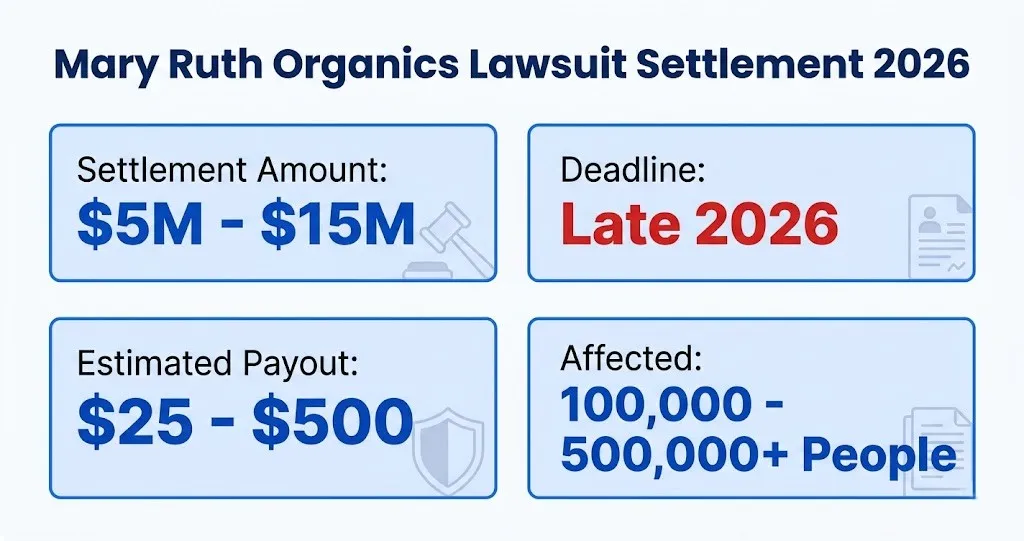
In comparable cases, supplement companies have settled for amounts ranging from $2 million to $15 million depending on the number of affected consumers and the severity of allegations. Given MaryRuth’s large customer base and the involvement of infant products, legal analysts expect any settlement to be on the higher end.
| Settlement Factor | Estimate |
|---|---|
| Potential Settlement Range | $5 million to $15 million |
| Number of Potential Claimants | 100,000 to 500,000+ |
| Expected Timeline for Approval | Late 2026 to mid-2027 |
| Distribution Method | Direct payment or product credits |
Settlement money typically comes from the company’s insurance, revenue, or a combination of both. A portion goes to attorney fees and court costs. The remainder is divided among qualifying class members.
Settlements in class action cases require court approval. A judge reviews the terms to make sure they are fair to all class members. After preliminary approval, consumers receive notice and can choose to participate or opt out.
Opting out means you give up your share of the class settlement. But it preserves your right to file an individual lawsuit. For most consumers, staying in the class is the simpler and more practical path.
Key Takeaway: While no settlement has been finalized, mediation is underway and legal analysts estimate a potential resolution of $5 million to $15 million, with payouts expected to begin in late 2026 or 2027.
Mary Ruth Organics Settlement Payout
Mary Ruth Organics settlement payout amounts will depend on several factors, including the total settlement fund, the number of valid claims, and the type of products purchased. Based on similar supplement class actions, individual payouts could range from $25 to $500.
The math is simple. Take the total settlement fund, subtract legal fees (usually 25% to 33%), and divide the rest among all valid claims. If 200,000 people file claims on a $10 million settlement, the per-person amount shrinks. If only 50,000 file, payouts rise.
Estimated payout scenarios:
| Scenario | Settlement Fund | Claimants | Est. Payout Per Person |
|---|---|---|---|
| Low Participation | $10 million | 50,000 | $130 to $150 |
| Medium Participation | $10 million | 150,000 | $45 to $65 |
| High Participation | $10 million | 300,000 | $20 to $30 |
Claimants with receipts or other proof of purchase typically receive higher payments. Some settlements create tiers: one amount for consumers with proof and a lower amount for those who submit claims without documentation.
If you bought MaryRuth products regularly over several years, your payout could be at the higher end. People who purchased a single bottle will likely receive less.
Keep every receipt you have. Check your email for order confirmations from Amazon, the MaryRuth website, or any retailer. Digital records count as proof of purchase in most class action settlements.
Mary Ruth Organics Lawsuit Eligibility
Mary Ruth Organics lawsuit eligibility is open to any U.S. consumer who purchased qualifying MaryRuth products during the class period. The proposed class period runs from 2019 to 2025, though this may be adjusted during litigation.
You likely qualify if you bought any of these products:
- MaryRuth’s Liquid Morning Multivitamin
- MaryRuth’s Liquid Nighttime Multimineral
- MaryRuth’s Organic Infant Liquid Vitamin D3 + K2 Drops
- MaryRuth’s Toddler Liquid Multivitamin
- MaryRuth’s Prenatal and Postnatal Liquid Vitamins
- Other liquid supplement products from the brand
You do not need to prove you were physically harmed. The class action covers economic harm, meaning you paid money for a product that was allegedly not what it claimed to be. That alone is enough to qualify.
| Eligibility Requirement | Details |
|---|---|
| Who Qualifies | U.S. consumers who bought MaryRuth products |
| Class Period | 2019 to 2025 (proposed) |
| Proof Needed | Receipts preferred but not always required |
| Physical Harm Required | No |
| Age Restriction | None (purchases for minors count) |
If you purchased MaryRuth supplements for your child, your claim is on your child’s behalf. Parents and guardians can file claims for minors.
There is no cost to join the class action. Class members never pay attorney fees out of pocket. Lawyers are paid from the settlement fund.
How to File a Claim Against Mary Ruth Organics
How to file a claim against Mary Ruth Organics depends on the current stage of the case. Since a settlement has not been finalized as of mid-2026, formal claims are not yet open. But you can take steps now to be ready.
Steps to prepare your claim today:
- Gather all purchase receipts (paper and digital)
- Save screenshots of email order confirmations from Amazon, Walmart, Target, or the MaryRuth website
- Keep any unused MaryRuth products with lot numbers visible
- Document the dates and quantities of your purchases
- Register with the class action administrator’s website (once available)
Once a settlement receives preliminary court approval, a claims process will open. You will receive notice by email, mail, or both. The notice will include instructions and a claim form.
Claim forms are usually simple. They ask for your name, address, products purchased, approximate dates, and any proof of purchase. Most forms can be completed online in under 10 minutes.
Quick Fact: In most class actions, the claims window stays open for 60 to 120 days after notice is sent. Missing the deadline means losing your share of the settlement. Set a calendar reminder once the window opens.
If you believe you or your child suffered physical harm from MaryRuth products, you may want to consult with an attorney about filing an individual lawsuit. Individual claims can yield higher compensation but require more evidence.
Key Takeaway: No formal claims process is open yet, but consumers should gather receipts and purchase records now to be ready when the settlement claims window opens, which is expected in late 2026 or early 2027.
Mary Ruth Organics Refund
Mary Ruth Organics refund options exist outside of the lawsuit through the company’s standard return policy. However, the class action settlement is expected to provide additional compensation beyond a simple product refund.
The company’s standard refund policy allows returns within 30 days of purchase for most products. After that window closes, your primary path to recovery is through the class action.
| Refund Option | Details |
|---|---|
| Company Return Policy | 30-day window from purchase |
| Class Action Payout | $25 to $500 estimated |
| Individual Lawsuit | Potentially higher, case-by-case |
| Credit Card Chargeback | Varies by card issuer, time limits apply |
Some consumers have reported success requesting refunds directly from MaryRuth’s customer service team by citing the lawsuit. Results vary. The company is not required to issue refunds outside its standard policy.
If you purchased through Amazon, you may have separate return protections through Amazon’s A-to-Z Guarantee. Check your order history for eligible return windows.
The class action settlement, once finalized, may offer either cash payments, product replacement credits, or a combination. Cash is always preferable for consumers, and plaintiffs’ attorneys typically push for cash-only distributions.
Don’t accept a store credit or product replacement if the settlement offers cash. You are under no obligation to continue purchasing from a brand you no longer trust.
Mary Ruth Organics FDA
Mary Ruth Organics FDA involvement has been limited, which is part of the problem. The FDA does not approve dietary supplements before they go to market. Supplements operate under a different regulatory framework than prescription drugs.
Under the Dietary Supplement Health and Education Act of 1994 (DSHEA), supplement companies are responsible for ensuring their own products are safe. The FDA can only take action after a product is already on shelves and shown to be dangerous.
How FDA oversight works for supplements:
- No pre-market approval required
- Companies self-certify safety and labeling accuracy
- FDA can issue warning letters for violations
- FDA can request voluntary recalls
- FDA can pursue enforcement actions for serious violations
As of mid-2026, the FDA has not issued a formal warning letter or recall notice specific to MaryRuth Organics related to heavy metal contamination. This does not mean the products are safe. It means the FDA has not yet acted.
Plaintiffs in the lawsuit argue that this regulatory gap is exactly why class actions are necessary. When the government does not act quickly enough, private lawsuits become the enforcement mechanism.
The FDA has been increasing scrutiny on the supplement industry overall. In 2025, the agency proposed new rules requiring third-party testing for heavy metals in supplements marketed to children. Those rules have not been finalized yet.
Mary Ruth Organics Complaints
Mary Ruth Organics complaints from consumers span product quality, customer service, and health concerns. Thousands of consumers have raised issues through the Better Business Bureau, Amazon reviews, and social media platforms.
Common complaint categories include:
- Strange taste or odor in liquid supplements
- Gastrointestinal issues after taking products
- Concerns about heavy metal content following media reports
- Difficulty obtaining refunds after the 30-day return window
- Inconsistent product quality between batches
The Better Business Bureau shows a pattern of consumer complaints filed against MaryRuth Organics since 2022. While the company responds to most complaints, consumer satisfaction with those responses varies significantly.
| Complaint Source | Volume (Est.) | Common Issue |
|---|---|---|
| Better Business Bureau | 100+ complaints | Product quality, refunds |
| Amazon Reviews (1-star) | 2,000+ reviews | Taste, side effects, safety concerns |
| Social Media | Thousands of posts | Heavy metal fears, brand trust |
| Court Filings | Multiple lawsuits | Contamination, false advertising |
Amazon reviews for MaryRuth products show a noticeable shift in sentiment after the lawsuit became public. Recent reviews frequently mention contamination concerns and link to news coverage of the legal action.
Consumer complaints serve as valuable evidence in class action cases. If you have a documented complaint, whether filed with a retailer, the BBB, or posted online, it could support the broader case.
Key Takeaway: Consumer complaints about MaryRuth Organics have surged since the lawsuit became public, with common issues including product quality concerns, difficulty getting refunds, and fears about heavy metal contamination in products given to children.
Mary Ruth Organics Product Recall
Mary Ruth Organics product recall has not been issued as of mid-2026. Despite the lawsuit allegations, the company has not voluntarily recalled any products, and the FDA has not mandated a recall.
This is not unusual for supplement companies facing lawsuits. Product recalls are typically triggered by one of two events: the company voluntarily pulls products, or the FDA forces a recall through enforcement action.
Why no recall has happened yet:
- FDA oversight of supplements is reactive, not proactive
- The company disputes the plaintiffs’ testing results
- Recall decisions often wait until litigation concludes
- No acute illness outbreak has been directly linked to specific products
The absence of a recall does not mean the products are safe. It means the legal and regulatory processes have not yet reached the point where a recall is triggered.
Consumers should not wait for a recall to take precautionary action. If you are concerned about any MaryRuth product, stop using it. Store it safely in case it is needed as evidence later.
| Recall Status | Details |
|---|---|
| Voluntary Recall | Not issued |
| FDA-Mandated Recall | Not issued |
| Company Position | Disputes contamination claims |
| Consumer Action | Precautionary discontinuation recommended |
In similar cases involving other supplement brands, recalls have sometimes come months or years after lawsuits were filed. The legal process often moves faster than the regulatory process.
Mary Ruth Organics Lawsuit Timeline
The Mary Ruth Organics lawsuit timeline spans from late 2023 through the present, with key developments occurring in each year. Here is a complete chronological breakdown.
| Date | Event |
|---|---|
| Late 2023 | First consumer complaints and initial lawsuit filings |
| Early 2024 | Additional class action complaints filed in multiple jurisdictions |
| Mid-2024 | Court consolidates related cases |
| Late 2024 | Discovery phase begins; document production ordered |
| Early 2025 | Independent lab testing results submitted |
| Mid-2025 | MaryRuth files motions to dismiss (partially denied) |
| Late 2025 | Class certification briefing begins |
| January 2026 | Discovery deadline extended by 90 days |
| March 2026 | Updated lab results filed as evidence |
| April 2026 | Mediation sessions scheduled |
| Summer 2026 | Settlement framework expected |
| Late 2026 to 2027 | Potential settlement approval and claims process |
The case has followed a typical trajectory for a consumer class action. Early filings lead to discovery, which leads to settlement talks. Trial remains possible but unlikely.
Most class actions in the supplement industry settle before reaching a jury. Trials are expensive and unpredictable for both sides. Companies prefer to resolve claims quietly. Plaintiffs prefer guaranteed compensation over the risk of losing at trial.
The next major milestone to watch is the outcome of mediation sessions in mid-2026. If mediation succeeds, a preliminary settlement agreement could come as early as fall 2026.
Key Takeaway: The Mary Ruth Organics lawsuit has been progressing steadily since 2023, with 2026 marking a critical year as mediation sessions and potential settlement discussions could lead to a resolution and the opening of a claims process for affected consumers.
Frequently Asked Questions
What is the Mary Ruth Organics lawsuit about?
The Mary Ruth Organics lawsuit alleges that the company’s supplements contain unsafe levels of heavy metals, including lead and arsenic.
Plaintiffs also claim the brand engaged in false advertising by marketing products as “pure” and “clean.”
The case includes products marketed to infants, children, and pregnant women.
How much money can I get from the Mary Ruth Organics settlement?
Individual payouts are estimated between $25 and $500 depending on products purchased and proof of purchase.
The total settlement fund could range from $5 million to $15 million.
Payments are expected to begin in late 2026 or early 2027.
Who qualifies for the Mary Ruth Organics class action?
Any U.S. consumer who purchased qualifying MaryRuth Organics products between 2019 and 2025 may qualify.
You do not need to prove physical harm.
Proof of purchase strengthens your claim but may not be strictly required.
Is there a deadline to file a Mary Ruth Organics claim?
No formal deadline exists yet because the settlement has not been finalized.
Once approved, the claims window will likely stay open for 60 to 120 days.
Watch for official notice by email or mail once the process begins.
Are Mary Ruth Organics products safe to use right now?
The safety of MaryRuth products is disputed and under active litigation.
No recall has been issued, but independent testing found heavy metals in several products.
Consumers concerned about risk should discontinue use and talk to a healthcare provider, especially for children’s products.
This lawsuit is far from over, but 2026 could be the turning point. Settlement talks are active, and the claims process may open before the end of the year.
Start gathering your receipts and purchase records today. If you bought MaryRuth products for your family, stay alert for official class action notices.
Your next step is simple: save your proof of purchase and watch for updates. The window to file a claim won’t stay open forever.
