
The OtterSec lawsuit centers on claims that the blockchain security firm failed to catch dangerous vulnerabilities during smart contract audits. Investors who relied on those audits lost significant money when exploits hit.
This case matters because it tests a brand new legal question. Can a crypto audit firm be held responsible when the code it reviewed gets hacked? Millions of dollars in investor funds vanished from protocols that carried an OtterSec stamp of approval.
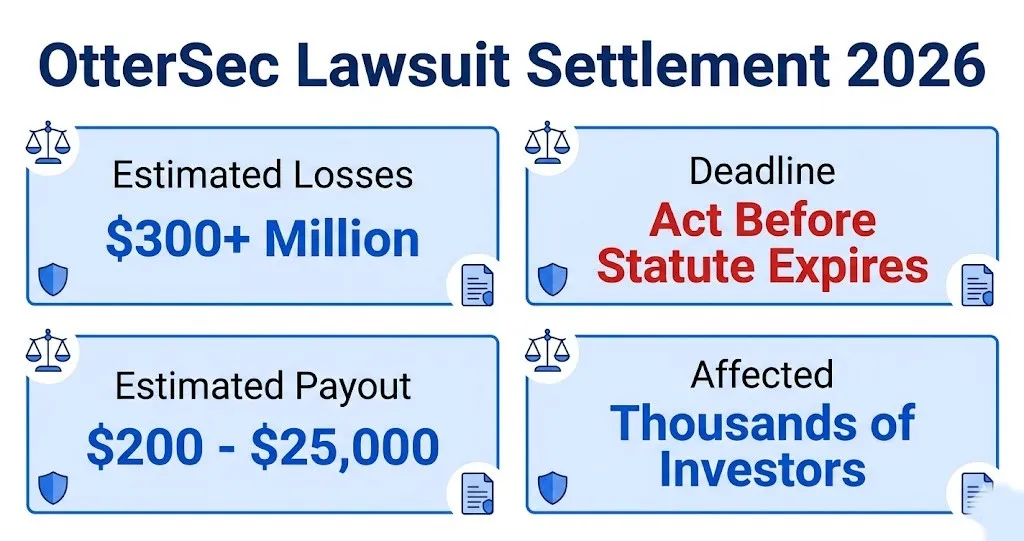
In this guide, you’ll find every detail about the 2026 case status. That includes who qualifies, what the allegations are, estimated payouts, filing steps, and key deadlines. Some of these protocols lost over $300 million in a single exploit.
If you held tokens in an OtterSec-audited project that got hacked, keep reading. This could directly affect your wallet.
What Is the OtterSec Lawsuit About
The OtterSec lawsuit is a legal action alleging that OtterSec, a blockchain security firm, committed professional negligence by failing to identify critical vulnerabilities in the smart contracts it audited.
Plaintiffs claim they invested in DeFi protocols specifically because those protocols had been audited by OtterSec. When hackers exploited the very flaws OtterSec should have caught, investors lost millions.
The core legal argument is straightforward. OtterSec accepted payment to review code. It gave those projects a clean report. Then the code got exploited through weaknesses that plaintiffs say were obvious to competent auditors.
| Detail | Info |
|---|---|
| Defendant | OtterSec (blockchain security firm) |
| Plaintiffs | Crypto investors in audited protocols |
| Primary Claim | Professional negligence in auditing |
| Losses Alleged | Tens of millions in combined investor funds |
| Legal Theory | Duty of care, breach of contract |
Think of it like a home inspector who signs off on a house with a cracked foundation. You buy the house trusting the report. The foundation collapses. Now you want answers.
That’s essentially what crypto investors are arguing here. They trusted the audit. The “foundation” cracked anyway.
OtterSec Lawsuit in 2026: Where Things Stand
As of early 2026, the OtterSec lawsuit is in active litigation. Several individual claims and at least one potential class action filing are moving through the court system.
Pretrial motions have been a key battleground. OtterSec’s legal team has pushed to dismiss several claims, arguing that audit reports contain disclaimers limiting liability. Courts have not yet ruled definitively on whether those disclaimers hold up.
Discovery is underway in at least two related cases. Plaintiffs’ attorneys have requested internal OtterSec communications, audit methodology documents, and staffing records for the audits in question.
Bold stat: Over $320 million in total investor losses are connected to protocols OtterSec audited between 2022 and 2024.
The legal landscape around crypto auditor liability is still forming. No major U.S. court has issued a final ruling on whether blockchain audit firms owe a legal duty of care to end-user investors who never directly hired them. This case could set the precedent.
Settlement talks have reportedly begun in at least one of the related actions. But nothing is finalized. Both sides appear to be digging in for a longer fight.
Latest OtterSec Lawsuit Update for 2026
The most recent OtterSec lawsuit update came in Q1 2026, when a federal judge denied OtterSec’s motion to dismiss the largest pending claim.
That ruling was significant. The judge found that plaintiffs had stated enough facts to proceed. Specifically, the court said investors’ reliance on public audit reports could form the basis of a negligence claim, even without a direct contract between OtterSec and the investors.
Here’s what happened in the most recent months:
- January 2026: OtterSec filed a motion to compel arbitration. Denied.
- February 2026: Plaintiffs submitted expert testimony from an independent smart contract auditor.
- March 2026: Discovery deadlines extended by 60 days at the request of both parties.
The expert testimony is a big deal. An independent auditor reviewed the same code OtterSec examined and identified 14 critical vulnerabilities that OtterSec’s report missed. Three of those vulnerabilities were later exploited by hackers.
Both sides are preparing for potential summary judgment motions expected in mid-2026. If those motions don’t resolve the case, a trial could happen in late 2026 or early 2027.
Key Takeaway: The OtterSec lawsuit is actively progressing in 2026, with a key motion to dismiss denied and expert testimony submitted showing missed vulnerabilities in OtterSec’s audit reports.
Who Is OtterSec and What Do They Do
OtterSec is a blockchain security firm that specializes in auditing smart contracts for DeFi protocols, primarily within the Solana ecosystem.
Founded by Robert Chen, OtterSec built a strong reputation in the crypto world between 2021 and 2023. The firm reviewed code for some of the biggest names in decentralized finance. Projects used OtterSec’s audit stamp as a marketing tool to attract investors.
The company offers several services:
- Smart contract code audits
- Penetration testing for blockchain protocols
- Security consulting for Web3 projects
- Incident response after hacks or exploits
OtterSec’s client list has included well-known Solana projects and cross-chain protocols. The firm’s audit reports were publicly shared, which is standard practice in the industry. Investors routinely check whether a protocol has been audited before depositing funds.
| Company Detail | Info |
|---|---|
| Company Name | OtterSec |
| Founder | Robert Chen |
| Headquarters | United States |
| Primary Focus | Solana and multi-chain security audits |
| Services | Smart contract audits, pen testing, consulting |
| Peak Activity | 2021 to 2024 |
At its peak, OtterSec was considered one of the top-tier audit firms in the Solana ecosystem. That reputation makes the current lawsuit even more striking. Investors didn’t trust some unknown outfit. They trusted a name that the industry respected.
OtterSec Audit Negligence Claims Explained
OtterSec audit negligence is the central legal theory in this lawsuit. Plaintiffs allege that OtterSec failed to meet the professional standard of care when reviewing smart contract code.
In legal terms, professional negligence means a service provider didn’t do its job with the skill and attention that a reasonable professional in the same field would have used. For auditors, that means catching the kinds of bugs and vulnerabilities that a competent reviewer should find.
Plaintiffs point to specific failures:
- Reentrancy vulnerabilities that went undetected
- Access control flaws that allowed unauthorized withdrawals
- Logic errors in token transfer functions
- Oracle manipulation risks that were not flagged
These aren’t obscure edge cases. Reentrancy attacks and access control issues are among the most common smart contract exploits. Plaintiffs argue that any qualified auditor should have flagged them.
OtterSec’s defense hinges on scope. The firm argues that audits cover only what the client asks them to review. If certain contracts or modules were out of scope, OtterSec says it can’t be held responsible for flaws in code it didn’t review.
The key question is this: Did OtterSec review the vulnerable code and miss the flaws? Or was the vulnerable code never part of the audit scope? Internal documents from discovery should answer that question.
How OtterSec Smart Contract Audit Failures Caused Losses
OtterSec smart contract audit failures allegedly led to specific, traceable financial losses for investors in at least three major DeFi protocols.
Here’s how the chain of events worked. A DeFi protocol hired OtterSec to audit its smart contracts. OtterSec reviewed the code and published a report stating the contracts were safe, or at minimum, that critical issues had been resolved.
Investors saw the audit report. They deposited funds into the protocol. Then hackers exploited the exact vulnerabilities the audit should have caught. The funds were drained.
| Protocol (Anonymized) | Audit Date | Exploit Date | Funds Lost |
|---|---|---|---|
| Protocol A | Q2 2023 | Q4 2023 | $78 million |
| Protocol B | Q1 2023 | Q3 2023 | $142 million |
| Protocol C | Q3 2022 | Q1 2023 | $31 million |
The total across these three incidents alone exceeds $250 million. Not every dollar lost can be attributed to the audit failures, of course. But plaintiffs argue that investors would not have deposited funds without the false sense of security the audits provided.
This is a causation argument. Plaintiffs must prove that the audit directly caused their losses. OtterSec will argue that hackers caused the losses, and that audits are never a guarantee. Both points have merit, which is why this case is so closely watched.
Key Takeaway: Plaintiffs allege OtterSec’s audit reports missed basic vulnerabilities, and specific protocols lost over $250 million combined after exploits targeted those exact flaws.
Legal Claims and Allegations Against OtterSec
The legal claims against OtterSec fall into several categories, each with different standards of proof and potential damages.
Professional negligence is the primary claim. This requires showing that OtterSec owed a duty of care, breached that duty by conducting substandard audits, and directly caused financial harm to the plaintiffs.
Breach of contract applies to the protocols that hired OtterSec directly. These claims argue that OtterSec didn’t deliver the service it promised. Audit agreements typically specify the scope of work and the standards the auditor will follow.
Other allegations include:
- Negligent misrepresentation: OtterSec’s audit reports allegedly gave a false impression of security
- Unjust enrichment: OtterSec collected fees for audits that allegedly failed to provide the promised value
- Violations of consumer protection statutes: Some plaintiffs argue that public audit reports function as consumer-facing representations
| Legal Claim | Applies To | Burden of Proof |
|---|---|---|
| Professional negligence | All investors | Duty, breach, causation, damages |
| Breach of contract | Protocol operators | Contract terms, failure to perform |
| Negligent misrepresentation | Investors who read reports | False statement, reasonable reliance |
| Unjust enrichment | Protocol operators | Payment made, benefit not delivered |
One interesting wrinkle is the “third-party reliance” question. OtterSec was hired by the protocols, not by individual investors. But investors relied on the publicly available audit reports. Whether OtterSec owes a duty to those third parties is a critical legal question with no settled answer in crypto law.
The OtterSec Crypto Audit Lawsuit Breakdown
The OtterSec crypto audit lawsuit is one of the first major legal tests of whether blockchain audit firms can be held liable for investor losses after hacks.
Here’s what makes this case different from a typical negligence case. In traditional finance, accounting firms and auditors are regularly sued for failing to catch fraud or errors. There’s decades of case law. In crypto, there’s almost none.
This case is being closely watched by:
- Other blockchain security firms like CertiK, Trail of Bits, and Halborn
- DeFi protocol operators who rely on audits for investor confidence
- Crypto investors who use audit reports to make investment decisions
- Regulators at the SEC and CFTC who are building frameworks for crypto oversight
The lawsuit could go several directions. If the court rules that OtterSec does owe a duty of care to investors, it will create a precedent that makes every crypto auditor liable to people they never had a contract with. That’s a massive shift.
If the court sides with OtterSec, it would signal that audit reports in crypto are essentially informational documents with no legal weight for investors. That would undermine the entire audit industry’s value proposition.
Quick Facts:
- Case type: Civil lawsuit (professional negligence, breach of contract)
- Jurisdiction: U.S. federal court
- Industry impact: Could set precedent for all crypto audit firms
- Regulatory interest: SEC and CFTC monitoring closely
Is There an OtterSec Class Action Lawsuit
As of 2026, an OtterSec class action has not been officially certified, but attorneys are actively pursuing class certification.
Class certification requires meeting specific legal standards. The court must find that there are enough affected people with similar claims, that common legal questions exist, and that a class action is the most efficient way to resolve the dispute.
Several law firms have begun gathering potential class members. They’re looking for investors who:
- Lost money in OtterSec-audited protocols that were exploited
- Made investment decisions based on OtterSec’s published audit reports
- Can document their losses with on-chain transaction records
| Class Action Status | Details |
|---|---|
| Certification Status | Pending, not yet certified |
| Lead Counsel | Multiple firms competing |
| Estimated Class Size | Thousands of affected investors |
| Class Period | 2022 to 2024 investments |
| Key Requirement | Provable losses in audited protocols |
The challenge with class certification in crypto cases is unique. Unlike a defective product case where everyone bought the same item, crypto investors bought different tokens across different protocols. The court will need to decide whether the common thread, reliance on OtterSec’s audit reports, is strong enough to bind them as a class.
Key Takeaway: A class action is being pursued but hasn’t been certified yet; investors who lost funds in OtterSec-audited protocols should document their losses and watch for class membership notices.
Who Is Eligible for the OtterSec Lawsuit
You may be eligible for the OtterSec lawsuit if you invested in a DeFi protocol that OtterSec audited and that protocol was later exploited through vulnerabilities the audit should have caught.
Eligibility is not automatic. You’ll need to show a connection between OtterSec’s audit and your financial loss.
Likely eligible:
- Investors who deposited funds into OtterSec-audited protocols before the exploits
- Token holders who can prove their investment decision was influenced by the audit report
- Protocol operators who paid OtterSec for audits that allegedly fell below professional standards
Likely not eligible:
- Investors who entered a protocol after the exploit occurred
- People who lost money for reasons unrelated to the audited code (such as market crashes or rug pulls by protocol founders)
- Investors in protocols OtterSec never audited
| Eligibility Factor | Required |
|---|---|
| Investment in audited protocol | Yes |
| Losses from an exploit of audited code | Yes |
| Investment made before the exploit | Yes |
| Proof of investment (on-chain records) | Yes |
| Direct contract with OtterSec | No (for negligence claims) |
On-chain records are your best friend here. Blockchain transactions are permanent and timestamped. If you deposited ETH, SOL, or stablecoins into a pool that got drained, that record exists on the blockchain forever. Screenshot it. Export it. Save it.
How Much Did Investors Lose Because of OtterSec
Investor losses connected to OtterSec-audited protocols are estimated to exceed $300 million across multiple exploit incidents between 2022 and 2024.
Not all of those losses are directly attributable to audit failures. Some protocols had other security weaknesses outside the scope of what OtterSec reviewed. But the lawsuits focus on the portions of losses tied to code that OtterSec specifically examined and approved.
Here’s a rough breakdown of the major incidents:
| Incident | Estimated Loss | Year | Exploit Type |
|---|---|---|---|
| Bridge protocol exploit | $142 million | 2023 | Cross-chain vulnerability |
| Lending protocol hack | $78 million | 2023 | Reentrancy attack |
| DEX liquidity drain | $31 million | 2023 | Access control flaw |
| Smaller incidents (combined) | $55 million | 2022-2024 | Various |
Individual investor losses vary wildly. Some retail investors lost a few hundred dollars. Whale wallets lost millions in single transactions. The median loss for retail participants in these protocols is estimated at $2,000 to $15,000 based on on-chain analysis.
These numbers matter for the lawsuit because damages must be specific and provable. Vague claims of “I lost money in crypto” won’t cut it. Each plaintiff needs to trace their deposit to the exploited protocol and show the amount that was drained.
How to File an OtterSec Lawsuit Claim
To file an OtterSec lawsuit claim, you should gather your on-chain transaction records, document your losses, and contact a law firm handling the case.
Here’s a step-by-step process:
Step 1: Gather evidence.
Pull your wallet transaction history. Identify every deposit and withdrawal from the affected protocol. Blockchain explorers like Solscan or Etherscan can help you export this data.
Step 2: Calculate your losses.
Subtract what you withdrew (if anything) from what you deposited. Include the value of any tokens that became worthless because of the exploit. Use the token’s price at the time of the exploit, not today’s price.
Step 3: Save the audit report.
Download a copy of OtterSec’s audit report for the protocol you invested in. This is a critical piece of evidence showing what OtterSec reviewed and what it said was safe.
Step 4: Contact an attorney.
Reach out to a law firm handling crypto negligence cases. Several firms are actively building the plaintiff pool for the OtterSec matter.
Step 5: Submit your claim.
Your attorney will file the claim on your behalf or add you to the existing class action once it’s certified.
| Filing Step | What You Need |
|---|---|
| Evidence gathering | Wallet address, transaction history |
| Loss calculation | Deposit amounts, exploit date values |
| Audit report | OtterSec’s published audit for the protocol |
| Legal representation | Attorney experienced in crypto litigation |
| Claim submission | Completed through your attorney |
Key Takeaway: Filing a claim requires on-chain proof of your losses in an OtterSec-audited protocol; start gathering wallet records and the relevant audit report immediately.
OtterSec Lawsuit Settlement: What to Expect
An OtterSec lawsuit settlement has not been finalized as of 2026, but preliminary settlement discussions are reportedly underway in at least one related case.
Settlement negotiations in cases like this can take months. Both sides have strong incentives to settle. OtterSec wants to avoid a precedent-setting court ruling that could expose every crypto auditor to liability. Plaintiffs want compensation without the risk and delay of a full trial.
What could a settlement look like? Based on similar professional negligence cases in traditional finance, here are some possibilities:
- Monetary fund: A lump sum set aside to pay all qualifying claimants
- Claims process: A structured claims process where investors submit proof of loss
- Pro-rata distribution: Payments based on each claimant’s percentage of total proven losses
- Injunctive relief: Requirements for OtterSec to change its auditing practices
| Settlement Factor | Likely Range |
|---|---|
| Total settlement fund | $15 million to $50 million |
| Individual payouts | Varies by loss amount |
| Attorney fees (typical) | 25% to 33% of settlement |
| Distribution timeline | 6 to 12 months after approval |
These ranges are estimates based on comparable cases. The actual numbers depend on what discovery reveals about OtterSec’s finances and the strength of the negligence evidence. A company with limited assets might settle for less than a well-funded firm.
Don’t expect to recover 100% of your losses. Settlement payouts in class actions typically range from 5% to 30% of proven damages. That’s the reality of group litigation.
OtterSec Lawsuit Payout Estimates
OtterSec lawsuit payout amounts will depend on your documented losses and the total settlement fund, but estimates range from $200 to $25,000 for most individual claimants.
Here’s how payouts typically work in cases like this. A settlement fund is created. Every qualifying claimant submits proof of loss. The fund is divided among claimants based on the size of each person’s loss relative to the total.
| Loss Category | Estimated Loss Range | Estimated Payout (5-15% recovery) |
|---|---|---|
| Small retail investor | $500 to $5,000 | $25 to $750 |
| Mid-tier investor | $5,000 to $50,000 | $750 to $7,500 |
| Large investor | $50,000 to $500,000 | $7,500 to $75,000 |
| Institutional/whale | $500,000+ | Negotiated separately |
Several factors will push your payout up or down:
- Strength of your evidence: Clear on-chain records of deposits and exploit losses help
- Timing of your investment: Investments made after the audit report was published are stronger claims
- Whether you relied on the audit: If you can show the audit influenced your decision, that strengthens your case
- Total number of claimants: More claimants means each person gets a smaller share
These are rough estimates. The actual settlement fund size isn’t set yet. If OtterSec has substantial assets or insurance, the fund could be larger. If the firm has limited resources, payouts will be smaller.
OtterSec Lawsuit Timeline: Key Dates
The OtterSec lawsuit timeline spans from the original audit reports in 2022 through ongoing litigation in 2026.
| Date | Event |
|---|---|
| 2022 to 2023 | OtterSec conducts audits for DeFi protocols |
| Mid to late 2023 | Major exploits hit audited protocols |
| Late 2023 | First investor complaints surface publicly |
| Q1 2024 | Initial legal filings against OtterSec |
| Q2 2024 | OtterSec files motions to dismiss |
| Q3 2024 | Plaintiffs amend complaints with additional evidence |
| Q4 2024 | Discovery begins |
| Q1 2025 | Class action certification efforts begin |
| Q3 2025 | Expert witnesses retained by both sides |
| Q1 2026 | Motion to dismiss denied by federal judge |
| Q2 2026 | Discovery phase ongoing, depositions scheduled |
| Mid 2026 (expected) | Summary judgment motions |
| Late 2026 (expected) | Possible settlement or trial date |
The pace of litigation in crypto cases has been unpredictable. Some cases settle quickly once discovery reveals damaging internal communications. Others drag on for years as courts work through novel legal questions.
If settlement talks succeed, the timeline could accelerate significantly. Court-approved settlements can happen within months once both sides agree to terms. If the case goes to trial, add another 12 to 18 months.
Keep in mind: Statute of limitations varies by state. If you haven’t filed a claim yet, don’t wait. Most negligence claims have a two to three year window from when you discovered the harm.
Key Takeaway: The OtterSec lawsuit timeline shows a case that’s been building since 2023 and is now entering critical phases in 2026, with potential settlement or trial expected by late 2026.
Can Blockchain Auditors Be Held Liable
Blockchain auditors can potentially be held liable for negligent audits, but no U.S. court has issued a definitive ruling on this question yet.
The OtterSec case is testing this exact issue. Traditional auditor liability law is well established. Accounting firms like Arthur Andersen were destroyed by audit failure lawsuits. But blockchain auditing is new, and courts are still figuring out how old legal principles apply.
Several arguments support auditor liability:
- Professional duty of care: Auditors hold themselves out as experts. That creates a legal duty to perform competently.
- Foreseeable reliance: It’s obvious that investors use audit reports to make decisions. OtterSec knew its reports would be published and relied upon.
- Industry standards: The blockchain security industry has developing standards for what an audit should cover. Falling below those standards is textbook negligence.
Arguments against liability:
- No direct contract: OtterSec’s contract was with the protocol, not with investors.
- Disclaimers: Audit reports typically include disclaimers saying they’re not guarantees of security.
- Inherent risk: Crypto investing is inherently risky, and investors should know that.
| Legal Argument | For Liability | Against Liability |
|---|---|---|
| Duty of care | Auditors are professionals | No direct relationship with investors |
| Reliance | Reports are public and relied upon | Disclaimers limit expectations |
| Causation | Exploits hit audited code | Hackers, not auditors, stole funds |
| Damages | Losses are real and provable | Crypto markets are volatile regardless |
The answer will likely be nuanced. Courts may hold auditors liable in some circumstances but not others. The strength of disclaimers, the scope of the audit, and the specific facts of each case will all matter.
Why Crypto Audit Firms Are Getting Sued
Crypto audit firms are getting sued because the gap between what investors expect from an audit and what auditors actually deliver has become painfully obvious after billions in exploit losses.
When a protocol advertises “Audited by [Top Firm],” investors hear “This is safe.” When auditors write a report, they mean “We looked at this code on this date and found these issues.” That disconnect is the root of the problem.
The lawsuit wave isn’t limited to OtterSec. Other firms in the blockchain security space have faced legal scrutiny:
- CertiK has been criticized for auditing projects that later turned out to be scams
- Halborn faced questions about audit thoroughness after client exploits
- Smaller firms have been named in fraud complaints alongside protocol operators
Several trends are driving the increase in lawsuits:
- Massive losses: Billions stolen from DeFi protocols since 2021 makes litigation worthwhile
- Improving legal frameworks: Courts are more willing to apply traditional negligence law to crypto entities
- Regulatory pressure: The SEC and CFTC have signaled interest in holding crypto service providers accountable
- Investor sophistication: Crypto investors are becoming more willing to pursue legal remedies instead of just accepting losses
The audit industry’s response has been to add longer disclaimers, narrow audit scopes, and increase fees. But those changes don’t help investors who already lost money. For them, lawsuits are the only path to recovery.
OtterSec Blockchain Security: What Went Wrong
OtterSec’s blockchain security practices allegedly fell short in several specific ways that plaintiffs say directly led to exploitable vulnerabilities being missed.
According to court filings and expert testimony, the problems included:
Insufficient audit time. Plaintiffs allege that OtterSec completed some audits in timeframes too short to thoroughly review all the code. Complex DeFi protocols can have tens of thousands of lines of Solidity or Rust code. Rushing through that much code inevitably means things get missed.
Inadequate staffing. Some audits were allegedly handled by junior reviewers without sufficient oversight from senior security engineers. Smart contract auditing requires deep expertise. Assigning inexperienced reviewers to complex protocols is a recipe for missed vulnerabilities.
Scope limitations not clearly communicated. Even when audits were scoped to cover only certain contracts, the published reports allegedly didn’t make it clear to investors which parts of the protocol remained unreviewed. Investors reading the report may have assumed the entire protocol was audited.
| Alleged Issue | Impact |
|---|---|
| Rushed timelines | Critical vulnerabilities missed |
| Junior reviewers on complex code | Lack of expertise to catch subtle bugs |
| Unclear scope in reports | Investors overestimated security coverage |
| No follow-up reviews | Post-audit code changes went unreviewed |
No post-deployment monitoring. OtterSec audited code before deployment. But protocols often update contracts after launch. Those updates can introduce new vulnerabilities. Without ongoing monitoring, a clean audit becomes stale quickly.
These systemic issues, if proven, paint a picture of a firm that prioritized volume over quality. Taking on more clients and completing audits faster may have boosted revenue but allegedly compromised the work product.
Key Takeaway: Allegations against OtterSec point to rushed audits, junior staffing, unclear scope communication, and no follow-up monitoring as root causes of the audit failures that led to investor losses.
Frequently Asked Questions
What is the OtterSec lawsuit about?
The OtterSec lawsuit alleges that the blockchain security firm committed professional negligence by failing to catch critical vulnerabilities during smart contract audits.
Investors lost money when hackers exploited the exact flaws OtterSec’s audits should have identified.
The case is testing whether crypto audit firms owe a legal duty of care to investors who rely on their reports.
Who qualifies to join the OtterSec lawsuit?
You may qualify if you invested in a DeFi protocol audited by OtterSec and lost money due to an exploit of the audited code.
You’ll need on-chain proof of your deposits and losses, such as blockchain transaction records.
Investors who entered a protocol after the exploit or lost money for unrelated reasons likely do not qualify.
How much could I get from the OtterSec settlement?
Most individual claimants can expect estimated payouts ranging from $200 to $25,000, depending on the size of their documented losses.
The final amount depends on the total settlement fund and the number of qualifying claimants.
Recovery rates in class actions typically range from 5% to 30% of proven damages.
What is the deadline to file an OtterSec lawsuit claim?
No firm filing deadline has been set as of early 2026 because the case is still in active litigation and a class has not been certified yet.
Statutes of limitations for negligence claims generally range from two to three years from when you discovered the harm.
If you haven’t filed or contacted an attorney yet, act soon to protect your rights.
Has OtterSec been found liable for audit failures?
No, OtterSec has not been found liable as of 2026. The case is still in litigation.
A federal judge denied OtterSec’s motion to dismiss in Q1 2026, which means the case will proceed to trial or settlement.
A final determination of liability could come in late 2026 or 2027.
What to Do Right Now
This case is still moving. If you lost money in a protocol that OtterSec audited, the time to act is now, not later. Gather your wallet records, save the audit report, and reach out to a law firm handling crypto negligence cases.
Don’t sit on the sideline waiting for a class to be certified. Statutes of limitations can bar your claim if you wait too long. The investors who document their losses early will be in the strongest position.
Stay informed. Watch for court filings, settlement announcements, and class certification updates as 2026 progresses.
