
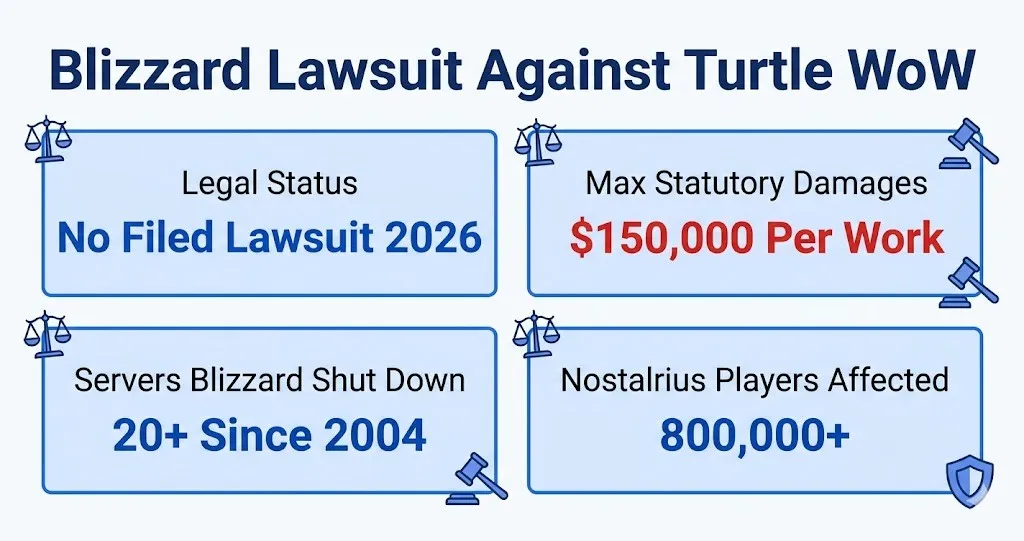
As of 2026, no confirmed filed lawsuit exists in U.S. courts specifically naming Turtle WoW as a defendant in an active Blizzard lawsuit. That said, Blizzard Entertainment has a long, well-documented history of using copyright law, DMCA notices, and cease and desist letters to shut down private World of Warcraft servers.
This article covers everything players need to understand. You’ll learn the legal tools Blizzard has, what makes Turtle WoW different from past targets, and what real legal risk looks like for operators versus players.
One fact that surprises most people: Blizzard has never lost a major copyright case against a private WoW server in U.S. court. The servers always shut down first.
That track record matters a lot right now.
What Is the Blizzard Lawsuit Against Turtle WoW?
The “Blizzard lawsuit against Turtle WoW” refers to the ongoing legal tension between Blizzard Entertainment and the Turtle WoW private server, not necessarily a filed court complaint.
As of early 2026, Turtle WoW has not been named in a publicly filed federal lawsuit by Blizzard Entertainment. However, Blizzard’s legal team has historically used a multi-step approach before any courtroom filing. That process starts with monitoring, then DMCA notices, then cease and desist letters, and only rarely escalates to full litigation.
Turtle WoW operates as a fan-made private server running a modified version of World of Warcraft’s 1.16 client. It offers custom content, quests, and races not found in official WoW. That custom layer is the key factor in any legal analysis.
| Detail | Info |
|---|---|
| Server Name | Turtle WoW |
| WoW Version Used | 1.16 (Vanilla-era client, modified) |
| Operator Location | Publicly unlisted |
| Blizzard Lawsuit Filed (2026) | No confirmed federal filing |
| Legal Status | Legally ambiguous; potential IP infringement |
Blizzard holds registered copyrights across World of Warcraft’s client software, artwork, music, and lore under U.S. copyright law (17 U.S.C. Section 106). Any server using that client without a license is operating in legally dangerous territory.
Is There an Active Turtle WoW Lawsuit in 2026?
No active, publicly docketed lawsuit specifically names Turtle WoW as a defendant in U.S. federal court as of 2026.
That distinction matters. “Lawsuit” and “legal threat” are not the same thing. Blizzard sends far more cease and desist letters than it files lawsuits. Court filings are expensive, public, and slow. Letters and DMCA notices are faster and often more effective.
Turtle WoW has been running since approximately 2018. Its longevity does not mean Blizzard has given it a pass. It may simply mean Turtle WoW has not yet crossed a threshold that triggers formal litigation.
- Blizzard has shut down dozens of servers without filing a single lawsuit
- Cease and desist compliance is nearly universal among private server operators
- Public attention often accelerates Blizzard’s legal response timeline
Key fact for 2026: Blizzard, now operating under Microsoft’s ownership since the 2023 acquisition closed, has shifted some enforcement priorities. However, core intellectual property protection remains a legal obligation for copyright holders.
Is Turtle WoW Legal?
Turtle WoW is not legal under strict U.S. copyright law, but its situation is more complicated than a simple yes or no.
The server uses World of Warcraft’s game client files. Those files are owned by Blizzard. Distributing or enabling access to them without a license violates Blizzard’s copyright. That’s the core legal problem.
Think of it like this: if someone built a theme park using Disney’s characters without permission, “we made our own rides” doesn’t eliminate the copyright issue. The underlying characters are still protected.
Turtle WoW’s custom content adds original material, but it runs on top of Blizzard’s copyrighted engine and game files. The custom layer doesn’t wipe out the underlying infringement.
| Legal Question | Answer |
|---|---|
| Does Turtle WoW use Blizzard’s copyrighted client? | Yes |
| Does Blizzard license private servers? | No |
| Is operating the server legal? | No, under 17 U.S.C. Section 106 |
| Is playing on the server illegal for users? | Extremely low legal risk for players |
Key Takeaway: No confirmed federal lawsuit names Turtle WoW in 2026, but the server operates outside the bounds of U.S. copyright law by using Blizzard’s protected game client without a license.
Can Blizzard Sue Turtle WoW?
Yes, Blizzard can sue Turtle WoW’s operators, and has strong legal standing to do so under multiple federal statutes.
The legal basis includes copyright infringement under 17 U.S.C. Section 106, violation of the Digital Millennium Copyright Act’s anti-circumvention provisions under 17 U.S.C. Section 1201, and breach of Blizzard’s End User License Agreement.
Blizzard proved it can win these cases. In MDY Industries v. Blizzard Entertainment (decided by the Ninth Circuit in 2010), the court affirmed Blizzard’s broad rights over how WoW’s game files are accessed and used. That precedent still stands in 2026.
The bigger question isn’t whether Blizzard can sue. It’s whether Blizzard chooses to sue versus using faster, cheaper legal tools.
- Copyright claim: Distribution and execution of WoW client files
- DMCA Section 1201: Circumventing technological protection measures on game files
- EULA breach: Every user agreed not to use the client on unauthorized servers
Statutory damages for copyright infringement can reach $150,000 per work infringed when willfulness is proven. For a game with thousands of protected assets, that exposure is enormous.
Blizzard vs. Private WoW Server History
Blizzard’s history of legal action against private WoW servers stretches back to the early 2000s.
The most famous case is Nostalrius, a vanilla WoW private server that reached over 800,000 registered players before Blizzard sent a cease and desist in April 2016. Nostalrius shut down within weeks. No lawsuit was filed because none was needed.
Blizzard also pursued legal action in Blizzard Entertainment v. Bnetd (2005), where the Eighth Circuit upheld the enforceability of Blizzard’s EULA against reverse-engineered server software. That case set an important precedent for all private server operators.
| Server | Action Taken | Year | Outcome |
|---|---|---|---|
| Bnetd | Federal lawsuit | 2002 | Blizzard won |
| Nostalrius | Cease and desist | 2016 | Server shut down |
| Elysium | Community pressure + C&D | 2017 | Server shut down |
| Lights Hope | DMCA + community | 2018 | Merged and scaled back |
| Felmyst | C&D | 2018 | Shut down in hours |
The pattern is clear. Blizzard rarely needs a courtroom to win. The threat of one is usually enough.
Blizzard Copyright Lawsuit WoW: The Legal Framework
Blizzard’s copyright claims against private servers rest on federal law, specifically the Copyright Act of 1976 as codified in Title 17 of the U.S. Code.
Section 106 gives Blizzard the exclusive right to reproduce, distribute, and create derivative works from World of Warcraft. A private server does all three: it copies the game files, distributes access to them, and creates a derivative game environment.
Section 1201 of the DMCA adds another layer. WoW’s game files include technological protection measures. Circumventing them, which private server emulators inherently do, is a separate federal violation independent of the copyright claim.
Key statutory damages for willful copyright infringement: up to $150,000 per work. With WoW containing thousands of separately copyrightable assets (character models, music tracks, zone designs), theoretical damages could reach into the hundreds of millions.
- Reproduction right (Section 106(1)): Copying client files to the server
- Distribution right (Section 106(3)): Giving players access to those files
- Derivative works right (Section 106(2)): Building a modified game on top of Blizzard’s code
That’s a strong legal hand. Private server operators rarely contest it in court.
Key Takeaway: Blizzard’s legal history shows a near-perfect record against private servers, with copyright law, the DMCA, and binding EULA terms giving Blizzard three separate legal weapons it can deploy without even going to trial.
Blizzard DMCA Private Server: How Takedowns Work
A Blizzard DMCA notice is often the first formal legal step the company takes against a private server.
Under the Digital Millennium Copyright Act (17 U.S.C. Sections 512 and 1201), Blizzard can send takedown notices to hosting providers, domain registrars, and internet service providers. Those third parties are legally required to act on valid DMCA notices or risk losing their own liability protections.
This means Blizzard doesn’t even need to contact the server operators directly. It can go around them and cut off the hosting infrastructure.
For Turtle WoW specifically, its hosting situation matters enormously. If it uses a U.S.-based host or a host in a country with strong DMCA equivalents, a notice from Blizzard’s legal team could take the server offline within 24 to 72 hours.
| DMCA Tool | Target | Effect |
|---|---|---|
| Section 512 notice | Hosting provider | Server files taken down |
| Section 1201 claim | Server operator | Anti-circumvention violation |
| Domain takedown request | Registrar | Website goes dark |
| Cease and desist letter | Operator directly | Legal pressure to self-shutdown |
Blizzard has a dedicated legal team and outside counsel that handles these filings regularly. The process is efficient and well-practiced.
Turtle WoW Cease and Desist: What Would It Look Like?
A cease and desist letter to Turtle WoW would demand immediate shutdown of all server operations and cessation of any distribution of Blizzard’s copyrighted materials.
These letters are not lawsuits. They carry no court authority. But they signal that Blizzard’s legal team has identified the server and is prepared to escalate to federal litigation if the demand is ignored.
In Blizzard’s past enforcement actions, cease and desist letters typically include:
- A list of specific copyrighted works being infringed
- A demand to destroy all copies of Blizzard’s files from the operator’s servers
- A deadline (usually 10 to 30 days) to comply
- A statement that continued operation will result in federal litigation
Most server operators comply immediately. The financial risk of defending a federal copyright lawsuit is simply too high for volunteer-run fan projects.
If Turtle WoW received a cease and desist in 2026, the realistic outcome is server shutdown within days, not a courtroom battle. That’s the historical pattern across every comparable case.
Blizzard Intellectual Property and WoW: What Is Protected?
Blizzard holds registered copyright protection over an enormous range of World of Warcraft assets.
The protected portfolio includes the WoW game client software, all artwork and character models, all music and sound files, all written lore and quest text, all zone and dungeon designs, and the underlying game engine code. Each category is separately copyrightable under U.S. law.
Blizzard also holds trademark registrations for “World of Warcraft,” “WoW,” and dozens of character names and faction names. Trademark law adds another enforcement tool on top of copyright.
The scope of protection is why private servers are inherently exposed. You cannot run a convincing WoW private server without using Blizzard’s assets. The game experience is the intellectual property.
- Copyright registration: World of Warcraft game client, multiple registration numbers
- Trademark: “World of Warcraft,” “Warcraft,” “WoW,” Blizzard logo family
- Trade secret: Server-side code and architecture (separate from client)
Microsoft’s 2023 acquisition of Activision Blizzard did not change the underlying IP ownership. Those rights transferred with the company and are actively maintained.
Key Takeaway: Blizzard holds overlapping copyright and trademark protections across every aspect of WoW, meaning a private server using any recognizable WoW content faces multiple simultaneous legal exposure points.
Blizzard Terms of Service and Private Servers
Every World of Warcraft player agrees to Blizzard’s Terms of Service and End User License Agreement (EULA) when they install or play the game.
Those agreements include explicit prohibitions. Section 2 of Blizzard’s EULA prohibits using the game client on any unauthorized server. It also prohibits reverse engineering, decompiling, or creating derivative works from the game software.
Players who use Turtle WoW are technically violating those terms. This is worth understanding clearly.
| Violation Type | Who Is Affected | Real Legal Risk |
|---|---|---|
| Operating the private server | Server operators | High: copyright, DMCA, EULA |
| Playing on the private server | End players | Very low: Blizzard rarely pursues players |
| Donating money to the server | Players who donated | Low to moderate depending on structure |
Blizzard’s enforcement history shows it targets operators, not players. In no documented case has Blizzard sued an individual player for using a private server.
That said, Blizzard reserves the right to terminate accounts of players caught using private servers. Account bans are a real consequence even if lawsuits against players are not.
Private WoW Server Copyright Infringement: The Core Legal Issue
Copyright infringement is the central legal issue in any Blizzard action against a private WoW server.
Infringement occurs when someone exercises one of the copyright holder’s exclusive rights without permission. For private servers, the infringing acts happen at multiple points: when the server operator copies Blizzard’s files to their hardware, when players download or connect to those files, and when the server distributes a game experience built on Blizzard’s protected content.
There is no recognized fair use defense for commercial or quasi-commercial game server operation. The four-factor fair use test under 17 U.S.C. Section 107 does not favor private server operators.
- Factor 1 (Purpose): Commercial or entertainment use, not transformative commentary
- Factor 2 (Nature of work): Highly creative, strongly protected
- Factor 3 (Amount used): Essentially the entire work
- Factor 4 (Market effect): Directly competes with Blizzard’s official servers
Turtle WoW’s custom content may add original expression. But it does not transform the underlying WoW assets it depends on. Courts have consistently rejected similar arguments in software copyright cases.
Is Turtle WoW’s Custom Content a Legal Defense?
Turtle WoW’s custom content is not a complete legal defense, but it may affect the scope of damages or the strength of certain claims.
Turtle WoW is genuinely different from simple emulator servers. It has added original races, quests, artwork, and storylines. That original content belongs to its creators. Blizzard has no claim over that original material.
But here is the practical reality: Turtle WoW’s custom content runs on top of the WoW 1.16 game client. You cannot access the custom content without first using Blizzard’s copyrighted software. The original content doesn’t sever the underlying infringement; it rides on top of it.
Think of it like writing original song lyrics over a copyrighted backing track without permission. Your lyrics might be original. But the song still infringes.
The custom content argument might:
- Reduce Blizzard’s statutory damages calculation
- Complicate a derivative works analysis
- Give Turtle WoW’s legal team something to argue in settlement negotiations
The custom content argument will not:
- Eliminate copyright liability for using the WoW client
- Overcome the EULA violation
- Prevent a DMCA notice from reaching the hosting provider
What Happens If Blizzard Shuts Down Turtle WoW?
If Blizzard takes action to shut down Turtle WoW in 2026, players would lose access to the server without prior warning.
Based on past enforcement actions, a Blizzard-forced shutdown would be sudden. Nostalrius gave players only days of notice after receiving its cease and desist in 2016. Felmyst shut down within hours of receiving legal contact in 2018.
Player data, including characters, progression, and community history, would likely be lost permanently. Turtle WoW’s operators would face legal obligations to destroy Blizzard’s files from their systems.
| What Players Lose | Recovery Possible? |
|---|---|
| Character progress | No (server-side data gone) |
| Community Discord/forums | Yes (these are independent) |
| Access to custom content | Partial (some may be released by devs) |
| Money donated to server | No refund mechanism exists |
| Time invested | No legal recourse |
The Turtle WoW community has built real custom content that the developers could theoretically release independently. But the WoW-compatible client files would need to be removed.
Key Takeaway: A Blizzard enforcement action against Turtle WoW in 2026 would most likely result in sudden server shutdown, with no legal recourse for players who lose characters or donated funds.
What Is the Legal Risk for Turtle WoW Players?
The legal risk for individual Turtle WoW players is very low, but not zero.
Blizzard’s enforcement history shows it targets server operators, not the players connecting to those servers. In over 20 years of WoW private server enforcement, Blizzard has never filed a lawsuit against an individual end user for playing on a private server.
The practical legal risk for players includes:
- Account termination: Blizzard can and does ban official WoW accounts of known private server users
- EULA technical violation: Playing on Turtle WoW does breach the EULA, which creates account risk
- No lawsuit risk: No documented case of Blizzard suing an individual player exists in U.S. court records
Players who donate money to Turtle WoW occupy a slightly more complicated position. Large donations that help fund ongoing operations could theoretically be characterized as aiding and abetting infringement, though no case has tested this theory in the gaming context.
The realistic advice is this: individual players face account risk, not courtroom risk.
Will Turtle WoW Shut Down in 2026?
A confirmed 2026 shutdown of Turtle WoW has not been announced as of this writing, but the legal environment makes long-term survival uncertain.
Turtle WoW has operated since approximately 2018, making it one of the longer-running private WoW servers in the modern era. Its longevity reflects both Blizzard’s selective enforcement strategy and the server’s relatively low public profile compared to Nostalrius at its peak.
However, several 2026 factors increase the risk:
- Blizzard’s WoW Classic servers now cover vanilla content, reducing the “no official alternative” argument
- Microsoft’s ownership has brought stricter IP auditing across Activision Blizzard properties
- Turtle WoW’s growing custom content has raised its public profile significantly
| Risk Factor | Impact Level |
|---|---|
| WoW Classic now covers vanilla era | High (Blizzard has more motivation to enforce) |
| Microsoft IP audit culture | Moderate |
| Growing Turtle WoW player base | Moderate (more visibility) |
| Server’s non-commercial structure | Low mitigating factor |
| Custom content originality | Low mitigating factor |
No shutdown date is confirmed. But the legal clock for any private WoW server that grows large enough to attract Blizzard’s attention has always been ticking.
What Legal Defenses Do Private WoW Servers Have?
Private WoW server operators have limited but real legal defenses, though none of them are strong enough to guarantee winning in federal court.
The strongest theoretical defense is the server emulation argument. Private server software (like the emulators that power WoW private servers) does not copy Blizzard’s server-side code. It reverse-engineers the behavior of the server through clean-room methods. Courts have recognized a limited right to reverse engineer for interoperability under Sega v. Accolade (1992) and Sony v. Connectix (2000).
But those cases involved specific interoperability goals, not recreational gaming. The analogy doesn’t map cleanly onto WoW private servers.
Available defenses and their realistic strength:
- Clean-room reverse engineering: Moderate strength for the emulator software itself
- Non-commercial nature: Weak; courts don’t give fan projects a free pass
- Custom original content: Weak; doesn’t overcome the underlying WoW client infringement
- Game preservation argument: Legally untested and very weak
- Fair use: Very weak; all four factors cut against private servers
The Electronic Frontier Foundation and some legal scholars have argued for broader game preservation rights. As of 2026, no U.S. court has adopted that argument to protect a live private gaming server.
Frequently Asked Questions
Has Blizzard actually filed a lawsuit against Turtle WoW in 2026?
No confirmed federal lawsuit names Turtle WoW as a defendant in U.S. court as of 2026.
Blizzard typically uses cease and desist letters and DMCA notices before resorting to litigation.
The absence of a filed lawsuit does not mean Turtle WoW is legally safe or exempt from Blizzard’s IP rights.
Is playing on Turtle WoW illegal for regular players?
Playing on Turtle WoW violates Blizzard’s Terms of Service and EULA, but individual players face extremely low legal risk.
Blizzard has never sued an individual player for using a private server in over 20 years of enforcement history.
The real risk for players is account termination on official Blizzard games, not a civil lawsuit.
What happened when Blizzard sued other private WoW servers?
Blizzard’s most significant direct lawsuit was against MDY Industries in 2008, which the Ninth Circuit decided in Blizzard’s favor in 2010.
In cases like Nostalrius (2016) and Felmyst (2018), Blizzard used cease and desist letters rather than lawsuits, and both servers shut down immediately.
Blizzard has never lost a major copyright enforcement action against a WoW private server in U.S. federal court.
Can Turtle WoW’s custom content protect it from a Blizzard lawsuit?
Turtle WoW’s custom content does not eliminate its legal exposure because the server still runs on Blizzard’s copyrighted WoW client.
Custom races and quests may reduce the scope of damages argued in litigation, but they do not override the core copyright infringement from using WoW’s game files without a license.
No U.S. court has accepted custom fan content as a complete defense to running an unauthorized game server.
What should Turtle WoW players do if the server shuts down in 2026?
Players should back up any screenshots, videos, or character documentation they want to preserve, since server-side character data cannot be recovered after a shutdown.
Watch the official Turtle WoW Discord and community forums for real-time announcements from the development team.
Donated funds are generally not recoverable through legal channels if a private server shuts down, so future donations carry that financial risk.
The Situation Is Serious and Worth Watching
The Blizzard lawsuit against Turtle WoW is not a confirmed filed case in 2026. But the legal framework that could produce one is fully in place. Blizzard holds every legal tool it needs.
Players who love Turtle WoW should stay connected to the official community channels. Watch for any announcements about legal contact or operational changes from the server team.
Back up what you can. Understand the legal reality. And know that if a cease and desist arrives, history says the server will likely comply.
