
The Fortnite lawsuit is still making waves in 2026, with millions of dollars in settlement payments reaching players and parents nationwide. Epic Games has now paid over $245 million through the FTC settlement alone, and several related legal actions remain active this year.
If you played Fortnite or your child racked up charges without your permission, you could be owed money. This guide breaks down every active lawsuit, who qualifies, how to file a claim, exact payout amounts, and the deadlines you can’t afford to miss.
Here’s one number worth remembering: the FTC received more than 37 million individual refund requests. That’s not a typo. Tens of millions of people believed they were wronged by Epic Games.
You’ll find everything organized by topic below, from the big-picture overview down to specific filing instructions and dollar figures.
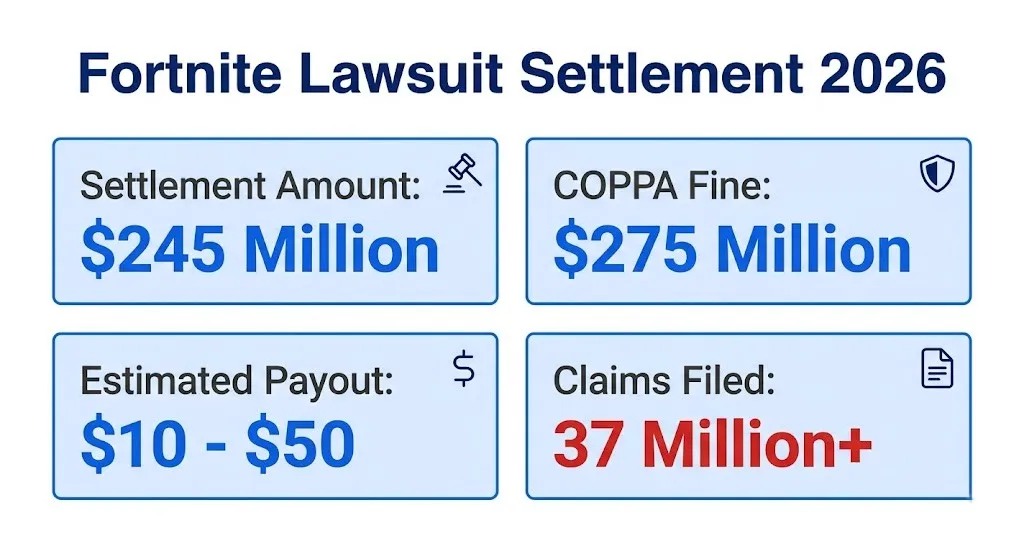
Fortnite Lawsuit 2026: What You Need to Know Right Now
The Fortnite lawsuit in 2026 involves multiple ongoing legal actions against Epic Games, including FTC settlements, state attorney general cases, and private class action claims. This is not one single lawsuit. It’s a web of related cases.
The biggest piece is the $245 million FTC settlement from December 2022. The FTC found that Epic Games used deceptive design tricks (called dark patterns) and charged players without proper consent. Refund checks and PayPal payments started going out in late 2023 and continued through 2024 and 2025.
By 2026, the focus has shifted to three areas:
- Unclaimed funds from the original FTC settlement being redistributed
- State-level enforcement actions building on the FTC’s findings
- Ongoing compliance monitoring of Epic Games under its consent decree
| Detail | Info |
|---|---|
| Total FTC Settlement | $245 million |
| Claims Received | 37+ million |
| First Payments Sent | Late 2023 |
| Consent Decree Duration | Through 2042 (20 years) |
| Active in 2026 | Yes |
The consent decree with the FTC lasts 20 years. That means Epic Games will remain under federal oversight well into the 2040s.
Fortnite Class Action Lawsuit Explained
The Fortnite class action lawsuit is a legal claim filed on behalf of a large group of players (and parents) who say Epic Games harmed them through unfair business practices. Class actions let thousands or millions of people sue together instead of filing individual cases.
Multiple class action complaints have been filed against Epic Games over the years. The core allegations include:
- Tricking players into making purchases they didn’t want
- Making it nearly impossible to cancel or get refunds for accidental purchases
- Collecting personal data from children under 13 without parental consent
- Using psychological pressure tactics to push in-game spending
The class action cases are separate from the FTC enforcement action, though they share similar factual claims. Some private class actions have settled. Others have been consolidated or dismissed.
In 2026, the active class action landscape focuses on state-specific claims. Several states have their own consumer protection statutes that give players additional grounds to sue beyond federal law.
Quick Fact: A class action does not require you to hire your own attorney. If a class is certified, you’re automatically included unless you opt out.
How to File a Fortnite Lawsuit Claim
Filing a Fortnite lawsuit claim in 2026 depends on which specific settlement or case you’re trying to join. For the main FTC settlement, the original claim window has closed, but redistribution of unclaimed funds may create new opportunities.
Here’s what the filing process looked like for the FTC settlement (and what to expect if new claim periods open):
- Visit the official settlement administrator’s website
- Enter your Epic Games account email or the email tied to your payment method
- Verify your identity with account details
- Submit the claim form electronically
- Wait for confirmation via email
| Step | What to Do |
|---|---|
| Step 1 | Check your email for settlement notices |
| Step 2 | Verify your Epic Games account information |
| Step 3 | Complete the online claim form |
| Step 4 | Submit any required proof (receipts, bank statements) |
| Step 5 | Wait for payout confirmation |
For new state-level cases in 2026, filing may involve contacting the state attorney general’s office or a designated claims administrator. Watch for official notices from your state’s AG.
If you missed the original FTC claim window, don’t assume you’re out of luck. Unclaimed funds are often redistributed, and new claim rounds can open.
Key Takeaway: The Fortnite lawsuit involves multiple legal actions against Epic Games, with the $245 million FTC settlement as the centerpiece, and 2026 brings new developments including unclaimed fund redistribution and state-level cases.
Fortnite Settlement Payout: How Much Money Is Available
The total Fortnite settlement payout pool from the FTC case alone is $245 million. That number represents the penalty Epic Games agreed to pay for violating consumer protection and children’s privacy laws.
This $245 million was split into two parts:
- $245 million for consumer refunds (the full amount was designated for player restitution)
- A separate $275 million penalty for COPPA violations (paid to the U.S. Treasury, not to players)
So the combined financial hit to Epic Games was actually $520 million. The $275 million COPPA fine was the largest ever imposed for a children’s privacy case in U.S. history.
| Settlement Component | Amount | Where It Goes |
|---|---|---|
| FTC Consumer Refunds | $245 million | Directly to affected players |
| COPPA Penalty | $275 million | U.S. Treasury |
| Total Epic Games Penalty | $520 million | Split as above |
Additional state-level settlements could add tens of millions more. Several state attorneys general have reached or are negotiating separate deals.
The settlement fund is not bottomless. With 37 million claims filed, individual payouts are naturally smaller than the headline number suggests.
The Fortnite FTC Settlement Breakdown
The Fortnite FTC settlement stems from a December 2022 agreement between Epic Games and the Federal Trade Commission. The FTC alleged that Epic Games violated the FTC Act and COPPA through two main schemes.
Scheme 1: Dark Patterns
Epic Games designed its purchase system so players could accidentally buy items with a single button press. The “purchase” and “cancel” buttons were placed in confusing positions. Refund requests were buried behind multiple menus.
Scheme 2: Unauthorized Children’s Charges
Children could make purchases using saved payment methods without any parental verification. Some parents reported hundreds or even thousands of dollars in unwanted charges. Epic made the refund process deliberately difficult.
The FTC’s complaint was filed in the U.S. District Court for the Eastern District of North Carolina. The case number is 5:22-cv-00518.
Key terms of the settlement include:
- Epic must obtain affirmative consent before charging players
- Default settings must protect privacy, especially for minors
- Epic cannot use dark patterns in purchase flows
- A 20-year consent decree governs Epic’s practices through 2042
- Independent compliance audits are required regularly
This settlement was championed by former FTC Chair Lina Khan and remains one of the agency’s landmark enforcement actions in the gaming industry.
Fortnite Lawsuit Eligibility: Who Qualifies
You qualify for the Fortnite lawsuit settlement if Epic Games charged you (or your child) without proper authorization, or if you were affected by deceptive purchase design in Fortnite. The eligibility criteria are specific to each case.
For the FTC Settlement, you qualified if:
- You were charged for in-game purchases in Fortnite that you didn’t authorize
- Your child made purchases without your knowledge or consent
- You requested a refund from Epic Games and were denied or given only V-Bucks credit
- You were locked out of your account after disputing charges with your bank
Who does NOT qualify:
- Players who made intentional purchases and have no complaint
- Players who already received a full refund directly from Epic Games before the settlement
- Players who never spent real money on Fortnite
| Eligibility Factor | Qualified | Not Qualified |
|---|---|---|
| Unauthorized child purchases | Yes | N/A |
| Accidental purchases via dark patterns | Yes | N/A |
| Intentional purchases, no complaint | N/A | Yes |
| Already received full refund | N/A | Yes |
| Never spent real money | N/A | Yes |
Parents have a particularly strong case. The FTC specifically highlighted that children as young as 7 or 8 years old were making purchases without parental knowledge.
If you’re unsure whether you qualify, check your Epic Games purchase history and bank or credit card statements for charges you didn’t recognize.
Key Takeaway: The FTC settlement totals $245 million in player refunds plus $275 million in COPPA fines, and eligibility centers on unauthorized or deceptive charges, especially those involving children.
How Much Money Will You Get from the Fortnite Lawsuit
Most individual payouts from the Fortnite lawsuit range from $10 to $50 per claim, though some claimants with higher documented losses received more. The exact amount depends on your specific situation.
The math is straightforward but not generous. When you divide $245 million by 37 million claims, the average comes out to roughly $6.60 per person. However, not all claims were approved, and the distribution formula weighted payouts by the amount of unauthorized charges each person documented.
Think of it like splitting a pizza with 37 million people. Even a massive pizza doesn’t leave much per slice.
Factors that affect your payout:
- Total dollar amount of your unauthorized charges
- Whether you provided documentation (bank statements, screenshots)
- Whether your claim involved a minor child
- How many total valid claims the administrator approved
| Claim Type | Estimated Payout Range |
|---|---|
| Small unauthorized charges (under $20) | $10 to $20 |
| Moderate charges ($20 to $100) | $20 to $50 |
| Large documented losses ($100+) | $50 to $100+ |
| Undocumented general claims | Under $10 |
Some players reported receiving checks for less than $5. Others with well-documented patterns of unauthorized charges received payments exceeding $100. The variation is wide.
Fortnite Class Action Payout Amounts
Fortnite class action payout amounts differ from the FTC settlement payouts because private class actions have separate settlement funds with different distribution formulas. In some private class actions, individual payouts are tied more directly to proven financial loss.
Private class action settlements involving Fortnite have been smaller in total fund size compared to the FTC’s $245 million. Individual state-level class actions have settled for amounts ranging from $1 million to $15 million, depending on the state and the number of class members.
The payout structure in class actions typically follows this breakdown:
- Attorney fees: 25% to 33% of the settlement fund
- Administrative costs: 5% to 10%
- Class member payouts: The remaining 57% to 70%
| Component | Percentage of Fund |
|---|---|
| Attorney Fees | 25% to 33% |
| Admin Costs | 5% to 10% |
| Player Payouts | 57% to 70% |
This means if a state-level class action settles for $10 million, roughly $5.7 million to $7 million actually reaches players. Divide that among thousands of class members, and individual checks can range from $15 to $75.
The takeaway here is that class action payouts are never windfall money for individual claimants. They’re meant to provide restitution and punish the company financially.
Fortnite Refund 2026: What’s Changed This Year
Fortnite refunds in 2026 are primarily coming from unclaimed FTC settlement funds and new state-level enforcement actions. The original FTC claim deadline passed, but the refund process isn’t entirely finished.
Here’s what’s different in 2026:
Unclaimed Fund Redistribution
When settlement checks go uncashed or claims go unfiled, the remaining money doesn’t go back to Epic Games. The settlement administrator redistributes those funds to approved claimants in additional rounds.
New State Actions
Several state attorneys general have been investigating Epic Games independently. States like California, New York, and Illinois have consumer protection divisions that can pursue separate restitution for their residents.
Epic Games Refund Policy Changes
Under the consent decree, Epic Games was required to overhaul its refund process. By 2026, Fortnite now includes:
- A mandatory purchase confirmation screen
- A self-service refund option for purchases made within 24 hours
- Parental spending controls enabled by default for accounts flagged as belonging to minors
- Clear pricing display before any transaction completes
| Change | Before Settlement | After Settlement (2026) |
|---|---|---|
| Purchase Confirmation | None (one-click buy) | Required confirmation screen |
| Self-Service Refund | Not available | Available within 24 hours |
| Parental Controls | Off by default | On by default for minors |
| Pricing Display | Obscured in some menus | Clear display before purchase |
If you tried to get a refund from Epic Games in 2023 and were denied, the 2026 process is significantly easier.
Key Takeaway: Individual payouts from the Fortnite lawsuit average $10 to $50, but 2026 brings new refund opportunities through unclaimed fund redistribution and state-level enforcement actions.
How to File a Fortnite Lawsuit Claim Step by Step
Filing a Fortnite lawsuit claim requires gathering your account information, locating the correct claim portal, and submitting your documentation before the deadline. The process is designed to be straightforward, but missing a step can delay or void your claim.
Step-by-step instructions for 2026:
Step 1: Gather Your Information
Pull together your Epic Games username, the email address linked to your account, and any bank or credit card statements showing Fortnite charges. Screenshots help too.
Step 2: Check for Active Claim Periods
Visit the FTC’s official refund page or your state attorney general’s website. Look for announcements about open claim windows. In 2026, new rounds may open as unclaimed funds become available.
Step 3: Complete the Claim Form
Fill out every field accurately. Mismatched email addresses or incorrect account names are the most common reasons claims get rejected.
Step 4: Upload Supporting Documents
Attach bank statements, charge notifications, or Epic Games purchase receipts. More documentation means a stronger claim and potentially a higher payout.
Step 5: Submit and Save Confirmation
After submitting, save your confirmation number and any emails you receive. You’ll need these if there’s a question about your claim later.
| Common Mistakes | How to Avoid Them |
|---|---|
| Wrong email address | Use the email tied to your Epic account |
| Missing documentation | Attach bank statements showing charges |
| Filing after deadline | Check dates before starting |
| Duplicate submissions | File once, save confirmation |
The entire process takes about 15 to 20 minutes if you have your documents ready.
Fortnite Settlement Deadline 2026
The original Fortnite FTC settlement claim deadline was September 17, 2023, but 2026 deadlines exist for state-level cases and potential redistribution rounds. Missing a deadline means losing your right to payment entirely.
Here are the key dates to watch in 2026:
| Deadline | Details |
|---|---|
| FTC Original Deadline | September 17, 2023 (passed) |
| Unclaimed Fund Redistribution | TBD, expected mid-2026 |
| State AG Claim Deadlines | Varies by state (check your state AG) |
| Consent Decree Expiration | 2042 |
For state-level settlements, deadlines are set individually. Some states give claimants 60 to 90 days from the announcement date. Others allow up to six months.
How to stay informed about new deadlines:
- Sign up for FTC email alerts
- Follow your state attorney general’s consumer protection updates
- Check the settlement administrator’s website periodically
- Monitor court docket filings in the Eastern District of North Carolina
Think of settlement deadlines like airplane boarding. Once that gate closes, it doesn’t matter if you have a ticket. You have to be there on time.
The FTC’s consent decree ensures that Epic Games remains under legal obligation for two decades. New violations could trigger additional settlement funds with new deadlines at any point before 2042.
Epic Games Lawsuit 2026: Full Legal Picture
The Epic Games lawsuit landscape in 2026 extends far beyond the original Fortnite FTC case. Epic Games is facing legal pressure from multiple directions, including federal agencies, state governments, and international regulators.
Active legal actions against Epic Games in 2026:
- FTC consent decree enforcement (ongoing monitoring through 2042)
- State attorney general investigations (California, New York, Illinois, and others)
- European Commission inquiries into Epic’s data practices under GDPR
- Private class action lawsuits in various federal and state courts
- COPPA compliance audits mandated by the 2022 settlement
| Legal Action | Status in 2026 |
|---|---|
| FTC Consent Decree | Active, monitored |
| State AG Investigations | Ongoing in multiple states |
| EU/GDPR Inquiries | Under investigation |
| Private Class Actions | Mixed (some settled, some active) |
| COPPA Audits | Mandatory, periodic |
Epic Games CEO Tim Sweeney has publicly pushed back against some regulatory actions, arguing that the company has overhauled its practices since 2022. Whether regulators agree remains to be seen.
The company reported spending over $100 million on compliance upgrades since the FTC settlement. That includes redesigning purchase flows, hiring privacy officers, and building parental control systems.
Key Takeaway: The Fortnite settlement deadline for the original FTC claim has passed, but state-level deadlines and unclaimed fund rounds in 2026 create new opportunities, and Epic Games remains under legal pressure from federal, state, and international authorities.
The Fortnite Dark Patterns Lawsuit
The Fortnite dark patterns lawsuit centered on Epic Games’ deliberate use of confusing interface design to trick players into spending money. Dark patterns are deceptive design elements that manipulate users into taking actions they didn’t intend.
The FTC identified several specific dark patterns in Fortnite:
- Accidental purchases: The “buy” button was placed where players expected a navigation or cancel button. One accidental press and your credit card was charged.
- No confirmation screen: Purchases went through instantly with no “Are you sure?” prompt.
- Buried refund options: Getting a refund required navigating multiple menus, and Epic limited refunds to three per account.
- Currency obfuscation: V-Bucks pricing made it difficult to understand real-dollar costs. Players couldn’t easily calculate that a 2,000 V-Buck skin cost roughly $16.
This matters beyond gaming. The FTC’s action against Epic Games set a precedent for how regulators approach dark patterns across all digital platforms. Any app or website that uses similar tricks is now on notice.
Before the settlement:
A player could accidentally buy a $20 skin by pressing a single button while trying to inspect an item. That’s like a vending machine charging your credit card because you looked at a candy bar too long.
After the settlement:
Epic Games must now show a confirmation screen for every purchase and provide instant self-service refunds for accidental buys.
Fortnite Unauthorized Charges Lawsuit
The Fortnite unauthorized charges lawsuit targeted Epic Games for allowing purchases to go through without the account holder’s knowledge or consent. Parents bore the heaviest burden in this part of the case.
The FTC documented thousands of complaints from parents who discovered surprise charges on their bank statements. Some families reported $500 to $1,000 in unauthorized Fortnite purchases made by their children.
How unauthorized charges happened:
- Children used saved payment methods on shared devices
- No parental verification was required for purchases
- Epic Games’ default settings allowed one-click buying
- Account-sharing between family members made spending invisible until the credit card bill arrived
| Reported Issue | Frequency in FTC Complaints |
|---|---|
| Child used saved credit card | Very common |
| No parental PIN required | Very common |
| Charges discovered weeks later | Common |
| Epic denied refund request | Common |
| Account locked after bank dispute | Reported frequently |
One particularly frustrating pattern: when parents disputed Fortnite charges with their bank, Epic Games would lock the player’s account entirely. This punished families for trying to recover their money.
The settlement requires Epic to implement mandatory parental consent for purchases on accounts belonging to players under 13. Spending limits and purchase notifications are now built into the platform by default.
Fortnite Children’s Privacy Lawsuit
The Fortnite children’s privacy lawsuit addressed Epic Games’ collection and use of personal data from players under 13 years old without parental consent. This is one of the most significant children’s privacy enforcement actions in U.S. history.
The FTC alleged that Epic Games:
- Collected personal information from children under 13 without obtaining verifiable parental consent
- Enabled real-time voice and text chat for children by default, exposing them to adult strangers
- Failed to provide parents with meaningful controls over their children’s data
- Ignored internal employee warnings about privacy risks to young players
The $275 million COPPA fine was the largest penalty ever assessed under the Children’s Online Privacy Protection Act. That record still stands in 2026.
What COPPA requires:
- Verifiable parental consent before collecting data from children under 13
- Clear privacy policies written in language parents can understand
- The ability for parents to review and delete their child’s data
- Reasonable data security measures
| COPPA Requirement | Epic’s Violation |
|---|---|
| Parental consent | Not obtained |
| Privacy policy clarity | Inadequate |
| Parental data access | Not provided |
| Default privacy settings | Communications open by default |
Epic Games internal documents showed that employees raised concerns about child safety as early as 2019. Management allegedly prioritized growth over compliance.
By 2026, Epic Games has implemented age verification systems, default-off voice chat for young players, and parental dashboards showing play time and spending data.
Key Takeaway: Epic Games deliberately used dark patterns to drive purchases, allowed unauthorized charges through lack of parental controls, and violated COPPA by collecting children’s data without consent, resulting in the largest children’s privacy fine in U.S. history.
Fortnite COPPA Violation Lawsuit
The Fortnite COPPA violation lawsuit specifically deals with Epic Games’ failure to comply with the Children’s Online Privacy Protection Act. COPPA is a federal law that sets strict rules for how companies handle data from kids under 13.
This case is separate from the $245 million dark patterns settlement. The COPPA violation resulted in its own $275 million civil penalty, paid directly to the U.S. Treasury rather than to individual players.
Key COPPA violations by Epic Games:
- Epic’s age gate was easily bypassed. Children could enter any birthdate to create an account.
- Voice chat connected children with strangers by default. Microphones were live from the moment a child joined a match.
- Text chat was enabled for all players with no age-based restrictions.
- Epic collected geolocation data, device identifiers, and gameplay behavior from children without consent.
The FTC’s complaint noted that Epic’s own employees called the default voice chat setting “a significant problem” for child safety. Internal emails showed awareness of the issue years before enforcement.
| COPPA Case Detail | Information |
|---|---|
| Fine Amount | $275 million |
| Paid To | U.S. Treasury |
| Record Status | Largest COPPA fine ever |
| Key Violation | Default-on voice chat for children |
| Consent Decree | 20 years (through 2042) |
The COPPA penalty does not directly benefit individual families financially. Its purpose is to punish the company and deter future violations. However, the findings from this case strengthen private lawsuits and state AG actions where individual payouts are available.
Is the Fortnite Lawsuit Still Active in 2026
Yes, the Fortnite lawsuit is still active in 2026. The FTC’s 20-year consent decree runs through 2042, state investigations continue, and private class actions remain in various stages of litigation.
What “still active” means in practical terms:
- Epic Games must submit regular compliance reports to the FTC
- Independent auditors review Epic’s privacy and purchase practices
- Any new violations could trigger additional penalties and new settlement funds
- State attorneys general can (and are) pursuing their own cases based on the same factual record
| Case Component | Status in 2026 |
|---|---|
| FTC Consent Decree | Active through 2042 |
| Consumer Refund Distribution | Ongoing (redistribution rounds) |
| State AG Investigations | Active in multiple states |
| Private Class Actions | Mixed (some settled, others pending) |
| COPPA Compliance Monitoring | Mandatory audits continuing |
The short answer: if you think you were affected by Fortnite’s deceptive practices, 2026 is not too late to look into your options. New claim windows, state-level settlements, and redistribution rounds may still apply to you.
The legal pressure on Epic Games isn’t going away anytime soon. Twenty years of federal oversight means the company will be watched closely until the early 2040s. Every design change, every privacy update, and every purchase flow modification gets reviewed.
This isn’t a case that ended with a check. It’s an ongoing obligation that reshapes how Epic Games does business for the next two decades.
Key Takeaway: The Fortnite lawsuit remains active in 2026 with ongoing FTC oversight through 2042, continuing state investigations, and potential new claim opportunities for affected players and parents.
Frequently Asked Questions
How much money will I get from the Fortnite lawsuit in 2026?
Most approved claimants received between $10 and $50 from the FTC settlement.
The exact amount depends on your documented unauthorized charges and the strength of your submitted evidence.
Some claimants with large documented losses received over $100, while others got less than $10.
Can I still file a Fortnite lawsuit claim in 2026?
The original FTC claim deadline passed in September 2023, but new opportunities may open in 2026.
Unclaimed fund redistribution rounds and state-level settlements could create new claim windows.
Check the FTC’s refund page and your state attorney general’s website for current filing options.
Who qualifies for the Fortnite class action lawsuit settlement?
You qualify if Epic Games charged you without authorization or if your child made purchases without your consent.
Players who were tricked into buying items through confusing button placement also qualify.
You do not qualify if you made intentional purchases and had no issues with billing or refunds.
What was the Fortnite FTC settlement about?
The FTC settlement addressed Epic Games’ use of dark patterns and unauthorized charges in Fortnite.
Epic paid $245 million in consumer refunds and a separate $275 million COPPA fine for children’s privacy violations.
The total penalty of $520 million was one of the largest FTC gaming enforcement actions ever.
When is the Fortnite settlement deadline in 2026?
The main FTC settlement deadline passed in 2023, but state-level deadlines vary by state and case.
New redistribution deadlines for unclaimed FTC funds are expected in mid-2026.
Sign up for FTC email alerts and monitor your state’s attorney general office for specific dates.
What to Do Next
The Fortnite lawsuit isn’t old news. It’s still active, still paying out, and still evolving in 2026. If you or your child was affected by unauthorized charges or deceptive purchase design, your window to act may not be closed.
Check your Epic Games account history. Review your bank statements for old Fortnite charges. Look for settlement notices in your email, including spam and promotions folders.
Stay informed. New claim rounds and state-level settlements can appear with short filing windows. Acting quickly when a new deadline is announced is the single best thing you can do to protect your right to a payout.
