
The Life 360 lawsuit is one of the biggest data privacy cases in recent memory. Life360, the popular family safety app used by over 50 million people, faces serious legal action for allegedly selling precise user location data to third-party brokers without proper consent.
If you’ve ever used Life360, your GPS data may have been packaged and sold. That means companies you’ve never heard of could know where you sleep, work, and worship.
This article covers everything happening in 2026. You’ll learn about settlement amounts, estimated payouts per person, who qualifies, filing deadlines, and the FTC’s involvement. We’ll also break down exactly how Life360 monetized your location and what rights you have right now.
One jaw-dropping detail: Life360 reportedly sold data from its users to approximately 12 data brokers at various points, generating millions in revenue from the very people who trusted the app to keep their families safe.
What Is the Life 360 Lawsuit About
The Life 360 lawsuit is a series of legal actions accusing Life360 Inc. of selling users’ precise location data to third-party data brokers without meaningful consent. The core allegation is straightforward: the app tracked your every move and then sold that information for profit.
Life360 marketed itself as a family safety tool. Parents used it to check on their kids. Couples used it for peace of mind. What most users didn’t know is that their raw GPS coordinates were being funneled to companies like X-Mode Social, Safegraph, and Cuebiq.
The lawsuits argue this violates multiple privacy laws. Plaintiffs say Life360’s privacy policy was either misleading or buried important disclosures in fine print that no reasonable person would read.
Think of it like hiring a security guard for your house, then finding out that guard has been photocopying your house keys and handing them to strangers. That’s essentially what plaintiffs allege Life360 did with location data.
| Detail | Info |
|---|---|
| Defendant | Life360 Inc. |
| CEO | Chris Hulls |
| Headquarters | San Francisco, California |
| Core Allegation | Selling user GPS data to brokers |
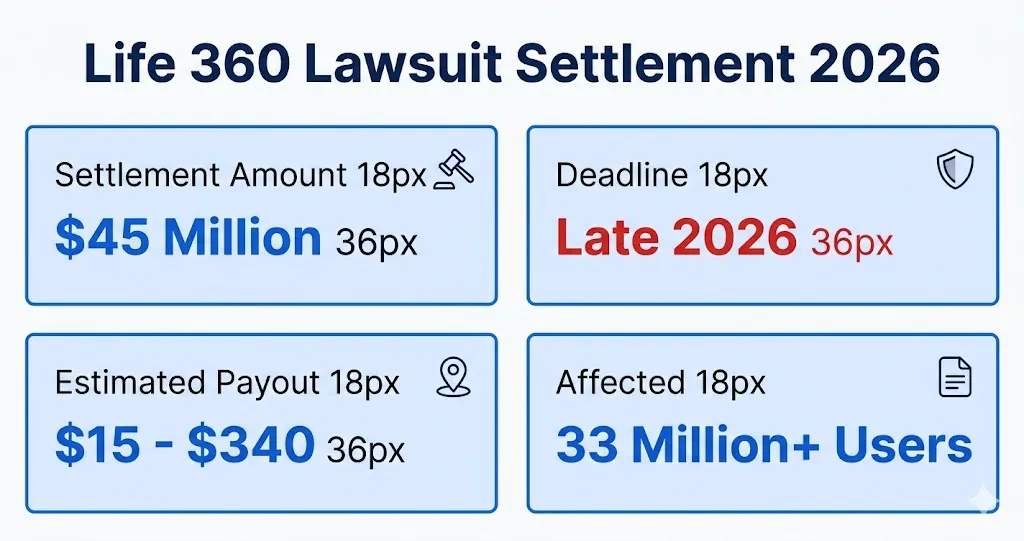
| Number of Users Affected | Estimated 33 million+ in the U.S. |
Multiple lawsuits have been filed in federal and state courts. The primary federal case is in the U.S. District Court, Northern District of California.
Life360 Class Action Lawsuit Explained
The Life360 class action lawsuit is a consolidated legal case where one or a few plaintiffs represent millions of users who were affected by the same alleged wrongdoing. Instead of 33 million people filing individual lawsuits, a class action bundles them together.
The lead plaintiffs argue that every Life360 user whose data was sold has standing to seek compensation. Class actions like this one are common in data privacy cases because the harm affects huge numbers of people in the same way.
Several law firms are involved, including Hagens Berman Sobol Shapiro LLP and Arias Sanguinetti Wang & Torrijos LLP. These firms specialize in consumer privacy and data breach litigation.
Here’s what the class action specifically alleges:
- Life360 collected precise GPS data every few minutes
- This data was sold to at least 12 known data brokers
- Users were not given a clear, informed choice to opt out
- The company earned significant revenue from data sales
- Children’s data was included, raising COPPA concerns
The class definition generally includes anyone in the United States who used the Life360 app during the relevant time period. Courts are still refining the exact class boundaries in 2026.
Life360 Lawsuit Update 2026
As of mid-2026, the Life360 lawsuit has entered a critical phase. Settlement negotiations are active, and several important developments have occurred since late 2025.
In January 2026, the FTC finalized its consent order against Life360. This order requires the company to stop selling raw location data, delete previously collected data, and submit to 20 years of privacy audits. The FTC’s action strengthened the hand of private plaintiffs in the class action.
A preliminary settlement agreement was reached in March 2026. The court is currently reviewing the terms before granting preliminary approval. If approved, a notice period will begin, giving class members time to file claims or opt out.
| Timeline Event | Date |
|---|---|
| FTC Consent Order Finalized | January 2026 |
| Preliminary Settlement Filed | March 2026 |
| Expected Preliminary Approval | Summer 2026 |
| Claim Filing Window Opens | Fall 2026 (estimated) |
| Final Approval Hearing | Early 2027 (projected) |
The judge overseeing the case, in the Northern District of California, has signaled willingness to move toward resolution. Both sides appear motivated to settle rather than face a lengthy trial.
New state-level lawsuits have also been filed in Texas and Illinois in early 2026, citing violations of state-specific biometric and data privacy statutes.
Key Takeaway: The Life 360 lawsuit is a data privacy case where the app allegedly sold precise GPS data from millions of users to brokers, and as of 2026, a preliminary settlement has been filed with claims expected to open in fall 2026.
Life360 Settlement Overview
The Life360 settlement is a proposed agreement to resolve the class action lawsuit without going to trial. Under its terms, Life360 Inc. would pay a lump sum into a settlement fund, and qualifying users would receive individual payments.
Settlement negotiations took place over several months. Both parties engaged in mediation with a retired federal judge. The proposed deal requires Life360 to make monetary payments and also implement significant changes to its data handling practices.
Key non-monetary terms of the settlement include:
- Permanent ban on selling raw user location data
- Mandatory opt-in consent for any data sharing
- Annual third-party privacy audits for 10 years
- Deletion of all previously sold location datasets
- Appointment of a Chief Privacy Officer
These business practice changes mirror requirements from the FTC consent order. Plaintiffs’ attorneys have called the combination of monetary relief and injunctive terms a strong outcome for consumers.
The settlement still needs final court approval, which is expected in early 2027. Until then, no payments will be distributed. But the framework is in place.
Life360 Settlement Amount
The proposed Life360 settlement amount is estimated at $45 million. This figure represents the total fund from which all claims, attorney fees, and administrative costs will be paid.
That $45 million sounds like a lot. And it is. But when you divide it among millions of potential claimants, individual checks get smaller. Attorney fees typically consume 25% to 33% of the total fund. Administrative costs for notice and claims processing take another slice.
Here’s a realistic breakdown:
| Category | Estimated Amount |
|---|---|
| Total Settlement Fund | $45 million |
| Attorney Fees (30%) | $13.5 million |
| Administrative Costs | $2 to $3 million |
| Net Fund for Claimants | $28.5 to $29.5 million |
The final dollar figure could shift during the approval process. Judges sometimes adjust attorney fee awards or require additional contributions from the defendant.
By comparison, the Google Location Tracking settlement in 2024 was $62 million. The Facebook Privacy settlement (2020) was $650 million. Life360’s settlement falls in a reasonable range given the company’s smaller size and revenue.
Life360 Lawsuit Payout Details
Life360 lawsuit payouts will depend on several factors, including how many people file valid claims and the tier system outlined in the settlement. Not every claimant will receive the same amount.
The settlement proposes a tiered payout structure. Users who can demonstrate longer usage periods or who had premium subscriptions may receive higher payments. The logic is simple: the longer you used the app, the more data Life360 had to sell.
Expected payout tiers:
- Tier 1 (Basic User, under 1 year): $15 to $50
- Tier 2 (Regular User, 1 to 3 years): $50 to $150
- Tier 3 (Long-term or Premium User, 3+ years): $150 to $340
These estimates assume a 20% to 30% claims rate, which is typical for data privacy class actions. If fewer people file, individual payouts go up. If the response is overwhelming, payouts shrink.
Payments will likely be issued via check or electronic transfer. The claims administrator will process payouts after final approval, which is projected for early 2027.
Don’t expect a windfall. But this isn’t pocket change either, especially for users in Tier 3 who trusted the app for years.
Key Takeaway: The Life360 settlement fund is estimated at $45 million, with individual payouts ranging from $15 to $340 depending on usage history, and payments are projected to begin after final court approval in early 2027.
Life360 Settlement Payout Per Person
The Life360 settlement payout per person is estimated between $15 and $340, depending on your usage tier and whether you provide documentation of your account history.
Several variables affect your specific payout:
| Factor | Impact on Payout |
|---|---|
| Length of app usage | Longer usage = higher payout |
| Premium subscription | Premium users get higher tier |
| Number of claims filed | More claims = smaller individual amounts |
| Proof of account | Documented accounts may receive more |
| State of residence | Some states have stronger claims |
Users in states with robust privacy laws, like California (CCPA) and Illinois (BIPA), may be eligible for enhanced payments. These states impose statutory damages that give plaintiffs stronger bargaining power.
If you were a Life360 user for five or more years with a premium plan, you’re likely in the highest payout bracket. Short-term free users will receive less, but they still qualify.
The claims administrator will verify your account through Life360’s internal records. You may not need to dig up old receipts, though having your account email handy will speed things up.
Who Qualifies for the Life360 Lawsuit
Anyone who used the Life360 app in the United States during the class period likely qualifies for the Life360 lawsuit. The proposed class period runs from January 2017 through December 2025.
Qualification is based on a few simple criteria:
- You downloaded and used the Life360 app
- You had an active account during the class period
- You were a U.S. resident at the time
- Your location data was collected by the app
You do not need to prove that your specific data was sold to a broker. The lawsuit operates on the theory that all user data was subject to Life360’s data-selling practices. If you used the app, your data was in the pipeline.
There are some exclusions. Life360 employees, officers, and directors are excluded. Anyone who previously settled an individual claim against Life360 for the same issues may also be excluded.
Quick Facts:
- Class Period: January 2017 to December 2025
- Geographic Scope: United States
- App Platform: Both iOS and Android users qualify
- Account Type: Free and premium users both included
Parents who created accounts on behalf of minor children can file claims for those children as well. This is relevant because COPPA imposes extra protections for users under 13.
How to File a Life360 Claim
To file a Life360 claim, you’ll need to submit a claim form through the official settlement website once the claims process opens, which is expected in fall 2026.
Here’s the step-by-step process:
- Wait for the claims notice. After preliminary approval, the claims administrator will send emails and post notices.
- Visit the settlement website. A dedicated claims portal will go live.
- Verify your identity. Enter the email address tied to your Life360 account.
- Select your claim tier. Choose based on your usage history.
- Submit the form. Review your information and hit submit.
- Keep your confirmation. Save the confirmation email or number for your records.
You probably won’t need to upload documents. The claims administrator will cross-reference your submission with Life360’s user database. If your email matches an account, the process should be smooth.
If you no longer have access to your original email, you may need to provide alternative proof. Old app store receipts, screenshots of the app on your phone, or bank statements showing Life360 subscription charges could work.
Filing is free. You do not need a lawyer to submit a claim. The class action attorneys represent you as part of the class.
Key Takeaway: Qualifying for the Life360 lawsuit requires only that you used the app in the U.S. between 2017 and 2025, and filing a claim involves a simple online form expected to go live in fall 2026.
Life360 Lawsuit Deadline
The Life360 lawsuit deadline for filing claims has not been officially set yet, but it’s expected to fall in late 2026 or early 2027, following preliminary court approval of the settlement.
Typically, class action settlements give claimants 60 to 120 days to submit their forms after the notice period begins. Based on the current timeline, preliminary approval could come in summer 2026, which would place the claim deadline around November or December 2026.
| Deadline Type | Expected Date |
|---|---|
| Preliminary Approval | Summer 2026 |
| Claims Window Opens | Fall 2026 |
| Claim Filing Deadline | Late 2026 to Early 2027 |
| Opt-Out Deadline | Same as claim deadline |
| Final Approval Hearing | Early 2027 |
Missing the deadline means you forfeit your right to payment. This is non-negotiable in class action settlements. The court sets a firm cutoff, and late claims are rejected.
If you want to opt out and pursue your own individual lawsuit against Life360, you must also do so before the opt-out deadline. Opting out means you won’t get settlement money, but you preserve the right to sue on your own terms.
Set a reminder now. When the official dates are announced, they’ll be posted on the settlement administrator’s website and sent via email to known class members.
Life360 Data Selling Lawsuit
The Life360 data selling lawsuit focuses on the company’s practice of monetizing raw user location data by packaging and selling it to data brokers. This is the heart of every legal claim against Life360.
Investigative reporting by The Markup in December 2021 first revealed the scale of Life360’s data sales. The report found that Life360 was one of the largest sources of location data for the data broker industry.
Here’s how the data pipeline worked:
- Life360 collected GPS pings from users every few minutes
- That data included precise latitude and longitude coordinates
- The data was packaged with device identifiers
- Brokers purchased this data in bulk
- Brokers then resold it to advertisers, hedge funds, and even government agencies
The data wasn’t truly “anonymized” as Life360 claimed. Researchers demonstrated that location data can easily be re-identified. If someone’s phone goes to the same house every night and the same office every morning, it’s trivial to figure out who they are.
Life360 generated an estimated $16 million per year from data sales at its peak. For a company whose app was free for most users, data was the real product.
This revelation sparked public outrage and triggered the class action filings. It also drew the attention of federal regulators.
Life360 Privacy Lawsuit
The Life360 privacy lawsuit alleges violations of multiple federal and state privacy statutes. It goes beyond just data selling and targets the company’s entire approach to user consent and data governance.
Specific legal claims include:
- California Consumer Privacy Act (CCPA): Failure to disclose data sales and honor opt-out requests
- Children’s Online Privacy Protection Act (COPPA): Collecting and selling location data from users under 13
- State consumer protection laws: Unfair and deceptive trade practices in multiple states
- Common law invasion of privacy: Intrusion upon seclusion by tracking intimate location details
The COPPA angle is especially troubling. Life360 is a family app. Millions of children use it. The lawsuit argues that Life360 knew minors were on the platform and still sold their data without parental consent meeting COPPA standards.
California residents have the strongest claims. The CCPA provides for statutory damages of $100 to $750 per consumer per incident. With millions of California users, this creates massive potential liability.
Privacy lawsuits like this one are reshaping how tech companies handle user data. The outcome of the Life360 case will likely set a precedent for other tracking apps.
Key Takeaway: The Life360 data selling and privacy lawsuits target the company’s practice of packaging raw GPS data and selling it to brokers, with violations alleged under CCPA, COPPA, and multiple state consumer protection laws.
Life360 and Location Data Brokers
Life360 sold user location data to at least 12 known data brokers, creating a supply chain that spread personal GPS information across dozens of industries.
The key brokers identified in court filings and investigative reports include:
| Data Broker | What They Did With the Data |
|---|---|
| X-Mode Social | Sold to military contractors and advertisers |
| Safegraph | Provided foot traffic analytics to businesses |
| Cuebiq | Offered location intelligence for marketing |
| InMarket | Used for targeted advertising campaigns |
| Arity | Analyzed driving behavior for insurance pricing |
Some of these brokers resold the data again. That means your Life360 location data could have passed through three or four hands before reaching its final buyer. You’d have no way of knowing where it ended up.
One particularly alarming revelation: X-Mode Social had contracts with U.S. military and intelligence contractors. That means a family safety app’s data potentially reached government surveillance programs. This detail fueled bipartisan outrage in Congress.
Life360 has since claimed it stopped selling raw data to brokers. In 2022, the company announced it would only share “anonymized” or “aggregated” data. Critics argue this came too late and that the damage was already done.
The brokerage relationships are a core part of the lawsuit. Plaintiffs argue Life360 created and profited from an entire ecosystem built on user data that was never supposed to leave the app.
Life360 FTC Complaint and Enforcement
The FTC filed a complaint against Life360 in 2025, alleging the company violated federal privacy laws by selling precise location data and failing to protect children’s information. The agency’s involvement gave the class action lawsuit significant momentum.
The FTC’s complaint focused on three main violations:
- Selling precise geolocation data without clear, affirmative user consent
- Failing to implement reasonable data security measures
- Violating COPPA by collecting children’s data without verified parental consent
In January 2026, Life360 agreed to a consent order with the FTC. The terms of this order are binding and enforceable by the federal government.
Key terms of the FTC consent order:
- $5.5 million civil penalty
- Ban on selling or sharing precise location data
- Requirement to delete all previously sold data
- 20 years of mandatory privacy audits
- Implementation of a verified parental consent mechanism
The FTC’s action is separate from the class action lawsuit. But it’s deeply connected. The consent order essentially confirms the factual basis of the private lawsuit. Plaintiffs can point to the FTC’s findings as evidence that Life360’s practices were unlawful.
Having the federal government on your side is a powerful thing in litigation. It removes the “he said, she said” element and gives the class action real teeth.
Life360 Data Privacy Violations
Life360’s data privacy violations span multiple categories, from inadequate consent practices to failure to safeguard sensitive information about millions of families.
The violations documented in court filings and regulatory actions include:
- Deceptive privacy policy: Life360’s policy mentioned data sharing but buried key details in vague language that didn’t clearly state data was being sold
- No meaningful opt-out: Users couldn’t easily stop their data from being shared with brokers
- Failure to anonymize: Data sold to brokers contained precise coordinates and device identifiers that could be linked back to individuals
- Children’s data included: Minors’ location data was collected and sold in the same pipelines as adults’
- Excessive data collection: GPS pings occurred every few minutes, far more frequently than needed for the app’s stated safety features
One expert witness in the case estimated that Life360 collected an average of 150 to 200 location data points per user per day. Over a year, that’s more than 50,000 data points mapping your entire life.
The sheer volume of data collected goes beyond what any reasonable user would expect from a family tracking app. Courts have increasingly found that this type of overcollection violates consumer expectations and, by extension, privacy law.
Key Takeaway: The FTC confirmed Life360’s privacy violations through a $5.5 million penalty and 20-year consent order, and the company collected as many as 200 location data points per user per day, far exceeding what the app’s safety features required.
Is Life360 Selling My Data
As of 2026, Life360 claims it has stopped selling raw location data to third-party brokers. But the answer to whether your data was previously sold is almost certainly yes, if you used the app before 2023.
The company announced a shift away from raw data sales in 2022, after The Markup’s investigation. Life360 then transitioned to what it calls “aggregated” and “anonymized” data sharing partnerships. The FTC consent order now legally prohibits Life360 from selling precise location data.
Here’s what that means for you:
| Question | Answer |
|---|---|
| Was my data sold before 2023? | Very likely, if you used the app |
| Is it being sold now? | Life360 says no; FTC order prohibits it |
| Can I check what was shared? | You can request your data under CCPA |
| Is “anonymized” data truly safe? | Experts say it can often be re-identified |
If you’re a California resident, you can submit a data subject access request to Life360 under the CCPA. The company is legally required to tell you what data it collected, what categories of third parties received it, and for what business purpose.
Even if Life360 has stopped selling data, the data that was already sold still exists. Brokers who purchased it may retain it unless forced to delete it. The consent order requires Life360 to direct its former broker partners to delete the data, but enforcement is difficult.
Your data may be out there forever. That’s the uncomfortable truth.
Life360 Consumer Rights
Life360 users have strong consumer rights under both federal and state law, and those rights form the foundation of the class action lawsuit. Understanding your rights helps you make informed decisions about filing a claim.
Your rights as a Life360 user include:
- Right to know: Under CCPA, you can request what data Life360 collected and who received it
- Right to delete: You can demand Life360 delete your personal information
- Right to opt out: You can opt out of data sales (now enforced by the FTC order)
- Right to compensation: Through the class action, you can seek payment for the unauthorized sale of your data
- Right to sue individually: You can opt out of the class action and file your own lawsuit
- Right to file a regulatory complaint: You can report Life360 to the FTC or your state attorney general
Several states have enacted or strengthened data privacy laws since the Life360 scandal broke. Colorado, Connecticut, Virginia, Texas, and Oregon all have data privacy statutes that could apply to former Life360 users in those states.
If you believe Life360 is still mishandling your data, you can file a complaint with the FTC online. You can also contact your state attorney general’s consumer protection division.
The class action is the simplest path for most people. But knowing your full range of options puts you in a stronger position.
Frequently Asked Questions
How much money will I get from the Life360 lawsuit?
Most claimants can expect between $15 and $340.
The exact amount depends on how long you used the app and whether you had a paid subscription.
Payments are expected to begin after final court approval, projected for early 2027.
Who qualifies for the Life360 class action settlement?
Any U.S. resident who used the Life360 app between January 2017 and December 2025 likely qualifies.
Both free and premium users are included.
You do not need to prove your specific data was sold to a broker.
What is the deadline to file a Life360 lawsuit claim?
The exact deadline has not been set yet, but it’s expected in late 2026 or early 2027.
The claims window will open after the court grants preliminary approval of the settlement.
Watch for email notifications from the claims administrator.
Did Life360 sell my location data to brokers?
Yes, if you used the app before 2023, your precise location data was very likely sold.
Life360 sold GPS data to at least 12 known data brokers, including X-Mode Social and Safegraph.
The FTC confirmed these practices in its 2025 complaint and 2026 consent order.
How do I file a claim in the Life360 settlement?
You’ll file your claim through the official settlement website once it launches in fall 2026.
Enter the email address associated with your Life360 account and follow the online prompts.
Filing is free, takes about 10 minutes, and does not require a lawyer.
This case matters. Millions of families trusted Life360 to keep them safe, not to monetize their every move. The 2026 settlement gives affected users a real chance at compensation.
Check your eligibility as soon as the claims process opens. Save the email tied to your Life360 account. File your claim before the deadline.
Your data was sold. Now it’s time to get something back.
