
The Market America lawsuit is one of the most closely watched multi-level marketing legal battles in the country right now. Thousands of current and former distributors have accused the company of operating an illegal pyramid scheme that cost them thousands of dollars each.
If you ever signed up as a Market America UnFranchise Owner or spent money on products to meet sales quotas, you could have a legal claim. This article breaks down the allegations, who qualifies, estimated payouts, and where things stand heading into 2026.
The numbers behind this case are staggering. Independent research suggests the average Market America distributor loses between $1,200 and $6,000 per year after factoring in product purchases, training fees, and annual costs.
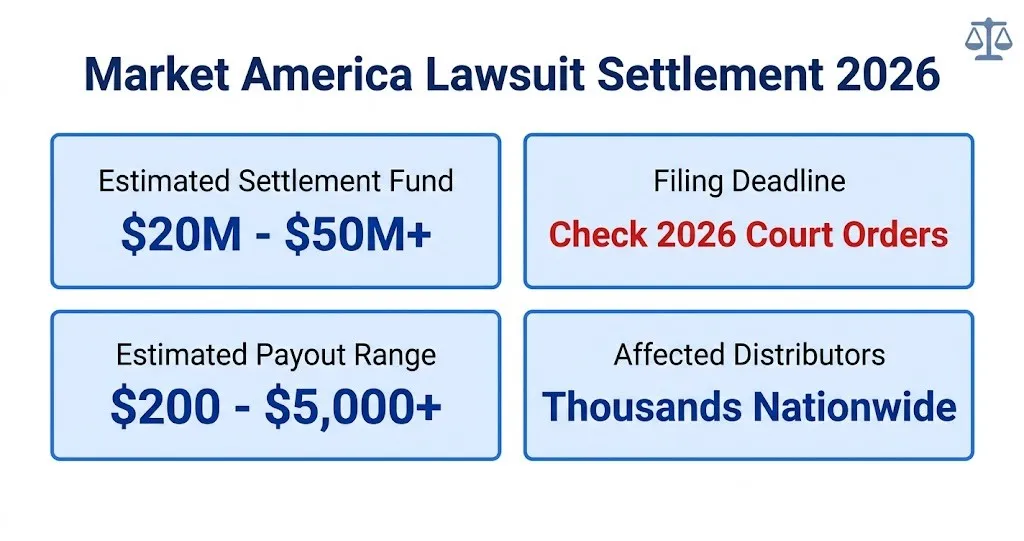
Market America Lawsuit 2026: Where Things Stand Right Now
The Market America lawsuit entered a critical phase in 2026 with ongoing litigation in federal court. Plaintiffs continue to press claims that the company’s business model was designed to enrich top-tier recruiters at the expense of ordinary distributors.
Federal court filings from late 2025 confirmed that class certification arguments are actively before the court. Attorneys representing thousands of former distributors are seeking to consolidate individual claims into a unified class action.
The company, headquartered in Greensboro, North Carolina, has denied all wrongdoing. Market America maintains that its compensation plan rewards genuine retail sales, not recruitment alone.
| Case Detail | Current Status |
|---|---|
| Court | U.S. District Court, Middle District of North Carolina |
| Case Type | Class Action / Consumer Fraud |
| Defendants | Market America Inc., Market America Worldwide |
| Year Filed | Multiple filings, 2017 to present |
| 2026 Status | Active litigation, class certification pending |
| Primary Claims | Pyramid scheme, deceptive business practices, RICO |
Attorneys on the plaintiff side argue that less than 1% of distributors ever earn meaningful income. That statistic sits at the core of the legal theory.
Market America Class Action Lawsuit: The Core Allegations
The Market America class action lawsuit centers on claims that the company misrepresented earning potential to recruit new members. Plaintiffs say they were shown glossy income projections that almost nobody actually achieved.
The core legal claims include violations of federal RICO statutes, state consumer fraud laws, and unjust enrichment. Some individual suits also cite breach of contract and fraudulent misrepresentation.
What makes this case distinctive is the breadth of the alleged scheme. Plaintiffs argue that Market America’s entire compensation structure, including personal volume requirements and mandatory product purchases, was designed to extract money from distributors rather than generate genuine retail revenue.
Key allegations include:
- False and misleading income representations during recruitment
- Mandatory product purchase quotas that primarily benefited the company
- Failure to disclose that the vast majority of distributors lose money
- Using recruitment as the primary driver of revenue rather than real product sales
- Charging annual renewal fees and training costs with no corresponding income benefit
The sheer volume of plaintiffs in related filings suggests this is not a fringe complaint. Thousands of former distributors across multiple states have raised nearly identical grievances.
Market America Settlement: What Has Been Offered So Far
No single global settlement has been finalized in the Market America lawsuit as of early 2026. However, there have been partial resolutions in some related state-level claims and arbitration proceedings.
The absence of a full settlement does not mean affected distributors have no options. Active litigation means the pressure on Market America to resolve claims continues to build with each court date.
Legal analysts tracking the case believe a broader settlement discussion is likely in 2026 as class certification decisions force the company to weigh litigation costs against resolution. Cases of this scale often reach a tipping point when class status is confirmed.
| Settlement Stage | Details |
|---|---|
| Global Settlement | Not yet finalized as of 2026 |
| Partial Resolutions | Some individual arbitration outcomes |
| Estimated Fund (if settled) | Projections range from $20M to $50M+ depending on class size |
| Expected Payout Range | $500 to $5,000+ per claimant depending on documented losses |
| Claims Administrator | To be appointed upon settlement approval |
Watch for court announcements from the Middle District of North Carolina for official settlement news.
Key Takeaway: No global Market America settlement exists yet in 2026, but active litigation and class certification proceedings are pushing the case toward a resolution that could benefit thousands of former distributors.
Market America Lawsuit Eligibility: Do You Qualify?
You may qualify for the Market America lawsuit if you paid money to join, maintain membership, or purchase products as a distributor. Eligibility is broader than most people assume.
The general eligibility criteria being argued by plaintiff attorneys include:
- You enrolled as a Market America UnFranchise Owner at any point, generally within the applicable statute of limitations
- You purchased products to meet personal volume (PV) or business volume (BV) requirements
- You paid annual renewal fees or training program costs
- You suffered net financial losses after accounting for all expenses versus any income earned
- You were shown income representations during recruitment that turned out to be false or misleading
Geographic eligibility appears broad. Plaintiffs from multiple U.S. states are included in active filings.
| Eligibility Factor | Qualifies? |
|---|---|
| Signed up as UnFranchise Owner | Yes |
| Purchased products to meet quotas | Yes |
| Paid for mandatory training | Yes |
| Lost money after deducting all costs | Yes |
| Only ever bought products as a customer | Possibly, depending on claims |
| Never joined as a distributor | Generally no |
The statute of limitations varies by state and claim type. Acting sooner rather than later is always safer when it comes to preserving your legal rights.
How Much Can I Get From the Market America Lawsuit?
The amount you could recover from the Market America lawsuit depends on your documented financial losses as a distributor. There is no single fixed payout amount yet because no global settlement fund has been established.
In similar MLM class action cases, individual payouts have ranged from a few hundred dollars to several thousand. The Herbalife settlement, for example, distributed around $200 million among approximately 350,000 claimants, averaging roughly $570 each. Market America’s case could follow a similar structure.
If the projected settlement fund lands between $20 million and $50 million, and if tens of thousands of valid claimants file, individual payouts could fall in the $500 to $5,000 range depending on documented losses.
| Payout Scenario | Estimated Recovery |
|---|---|
| Low claim (minimal documented losses) | $200 to $500 |
| Mid-range claim (1 to 3 years of losses) | $500 to $2,000 |
| High claim (multi-year losses, strong documentation) | $2,000 to $5,000+ |
| Settlement fund estimate | $20 million to $50 million+ |
Keep your receipts, bank statements, and any Market America purchase records. Documentation directly increases your potential recovery.
Market America Pyramid Scheme Lawsuit: The Legal Theory Explained
The Market America pyramid scheme lawsuit is built on a well-established legal framework the FTC has used to pursue MLM companies for decades. The core theory is simple: when a company earns more from recruiting new members than from selling products to real customers, it functions as a pyramid scheme.
Plaintiffs argue that Market America’s personal volume (PV) requirements force distributors to buy products themselves. This internal purchasing, they say, substitutes for actual retail sales and props up the appearance of a legitimate business.
Think of it like a store that only sells to its own employees. At some point, the “sales” stop being real commerce and start being internal transfers that benefit only the people at the top.
Key pyramid scheme arguments in the lawsuit:
- Most revenue came from distributor purchases, not genuine outside retail customers
- Recruitment was the primary income driver, not product sales
- Mathematical saturation of the market was inevitable given the recruitment model
- Income claims made during recruiting were statistically impossible for most participants
The legal threshold for proving a pyramid scheme under FTC standards is well-documented. Plaintiffs believe the evidence against Market America clears that bar.
Key Takeaway: The Market America pyramid scheme lawsuit argues that the company’s revenue model depended on distributor self-purchases and recruitment fees rather than genuine retail sales, which is the legal definition of an illegal pyramid scheme under FTC guidelines.
Is Market America a Pyramid Scheme? What the Evidence Shows
Whether Market America is a pyramid scheme is a legal question still being decided in court, but the existing evidence paints a troubling picture. Market America’s own income disclosure statements have historically shown that the vast majority of distributors earn little to nothing.
In publicly available income disclosure data, fewer than 1% of active UnFranchise Owners reached income levels that would offset their annual costs. The median active distributor earned well below the expenses required to maintain active status.
Critics and former members point to several specific practices:
- Distributors must maintain monthly PV to remain eligible for commissions
- PV requirements essentially mandate regular product purchases regardless of actual customer demand
- Recruitment is rewarded more generously than retail sales in the compensation structure
- Annual fees, website fees, and convention costs add up to $1,000 to $3,000 per year for many members
The company disputes all of this. Market America argues that its products are sold to genuine retail customers through SHOP.COM and that its compensation plan is legal and compliant.
Courts will ultimately decide. But the documented gap between promoted income potential and actual distributor earnings is a central piece of the lawsuit’s evidence.
Market America MLM Lawsuit: How It Compares to Similar Cases
The Market America MLM lawsuit fits into a long pattern of legal actions against multi-level marketing companies. Understanding how similar cases ended gives a clearer picture of what Market America distributors might expect.
Some of the most relevant comparisons:
| Company | Settlement Amount | Claimants | Avg. Payout |
|---|---|---|---|
| Herbalife | $200 million | ~350,000 | ~$570 |
| Fortune Hi-Tech Marketing | $7.75 million | Thousands | Varies |
| Vemma Nutrition | FTC shutdown + $238M judgment | Nationwide | N/A |
| BurnLounge | FTC win, company shut down | Thousands | N/A |
| YMCA (unrelated example replaced) | — | — | — |
Market America’s situation has elements of both the Herbalife model (large company, national distributor base) and smaller enforcement actions. The scale of the company and its decades-long operation make it more similar to the Herbalife resolution path.
What this means in practice is that a negotiated settlement remains the most likely outcome. Full trials in class actions of this scale are relatively rare. The legal and financial pressure on Market America grows with each month of active litigation.
Market America FTC Investigation: Federal Scrutiny Explained
The FTC’s involvement in Market America’s legal troubles has been a consistent background factor in the broader lawsuit landscape. The FTC has not launched a formal enforcement action against Market America in the same way it did against Herbalife or Vemma, but the regulatory framework it established in those cases directly informs the private lawsuits now active.
The FTC’s 2004 policy guidance on pyramid schemes and its 2019 business guidance to multi-level marketers set clear standards. Private plaintiff attorneys use those standards as a roadmap.
Under FTC standards, a legitimate MLM must:
- Generate the majority of revenue from sales to real end-user consumers (not distributors)
- Provide honest income disclosures with median earnings prominently displayed
- Not require mandatory purchases as a condition of participation or advancement
- Not make income claims that are not representative of typical distributor outcomes
Plaintiffs argue Market America fails most or all of these tests. Whether the FTC itself takes formal action in 2026 remains to be seen, but existing FTC guidance strengthens the private lawsuit claims significantly.
Key Takeaway: While the FTC has not filed its own Market America enforcement action as of 2026, the regulatory standards it established against other MLMs form the backbone of the private class action claims now before the court.
Market America SHOP.COM Lawsuit: The E-Commerce Angle
The SHOP.COM platform sits at the center of a specific strand of Market America lawsuit claims. SHOP.COM is Market America’s consumer shopping portal, and the company has long promoted it as the key to its retail legitimacy.
Plaintiffs argue that SHOP.COM was used to blur the line between genuine retail customers and distributors making mandatory purchases. When a distributor buys through SHOP.COM to meet their personal volume requirement, the company counts it as a retail sale.
This is a critical legal distinction. If distributor self-purchases are counted as retail sales, the company looks legitimate. If courts strip those purchases out of the retail sales calculation, the pyramid scheme allegation becomes much stronger.
Key SHOP.COM lawsuit arguments:
- Distributor purchases through SHOP.COM were systematically classified as customer retail sales
- The platform design incentivized self-purchasing over genuine customer recruitment
- Cashback rewards through SHOP.COM created a false impression of consumer demand
- Marketing materials used SHOP.COM’s retail sales volume to legitimize income projections
This e-commerce angle makes the Market America case more technically complex than a typical MLM lawsuit. It also means that financial records from SHOP.COM transactions could be critical evidence as the case moves forward.
Market America Founders Sued: The Ridinger Connection
The Market America founders have been named personally in various legal complaints, adding a significant layer to the overall lawsuit. JR Ridinger, who co-founded Market America in 1992, passed away in August 2022, but legal claims related to his decisions and statements during his leadership remain active.
His wife, Loren Ridinger, and longtime business partner Marc Ashley have faced allegations related to the company’s direction and income representations made during their tenures. Personal liability claims in MLM lawsuits are relatively uncommon but not unprecedented.
The Vemma case established a precedent where individual executives, not just the company itself, faced FTC enforcement. Plaintiff attorneys in the Market America case have used similar arguments.
| Person | Role | Legal Status in Complaints |
|---|---|---|
| JR Ridinger | Co-Founder (deceased 2022) | Named in historical claims |
| Loren Ridinger | Co-Founder, Executive | Named in active complaints |
| Marc Ashley | President and CEO | Named in active complaints |
| Market America Inc. | Primary Defendant | Active defendant |
| Market America Worldwide | Related Entity | Named defendant |
The personal naming of executives signals that plaintiff attorneys believe the alleged deception came from the top of the organization, not from rogue distributors acting alone.
Key Takeaway: Market America’s top executives, including Loren Ridinger and Marc Ashley, have been named personally in legal complaints, which reflects plaintiff attorneys’ argument that the alleged fraud was directed from company leadership rather than occurring at the distributor level.
Market America Distributor Losses: What the Numbers Show
Market America distributor losses documented in the lawsuit filings are substantial. The financial harm alleged is not trivial, and the pattern of losses appears consistent across thousands of former distributors.
According to claims in active litigation and Market America’s own historical income disclosure statements:
- The majority of active UnFranchise Owners earned less than $1,000 per year in commissions
- Annual costs to maintain active status, including product purchases, fees, and training, typically totaled $3,000 to $8,000 per year
- The net result for most distributors was a loss ranging from $1,200 to $6,000 annually
- Long-term distributors who stayed with the program for 3 to 5 years could face total losses of $5,000 to $30,000 or more
These numbers matter in court because they help establish actual damages. In consumer fraud class actions, documented financial harm directly influences the size of any settlement fund.
| Loss Category | Average Amount |
|---|---|
| Annual product purchases (mandatory PV) | $1,200 to $3,600 |
| Annual renewal and website fees | $300 to $600 |
| Training, events, conventions | $500 to $2,000 |
| Marketing materials and tools | $200 to $500 |
| Total average annual loss | $2,200 to $6,700 |
If you have receipts, bank statements, or credit card records showing purchases made to maintain active distributor status, those documents are your most valuable assets in a potential claim.
Market America Refund Claims: Can You Get Your Money Back?
Market America refund claims are possible through the lawsuit process, and the legal theory supports recovery of out-of-pocket losses. The key is establishing that you spent money based on false or misleading representations.
Refundable losses typically include:
- Enrollment fees paid to become an UnFranchise Owner
- Product purchases made specifically to meet PV or BV requirements
- Annual renewal fees paid to maintain active status
- Training program fees and convention registration costs
- Marketing tools and materials purchased at company direction
The legal basis for refund claims includes unjust enrichment, consumer fraud statutes, and breach of contract theories. Some plaintiff attorneys are pursuing disgorgement of profits, which would require Market America to return money it earned through the allegedly deceptive scheme.
Gather the following before filing any claim:
- Original enrollment agreement and any signed distributor contracts
- Bank statements or credit card records showing all Market America purchases
- Email communications about income expectations or product purchase requirements
- Any income projections or earnings representations shown to you during recruitment
- Records of any products purchased that you could not resell
Documentation quality directly affects claim outcomes. The stronger your paper trail, the stronger your individual claim.
Market America Lawsuit Update 2026: Latest Developments
The most current Market America lawsuit update as of early 2026 shows the case remains active and moving through federal court proceedings. Class certification is the pivotal next step, and a ruling could come as early as mid-2026.
Key 2025 to 2026 developments:
- Plaintiff attorneys filed updated class certification briefs in late 2025 expanding the proposed class to include distributors from additional states
- Market America’s legal team filed motions to compel arbitration for a subset of claimants, which is currently being contested
- Discovery proceedings have produced significant financial data about distributor earnings and product sales patterns
- Some individual arbitration claims have reached private resolutions, though terms remain confidential
- Legal observers tracking the case expect a significant development, either a class certification ruling or a settlement announcement, before the end of 2026
The arbitration motion is significant. Many Market America distributor agreements contain mandatory arbitration clauses, which the company is attempting to use to block class action participation for those distributors. Courts have gone both ways on this issue in similar MLM cases.
A mid-2026 class certification ruling in favor of plaintiffs would be a major turning point. It would force Market America to confront the full financial exposure of a unified class rather than individual claims.
Key Takeaway: The Market America lawsuit update for 2026 shows active federal court proceedings with class certification expected by mid-year, a potential arbitration ruling that could affect thousands of claimants, and settlement discussions likely to accelerate depending on those outcomes.
Market America Legal History: How We Got Here
Market America’s legal history stretches back decades and shows a pattern of complaints that eventually led to the current litigation. Understanding the timeline puts the 2026 lawsuit in proper context.
Market America Legal Timeline:
| Year | Event |
|---|---|
| 1992 | Market America founded by JR Ridinger in Greensboro, NC |
| 2000s | First formal complaints filed with FTC and state attorneys general |
| 2010 | Civil complaints filed in multiple states by former distributors |
| 2017 | Federal class action complaint filed in U.S. District Court |
| 2019 | FTC’s updated MLM guidance increases legal pressure on MLM companies broadly |
| 2020 to 2022 | Discovery proceedings expand; plaintiff class grows |
| 2022 | JR Ridinger passes away in August; legal claims continue against the company |
| 2023 to 2024 | Class certification briefs filed; company files motions to compel arbitration |
| 2025 | Updated filings expand state coverage of proposed class |
| 2026 | Class certification ruling expected; settlement discussions possible |
The company survived earlier scrutiny partly because regulators had not yet developed the specific analytical tools now used to distinguish between legitimate MLMs and pyramid schemes. The Herbalife settlement in 2016 changed the legal landscape significantly.
After the Herbalife case, plaintiff attorneys had a detailed blueprint for how to build and prove an MLM pyramid scheme case. Market America has been in the crosshairs of that evolved legal strategy ever since.
Market America Distributor Fraud: Understanding the Specific Claims
The Market America distributor fraud claims break down into specific, concrete allegations rather than vague accusations. Each claim type has its own legal standard and its own pool of potential claimants.
The main fraud theories being pursued:
Fraudulent Misrepresentation: Recruiters allegedly told prospects they could earn full-time income from part-time Market America work. Written and oral representations allegedly depicted income levels achievable by only a tiny fraction of distributors.
Material Omission: The lawsuit alleges that Market America failed to disclose the median distributor earnings, the typical net loss after expenses, and the statistical likelihood of failure before prospects signed up and paid enrollment fees.
Deceptive Business Practices: State consumer protection statutes in multiple states prohibit unfair or deceptive acts in commerce. Plaintiffs argue that misrepresenting the income potential of an MLM business opportunity violates those statutes.
RICO Claims: Some complaints include claims under the Racketeer Influenced and Corrupt Organizations Act, arguing that Market America’s business practices constituted an ongoing fraudulent enterprise. RICO claims, if successful, can result in treble damages, meaning the court could award three times the actual losses.
The treble damages potential under RICO is significant. If a claimant lost $5,000, a successful RICO finding could mean a $15,000 recovery from that individual claim alone.
Frequently Asked Questions
What is the Market America lawsuit about?
The Market America lawsuit accuses the company of operating an illegal pyramid scheme that caused financial losses for thousands of distributors.
Plaintiffs claim Market America misrepresented earning potential, required mandatory product purchases, and prioritized recruitment over genuine retail sales.
The case is currently active in U.S. District Court with class certification proceedings underway in 2026.
Who qualifies for the Market America class action lawsuit?
You may qualify if you enrolled as a Market America UnFranchise Owner and suffered net financial losses after accounting for all fees, product purchases, and business costs.
Former distributors who were shown misleading income representations during recruitment are also potential claimants.
Geographic eligibility extends across multiple U.S. states, and the proposed class is being expanded in 2026 filings.
How much money can I get from the Market America lawsuit?
No fixed payout amount exists yet because no global settlement has been finalized as of 2026.
Estimated individual recoveries range from $200 to $5,000+ depending on documented losses and the ultimate size of any settlement fund.
Claimants with strong documentation of multi-year losses stand to recover the most under any settlement structure.
Is Market America still operating while the lawsuit is active?
Yes, Market America continues to operate its business and SHOP.COM platform while the lawsuit proceeds.
A pending lawsuit does not automatically shut down a company’s operations during litigation.
The company has denied all allegations and continues to defend itself in court as of 2026.
What is the deadline to file a Market America lawsuit claim in 2026?
No single universal filing deadline applies to all Market America claims as of early 2026 because no settlement claims period has been formally opened.
Individual state statutes of limitations for consumer fraud claims typically range from 2 to 6 years from the date of harm.
Contacting a class action attorney now preserves your rights before any court-imposed deadlines are set.
Closing
The Market America lawsuit is at a pivotal moment in 2026. Class certification proceedings, arbitration disputes, and the potential for a major settlement fund all converge this year. Former distributors who lost money have real legal options worth exploring.
Start by gathering your financial records. Enrollment agreements, purchase receipts, and bank statements are the foundation of any strong claim.
Stay current on court rulings from the Middle District of North Carolina. A class certification decision expected by mid-2026 could open formal claims processes for thousands of affected distributors.
