
The Chobani yogurt lawsuit is still active in 2026, and consumers who bought certain products may be owed money. Multiple legal actions target the company over misleading labels, inflated health claims, and questionable ingredient disclosures.
If you’ve purchased Chobani yogurt in the past several years, this matters to you. Some claims allege the company hid added sugars. Others challenge whether “natural” ingredients actually were natural. A separate line of complaints even raises questions about potential health risks from specific additives.
This article breaks down every active case, who qualifies, how much you could receive, and the exact steps to file a claim. One key fact that might surprise you: some claimants may not even need a receipt to get paid.
Here’s what you need to know right now in 2026.
Chobani Yogurt Lawsuit 2026
The Chobani yogurt lawsuit in 2026 refers to multiple ongoing legal actions accusing the company of misleading consumers about its products. These cases span false advertising, ingredient misrepresentation, and potential health concerns tied to certain additives.
Chobani, founded by Hamdi Ulukaya and headquartered in New York, grew into one of the top-selling yogurt brands in the United States. That massive market share is precisely why these lawsuits affect so many people. Millions of households bought Chobani products based on label claims that plaintiffs argue were deceptive.
As of early 2026, several of these cases have progressed through discovery and into settlement discussions. Others remain in active litigation.
| Detail | Info |
|---|---|
| Defendant | Chobani LLC |
| Headquarters | Norwich, New York |
| Primary Allegations | False advertising, ingredient mislabeling, health risk concealment |
| Court Jurisdiction | Multiple U.S. District Courts |
| Status in 2026 | Active litigation and settlement negotiations |
The scope of these lawsuits covers products sold nationwide. That means consumers in every state could potentially qualify.
If you bought Chobani yogurt between 2019 and 2025, you should pay close attention to the eligibility details below.
Chobani Yogurt Class Action Lawsuit
A Chobani yogurt class action lawsuit is a legal case where one or more plaintiffs sue on behalf of a large group of consumers who were all harmed in similar ways. Instead of each person filing separately, the class action bundles everyone’s claims together.
This approach makes sense for situations like this one. Most individual Chobani purchases cost a few dollars. Nobody’s going to hire a lawyer over a $2 yogurt cup. But when millions of consumers were allegedly deceived, the combined damages become significant.
Several class actions have been filed against Chobani in different federal courts. The claims focus on:
- Misleading “natural” labeling on products containing synthetic or heavily processed ingredients
- Understated sugar content on nutrition labels
- Inflated protein claims on Greek yogurt products
- Deceptive health marketing suggesting benefits that weren’t supported by evidence
Class certification is a critical step. Once a court certifies the class, all qualifying consumers automatically become part of the case unless they opt out.
Some of these classes have already been certified. Others are still awaiting a judge’s ruling in 2026.
Chobani Greek Yogurt Lawsuit
The Chobani Greek yogurt lawsuit specifically targets the company’s flagship product line. Plaintiffs allege that Chobani’s Greek yogurt was marketed with misleading protein and nutritional claims that didn’t match reality.
Greek yogurt commands a premium price because consumers believe it’s healthier. More protein. Less sugar. Better nutrition. Plaintiffs argue Chobani exploited that perception by overstating protein content on some product lines and downplaying added ingredients.
Think of it this way: you’re paying extra for what you think is a superior product, but the label might not tell the full story. That’s the core of this case.
Key allegations in the Greek yogurt lawsuits include:
- Protein amounts listed on labels allegedly didn’t match independent testing results
- Some “Greek” yogurt products contained thickeners and additives not traditionally associated with authentic Greek yogurt
- Marketing materials implied a simpler, purer product than what was actually inside the container
| Product Line | Allegation |
|---|---|
| Chobani Greek Yogurt (original) | Protein content overstated |
| Chobani Flip | Misleading “Greek yogurt” branding with heavy additives |
| Chobani Less Sugar Greek | Sugar reduction claims questioned |
These cases have drawn attention because Greek yogurt is a $4.5 billion market in the U.S. alone. The stakes are high for both consumers and the company.
Key Takeaway: Multiple lawsuits targeting Chobani are active in 2026, covering class action claims, Greek yogurt misrepresentation, and false advertising across several product lines.
Chobani Yogurt Cancer Lawsuit
The Chobani yogurt cancer lawsuit involves allegations that certain ingredients or additives in Chobani products may be linked to cancer risk. These claims are among the most serious and the most contested in the Chobani litigation landscape.
It’s important to be specific here. The cancer-related claims don’t allege that yogurt itself causes cancer. Instead, they focus on specific additives, preservatives, or processing chemicals used in certain Chobani product lines that plaintiffs argue may carry carcinogenic properties.
Some of the substances flagged in these lawsuits include:
- Potassium sorbate, a preservative that some studies have linked to DNA damage in lab settings
- Artificial flavoring compounds used in flavored varieties
- Titanium dioxide, which has faced scrutiny in food products globally
No court has ruled that Chobani products cause cancer. These claims are based on emerging research and consumer concern, not confirmed medical findings.
| Substance | Concern | Status |
|---|---|---|
| Potassium sorbate | Potential DNA damage | Under review |
| Titanium dioxide | Classified as possibly carcinogenic by IARC | Banned in EU food, still allowed in U.S. |
| Certain artificial flavors | Limited long-term safety data | Litigation ongoing |
The cancer lawsuits face a higher burden of proof than the labeling cases. Plaintiffs need to show that Chobani knew or should have known about these risks and failed to disclose them.
These cases are still in early litigation stages as of 2026. No settlements have been reached on the cancer-specific claims yet.
Chobani Yogurt False Advertising Lawsuit
The Chobani yogurt false advertising lawsuit accuses the company of making marketing claims that were either untrue or deliberately misleading to consumers. This is the broadest category of Chobani litigation and covers the most products.
False advertising lawsuits against food companies have exploded in recent years. Courts are taking them seriously. When a label says “all natural” but the product contains processed or synthetic ingredients, that’s a potential violation of federal and state consumer protection laws.
Plaintiffs in these cases point to several specific claims Chobani made:
- “Only Natural Ingredients” appeared on products that contained ingredients like “evaporated cane juice,” which is essentially a disguised term for added sugar
- “No Artificial Flavors” was used on products that contained flavoring compounds derived through chemical processes
- “Simple Ingredients” marketing implied a short, clean ingredient list when the actual list was longer and more complex
The legal framework here involves the Lanham Act at the federal level and various state consumer fraud statutes. California, New York, and Illinois have been especially active jurisdictions for these claims.
One reason these cases have legs is precedent. Other major food companies have paid tens of millions of dollars to settle similar false advertising claims in recent years.
Chobani has denied the allegations and maintained that its labeling complies with FDA guidelines. The company argues that terms like “natural” don’t have a strict legal definition under federal law, which creates a gray area.
Chobani Yogurt Sugar Content Lawsuit
The Chobani yogurt sugar content lawsuit alleges that Chobani understated or disguised the amount of sugar in its products. Consumers who thought they were making a healthy choice may have been consuming more sugar than they realized.
Sugar labeling has become a hot-button legal issue in the food industry. The FDA updated its Nutrition Facts label requirements in recent years, requiring companies to distinguish between naturally occurring sugars and added sugars. Plaintiffs argue Chobani was slow to comply and used creative wording to minimize the appearance of sugar content.
Specific allegations include:
- Using the term “evaporated cane juice” instead of “sugar” on ingredient lists to make products seem healthier
- Marketing certain products as “less sugar” when the reduction was minimal compared to competitors
- Placing sugar-related information in small print while highlighting protein content in large, bold text
| Product | Label Claim | Alleged Reality |
|---|---|---|
| Chobani Vanilla Greek | “Less Sugar” | Only 2g less than standard flavored yogurts |
| Chobani Flip | No prominent sugar disclosure | Up to 17g sugar per serving |
| Chobani Smooth | “Simple ingredients” | Contains multiple sweetening agents |
For context, the American Heart Association recommends no more than 25g of added sugar per day for women and 36g for men. A single serving of some Chobani products could account for nearly half that limit.
These sugar content claims have been some of the strongest in the litigation because the evidence is right there on the label. It’s measurable. It’s verifiable. And it directly affects purchasing decisions.
Key Takeaway: The false advertising, cancer, and sugar content lawsuits each target different aspects of Chobani’s practices, but they all center on whether consumers were given honest information about what they were buying and eating.
Chobani Yogurt Ingredients Lawsuit
The Chobani yogurt ingredients lawsuit focuses on specific components in Chobani products that plaintiffs say were either mislabeled, inadequately disclosed, or potentially harmful. This goes beyond sugar and into the full ingredient profile.
When you flip a yogurt container over and read the ingredients list, you expect it to be accurate. Plaintiffs in this case argue it wasn’t always.
Key ingredient-related allegations include:
- “Natural flavors” is a catch-all term that can include dozens of chemical compounds. Plaintiffs want specificity.
- Pectin and carrageenan are thickeners that some consumers specifically try to avoid. Their presence wasn’t always prominently disclosed.
- Milk sourcing claims suggested local, small-farm dairy, but the supply chain allegedly included large industrial dairy operations.
The ingredients lawsuit overlaps with the false advertising case in some areas. But it stands apart because it targets the actual composition of the product, not just how it was marketed.
Some consumers with allergies or dietary restrictions say they relied on Chobani’s ingredient disclosures to make safe choices. If those disclosures were inaccurate, the potential harm goes beyond financial loss into personal health territory.
| Ingredient | Issue | Consumer Impact |
|---|---|---|
| Natural flavors | Vague labeling | Can’t identify specific allergens |
| Carrageenan | Not prominently listed in some packaging | GI issues for sensitive consumers |
| Milk protein concentrate | Sourcing misrepresented | Ethical and quality concerns |
This case is significant because it could force Chobani to overhaul its labeling practices entirely. That would affect every product the company sells.
Chobani Lawsuit Update 2026
The latest Chobani lawsuit update for 2026 shows several cases moving toward resolution while others continue through the litigation process. Here’s where things stand as of early 2026.
The false advertising and sugar content class actions are the furthest along. Preliminary settlement discussions have been reported in at least two federal courts. The cancer-related claims remain in discovery, with expert testimony still being gathered.
Timeline of key developments:
| Date | Event |
|---|---|
| Late 2023 | Initial class action complaints filed |
| Mid 2024 | Class certification granted in labeling cases |
| Early 2025 | Discovery phase completed for advertising claims |
| Late 2025 | Settlement negotiations began |
| Q1 2026 | Preliminary settlement approval expected |
| Mid 2026 | Claims filing period projected to open |
| Late 2026 | Final approval hearing anticipated |
Chobani has not publicly admitted wrongdoing in any of the cases. Settlement discussions, when they happen, typically include language stating that the company denies liability but agrees to pay to avoid prolonged litigation costs.
One thing to watch: if a preliminary settlement is approved in the first half of 2026, the claims filing window could open by summer 2026. That means eligible consumers would need to act within a set deadline, usually 60 to 120 days after the window opens.
Stay alert for court notices. If you bought Chobani products during the covered period, you may receive a postcard or email notification when the claims process begins.
Chobani Yogurt Lawsuit Eligibility
Chobani yogurt lawsuit eligibility depends on what you purchased, when you bought it, and where you lived at the time. Not every Chobani customer automatically qualifies, but the criteria are broad enough that millions of people likely do.
To qualify for the class action settlement, you generally need to meet these conditions:
- Purchased qualifying Chobani products during the covered time period
- Resided in the United States at the time of purchase
- Did not opt out of the class action
- Can show or attest to your purchase (receipt, loyalty card data, or sworn statement)
The covered time period varies slightly depending on the specific case, but most lawsuits cover purchases made between 2019 and 2025.
| Eligibility Factor | Requirement |
|---|---|
| Products | Chobani Greek Yogurt, Chobani Flip, Chobani Less Sugar, Chobani Zero Sugar, Chobani Smooth |
| Purchase Period | Approximately 2019 to 2025 |
| Location | United States (all 50 states) |
| Proof Required | Receipt, loyalty data, or sworn declaration |
| Age | Must be 18 or older (or file through a guardian) |
If you’re unsure whether you qualify, the safest move is to file a claim when the window opens. The claims administrator reviews each submission and will notify you if there’s an issue.
You don’t need to have experienced a health problem to qualify for the labeling and advertising cases. Simply buying the product based on allegedly false claims is enough.
Key Takeaway: If you bought Chobani yogurt products in the U.S. between 2019 and 2025, you likely meet the basic eligibility requirements for at least one of the active class action cases.
Chobani Lawsuit Settlement Amount
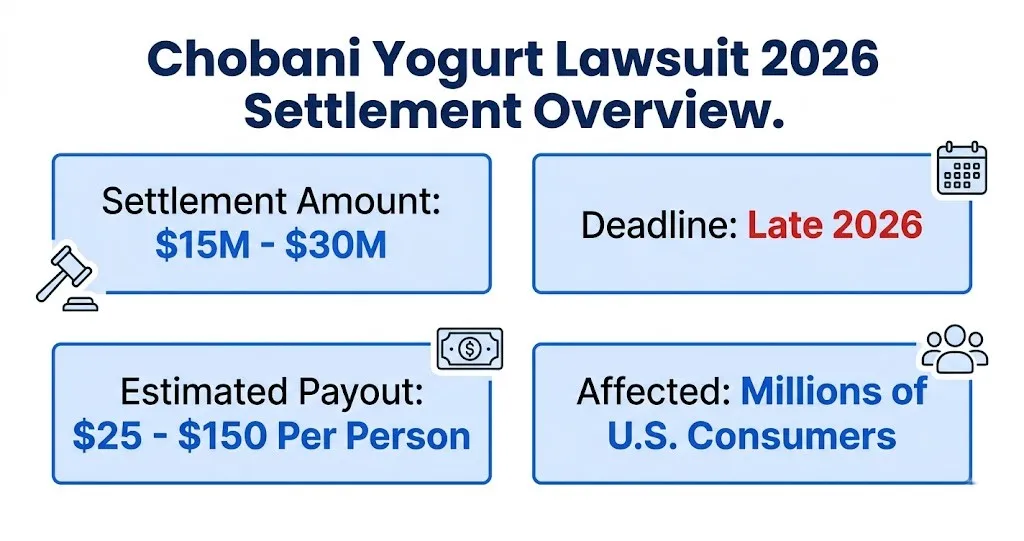
The Chobani lawsuit settlement amount has not been finalized as of early 2026, but court filings and legal analysis suggest the total fund could range between $15 million and $30 million across all active cases.
That range is based on several factors. Food labeling class actions of similar scope have settled in this range historically. Companies like Kellogg’s, General Mills, and Kind Snacks have paid comparable amounts for similar false advertising claims.
Here’s how the settlement fund typically breaks down:
| Allocation | Percentage | Estimated Amount |
|---|---|---|
| Consumer payments | 50% to 60% | $7.5M to $18M |
| Attorney fees | 25% to 33% | $3.75M to $10M |
| Administrative costs | 5% to 10% | $750K to $3M |
| Cy pres (charitable donation) | 5% to 10% | $750K to $3M |
The exact amount will depend on several things: how many claimants file, the final court-approved terms, and whether Chobani agrees to non-monetary relief like label changes.
Non-monetary relief is worth mentioning. In many food labeling settlements, the company agrees to modify its packaging and marketing practices going forward. That’s a win for consumers even beyond the cash payments.
Chobani’s annual revenue exceeds $2 billion. A $15 million to $30 million settlement, while significant, represents a small fraction of the company’s earnings. Courts consider this when evaluating whether a settlement is fair and adequate.
Chobani Lawsuit Payout Per Person
The estimated Chobani lawsuit payout per person is expected to fall between $25 and $150, depending on the number of products purchased, proof submitted, and total claimant count.
That’s the reality of consumer class actions. The per-person payouts aren’t life-changing. But they’re real money, and filing a claim is usually free and takes less than 10 minutes.
Here’s how the math typically works. If the settlement fund is $20 million and 200,000 people file claims, each person gets roughly $100 before adjustments. But if a million people file, that drops to $20 per person.
| Scenario | Fund Size | Claimant Count | Estimated Payout |
|---|---|---|---|
| Low participation | $20M | 100,000 | $100 to $150 |
| Medium participation | $20M | 300,000 | $40 to $65 |
| High participation | $20M | 500,000+ | $25 to $40 |
Your individual payout could be higher if you:
- Purchased large quantities of Chobani products over the covered period
- Have receipts or loyalty card records documenting your purchases
- File your claim early and completely
Some settlements offer tiered payouts. People with proof of purchase get more than those who submit a sworn declaration without receipts. Expect a similar structure here.
Think of it like finding a $50 bill in your coat pocket. It’s not going to pay your rent, but it’s money you’re owed and it takes almost no effort to collect.
How to File a Chobani Yogurt Lawsuit Claim
Filing a Chobani yogurt lawsuit claim is a straightforward process that most people can complete online in under 10 minutes. Once the claims period opens, you’ll submit your information through the official settlement website.
Here’s the step-by-step process based on how similar food product class actions have operated:
Step 1: Visit the official settlement claims website (the URL will be listed in court notices and class action notification mailings).
Step 2: Fill out the online claim form with your name, address, and contact information.
Step 3: Indicate which Chobani products you purchased and the approximate quantity.
Step 4: Upload proof of purchase if you have it (receipts, screenshots of loyalty card history, bank statements showing Chobani purchases).
Step 5: If you don’t have proof, you’ll complete a sworn declaration stating your purchases under penalty of perjury.
Step 6: Submit your claim and save your confirmation number.
| Filing Detail | Info |
|---|---|
| Filing Method | Online (primary), mail (alternative) |
| Cost to File | Free |
| Time Required | 5 to 10 minutes |
| Proof Needed | Receipts preferred, sworn statement accepted |
| Claims Period | Expected to open mid-2026 |
Don’t wait until the last day. Claims filed early are processed first, and if issues arise with your submission, you’ll have time to correct them before the deadline.
You don’t need a lawyer to file. The class action attorneys handle the legal work. Your only job is to submit your claim.
Key Takeaway: Filing a claim is free, fast, and doesn’t require a lawyer. You may not even need receipts, though having them could increase your payout amount.
Chobani Lawsuit Proof of Purchase
Proof of purchase for the Chobani lawsuit can include receipts, loyalty card records, credit card statements, or even a sworn declaration if you don’t have physical documentation. You’re not automatically disqualified just because you threw away your receipts.
Most people don’t save grocery receipts for years. Class action administrators know this. That’s why nearly all food product settlements accept sworn statements as an alternative form of proof.
Here’s what counts as valid proof:
- Paper receipts from grocery stores showing Chobani product purchases
- Digital receipts from online grocery orders (Instacart, Amazon Fresh, Walmart Grocery)
- Loyalty card records from stores like Kroger, Safeway, or Target
- Credit or debit card statements showing transactions at grocery stores during the covered period
- Sworn declaration (a statement under oath that you purchased the products)
| Proof Type | Strength | Payout Impact |
|---|---|---|
| Original receipt with product listed | Strongest | Higher payout tier |
| Digital receipt or online order confirmation | Strong | Higher payout tier |
| Loyalty card or bank statement | Moderate | May qualify for higher tier |
| Sworn declaration (no receipts) | Accepted | Lower payout tier |
One practical tip: check your email for old Instacart or grocery delivery confirmations. Many people have a digital trail they’ve forgotten about. Search your inbox for “Chobani” or the name of your grocery store.
If you used a store loyalty card, call the store’s customer service line. Many retailers can pull purchase history going back several years.
Chobani Yogurt Lawsuit Deadline
The Chobani yogurt lawsuit deadline for filing claims is expected to fall in late 2026 or early 2027, depending on when the court grants final settlement approval. Once the claims window opens, you’ll typically have 60 to 120 days to submit your claim.
Missing the deadline means you lose your right to receive payment. Period. Courts don’t make exceptions for late filers once the window closes.
Here’s the projected timeline based on current case progression:
| Milestone | Projected Date |
|---|---|
| Preliminary settlement approval | Q1 to Q2 2026 |
| Claims period opens | Mid-2026 |
| Objection deadline | 30 days after notice |
| Opt-out deadline | 30 days after notice |
| Final approval hearing | Q3 to Q4 2026 |
| Claims filing deadline | Late 2026 to early 2027 |
| Payments distributed | Q1 to Q2 2027 |
These dates are estimates. Court schedules shift. Judges can delay hearings. Settlement terms get renegotiated. The only way to stay current is to monitor court filings or sign up for notifications through the settlement administrator’s website.
Here’s the critical thing: don’t wait for the deadline to approach before you act. When the claims window opens, file immediately. Early filers avoid the last-minute rush and have time to fix any errors on their forms.
Set a reminder. Mark your calendar. Whatever system works for you. The deadline won’t bend for anyone.
Is Chobani Yogurt Safe to Eat?
Chobani yogurt is generally considered safe to eat based on current FDA standards and has not been recalled or pulled from shelves due to the lawsuits. The legal cases focus on labeling and marketing practices, not an immediate health danger.
That said, “safe” and “honestly labeled” are two different things. A product can be safe to consume while still being marketed in a misleading way. That’s the distinction at the heart of most Chobani lawsuits.
The cancer-related claims are a separate matter. Those cases allege that certain additives may carry long-term health risks. But no regulatory agency has issued warnings about Chobani products specifically.
Key facts about Chobani’s safety status:
- No FDA recall has been issued for any Chobani yogurt product related to these lawsuits
- No CDC health alerts have named Chobani products as a disease risk
- Chobani products remain on store shelves in all major grocery chains
- The lawsuits focus on what consumers were told, not whether the product causes immediate harm
| Safety Question | Current Answer |
|---|---|
| Has Chobani been recalled? | No |
| Is Chobani banned anywhere? | No |
| Are there FDA warnings about Chobani? | No |
| Should I stop eating Chobani? | That’s a personal choice based on your comfort level |
If you have specific dietary concerns or sensitivities to ingredients like carrageenan or certain preservatives, read the current label carefully. The ingredients list on the package is the most reliable guide.
Key Takeaway: Chobani yogurt remains on shelves and hasn’t been recalled. The lawsuits challenge how the product is marketed, not whether it’s immediately dangerous to eat.
Chobani Yogurt Health Risks
The health risks associated with the Chobani yogurt lawsuits relate to specific additives and ingredients, not yogurt itself. Plaintiffs claim that certain substances found in Chobani products may pose long-term health concerns that weren’t adequately disclosed.
Yogurt, as a food category, is widely recognized as nutritious. The issue is what gets added to it during manufacturing and flavoring.
Specific health concerns raised in the lawsuits include:
- Excessive added sugar contributing to obesity, diabetes, and heart disease risk
- Potassium sorbate and its potential impact on cellular DNA based on laboratory studies
- Titanium dioxide (used in some food products for whitening), which the International Agency for Research on Cancer classifies as Group 2B: possibly carcinogenic to humans
- Carrageenan, which some research links to gastrointestinal inflammation
It’s worth noting the difference between laboratory findings and real-world dietary exposure. A substance that damages cells in a petri dish at high concentrations may behave differently when consumed in small amounts through food. This is a central point of debate in the cancer-related lawsuits.
| Ingredient | Alleged Risk | Scientific Consensus |
|---|---|---|
| Added sugars | Metabolic disease | Well-established link |
| Potassium sorbate | DNA damage | Preliminary, lab-based studies only |
| Titanium dioxide | Cancer (Group 2B) | Possible risk, not confirmed |
| Carrageenan | GI inflammation | Mixed evidence |
The health risk claims face the toughest legal battle of all the Chobani lawsuits. Proving causation between a specific food additive and a health outcome is extremely difficult in court.
Chobani Yogurt FDA Investigation
The Chobani yogurt FDA investigation refers to regulatory scrutiny over the company’s labeling practices, particularly its use of terms like “natural” and “evaporated cane juice” on product packaging. The FDA has not launched a formal enforcement action against Chobani, but it has issued industry-wide guidance that directly affects the company.
The FDA’s role in this story is more about setting the rules than punishing Chobani specifically. In 2016, the FDA issued guidance telling food companies to stop using the term “evaporated cane juice” because it misleads consumers into thinking a product contains less sugar than it actually does.
Chobani was one of many companies using that term. The FDA’s guidance forced a labeling update across the industry.
More recently, the FDA has been working on defining the term “healthy” for food labels. This could have major implications for Chobani’s marketing, since several of its products carry health-forward branding.
Key FDA actions relevant to the Chobani lawsuits:
- 2016: Guidance against “evaporated cane juice” terminology
- 2022: Proposed updated definition of “healthy” for food labeling
- 2023: Finalized rule on added sugar disclosure requirements
- 2024 to 2025: Ongoing review of “natural” labeling claims across the food industry
- 2026: Expected enforcement updates on “natural” and “healthy” label terms
| FDA Action | Year | Impact on Chobani |
|---|---|---|
| Evaporated cane juice guidance | 2016 | Forced ingredient label rewording |
| Added sugar disclosure rule | 2023 | Required clearer sugar labeling |
| “Healthy” definition update | 2022 to 2026 | May restrict health-forward marketing |
| “Natural” labeling review | Ongoing | Could require ingredient reformulation |
The FDA investigation isn’t a criminal probe. It’s part of the agency’s ongoing effort to hold food companies accountable for honest labeling. But the regulatory backdrop strengthens the plaintiffs’ case in court.
Key Takeaway: The FDA hasn’t formally charged Chobani, but its evolving labeling rules directly support the claims made in the lawsuits and could force the company to change how it markets its products.
Frequently Asked Questions
How much money will I get from the Chobani yogurt lawsuit?
Most claimants can expect between $25 and $150 depending on the number of products purchased and proof submitted.
The exact amount depends on total claimant participation and the final settlement fund size.
Payments are expected to begin in late 2026 or early 2027.
Do I need a receipt to file a Chobani lawsuit claim?
No, a receipt is not required to file a claim.
You can submit a sworn declaration stating that you purchased Chobani products during the covered period.
However, having receipts or loyalty card records may qualify you for a higher payout tier.
Is the Chobani yogurt cancer lawsuit real?
Yes, lawsuits have been filed alleging that certain additives in Chobani products may carry cancer-related health risks.
These cases are still in early litigation as of 2026 and no settlements have been reached on cancer-specific claims.
No regulatory agency has confirmed that Chobani products cause cancer.
What is the deadline to file a Chobani lawsuit claim in 2026?
The claims filing deadline is expected to fall in late 2026 or early 2027, depending on court approval timelines.
Once the claims window opens, you’ll typically have 60 to 120 days to submit.
Monitor the official settlement website for exact dates once they’re announced.
Which Chobani products are included in the lawsuit?
The lawsuits cover several Chobani product lines including Chobani Greek Yogurt, Chobani Flip, Chobani Less Sugar, Chobani Zero Sugar, and Chobani Smooth.
The covered purchase period is approximately 2019 to 2025.
Specific product eligibility may vary slightly between the different active cases.
The Chobani yogurt lawsuit in 2026 affects millions of consumers who deserve to know their rights. Whether you’re owed $25 or $150, the money is there for those who file.
Check your eligibility based on the product list and purchase dates outlined above. When the claims window opens, file your claim immediately. Don’t leave money on the table because you missed a deadline.
Your next step is simple: gather any purchase records you can find and be ready to act the moment filings go live.
