
The DoD banned book lawsuit is a federal legal challenge targeting the Department of Defense for pulling books from school libraries on military bases. This case affects military families worldwide whose children attend DoDEA schools.
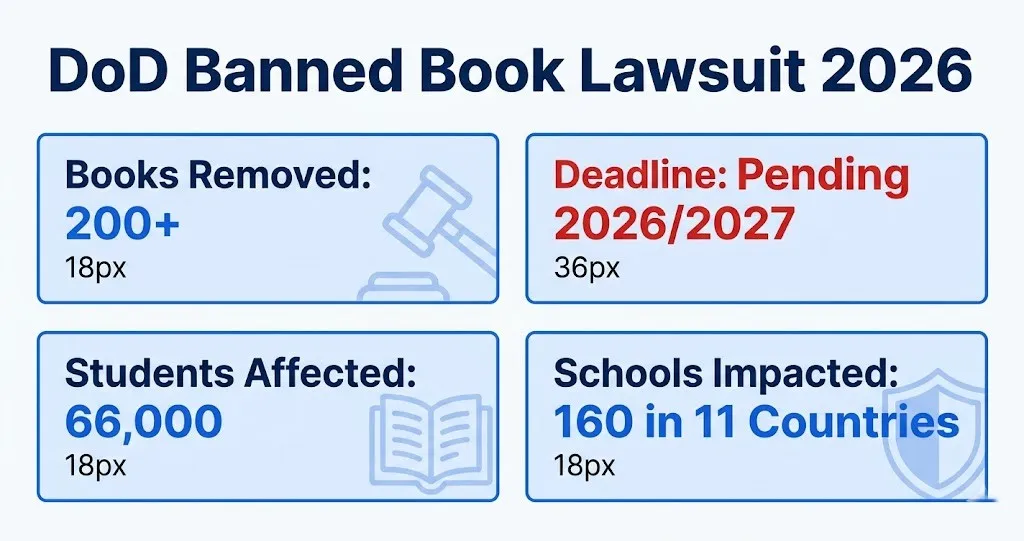
As of 2026, the lawsuit alleges that the Pentagon violated students’ First Amendment rights by removing books based on political pressure rather than educational standards. Over 200 titles have reportedly been pulled from DoDEA library shelves across multiple continents.
This article covers every angle of the case. You’ll find the latest 2026 updates, a breakdown of the banned books list, who filed the lawsuit, and whether military families can get involved.
The stakes here are real. Roughly 66,000 students attend DoDEA schools in the U.S. and overseas, and this case could reshape how the federal government handles library content in every one of those schools.
DoD Banned Book Lawsuit
The DoD banned book lawsuit is a federal case challenging the Department of Defense’s decision to remove books from DoDEA school libraries based on content objections. It was filed in U.S. federal court by a coalition of parents, authors, and free speech organizations.
The core claim is straightforward. The government removed books not because they were educationally inappropriate but because certain political figures and advocacy groups found them objectionable.
| Detail | Info |
|---|---|
| Case Type | First Amendment / Civil Liberties |
| Defendant | Department of Defense / DoDEA |
| Plaintiffs | Military parents, authors, advocacy groups |
| Court | U.S. Federal District Court |
| Books Affected | 200+ titles removed |
| Students Impacted | Approximately 66,000 |
This isn’t a typical product liability or consumer class action. It’s a constitutional challenge. The plaintiffs argue that the book removals amount to government censorship, which would violate the First Amendment even in a military education context.
What makes this case unique is jurisdiction. DoDEA schools are federally run. That means the usual state-level book ban fights don’t apply here. The federal government is both the school operator and the defendant.
The case has drawn attention from civil liberties organizations, library advocacy groups, and military family associations, all of whom see the outcome as a potential precedent for government-run educational institutions.
DoD Banned Book Lawsuit Update 2026
As of mid-2026, the DoD banned book lawsuit remains active in federal court. The case has survived initial motions to dismiss, and discovery is underway.
The judge denied the government’s argument that book selection is purely an administrative decision outside judicial review. That ruling was a significant win for the plaintiffs because it means the court will examine the reasons behind each book removal.
Key 2026 milestones include:
- Early 2026: Motion to dismiss denied
- Spring 2026: Discovery phase begins; DoDEA ordered to produce internal communications about book removal decisions
- Summer 2026: Depositions of DoDEA officials scheduled
- Late 2026: Summary judgment motions expected
Internal emails and memos are now being reviewed. Early reports suggest that some book removals were prompted by political pressure from members of Congress rather than standard review processes.
A trial date has not been set yet. Legal experts expect that if summary judgment doesn’t resolve the case, a trial could happen in early 2027.
The plaintiffs have also asked for a preliminary injunction to restore some of the removed books while the case proceeds. That motion is still pending as of this writing.
Department of Defense Book Ban
The Department of Defense book ban refers to DoDEA’s systematic removal of books from school libraries at military installations. The removals began in earnest around 2023 and escalated through 2024 and 2025.
DoDEA operates 160 schools across 8 districts in 11 countries. It serves children of active-duty military personnel, DoD civilians, and eligible family members. When books disappear from these shelves, there’s often no local school board to appeal to.
The ban didn’t happen in a vacuum. Congressional pressure played a direct role. Several lawmakers sent letters to the Secretary of Defense demanding that certain titles be reviewed and removed.
Books were flagged for content related to:
- Race and racial identity
- LGBTQ+ themes and characters
- Gender identity
- Sexual education
- Social justice topics
Unlike local school districts where parents can attend board meetings and challenge decisions, DoDEA operates under federal authority. Families stationed overseas have even fewer avenues to push back. That power imbalance is one reason the lawsuit gained traction so quickly.
The Pentagon has maintained that the removals followed a standard review process. Plaintiffs counter that the “review process” was created specifically to justify politically motivated removals.
Key Takeaway: The DoD banned book lawsuit is a live federal case in 2026 that challenges the removal of over 200 books from military school libraries, with discovery revealing that political pressure may have driven the removals.
Who Filed the DoD Book Ban Lawsuit
The lawsuit was filed by a coalition of military parents, published authors whose books were removed, and free speech organizations. PEN America played a central organizing role in bringing the case forward.
The named plaintiffs include parents stationed at military bases in the U.S. and abroad. Several are active-duty service members whose children lost access to books they were actively reading for school assignments.
| Plaintiff Category | Examples |
|---|---|
| Military Parents | Active-duty families at U.S. and overseas bases |
| Authors | Writers whose books were pulled from DoDEA shelves |
| Organizations | PEN America, with support from ACLU and ALA |
| Legal Representation | Pro bono civil rights attorneys |
The authors involved have described the experience as chilling. One plaintiff author noted that having a book removed from a military school library sends a message that certain stories and identities aren’t welcome in military communities.
Legal representation comes from experienced First Amendment litigators. The legal team has handled previous book ban cases in state courts and brought that expertise to the federal level.
What’s notable is the diversity of the plaintiff group. These aren’t just activists. They’re military families who understand the chain of command and still chose to challenge it in court. That takes a specific kind of courage in a community where rocking the boat can have career consequences.
DoD Banned Books List
The DoD banned books list includes over 200 titles that were removed from DoDEA school libraries. The list spans picture books, young adult novels, nonfiction, and classic literary works.
Some of the most widely reported removed titles include:
- “Gender Queer” by Maia Kobabe (memoir about gender identity)
- “All Boys Aren’t Blue” by George M. Johnson (memoir)
- “The Hate U Give” by Angie Thomas (young adult fiction about race and police violence)
- “Stamped: Racism, Antiracism, and You” by Jason Reynolds and Ibram X. Kendi
- “And Tango Makes Three” by Justin Richardson (picture book about same-sex penguin parents)
- “Beloved” by Toni Morrison (Pulitzer Prize-winning novel)
The books share common threads. Most deal with race, gender identity, sexual orientation, or social justice.
Several titles on the list have won major literary awards. “Beloved” won the Pulitzer Prize. “The Hate U Give” was a National Book Award finalist. Removing award-winning literature from school libraries raised particular alarm among educators and literary organizations.
DoDEA has not published an official public list of all removed books. The full scope of removals has been pieced together through Freedom of Information Act (FOIA) requests, parent reports, and librarian testimony.
The breadth of the list is part of the legal argument. Plaintiffs contend that the sheer number and pattern of removals demonstrates viewpoint discrimination rather than case-by-case educational review.
DoDEA Book Removal Lawsuit
The DoDEA book removal lawsuit specifically targets the process DoDEA used to pull books from library shelves. The claim is that the process was pretextual, designed to create an appearance of legitimate review while executing politically motivated censorship.
Under normal circumstances, school libraries follow collection development policies. These policies set criteria for adding and removing books based on age-appropriateness, educational value, and community standards.
The plaintiffs argue DoDEA did something different. They say the agency:
- Created a rushed review process in response to congressional demands
- Used vague criteria like “controversial content” instead of established standards
- Failed to involve librarians or educators in final removal decisions
- Did not provide families with notice or appeal options
Court filings describe a timeline where congressional letters arrived, and within weeks, books began disappearing from shelves. That speed, the plaintiffs argue, is inconsistent with genuine educational review.
DoDEA counters that it has the authority to manage its own library collections. The agency says it followed internal guidelines and that the removals were within its discretion.
The court will need to decide whether DoDEA’s review process was a genuine exercise of educational judgment or a rubber stamp for political censorship. That distinction is at the heart of First Amendment case law around school libraries.
Key Takeaway: The plaintiffs allege DoDEA’s book removal process was a sham, created under political pressure and executed without meaningful input from educators or librarians.
DoD Book Removal Policy
The DoD book removal policy that DoDEA followed during the contested removals has come under intense scrutiny. On paper, DoDEA has a collection management policy that allows periodic review of library materials.
Before the controversy, that policy worked like most school library systems. Librarians would evaluate books based on professional standards, curriculum alignment, and reading level. Challenges from parents could trigger a formal review by a committee.
That changed when external political pressure entered the picture. The revised process, according to court filings, looked like this:
| Step | Pre-Controversy Process | Post-Controversy Process |
|---|---|---|
| Trigger | Parent complaint or routine review | Congressional letter or media coverage |
| Review Body | Librarian-led committee | DoDEA administrative officials |
| Criteria | Age-appropriateness, curriculum fit | “Controversial content” label |
| Timeline | Weeks to months | Days to weeks |
| Appeal Option | Yes, formal process | No clear process available |
| Librarian Input | Central to decision | Minimal or bypassed |
The contrast is stark. A system that once relied on professional expertise shifted to one driven by political responsiveness.
Plaintiffs point to this shift as evidence that the removals weren’t about protecting students. They were about satisfying political demands.
DoDEA has said it plans to update its policies regardless of the lawsuit’s outcome. Whether those updates will address the core concerns remains to be seen.
DoDEA Library Censorship
DoDEA library censorship is the term free speech advocates use to describe the pattern of book removals across military school libraries. They argue the removals constitute government censorship because DoDEA is a federal agency restricting access to constitutionally protected expression.
This framing matters legally. Government censorship triggers strict First Amendment scrutiny. If DoDEA’s actions qualify as censorship, the government must prove a compelling interest and show it used the least restrictive means available.
The American Library Association (ALA) has tracked DoDEA’s actions alongside the broader national book ban movement. ALA reported a record number of book challenges across the U.S. in recent years, and DoDEA’s removals fit the same pattern.
What sets DoDEA apart from local school districts is the power dynamic. Military families can’t simply show up at a school board meeting. There is no elected school board. Decisions come from appointed officials in the Pentagon.
For families stationed overseas, the isolation is even greater. A parent at a base in Germany or Japan has no local alternative. The DoDEA school library might be the only English-language library their child can access.
That captive audience reality strengthens the plaintiffs’ argument. When the government controls the only available library, removing books from it carries more weight than a local school board doing the same thing.
DoD Book Ban First Amendment
The DoD book ban raises serious First Amendment questions about government censorship in educational settings. The First Amendment protects the right to receive information, and courts have recognized that this right extends to students in school libraries.
The landmark case here is Board of Education v. Pico (1982). In that Supreme Court decision, the justices ruled that school boards cannot remove books from libraries simply because they dislike the ideas in them.
Key First Amendment principles at play:
- Viewpoint discrimination is presumptively unconstitutional
- Students have a right to receive information and ideas
- Government actors cannot remove library books based on political disagreement with their content
- The “right to read” is a recognized constitutional interest
The DoD case applies Pico’s framework to a federal agency. If a local school board can’t remove books for political reasons, can the Pentagon? The plaintiffs say no.
The government’s defense rests on the argument that DoDEA has broader authority than local school boards because it operates under federal military education mandates. They argue that military readiness and community standards give DoDEA more discretion.
Legal scholars have noted that this argument is risky for the government. If the court agrees that federal agencies have more censorship power than local school boards, it could set a troubling precedent for government-run institutions of all kinds.
Key Takeaway: The Pico standard from 1982 says schools can’t remove books just because officials dislike the ideas in them, and plaintiffs are pushing to apply this same rule to the Pentagon.
Military School Book Ban
The military school book ban affects roughly 66,000 students attending DoDEA schools at bases in the continental U.S., Europe, the Pacific, and the Middle East. These students had no say in whether their library shelves were cleared.
For military kids, school libraries serve a function beyond academics. Military children relocate an average of six to nine times during their K-12 years. Libraries become one of the few constants. Losing access to familiar books during a transfer can feel like losing a lifeline.
| Impact Area | Details |
|---|---|
| Students Affected | ~66,000 across DoDEA |
| Schools Impacted | 160 schools in 11 countries |
| Average Student Relocations | 6 to 9 during K-12 |
| Library Access Alternatives | Often none, especially overseas |
Teachers have reported curriculum disruptions. Some assigned books were pulled mid-semester, leaving educators scrambling for alternatives. Reading programs that relied on specific titles had to be restructured.
Student reactions have been mixed, according to parent testimony. Some older students organized informal book-sharing networks. Others expressed frustration and confusion about why their books disappeared.
Military family advocacy groups, including Blue Star Families, have expressed concern that the ban sends the wrong message to children of service members. The implicit message, advocates say, is that the government that their parents serve doesn’t trust them to read freely.
Military Families Book Ban Rights
Military families have specific rights regarding their children’s education, even within the DoDEA system. Federal law requires DoDEA to provide an education comparable to the best school systems in the United States.
That comparability standard is important. If the best school districts in the country are not banning these books, then DoDEA’s removals arguably violate its own mandate.
Rights that military families can assert include:
- First Amendment protections that apply to all U.S. citizens, including military dependents
- DoDEA’s own policies requiring age-appropriate, diverse, and educationally valuable library collections
- Federal education standards mandating comparable quality to top U.S. school districts
- The right to challenge book removals through formal complaint processes (though the current process is under legal challenge)
Families stationed overseas face additional hurdles. They may not have access to alternative libraries, bookstores, or digital lending programs. Their children are a captive audience for DoDEA’s decisions.
Some parents have organized informally. At several bases, families have created “free little libraries” on their own front porches, stocking them with the removed titles. These grassroots efforts have become symbols of resistance within military communities.
The lawsuit itself is, in many ways, an exercise of those rights. Parents who joined as plaintiffs are asserting that being part of the military community doesn’t mean surrendering their children’s right to read.
How to Join the DoD Book Ban Lawsuit
Military families who want to support the DoD book ban lawsuit have several options, though direct participation depends on the case structure. The lawsuit was filed by named plaintiffs, and it isn’t structured as a traditional class action with open enrollment.
Here’s what families can do:
| Action | How It Works |
|---|---|
| Contact Plaintiff Organizations | Reach out to PEN America or ACLU to express interest |
| Submit a Declaration | Provide a written statement about how book removals affected your family |
| Document Removals | Record which books were removed from your child’s school library |
| Attend Public Hearings | If the court holds public proceedings, attend or submit public comments |
| Support Advocacy Groups | Join organizations tracking and fighting the removals |
Families who want to become named plaintiffs would need to work with the legal team. This typically requires demonstrating direct harm, such as a child who lost access to a specific book at a specific DoDEA school.
Even if you don’t become a formal plaintiff, your story matters. Courts consider the breadth of impact when evaluating cases like this. Declarations from affected families strengthen the record.
One practical note: active-duty service members considering participation should understand that military regulations protect the right to participate in lawsuits. Retaliation for joining a civil rights lawsuit is prohibited under federal law.
Key Takeaway: The DoD book ban lawsuit isn’t a class action you can simply “join,” but military families can support it by contacting PEN America, documenting book removals, and submitting declarations to the legal team.
DoDEA School Library Lawsuit
The DoDEA school library lawsuit is distinct from other book ban cases because it targets a federally operated school system rather than a local district. This federal dimension gives the case national significance regardless of the specific court ruling.
Unlike local school board cases, there’s no elected body to vote out. DoDEA answers to the Secretary of Defense and, ultimately, the President. That chain of command means the political dynamics are completely different from a suburban school board fight.
The lawsuit was filed in U.S. District Court. The specific venue matters because federal judges handle constitutional claims differently than state courts. Federal judges also have lifetime appointments, which can insulate them from political pressure when ruling on controversial cases.
Key procedural details of the case:
- Filed: Federal district court
- Case type: Civil rights / First Amendment
- Relief sought: Injunctive relief (return the books) and declaratory judgment (ruling that removals were unconstitutional)
- Damages: The primary ask is not monetary; it’s policy change
- Class certification: Not sought; named plaintiffs only
The fact that the plaintiffs are primarily seeking injunctive relief rather than money changes the case dynamics. This isn’t about payouts. It’s about getting books back on shelves and preventing future politically motivated removals.
If the plaintiffs win, the court order would likely require DoDEA to restore removed books and establish a transparent, educator-led review process going forward.
Pentagon Book Ban Legal Challenge
The Pentagon book ban legal challenge puts the Defense Department in an unusual position. The Pentagon is accustomed to defending national security decisions in court, not library policies.
Legal experts have noted the irony. The military defends constitutional freedoms abroad while being accused of restricting them at home, specifically for the children of the people doing the defending.
The government’s legal strategy has focused on two main arguments:
- Administrative discretion: DoDEA has the authority to manage its educational programs, including library collections, without judicial interference.
- Curriculum control: The government argues that library content decisions are part of curriculum design, which traditionally receives deference from courts.
The plaintiffs counter both points. On discretion, they cite Pico and argue that discretion doesn’t extend to politically motivated censorship. On curriculum, they point out that library books are supplementary resources, not assigned textbooks, and deserve different legal treatment.
One wildcard in the case is the political environment. If the administration changes its stance on book removals, the case could become moot. But the plaintiffs have asked the court to issue a ruling regardless, to establish precedent that would survive future political shifts.
The case is being closely watched by legal scholars, civil liberties organizations, and school library advocates nationwide. A ruling here could influence how every government-run educational institution handles library content decisions.
DoD Book Ban Settlement
As of 2026, there is no settlement in the DoD book ban case. The parties have not entered formal settlement negotiations, and the case continues through the discovery phase.
Settlement in a case like this would look very different from a typical consumer lawsuit. Since the plaintiffs aren’t primarily seeking money, a settlement would likely involve policy changes rather than a payout fund.
| Settlement Scenario | What It Could Include |
|---|---|
| Full Settlement | Return all removed books; new transparent review policy; educator-led review committees; regular reporting requirements |
| Partial Settlement | Return some books; revised policy with federal oversight |
| No Settlement (Trial) | Court-ordered remedy if plaintiffs win; potential appeal |
| Government Wins | Removals stand; precedent favoring agency discretion |
If the government decided to settle, it would likely want to avoid a court ruling that limits its authority over DoDEA operations. A negotiated agreement would give the Pentagon more control over the final terms.
For plaintiffs, settlement has risks too. A settlement doesn’t create legal precedent the way a court ruling does. If the goal is to protect all government-run school libraries going forward, a judicial opinion carries far more weight than a private agreement.
Legal observers consider a settlement unlikely in the near term. Both sides appear committed to litigating the core constitutional questions. The discovery phase is producing significant evidence, and neither party has signaled willingness to negotiate.
Key Takeaway: No settlement exists yet in the DoD book ban case, and if one happens, it would likely involve policy reforms and book restorations rather than financial payouts to families.
Banned Books Military Schools List
The complete banned books military schools list continues to grow as more information emerges through discovery and FOIA requests. The list is not a single official document from DoDEA but rather a compiled record from multiple sources.
Books removed from DoDEA libraries fall into several categories:
| Category | Examples | Number of Titles |
|---|---|---|
| LGBTQ+ Themes | “Gender Queer,” “All Boys Aren’t Blue” | 60+ |
| Racial Justice | “The Hate U Give,” “Stamped” | 50+ |
| Sexual Health/Education | Various health and puberty books | 30+ |
| Classic Literature | “Beloved,” “The Bluest Eye” | 20+ |
| Other | Various titles flagged for “mature content” | 40+ |
The categorization reveals a pattern. The overwhelming majority of removed books deal with race, gender, or sexuality. Very few books were removed for reasons unrelated to these themes.
That pattern is central to the plaintiffs’ case. If the removals targeted books based on their viewpoint rather than their educational quality, that’s textbook viewpoint discrimination under the First Amendment.
Parents and librarians have reported that some books were removed without any formal notification. In several cases, students went to check out a book and found it simply gone from the catalog. No explanation was given.
PEN America has maintained a running database of the removed titles. The American Library Association has cross-referenced DoDEA removals with its national index of challenged and banned books. The overlap is nearly total, suggesting DoDEA followed the same playbook as the most aggressive local book ban campaigns.
Frequently Asked Questions
What is the DoD banned book lawsuit about?
The DoD banned book lawsuit challenges the removal of over 200 books from DoDEA school libraries on military bases.
Plaintiffs allege the Pentagon removed books based on political pressure, not educational judgment.
The case raises First Amendment questions about government censorship in federally run schools.
Which books were banned from DoD schools?
Over 200 titles were removed, including “Gender Queer,” “The Hate U Give,” “Beloved,” and “Stamped.”
Most removed books address race, gender identity, LGBTQ+ themes, or social justice.
Several are award-winning works recognized by the Pulitzer Prize and National Book Award.
Can military families join the DoD book ban lawsuit?
The lawsuit is not structured as a class action, so families cannot simply enroll online.
However, families can contact PEN America or the ACLU to submit declarations and document book removals.
Active-duty families are legally protected from retaliation for participating in civil rights lawsuits.
Is there a settlement in the DoD banned book case?
As of 2026, there is no settlement in the case.
Both sides are in the discovery phase, and neither has signaled willingness to negotiate.
If a settlement occurs, it would likely involve policy reforms and book restorations rather than financial payments.
What happens if the DoD loses the book ban lawsuit?
If the DoD loses, a federal court could order all removed books returned to DoDEA library shelves.
The court could also require DoDEA to adopt a transparent, educator-led book review process.
A ruling against the Pentagon would set a precedent for all federally operated educational institutions.
This case sits at the intersection of military life, parental rights, and constitutional freedom. The outcome will affect tens of thousands of military children and could reshape how the federal government handles library content decisions.
If your family has been affected by DoDEA book removals, document everything. Save communications, note which books disappeared, and reach out to advocacy organizations tracking the case.
Stay informed as the case moves through discovery and toward potential trial in 2027. Your voice and your records could make a real difference.
