
The Justin Baldoni lawsuit has become one of the most closely watched legal battles in Hollywood history. What started as behind-the-scenes tension on the set of It Ends With Us has exploded into multiple lawsuits involving defamation claims, sexual harassment allegations, and a $250 million suit against The New York Times.
As of 2026, there are now several overlapping legal actions. Baldoni is suing. Lively is suing. Ryan Reynolds is named as a defendant. The New York Times is fighting back.
This article breaks down every lawsuit, every claim, and every development. You’ll find timelines, court dates, dismissed motions, and what legal experts say about where this case lands. Whether you’re following the celebrity drama or studying the legal strategy, this is the most complete picture available right now.
What Is the Justin Baldoni Lawsuit About
The Justin Baldoni lawsuit refers to a web of legal actions tied to the 2024 film It Ends With Us. At its core, the dispute involves allegations of defamation, sexual harassment, retaliation, and a coordinated smear campaign.
Baldoni directed and starred in the film alongside Blake Lively. After production wrapped, their professional relationship fell apart publicly. Lively accused Baldoni of sexual harassment and creating a hostile work environment. Baldoni fired back with claims that Lively and her husband Ryan Reynolds orchestrated a PR attack to destroy his reputation.
| Party | Role | Primary Claims |
|---|---|---|
| Justin Baldoni | Director/Actor | Defamation, civil extortion, tortious interference |
| Blake Lively | Actress/Producer | Sexual harassment, retaliation, hostile work environment |
| Ryan Reynolds | Actor (Lively’s husband) | Named as co-defendant in Baldoni’s defamation suit |
| The New York Times | Publisher | Named in $250M defamation suit by Baldoni |
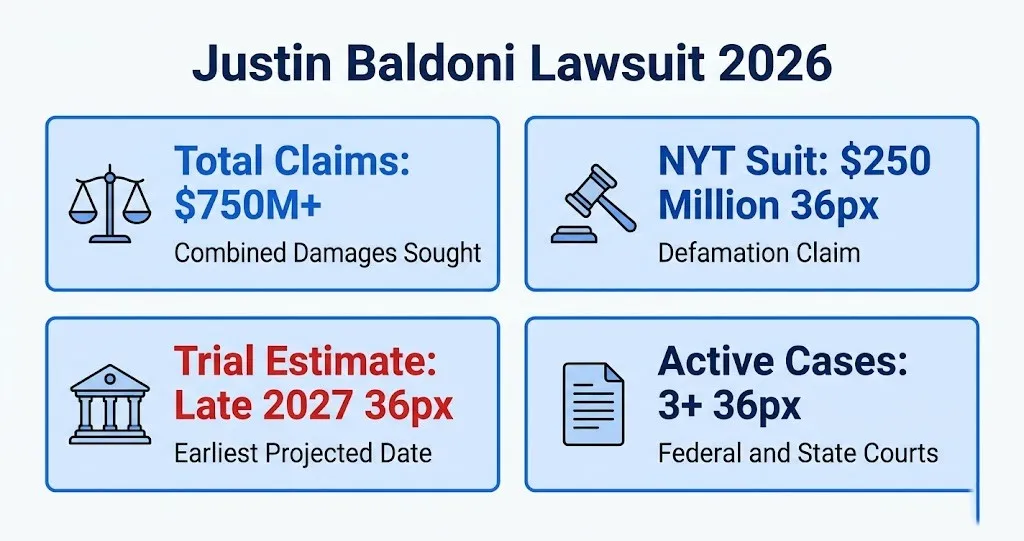
The stakes are enormous. Combined, the lawsuits involve claims exceeding $750 million in damages. This isn’t just a celebrity spat. It’s a legal war with real consequences for defamation law, media accountability, and workplace harassment standards in the entertainment industry.
Justin Baldoni Lawsuit Update 2026
The biggest development in the Justin Baldoni lawsuit update for 2026 is the progression of the federal defamation case against The New York Times. That case has moved past initial motions and entered the discovery phase.
In early 2026, Baldoni’s legal team, led by attorney Bryan Freedman, secured a key ruling allowing the case to proceed. The court found that Baldoni’s complaint stated enough factual allegations to survive a motion to dismiss on several counts.
Meanwhile, Blake Lively’s federal complaint against Baldoni moved forward in the U.S. District Court for the Southern District of New York. The judge set a schedule for depositions and document exchanges.
Key 2026 developments include:
- January 2026: Lively’s legal team filed amended claims adding new allegations
- February 2026: Baldoni’s NYT defamation case survived partial motion to dismiss
- Spring 2026: Discovery phase opened in both federal cases
- Mid-2026: Depositions expected for key witnesses including publicists Melissa Nathan and Jennifer Abel
Both sides have been aggressive in public filings. Neither party shows interest in backing down.
Ryan Reynolds and Justin Baldoni Lawsuit Explained
Ryan Reynolds is directly named in Justin Baldoni’s lawsuit. Baldoni alleges that Reynolds played an active role in a coordinated campaign to destroy his career and reputation.
According to Baldoni’s complaint, Reynolds helped craft public narratives that painted Baldoni as a predator. The filing claims Reynolds used his massive social media platform and industry influence to isolate Baldoni professionally.
Baldoni’s legal team pointed to specific text messages and communications. They allege Reynolds was involved in strategy sessions about how to “bury” Baldoni during the It Ends With Us press tour in mid-2024.
Reynolds has pushed back through his attorneys. His legal team argues that Reynolds was simply supporting his wife, Blake Lively, who had raised legitimate workplace concerns. They characterize Baldoni’s claims as an attempt to silence a harassment victim.
| Allegation by Baldoni | Reynolds’ Defense |
|---|---|
| Coordinated smear campaign | Supported wife’s legitimate complaints |
| Used social media influence to harm Baldoni | Protected family from retaliation |
| Participated in PR strategy against Baldoni | Exercised free speech rights |
| Interfered with Baldoni’s business relationships | No direct business interference |
The question of Reynolds’ involvement could be pivotal. If the court finds he actively participated in a campaign beyond simply supporting Lively, it changes the legal calculus dramatically.
Key Takeaway: Three separate but overlapping lawsuits now define this dispute, with combined damage claims exceeding $750 million and the discovery phase opening across multiple cases in 2026.
Ryan Reynolds and Justin Baldoni Defamation Lawsuit
The defamation claims sit at the heart of what Baldoni is arguing. He says Reynolds and Lively made false statements that damaged his career, his production company Wayfarer Studios, and his personal reputation.
Under New York defamation law, Baldoni must prove specific elements. Because he is a public figure, the standard is higher. He must show that false statements were made with “actual malice”, meaning the defendants knew the statements were false or acted with reckless disregard for the truth.
Baldoni’s filing identifies several allegedly defamatory statements. These include characterizations of him as a sexual predator, claims about his on-set behavior, and allegations about his crisis PR tactics.
The actual malice standard is a tough bar to clear. Think of it like this: it’s not enough to prove someone said something mean about you. You have to prove they knew it was a lie when they said it, or that they didn’t care whether it was true.
- Defamation per se claims allege statements so harmful they don’t require proof of specific damages
- Defamation per quod claims require showing actual financial losses
- Baldoni’s complaint includes both categories
- Specific monetary losses cited include cancelled production deals and lost endorsements
Reynolds’ attorneys have signaled they may pursue anti-SLAPP protections. These laws are designed to prevent lawsuits that punish people for exercising their right to free speech on public issues.
Justin Baldoni and Blake Lively Lawsuit
The Justin Baldoni and Blake Lively lawsuit is really two lawsuits running on parallel tracks. Lively filed sexual harassment claims against Baldoni. Baldoni filed defamation claims against Lively.
Lively’s initial complaint, filed in late 2024, accused Baldoni of inappropriate behavior on set. She described unwanted physical contact, comments about her body, and attempts to show her explicit material. She also claimed Baldoni retaliated against her when she raised concerns.
Baldoni categorically denied all harassment allegations. His countersuit accused Lively of fabricating claims to gain leverage in a business dispute over the film’s creative direction.
The two cases paint completely different pictures of what happened on set. One person’s version of events cannot coexist with the other’s. Someone is lying, and the courts will eventually have to sort that out.
| Lively’s Allegations | Baldoni’s Response |
|---|---|
| Unwanted physical contact on set | Denies all physical misconduct |
| Showed inappropriate material | Claims interactions were professional |
| Created hostile work environment | Says Lively sought creative control |
| Retaliated after complaints | Says Lively initiated the public attack |
Industry observers have noted how unusual this case is. Dueling lawsuits between a lead actress and director of a major studio film are virtually unprecedented at this scale.
Justin Baldoni and the It Ends With Us Lawsuit
The film It Ends With Us is where everything started. Based on Colleen Hoover’s bestselling novel, the movie was supposed to be a straightforward hit. It grossed over $350 million worldwide at the box office in 2024.
But behind the scenes, the production was fracturing. Reports emerged of creative disagreements between Baldoni (director) and Lively (lead actress and producer). Lively allegedly pushed for more control over the film’s marketing and final cut.
The promotional tour became visibly awkward. Lively and Baldoni did not appear together for press. Social media picked up on the tension immediately. Cast members appeared to “side” with Lively in their public appearances.
Sony Pictures, the film’s distributor, has stayed largely out of the legal crossfire. But the studio’s internal communications may become relevant during discovery. Both legal teams have indicated interest in obtaining Sony’s records about the film’s production and marketing decisions.
The irony hasn’t been lost on anyone. It Ends With Us tells the story of a woman leaving an abusive relationship. The real-life legal battle between its star and director now centers on allegations of harassment and abuse of power. That connection has made the case a flashpoint in broader cultural conversations about workplace safety in Hollywood.
Defamation Lawsuit Between Ryan Reynolds and Baldoni
The defamation claims between Reynolds and Baldoni deserve separate analysis from the broader case. Baldoni’s suit specifically accuses Reynolds of tortious interference with business relationships.
This legal claim goes beyond saying bad things. It means Baldoni alleges Reynolds took deliberate steps to damage Baldoni’s professional deals and partnerships.
According to the complaint, after the public fallout from It Ends With Us, Baldoni lost multiple projects. Wayfarer Studios saw partners pull out. Talent agencies reportedly dropped Baldoni. The suit argues Reynolds’ public and private actions directly caused these losses.
- Baldoni claims Reynolds contacted industry figures to discourage working with him
- The filing alleges Reynolds used his production company, Maximum Effort, as leverage
- Specific lost deals are cited, though dollar amounts are partially redacted in public filings
- Reynolds’ team calls these claims “baseless and retaliatory”
Tortious interference is notoriously difficult to prove. You need to show a valid business relationship existed, the defendant knew about it, the defendant intentionally interfered, and you suffered damages as a result. Each element requires concrete evidence, not just suspicion.
Key Takeaway: Baldoni’s defamation claims against both Reynolds and Lively hinge on proving actual malice, a high legal standard that requires showing defendants knew their statements were false or didn’t care about the truth.
Justin Baldoni Lawsuit Against the NY Times
Justin Baldoni’s lawsuit against the NY Times is a $250 million defamation action. It’s one of the largest defamation suits filed against a major U.S. newspaper in recent years.
The suit targets a December 2024 New York Times article that detailed Lively’s harassment allegations. Baldoni’s complaint claims the article was one-sided, relied on selectively edited text messages, and presented an intentionally misleading narrative.
Baldoni’s lawyers argue the Times violated basic journalistic standards. They say the paper failed to include Baldoni’s full responses, took communications out of context, and coordinated with Lively’s PR team in crafting the story.
| Claim Against NYT | NYT’s Defense |
|---|---|
| Published misleading text message excerpts | Published newsworthy, accurate reporting |
| Failed to include Baldoni’s full response | Gave Baldoni opportunity to comment |
| Coordinated with Lively’s legal team | Standard source communications |
| Defamation causing $250M in damages | Protected by First Amendment |
The New York Times has vigorously defended the article. The paper filed a motion to dismiss, calling the suit an attempt to chill press freedom. The Times pointed to its editorial process and argued the article was thoroughly fact-checked.
This case has attracted attention from media law experts and First Amendment scholars. The outcome could set important precedents about how newspapers report on harassment allegations in the #MeToo era.
Justin Baldoni New York Times Lawsuit Details
The specifics of the New York Times lawsuit reveal just how granular Baldoni’s legal strategy has become. His complaint runs over 80 pages and identifies dozens of allegedly false or misleading statements.
Central to the suit are text messages between Baldoni’s former publicists, Melissa Nathan and Jennifer Abel, and Baldoni himself. The Times published excerpts of these messages that appeared to show Baldoni’s team planning a retaliatory PR campaign against Lively.
Baldoni’s lawyers argue those texts were cherry-picked. They say the full message threads, when read in context, show a standard crisis PR response to false allegations, not a coordinated attack.
Key claims in the NYT suit include:
- The article falsely implied Baldoni orchestrated a “social manipulation” campaign
- Text messages were taken out of chronological order to create a false impression
- The Times failed to investigate Lively’s claims independently
- Reporter contacts with Lively’s attorney Roberta Kaplan show improper coordination
The discovery phase in this case could be explosive. Baldoni’s team wants access to all communications between the Times reporters and Lively’s legal and PR teams. The Times is fighting to protect source confidentiality under journalist shield laws.
This tension between defamation claims and press freedom makes the case legally significant well beyond Hollywood gossip. Legal scholars are watching closely.
Justin Baldoni Defamation Case in 2026
The Justin Baldoni defamation case has reached a critical phase in 2026. The courts have ruled on preliminary motions, and the litigation is now in active discovery.
For Baldoni to win any of his defamation claims, he faces the actual malice standard established by the Supreme Court in New York Times Co. v. Sullivan (1964). As a public figure, Baldoni can’t simply prove the statements were false. He must prove the defendants either knew the statements were lies or showed reckless disregard for the truth.
In practical terms, this means Baldoni’s lawyers need a smoking gun. They need internal emails, texts, or testimony showing Lively, Reynolds, or the Times knew the accusations were false when they made or published them.
| Legal Standard | What Baldoni Must Prove |
|---|---|
| False statement of fact | The statements weren’t opinions or true |
| Publication to third parties | The statements were shared publicly |
| Actual malice | Defendants knew the statements were false |
| Damages | Specific financial and reputational harm |
Legal analysts are divided on Baldoni’s chances. Some believe the text message evidence could support his claims. Others argue that the public figure standard creates an almost insurmountable barrier, especially against a news organization like the Times.
The 2026 calendar will be decisive. Key depositions and document productions are scheduled for the second and third quarters of the year.
Key Takeaway: Baldoni’s $250 million suit against The New York Times is now in discovery, with both sides fighting over access to communications that could determine whether the paper’s reporting meets the legal definition of actual malice.
Was the Justin Baldoni Lawsuit Dismissed
Parts of the Justin Baldoni lawsuit were dismissed, but the core claims survived. This is a critical distinction that many headlines have gotten wrong.
In Lively’s federal case against Baldoni, a judge dismissed certain state-law claims that overlapped with federal jurisdiction. However, the primary sexual harassment and retaliation claims remained intact. The court ruled Lively had stated sufficient facts to proceed.
On Baldoni’s side, his defamation suit against the Times survived a partial motion to dismiss. The court found that at least some of the allegedly defamatory statements were specific enough to be actionable. Other claims, characterized as opinion rather than fact, were thrown out.
Here’s the breakdown of what stayed and what went:
- Survived: Core defamation claims against NYT regarding specific factual statements
- Survived: Lively’s sexual harassment allegations against Baldoni
- Dismissed: Certain state-law claims in Lively’s federal suit (procedural, not substantive)
- Dismissed: Some of Baldoni’s claims based on opinion statements protected by the First Amendment
- Pending: Several claims still under review by the court
The fact that both sides lost some claims but kept others tells you something important. Neither party has a slam-dunk case. The courts see enough merit on both sides to let the litigation continue. That’s exactly why this fight is going to drag on for a while.
Justin Baldoni Countersuit Explained
Justin Baldoni’s countersuit flipped the narrative. Instead of just defending against Lively’s allegations, Baldoni went on offense with a massive legal filing of his own.
The countersuit, filed in early 2025, names Blake Lively, Ryan Reynolds, and Lively’s publicist Leslie Sloane as defendants. It alleges civil extortion, defamation, and invasion of privacy.
Baldoni’s central argument is that Lively weaponized sexual harassment allegations to gain leverage. He claims she used the threat of going public with accusations to demand creative control over the film and favorable contract terms.
The countersuit specifically alleges:
- Lively’s team issued an ultimatum during production: give her more control or face public accusations
- When Baldoni refused, Lively escalated to media and legal action
- The allegations were timed to coincide with the film’s release for maximum reputational damage
- Lively and Reynolds coordinated with media outlets to control the public narrative
Lively’s attorneys have called the countersuit “a textbook example of DARVO,” which stands for Deny, Attack, Reverse Victim and Offender. They argue Baldoni is attempting to reframe legitimate harassment complaints as extortion.
The countersuit adds another layer of complexity. Both parties now face significant legal exposure, and neither can afford to back down without major concessions.
Who Is Suing Justin Baldoni
Multiple parties have filed legal actions against Justin Baldoni. Understanding who is suing and on what grounds is essential to following this case.
Blake Lively is the primary plaintiff suing Baldoni. Her claims center on sexual harassment, retaliation, and creating a hostile work environment during the production of It Ends With Us. Her complaint was originally filed with the California Civil Rights Department before moving to federal court.
| Plaintiff | Claims Against Baldoni | Court |
|---|---|---|
| Blake Lively | Sexual harassment, retaliation, hostile work environment | U.S. District Court, S.D.N.Y. |
| Lively (via amended complaint) | Emotional distress, punitive damages | Same federal case |
It’s worth noting that Baldoni is both a defendant (in Lively’s case) and a plaintiff (in his defamation suits). He’s fighting a two-front legal war. He has to defend himself against harassment allegations while simultaneously prosecuting defamation claims against Lively, Reynolds, and the New York Times.
The dual positioning creates unusual dynamics. Anything Baldoni says in his own defense could potentially be used against him in Lively’s case, and vice versa. Both legal teams must coordinate their strategies across multiple cases, multiple courts, and multiple sets of rules.
Key Takeaway: Both Baldoni and Lively are simultaneously plaintiffs and defendants across overlapping cases, creating a tangled legal situation where anything said in one proceeding could affect the outcome of another.
Blake Lively Sexual Harassment Claims Against Baldoni
Blake Lively’s sexual harassment claims against Baldoni are detailed and specific. Her complaint describes multiple incidents during the filming of It Ends With Us in 2023 and early 2024.
According to Lively’s filing, Baldoni engaged in a pattern of inappropriate behavior. The allegations include:
- Improvising intimate scenes beyond what was scripted or agreed upon
- Making comments about Lively’s body and weight, including during her pregnancy
- Showing her explicit videos and images unrelated to the production
- Entering her personal space and trailer without invitation
- Retaliating against her after she raised complaints with the production team
Lively also alleges that Baldoni’s behavior extended beyond personal misconduct. She claims he hired a crisis PR firm to discredit her after she complained internally. The filing names Melissa Nathan of TAG PR as a key figure in the alleged retaliation campaign.
Baldoni has denied every allegation. His legal team produced communications they say show the on-set interactions were professional and collaborative. They point to complimentary text messages Lively sent Baldoni during production as evidence the relationship wasn’t hostile.
The he-said-she-said nature of these claims makes them incredibly difficult to resolve. Witness testimony from crew members, production staff, and intimacy coordinators will be critical. Both sides have indicated they plan to depose multiple on-set witnesses during the 2026 discovery phase.
Ryan Reynolds Amid the Justin Baldoni Lawsuit
Ryan Reynolds has tried to stay publicly quiet amid the Justin Baldoni lawsuit, but the legal filings make his involvement impossible to ignore.
Reynolds has not made direct public statements about the case. His social media has remained focused on his business ventures and family. His attorneys handle all legal communications.
But Baldoni’s complaint paints Reynolds as anything but a bystander. The filing alleges Reynolds was an active participant in the strategy to damage Baldoni. Specific claims include:
- Participating in meetings about how to manage Baldoni’s public image negatively
- Writing or approving a scene in the Deadpool and Wolverine film that allegedly mocked Baldoni
- Using industry connections to encourage others to distance themselves from Baldoni
- Supporting Lively’s decision to go public with her allegations as a strategic move
Reynolds’ legal team has pushed back on every point. They argue that a husband supporting his wife through a workplace harassment complaint is not a conspiracy. They say the Deadpool reference, if it exists, is protected creative expression.
The broader entertainment industry is watching Reynolds closely. As one of Hollywood’s most bankable stars, his involvement in a defamation suit carries enormous weight. If the case goes to trial, Reynolds could be called to testify, putting one of the world’s most famous actors on the witness stand.
Baldoni Lawsuit Court Date in 2026
The Baldoni lawsuit court dates in 2026 are spread across multiple cases and jurisdictions. Keeping track of them requires following at least three separate legal actions.
| Case | Court | Key 2026 Date | Phase |
|---|---|---|---|
| Baldoni v. New York Times | S.D.N.Y. Federal Court | Spring 2026 | Discovery, depositions |
| Lively v. Baldoni | S.D.N.Y. Federal Court | Summer 2026 | Discovery, document production |
| Baldoni v. Lively/Reynolds | New York State Court | Fall 2026 | Motions, possible consolidation |
The federal cases are moving faster than the state action. The judge in the NYT case has been particularly active in setting deadlines and pushing both sides to comply with discovery requests.
A potential trial date hasn’t been set for any of the cases yet. Legal experts estimate that if no settlement occurs, the earliest a trial could begin would be late 2027 or early 2028. Federal defamation cases involving this volume of discovery typically take 18 to 24 months from the start of active litigation to reach trial.
Pre-trial motions for summary judgment are expected in late 2026 or early 2027. These motions could narrow the claims that go to trial or potentially resolve entire cases without a jury.
Key Takeaway: No trial date has been set in any of the Baldoni cases, with legal experts projecting the earliest trial could happen in late 2027, though pre-trial motions and depositions will keep the case active throughout 2026.
Justin Baldoni Lawsuit Timeline
The Justin Baldoni lawsuit timeline stretches from mid-2023 to the present. Here’s every major event in chronological order.
| Date | Event |
|---|---|
| Summer 2023 | Filming begins on It Ends With Us in New Jersey |
| Fall 2023 | Lively allegedly raises harassment concerns with production |
| January 2024 | Lively’s team meets with Baldoni’s team about on-set behavior |
| August 2024 | It Ends With Us premieres; public tension between Lively and Baldoni |
| August 2024 | Film grosses $350M+ worldwide despite behind-the-scenes turmoil |
| December 2024 | New York Times publishes detailed article about Lively’s allegations |
| December 2024 | Lively files federal complaint against Baldoni |
| January 2025 | Baldoni files $250M defamation suit against the New York Times |
| January 2025 | Baldoni files countersuit against Lively and Reynolds |
| Spring 2025 | Initial motions to dismiss filed by all parties |
| Late 2025 | Courts rule on motions; core claims survive on both sides |
| Early 2026 | Discovery phase begins in federal cases |
| Mid-2026 | Depositions of key witnesses scheduled |
The timeline shows how quickly this escalated. In barely a year, the situation went from behind-the-scenes tension to multiple lawsuits totaling hundreds of millions of dollars.
Both sides have shown they are prepared for a long fight. Neither party has publicly discussed settlement. The attorneys involved are known for aggressive litigation, not quiet resolution.
Justin Baldoni Lawsuit Settlement Prospects
A Justin Baldoni lawsuit settlement is possible but not likely in the near term. Both sides appear deeply entrenched, and the personal nature of the allegations makes compromise difficult.
Settlement in defamation cases typically happens for one of three reasons: the evidence becomes overwhelming against one side, the legal costs become unbearable, or public pressure forces a deal. None of those factors have fully materialized yet.
For Baldoni, settling would mean accepting that his reputation was damaged without a public vindication. That’s a tough pill for someone who has built his brand around being a positive male role model.
For Lively, settling with Baldoni could be perceived as backing down from harassment claims. That carries its own reputational risk, especially given her public stance on women’s safety.
Factors that could push toward settlement:
- Discovery reveals damaging evidence that makes trial risky for one side
- Legal costs mount into the tens of millions for both parties
- Industry pressure from studios, agencies, or unions encourages resolution
- Public fatigue with the case reduces its PR value for either side
Factors that could prevent settlement:
- Personal animosity between the parties runs too deep
- Both sides believe they’ll win at trial
- The NYT case has broader First Amendment implications that resist private settlement
- Public interest in the case gives both sides incentive to seek vindication
If a settlement does happen, it would likely include confidentiality clauses. The public might never know the final terms. Based on similar Hollywood defamation cases, a settlement range of $10 million to $50 million across all claims is plausible, though that’s speculative.
Frequently Asked Questions
What is the Justin Baldoni lawsuit about?
The Justin Baldoni lawsuit involves multiple legal actions between Baldoni, Blake Lively, Ryan Reynolds, and The New York Times.
Lively alleges sexual harassment during filming of It Ends With Us.
Baldoni alleges defamation and a coordinated smear campaign, seeking over $250 million in damages.
Did Justin Baldoni’s lawsuit get dismissed?
Parts of the various lawsuits were dismissed, but the core claims survived on both sides.
Certain state-law claims in Lively’s case were dropped for procedural reasons.
Baldoni’s main defamation allegations against the NYT and other defendants are still active in 2026.
How much is Justin Baldoni suing the New York Times for?
Baldoni is suing The New York Times for $250 million in damages.
The suit alleges the paper published a one-sided, misleading article about Lively’s harassment claims.
The case is in the discovery phase in federal court as of 2026.
Is Ryan Reynolds named in Justin Baldoni’s lawsuit?
Yes, Ryan Reynolds is named as a defendant in Baldoni’s countersuit.
Baldoni alleges Reynolds actively participated in a campaign to damage his reputation and career.
Reynolds’ legal team argues he was simply supporting his wife through a legitimate workplace complaint.
When is the next court date in the Baldoni case?
Key court activity is expected throughout mid to late 2026, including depositions and document productions.
No trial date has been set in any of the cases.
Legal experts estimate the earliest trial could begin in late 2027 or early 2028.
This legal battle shows no signs of slowing down. Every filing adds new layers, and the discovery process is expected to surface communications that could shift the case dramatically.
If you’re following the Baldoni lawsuits, pay attention to deposition schedules and motion rulings throughout 2026. Those proceedings will signal which direction the case is heading long before any trial begins.
Stay informed. The next major court rulings could come at any time.
