
The hernia mesh lawsuit is one of the largest medical device litigations in American history, and 2026 is shaping up to be a turning point. Tens of thousands of patients claim that defective surgical mesh caused them serious harm, from chronic pain and infections to emergency revision surgeries.
If you had hernia mesh implanted and suffered complications, you may be owed money. Settlement talks are heating up. New bellwether trials are on the calendar. Manufacturers like C.R. Bard and Johnson & Johnson face mounting pressure.
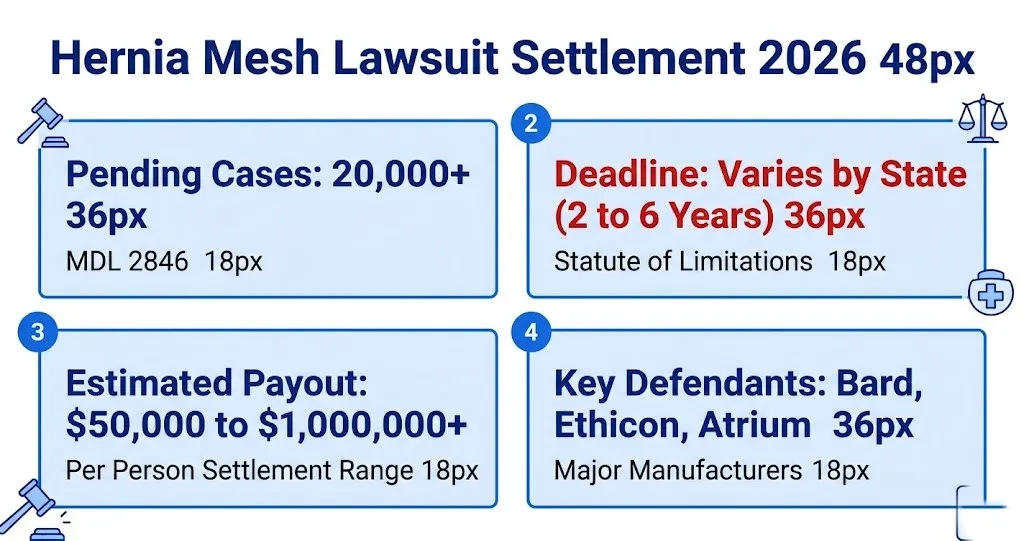
This article breaks down everything happening right now. You’ll find 2026 settlement estimates, eligibility rules, filing deadlines, and manufacturer-specific updates. One number worth knowing: Bard alone faces over 20,000 pending lawsuits as of early 2026.
The clock is ticking on some claims. Here’s what you need to know.
What Is the Hernia Mesh Lawsuit About
The hernia mesh lawsuit is a collection of thousands of individual lawsuits filed against manufacturers of surgical mesh products used in hernia repair. Patients allege these mesh devices were defective, causing injuries that range from chronic pain to life-threatening infections.
Surgical mesh is a net-like material implanted during hernia surgery. It’s meant to reinforce weakened tissue and prevent the hernia from coming back. The problem? Many patients say the mesh did more harm than good.
Lawsuits target several manufacturers. The biggest names include C.R. Bard (now part of Becton Dickinson), Johnson & Johnson’s Ethicon division, Atrium Medical, and Medtronic. Patients claim these companies knew about design flaws and failed to warn doctors or the public.
| Detail | Info |
|---|---|
| Type of Litigation | Mass tort and multidistrict litigation (MDL) |
| Number of Pending Cases | 20,000+ (Bard MDL alone) |
| Key Defendants | C.R. Bard, Ethicon, Atrium, Medtronic |
| Primary Court | Southern District of Ohio (MDL 2846) |
| Core Allegation | Defective design causing patient injuries |
The allegations aren’t just about one bad product. Multiple mesh designs from different companies are involved. Some used polypropylene plastic that degrades inside the body. Others had coatings that triggered severe immune reactions.
These cases aren’t frivolous. Several bellwether trials have already resulted in multimillion-dollar verdicts against manufacturers.
Hernia Mesh Lawsuit Settlement Amounts in 2026
Settlement amounts in 2026 hernia mesh cases are expected to range from $50,000 to over $1 million per plaintiff, depending on the severity of injuries and the specific product involved. No single global settlement has been finalized across all MDLs as of early 2026.
Individual case values vary widely. A patient who needed one revision surgery will likely receive less than someone who endured multiple operations, bowel resections, or permanent disability.
Some context helps. In prior bellwether trials, juries awarded between $250,000 and $70 million in individual cases against Bard. Those verdicts don’t mean every plaintiff gets that amount. But they set a benchmark for settlement negotiations.
| Injury Severity | Estimated Settlement Range |
|---|---|
| Mild complications, single revision | $50,000 to $150,000 |
| Moderate injuries, mesh removal | $150,000 to $500,000 |
| Severe injuries, multiple surgeries | $500,000 to $1,000,000+ |
| Catastrophic harm, permanent disability | $1,000,000 to $5,000,000+ |
Bard has been the most active defendant in settlement talks. Reports indicate the company has resolved several thousand cases confidentially. The exact dollar amounts remain under seal in most instances.
Ethicon cases have moved more slowly. Johnson & Johnson has historically fought these claims harder in court rather than settling early.
Is There a Hernia Mesh Class Action Lawsuit
The hernia mesh lawsuit is not a class action. It is a mass tort handled through multidistrict litigation, or MDL. This distinction matters because it directly affects how much money each plaintiff can receive.
In a class action, one lawsuit represents everyone. The settlement gets divided equally or by formula. Everyone gets the same basic deal. In a mass tort, each person’s case stays individual. Your injuries, your medical records, and your specific mesh product determine your payout.
Think of it like this. A class action is a bus where everyone rides together. A mass tort is more like a carpool lane where each car has its own destination. Same highway, different outcomes.
Quick Facts:
- Hernia mesh cases are consolidated in MDLs for pretrial efficiency
- Each plaintiff maintains their own individual claim
- Settlement amounts differ based on personal injury details
- Cases can be remanded to state courts for individual trials
- No single “class” of plaintiffs exists in these proceedings
The MDL system speeds things up. Pretrial motions, expert witness disputes, and document discovery happen once instead of thousands of times. But when it’s time for trial or settlement, each case is treated on its own merits.
This structure usually means higher payouts for seriously injured plaintiffs than a class action would deliver.
Key Takeaway: The hernia mesh lawsuit involves tens of thousands of individual claims against major manufacturers, with 2026 settlement estimates ranging from $50,000 to over $1 million per person depending on injury severity.
Bard Hernia Mesh Lawsuit Update
The Bard hernia mesh lawsuit is the largest segment of hernia mesh litigation, with over 20,000 cases pending in MDL 2846 in the Southern District of Ohio as of early 2026. C.R. Bard, now owned by Becton Dickinson, faces allegations that multiple mesh products were defectively designed.
Bard’s mesh products named in lawsuits include the Ventralex, PerFix Plug, 3DMax, and several others. Patients claim these devices shrank after implantation, migrated from the surgical site, or caused severe inflammatory reactions.
Several bellwether trials have already gone to verdict. In one notable case, a jury awarded $70 million to a single plaintiff. Other verdicts have ranged from hundreds of thousands to tens of millions of dollars.
| Bard Product | Key Allegation |
|---|---|
| Ventralex | Mesh migration and adhesion to organs |
| PerFix Plug | Chronic pain and mesh contraction |
| 3DMax | Mesh erosion and infection |
| Composix | Delamination and bowel injury |
Becton Dickinson acquired C.R. Bard in 2017 for $24 billion. That acquisition came with all the legal baggage. BD has set aside significant litigation reserves, though the exact figures aren’t fully public.
Settlement negotiations are ongoing. Some cases have been resolved individually. The pace of resolutions picked up in 2025, and legal observers expect 2026 to see larger blocks of cases settle.
Judge Edmund A. Sargus Jr. continues to oversee the MDL. He has pushed both sides toward resolution while allowing bellwether trials to proceed.
Johnson and Johnson Hernia Mesh Lawsuit
The Johnson and Johnson hernia mesh lawsuit centers on products made by Ethicon, J&J’s surgical device subsidiary. Ethicon’s Physiomesh was the most controversial product, pulled from the market in 2016 after studies showed high failure rates.
Ethicon voluntarily recalled Physiomesh after two European studies found patients experienced higher rates of hernia recurrence and reoperation compared to other mesh products. That recall became Exhibit A in thousands of lawsuits.
J&J has taken a more aggressive defense posture than Bard. The company has fought more cases at trial rather than settling early. This strategy has produced mixed results.
Some Ethicon trial verdicts:
- $2 million verdict in a 2019 bellwether trial
- Defense wins in other bellwether cases
- Multiple cases remanded to state courts for individual proceedings
| Detail | Info |
|---|---|
| Subsidiary | Ethicon Inc. |
| Key Product | Physiomesh Flexible Composite Mesh |
| Recall Year | 2016 |
| Reason for Recall | Higher-than-expected failure and reoperation rates |
| MDL Status | Separate track from Bard cases |
Patients who received Ethicon Physiomesh between 2010 and 2016 are the primary claimants. But lawsuits also involve other Ethicon mesh products, including the Proceed mesh and Prolene mesh.
J&J’s legal reserves for mesh litigation are substantial. The company’s annual filings indicate billions in contingent liabilities across all litigation, though hernia mesh is one of several product liability fronts.
Who Qualifies for a Hernia Mesh Lawsuit
You may qualify for a hernia mesh lawsuit if you received a surgical mesh implant for hernia repair and later experienced complications such as chronic pain, infection, mesh migration, or the need for revision surgery. Having medical records that document these issues is essential.
Not every person who received hernia mesh has a case. The key question is whether the mesh caused harm beyond normal surgical risks. A successful hernia repair with no complications, even if it used a product named in lawsuits, typically doesn’t qualify.
Eligibility checklist:
- You had hernia mesh implanted during surgery
- You experienced complications after the procedure
- Your complications required medical treatment or additional surgery
- The mesh product was made by a defendant manufacturer (Bard, Ethicon, Atrium, etc.)
- Your claim falls within the statute of limitations for your state
Some complications take years to appear. Mesh can degrade slowly inside the body. Pain might build gradually. Infections can develop long after the original surgery. That delayed onset is one reason these lawsuits keep growing.
If you’re unsure which mesh product you received, your surgeon’s records or the hospital’s operative report should identify it. Every implanted device gets logged.
Having documentation is the difference between a strong claim and a weak one. Medical records, imaging studies, and surgical notes all serve as evidence.
Key Takeaway: Both Bard and Johnson & Johnson face massive litigation over hernia mesh products, and you may qualify if you had mesh implanted and experienced documented complications afterward.
Hernia Mesh Implant Lawsuit Claims
Hernia mesh implant lawsuit claims allege that manufacturers sold devices with known defect risks, failed to conduct adequate testing, and did not properly warn surgeons or patients about potential dangers. These claims fall under product liability law.
Product liability means a company can be held responsible when its product injures someone. Plaintiffs don’t have to prove the manufacturer was careless in every scenario. In strict liability states, simply showing the product was defective and caused harm can be enough.
Three main legal theories drive these cases:
- Design defect: The mesh was inherently flawed in its design
- Manufacturing defect: Something went wrong during production
- Failure to warn: The company didn’t adequately disclose risks to doctors or patients
Most hernia mesh lawsuits focus on design defect and failure to warn. The argument is that polypropylene mesh degrades inside the body over time, and manufacturers knew or should have known this would cause problems.
| Legal Theory | What It Means |
|---|---|
| Design Defect | The product’s design is unreasonably dangerous |
| Manufacturing Defect | The product was made incorrectly |
| Failure to Warn | Risks were not properly communicated |
The FDA’s 510(k) clearance process is a frequent target. Manufacturers got mesh products approved by showing they were “substantially equivalent” to devices already on the market. Critics say this shortcut allowed dangerous products to reach patients without rigorous clinical testing.
That regulatory gap strengthens plaintiffs’ arguments. It shows these products never went through full clinical trials before being implanted in millions of people.
Hernia Mesh Complications That Lead to Lawsuits
The complications most commonly cited in hernia mesh lawsuits include chronic pain, mesh infection, mesh migration, bowel obstruction, adhesion to organs, and hernia recurrence. These injuries often require additional surgeries to correct.
Chronic pain is the most frequent complaint. Patients describe it as constant, burning, or stabbing pain at the mesh site that doesn’t respond to medication. For many, it persists for years after implantation.
Mesh migration happens when the device moves from its original placement. It can travel into nearby organs, causing perforation of the bowel, bladder, or other structures. This is a medical emergency.
Common complications in lawsuits:
- Chronic pain lasting months or years
- Mesh infection requiring hospitalization
- Mesh erosion into surrounding tissue
- Mesh contraction or shrinkage
- Bowel obstruction or perforation
- Adhesion of mesh to intestines or organs
- Hernia recurrence despite the mesh
- Fistula formation
- Autoimmune reactions to polypropylene
| Complication | Severity Level | Typical Treatment |
|---|---|---|
| Chronic pain | Moderate to severe | Pain management, possible mesh removal |
| Mesh infection | Severe | Antibiotics, surgical removal |
| Mesh migration | Severe to critical | Emergency surgery |
| Bowel obstruction | Critical | Emergency surgery |
| Hernia recurrence | Moderate | Repeat surgery |
Each complication adds value to a legal claim. A patient with mesh infection who needed two revision surgeries has a stronger case than someone with mild, manageable pain. The documentation of these complications in medical records is what builds a case.
Abdominal Hernia Mesh Lawsuit Cases
Abdominal hernia mesh lawsuits involve mesh products used specifically to repair ventral, incisional, and umbilical hernias in the abdominal wall. These repairs are among the most common uses of surgical mesh, and they account for a large portion of the overall litigation.
Over one million hernia repairs are performed in the United States each year. The majority involve some type of mesh. Abdominal wall repairs tend to use larger mesh pieces than inguinal (groin) hernia repairs, which can increase the risk of complications.
Larger mesh means more surface area in contact with internal tissue. That creates more opportunity for adhesion, infection, and inflammatory response. Several studies have shown that abdominal mesh placements carry higher complication rates than groin repairs.
| Hernia Type | Mesh Size Used | Complication Risk |
|---|---|---|
| Ventral (abdominal wall) | Large | Higher |
| Incisional (at surgical scar) | Medium to large | Higher |
| Umbilical (belly button) | Small to medium | Moderate |
| Inguinal (groin) | Small | Lower to moderate |
Bard’s Composix and Ventralex products are frequently named in abdominal mesh cases. The Composix mesh had a dual-layer design that allegedly separated inside patients, requiring emergency surgery.
Patients who had open abdominal hernia repair with mesh and later needed revision surgery are strong candidates for these claims. The operative reports from both the original surgery and any follow-up procedures form the backbone of the legal case.
Key Takeaway: Hernia mesh complications range from chronic pain to life-threatening bowel obstructions, and abdominal mesh repairs carry some of the highest complication rates due to the larger implant sizes used.
Bard Davol Hernia Mesh Lawsuit Details
The Bard Davol hernia mesh lawsuit refers to cases against Davol Inc., a subsidiary of C.R. Bard that manufactured many of the hernia mesh products at issue. Davol is the actual entity named as defendant in many of these lawsuits, not just the Bard parent company.
This distinction matters for legal reasons. Davol Inc., based in Warwick, Rhode Island, designed, tested, and distributed the mesh products. When patients sue, they typically name Davol Inc., C.R. Bard Inc., and Becton Dickinson & Co. as co-defendants.
Some of Davol’s most-sued products include:
- Bard Ventralex ST hernia patch
- Bard PerFix Plug mesh
- Bard Marlex mesh
- Bard Composix mesh
- Bard 3DMax mesh
Separate from the federal MDL in Ohio, a large number of Bard Davol cases are also pending in Rhode Island Superior Court. Rhode Island is where Davol is headquartered, giving that state’s courts jurisdiction over many claims.
| Court | Case Type | Status |
|---|---|---|
| Southern District of Ohio (MDL 2846) | Federal MDL | Active, bellwether trials completed |
| Rhode Island Superior Court | State mass tort | Active, settlements ongoing |
| Various state courts | Individual cases | Remanded from MDL or filed independently |
The Rhode Island cases have been a significant pressure point. Several settlements have been reached there, though most terms remain confidential. Legal analysts watch both tracks closely because outcomes in one forum influence negotiations in the other.
Becton Dickinson’s financial exposure through Davol is substantial. The company has acknowledged in SEC filings that hernia mesh litigation represents a material liability.
Hernia Mesh Lawsuit Payout Per Person
The payout per person in a hernia mesh lawsuit varies widely, but most estimates for 2026 fall between $50,000 and $1 million for cases that settle, with exceptional cases reaching higher amounts through trial verdicts. Your individual payout depends on several specific factors.
No two cases are identical. The mesh product, the type of injury, the number of surgeries needed, your age, your lost income, and your ongoing medical needs all affect the number.
Factors that determine your payout:
- Severity of your complications
- Number of revision or removal surgeries
- Duration and intensity of chronic pain
- Impact on your ability to work
- Medical expenses (past and future)
- Which mesh product was implanted
- Strength of your medical documentation
| Payout Factor | Impact on Amount |
|---|---|
| Single revision surgery | Lower range ($50K to $200K) |
| Multiple surgeries | Mid range ($200K to $500K) |
| Permanent disability | Upper range ($500K to $1M+) |
| Bowel resection or organ damage | Highest range ($1M+) |
| Strong medical records | Increases value significantly |
| Weak documentation | Reduces value substantially |
Attorney fees also affect your take-home amount. Most hernia mesh lawyers work on contingency, typically taking 33% to 40% of the settlement. Court costs and expenses come off the top before that calculation in many agreements.
If your case goes to trial and wins, the payout could be dramatically higher. But trials are risky. Juries don’t always side with the plaintiff. The certainty of a settlement often outweighs the gamble of a trial.
Hernia Mesh MDL Update for 2026
The hernia mesh MDL (multidistrict litigation) in 2026 is centered in MDL No. 2846, Bard’s consolidated case in the Southern District of Ohio under Judge Edmund A. Sargus Jr. This MDL remains one of the largest active mass torts in the federal court system.
As of early 2026, over 20,000 cases remain pending in this MDL. The number has fluctuated as some cases settle individually and new filings continue. The trend has been a slow, steady push toward broader settlement discussions.
Several bellwether trials have already been completed. Bellwether trials are test cases selected to gauge how juries respond to the evidence. Results from these trials shape settlement offers for the remaining cases.
2026 MDL milestones to watch:
- Additional bellwether trial dates scheduled for mid-2026
- Continued individual case settlements
- Potential for a global settlement framework announcement
- Possible remand of unsettled cases to state courts
- New Daubert hearings on expert testimony
| MDL Detail | Current Status |
|---|---|
| MDL Number | 2846 |
| Court | Southern District of Ohio |
| Presiding Judge | Judge Edmund A. Sargus Jr. |
| Pending Cases | 20,000+ |
| Bellwether Trials Completed | Multiple (with mixed verdicts) |
| Global Settlement | Under negotiation |
Ethicon mesh cases are tracked separately from Bard cases, though some have been consolidated in similar fashion. The Ethicon proceedings have moved at a different pace with fewer bellwether trials.
The MDL process can feel painfully slow. Some plaintiffs have waited 5 to 7 years for resolution. But 2026 may bring movement. Both sides face pressure to resolve these cases rather than litigate them one by one for another decade.
Key Takeaway: Over 20,000 Bard hernia mesh cases remain in MDL 2846, with 2026 bringing new bellwether trials and increasing settlement pressure that could accelerate resolutions for thousands of plaintiffs.
How to File a Hernia Mesh Lawsuit
To file a hernia mesh lawsuit, you need to contact a product liability attorney who handles medical device cases, gather your medical records showing the mesh implant and resulting complications, and have the attorney evaluate whether your claim has merit. Most attorneys offer a free case review.
The process isn’t as complicated as it sounds. Here’s the typical path from start to filing:
Step-by-step filing process:
- Contact a hernia mesh attorney for a free consultation
- Provide your medical records, surgical reports, and complication history
- The attorney identifies which mesh product you received
- The attorney evaluates the strength of your claim
- A formal complaint is drafted and filed in the appropriate court
- Your case is either added to the MDL or filed in state court
You don’t pay anything upfront. Hernia mesh attorneys work on contingency. They only get paid if you win or settle. If your case doesn’t result in compensation, you owe nothing for legal fees.
| Filing Step | What You Need |
|---|---|
| Initial consultation | Basic info about your surgery and complications |
| Medical record review | Operative reports, imaging, follow-up notes |
| Product identification | Surgeon’s records or hospital implant log |
| Case evaluation | Attorney assessment of claim viability |
| Filing | Signed retainer agreement and completed complaint |
Time matters. Every state has a statute of limitations that sets a deadline for filing. Missing that deadline means losing your right to sue permanently. Don’t assume you have unlimited time.
Getting your medical records is the most important preparation step. Call your surgeon’s office and the hospital where the procedure was done. Request your full operative report, which will identify the exact mesh product used.
Hernia Mesh Lawsuit Statute of Limitations
The statute of limitations for a hernia mesh lawsuit varies by state but typically ranges from 2 to 6 years from the date you discovered (or should have discovered) that the mesh caused your injury. This is called the “discovery rule.”
The discovery rule is critical in mesh cases. Many patients don’t realize their problems are caused by the mesh until years after surgery. The clock usually starts when you knew or should have known the mesh was the source of your complications.
| State | Statute of Limitations (Product Liability) |
|---|---|
| California | 2 years from discovery |
| Texas | 2 years from discovery |
| Florida | 4 years from discovery (updated 2023) |
| New York | 3 years from discovery |
| Illinois | 2 years from discovery |
| Ohio | 2 years from discovery |
| Pennsylvania | 2 years from discovery |
Some states also have a “statute of repose,” which sets an absolute outer deadline regardless of when you discovered the injury. For example, a state might give you 2 years from discovery but cap it at 10 years from the date of surgery no matter what.
Red flags that your deadline may be approaching:
- Your hernia mesh surgery was 5+ years ago
- You’ve known about complications for over a year
- Your doctor told you the mesh caused your problems months ago
- You live in a state with a short limitations period
If you’re close to a deadline, act fast. Filing even one day late can permanently bar your claim. An attorney can quickly assess whether your case is still within the window.
Hernia Mesh Lawsuit Marketing Campaigns Explained
Hernia mesh lawsuit marketing campaigns are advertising efforts by law firms and lead generation companies designed to find injured patients and connect them with attorneys handling hernia mesh cases. These campaigns are a major industry within mass tort litigation.
You’ve probably seen the ads. TV commercials asking, “Have you been injured by hernia mesh?” Online ads popping up on social media. Mailers arriving in your mailbox. Radio spots during your morning commute. All of that is part of a carefully planned marketing operation.
The hernia mesh lawsuit space is one of the most heavily marketed mass torts in recent memory. Law firms and marketing companies spend millions of dollars per month on these campaigns. The spending reflects the potential value of each case.
Types of marketing campaigns used:
- Television and cable advertising
- Social media ads (Facebook, Instagram, YouTube)
- Google search ads and pay-per-click campaigns
- Direct mail campaigns to patients
- Online content marketing and SEO
- Radio and podcast advertising
| Marketing Channel | Estimated Cost Per Signed Case |
|---|---|
| Television | $3,000 to $8,000 |
| Digital/Online | $1,500 to $5,000 |
| Direct Mail | $2,000 to $6,000 |
| Social Media | $1,000 to $4,000 |
Not all firms advertising for hernia mesh cases actually handle the litigation themselves. Many are “case acquisition” firms that sign up clients and then refer them to trial attorneys. The referring firm takes a cut of the eventual fee.
Understanding how these campaigns work helps you evaluate who is contacting you. A legitimate attorney will want to review your medical records before making promises. Anyone guaranteeing a specific payout before seeing your records should raise concerns.
Key Takeaway: Filing a hernia mesh lawsuit requires an attorney, your medical records, and action before your state’s statute of limitations expires, while marketing campaigns by law firms spend millions to find eligible plaintiffs.
Hernia Mesh Lawsuit Mass Tort Marketing
Mass tort marketing for hernia mesh lawsuits is a specialized industry where legal marketing firms generate leads for attorneys by identifying and qualifying potential plaintiffs. This process involves significant investment and careful targeting.
The mass tort marketing ecosystem has three main players. Lead generation companies create the ads and collect inquiries. Law firms review and sign qualifying cases. And sometimes, a third layer of “case buyers” purchases signed cases from smaller firms to bundle them for trial groups.
This might sound shady, but it’s legal and regulated. State bar associations set rules about attorney advertising. The FTC governs deceptive advertising practices. And most legitimate firms follow these guidelines carefully.
How mass tort marketing works in practice:
- Marketing firm runs ad campaign targeting hernia mesh patients
- Potential plaintiffs call a hotline or fill out an online form
- Intake specialists screen callers for basic eligibility
- Qualifying callers are connected to a licensed attorney
- The attorney reviews medical records and signs the case
- Signed cases are either litigated by that firm or co-counseled with a trial firm
| Marketing Term | What It Means |
|---|---|
| Lead | A person who responds to an ad |
| Qualified Lead | A lead who meets basic screening criteria |
| Signed Case | A plaintiff who has retained an attorney |
| Case Acquisition Cost | Total marketing spend divided by signed cases |
| Retainer Agreement | The contract between attorney and client |
The hernia mesh space became so competitive that acquisition costs skyrocketed between 2020 and 2025. Some firms reported spending $5,000 to $10,000 per signed case. That investment only makes sense because individual case values can reach six or seven figures.
Quality matters more than quantity. A firm that signs 1,000 weak cases with thin medical records will fare worse than one with 200 well-documented, severe injury cases.
How Hernia Mesh Lawsuit Signed Cases Work
A signed case in hernia mesh litigation means a plaintiff has formally retained an attorney by signing a retainer agreement, allowing the lawyer to represent them in their claim. This is the point where a “lead” becomes an actual legal case.
The journey from seeing a TV ad to having a signed case involves several steps. Not everyone who calls qualifies. And not every qualified lead ends up signing.
What happens after signing:
- Your attorney requests your complete medical records
- Experts review the records to confirm the mesh product and injuries
- A case assessment determines the estimated value of your claim
- The attorney files the complaint in the appropriate court
- Your case enters the litigation process (MDL, state court, or both)
The signed case is an asset in mass tort litigation. Attorneys invest time and money in each one. They advance costs for medical record retrieval, expert reviews, court filing fees, and case management.
| Stage | What Happens | Who Pays |
|---|---|---|
| Lead generation | Marketing creates awareness | Marketing firm or law firm |
| Intake screening | Basic eligibility questions | Law firm |
| Medical record review | Records requested and analyzed | Law firm (advanced as costs) |
| Case signing | Retainer agreement executed | No cost to plaintiff |
| Litigation | Complaint filed, discovery begins | Law firm advances costs |
| Resolution | Settlement or trial | Attorney fee deducted from recovery |
Some firms sell or transfer signed cases to other attorneys. This practice, called case referral, is legal when done with the client’s consent and proper fee-sharing agreements between attorneys.
If you’ve signed a retainer and haven’t heard from your attorney in months, don’t panic. Mass tort cases move slowly. But you should feel comfortable calling for updates. It’s your case. You have every right to know what’s happening.
Frequently Asked Questions
How much money can I get from a hernia mesh lawsuit in 2026?
Most plaintiffs can expect between $50,000 and $1 million depending on injury severity.
Cases involving multiple surgeries or permanent disability tend to settle at the higher end.
Exceptional cases with catastrophic harm have reached multimillion-dollar verdicts at trial.
What is the deadline to file a hernia mesh lawsuit?
The deadline depends on your state’s statute of limitations, which typically ranges from 2 to 6 years from the date of injury discovery.
Some states also impose an absolute outer deadline called a statute of repose.
Contact an attorney immediately if your surgery was more than five years ago.
Does the Bard hernia mesh lawsuit include all Bard products?
The litigation covers multiple Bard mesh products, including the Ventralex, PerFix Plug, 3DMax, Composix, and Marlex.
Not every Bard product is named, so checking your surgical records for the specific device is important.
Davol Inc., the Bard subsidiary that manufactured these products, is typically named as a defendant.
What complications qualify for a hernia mesh lawsuit?
Qualifying complications include chronic pain, mesh infection, mesh migration, bowel obstruction, mesh erosion, adhesion to organs, and hernia recurrence.
You must have medical documentation showing the mesh caused or contributed to these problems.
Revision surgery or mesh removal significantly strengthens a claim.
Is the hernia mesh lawsuit a class action or mass tort?
Hernia mesh lawsuits are mass torts, not class actions.
Each plaintiff maintains an individual case with its own facts, injuries, and settlement value.
Cases are consolidated in MDLs for efficiency, but individual claims are evaluated and resolved separately.
Key Takeaway: Hernia mesh lawsuit signed cases represent real legal commitments between attorneys and injured patients, with each case evaluated individually based on medical evidence and injury severity.
Your hernia mesh claim has a deadline, and waiting too long could cost you everything. If you received mesh and suffered complications, 2026 is the year to act.
Gather your surgical records. Identify the mesh product. Talk to an attorney who handles these cases. The process costs you nothing upfront.
The manufacturers are sitting on billions. Don’t leave your share on the table.
