
The Drake lawsuit against Universal Music Group is over, at least for now. Drake voluntarily dismissed his defamation case in early 2025, ending one of the most high-profile legal battles the music industry has seen in years.
But “dismissed” doesn’t always mean “done.” The details of how and why Drake walked away from his own lawsuit tell a bigger story about artist-label power dynamics, streaming manipulation claims, and the legal limits of rap beef.
This article covers every angle of the case as it stands in 2026. You’ll learn what Drake alleged, why he dropped his claims, whether he can sue again, and what financial fallout followed.
One fact that surprised many observers: Drake originally filed in Texas state court before moving to federal court in New York. That procedural shift changed the entire trajectory of his case.
Drake Lawsuit: What the Entire Case Is About
The Drake lawsuit refers to legal action filed by rapper Aubrey Drake Graham against Universal Music Group in late 2024. Drake accused UMG, his own record label, of boosting a song he said falsely portrayed him as a pedophile.
The song in question was Kendrick Lamar’s “Not Like Us,” released in May 2024. It became a massive hit. Drake claimed UMG promoted the track through artificial streaming methods and paid radio placements while knowing the lyrics contained false, damaging accusations.
| Detail | Info |
|---|---|
| Plaintiff | Drake (Aubrey Drake Graham) |
| Defendant | Universal Music Group |
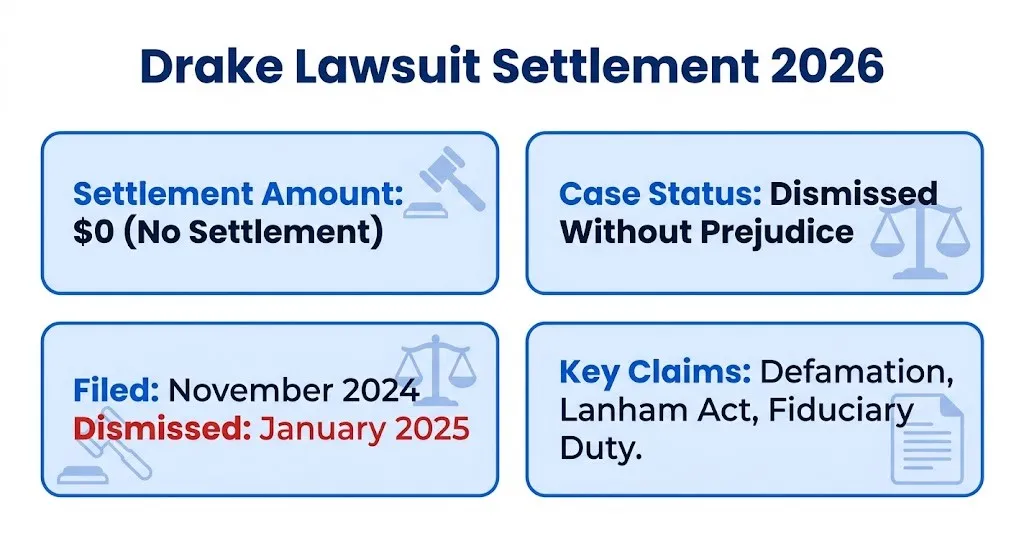
| Filed | November 2024 |
| Court | Southern District of New York |
| Core Claim | Defamation, false advertising |
| Status as of 2026 | Voluntarily dismissed |
Drake filed the case as both an artist and a businessman. He argued that UMG had a duty not to weaponize false claims against one of its own signed artists.
The case drew massive attention because it blurred the lines between artistic expression, corporate strategy, and personal reputation.
Drake Lawsuit Update: Where Things Stand in 2026
The most recent Drake lawsuit update is that all active claims have been withdrawn. Drake filed a voluntary dismissal in January 2025. No settlement was publicly announced.
As of mid-2026, no new filings have appeared in federal or state court. Drake has not indicated plans to refile.
Behind the scenes, sources close to the situation suggest private negotiations may have played a role. UMG never publicly commented on any resolution beyond confirming the dismissal.
- No trial date was ever set
- No depositions were completed
- No discovery documents became public
- No monetary judgment was entered
The legal chapter appears closed, but the door isn’t fully locked. The type of dismissal Drake chose matters enormously for his future options.
Drake Lawsuit Dismissed: How and Why It Ended
Drake’s lawsuit was dismissed because he chose to withdraw it voluntarily. The court did not throw it out. Drake’s legal team filed the paperwork themselves.
This is an important distinction. A judge-ordered dismissal usually means the case lacked merit. A voluntary dismissal means the plaintiff decided to walk away. The reasons can range from a private deal to a strategic retreat.
Reports from January 2025 confirmed the dismissal was filed “without prejudice.” That legal term means Drake preserved his right to bring the same claims again later.
| Dismissal Type | What It Means |
|---|---|
| With Prejudice | Case is permanently closed; cannot refile |
| Without Prejudice | Case is closed but can be refiled later |
| Drake’s Dismissal | Without prejudice (can refile) |
Think of it like pausing a chess game instead of flipping the board. The pieces stay where they are.
No public explanation came from Drake’s attorneys. UMG released no statement claiming victory.
Key Takeaway: Drake voluntarily dismissed his lawsuit without prejudice, meaning he kept his legal options open for the future while stepping back from active litigation in early 2025.
Drake Lawsuit Against UMG: Artist vs. Label Clash
The Drake lawsuit against UMG was unusual because Drake was suing his own label. Most artist-label disputes involve contract terms or royalties. This one accused UMG of actively harming its own artist’s reputation.
Drake’s core argument was simple: UMG profited from “Not Like Us” while knowing the song labeled him a predator. Since UMG distributed both Drake and Kendrick Lamar’s music, Drake said the label had a conflict of interest it chose to exploit.
UMG pushed back through public statements and legal filings. The label called Drake’s claims meritless. It argued that promoting one artist’s music doesn’t mean endorsing that artist’s lyrical content.
- Drake is signed to Republic Records, a UMG subsidiary
- Kendrick Lamar was affiliated with Top Dawg Entertainment and later pgLang, distributed by UMG
- Both artists generated massive revenue for the same parent company
The case highlighted a structural problem in the music industry. When one company controls multiple competing artists, what happens when their rivalry turns into defamation?
That question remains unanswered in court. But it sparked industry-wide conversations about label accountability.
Drake Defamation Lawsuit: The Legal Claims Explained
Drake’s defamation lawsuit alleged that UMG knowingly spread false statements that damaged his reputation. The specific accusation was that “Not Like Us” called Drake a pedophile through its lyrics and music video imagery.
Defamation claims require proving several elements under U.S. law:
| Element | What Drake Needed to Prove |
|---|---|
| False statement | The song’s claims about him were untrue |
| Publication | UMG distributed the song widely |
| Fault | UMG knew or should have known the claims were false |
| Damages | Drake suffered real harm to his reputation or income |
The tricky part for Drake was the intersection with First Amendment protections. Rap lyrics have historically been treated as artistic expression, not literal statements of fact.
Courts have generally been reluctant to treat song lyrics as defamation. Drake’s legal team tried to argue that UMG’s promotional campaign turned artistic expression into a corporate-backed smear.
This legal theory was untested. No prior case had established that a label’s marketing of a diss track could convert protected speech into actionable defamation.
Drake Lawsuit 2026: Any New Developments This Year?
As of 2026, the Drake lawsuit has produced no new court filings, public statements, or legal motions. The case remains in a holding pattern after the January 2025 dismissal.
Drake has not filed any new claims in federal or state court. UMG has not pursued any counterclaims.
- No new lawsuits filed in 2026
- No arbitration proceedings reported
- No public settlement announcement
- Drake’s contract status with UMG remains unclear
Some legal analysts speculated that 2026 could bring a refiling. Statutes of limitations for defamation vary by state but typically run one to three years from the date of the alleged harm.
Since “Not Like Us” was released in May 2024, Drake would likely need to act before May 2027 in most jurisdictions. That window is narrowing.
The silence from both sides in 2026 suggests either a private resolution or a strategic decision to let the matter cool down before any potential next move.
Key Takeaway: No new legal action has occurred in 2026, but Drake’s window to refile remains open through at least mid-2027 based on typical defamation statute of limitations periods.
Drake Lawsuit Timeline: Key Dates From Start to Finish
The Drake lawsuit timeline spans roughly three months of active legal proceedings. Here’s every major date that mattered.
| Date | Event |
|---|---|
| May 2024 | Kendrick Lamar releases “Not Like Us” |
| Summer 2024 | Song becomes a massive hit; wins Grammy nomination |
| November 2024 | Drake files pre-action petition in Texas state court |
| November 2024 | Drake files federal lawsuit against UMG in SDNY |
| December 2024 | UMG responds publicly, calls claims meritless |
| January 2025 | Drake voluntarily dismisses federal lawsuit |
| January 2025 | Drake withdraws Texas petition |
| 2025-2026 | No further legal activity |
The Texas petition came first. Drake filed it seeking to preserve evidence before bringing a full lawsuit. That petition targeted UMG and sought information about streaming manipulation and promotional spending on “Not Like Us.”
Days later, the federal case landed in New York. The rapid one-two filing strategy suggested Drake’s team had planned both moves in advance.
The whole thing collapsed within about two months. From filing to dismissal, it was one of the shortest high-profile entertainment lawsuits in recent memory.
Drake Drops Lawsuit: The Moment He Walked Away
Drake dropped his lawsuit on or around January 14, 2025. His attorneys filed a notice of voluntary dismissal in the Southern District of New York.
The filing was brief. It didn’t explain why Drake chose to withdraw. No press conference followed. No public letter was released.
Within the same week, Drake also withdrew his pre-action petition in Texas. Both legal fronts went dark simultaneously.
- Federal case in SDNY: dismissed
- Texas state petition: withdrawn
- No motions pending anywhere
- No sealed documents reported
The timing raised questions. Some observers noted that Drake dropped the case shortly after UMG’s legal team filed strong responses. Others pointed to the Grammy Awards cycle and suggested Drake wanted to avoid a drawn-out media circus.
A third theory floated by legal commentators: Drake achieved what he wanted just by filing. The lawsuit generated worldwide headlines about UMG’s alleged behavior. Sometimes the court of public opinion matters more than the courtroom.
Why Did Drake Drop His Lawsuit?
Drake has never publicly explained why he dropped his lawsuit. But legal experts and industry insiders have offered several theories that fit the available evidence.
Theory 1: Weak legal standing. Defamation claims involving song lyrics face huge First Amendment hurdles. Drake’s lawyers may have concluded the case was unlikely to survive a motion to dismiss.
Theory 2: Private deal. The parties may have reached a confidential agreement. This is common in entertainment disputes where both sides have financial reasons to avoid a public fight.
Theory 3: Strategic messaging. Filing the lawsuit forced the world to hear Drake’s side. Once media coverage saturated, the legal case had served its purpose.
Theory 4: Contractual pressure. Drake is signed to a UMG subsidiary. Suing your own label while still under contract creates enormous practical problems for releasing new music.
No single theory has been confirmed. The most likely scenario involves some combination of all four.
What we know for certain: Drake filed without prejudice, which means his lawyers planned for the possibility of returning to court later.
Key Takeaway: Drake never explained his decision to drop the lawsuit, but the most credible theories involve a mix of legal risk, potential private negotiations, and the strategic value of the publicity the filing generated.
Drake Kendrick Lamar Lawsuit: The Beef Behind the Case
The Drake Kendrick Lamar rivalry is the engine that powered this entire lawsuit. Their feud, simmering for over a decade, exploded in 2024 with a series of diss tracks that broke streaming records.
Kendrick released “Not Like Us” in May 2024. The song accused Drake of being a predator and a “certified lover boy” in the worst possible sense. Its music video featured imagery that Drake’s legal team later called deliberately suggestive of pedophilia.
Drake fired back with his own tracks. But the cultural battle was lopsided. “Not Like Us” dominated radio, streaming platforms, and eventually earned a Grammy nomination.
- “Not Like Us” peaked at No. 1 on the Billboard Hot 100
- The song received heavy rotation on radio stations nationwide
- Spotify streams exceeded 1 billion within months
- The Grammy nomination added institutional validation
Drake didn’t sue Kendrick directly. He went after UMG, the company that distributed both their music. His argument: Kendrick had free speech to rap whatever he wanted, but UMG didn’t have the right to amplify defamatory content for profit.
That distinction between the artist and the corporation was the legal heart of the case. It’s also why the case might have worked better on paper than in practice.
Drake Not Like Us Lawsuit: Why That Song Was Central
“Not Like Us” was the single piece of content that triggered Drake’s entire legal battle. Without that song, there would have been no lawsuit.
The track includes lyrics that reference Drake living near a school. Its music video featured imagery of Drake’s OVO owl logo surrounded by indicators that his team said implied predatory behavior toward minors.
Drake’s legal filing cited specific promotional actions by UMG:
- Paying radio programmers to increase “Not Like Us” airplay
- Using bot-driven streaming to inflate the song’s numbers
- Timing promotional pushes to maximize cultural impact during the beef
- Submitting the song for Grammy consideration despite its content
UMG denied all of these allegations. The label said “Not Like Us” succeeded on its own merit and that its promotion followed standard industry practices.
| Allegation | UMG Response |
|---|---|
| Paid radio manipulation | Denied; called standard promotion |
| Bot-driven streaming | Denied; no evidence presented publicly |
| Strategic promotional timing | Called normal marketing |
| Grammy submission | Standard practice for hit songs |
The song’s success made Drake’s case harder, not easier. Proving that artificial promotion drove the song’s popularity is tough when the track was genuinely one of the biggest hits of 2024.
Drake Lawsuit Allegations Explained in Plain Language
Drake’s lawsuit contained several distinct legal allegations. Here’s what each one means in plain English.
Defamation: Drake claimed UMG helped spread false statements calling him a pedophile. Defamation requires proving the statements are factually false, not just mean or offensive.
Lanham Act Violation: This is a federal law about false advertising. Drake argued UMG marketed “Not Like Us” in ways that were misleading, especially its streaming numbers. If UMG used bots, that could qualify as deceptive business practice.
Breach of Fiduciary Duty: Drake argued UMG owed him loyalty as his label. By promoting content that damaged him, UMG allegedly broke its obligation to act in his interest.
- Defamation: false statements that harm reputation
- Lanham Act: false advertising and deceptive marketing
- Fiduciary duty: a label’s obligation to protect its artist
- RICO (hinted): organized pattern of harmful conduct
The RICO angle was never formally part of the federal filing. But Drake’s Texas petition referenced a “pattern of conduct” that some legal observers interpreted as a setup for racketeering claims.
Each allegation faced serious legal obstacles. Defamation and song lyrics rarely mix well in court. Lanham Act claims require concrete evidence of consumer deception. Fiduciary duty arguments between artists and labels are legally murky.
Key Takeaway: Drake’s lawsuit included defamation, false advertising, and breach of duty claims, but each faced significant legal hurdles that may have contributed to the voluntary dismissal.
Drake Voluntary Dismissal: What That Legal Term Means
A voluntary dismissal means the plaintiff chose to end the case on their own terms. The court did not force it. No judge ruled against Drake.
In federal court, a plaintiff can file a voluntary dismissal at any time before the defendant submits an answer or motion for summary judgment. Drake filed his dismissal early enough in the process that he retained full control.
The key detail: Drake dismissed “without prejudice.”
| Term | Definition | Drake’s Case |
|---|---|---|
| Voluntary Dismissal | Plaintiff ends the case | Yes |
| Without Prejudice | Can refile later | Yes |
| With Prejudice | Permanently closed | No |
| Involuntary Dismissal | Judge ends the case | Did not happen |
Without prejudice means the legal claims are preserved. Drake can return to court with the same arguments if he chooses. However, statutes of limitations still apply.
Some courts limit how many times a plaintiff can voluntarily dismiss and refile. Under Federal Rule of Civil Procedure 41(a), a plaintiff generally gets one free voluntary dismissal. A second dismissal of the same claim typically operates as “with prejudice.”
That means if Drake refiles and then drops the case again, it’s over for good.
Did Drake Win His Lawsuit?
Drake did not win his lawsuit. He also did not lose it. The case ended before any judge made a ruling on the merits.
Because Drake voluntarily dismissed, there was no verdict, no judgment, and no finding of fact. UMG was not found liable for anything. Drake was not found to have frivolous claims.
In legal terms, it’s a draw with no score. Nobody won a point.
- No trial occurred
- No summary judgment motion was decided
- No injunction was granted
- No damages were awarded
From a PR perspective, opinions are split. Drake supporters say he successfully drew attention to UMG’s alleged misconduct. Critics say he backed down when the legal pressure got real.
UMG can legitimately claim it was never found to have done anything wrong. Drake can legitimately say his case was never heard on the facts.
The only clear outcome: both sides spent significant money on legal fees. Major entertainment litigation of this type can cost each party hundreds of thousands of dollars in a matter of weeks.
Can Drake Refile His Lawsuit?
Yes, Drake can refile his lawsuit. The dismissal was without prejudice, which means the claims are legally preserved for a future filing.
But there are limits. Statutes of limitations are the biggest constraint.
| Claim Type | Typical Limitation Period | Estimated Deadline |
|---|---|---|
| Defamation (New York) | 1 year from publication | May 2025 (may have passed) |
| Lanham Act | No fixed federal statute; varies | Depends on ongoing harm |
| Breach of Fiduciary Duty | 3 to 6 years depending on state | 2027 to 2030 |
The defamation window is the tightest. New York has a one-year statute of limitations for defamation. Since “Not Like Us” was released in May 2024, that clock likely expired in May 2025.
Drake could potentially argue the “continuing wrong” doctrine. If UMG continued to profit from and promote the song into 2025 and 2026, each new promotional act might restart the clock.
The Lanham Act and fiduciary duty claims have longer windows. These are the more viable paths if Drake decides to return to court.
Legal strategy-wise, refiling makes sense only if Drake obtains new evidence. Without discovery from the first case, he’d be starting from roughly the same position.
Key Takeaway: Drake can technically refile, but the defamation deadline has likely passed; his strongest remaining claims would involve false advertising or breach of duty, and he’d need new evidence to justify round two.
Drake Legal Options After Dismissal
Beyond refiling the same case, Drake has several other legal paths available in 2026 and beyond.
Arbitration: Drake’s contract with Republic Records likely contains an arbitration clause. Private arbitration could address the fiduciary duty claims without public court proceedings.
State court claims: Drake could file in a different state with a longer defamation statute. California, for example, also has a one-year period, but other states allow two years.
Regulatory complaints: Drake could file complaints with the FTC or state attorneys general regarding alleged streaming manipulation. These wouldn’t be lawsuits but could trigger government investigations.
Contract renegotiation: Sometimes the threat of litigation achieves more than the lawsuit itself. Drake may use the existing legal record as leverage during future contract negotiations with UMG.
- Arbitration: private, faster, confidential
- New state filing: different jurisdiction, different rules
- Regulatory complaint: FTC or state AG involvement
- Contract talks: use legal history as bargaining power
Each option has trade-offs. Arbitration is private but limits public pressure. State filings face the same First Amendment issues. Regulatory complaints move slowly and may not produce personal remedies.
The most likely scenario, based on industry patterns, is that Drake uses the lawsuit’s existence as context for renegotiating his label deal rather than returning to court.
Drake UMG Legal Battle: The Bigger Industry Picture
The Drake UMG legal battle matters far beyond one rapper and one label. It raised fundamental questions about how the modern music industry operates.
When a single corporation controls multiple competing artists, conflicts of interest are inevitable. UMG is the world’s largest music company. It distributes artists who frequently take shots at each other.
Before Drake’s lawsuit, no major artist had formally accused their label of weaponizing a competitor’s content. That accusation, even without a trial, changed the conversation.
- UMG controls roughly 30% of the global recorded music market
- The company distributes hundreds of artists who compete for the same audiences
- Artist-on-artist diss tracks generate enormous engagement and revenue
- Labels profit regardless of which artist “wins” a public feud
The case also spotlighted streaming manipulation allegations. Whether or not UMG used bots, the accusation drew public scrutiny to how streaming numbers are generated and verified.
Industry groups have since discussed tighter auditing standards for streaming platforms. None of that would have happened without Drake’s filing.
Think of it like a whistleblower complaint. Even if the complaint gets withdrawn, the alarm has been sounded.
Drake Lawsuit: What Happened and What It All Means
The Drake lawsuit what happened story is ultimately a tale of a powerful artist testing the limits of his own label relationship. It started with music, moved to courts, and ended with silence.
Here’s the simplified version of the full story:
- Kendrick Lamar released “Not Like Us” in May 2024
- The song accused Drake of predatory behavior
- “Not Like Us” became a global smash hit
- Drake accused UMG of artificially promoting the song
- Drake filed legal papers in Texas and New York in November 2024
- UMG denied all allegations
- Drake voluntarily dismissed everything in January 2025
- No new action has occurred through 2026
The lasting significance is about precedent, not verdict. Drake showed that artists can and will hold labels accountable through the legal system, even if the cases don’t go to trial.
For fans, the takeaway is simpler. The beef produced historic music. The lawsuit produced no courtroom result. And the relationship between Drake and UMG remains publicly undefined heading into the second half of 2026.
Key Takeaway: The Drake lawsuit ended without any court ruling, but it permanently changed the conversation about label accountability, streaming transparency, and the legal boundaries of rap rivalries.
Frequently Asked Questions
What happened with the Drake lawsuit against UMG?
Drake voluntarily dismissed his lawsuit against Universal Music Group in January 2025.
He withdrew both his federal case in New York and his pre-action petition in Texas.
No settlement, verdict, or court ruling was ever issued.
Was Drake’s lawsuit dismissed with or without prejudice?
The dismissal was without prejudice.
This means Drake preserved the right to refile the same claims in the future.
A dismissal with prejudice would have permanently barred him from suing again on these issues.
Can Drake refile his lawsuit in 2026?
Drake can technically refile, but his defamation claims may be time-barred under New York’s one-year statute of limitations.
His Lanham Act and breach of fiduciary duty claims likely have longer windows.
Any refiling would need new evidence to be strategically worthwhile.
Did Drake win any part of his legal battle with UMG?
Drake did not win because no court ruling was ever made on the merits of his case.
UMG was never found liable for any wrongdoing.
The case ended before reaching the discovery phase, let alone trial.
How did the Drake lawsuit affect his music career?
The lawsuit generated massive media coverage but had no confirmed impact on Drake’s streaming numbers or record sales.
His contract status with UMG’s subsidiary Republic Records has not been publicly updated.
Industry observers believe the filing may give Drake leverage in future contract negotiations.
The Drake lawsuit may be dormant, but its impact is still being felt across the music industry. If you’re following this story, keep watching for any 2026 or 2027 filings before the remaining statutes of limitations expire.
Stay updated on this case by checking back regularly. The next move, if it comes, will likely arrive with little warning.
