
Quick Answer Box
- A car crash lawsuit in Texas is a civil claim seeking compensation for injuries caused by another driver’s negligence, including company vehicle drivers acting on the job.
- You generally qualify if you were less than 51 percent at fault and you file within Texas’s strict legal deadline.
- Payouts vary widely by injury severity and policy limits, with company vehicle cases often carrying substantially higher available compensation.
Case Snapshot
| Detail | Info |
|---|---|
| Court | County district courts, including Travis County (Austin), Bexar County (San Antonio), and Nueces County (Corpus Christi) |
| Case / Statute Number | Texas Civil Practice and Remedies Code Section 16.003 (deadline); Section 33.001 (fault allocation) |
| Filing Window | Generally two years from the date of the crash |
| Status | This covers individual personal injury claims under Texas law, not a class action or mass tort. There is no consolidated case or settlement fund |
| Settlement Fund | Not applicable. Each claim is resolved individually through insurance negotiation or a county court judgment |
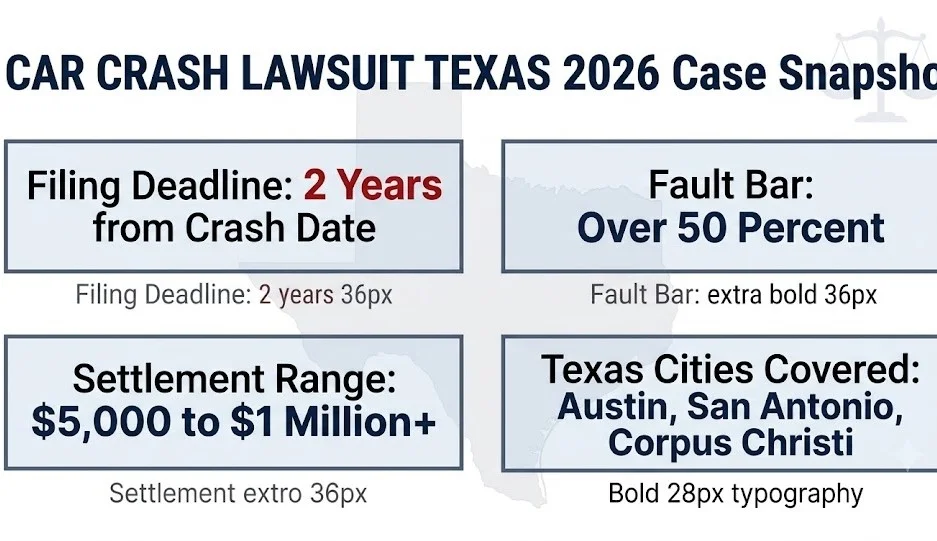
A car crash lawsuit in Texas runs on a hard two-year clock, and missing it ends the claim permanently. That single rule shapes nearly every decision an injured driver makes in Austin, San Antonio, or Corpus Christi.
Texas also uses a modified comparative fault system. Fault above 50 percent bars recovery entirely, according to Texas Civil Practice and Remedies Code Section 33.001.
Company vehicle crashes add another layer. Commercial insurance limits are often far higher than personal auto policies, which can dramatically change what a case is worth.
This piece breaks down how these claims actually move through Texas courts in 2026, city by city and driver type by driver type.
What Is a Car Crash Lawsuit in Texas
A car crash lawsuit in Texas is a civil action filed to recover damages after a vehicle collision caused by another party’s negligence. It is distinct from an insurance claim, which is a negotiation, not a court filing.
Most cases resolve through insurance settlement before reaching trial. A lawsuit becomes necessary when the insurer disputes fault, undervalues damages, or refuses a reasonable offer.
Quick facts:
- Legal basis: ordinary negligence under Texas tort law
- Filed in: county district court where the crash occurred or where the defendant resides
- Resolution path: settlement negotiation, then litigation if needed
- Deadline: two years from the date of injury under most circumstances
Attorney Insight: Attorneys handling these claims point out that filing a lawsuit does not mean going to trial, since most filed cases still settle before a jury ever hears them.
Austin Car Crash Lawsuit
An Austin car crash lawsuit is filed in Travis County District Court when negotiations with an insurer fail to produce fair compensation. Austin’s rapid growth has driven a sharp rise in highway and intersection collisions, particularly along I-35.
Travis County juries and judges apply the same statewide rules on comparative fault and damages as the rest of Texas. What differs locally is case volume and how quickly dockets move.
| Detail | Austin Specifics |
|---|---|
| Filing court | Travis County District Court |
| High-incident corridors | I-35, US-183, MoPac Expressway |
| Typical case types | Rear-end collisions, intersection crashes, highway pileups |
Attorney Insight: Attorneys practicing in Travis County note that congestion-related crashes on I-35 frequently involve multiple vehicles, which complicates fault allocation among several drivers.
San Antonio Car Crash Lawsuit
A San Antonio car crash lawsuit is filed in Bexar County District Court, serving one of the largest metro areas in Texas. High traffic volume on I-10, I-35, and Loop 410 produces a steady volume of collision litigation.
Bexar County’s caseload tends to run heavier than smaller Texas counties, which can extend the time between filing and trial. This makes early settlement negotiation especially important for plaintiffs seeking faster resolution.
Quick facts:
- Filing court: Bexar County District Court
- Major corridors: I-10, I-35, Loop 410
- Court caseload: among the highest in the state due to population density
Attorney Insight: Attorneys working Bexar County dockets say case scheduling delays make early evidence preservation, like dashcam footage and witness statements, even more critical than in smaller jurisdictions.
Corpus Christi Car Crash Lawsuit
A Corpus Christi car crash lawsuit is filed in Nueces County District Court, covering a coastal metro area with a distinct mix of commercial and tourist traffic. Port-related commercial vehicle activity adds complexity not seen in inland cities.
Weather plays a larger role here than in Austin or San Antonio. Hurricane season and coastal storm conditions contribute to a meaningful share of regional crash litigation.
| Detail | Corpus Christi Specifics |
|---|---|
| Filing court | Nueces County District Court |
| Notable factor | Heavy port and commercial vehicle traffic |
| Seasonal risk | Hurricane season weather-related crashes |
Litigation Watch: Venue matters more than most people assume, since court caseload, judge tendencies, and local traffic patterns all shape how a claim moves through Austin, San Antonio, or Corpus Christi.
Attorney Insight: Attorneys in the Corpus Christi area point to commercial port traffic as a recurring source of company vehicle litigation distinct from typical passenger vehicle crashes.
Austin Company Car Crash Lawsuit
An Austin company car crash lawsuit applies when the at-fault driver was operating a vehicle for work purposes at the time of the crash. This typically triggers vicarious liability against the employer under respondeat superior.
The key legal question is whether the driver was acting within the course and scope of employment. Texas courts, citing Painter v. American Drilling I, Ltd., have closely examined whether an activity served the employer’s business interest.
- Delivery drivers en route to a customer: typically within scope
- Employees commuting to or from work: typically outside scope
- Employees on a personal errand during work hours: depends on deviation extent
Attorney Insight: Attorneys evaluating these claims say proving the driver was performing job duties at the exact time of the crash is the single most contested issue in Austin company vehicle cases.
Corpus Christi Company Car Crash Lawsuit
A Corpus Christi company car crash lawsuit often involves port-related commercial traffic, oilfield service vehicles, or delivery fleets unique to the region’s industrial base. Liability theories mirror the rest of Texas but apply to a different mix of employers.
Negligent entrustment claims arise more frequently here when companies provide vehicles to drivers without verifying licensing or safety history. The controlling case, Williams v. Steves Industries, Inc., set out the elements required to prove this theory.
Negligent entrustment requires showing:
- The company provided the vehicle to the driver
- The company knew or should have known the driver was unfit
- The driver was negligent
- That negligence caused the crash
- The negligence was a proximate cause of injury
Attorney Insight: Attorneys handling negligent entrustment claims in Corpus Christi say documentation of a company’s hiring and vehicle assignment practices often becomes the deciding factor in these cases.
Texas Car Accident Statute of Limitations
The statute of limitations is two years from the date of the crash under Texas Civil Practice and Remedies Code Section 16.003. Missing this deadline results in automatic dismissal regardless of how strong the underlying claim is.
Exceptions exist for minors, whose deadline pauses until they turn 18, and for claims against government entities, which require notice within a much shorter window, often six months. Wrongful death claims run two years from the date of death, not the date of injury.
| Claim Type | Deadline |
|---|---|
| Standard car accident injury | 2 years from crash date |
| Wrongful death | 2 years from date of death |
| Claims against government entities | Often 6 months notice required |
| Minors injured in a crash | Tolled until age 18 |
Litigation Watch: The two-year deadline is rigid and courts apply it strictly, which is why early attorney consultation matters more than people expect.
Attorney Insight: Attorneys stress that insurance company reporting deadlines, sometimes as short as 30 days, are separate from the two-year lawsuit deadline and are frequently missed by claimants unaware of the distinction.
Texas Comparative Negligence Car Accident
Texas comparative negligence law reduces a plaintiff’s recovery by their percentage of fault, and bars recovery entirely above 50 percent. This is codified in Texas Civil Practice and Remedies Code Section 33.001, often called the 51 percent rule.
A plaintiff found 40 percent at fault recovers 60 percent of total damages. A plaintiff found 51 percent at fault recovers nothing, regardless of injury severity.
Example breakdown:
- Plaintiff 30% at fault, total damages $100,000: recovers $70,000
- Plaintiff 50% at fault, total damages $100,000: recovers $50,000
- Plaintiff 51% at fault, total damages $100,000: recovers $0
Attorney Insight: Attorneys say insurance adjusters routinely push fault percentages higher than warranted specifically to approach or exceed the 50 percent threshold, since doing so eliminates their payout obligation entirely.
Who Qualifies to File a Car Crash Lawsuit
A person qualifies to file if they were injured by another party’s negligence and their own fault does not exceed 50 percent. Property damage alone, without injury, is also recoverable but typically resolved through simpler insurance claims.
Passengers in either vehicle generally qualify regardless of which driver was at fault, since passengers rarely bear responsibility for the crash. Pedestrians and cyclists struck by negligent drivers qualify under the same comparative fault framework.
Generally qualifies:
- Injured drivers found 50 percent or less at fault
- Passengers in either vehicle
- Pedestrians or cyclists struck by a negligent driver
- Family members filing a wrongful death claim after a fatal crash
Attorney Insight: Attorneys reviewing new claims say passengers are often surprised to learn they can pursue compensation from both drivers if fault is shared between them.
Car Crash Lawsuit Payout Texas
Payout amounts in Texas car crash cases vary enormously based on injury severity, available insurance limits, and comparative fault findings. There is no fixed statewide average that applies meaningfully across case types.
Minor injury claims with limited medical treatment often settle in the low thousands to tens of thousands of dollars. Severe injury claims involving surgery, long-term care, or permanent disability can reach six or seven figures, particularly when commercial insurance applies.
| Injury Severity | Typical Settlement Range |
|---|---|
| Minor injury, limited treatment | $5,000 to $25,000 |
| Moderate injury, ongoing treatment | $25,000 to $100,000 |
| Severe injury, surgery or permanent impairment | $100,000 to $1 million or more |
| Company vehicle cases with high policy limits | Often substantially higher across all categories |
Attorney Insight: Attorneys caution that policy limits, not just injury severity, frequently cap what a claim can realistically recover, which is why identifying every available insurance policy matters early in a case.
Average Car Accident Settlement Texas
There is no single reliable statewide average for Texas car accident settlements, since case values depend heavily on injury type and policy limits. Aggregated averages often mislead more than they inform.
What matters more is understanding the components that build a settlement figure. These include economic damages, like medical bills and lost wages, and non-economic damages, like pain and suffering.
Settlement value components:
- Medical expenses, both incurred and anticipated future costs
- Lost wages and diminished earning capacity
- Property damage to the vehicle
- Pain and suffering, calculated using injury severity and documentation
- Available insurance policy limits, which can cap total recovery
Attorney Insight: Attorneys building settlement demands say thorough medical documentation, not just injury severity, is what ultimately drives a strong non-economic damages calculation.
How to File a Car Accident Lawsuit in Texas
Filing begins with documenting the crash, then escalates to a formal lawsuit only if insurance negotiation fails to produce fair compensation. Most cases never require a courtroom appearance.
The process typically starts with a demand letter to the at-fault party’s insurer. If that fails, the next step is filing a petition in the appropriate county district court.
Filing steps:
- Seek medical treatment and document all injuries
- File a police report and gather evidence at the scene if possible
- Notify your insurance company promptly
- Consult a personal injury attorney before deadlines approach
- Send a demand letter to the at-fault party’s insurer
- File a lawsuit in the appropriate county district court if settlement fails
Attorney Insight: Attorneys say cases with thorough early documentation, including photos, witness contact information, and prompt medical records, consistently produce stronger settlement leverage.
Car Accident Lawsuit Timeline Texas
A Texas car accident lawsuit typically unfolds over several months to more than a year, depending on case complexity and court caseload. Simple, undisputed cases resolve fastest.
Severe injury cases with disputed liability or high damages often take longer, particularly in busier counties like Bexar. Discovery, depositions, and pretrial motions all add time before any trial date.
| Stage | Typical Timeframe |
|---|---|
| Initial medical treatment and documentation | First weeks to months |
| Insurance negotiation | 2 to 6 months |
| Lawsuit filing, if needed | After negotiation stalls |
| Discovery and depositions | 6 months to over a year |
| Trial, if case does not settle | Often 1 to 2 years after filing |
Litigation Watch: Most car crash lawsuits in Texas resolve well before trial, but the threat of litigation is frequently what produces a fair settlement offer in the first place.
Attorney Insight: Attorneys note that insurers tend to negotiate more seriously once a lawsuit is actually filed, since litigation signals the claimant is prepared to go the distance.
Company Vehicle Accident Liability Texas
Company vehicle accident liability in Texas typically rests on respondeat superior, holding employers responsible for employee negligence within the course and scope of employment. This doctrine does not require proving the employer was directly at fault.
Texas courts examine whether the driver was furthering the employer’s business interest at the time of the crash. A delivery in progress generally qualifies. A personal errand during a lunch break generally does not, as Texas courts held in Molina v. City of Pasadena.
Liability theories in company vehicle cases:
- Respondeat superior: employer liable for employee negligence within job scope
- Negligent entrustment: owner liable for giving a vehicle to an unfit driver
- Direct negligence: employer liable for its own hiring, training, or maintenance failures
Attorney Insight: Attorneys handling these cases say commercial insurance policies typically carry far higher limits than personal auto coverage, which is precisely why employers fight hard to avoid vicarious liability findings.
Car Crash Lawsuit Lawyers in Texas
Car crash lawsuit lawyers in Texas typically work on contingency, meaning no upfront fee and payment only from a successful settlement or verdict. Most personal injury attorneys offer free initial consultations to evaluate a potential claim.
Experience with company vehicle cases specifically matters, since these claims require investigating employment records, commercial insurance policies, and scope-of-employment evidence that ordinary driver-on-driver cases do not involve.
What to ask a prospective attorney:
- Have they handled cases in your specific county, whether Travis, Bexar, or Nueces
- Do they have experience with commercial or company vehicle liability claims
- What is their fee structure and how are case costs handled
- How quickly do they typically resolve cases similar to yours
Attorney Insight: Attorneys experienced in company vehicle litigation say identifying every potentially liable party, including the driver, employer, and sometimes a vehicle leasing company, often determines the true value of a claim.
Frequently Asked Questions
How long do I have to file a car crash lawsuit in Texas?
You generally have two years from the date of the crash to file a lawsuit.
This deadline comes from Texas Civil Practice and Remedies Code Section 16.003.
Exceptions apply for minors and claims against government entities, which often require much shorter notice periods.
What happens if I was partially at fault for the crash?
You can still recover compensation if your fault is 50 percent or less.
Your damages are reduced by your percentage of fault under Texas’s modified comparative negligence rule.
If your fault exceeds 50 percent, you cannot recover any compensation.
Can I sue an employer if their employee caused my crash?
Yes, if the employee was acting within the course and scope of employment at the time.
This is called vicarious liability or respondeat superior under Texas law.
Commercial insurance policies in these cases often carry significantly higher limits than personal auto coverage.
How much is the average car crash lawsuit settlement in Texas?
There is no single reliable average, since settlements depend on injury severity and policy limits.
Minor injuries often settle for thousands to tens of thousands of dollars.
Severe injuries involving surgery or permanent impairment can reach six or seven figures, especially in company vehicle cases.
Where do I file a car crash lawsuit in Austin, San Antonio, or Corpus Christi?
Austin cases are filed in Travis County District Court.
San Antonio cases are filed in Bexar County District Court.
Corpus Christi cases are filed in Nueces County District Court.
Do I need a lawyer for a car crash lawsuit in Texas?
It depends on injury severity and whether fault or damages are disputed.
Most personal injury attorneys offer free consultations and work on contingency, so there is no upfront cost to find out.
Company vehicle cases especially benefit from legal representation given the added liability complexity.
The Bottom Line for 2026
A car crash lawsuit in Texas runs on strict deadlines and an unforgiving fault rule that can eliminate recovery entirely above 50 percent responsibility. Company vehicle cases add real complexity, but often higher available compensation through commercial insurance.
Anyone injured in Austin, San Antonio, or Corpus Christi should document everything immediately and avoid waiting to consult a personal injury attorney. The two-year deadline does not pause for recovery, negotiation, or uncertainty about next steps.
