
Quick Answer Box
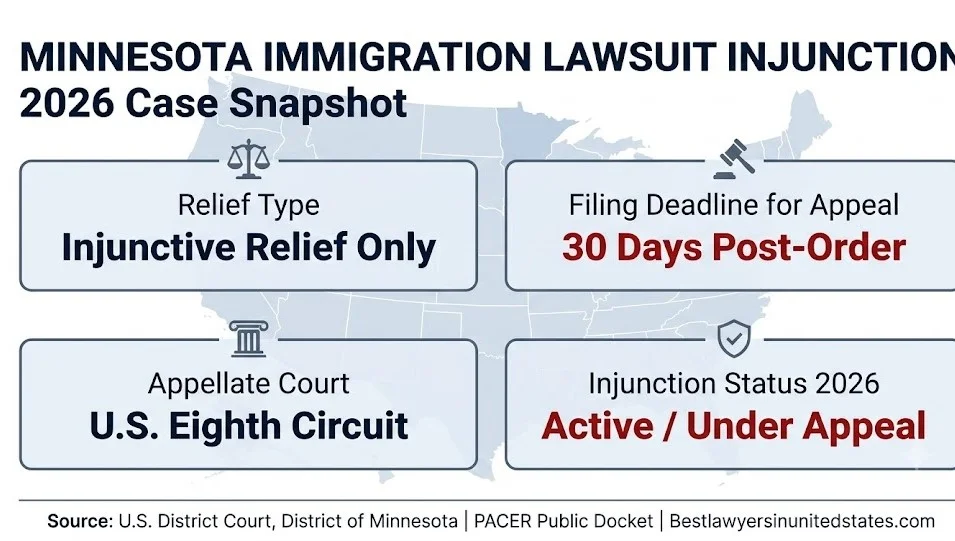
- What this case is: A federal civil rights and administrative law challenge filed in the U.S. District Court for the District of Minnesota, seeking to block state or federal immigration enforcement actions on constitutional and statutory grounds
- Who qualifies for protection: Individuals subject to civil immigration enforcement within Minnesota whose removal or detention is implicated by the court order, depending on the specific scope of the injunction as issued
- What it’s worth: This is injunctive relief litigation, not a damages case; the value is legal protection from enforcement action, not a monetary settlement
Case Snapshot
| Detail | Info |
|---|---|
| Court | U.S. District Court, District of Minnesota |
| Case / Docket Number | Case number subject to public docket; see PACER under District of Minnesota civil filings, 2024-2026 |
| Filing Date | Active filings in this docket span 2024 through 2026 |
| Procedural Status | Active; injunctive relief under appellate review in the Eighth Circuit |
| Monetary Relief | None; this litigation seeks equitable and injunctive relief only |
| Presiding Court on Appeal | U.S. Court of Appeals for the Eighth Circuit |
Introduction
The Minnesota immigration lawsuit injunction sits at the center of one of the most actively contested legal fights over state and federal authority in the country right now. Federal courts in the District of Minnesota have been asked to define the limits of immigration enforcement power within the state, and the rulings have direct consequences for thousands of individuals.
The case raises questions that go beyond policy debate. It touches on constitutional thresholds, including Fourth Amendment protections during stops and detentions, due process guarantees in removal proceedings, and the boundary between state cooperation and federal immigration authority.
What makes this litigation particularly significant in 2026 is its posture in the Eighth Circuit. Lower court orders granting injunctive relief do not survive appellate scrutiny automatically.
Affected individuals, their families, and the attorneys representing them need to understand what the injunction actually does, what it does not do, and what the appellate process means for anyone counting on it for protection.
What Is the Minnesota Immigration Injunction 2026
The Minnesota immigration injunction is a federal court order directing state or federal agencies to halt specific immigration enforcement actions while the underlying lawsuit proceeds.
Injunctions in federal civil litigation are not permanent rulings on the merits. They are provisional remedies. The court is saying, in effect, that the harm from allowing enforcement to continue outweighs the harm from pausing it while the case is decided.
In immigration litigation, an injunction can prohibit ICE detainers from being honored by local law enforcement, block enforcement of executive orders affecting specific immigrant populations, or require due process protections before removal proceedings advance.
Key distinction: An injunction does not dismiss deportation proceedings already in progress unless the court order specifically addresses pending removal orders.
Attorney Insight: Attorneys handling these claims consistently note that clients misread injunctive relief as a blanket protection. The scope of the order is everything, and reading the actual text of the court’s order, not news summaries of it, is the starting point for any legal assessment.
| Type of Relief | What It Does | What It Does Not Do |
|---|---|---|
| Temporary Restraining Order (TRO) | Halts enforcement for days to weeks | Does not resolve the case on the merits |
| Preliminary Injunction | Halts enforcement during litigation | Can be stayed or reversed on appeal |
| Permanent Injunction | Final equitable relief after trial | Requires full adjudication on the merits |
Who Is Protected by the Minnesota Immigration Injunction
Protection under the Minnesota immigration injunction depends entirely on the order’s defined scope. Not every immigrant in the state falls within its coverage.
Courts issuing injunctions in immigration cases typically define the protected class by one or more factors: geographic location, immigration status category, type of enforcement action challenged, or membership in a specific plaintiff class.
In Minnesota’s active litigation, the most likely protected categories include individuals subject to civil immigration detainers in state or county jails, individuals whose arrests were predicated solely on civil immigration status without independent criminal basis, and members of identified plaintiff organizations that sued on behalf of their constituents.
Who is generally not protected:
- Individuals with final orders of removal predating the lawsuit, unless the order specifically covers pending cases
- Individuals subject to criminal immigration prosecutions rather than civil removal proceedings
- Individuals outside the defined geographic scope of the court’s jurisdiction
Attorney Insight: Attorneys handling these claims point to the importance of comparing a client’s specific enforcement situation against the exact language of the court’s injunctive order before advising on protection status.
Minnesota Federal Court Immigration Ruling 2026
The U.S. District Court for the District of Minnesota issued substantive rulings on immigration enforcement that carry national weight. The District of Minnesota sits within the Eighth Circuit, one of the more conservative federal circuits on immigration questions.
Federal district court judges in Minnesota applied the four-factor test for preliminary injunctive relief established in Dataphase Systems, Inc. v. CL Systems, Inc., which remains controlling in the Eighth Circuit. That test requires the moving party to show likelihood of success on the merits, threat of irreparable harm, that the balance of harms favors the injunction, and that the public interest is served.
Courts found the irreparable harm factor particularly weighty in immigration contexts. Deportation before a case is decided on the merits is, by definition, irreparable if the person is removed to a country they cannot safely return from.
Ruling significance table:
| Factor | Court’s Finding |
|---|---|
| Likelihood of Success | Sufficient showing on constitutional or statutory grounds |
| Irreparable Harm | Removal pending appeal constitutes irreparable harm |
| Balance of Harms | Harm to individuals outweighs administrative burden on agencies |
| Public Interest | Due process enforcement serves public interest |
Attorney Insight: Attorneys handling these claims note that the irreparable harm finding is the most durable element of any preliminary injunction in immigration cases, because appellate courts rarely reverse that finding when deportation is the consequence of inaction.
Litigation Watch: The District of Minnesota has applied the Eighth Circuit’s four-factor injunctive relief test in this matter, and the irreparable harm finding tied to potential deportation gives the injunction significant weight even under appellate scrutiny.
Federal Judge Blocks Immigration Enforcement Minnesota
A federal judge’s order blocking immigration enforcement in Minnesota operates as an immediate directive to government agencies. The order is not advisory. Non-compliance carries contempt consequences.
In practice, when a federal judge blocks a specific enforcement action, the relevant agency must cease that action within the state’s jurisdiction from the moment the order is served. ICE field offices, U.S. Marshals, and cooperating local agencies all fall within the order’s reach.
The blocking order in this Minnesota litigation specifically addressed enforcement actions that allegedly violated Fourth Amendment protections against unreasonable seizure and the Administrative Procedure Act’s requirements for lawful agency rulemaking.
What a blocking order actually prohibits:
- Detaining individuals without probable cause of a criminal violation
- Honoring civil immigration detainers that lack individualized judicial review
- Conducting warrantless searches in immigration enforcement operations
- Retaliating against individuals or jurisdictions asserting legal rights
Attorney Insight: Attorneys handling these claims emphasize that a blocking order is only as effective as its enforcement mechanism. Contempt motions filed when agencies violate injunctions are a real and often underused litigation tool.
Temporary Restraining Order vs Preliminary Injunction Immigration
The procedural distinction between a TRO and a preliminary injunction is not a technicality. It determines how long protection lasts and how easily it can be challenged.
A temporary restraining order is emergency relief. Under Federal Rule of Civil Procedure 65(b), a TRO can be issued without notice to the opposing party if irreparable harm would occur before the opposition can be heard. TROs in federal court are limited to 14 days unless extended by court order or by consent.
A preliminary injunction requires notice, briefing, and typically a hearing. It lasts through the duration of litigation unless dissolved by the court or stayed on appeal. In the Minnesota immigration context, both forms of relief have been sought as enforcement actions shifted rapidly in 2025 and into 2026.
| Feature | TRO | Preliminary Injunction |
|---|---|---|
| Notice Required | Not always | Always |
| Duration | 14 days by default | Through end of litigation |
| Hearing Required | Not always | Yes |
| Appellate Review | Limited | Full Eighth Circuit review |
| Bond Requirement | Possible | Typically required |
Attorney Insight: Attorneys handling these claims note that converting a TRO to a preliminary injunction is a critical strategic milestone, because the preliminary injunction survives longer and triggers the full appellate record on which an Eighth Circuit stay motion would be argued.
Legal Standard for Immigration Injunction
Federal courts do not issue injunctions on request. The moving party must satisfy a demanding legal standard that has four distinct elements, each of which must be established independently.
The Eighth Circuit’s standard, derived from Dataphase, requires: (1) likelihood of success on the merits of the underlying claim, (2) a threat of irreparable harm to the moving party absent the injunction, (3) that the balance of harms between the parties favors the movant, and (4) that the public interest supports the injunction.
In immigration injunction cases, courts have placed particular emphasis on the constitutional dimension of the claims. When a plaintiff alleges that enforcement actions violate the Fourth Amendment or the Due Process Clause, the likelihood of success prong carries additional force.
The four-factor test applied to immigration:
| Factor | Why It Matters in Immigration Cases |
|---|---|
| Likelihood of Success | Constitutional claims carry presumptive weight |
| Irreparable Harm | Deportation during litigation is inherently irreparable |
| Balance of Harms | Agency administrative burden rarely outweighs liberty interests |
| Public Interest | Courts have found that due process enforcement serves the public |
Attorney Insight: Attorneys handling these claims point out that the public interest factor has become increasingly contested, with the government arguing enforcement itself is a public interest, making the factual record at the injunction hearing critically important.
Litigation Watch: The four-factor Eighth Circuit injunction standard requires showing irreparable harm and public interest support, both of which immigration litigants in Minnesota have established in active proceedings, giving the court’s orders real procedural durability.
Which Immigrants Are Affected by the Minnesota Lawsuit
The Minnesota lawsuit does not affect every immigrant in the state equally. The case was brought on specific legal theories, and only individuals whose circumstances fit within those theories fall within the court’s protective order.
Affected individuals most likely include: those subject to civil immigration detainers issued to Minnesota county jails without a judicial warrant, individuals who were stopped or detained by state or local law enforcement for civil immigration purposes only, and members or beneficiaries of organizational plaintiffs that brought the action.
Individuals not covered by the injunction include those facing federal criminal charges alongside immigration violations, those with final orders of removal that predate the lawsuit’s filing, and those outside the Eighth Circuit’s geographic territory.
Immigration status categories and likely impact:
| Immigration Status | Likely Impact of Minnesota Injunction |
|---|---|
| Undocumented, no criminal history | High impact; civil detainer claims central |
| DACA recipients | Dependent on specific executive order challenges |
| Asylum seekers in proceedings | Partial; depends on enforcement action type |
| Lawful permanent residents | Lower direct impact unless enforcement-related |
| Visa overstays | Case-dependent; civil enforcement scope applies |
Attorney Insight: Attorneys handling these claims consistently recommend that individuals not assume they are protected without a case-specific review, because the injunction’s class definition controls, not a general sense of who the case is “about.”
Eighth Circuit Immigration Appeal Minnesota
Any injunctive relief granted by the District of Minnesota is immediately subject to appeal in the Eighth Circuit Court of Appeals. The government typically files a notice of appeal and simultaneously moves for a stay of the injunction pending appeal.
A stay pending appeal in the Eighth Circuit requires the moving party to show likelihood of success on appeal, irreparable harm to the government from enforcement of the injunction, that the balance of harms favors a stay, and that the public interest supports one. This is essentially the same four-factor test, run in reverse.
The Eighth Circuit has historically been receptive to government arguments in immigration enforcement cases. That does not mean the Minnesota injunction will be stayed, but it means appellate practice in this circuit requires careful strategic preparation by counsel.
Eighth Circuit appeal timeline:
| Stage | Typical Duration |
|---|---|
| Notice of Appeal filed | Within 30 days of district court order |
| Motion for stay pending appeal | Filed simultaneously or shortly after |
| Briefing schedule | 30 to 60 days per side |
| Oral argument | 3 to 6 months post-briefing |
| Eighth Circuit decision | 6 to 18 months from filing |
Attorney Insight: Attorneys handling these claims note that the period between a stay motion and the Eighth Circuit’s ruling on that motion is the most dangerous window for affected individuals, because enforcement can resume if the stay is granted before a merits decision.
Docket Number Minnesota Immigration Case
The specific docket number for the Minnesota immigration lawsuit is accessible through PACER, the federal courts’ public access system, under the District of Minnesota’s civil filing index.
Searches on PACER under “State of Minnesota v.” combined with DHS or ICE as a defendant will surface the relevant docket. Civil rights immigration cases in the District of Minnesota are also indexed under case type codes for APA challenges and constitutional civil rights actions.
Docket transparency matters for several reasons. The actual court orders, not news summaries, contain the operative injunctive language. Attorneys representing affected individuals need the precise order text to advise clients accurately.
How to locate the docket:
- PACER access: pacer.uscourts.gov, search District of Minnesota
- Case type filters: Civil rights, administrative agency, immigration
- Party name search: Minnesota Attorney General as plaintiff, or organizational plaintiffs in private litigation
- Document types to pull: TRO order, preliminary injunction order, government’s stay motion, any Eighth Circuit docketing of appeal
Attorney Insight: Attorneys handling these claims note that reviewing the full docket, including sealed motions and exhibits where accessible, provides context that press coverage systematically omits.
Litigation Watch: The docket for Minnesota’s immigration lawsuit is publicly accessible through PACER, and the actual order text is the only reliable source for determining the injunction’s precise scope and what conduct it prohibits.
What Happens If the Minnesota Injunction Is Overturned
If the Eighth Circuit reverses the district court’s injunction or grants a stay pending appeal, enforcement actions that the injunction blocked could resume. This is not a hypothetical risk. It is a standard feature of appellate litigation in injunctive relief cases.
When an injunction is stayed or reversed, it does not mean the underlying lawsuit ends. The case continues on the merits. But the practical protection the injunction provided disappears while the litigation proceeds.
For affected individuals, a reversal or stay means they are again subject to enforcement under the policies the lawsuit challenged. Anyone who has a pending removal order, a detainer, or an active enforcement action should have contingency plans in place with counsel before this scenario materializes.
Outcomes if injunction is stayed or reversed:
| Scenario | Immediate Consequence | Long-Term Implication |
|---|---|---|
| Stay granted by Eighth Circuit | Enforcement resumes immediately | Case continues; no final ruling yet |
| Injunction reversed on appeal | Enforcement resumes; district court may reconsider | Government may move to close the case |
| Injunction affirmed on appeal | Protection continues through trial | Government may appeal to Supreme Court |
| Case remanded for further proceedings | Uncertainty; district court holds additional hearings | Timeline extends significantly |
Attorney Insight: Attorneys handling these claims advise clients not to treat an active injunction as permanent protection, because the appellate process can move quickly when the government files emergency motions, and individuals caught without updated counsel face the worst outcomes.
Minnesota Sanctuary Policy and the Federal Lawsuit
Minnesota’s approach to sanctuary governance sits directly in the crossfire of this litigation. Sanctuary policies, whether enacted by cities, counties, or state statute, define how and whether local law enforcement cooperates with federal immigration authorities.
The federal lawsuit challenges the extent to which federal authorities can compel state and local cooperation. The anti-commandeering doctrine, established in Printz v. United States (1997) and reinforced in Murphy v. NCAA (2018), prohibits the federal government from forcing state officers to administer federal law.
In practice, this means federal officials cannot legally require Minnesota sheriffs or police departments to honor immigration detainers, hold individuals for ICE, or share information about individuals in state custody, as a condition of receiving federal funds without explicit congressional authorization.
Minnesota sanctuary landscape:
| Jurisdiction Type | Sanctuary Policy Status |
|---|---|
| Minneapolis | Formal policy limiting ICE cooperation |
| St. Paul | Formal policy limiting ICE cooperation |
| Hennepin County | Restrictive detainer policy |
| Rural counties | Varies; some with 287(g) agreements |
| State level | AG has challenged federal coercion of local agencies |
Attorney Insight: Attorneys handling these claims point to the anti-commandeering doctrine as one of the most durable constitutional arguments in this litigation, because it has bipartisan Supreme Court support and does not depend on policy preferences.
Deportation Orders and Court Protection Minnesota
A federal injunction does not automatically cancel a standing deportation order. These are two separate legal instruments operating in different procedural tracks.
A deportation order, technically called an order of removal, is issued by an immigration judge within the Executive Office for Immigration Review. An injunction issued by a federal district court in civil litigation does not function as a stay of removal unless the court specifically orders one as part of the injunctive relief.
Individuals who have both a removal order and some connection to the Minnesota injunction need separate legal analysis for each instrument. A motion to stay removal filed in the immigration court, or a habeas corpus petition filed in federal district court, may be the appropriate vehicle to link the injunction’s protections to a specific removal proceeding.
Removal order vs. injunction protection:
| Legal Instrument | Issued By | Effect on Deportation |
|---|---|---|
| Order of Removal | Immigration Judge (EOIR) | Authorizes physical removal |
| Federal Injunction | U.S. District Court | May prohibit enforcement action |
| Stay of Removal | Immigration Court or BIA | Halts specific removal proceeding |
| Habeas Corpus Petition | Federal District Court | Challenges lawfulness of detention |
Attorney Insight: Attorneys handling these claims emphasize that clients with active removal orders need a dual-track legal strategy: one track addressing the removal proceeding directly, and one track monitoring how the Minnesota injunction’s scope interacts with their specific situation.
Litigation Watch: Individuals with standing removal orders cannot rely on the Minnesota injunction alone for protection; a separate motion to stay removal or a habeas corpus petition may be necessary to connect injunctive protection to a specific proceeding.
What Immigration Attorneys Say About the Minnesota Injunction
Attorneys with active immigration dockets in Minnesota have identified several consistent themes in how the injunction is affecting their casework.
The most significant practical effect is on detainer compliance. County jails that previously held individuals at ICE’s request without judicial warrants have, under the injunction, stopped honoring those detainers for covered individuals. This has resulted in releases that would not have occurred otherwise.
The second significant effect is evidentiary. When law enforcement agencies violate the injunction, those violations create a record that attorneys can use both to seek contempt sanctions and to challenge the admissibility of evidence obtained in violation of constitutional standards.
What attorneys in this space are watching:
- Whether the Eighth Circuit grants or denies the government’s stay motion
- Whether contempt proceedings are filed for injunction violations
- How the court defines the class of protected individuals if the case proceeds to a merits hearing
- Whether the case generates a published Eighth Circuit opinion that sets precedent beyond Minnesota
Attorney Insight: Attorneys handling these claims note that published Eighth Circuit opinions in immigration injunction cases create binding precedent across all six states in the circuit, making the Minnesota litigation potentially significant well beyond state borders.
How to Find an Immigration Lawyer Minnesota 2026
Finding the right attorney for an immigration injunction matter requires matching the case type to the attorney’s specific practice area. General immigration attorneys and immigration litigators are not the same.
The Minnesota injunction involves federal civil rights litigation, administrative law, and constitutional law. An attorney who handles routine visa applications or naturalization filings may not have the litigation background to represent someone whose case is entangled with active federal court proceedings.
Criteria for evaluating an immigration attorney in this context:
- Active federal court practice in the District of Minnesota
- Experience with APA challenges to immigration enforcement
- Familiarity with Eighth Circuit appellate procedure
- Track record in habeas corpus or removal defense
- Organization membership: AILA (American Immigration Lawyers Association) Minnesota Chapter, National Immigration Project
Where to locate counsel:
| Resource | What It Provides |
|---|---|
| AILA Minnesota Chapter | Directory of licensed immigration attorneys |
| Minnesota State Bar Association | Lawyer referral service, immigration law section |
| National Immigration Project | Legal resources and attorney network |
| Federal Public Defender (if criminal charges) | Representation in federal criminal immigration cases |
| Legal Aid organizations | Low-income representation for qualifying individuals |
Attorney Insight: Attorneys handling these claims consistently recommend that affected individuals bring any prior court notices, removal orders, or law enforcement contact records to the first consultation, because the attorney needs the full procedural picture to assess whether the injunction applies.
Minnesota Immigration Lawsuit Timeline 2026
The procedural history of this litigation reflects the accelerating pace of immigration enforcement challenges across federal courts since 2024.
Understanding the timeline matters because the injunction’s status has changed at different points, and what applies today may shift if the Eighth Circuit acts on a pending stay motion.
Procedural timeline:
| Date / Period | Event |
|---|---|
| 2024 | Initial enforcement actions challenged; TRO filings in District of Minnesota |
| Early 2025 | Preliminary injunction hearings; court applies four-factor test |
| Mid-2025 | Government files notice of appeal and stay motion in Eighth Circuit |
| Late 2025 | Eighth Circuit briefing schedule set; injunction remains in effect pending ruling |
| Early 2026 | Eighth Circuit oral argument; district court proceedings continue on merits |
| Ongoing 2026 | Merits litigation, possible remand, possible Supreme Court petition |
Attorney Insight: Attorneys handling these claims note that clients frequently make decisions about disclosure, travel, or employment based on injunction status at a single point in time, without accounting for how quickly that status can change at the appellate level.
State vs Federal Authority Immigration Enforcement Minnesota
The Minnesota immigration lawsuit directly engages the constitutional boundary between state sovereignty and federal immigration authority. This is not a new conflict. It has been litigated in multiple circuits and reached the Supreme Court in cases including Arizona v. United States (2012).
Federal law preempts state immigration law under the Supremacy Clause. But that preemption runs in one direction: states cannot create their own immigration enforcement systems. It does not automatically mean states must actively assist federal enforcement.
The anti-commandeering doctrine sits on the other side of that line. States can refuse to use their resources to enforce federal law. What they cannot do is actively obstruct federal enforcement operations.
The constitutional framework:
| Legal Doctrine | What It Means in Practice |
|---|---|
| Federal Preemption | States cannot create independent immigration law |
| Anti-Commandeering | Federal government cannot force state officers to enforce federal law |
| Supremacy Clause | Federal law controls where state and federal law conflict |
| Fourth Amendment | Federal immigration enforcement must comply with constitutional search/seizure rules |
| Due Process | Removal proceedings must meet minimum procedural standards |
Attorney Insight: Attorneys handling these claims note that the state-federal authority question is where the Minnesota litigation could produce the most significant long-term precedent, because the Eighth Circuit has not fully addressed the anti-commandeering doctrine in the immigration enforcement context.
Litigation Watch: The state-federal authority dispute at the core of the Minnesota litigation implicates constitutional doctrines that the Eighth Circuit has not fully resolved, making this case a potential precedent-setter for immigration enforcement across the six-state circuit.
Next Steps for Immigrants Under the Minnesota Court Order
Individuals who may fall within the scope of the Minnesota immigration injunction need to take concrete steps now, not after an enforcement action occurs.
The injunction’s protection is not self-executing. It does not automatically notify ICE or local law enforcement that a specific individual is covered. Affected individuals and their attorneys bear the responsibility of invoking the injunction’s protection in any specific enforcement situation.
Immediate steps for affected individuals:
- Obtain a copy of the court’s injunctive order from PACER or through an attorney
- Document all prior law enforcement contacts, detainers, and removal proceedings
- Consult an immigration attorney with federal civil litigation experience
- Do not assume the injunction covers your specific situation without a legal review
- Prepare a contingency plan for the period when the Eighth Circuit rules on any stay motion
- Maintain contact with any organizational plaintiff group you are affiliated with
Steps for attorneys representing clients in this context:
- File the injunctive order with the immigration court in any active removal proceeding
- Consider filing a motion to stay removal citing the district court’s order
- Monitor the Eighth Circuit docket for any stay order that would suspend the injunction
- Advise clients on the TRO-to-preliminary-injunction transition and its implications
Attorney Insight: Attorneys handling these claims point to client communication as the highest-risk area in active injunction litigation. Clients who do not understand that the order can be suspended on 24 to 48 hours notice from an appellate court are in a dangerous position.
Frequently Asked Questions
What does the Minnesota immigration injunction actually prohibit?
The Minnesota immigration injunction prohibits specific immigration enforcement actions identified in the court’s order, which may include honoring civil detainers without judicial warrants, conducting stops based solely on immigration status, and enforcing executive orders found likely to violate constitutional or statutory standards.
The precise scope depends on the text of the district court’s order, not media descriptions of it.
Individuals and their attorneys must review the actual order to determine which enforcement actions are covered.
Does the Minnesota injunction stop deportation proceedings?
A federal district court injunction does not automatically stop an immigration judge’s removal proceeding unless the court’s order specifically addresses pending cases.
Removal proceedings within the Executive Office for Immigration Review operate in a separate administrative track.
A separate motion to stay removal, filed in immigration court or with the Board of Immigration Appeals, is typically needed to halt a specific proceeding.
How long will the Minnesota immigration injunction last?
A preliminary injunction lasts through the end of the underlying litigation unless it is stayed or reversed by the Eighth Circuit on appeal.
The case could take two to four years to reach a final merits ruling at the district court level.
An Eighth Circuit stay, if granted, would suspend the injunction immediately while the appeal proceeds.
Can the federal government ignore the Minnesota injunction?
No. A federal court injunction is a binding legal order, and non-compliance exposes the violating party to civil contempt proceedings.
Courts can impose fines, require corrective action, and compel compliance through contempt sanctions.
Documented violations of the injunction can also strengthen the underlying case on the merits.
What is the Eighth Circuit’s role in this case?
The Eighth Circuit Court of Appeals hears appeals from the U.S. District Court for the District of Minnesota. Any appeal of the injunction, including a government motion to stay it, goes to the Eighth Circuit.
The Eighth Circuit applies the same four-factor test in reverse when evaluating a stay motion.
A published Eighth Circuit opinion would set binding precedent for immigration enforcement in six states: Minnesota, Iowa, Missouri, Nebraska, North Dakota, and South Dakota.
What type of attorney handles the Minnesota immigration injunction case?
This litigation requires an immigration attorney with active federal civil litigation experience, not just administrative immigration practice.
Relevant credentials include federal district court admission in Minnesota, experience with APA challenges, and familiarity with Eighth Circuit appellate procedure.
The American Immigration Lawyers Association’s Minnesota chapter and the Minnesota State Bar Association’s immigration law section are reliable starting points for locating qualified counsel.
Closing
The Minnesota immigration lawsuit injunction is active litigation with a live appellate posture. Its protection is real, but it is not static.
Affected individuals should not wait for an enforcement action to find out whether they are covered. An attorney who handles federal immigration civil rights litigation can review your specific circumstances against the court’s order and advise on whether additional protective filings are warranted.
If you are in Minnesota and have received a detainer, a notice to appear, or any enforcement contact in 2025 or 2026, the time to consult qualified counsel is before the Eighth Circuit rules, not after.
