
Quick Answer Box
- What this case is: Active federal civil litigation in the U.S. District Court for the Southern District of New York, docket number 1:24-cv-10049, in which Blake Lively alleges sexual harassment, retaliation, and a coordinated PR smear campaign against Justin Baldoni and Wayfarer Studios; Baldoni has filed a $400 million countersuit against Lively, Ryan Reynolds, and Lively’s publicist for defamation and civil extortion
- Who is involved: Blake Lively (plaintiff); Justin Baldoni and Wayfarer Studios (primary defendants); Melissa Nathan and Jed Wallace of Street Relations Inc. (named defendants); Ryan Reynolds and Leslie Sloane (counterclaim defendants); Taylor Swift (third party whose text messages appear in Baldoni’s filings)
- What it’s worth: Lively seeks unspecified compensatory and punitive damages with no statutory cap under FEHA; Baldoni’s countersuit demands $400 million for reputational and economic harm to himself, Wayfarer Studios, and associated business relationships
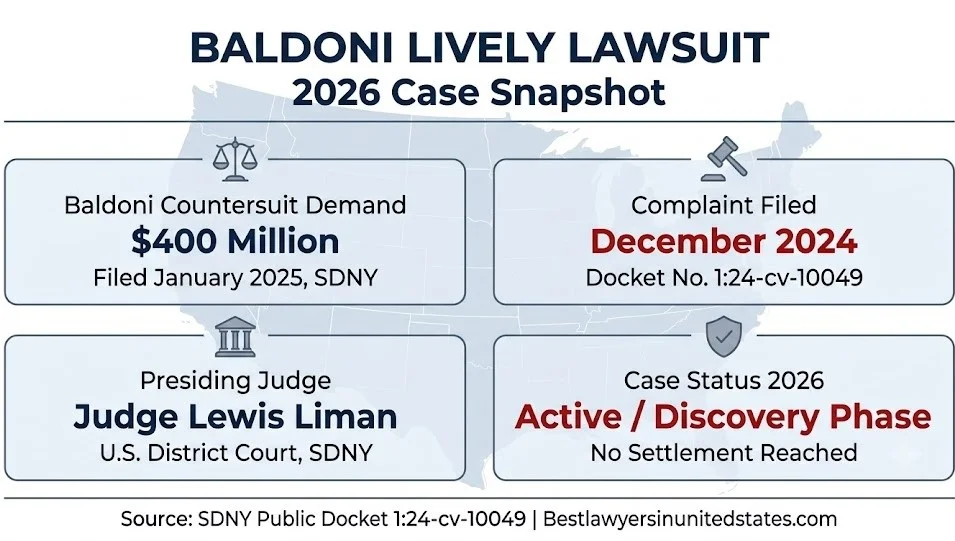
Case Snapshot
| Detail | Info |
|---|---|
| Court | U.S. District Court, Southern District of New York |
| Docket Number | 1:24-cv-10049 |
| Lively Complaint Filed | December 2024 |
| Baldoni Countersuit Filed | January 2025 |
| Presiding Judge | Judge Lewis Liman, SDNY |
| Baldoni Countersuit Demand | $400 million |
| Lively Damages Sought | Unspecified; compensatory and punitive |
| Case Status | Active; discovery phase, 2026 |
| Settlement | None reached as of 2026 |
Introduction
The baldoni lively lawsuit is one of the most legally complex celebrity civil cases to enter active federal discovery in years, and its 2026 status demands more than a timeline of press releases. Filed in the Southern District of New York under docket number 1:24-cv-10049, the case now involves competing statutory and tort claims, a $400 million countersuit, three counterclaim defendants including Ryan Reynolds, and a tranche of Taylor Swift text messages that Baldoni’s legal team placed into the court record
The case is no longer a story about a film set dispute. It is a multi-party federal civil action with documentary evidence, deposition schedules, and pending motions that will shape its outcome.
What the press has not explained is how each legal element functions independently. The Swift texts are not just a public relations moment. Reynolds’ inclusion in the countersuit is not a headline. Both are legal developments with specific evidentiary and liability implications.
Here is something related: Attorney General Lawsuit HHS Cuts: 2026 Legal Guide
This analysis addresses each claim, each party’s exposure, and the procedural trajectory through 2026.
What Is the Baldoni Lively Lawsuit About in 2026
The baldoni lively lawsuit is a bilateral federal civil action arising from the production and promotion of the 2024 film It Ends With Us, in which Justin Baldoni directed and Blake Lively starred.
Lively’s complaint, filed in December 2024, alleges that Baldoni engaged in sexual harassment on set, retaliated against her after she raised concerns, and orchestrated a coordinated public relations campaign through third-party crisis communications professionals to damage her reputation. The complaint names Baldoni, Wayfarer Studios, Melissa Nathan, and Jed Wallace of Street Relations Inc. as defendants.
Baldoni’s countersuit, filed in January 2025, alleges that Lively and her associates fabricated the harassment narrative, fed it to journalists, and used the threat of public exposure as leverage to extract creative control concessions. His counterclaims seek $400 million and name Lively, Ryan Reynolds, and publicist Leslie Sloane.
The bilateral claim structure at a glance:
| Party | Role | Primary Legal Theory |
|---|---|---|
| Blake Lively | Plaintiff / Counterclaim Defendant | Sexual harassment, retaliation, IIED |
| Justin Baldoni | Defendant / Counterclaimant | Defamation, civil extortion, tortious interference |
| Ryan Reynolds | Counterclaim Defendant | Alleged co-participant in defamation campaign |
| Leslie Sloane | Counterclaim Defendant | Alleged media placement of false statements |
| Melissa Nathan | Named Defendant | Civil conspiracy; tortious conduct |
| Jed Wallace / Street Relations | Named Defendant | Civil conspiracy; tortious conduct |
Attorney Insight: Attorneys handling multi-party bilateral civil litigation note that cases structured this way, with every primary party simultaneously a plaintiff and a defendant on different theories, require significantly more complex jury instructions and create amplified settlement obstacles compared to standard civil disputes.
Lively Baldoni Swift Text Messages Lawsuit Explained
The Taylor Swift text messages entered the public record through Baldoni’s legal filings, not through a subpoena or court order. Baldoni’s legal team included references to text message communications involving Swift as part of the factual narrative supporting his counterclaims.
The specific context is this: according to Baldoni’s filings, text messages between Swift and Lively, and communications referencing those exchanges, were used to support the allegation that Lively had a coordinated network of high-profile allies who amplified the negative narrative about Baldoni. Swift is not a party to the lawsuit. She has not been named as a defendant or counterclaim defendant.
The filing of materials referencing Swift’s communications was a deliberate litigation strategy. By placing them in the court record, Baldoni’s team introduced the Swift connection into the discoverable record and into public consciousness simultaneously.
Swift texts: what is actually known:
| Element | Status |
|---|---|
| Swift named as party | No; third party only |
| Texts filed by | Baldoni’s legal team |
| Purpose in filings | Support defamation / coordinated campaign theory |
| Subpoena issued to Swift | Not publicly confirmed as of 2026 |
| Texts entered as formal evidence | Pending; discovery phase ongoing |
Bold callout: The introduction of Swift’s communications into Baldoni’s filings does not make Swift a witness or a party. It makes those communications potentially subject to third-party discovery if the court finds them material.
Attorney Insight: Attorneys handling high-profile defamation cases note that introducing third-party celebrity communications into court filings before formal discovery is a calculated dual-purpose tactic: it builds the factual narrative in the public record while simultaneously laying the groundwork for a third-party subpoena.
Litigation Watch: The Taylor Swift text messages were introduced into the court record through Baldoni’s filings as part of his coordinated defamation campaign theory, making them potentially subject to third-party discovery even though Swift is not a named party in docket 1:24-cv-10049.
Are the Taylor Swift Texts Admissible in the Baldoni Lively Case
Admissibility of the Taylor Swift text messages depends on three distinct legal questions: relevance, hearsay, and privilege.
On relevance, Baldoni’s legal theory requires showing that Lively had a coordinated network of public allies who participated in the alleged defamation campaign. If Swift’s texts contain statements relevant to that coordination, they clear the relevance threshold under Federal Rule of Evidence 401.
On hearsay, text messages are out-of-court statements. They are admissible under multiple exceptions, including party admissions if Lively is the author, statements of co-conspirators if the coordination theory succeeds, or simply as operative facts rather than for the truth of the matter asserted.
On privilege, Swift’s personal text messages are not protected by attorney-client privilege. They could be protected by other doctrines, such as a joint defense agreement if Swift’s counsel and Lively’s counsel entered one, but no such agreement has been publicly confirmed.
Admissibility analysis:
| Legal Question | Analysis | Outcome |
|---|---|---|
| Relevance (FRE 401) | Material to coordination theory | Likely passes |
| Hearsay (FRE 801) | Multiple exceptions available | Likely admissible under exception |
| Attorney-Client Privilege | Not applicable to Swift directly | No privilege protection |
| Joint Defense Privilege | Possible if agreement exists | Unconfirmed; contested |
| Authentication (FRE 901) | Requires verification of authorship | Standard process; achievable |
Attorney Insight: Attorneys handling federal civil cases with third-party digital communications note that text messages rarely face a complete admissibility bar; the more common fight is over authentication, completeness, and the specific purpose for which the jury is permitted to consider them.
Ryan Reynolds Named in Baldoni Countersuit
Ryan Reynolds is a named counterclaim defendant in Baldoni’s January 2025 countersuit. He is not a peripheral figure in the filing. Baldoni’s legal team specifically alleges that Reynolds participated in planning and executing the media campaign that Baldoni characterizes as defamatory.
Reynolds’ inclusion rests on the allegation that he used his public platform, his business relationships, and his personal communications to amplify negative information about Baldoni and to facilitate the media placements that Baldoni claims constituted defamation.
Being named as a counterclaim defendant carries specific procedural consequences. Reynolds must retain separate legal counsel. He is subject to full civil discovery, including deposition. His communications with Lively, with her publicist, and with any media contacts are potentially discoverable.
Reynolds’ legal position as counterclaim defendant:
| Procedural Consequence | Detail |
|---|---|
| Must retain counsel | Separate representation from Lively |
| Subject to deposition | Full deposition on his alleged role |
| Communications discoverable | Texts, emails with Lively, publicists, media |
| Potential liability | Joint and several if defamation proven |
| Trial exposure | Could testify as adverse witness |
Bold callout: Reynolds’ status as a named counterclaim defendant means his personal communications from the period in question are subject to document production demands, not just voluntary disclosure.
Attorney Insight: Attorneys handling cases where a party’s spouse or close associate is named as a co-defendant note that the litigation dynamics shift significantly, because coordinating a defense strategy across separately represented defendants on the same factual record creates communication challenges and potential privilege complications.
What Is Ryan Reynolds’ Legal Exposure in the Baldoni Lively Lawsuit
Reynolds’ legal exposure in the baldoni lively lawsuit depends on what Baldoni can prove about Reynolds’ specific conduct and his intent.
To hold Reynolds liable for defamation, Baldoni must establish four elements: that Reynolds made or caused to be made a false statement of fact about Baldoni, that the statement was published to a third party, that Baldoni suffered damages as a result, and, because both parties are public figures, that Reynolds acted with actual malice, meaning he knew the statement was false or acted with reckless disregard for its truth.
The actual malice standard is demanding. Reynolds’ documented communications will be the evidentiary battleground. If those communications show Reynolds knew the harassment narrative was false and pushed it anyway, the actual malice element is potentially satisfied. If they show Reynolds simply supported his wife’s account in good faith, the defamation theory against him is substantially weaker.
Reynolds’ defamation liability analysis:
| Element | What Baldoni Must Prove | Difficulty Level |
|---|---|---|
| False statement of fact | Reynolds made or caused a false statement | High; narrative v. narrative |
| Publication | Statement reached third parties | Low; media coverage documented |
| Damages | Baldoni’s career and business harmed | Medium; economic evidence needed |
| Actual malice | Reynolds knew it was false or was reckless | High; requires communications evidence |
Attorney Insight: Attorneys handling defamation claims against public figure defendants note that the actual malice standard effectively requires internal communications showing conscious disregard for the truth, which is why Reynolds’ text messages and emails from the relevant period are the most consequential discovery target in his portion of the case.
Litigation Watch: Ryan Reynolds’ actual legal exposure in the Baldoni countersuit hinges entirely on whether discovery produces communications showing he knew Baldoni’s harassment narrative was false and promoted it anyway, a high evidentiary bar that Baldoni’s team must meet to survive summary judgment on the Reynolds claims.
Justin Baldoni Defamation Claims Against Blake Lively
Baldoni’s defamation claims against Lively allege that she made and caused to be made false statements of fact to journalists and media outlets, with the New York Times’ December 2024 report identified as a primary vehicle for the alleged defamatory publication.
Defamation in New York, where the SDNY sits, requires a false statement of fact, publication to a third party, fault, and damages. Because Baldoni is a public figure, he must prove actual malice. The actual malice standard requires showing that Lively either knew her statements were false or acted with reckless disregard for their truth.
Baldoni’s filing points to the coordination of media outreach, the timing of the New York Times article relative to the filing of Lively’s complaint, and the private communications between Lively’s team and journalists as evidence that the publication was deliberate and strategic, not the product of good-faith disclosure.
Defamation claim elements under New York law:
| Element | Baldoni’s Alleged Proof |
|---|---|
| False statement of fact | Harassment narrative characterized as fabricated |
| Publication | New York Times report; other media outlets |
| Actual malice | Coordination of media timing before complaint filed |
| Damages | Career destruction; loss of Sony relationship; Wayfarer business losses |
Bold callout: The timing of the New York Times article relative to Lively’s formal complaint filing is the centerpiece of Baldoni’s actual malice argument. He alleges the coordinated release was designed to prejudice the public record before he could respond.
Attorney Insight: Attorneys handling defamation claims that rely on pre-litigation media campaigns note that the evidentiary burden of proving actual malice against a person who claims they were reporting genuine harassment is among the most contested factual questions in civil litigation, requiring extensive discovery into internal communications.
Blake Lively Sexual Harassment and Retaliation Claims Against Baldoni
Lively’s harassment claims arise under California’s Fair Employment and Housing Act, the statutory framework that governs workplace harassment claims in the entertainment production context.
FEHA defines sexual harassment as unwanted sexual conduct that is either severe enough to alter the terms of employment or sufficiently pervasive to create a hostile work environment. Lively’s complaint alleges that Baldoni’s conduct on the set of It Ends With Us met both thresholds.
The retaliation claim is legally independent. Under FEHA, retaliation occurs when an employer takes an adverse action against an employee because of a protected activity, specifically the reporting of harassment. Lively alleges that Baldoni and Wayfarer Studios, through their retention of crisis PR operatives, conducted a systematic reputational attack in direct response to her internal complaints.
Explore this too: Blake Lively Lawsuit Update: Full 2026 Legal Breakdown
FEHA claim elements Lively must prove:
| Claim | Required Proof | Key Evidence |
|---|---|---|
| Sexual harassment | Unwanted conduct; severity or pervasiveness | On-set incident documentation; witness testimony |
| Hostile work environment | Altered working conditions | Production records; crew testimony |
| Retaliation | Protected activity; adverse action; causal link | PR strategy communications; timeline of events |
| Employer ratification | Wayfarer approved or condoned conduct | Internal communications; executive testimony |
Attorney Insight: Attorneys handling FEHA retaliation claims note that the causal connection between protected activity and adverse action is often established through timing: when the retaliatory conduct begins immediately after a complaint is raised, courts treat the sequence as circumstantial evidence of causation.
Civil Extortion Theory in the Baldoni Lively Lawsuit
Baldoni’s civil extortion theory is legally distinct from his defamation claims and represents one of the more aggressive legal theories in his countersuit.
Under California Penal Code Section 519, civil extortion occurs when a party threatens to expose information about another, whether true or false, with the intent to extract a benefit. Baldoni alleges that Lively’s team threatened to go public with the harassment narrative unless Baldoni capitulated to her demands regarding creative control of It Ends With Us.
This theory does not require the underlying information to be false. That is what distinguishes civil extortion from defamation. Even if Lively’s harassment allegations were true, the use of a threatened public disclosure as leverage to extract a concession could constitute extortion under California law.
Civil extortion elements under California law:
| Element | What Baldoni Must Show |
|---|---|
| Threat to expose information | Lively’s team threatened public disclosure |
| Intent to extract benefit | Demand for creative control or other concession |
| Causal connection | Threat made before benefit was demanded |
| Damages | Business harm from the extortionate conduct |
Bold callout: The civil extortion theory is independent of whether the harassment allegations are true. A party can commit civil extortion using true information if the disclosure is threatened as leverage rather than disclosed in good faith.
Attorney Insight: Attorneys handling civil extortion claims note that this theory is particularly potent when discovery produces communications showing that the threat of disclosure and the demand for a concession were sequentially coordinated, because that sequence is direct evidence of the extractive intent element.
Litigation Watch: Baldoni’s civil extortion theory is legally independent of his defamation claims and does not require the harassment allegations to be false, which means it survives even if the jury finds Lively’s harassment account credible, making it the most structurally resilient count in his countersuit.
Anti-SLAPP Motion Baldoni Lively SDNY 2026
The anti-SLAPP motion is one of the most consequential pending procedural questions in the baldoni lively lawsuit. SLAPP stands for Strategic Lawsuit Against Public Participation. California’s anti-SLAPP statute, California Code of Civil Procedure Section 425.16, allows defendants to move to strike civil claims that arise from protected speech or petitioning activity.
Baldoni’s legal team has raised anti-SLAPP arguments targeting Lively’s claims that arise from the PR communications, specifically the allegation that the crisis communications operatives’ media outreach constitutes tortious conduct. The theory is that communications to journalists are protected activity under California’s statute, and claims arising from that activity should be stricken.
The procedural complication is significant. California’s anti-SLAPP statute is a state procedural rule. Its application in federal court depends on circuit precedent. The Ninth Circuit routinely applies it. The Second Circuit, which governs the SDNY, has not uniformly adopted it. Judge Liman’s ruling on whether California’s anti-SLAPP statute applies in this federal forum is a threshold question that will reshape the entire case structure.
Anti-SLAPP procedural analysis:
| Question | Legal Issue | Status |
|---|---|---|
| Does anti-SLAPP apply in SDNY? | Second Circuit has not uniformly resolved this | Pending ruling |
| Which claims are targeted? | Lively’s PR-related tort claims | Under motion |
| If granted: consequence | Claims stricken; attorney fees awarded to movant | Significant case narrowing |
| If denied: consequence | Full discovery proceeds on PR claims | Lively’s evidentiary position strengthened |
| Appellate review | Interlocutory appeal possible if granted | Could delay proceedings |
Attorney Insight: Attorneys practicing in the Second Circuit note that the anti-SLAPP applicability question is genuinely unsettled, and the Liman ruling in this case could become a significant SDNY precedent on whether California’s statute travels with California-connected claims filed in New York federal court.
Baldoni Lively Lawsuit SDNY Docket and Judge
The baldoni lively lawsuit is filed in the U.S. District Court for the Southern District of New York under docket number 1:24-cv-10049. The presiding judge is Judge Lewis Liman.
Judge Liman was appointed to the federal bench in 2018. His courtroom is known for active case management, tight scheduling orders, and a preference for early resolution of discovery disputes through motion practice rather than extended informal negotiation. Those characteristics matter here, because this case has multiple competing privilege claims, disputed discovery scope issues, and third-party subpoena questions that require judicial resolution.
The SDNY docket is publicly accessible through PACER. Key documents available on the public docket include Lively’s initial complaint, Baldoni’s answer and counterclaims, any scheduling orders issued by Judge Liman, and motion papers on discovery disputes and the anti-SLAPP question.
SDNY docket reference guide:
| Document Type | Availability | Where to Access |
|---|---|---|
| Lively’s complaint | Public | PACER, docket 1:24-cv-10049 |
| Baldoni’s answer and counterclaims | Public | PACER, same docket |
| Judge Liman’s scheduling orders | Public | PACER, same docket |
| Discovery dispute motions | Public (unless sealed) | PACER, same docket |
| Deposition transcripts | Typically sealed during discovery | Not yet public |
Bold callout: Judge Liman’s SDNY courtroom applies firm discovery deadlines. Delays that might occur in less actively managed jurisdictions are unlikely to be tolerated in this case, which accelerates the timeline toward a 2026 deposition phase.
Attorney Insight: Attorneys practicing in the SDNY note that Judge Liman’s case management style tends to compress the timeline for resolving pretrial motions, which means the anti-SLAPP ruling and any summary judgment motions in this case may arrive on a faster schedule than parties might expect in other federal districts.
Discovery and Depositions in the Baldoni Lively Case 2026
The discovery phase of the baldoni lively lawsuit is the operational center of the litigation in 2026. Both parties are engaged in document production, and the deposition schedule for key witnesses is either set or in active negotiation.
Document production in this case is exceptionally broad. It encompasses Wayfarer Studios’ internal communications, Melissa Nathan’s and Jed Wallace’s client files and strategy documents, Lively’s communications with her publicist and with third parties including Taylor Swift, Reynolds’ communications from the relevant period, and Sony Pictures’ records relating to the Wayfarer distribution relationship.
Privilege disputes have been filed. The central question is whether communications between crisis PR professionals and in-house or outside counsel are protected by attorney-client privilege or work product doctrine. Courts have generally declined to extend privilege to PR consultants unless they are directly integrated into the legal advice function, not merely managing public perception.
Key deposition targets by side:
| Lively’s Priority Depositions | Baldoni’s Priority Depositions |
|---|---|
| Justin Baldoni | Blake Lively |
| Melissa Nathan | Ryan Reynolds |
| Jed Wallace | Leslie Sloane (publicist) |
| Wayfarer Studios executives | Taylor Swift (if subpoenaed) |
| Sony Pictures representatives | Lively’s creative team members |
Attorney Insight: Attorneys following multi-party civil discovery note that deposition testimony from crisis PR operatives in cases like this frequently provides more decisive evidentiary value than testimony from the primary parties, because the operatives’ strategic communications documents tend to speak more directly to intent than the principals’ testimony.
Litigation Watch: The discovery phase in 2026 centers on three contested evidentiary battlegrounds: the privilege status of crisis PR communications, the scope of Reynolds’ and Swift’s discoverable communications, and the internal Wayfarer Studios documents relating to the Sony business relationship.
Wayfarer Studios Role in the Baldoni Lively Lawsuit
Wayfarer Studios is a named defendant in Lively’s complaint and sits at the center of Baldoni’s economic damages claims in his countersuit. Its role in the litigation operates on two distinct tracks.
On Lively’s track, Wayfarer Studios faces liability as Baldoni’s employer and production company. Under FEHA’s employer liability framework, a company can be held responsible for harassment by a supervisor, and for ratifying the conduct of non-employee operatives if the company directed, approved, or failed to address that conduct after learning of it. Lively’s complaint alleges that Wayfarer Studios was the entity that retained Nathan and Wallace, making the company directly responsible for the PR campaign as employer conduct.
On Baldoni’s track, Wayfarer Studios is positioned as a victim of the alleged defamation and civil extortion scheme. Baldoni’s countersuit alleges that the collapse of Wayfarer’s distribution relationship with Sony Pictures, and the reputational damage to the company’s development slate, are direct economic consequences of the defamatory campaign.
Wayfarer Studios’ dual legal exposure:
| Track | Role | Legal Theory |
|---|---|---|
| Lively’s complaint | Defendant employer | FEHA employer liability; ratification of PR conduct |
| Baldoni’s countersuit | Damaged party | Economic harm from defamation and extortion |
| Discovery exposure | Document producer | Internal communications; PR retention records |
Attorney Insight: Attorneys handling cases where a production company sits simultaneously as a defendant and a claimed victim note that this dual posture complicates the company’s litigation strategy because its counsel must simultaneously defend against liability and prosecute economic damages claims on the same factual record.
What Damages Are at Stake in the Baldoni Lively Lawsuit
The damages at stake in the baldoni lively lawsuit operate on two independent tracks, each with its own legal framework and its own ceiling.
On Lively’s side, FEHA permits compensatory damages for economic losses, including lost earnings and damaged career opportunities, non-economic damages for emotional distress, and punitive damages. Critically, California law imposes no statutory cap on punitive damages in FEHA harassment and retaliation cases. The punitive damages exposure depends on the jury’s assessment of Baldoni’s and Wayfarer’s culpability and financial condition.
On Baldoni’s side, the $400 million countersuit demand encompasses personal reputational harm, the alleged loss of the Sony distribution relationship, harm to Wayfarer Studios’ development pipeline, and the destruction of Street Relations Inc.’s business. Defamation damages in New York can include presumed damages for defamation per se, meaning statements that are harmful on their face without requiring proof of specific economic loss.
Helpful next step: Minnesota Immigration Lawsuit Injunction: 2026 Legal Guide
Damages comparison:
| Party | Damage Type | Ceiling |
|---|---|---|
| Lively (economic) | Lost earnings; career losses | No statutory cap |
| Lively (non-economic) | Emotional distress | No statutory cap under FEHA |
| Lively (punitive) | Punitive damages | No cap; jury discretion |
| Baldoni (reputational) | Personal harm | $400M claimed; jury determines actual amount |
| Baldoni (economic) | Wayfarer business losses | Proven economic damages |
| Baldoni (presumed) | Defamation per se | Available without proof of specific loss |
Attorney Insight: Attorneys handling bilateral high-stakes civil litigation note that when both sides face potentially uncapped damages exposure, the bilateral risk creates a settlement dynamic that differs fundamentally from cases where only one party has significant financial exposure.
Baldoni Lively Lawsuit Settlement Update 2026
No settlement has been reached in the baldoni lively lawsuit as of 2026. The case remains in active discovery, and the procedural posture suggests a settlement, if one occurs, is more likely to materialize after the deposition phase concludes.
Several structural factors reduce near-term settlement probability. Both parties have made aggressive public claims through their filings and through the press. A confidential settlement would deprive both sides of the public vindication their litigation postures have demanded. The $400 million countersuit creates a headline figure that makes any settlement amount difficult to frame as a win for Baldoni. And Lively’s uncapped punitive damages exposure gives her side significant leverage in any settlement negotiation.
The factor most likely to accelerate settlement is the deposition testimony of Nathan, Wallace, and other crisis PR operatives. Their communications constitute the strongest physical evidence in the case, and once both sides have seen that testimony on the record, the trial risk calculation becomes more precise.
Settlement probability factors:
| Factor | Effect on Settlement Timing |
|---|---|
| Both parties’ public posturing | Delays settlement; reputational stakes |
| $400 million countersuit figure | Creates optics problem for any settlement |
| Uncapped punitive damages (Lively) | Bilateral risk; motivates eventual resolution |
| PR operative deposition testimony | Primary catalyst for post-deposition settlement |
| Judge Liman’s case management | Accelerates timeline; may order settlement conference |
| Insurance coverage | Unknown; could facilitate resolution |
Attorney Insight: Attorneys handling complex multi-party defamation and harassment cases in federal court consistently identify the post-deposition window as the highest-probability settlement period, because documentary evidence produced in depositions tends to resolve factual uncertainty in ways that make trial risk concrete for both sides.
How Competing Claims Work at Trial in the Baldoni Lively Case
When a federal civil case contains competing claims where each party is simultaneously plaintiff and defendant on different theories, the trial structure becomes significantly more complex than a standard civil action.
Judge Liman will face a threshold question about whether to try all claims together or to bifurcate the trial. Bifurcation separates distinct sets of claims into sequential trial phases. If the harassment and retaliation claims are tried first, the jury’s factual findings on those claims will directly influence the defamation claims, because a finding that the harassment occurred makes Baldoni’s defamation theory substantially harder to sustain.
A unified trial, by contrast, requires the jury to hold two competing factual narratives in mind simultaneously: one in which Baldoni is the harasser and Lively the victim, and one in which Lively is the fabricator and Baldoni the defamed party. Jury instructions in that scenario are exceptionally complex.
Bifurcation versus unified trial:
| Trial Structure | Advantage | Risk |
|---|---|---|
| Bifurcated (harassment first) | Cleaner factual sequencing | Delay; two separate juries possible |
| Bifurcated (defamation first) | Tests Baldoni’s core theory early | Lively’s claims delayed |
| Unified trial | Efficient; single jury | Complex instructions; verdict inconsistency risk |
Attorney Insight: Attorneys handling bilateral civil cases with competing factual narratives note that bifurcation is often sought by the party whose claims are stronger on the first-tried issues, because a favorable first-phase verdict creates both legal and psychological momentum going into the second phase.
Litigation Watch: The trial structure question, bifurcated or unified, is one of the most consequential pretrial decisions Judge Liman will make, because the sequencing of competing harassment and defamation claims on the same factual record will materially affect which side enters closing arguments with the stronger evidentiary foundation.
What Attorneys Say About the Baldoni Lively Lawsuit Evidence
Attorneys who regularly handle entertainment industry harassment and defamation cases have identified three evidentiary developments in this case as legally significant beyond their public profile.
The first is the documentary record from the crisis PR operatives. Private communications between Melissa Nathan, Jed Wallace, and their clients constitute potential direct evidence of the retaliatory intent alleged by Lively. The absence of attorney-client privilege over those communications means they are available for full discovery.
The second is the bilateral nature of the digital communications evidence. Both sides have generated text messages, emails, and strategy documents that are now subject to production. In a case where the central factual dispute is about who orchestrated what and when, the internal communications record is likely to be more decisive than any witness’s trial testimony.
The third is the Taylor Swift text inclusion. By referencing Swift’s communications in filed documents, Baldoni’s team has placed those texts into the evidentiary framework of the case. Whether Judge Liman permits a third-party subpoena to obtain the full communications record from Swift’s devices or accounts is a ruling that could significantly expand the documentary record.
Evidence assessment by category:
- Crisis PR communications: High evidentiary value; likely admissible; no privilege protection
- Ryan Reynolds’ communications: High evidentiary value for Baldoni; subject to full discovery
- Taylor Swift texts: Potentially admissible; third-party subpoena required for full record
- Wayfarer Studios internal communications: Material to employer liability and economic damages
- Sony Pictures records: Material to Baldoni’s business damages claim
Attorney Insight: Attorneys following this case note that the strength of the documentary communications record, rather than the credibility of the primary parties’ trial testimony, will most likely determine the outcome at trial or precipitate a settlement before the case reaches a jury.
Baldoni Lively Lawsuit What Happens Next in 2026
The immediate trajectory of the baldoni lively lawsuit through the remainder of 2026 follows a predictable federal civil litigation arc with several specific decision points.
Judge Liman’s ruling on the anti-SLAPP applicability question is the most consequential near-term event. That ruling either narrows the case significantly or confirms full discovery on all claims. Either outcome reshapes the parties’ relative litigation positions.
After the anti-SLAPP ruling, fact discovery will drive toward its scheduled close. Key depositions of Baldoni, Lively, Reynolds, Nathan, and Wallace are the central events of that phase. Their testimony, combined with the document production record, will produce the factual picture that determines whether the case goes to trial or settles.
2026 and beyond: what to watch:
| Event | Significance |
|---|---|
| Anti-SLAPP ruling by Judge Liman | Determines scope of remaining claims |
| Deposition of Melissa Nathan | Central to retaliation and PR conspiracy claims |
| Deposition of Ryan Reynolds | Determines actual malice exposure for Reynolds |
| Close of fact discovery | Opens summary judgment motion window |
| Summary judgment briefing | Either party can seek dismissal of specific claims |
| Settlement conference (if ordered) | Judge-supervised negotiation opportunity |
| Trial date setting | Likely 2027 if no settlement |
Attorney Insight: Attorneys monitoring this case note that the period between the close of fact discovery and the filing of summary judgment motions is the most likely settlement window, because both sides will have seen the complete evidentiary record and can rationally assess which claims survive a directed verdict standard.
Frequently Asked Questions
What is the current status of the Baldoni Lively lawsuit in 2026?
The case is in the active discovery phase before Judge Lewis Liman in the U.S. District Court for the Southern District of New York, docket number 1:24-cv-10049.
Both parties are engaged in document production and preparing for key depositions of Baldoni, Lively, Ryan Reynolds, and the named PR operatives.
No settlement has been reached, and no trial date has been set as of 2026.
Why are Taylor Swift’s text messages part of the Baldoni Lively lawsuit?
Baldoni’s legal team referenced communications involving Taylor Swift in his court filings as part of the factual narrative supporting his defamation and coordinated campaign claims.
Swift is not a named party, but the inclusion of her communications in filed documents creates a basis for Baldoni’s team to seek a third-party subpoena for the full communications record.
Whether Judge Liman permits that subpoena is a pending legal question that could significantly expand the documentary evidence in the case.
What is Ryan Reynolds accused of in the Baldoni countersuit?
Baldoni’s $400 million countersuit names Reynolds as a counterclaim defendant who allegedly participated in planning and executing the media campaign that Baldoni characterizes as defamatory.
Reynolds must retain separate legal counsel, is subject to full civil discovery including deposition, and faces potential joint liability if Baldoni proves his defamation claims.
The actual malice standard, which requires showing Reynolds knew the statements were false or acted recklessly, is the central legal hurdle Baldoni must clear to hold Reynolds personally liable.
What is the anti-SLAPP motion in the Baldoni Lively case?
The anti-SLAPP motion is a procedural challenge filed by Baldoni’s legal team seeking to strike Lively’s claims that arise from the crisis PR communications on the grounds that media outreach is protected speech activity.
The motion raises an unresolved legal question about whether California’s anti-SLAPP statute applies in federal court in the Southern District of New York, which sits in the Second Circuit rather than the Ninth Circuit where anti-SLAPP is routinely applied.
Judge Liman’s ruling on this threshold question will either narrow the case significantly or confirm that all of Lively’s claims proceed to full discovery.
How much is the Baldoni Lively lawsuit worth?
Baldoni’s countersuit demands $400 million in damages for reputational harm to himself, business losses at Wayfarer Studios, and the economic destruction of Street Relations Inc.
Lively’s complaint seeks unspecified compensatory and punitive damages under FEHA, which has no statutory cap on punitive awards, meaning her potential recovery is determined by jury discretion rather than a legal limit.
Neither figure represents a judgment or a verified economic calculation; both are the claimed demands each side has placed before the court.
What type of attorney handles a case like the Baldoni Lively lawsuit?
This litigation requires attorneys with active federal civil trial experience spanning employment harassment law, defamation and media law, and entertainment industry contract disputes.
For individuals facing workplace harassment or retaliation in the entertainment industry, a California employment attorney with FEHA experience and federal district court admission is the appropriate starting point.
For defamation, civil extortion, or tortious interference claims, a civil litigation attorney with First Amendment experience and admission in the relevant federal district handles these matters.
Closing
The baldoni lively lawsuit is not a dispute that will resolve on public relations alone. It is active federal civil litigation with competing statutory claims, a $400 million countersuit, named third-party defendants, and a documentary evidence record that will determine the outcome regardless of what either side says publicly.
The most significant developments in 2026 are Judge Liman’s anti-SLAPP ruling and the deposition phase. Those two events will produce the evidentiary picture that either drives settlement or sets the case on a path to trial in 2027.
If you are an individual who has faced workplace harassment, retaliation, or a coordinated reputational attack in a professional context, the legal frameworks at issue in this case are directly applicable to your situation. An attorney who handles federal employment harassment or civil defamation litigation is the appropriate professional to consult about your specific circumstances.
Worth reading: Coldplay Copyright Lawsuit 2026: Claims and Legal Stakes
