
Quick Answer Box
- What the case is: Screenwriter Buck Woodall sued The Walt Disney Company in federal court, alleging the 2016 animated film Moana was copied from his registered screenplay Bucky.
- Who qualifies: This is not a class action. No public class or settlement fund exists. The case is a single-plaintiff copyright infringement action.
- What it’s worth: No public settlement has been announced. Courts dismissed Woodall’s claims at the district level; appellate proceedings followed. The financial outcome has not been publicly disclosed as of early 2026.
Case Snapshot
| Detail | Info |
|---|---|
| Court | U.S. District Court, Central District of California |
| Case Number | 2:16-cv-04652-SVW-E |
| Presiding Judge | Judge Stephen V. Wilson |
| Filing Date | June 28, 2016 |
| Appellate Court | U.S. Court of Appeals for the Ninth Circuit |
| Status | Dismissed at district level; appellate history through 2023; no active class action as of 2026 |
| Settlement Fund | No public settlement fund established |
| Plaintiff | Buck Woodall |
| Defendant | The Walt Disney Company / Walt Disney Animation Studios |
The Disney Moana copyright lawsuit is one of the most closely watched copyright infringement cases in recent entertainment litigation. Screenwriter Buck Woodall filed suit in the Central District of California in 2016, claiming Disney’s Oscar-winning animated film was built on the foundation of his registered screenplay.
Courts have since ruled against Woodall at the district level. The case has moved through the Ninth Circuit’s appellate process and remains a significant reference point in discussions about how courts evaluate copyright claims against major studios.
For creative professionals and entertainment law practitioners alike, the case raises enduring questions. What standard do federal courts use to measure whether two creative works are “substantially similar”? How does a studio’s independent creation defense actually work in practice?
This guide covers the full procedural history, the legal tests applied, and what the 2026 status of this litigation means for anyone following it.
Disney Moana Copyright Lawsuit: What Is This Case About?
The Disney Moana copyright lawsuit refers to the federal civil action filed by California-based writer Buck Woodall against The Walt Disney Company, alleging that the studio’s 2016 animated film Moana infringed on his copyrighted screenplay titled Bucky.
Woodall alleged that he shared his screenplay with individuals who had professional connections to Disney, and that the studio used his protected expression without authorization or compensation.
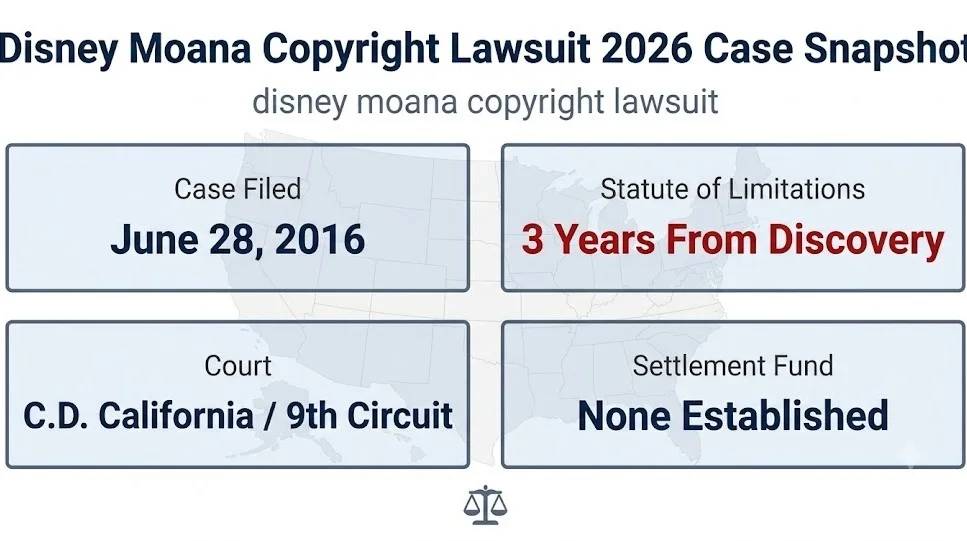
The case is captioned Woodall v. Walt Disney Co., Case No. 2:16-cv-04652-SVW-E, filed in the U.S. District Court for the Central District of California.
Key facts at a glance:
- Woodall registered Bucky with the U.S. Copyright Office before Moana was released.
- Moana grossed more than $640 million worldwide at the box office.
- The district court granted summary judgment in Disney’s favor.
- Woodall pursued an appeal to the Ninth Circuit.
Attorney Insight: Attorneys handling copyright infringement claims against major studios consistently identify the registration date as the first threshold document the court will examine, because it determines whether statutory damages and attorney’s fees are available.
Buck Woodall vs Disney: Who Is the Plaintiff?
Buck Woodall is an independent screenwriter and author based in California who developed the screenplay Bucky over several years before Moana entered production.
Woodall’s position was that Bucky featured an ocean-based Polynesian protagonist, themes of identity and heritage, a special relationship with the ocean, and specific narrative beats that appeared in Moana in a form he alleged was not coincidental.
He further alleged that he had shared the work through channels that could have given Disney’s creative team access to it, satisfying one of the key legal requirements for an infringement claim.
Plaintiff’s stated basis for the claim:
| Element | Woodall’s Allegation |
|---|---|
| Screenplay title | Bucky |
| Registration status | Registered with U.S. Copyright Office |
| Alleged access | Work shared with Disney-adjacent contacts |
| Claimed similarities | Protagonist, ocean setting, Polynesian culture, narrative arc |
| Relief sought | Damages, injunctive relief, copyright ownership claim |
Disney denied all allegations and maintained that Moana was developed entirely through its own independent creative process.
Attorney Insight: Attorneys handling these claims point to the access element as the hardest factual hurdle, because plaintiffs must demonstrate a reasonable possibility that the defendant’s creative team encountered the protected work before production began.
Who Filed the Moana Copyright Lawsuit?
Buck Woodall filed the Moana copyright lawsuit. He filed the complaint on June 28, 2016, approximately six months before Moana was released in U.S. theaters on November 23, 2016.
The timing is legally notable. Filing before a film’s release is unusual and signals that Woodall had advance knowledge of the production’s content, likely through promotional materials or industry channels.
The original complaint was filed pro se initially, though Woodall later retained legal representation. The case proceeded through standard federal civil litigation in the Central District of California.
Filing timeline:
- June 2016: Complaint filed, Case No. 2:16-cv-04652-SVW-E
- November 2016: Moana released in U.S. theaters
- 2017-2018: Discovery and motion practice
- 2018-2019: Disney’s motion for summary judgment filed and briefed
- 2020: District court grants summary judgment for Disney
- 2021-2023: Appellate proceedings before the Ninth Circuit
Attorney Insight: Attorneys handling these claims point to the pre-release filing date as a double-edged factor, because it establishes that the plaintiff had identified similarities before seeing the full film, but it also limits what evidence of copying is available to the court.
Moana Copyright Infringement Case: The Legal Claims Explained
The legal claims in the Moana copyright infringement case center on a single cause of action under the Copyright Act, 17 U.S.C. Section 501, which prohibits the unauthorized copying of a copyrighted work’s protected expression.
Woodall’s legal theory required proving two things. First, that he owned a valid copyright in Bucky. Second, that Disney copied protected expression from that work.
Courts in the Ninth Circuit apply a well-established two-part analysis to determine whether copying occurred when direct evidence is absent.
Two-part Ninth Circuit copyright analysis:
| Test Component | What It Measures |
|---|---|
| Extrinsic Test | Objective similarities in specific expressive elements: plot, characters, setting, dialogue, theme, mood |
| Intrinsic Test | Whether an ordinary reasonable person would find the works substantially similar in total concept and feel |
Both tests must be satisfied for an infringement finding. The extrinsic test is evaluated at summary judgment. The intrinsic test is for the jury.
Disney argued that any similarities between the works were limited to unprotectable ideas, broad themes, and facts, none of which copyright law protects.
Attorney Insight: Attorneys handling these claims point to the idea-expression dichotomy as the dispositive line, because a Polynesian ocean-voyage narrative is a genre concept that no single author can own, while specific dialogue, character details, and plot sequences can be protected.
What Happened in the Moana Copyright Case?
The district court granted summary judgment in favor of Disney. Judge Stephen V. Wilson ruled that Woodall had not demonstrated that the two works were substantially similar in their protectable expression.
The court applied the Ninth Circuit’s extrinsic test and found that the similarities Woodall identified were either unprotectable ideas or general themes common to the genre.
Procedural outcome at the district level:
- Disney moved for summary judgment on substantial similarity grounds.
- Judge Wilson applied the extrinsic test, comparing specific expressive elements.
- The court found no triable issue of material fact on substantial similarity.
- Summary judgment was entered for Disney.
- Woodall’s claims were dismissed with prejudice.
This outcome is consistent with how federal courts in the Ninth Circuit routinely handle copyright claims against major studios where the alleged similarities are at a high level of abstraction.
Attorney Insight: Attorneys handling these claims point to summary judgment as the most critical phase in entertainment copyright litigation, because courts frequently end these cases before trial by finding that the plaintiff’s identified similarities do not reach the level of protectable expression.
Litigation Watch: The district court dismissed Woodall’s claims on summary judgment, finding the similarities between Bucky and Moana were not protectable expression under the Ninth Circuit’s extrinsic test.
Substantial Similarity Copyright Test: How Courts Evaluated Moana
The substantial similarity copyright test is the doctrinal standard that determined the outcome of this case at the trial court level.
In the Ninth Circuit, the extrinsic test filters out elements that are not protectable under copyright law. These include general ideas, scenes-a-faire (standard elements of a genre), facts, and concepts that are part of the common cultural domain.
Elements the court examined in the Moana case:
| Element | Protectable? | Court’s Finding |
|---|---|---|
| Polynesian ocean-voyage setting | No, genre convention | Not protectable |
| Young protagonist seeking identity | No, broad theme | Not protectable |
| Relationship between character and ocean | No, idea | Not protectable |
| Specific character dialogue | Yes, if original | Not substantially similar |
| Specific plot sequences | Yes, if original | Not substantially similar |
| Total concept and feel | Jury question | Not reached (summary judgment) |
The court found that when unprotectable elements were filtered out, the remaining protectable expression in Bucky was not substantially similar to Moana.
Attorney Insight: Attorneys handling these claims point to the filtering process as the moment most copyright plaintiffs lose these cases, because studios are adept at arguing that the alleged similarities exist only at the idea level.
Disney Independent Creation Defense: What It Means and How It Worked
The independent creation defense is a complete defense to copyright infringement. It holds that if a defendant created the allegedly infringing work without copying the plaintiff’s protected expression, there is no liability, even if the two works are strikingly similar.
Disney’s defense team presented evidence that Moana was developed through a long internal creative process at Walt Disney Animation Studios, beginning years before any alleged contact with Woodall’s material.
Disney’s independent creation evidence included:
- Internal development timelines dating Moana‘s concept to the early 2010s.
- Documented research trips to Polynesian communities conducted by Disney’s creative team.
- Pre-production artwork, scripts, and storyboards predating any alleged access.
- Statements from directors Ron Clements and John Musker about the film’s origins.
This type of documentary evidence is exactly what courts require to support an independent creation defense. A studio that maintains thorough development records has a significant structural advantage over individual plaintiffs in copyright litigation.
Attorney Insight: Attorneys handling these claims point to the defendant’s development documentation as the practical reason why major studio copyright cases so rarely succeed at trial, because studios produce thousands of pages of pre-production evidence that are difficult to overcome.
Ninth Circuit Moana Appeal: What the Appellate Court Reviewed
Woodall appealed the district court’s summary judgment ruling to the U.S. Court of Appeals for the Ninth Circuit.
The Ninth Circuit reviewed the case under a de novo standard, meaning it examined the substantial similarity question fresh, without deferring to Judge Wilson’s conclusions.
Appellate review parameters:
| Issue | Standard of Review |
|---|---|
| Summary judgment ruling | De novo |
| Factual findings | Viewed in light most favorable to plaintiff |
| Legal application of extrinsic test | De novo |
| Credibility determinations | Not reviewable at appellate level |
The Ninth Circuit affirmed the district court’s dismissal. The appellate panel found that the district court correctly applied the extrinsic test and correctly concluded that the similarities Woodall identified were not protectable expression.
The Ninth Circuit’s decision further entrenches the standard that Polynesian mythology, ocean-journey narratives, and broad coming-of-age themes are in the public domain of ideas and cannot anchor a copyright infringement claim.
Attorney Insight: Attorneys handling these claims point to Ninth Circuit affirmances of summary judgment in copyright cases as significant precedents, because they send clear signals to the district courts about how to handle these cases at the pleading and discovery stage.
Litigation Watch: The Ninth Circuit affirmed Disney’s summary judgment win, holding that the similarities between Bucky and Moana did not reach the level of protectable expression, a ruling that strengthens the studio’s defense playbook for future cases.
Moana Copyright Lawsuit Dismissed: What That Means Legally
When a court dismisses a copyright case on summary judgment, the dismissal carries significant legal weight.
A dismissal with prejudice means the plaintiff cannot refile the same claims in the same court. Woodall’s claims were dismissed with prejudice at the district court level, meaning his only remaining option was the appellate route, which he pursued and lost.
What “dismissed with prejudice” means in practice:
- The plaintiff cannot refile the same claims in federal district court.
- The appellate court can reverse and remand, but only if it finds legal error.
- The Supreme Court can grant certiorari, but it does so rarely in copyright cases.
- No class action mechanism exists for this type of claim.
As of early 2026, there is no pending appeal, no Supreme Court petition of record, and no new litigation by Woodall against Disney on this specific claim.
The case is closed at all currently public levels of federal review.
Attorney Insight: Attorneys handling these claims point to the with-prejudice dismissal as the practical endpoint for most entertainment copyright plaintiffs, because reversal rates on Ninth Circuit copyright affirmances at the summary judgment stage are historically low.
Moana Copyright Lawsuit Outcome: Final Results
The outcome of the Moana copyright lawsuit is a complete defense victory for Disney at both the district and appellate levels.
No damages were awarded to Woodall. No settlement was publicly announced. Disney did not acknowledge any wrongdoing.
Case outcome summary:
| Stage | Outcome | Winner |
|---|---|---|
| U.S. District Court (C.D. Cal.) | Summary judgment granted | Disney |
| Ninth Circuit Court of Appeals | Affirmed | Disney |
| Settlement | None publicly announced | N/A |
| Damages awarded | None | N/A |
| Current case status (2026) | Closed at federal level | Disney |
Woodall’s registered copyright in Bucky remains his property. The ruling means Disney did not infringe it, not that the work lacks copyright protection.
Attorney Insight: Attorneys handling these claims point to the absence of any settlement as itself significant, because studios that face weak summary judgment positions frequently settle before briefing to avoid judicial opinions that could set unfavorable precedent.
Disney Moana Lawsuit 2026 Update: Where Does the Case Stand?
As of 2026, the Disney Moana copyright lawsuit has no active proceedings in any federal court.
The case was fully resolved at the appellate level. No new complaint has been filed by Woodall against Disney on the Bucky/Moana claims in any publicly available court record as of early 2026.
2026 status checklist:
- [ ] Active district court proceedings: No
- [ ] Pending Ninth Circuit appeal: No
- [ ] Supreme Court certiorari petition: None on public record
- [ ] Class action: Never existed
- [ ] New related claims filed: None on public record
- [ ] Settlement fund open: No
The case continues to be cited in legal scholarship and entertainment law briefs as an example of how the Ninth Circuit applies the extrinsic test in studio-versus-independent-creator disputes.
For any creator who believes a similar situation has affected their own work, the relevant statute of limitations under the Copyright Act is generally three years from the date the claim accrued.
Attorney Insight: Attorneys handling these claims point to the three-year statute of limitations as the clock that most potential plaintiffs underestimate, because in the Ninth Circuit, the clock typically runs from when the plaintiff knew or had reason to know of the alleged infringement.
Litigation Watch: The Moana copyright lawsuit is fully resolved as of 2026, with Disney prevailing at every federal court level, and no active proceedings, settlements, or class mechanisms exist for public participation.
Buck Woodall Moana Settlement: Was There Any Settlement?
No public settlement between Buck Woodall and Disney has been announced or confirmed in any court filing or public record.
The absence of a settlement is factually important here. It means Woodall pursued the case to final adjudication rather than accepting any negotiated resolution. Disney, in turn, never faced a financial settlement obligation in connection with this dispute.
Settlement status:
| Question | Answer |
|---|---|
| Was a settlement reached? | None publicly announced |
| Is a settlement fund open? | No |
| Can claimants participate in a settlement? | No settlement exists |
| Did Disney pay damages? | No court-ordered or disclosed payment |
| Did Woodall receive compensation? | No public record of compensation |
The distinction between a private settlement and a public one matters. Parties sometimes reach confidential resolutions that are not reflected in public court records. No reporting or court record confirms any such resolution in this case.
Attorney Insight: Attorneys handling these claims point to the lack of any dismissal notice filed by joint stipulation as evidence that no private settlement was reached in this specific matter, because settled cases are typically dismissed by joint motion rather than by the court’s ruling.
Disney Copyright Lawsuit Settlement Amount: Is There a Payout?
There is no settlement amount in the Moana copyright lawsuit because no settlement was reached.
Courts can award copyright infringement damages in two forms. Actual damages represent the plaintiff’s proven financial loss or the defendant’s profits attributable to the infringement. Statutory damages range from $750 to $30,000 per work for standard infringement, up to $150,000 per work for willful infringement.
Copyright damages framework (general reference):
| Damages Type | Range | Notes |
|---|---|---|
| Statutory (standard) | $750 to $30,000 per work | Available if copyright registered before infringement |
| Statutory (willful) | Up to $150,000 per work | Requires proof of knowing infringement |
| Actual damages | Proven loss or defendant’s profits | Complex to calculate for major films |
| Attorney’s fees | Court discretion | Available to prevailing party |
Because the court entered summary judgment for Disney, no damages of any kind were assessed. The question of damages was never submitted to a jury.
Attorney Insight: Attorneys handling these claims point to the damages potential as the factor that attracts contingency-fee copyright lawyers to high-profile studio cases, because statutory damages tied to a blockbuster film can theoretically reach substantial figures even without proof of actual financial loss.
Can I Join the Moana Copyright Lawsuit?
No. There is no class action in the Moana copyright lawsuit, and no mechanism exists for the public to join or file a claim related to this case.
The case was filed by a single plaintiff asserting his individual copyright in a specific screenplay. Copyright infringement claims are not class actions. Each claim requires the plaintiff to own a specific registered copyrighted work and to prove that the defendant copied protected expression from that specific work.
Who could theoretically file a separate copyright claim:
- A person who owns a registered copyright in a creative work.
- That person must be able to show that a defendant had access to their work.
- They must also show that protected expression from their work was copied.
- Each case is independent and requires individual legal action.
No other plaintiff has filed a publicly reported copyright lawsuit against Disney over Moana as of early 2026.
Attorney Insight: Attorneys handling these claims point to the individual nature of copyright ownership as the reason these cases are never class actions, because the court must examine each plaintiff’s specific registered work against the allegedly infringing work on a claim-by-claim basis.
Copyright Infringement Lawsuit Against Disney: How These Cases Generally Work
A copyright infringement lawsuit against Disney, or any major entertainment studio, follows a well-established federal litigation path.
The plaintiff must first file a registration with the U.S. Copyright Office, or demonstrate that registration is in place, before bringing suit in federal court. Federal courts have exclusive jurisdiction over copyright claims under 28 U.S.C. Section 1338.
Standard litigation path for a copyright claim against a studio:
- Plaintiff registers copyright with U.S. Copyright Office.
- Plaintiff files complaint in federal court (typically in the district where defendant is located).
- Defendant answers and typically moves to dismiss or moves for summary judgment.
- Discovery period, during which both sides exchange documents and take depositions.
- Studio typically files motion for summary judgment, arguing no substantial similarity in protectable expression.
- Court rules on summary judgment.
- If case survives, it proceeds to trial.
The vast majority of copyright cases against major studios do not survive step 6.
Attorney Insight: Attorneys handling these claims point to the summary judgment phase as the make-or-break moment, noting that plaintiffs need highly specific, expressive similarities to survive, not just thematic overlap.
Litigation Watch: Copyright claims against major studios almost universally turn on the extrinsic test at summary judgment, and the Ninth Circuit’s affirmance in the Moana case reinforces that genre themes and broad narrative arcs will not carry a plaintiff past that stage.
Disney Moana Lawsuit Court Ruling: Specific Holdings
The court rulings in the Moana lawsuit produced two distinct legal holdings that entertainment lawyers reference in subsequent cases.
The district court held that Woodall failed to raise a triable issue of material fact on substantial similarity in protectable expression, applying the Ninth Circuit’s extrinsic test and filtering out unprotectable elements.
The Ninth Circuit held on appeal that the district court correctly applied that standard and that the remaining similarities, after filtering, did not reach the threshold for a jury to decide.
Key holdings:
| Court | Holding | Legal Standard Applied |
|---|---|---|
| C.D. Cal. (Judge Wilson) | Summary judgment for Disney; no substantial similarity in protectable expression | Ninth Circuit extrinsic test |
| Ninth Circuit | Affirmed district court; correct application of filtering analysis | De novo review of summary judgment |
These holdings do not stand for the proposition that Disney never infringes anyone’s work. They stand for the specific proposition that Moana did not infringe Woodall’s Bucky based on the evidence presented and the legal standard applied.
Attorney Insight: Attorneys handling these claims point to the distinction between a ruling that no infringement occurred and a ruling that no protectable similarities exist as legally meaningful for future plaintiffs, because the court is not making a credibility determination about the plaintiff’s story.
What Type of Attorney Handles a Copyright Lawsuit Against Disney?
Copyright infringement claims against major entertainment studios require a specialized attorney with federal litigation experience and specific expertise in intellectual property law.
General practice attorneys and personal injury lawyers do not handle these cases. The field is narrow and technically demanding.
Attorney types for this kind of case:
| Attorney Type | Why Relevant |
|---|---|
| Intellectual property litigator | Primary role; handles copyright claims in federal court |
| Entertainment law attorney | Industry-specific knowledge of studio contracts and production timelines |
| Copyright registration specialist | Needed before any claim can be filed |
| Appellate IP attorney | Required if the case goes to the Ninth Circuit or beyond |
These attorneys frequently work on a contingency basis in high-value cases where the defendant is a major studio. In lower-value cases, hourly billing is more common.
Finding an attorney who has handled similar matters against studios, particularly in the Central District of California or the Southern District of New York, is the most practical starting point for any creator who believes their work has been copied.
Attorney Insight: Attorneys handling these claims point to the plaintiff’s copyright registration date as the single most important document they review at the initial consultation, because a registration that postdates the alleged infringement eliminates statutory damages and sharply limits the practical value of the case.
Disney Copyright Lawsuit 2026: What Creators Should Know Now
In 2026, the Moana copyright case serves as a foundational reference point in entertainment IP litigation, not as an open case with active proceedings.
The practical lessons for writers, screenwriters, and other creative professionals are concrete and court-tested.
Key takeaways for creators in 2026:
- Register your copyright immediately. Registration before any potential infringement is the threshold requirement for full statutory damages.
- Document all access. Keep records of every person or organization that received copies of your work.
- Understand the idea-expression line. Genre concepts, broad themes, and cultural settings cannot be copyrighted. Specific expression can be.
- Consult an IP attorney before sharing. Non-disclosure agreements and documentation can strengthen any future claim.
- Know the statute of limitations. The Copyright Act generally gives a plaintiff three years from the date they discovered or should have discovered the infringement.
The Moana case will continue to be cited by courts applying the Ninth Circuit’s substantial similarity framework for years to come.
Attorney Insight: Attorneys handling these claims point to the registration-before-disclosure practice as the single most actionable step any writer can take, because it costs less than $100 and preserves the full range of legal remedies if infringement later occurs.
Frequently Asked Questions
Did Buck Woodall win the Moana copyright lawsuit?
No, Buck Woodall did not win.
The U.S. District Court for the Central District of California granted summary judgment in Disney’s favor, and the Ninth Circuit affirmed that ruling on appeal.
What was the case number for the Moana copyright lawsuit?
The case is docketed as Case No. 2:16-cv-04652-SVW-E.
It was filed in the U.S. District Court, Central District of California, and presided over by Judge Stephen V. Wilson.
Was there a settlement in the Moana copyright lawsuit?
No public settlement has been announced or confirmed in any court filing or public record.
The case ended with a court ruling in Disney’s favor rather than a negotiated resolution.
What is the statute of limitations for a copyright lawsuit against Disney?
The Copyright Act generally provides a three-year statute of limitations, running from the date the plaintiff discovered or reasonably should have discovered the infringement.
In the Ninth Circuit, courts apply a discovery rule, meaning the clock starts when the plaintiff learns of the infringement.
Can other writers sue Disney for copying their work in connection with Moana?
Any writer who owns a registered copyright in a specific work could independently file a copyright claim if they believe their protected expression was copied.
No class action mechanism exists; each case must be filed separately based on the individual plaintiff’s specific registered work.
What type of lawyer handles a copyright lawsuit against a major studio like Disney?
An intellectual property litigator with federal court experience is the correct attorney type for these cases.
Entertainment law attorneys with specific knowledge of the Ninth Circuit’s substantial similarity framework are most equipped to evaluate the merits and viability of a potential claim.
Where This Case Stands and What Comes Next
The Disney Moana copyright lawsuit is closed. Disney prevailed at every level of federal review. No active proceedings exist in 2026, and no settlement fund is open to claimants.
The case matters because it defines how courts in the Ninth Circuit evaluate copyright claims against major studios. The filtering process, the extrinsic test, and the idea-expression line are the tools courts reach for first.
If you are a writer or creator who believes your registered work was copied by a major entertainment company, the time to consult an intellectual property attorney is before filing anything in court. An experienced copyright litigator can assess the strength of your access evidence and the degree of similarity in your specific protectable expression before any resources are committed to litigation.
