
Law of Resonance
Resonance is the natural tendency of energy to vibrate in harmony with similar frequencies. In physics, it describes how one vibrating object can cause another to vibrate at the same frequency. Think of a tuning fork—strike one, and another nearby fork tuned to the same note will begin to vibrate on its own. In the metaphysical sense, resonance is the invisible force that aligns our inner world with the outer world based on frequency.
The Law of Resonance explores how energy frequencies shape our thoughts, emotions, and life experiences. This 2025 update brings new insights from both science and spirituality—showing how vibrational alignment affects everything from relationships and health to success.
It bridges physics, neuroscience, and metaphysics to help readers understand how resonance works in real life and how to consciously tune into positive frequencies.
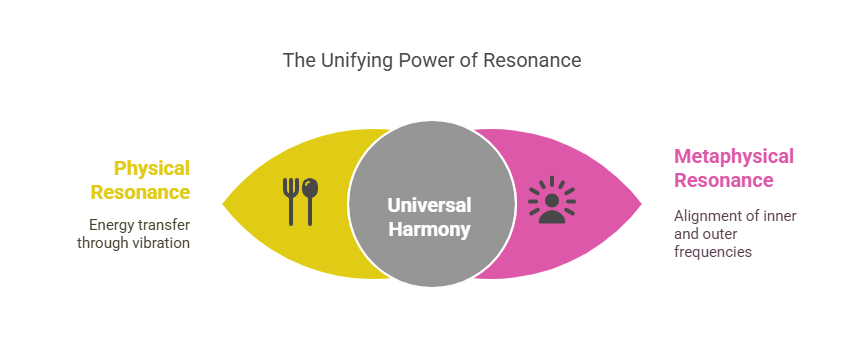
Why the Law of Resonance Matters in Everyday Life
Every thought, feeling, and intention we hold emits a frequency. The Law of Resonance suggests that the universe responds to the frequency we emit by mirroring it back to us. That means what we “resonate” with—whether it’s abundance, fear, love, or scarcity—shows up in our lives. It’s like tuning a radio: you hear only the station your dial is set to.
If you’re curious about vehicle compliance, check out our guide on whether dirt bikes are street legal in your state.
Historical and Scientific Background
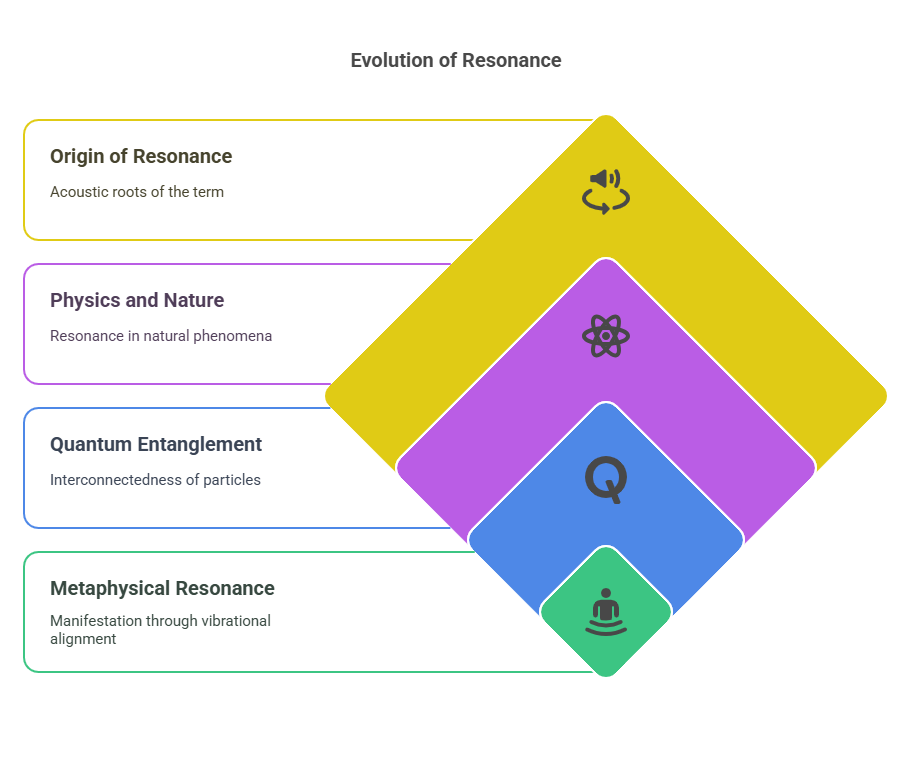
Origin of the Term ‘Resonance’
The term “resonance” comes from Latin resonare, meaning “to resound.” Originally a concept rooted in acoustics, it described how sound waves transfer energy. Over time, it has evolved into a broader term encompassing emotional, energetic, and spiritual experiences.
Resonance in Physics and Nature
Resonance is everywhere. It’s in how musical instruments amplify sound, how buildings are designed to withstand earthquakes, and even how planets interact gravitationally. Everything in the universe vibrates—atoms, molecules, light waves—nothing is ever truly still. This proves that resonance is not a myth but a fundamental law of nature.
Transition from Science to Metaphysics
As quantum physics evolved, so did our understanding of reality. Scientists discovered that particles can influence one another even when separated by vast distances—known as quantum entanglement. This gave spiritual thinkers a bridge: if everything is energy, and energy vibrates, then resonance could be the key to manifesting experiences through vibrational alignment.
The Law of Resonance Explained
Understanding Vibrations and Frequencies
Everything—including our thoughts—emits a vibrational frequency. Positive emotions like love and gratitude have high frequencies, while fear or anger vibrate lower. The Law of Resonance states that we attract people, situations, and outcomes that match our dominant vibration.
Like Attracts Like: The Core Principle
Unlike the Law of Attraction, which says we attract what we want, the Law of Resonance says we attract what we are. If you’re vibrating at a frequency of peace, you’ll notice peaceful experiences flowing into your life. It’s not about craving success—it’s about becoming the version of you who already has it. Alan Abramson lawyer
Difference Between Law of Attraction and Law of Resonance
While the Law of Attraction emphasizes visualization and wanting, the Law of Resonance focuses on alignment. You don’t just “ask” the universe—you embody the frequency of what you want. Resonance is the engine behind the attraction. Without vibrational alignment, attraction efforts fall flat.
Comparison: Law of Attraction vs. Law of Resonance
While both laws focus on manifesting reality, they work at slightly different levels of consciousness. Here’s how they compare:
| Aspect | Law of Attraction | Law of Resonance |
|---|---|---|
| Core Idea | You attract what you want | You attract what you are |
| Focus | Desire and visualization | Frequency and alignment |
| Method | Asking and believing | Embodying and becoming |
| Limitation | Can fail if emotion contradicts thought | Works when inner energy fully matches desire |
| Goal | Manifest external results | Align internal and external frequencies |
| Example | Visualizing wealth | Feeling abundant before wealth appears |
Takeaway:
Attraction starts the process—but resonance sustains it. Without vibrational alignment, attraction efforts don’t hold long-term power.
Resonance and Human Emotions
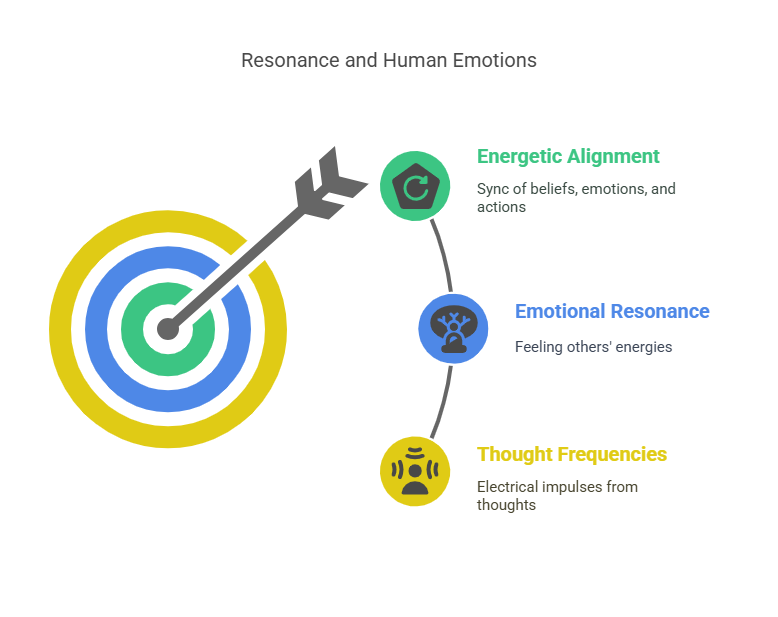
How Our Thoughts Carry Frequencies
Neuroscience shows that our thoughts create electrical impulses in the brain. These impulses radiate energy. That’s why repetitive thinking patterns shape not just our minds but our environments. A consistent thought of “I’m not good enough” sends out a very different frequency than “I am capable.”
Emotional Resonance with Others
Ever walked into a room and felt the tension? That’s emotional resonance in action. We’re constantly broadcasting energy, and others respond to it—consciously or unconsciously. This is why we feel drawn to some people and repelled by others; our energies either harmonize or clash.
Energy Alignment and Its Impact
When your inner beliefs, emotions, and actions are in sync, you’re in energetic alignment. In this state, you don’t chase things—they flow to you. Alignment boosts confidence, reduces stress, and creates a magnetic presence that influences your reality.
Applications of the Law of Resonance
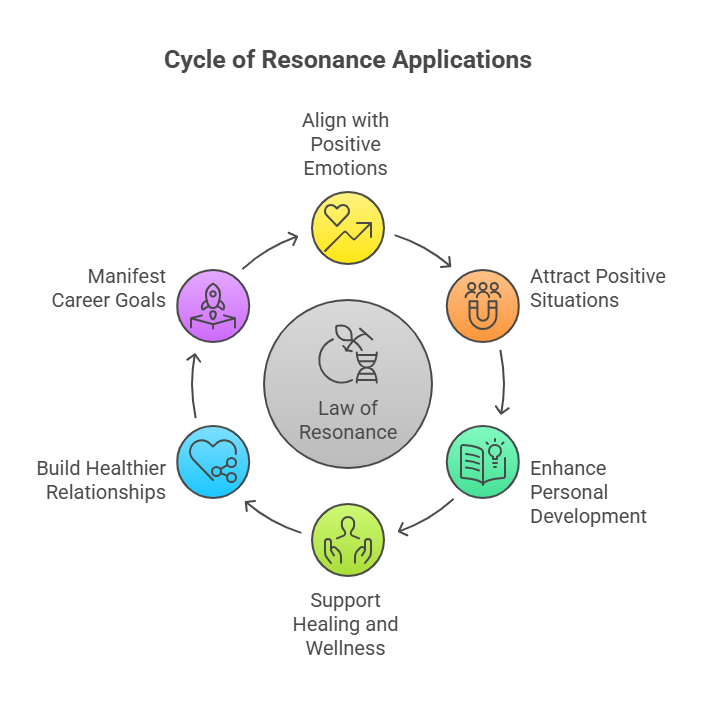
Personal Development
Using resonance, you can rewire your mindset. By aligning with higher-frequency emotions like joy or hope, you’ll attract situations that reinforce those feelings. Journaling, self-reflection, and intention-setting are powerful tools in this process.
Healing and Wellness
The body responds to vibrational energy. Sound therapy, reiki, and meditation all work on the principle of energetic resonance. By aligning your energy to a healing frequency, you can support the body’s natural ability to recover.
Relationships and Social Circles
We attract relationships that mirror our self-worth and emotional frequency. If you’re resonating with trust and openness, you’ll naturally build healthier, deeper connections. Toxic cycles often reflect unresolved inner frequencies.
Career and Goal Manifestation
Resonating with success, confidence, and purpose can open doors in your professional life. You begin to see new opportunities, connect with the right people, and experience “luck” that’s actually just vibrational alignment at work. Liam’s Law
Practices to Harness Resonance
Meditation and Mindfulness
Meditation helps quiet the noise and tune into your natural frequency. When you silence the mind, you can sense what you’re resonating with—and shift it. Even 10 minutes a day can align your energy and reset your emotional state.
Affirmations and Visualization
Affirmations work by creating mental resonance with desired outcomes. Say it enough times, and your subconscious begins to accept it as truth. Visualization takes this further by emotionally and mentally living the desired reality—helping you vibrate in sync with it.
Tuning into Your Desired Frequency
Ask yourself: “What would someone who already has what I want feel like?” Then, start feeling that way now. You’re basically setting your inner radio to the right station, allowing matching experiences to play out externally.
Challenges and Misconceptions
Why It Doesn’t Work for Everyone
Resonance works—but not if you’re forcing it. If you’re trying to think positively while subconsciously feeling fear, the fear wins. The universe responds to your dominant frequency—not what you say you want.
Misunderstanding “Positive Vibes Only”
Toxic positivity ignores genuine emotions, which are key to understanding and shifting your resonance. It’s okay to feel low—just don’t live there. Accept the feeling, process it, and choose better thoughts when you’re ready.
Difference Between Effort and Alignment
Working hard isn’t enough if your energy is off. True effort is most effective when it flows from aligned energy. When your internal state is in resonance with your goals, hard work becomes inspired action.
Scientific Support for the Law of Resonance
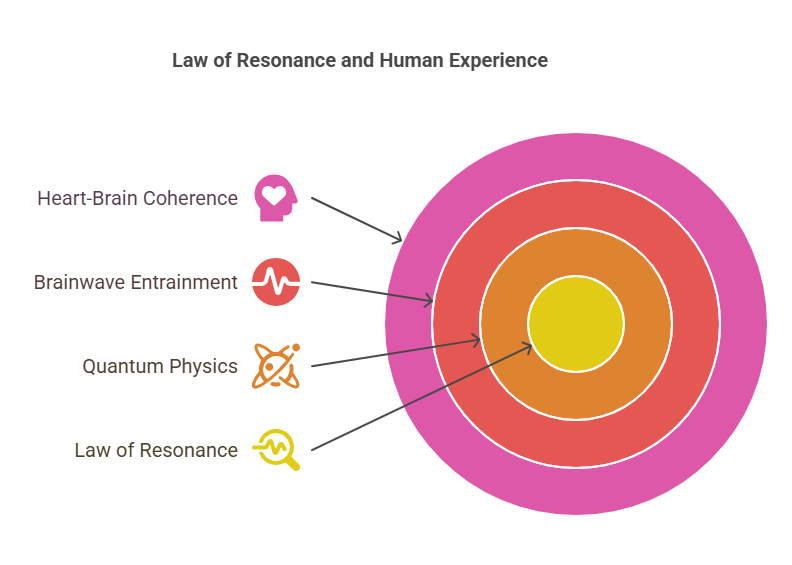
Quantum Physics and Frequency Matching
Quantum theory suggests that particles exist in waves of potential until observed. This idea aligns with resonance—when your energy “observes” or aligns with a frequency, it collapses into reality. Your vibration creates your experience.
Studies on Brainwave Entrainment
Brainwave entrainment shows that external rhythms can influence brain frequencies. This supports the idea that we can “tune” ourselves to new vibrations using tools like binaural beats, sound baths, or rhythmic breathing.
Heart-Brain Coherence Research
The HeartMath Institute found that emotions create measurable frequencies between the brain and heart. When we feel love or gratitude, this coherence creates a field that influences both our bodies and environments.
Key Takeaways from the Law of Resonance
- Everything in the universe vibrates with energy, including thoughts and emotions.
- You don’t attract what you want—you attract what you are energetically aligned with.
- Positive emotions like love, gratitude, and peace raise your frequency and attract matching experiences.
- Resonance bridges science and spirituality by linking physics, energy, and consciousness.
- Real transformation happens when your inner beliefs, emotions, and actions vibrate in harmony.
In essence, the Law of Resonance shows that your life mirrors your frequency—so by tuning your energy, you can reshape your reality.
Conclusion
The Law of Resonance isn’t just a fluffy self-help idea—it’s a powerful force rooted in science, energy, and consciousness. By understanding and working with your personal frequency, you can shift your reality in remarkable ways. Whether it’s through meditation, emotional alignment, or shifting your self-talk, the resonance you emit is always shaping what comes back to you. So the real question is—what are you resonating with today?
FAQs
What are the laws of resonance?
The Law of Resonance is a principle stating that energies of similar frequency attract and amplify one another. It works in nature, physics, and human experiences.
What is an example of the Law of Resonance?
A common example is tuning forks—strike one, and another nearby fork of the same frequency begins to vibrate. In life, think of meeting someone and instantly “clicking” with their vibe.
What is the Law of Resonance spiritually?
Spiritually, it means you attract what you’re aligned with emotionally and energetically. Your inner world sets the tone for what you manifest externally.
What is the Law of Resonance summary?
In short, the Law of Resonance means you don’t attract what you want—you attract what you are. Your dominant frequency determines your reality.
Is the Law of Resonance real or pseudoscience?
While not fully proven, it’s supported by concepts in quantum physics, neuroscience, and psychology. It’s widely used in spiritual and wellness communities for personal transformation.
What is the principle of resonance?
The principle of resonance states that when two systems vibrate at the same natural frequency, energy transfers between them efficiently. In physics, it’s how one vibrating object can make another vibrate without direct contact. Spiritually, it explains how similar energies attract and amplify one another.
Which law is best for manifestation?
While both the Law of Attraction and Law of Resonance are powerful, resonance is often considered deeper because it’s about becoming the energy you want to experience. Attraction focuses on desire; resonance focuses on alignment—making it more effective for long-term manifestation.
What is spiritual resonance?
Spiritual resonance refers to the energetic harmony between your soul and the universe. When your emotions, beliefs, and actions align with higher vibrations like love or gratitude, you naturally attract experiences that reflect those states.
What is called resonance in physics?
In physics, resonance occurs when an object vibrates at its natural frequency due to an external force matching that frequency. Examples include sound waves amplifying in musical instruments or buildings resonating during earthquakes.
What is the Law of Resonance in physics?
In scientific terms, the Law of Resonance explains how one system can influence another through vibration. This principle extends beyond mechanics and sound—showing up in electromagnetic waves, molecular vibrations, and even biological systems.
What are the four types of resonance?
The four main types of resonance are mechanical, acoustical, electrical, and optical resonance. Each involves energy transfer at matching frequencies, from sound vibrations to electromagnetic light waves.
What are the Laws of the Universe related to resonance?
Resonance connects with other universal principles like the Law of Vibration, Law of Assumption, and Law of Attraction. Together, they describe how energy, thought, and consciousness shape reality through frequency alignment.

Comments