
Dirt bike laws have changed quite a bit in recent years. Many states now offer clearer guidance on how to register off-road bikes for limited street use.
With the rise of electric dirt bikes and dual-sport conversions, more riders are exploring ways to stay legal while enjoying their rides.
This updated guide explains everything you need to know about street legal dirt bikes in 2025 — from requirements to the best conversion tips by state.
Basics of Dirt Bikes
Dirt bikes, also known as off-road motorcycles, are specifically designed for rugged trails, rough terrains, and outdoor adventures. Their lightweight frames, high suspension, and powerful engines make them ideal for trail riding, motocross tracks, and forest paths.
However, when it comes to riding on public roads, the rules change dramatically. These bikes are built for performance — not compliance — which means most models lack the essential features required for safe and legal street use.
Understanding how your bike responds to different terrains is crucial — much like understanding the forces that affect everyday energy in life Law of Resonance Explained With Real-Life Energy Shifts can provide insight into patterns and balance.
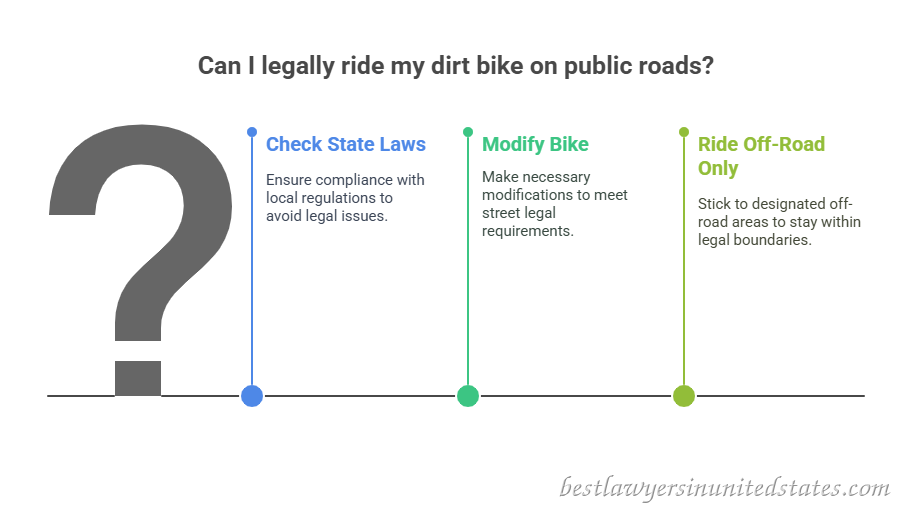
Are Dirt Bikes Street Legal by Default?
In most states, dirt bikes are not street legal by default. They’re built for off-road fun, not city traffic. Manufacturers design them without turn signals, mirrors, license plates, or other road-safety components.
Since they’re made for tracks and trails, they don’t meet the safety or emission standards required for on-road vehicles. However, with proper modifications, many dirt bikes can be converted into street legal motorcycles that comply with local laws.
Why Dirt Bikes Are Not Road-Ready
Dirt bikes belong to a category known as off-highway vehicles (OHVs) — machines designed for dirt, gravel, and mud rather than smooth pavement.
Because of this, they lack many essential components that make a vehicle safe and visible on public roads. Most dirt bikes don’t have proper lighting, mirrors, or emissions systems, which makes them unfit for registration or insurance until these gaps are fixed.
- No headlight or taillight
- No turn signals
- No horn
- No rearview mirrors
- No license plate
- Emission issues
What Makes a Dirt Bike Street Legal
To ride legally on public roads, a dirt bike must meet the same safety and equipment standards as any motorcycle. The exact requirements vary slightly by state, but most places follow similar guidelines.
Adding the right equipment not only keeps you compliant with the law but also makes your ride safer and more practical for daily use.
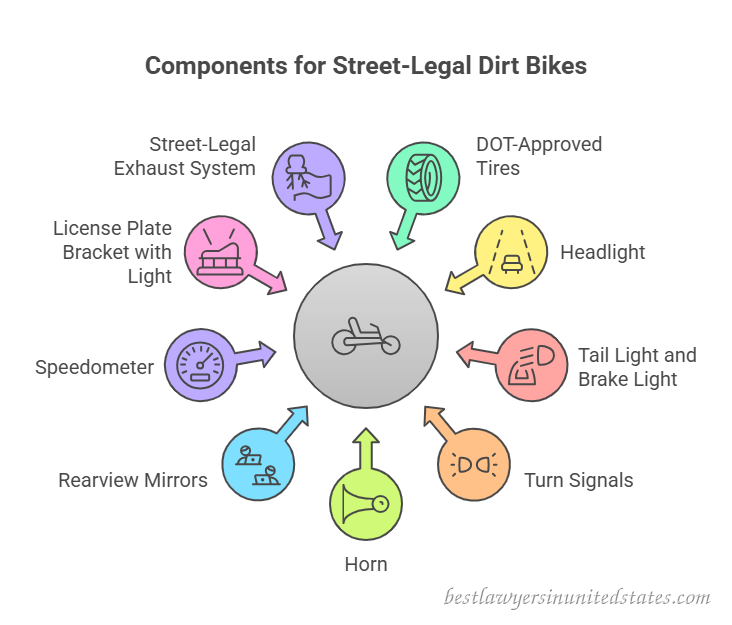
- DOT-approved tires
- Headlight (high/low beam)
- Tail light and brake light
- Turn signals
- Horn
- Two rearview mirrors
- Speedometer
- License plate bracket with light
- Street-legal exhaust system
How to Make Your Dirt Bike Street Legal
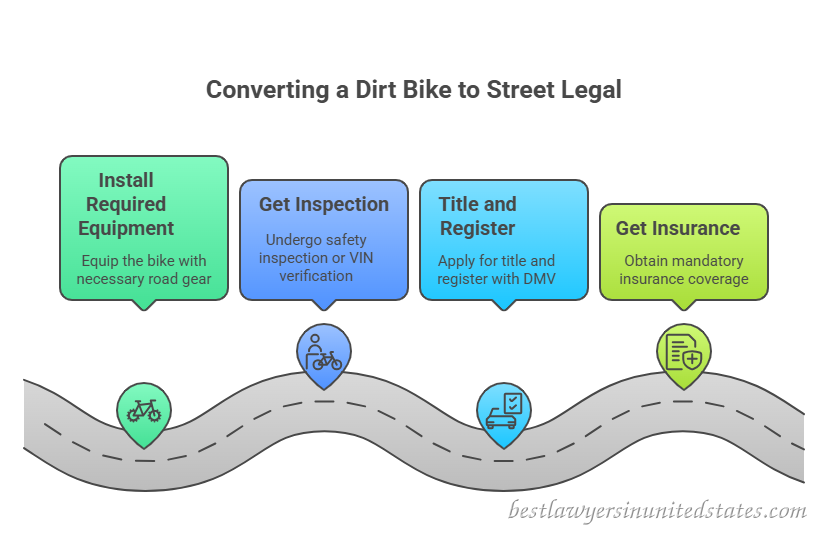
Step 1: Install the Required Equipment
Start by adding all the gear that makes your dirt bike road-ready. You can purchase a street legal conversion kit, which typically includes lights, mirrors, a horn, and a license plate bracket. Make sure the kit is DOT-approved and matches your bike’s model.
A practical way to get started is using a Dirt Bike Street Legal Kit – Transform Your Ride for the Road which includes most of the essential components you’ll need
Step 2: Get an Inspection (If Required)
Some states require a safety inspection or VIN verification to confirm your bike meets road standards. Check your local DMV or transportation department for the latest rules.
Step 3: Title and Register Your Dirt Bike
Once your bike passes inspection, you can apply for a title and registration. This process also involves getting a license plate and completing any state-specific paperwork.
Step 4: Get Insurance
Like any street-legal motorcycle, your dirt bike must be insured. Coverage requirements vary by state, so speak with an insurance provider to ensure you’re fully compliant.
Are Electric Dirt Bikes Street Legal?
Electric dirt bikes are becoming increasingly popular for both off-road fun and city commuting. Some models can be made street legal, but like gas-powered dirt bikes, they must meet all safety requirements — including lights, mirrors, horn, and registration.
Popular models like the Sur-Ron Light Bee X or Segway X260 can be converted with the right equipment, allowing you to ride legally on public roads while enjoying a quieter, cleaner ride. Always check your state’s regulations, as rules for electric motorcycles may differ slightly from traditional bikes.
Dirt Bike Street Legal Laws by State
Each U.S. state has its own rules regarding dirt bike street legality. Some states are lenient and make it relatively easy to register an off-road bike for street use, while others have strict requirements or prohibit conversions altogether.
Always check with your state’s DMV or transportation department before riding.
| State | Street Legal Status | Notes |
|---|---|---|
| Arizona | ✅ Easier legalization | Minimal inspection, most bikes can convert |
| Colorado | ✅ Moderate | Standard inspection and registration required |
| South Dakota | ✅ Easy | Only basic safety requirements |
| Montana | ✅ Easy | Minimal paperwork and inspection |
| California | ❌ Strict | Requires CARB-compliant emissions, full inspection, and registration |
| New York | ❌ Strict | Street conversion limited, must meet state rules |
| New Jersey | ❌ Strict | Heavy restrictions on off-road motorcycles |
| Texas | ✅ Moderate | Requires lights, mirrors, registration, and inspection |
| North Carolina | ✅ Moderate | Must meet safety standards and registration requirements |
| Virginia | ✅ Moderate | Street conversion allowed with inspection and insurance |
| South Carolina | ✅ Moderate | Requires basic safety equipment and registration |
| Florida | ✅ Moderate | Street legal with inspection and insurance |
| Alabama | ✅ Easier | Minimal conversion needed, inspection required |
Off-Road vs Dual-Sport Dirt Bikes
Not all dirt bikes are created equal when it comes to street legality. Off-road dirt bikes are built purely for trails, tracks, and outdoor adventures — they usually require extensive modifications to be street legal. In contrast, dual-sport or enduro bikes come from the factory with all the necessary equipment to ride on both roads and trails.
This includes lights, mirrors, a horn, and a license plate bracket. For riders who want the best of both worlds, dual-sport bikes offer convenience, safety, and legal compliance without the hassle of converting a purely off-road model.
Can You Get Pulled Over for Riding a Dirt Bike on the Street
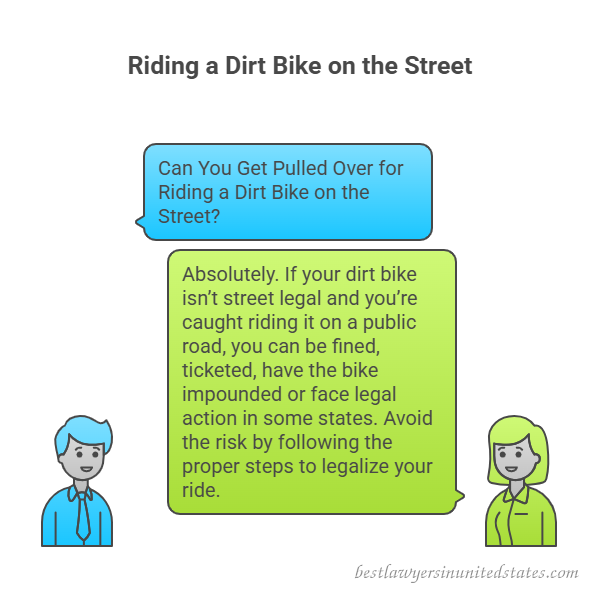
Absolutely — riding a dirt bike on public roads without proper registration and equipment can get you into serious trouble. Law enforcement may take action if your bike isn’t street legal, including issuing fines, tickets, or even impounding your bike.
In some states, repeated violations could lead to legal action.
Possible consequences include:
- Fines for riding without proper registration or license plates
- Tickets for missing mirrors, lights, or other required equipment
- Impoundment of the bike until compliance is met
- Legal action in certain jurisdictions
Riding an unregistered dirt bike on public roads can result in fines or legal issues. Understanding Formal Legal Promise – Meaning, Elements, and Examples helps you grasp potential liabilities and protections under the law.
Fines for street violations can add up quickly. If you’re worried about how legal fees may affect your finances, a Wage Garnishment Lawyer Reveals How to Stop Paycheck Seizures guide may offer helpful tips.
Street Legal Dirt Bike Alternatives
If converting your dirt bike seems complicated or costly, consider buying a factory-made street legal dirt bike instead. Many manufacturers offer dual-sport models that are ready to ride on both streets and trails without modifications.
Popular options from KTM, Honda, Yamaha, and Suzuki provide built-in lights, mirrors, horns, and emissions-compliant exhaust systems. Choosing a factory street-legal model saves time, reduces legal risks, and ensures your bike meets all state regulations from the start.
Always ensure you follow traffic rules and safety protocols. Knowing When Is It Legal to Back Up on an Expressway You Must Know This can help avoid unexpected legal trouble while riding
Pros and Cons of Making a Dirt Bike Street Legal
Pros of Making a Dirt Bike Street Legal:
- Ride anywhere: Enjoy both streets and trails without switching bikes
- Cost-effective: Save money by converting instead of buying a second bike
- Versatile commuting: Use your dirt bike for fun rides and short city commutes
Cons of Making a Dirt Bike Street Legal:
- Conversion costs: Parts and inspections can range from $300 to $1,000
- Not all bikes qualify: Some frames or models cannot be legally converted
- Time-consuming: The process of installing parts, inspection, and registration can take several weeks
Cost to Make a Dirt Bike Street Legal
Converting a dirt bike to street legal can vary in cost depending on the parts needed, inspections, and your state’s fees. On average, most riders spend between $300 and $1,000.
This typically covers lights, mirrors, horn, license plate bracket, and a street-legal exhaust system. Additional costs may include VIN inspections, emissions testing, or labor if you hire a mechanic.
Planning ahead and purchasing a complete conversion kit can help save time and money while ensuring your bike meets all legal requirements.
Best Street Legal Dirt Bike Kits
For riders looking to convert their dirt bikes quickly and safely, several reliable street-legal conversion kits are available. These kits typically include lights, mirrors, a horn, a license plate bracket, and sometimes a street-legal exhaust.
Always ensure the kit is DOT-approved and compatible with your bike’s make and model.
Popular conversion kits include:
- Tusk – Affordable, complete kits for most dirt bike models
- Baja Designs – High-quality lighting and mirror solutions
- XTC Power Products – Comprehensive kits with DOT-certified components
- Ryco – Easy-to-install kits with all essential parts
Some kits also include instructions for meeting state-specific regulations, making it easier to pass inspections and register your bike legally.
💡 Tip
Final Thoughts on Dirt Bike Street Legality
Riding a dirt bike on public roads isn’t as simple as hitting the throttle. To stay safe and legal, you need the right equipment, registration, and insurance, and you must follow your state’s rules.
Whether you choose to convert an off-road dirt bike or buy a factory street-legal dual-sport model, proper preparation ensures you can enjoy your ride anywhere without legal trouble. Always stay informed, plan ahead, and prioritize safety on every ride.
Key Takeaways:
- Dirt bikes aren’t street legal by default but can be modified.
- Each state has its own requirements — always check your DMV.
- Dual-sport bikes are a ready-made street-legal option.
- Legalizing your dirt bike improves safety and compliance.
FAQs
Can all dirt bikes be made street legal?
No, not all dirt bikes qualify for street use. Whether a bike can be converted depends on the model, frame, engine type, and state laws.
Some bikes may require extensive modifications or may not meet emissions standards, making them impossible to register for street use.
How long does it take to legalize a dirt bike?
The process usually takes 2–4 weeks, depending on how quickly you can install the required parts, pass inspections, and complete registration. Some states may take longer due to backlogs at the DMV.
Do I need a motorcycle license for a street legal dirt bike?
Yes, in most states, a valid motorcycle license or endorsement is required to ride a street-legal dirt bike. Always check your state’s DMV rules before hitting the road.
Is it better to buy a dual-sport bike instead of converting one?
For many riders, buying a dual-sport or enduro bike is easier than converting an off-road bike. Factory-made models are already equipped with lights, mirrors, horns, and other legal requirements, saving time and reducing legal risks.
Are there street legal dirt bikes available from manufacturers?
Yes, many manufacturers like KTM, Honda, Yamaha, and Suzuki produce factory street-legal dirt bikes that meet all state and federal regulations. These bikes are ready to ride on both trails and public roads.
What type of dirt bike is street-legal?
Dual-sport and enduro bikes are typically street-legal, as they come with all required equipment like lights, mirrors, and a license plate bracket. Off-road-only dirt bikes usually need modifications.
Is a dirt bike road legal?
Only if it has been converted with all required equipment and registered according to your state’s DMV rules. Riding an unmodified dirt bike on public roads is illegal.
Can you ride a dirt bike anywhere legally?
No — dirt bikes can only be ridden legally on off-road trails, private property, or public roads if street-legal. Always check local laws to avoid fines.
What happens if you get caught riding a dirt bike on the road?
You could face fines, tickets, impoundment, or legal action, depending on your state’s laws and the severity of the violation.
Do I need a license for a dirt bike?
Yes, a motorcycle license or endorsement is required for street-legal dirt bikes in most states.
How fast can a 250cc dirt bike go?
A typical 250cc dirt bike can reach speeds of 50–75 mph depending on terrain and modifications. Street-legal bikes may have additional restrictions to comply with regulations.
Disclaimer: This article is for informational purposes only and does not constitute legal advice. Always consult your local DMV or legal authority for state-specific regulations.

Comments