
Quick Answer Box
- The LMNT lawsuit is really three separate federal class actions accusing the electrolyte brand of hiding maltodextrin behind “All Natural” and “clean label” marketing.
- Anyone who purchased LMNT drink mixes believing the “no artificial ingredients” or “keto and paleo friendly” claims may potentially qualify, depending on which case and state applies.
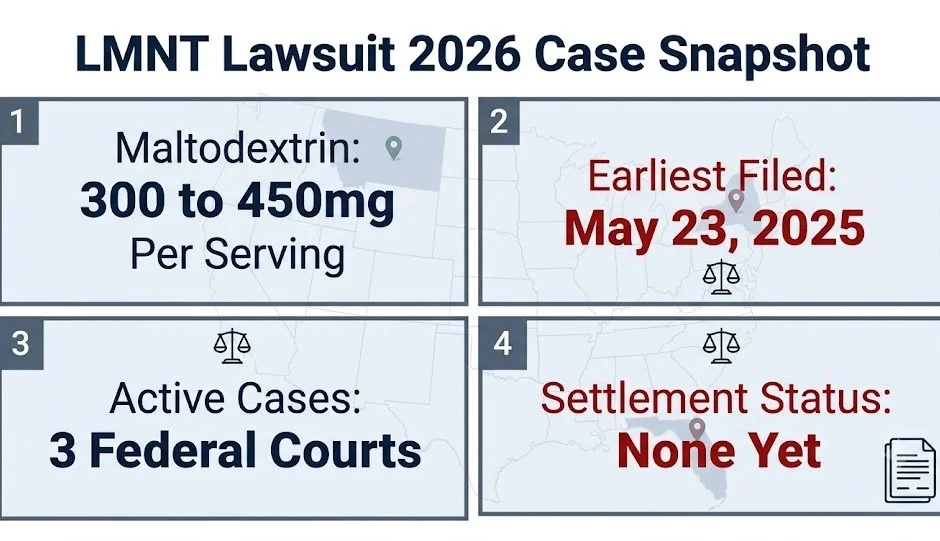
- No settlement has been reached as of 2026. Cases remain in early litigation, so there is no confirmed payout amount yet.
Case Snapshot
| Detail | Info |
|---|---|
| Court | U.S. District Court for the District of Montana (lead case); also pending in S.D. Fla. and E.D.N.Y. |
| Case Number | 2:25-cv-00052-JTJ (D. Mont.); 0:25-cv-61401 (S.D. Fla.); 25-cv-3126 (E.D.N.Y.) |
| Filing Date | Earliest filing May 23, 2025 |
| Status | Active, early-stage litigation, no consolidation confirmed |
| Settlement Fund | Not applicable. No settlement has been reached as of this writing |
Drink LMNT, Inc. is fighting three separate federal lawsuits at once over its “All Natural” marketing claims. The LMNT lawsuit story is not one case. It is a coordinated wave of nearly identical complaints filed within weeks of each other.
Each case makes the same central accusation. LMNT’s electrolyte drink mix contains between 300 and 450 milligrams of maltodextrin per serving, a highly processed additive not disclosed on the label.
That amount reportedly exceeds the combined weight of the product’s potassium and magnesium, two ingredients LMNT prominently advertises.
No settlement exists yet. All three cases remain active as 2026 continues.
What Is the LMNT Lawsuit About
The LMNT lawsuit is about whether the company’s “all natural” and “clean label” marketing claims are false or misleading. Plaintiffs allege LMNT advertises phrases like “No Artificial Ingredients” and “No Dodgy Ingredients” while omitting a significant processed additive from its labels.
The core ingredient at issue is maltodextrin, a refined carbohydrate with a glycemic index higher than table sugar. Plaintiffs argue LMNT conceals it under the vague label term “natural flavors” rather than disclosing it directly.
Consumers say they paid a premium price specifically because they believed the product was minimally processed and diet-compatible.
Core allegations across all three cases:
- False “All Natural Ingredients” and “No Artificial Ingredients” claims
- Undisclosed maltodextrin hidden under “natural flavors”
- Marketing targeting keto, paleo, and whole-foods diet followers
- Premium pricing based on the “clean label” positioning
Attorney Insight: Consumer protection attorneys note that “clean label” litigation has grown sharply as more brands market around specific dietary movements like keto and paleo.
LMNT Maltodextrin Allegations Explained
The maltodextrin allegations center on an undisclosed additive that directly contradicts LMNT’s core marketing message. Court filings state each serving contains 300 to 450 milligrams of maltodextrin, a highly processed carbohydrate typically used as a filler or flavor carrier.
Plaintiffs argue that amount exceeds the combined potassium and magnesium content, two electrolytes LMNT markets as the product’s primary selling point. Maltodextrin does not appear as its own line item on the label, according to the complaints, and is instead grouped under “natural flavors.”
Some complaints also cite research linking maltodextrin consumption to intestinal inflammation, adding a health dimension to the labeling dispute.
| Ingredient claim | Allegation |
|---|---|
| Marketed as | “All Natural,” “No Artificial Ingredients” |
| Actual content | 300 to 450 mg maltodextrin per serving |
| Labeling location | Grouped under “natural flavors” |
| Comparison | Exceeds combined potassium and magnesium content |
Attorney Insight: Food labeling attorneys note that grouping a processed additive under a vague catch-all term is one of the most commonly litigated labeling tactics in clean-label cases.
Vaughn v Drink LMNT Case Summary
Vaughn v. Drink LMNT is the first-filed case in this wave of litigation. Plaintiffs Lisa Vaughn, Barbara Scolaro, and Jordan Jarosky filed the complaint on May 23, 2025, in the U.S. District Court for the District of Montana.
The case is docketed as 2:25-cv-00052-JTJ, filed in the same state where Drink LMNT, Inc. maintains its principal place of business. The plaintiffs seek to represent a nationwide class along with state subclasses tied to California, Arkansas, and Montana.
Montana’s jurisdiction over this case makes practical sense, since it is also the company’s home state.
| Case element | Detail |
|---|---|
| Plaintiffs | Lisa Vaughn, Barbara Scolaro, Jordan Jarosky |
| Court | U.S. District Court for the District of Montana |
| Docket | 2:25-cv-00052-JTJ |
| Filed | May 23, 2025 |
Attorney Insight: Class action litigators note that filing in a defendant’s home state can simplify jurisdiction and discovery, since key company records and witnesses are already local.
Thomas v Drink LMNT Florida Lawsuit
Thomas v. Drink LMNT is the Florida case, filed in the U.S. District Court for the Southern District of Florida. The complaint, docketed as 0:25-cv-61401, was filed on July 11, 2025.
The named plaintiff resided in Broward County, Florida, after previously living in Henderson, Nevada, and reportedly purchased LMNT products in both states. The complaint invokes the Class Action Fairness Act, citing aggregate claims exceeding $5 million and more than 100 putative class members.
A related Florida filing brought by attorney Cristina Pierson of Kelley Uustal separately seeks to certify a national class along with Florida and Nevada subclasses.
Florida case basics:
- Docket: 0:25-cv-61401
- Filed: July 11, 2025
- Jurisdictional basis: Class Action Fairness Act (CAFA)
- Subclasses sought: Florida, Nevada, and a nationwide class
Attorney Insight: CAFA-based filings often signal attorneys are positioning a case for broad multistate recovery rather than a single-state dispute.
Sciortino v Drink LMNT New York Lawsuit
Sciortino v. Drink LMNT is the New York case, filed in the U.S. District Court for the Eastern District of New York. The case is docketed as 25-cv-3126, filed by two New York-based consumers in mid-2025.
This complaint echoes the same maltodextrin allegations as the Montana and Florida filings, focused specifically on New York consumers and New York consumer protection law. It targets LMNT’s health-focused branding as particularly misleading for buyers avoiding processed carbohydrates.
The near-identical language across all three complaints suggests coordinated legal strategy rather than three unrelated, independently discovered claims.
Litigation Watch: Three separate federal cases, filed in Montana, Florida, and New York within about two months of each other, all make nearly identical maltodextrin disclosure allegations against Drink LMNT.
Attorney Insight: Litigators tracking parallel filings like this note that near-simultaneous complaints across multiple districts often precede a request for coordinated pretrial proceedings.
Who Qualifies for the LMNT Lawsuit
Qualification generally requires having purchased an LMNT electrolyte drink mix based on its natural or clean-label marketing claims. Each pending case defines its proposed class slightly differently, depending on the court and named plaintiffs involved.
Consumers in Montana, California, and Arkansas may fall under the Vaughn case’s proposed subclasses. Consumers in Florida and Nevada may fall under the Thomas or Pierson filings, while New York consumers may fall under the Sciortino case.
General qualification signals:
- Purchased LMNT electrolyte drink mix, not just any electrolyte product
- Relied on “all natural,” “no artificial ingredients,” or “keto/paleo friendly” claims
- Have purchase records such as receipts or order confirmations
- Reside in or purchased the product while in one of the states named above
Attorney Insight: Class action attorneys stress that documented purchase history matters more at this stage than memory alone, since claims processes typically require some proof of purchase.
LMNT Lawsuit Eligible States
Eligible states currently named across the pending cases include Montana, California, Arkansas, Florida, Nevada, and New York. Each state corresponds to a specific subclass tied to one of the three active federal filings.
A nationwide class is also proposed in more than one of the pending cases, which would extend eligibility further if a court eventually certifies it. Certification has not occurred yet in any of the three cases.
States named in current filings:
- Montana, California, Arkansas (Vaughn case subclasses)
- Florida, Nevada (Thomas and Pierson filings)
- New York (Sciortino case)
- Proposed nationwide class in multiple filings, not yet certified
Attorney Insight: Consumer class attorneys note that state subclasses often exist specifically to strengthen claims under that state’s own consumer protection statute, which can offer stronger remedies than federal law alone.
Is There an LMNT Lawsuit Settlement
There is no LMNT lawsuit settlement as of this writing. All three federal cases remain in early litigation stages, with no settlement agreement filed publicly in any of them.
Reports from November 2025 confirmed the cases remained in discovery, and reporting into 2026 continues to describe the litigation as early-stage with no final judgment reached. Any claim of an active settlement or guaranteed payout should be treated skeptically until a filed agreement appears on the court docket.
Consumers should preserve purchase records now rather than wait for a settlement announcement to start gathering proof.
Settlement status check:
- No settlement filed in Vaughn (D. Mont.)
- No settlement filed in Thomas or Pierson (S.D. Fla.)
- No settlement filed in Sciortino (E.D.N.Y.)
Attorney Insight: Settlement attorneys note that clean-label food and supplement cases often take two to four years from filing to a final resolution, given how fact-intensive labeling disputes tend to be.
LMNT Lawsuit Current Status 2026
The current status in 2026 is active litigation without a settlement or class certification ruling in any of the three pending cases. Discovery, motion practice, and expert witness preparation are the primary activity happening behind the scenes right now.
No public court record confirms consolidation of the three cases into a single multidistrict proceeding as of this writing. Each case is proceeding independently in its own federal district.
Litigation Watch: As of 2026, three separate LMNT cases remain active in Montana, Florida, and New York federal courts, with no settlement or consolidation confirmed in any of them.
LMNT Lawsuit Timeline
The timeline below lays out the filing sequence across all three pending federal cases.
| Date | Event |
|---|---|
| May 23, 2025 | Vaughn v. Drink LMNT filed, D. Mont., docket 2:25-cv-00052-JTJ |
| Mid-2025 | Sciortino v. Drink LMNT filed, E.D.N.Y., docket 25-cv-3126 |
| July 11, 2025 | Thomas v. Drink LMNT filed, S.D. Fla., docket 0:25-cv-61401 |
| November 2025 | All cases confirmed in discovery, no settlement announced |
| 2026 | Cases remain active, described as early-stage litigation |
Attorney Insight: Litigation timeline trackers note the roughly two-month filing window across three states typically reflects coordinated attorney investigation rather than coincidence.
LMNT Class Certification Explained
Class certification is the court process that decides whether a case can proceed on behalf of a larger group rather than just the named plaintiffs. None of the three pending LMNT cases has reached a certification ruling yet.
To certify a class, plaintiffs generally must show the group shares common legal questions, that a class action is more efficient than individual suits, and that the named plaintiffs adequately represent the group. LMNT’s defense will likely challenge whether individual purchasing decisions varied too much for a single class.
Until certification happens, each case technically represents only its named plaintiffs, not the broader group of buyers.
What certification requires:
- Common legal questions shared across the proposed class
- Class treatment more efficient than individual lawsuits
- Adequate representation by the named plaintiffs
- Numerosity, meaning enough class members to justify group treatment
Attorney Insight: Class certification attorneys note that food and supplement labeling cases often survive certification challenges more easily than health-outcome cases, since the claim rests on the label itself rather than individualized injury.
What Damages Does the LMNT Lawsuit Seek
The LMNT lawsuit seeks monetary damages tied to the price premium consumers allegedly paid based on false marketing claims. Plaintiffs argue they would have paid less, or not purchased the product at all, had the maltodextrin content been disclosed.
Beyond damages, the complaints also seek injunctive relief, which would require LMNT to change its labeling and marketing going forward. A jury trial has been demanded in at least one of the pending cases.
Relief sought across the cases:
- Monetary damages for the alleged price premium paid
- Injunctive relief requiring accurate ingredient disclosure
- Jury trial demanded in at least one filing
- Attorneys’ fees and costs under applicable consumer protection statutes
Attorney Insight: Damages attorneys in labeling cases note that price-premium theories often rely on expert economic testimony showing how much of the price consumers paid specifically for the “clean” claims.
What Attorney Handles the LMNT Lawsuit
Consumer protection and false advertising attorneys handle cases like this one, since the claims center on labeling and marketing rather than physical injury. Firms including Kelley Uustal Trial Attorneys have already filed one of the pending complaints.
These attorneys typically work under state consumer protection statutes, federal Class Action Fairness Act provisions, and common law claims like unjust enrichment and breach of warranty.
Anyone considering contacting an attorney about a similar purchase should look for firms with active food and supplement labeling litigation experience specifically.
Attorney type for this case:
- Consumer protection and false advertising attorneys
- Firms with class action litigation experience
- Attorneys familiar with food and supplement labeling law
Attorney Insight: Consumer class counsel note that labeling cases often hinge on how convincingly the marketing language can be shown to mislead a reasonable consumer, not just a technical labeling violation.
How to Join the LMNT Lawsuit
Joining generally starts with confirming whether you purchased LMNT products based on the marketing claims at issue. Save receipts, order confirmations, and credit card statements showing LMNT purchases, along with any product packaging still in your possession.
From there, contacting a consumer protection attorney handling similar claims is the most direct path to understanding your options. No formal claims process exists yet, since no settlement has been reached in any of the three pending cases.
Steps to take now:
- Gather purchase records and packaging
- Note which state you were living in when you purchased the product
- Contact a consumer protection attorney to evaluate your situation
- Monitor the relevant court dockets for updates
Attorney Insight: Intake attorneys in pending class actions often ask for purchase dates and locations early, since that determines which of the three cases, if any, might eventually apply.
What Happens Next in the LMNT Lawsuit
What happens next depends on how discovery and motion practice unfold across the three pending cases. Courts in Montana, Florida, and New York will each need to rule on class certification before any case can proceed toward trial or settlement talks.
Increased regulatory attention on supplement marketing claims could also influence the pace of these cases. If the FTC pursues its own action against clean-label claims broadly, that could strengthen the plaintiffs’ arguments in all three lawsuits.
A confirmed settlement, if one eventually comes, would need to be filed publicly before consumers should expect any payout process to begin.
Possible paths forward:
- Courts rule on class certification in one or more of the pending cases
- Cases proceed toward trial if certification is granted
- Parties reach a settlement, which would then require court approval
- Regulatory action adds pressure toward a faster resolution
Attorney Insight: Litigation forecasters watching this case note that regulatory scrutiny of health claims often accelerates private settlement talks, since it adds independent evidence for plaintiffs to use.
Frequently Asked Questions
What is the LMNT lawsuit about?
The LMNT lawsuit alleges the company falsely marketed its electrolyte drink mix as “all natural” while hiding undisclosed maltodextrin.
Three separate federal cases make this same core allegation in Montana, Florida, and New York.
Is there a confirmed LMNT lawsuit settlement in 2026?
No, there is no confirmed settlement in any of the three pending LMNT cases as of 2026.
All three remain in early litigation, with discovery and class certification still unresolved.
Which courts are hearing the LMNT lawsuit?
Three federal courts are hearing separate LMNT cases: the District of Montana, the Southern District of Florida, and the Eastern District of New York.
Each case has its own docket number and proposed class definition.
Who might qualify for the LMNT lawsuit?
Consumers who purchased LMNT electrolyte drink mixes based on “all natural” or “clean label” marketing may potentially qualify.
Eligibility currently depends on which case applies, based on the state where the purchase occurred.
How much maltodextrin does LMNT allegedly contain?
Court filings allege LMNT contains between 300 and 450 milligrams of maltodextrin per serving.
Plaintiffs say that amount is not disclosed directly and is instead grouped under the label term “natural flavors.”
What should I do if I bought LMNT products?
Save your purchase records, including receipts, order confirmations, and any remaining product packaging.
Consider speaking with a consumer protection attorney to understand your options while these cases remain active.
The LMNT lawsuit is really three coordinated cases, not one, and none of them has reached a settlement yet. Anyone who bought LMNT based on its natural marketing claims should hold onto proof of purchase now.
Speaking with a consumer protection attorney makes sense if you want to understand your options before any settlement process begins.