
Quick Answer
- The “UMG lawsuit” is not one case. It is a cluster of active and recently resolved federal disputes covering AI music training, artist defamation claims, royalty disputes, and copyright ownership fights.
- Eligibility depends entirely on which case applies. Session musicians, independent distributors, and specific named artists each sit in different lawsuits with different courts.
- Payouts range from undisclosed private settlements to potential seven and eight figure damages, and most of these cases have not reached a public payout stage yet.
| Detail | Info |
|---|---|
| Courts Involved | US District Court, D. Massachusetts; US District Court, SDNY; US Court of Appeals, Second Circuit |
| Lead Cases | UMG/Sony v. Suno; UMG v. Udio (settled); AFM v. UMG and WMG; Graham v. UMG Recordings, No. 1:25-cv-00399 |
| Filing Dates | June 24, 2024 (Suno); late 2025 (Udio settlement); June 5, 2026 (AFM); January 15, 2025 (Drake) |
| Status | Mixed: Suno case active, Udio settled, AFM active, Drake dismissed and on appeal |
| Settlement Fund | Not publicly disclosed in any of the active or resolved UMG cases as of this writing |
Universal Music Group is not fighting one lawsuit in 2026. It is defending or pursuing at least five separate federal actions at once, spread across two courts and one appeals circuit.
That matters because most coverage of the UMG lawsuit treats it as a single story. It is not. A session musician suing over an AI licensing deal has nothing legally in common with Drake’s defamation appeal.
One number frames the stakes. UMG and its co-plaintiffs sought at least $500 million in damages in just one of these matters, the Believe and TuneCore copyright case, before it settled in April 2026.
This piece separates every active thread: who is suing whom, in which court, over what, and what a reader should actually do if one of these cases touches their own work or royalties.
UMG Lawsuit 2026
The UMG lawsuit landscape in 2026 refers to a group of distinct legal actions, not a single class action or MDL. Universal Music Group appears as both plaintiff and defendant across these matters, depending on the case.
As plaintiff, UMG has pursued AI companies and infringing distributors over unauthorized use of its catalog. As defendant, UMG faces claims from its own artists and a musicians’ union over how it has handled AI licensing revenue and artist conduct.
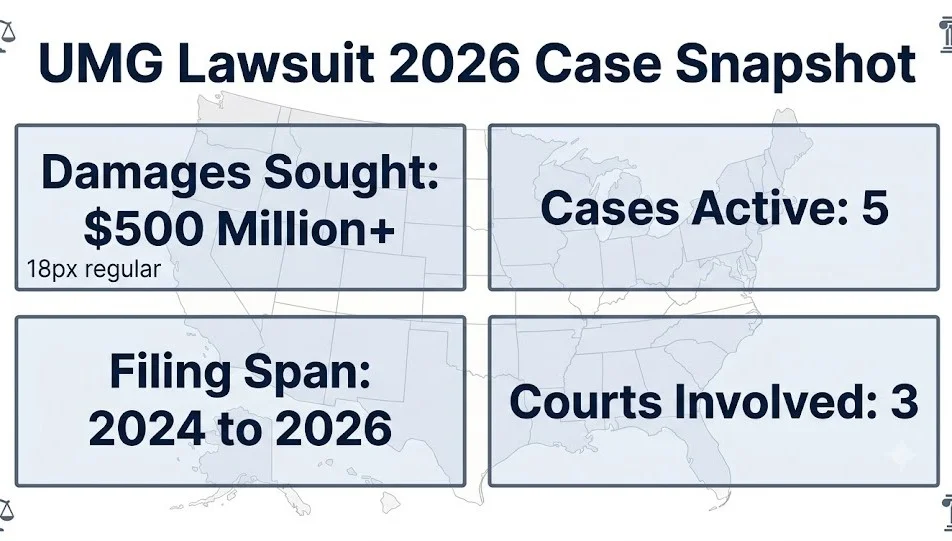
Readers searching “UMG lawsuit” are usually looking for one of six specific disputes. Confusing them costs time and can lead to wrong assumptions about eligibility.
Quick facts on scope:
- At least five separate federal matters were active or recently resolved as of mid-2026.
- Cases span two federal district courts and the Second Circuit Court of Appeals.
- No single “UMG class action” currently covers all these disputes at once.
Attorneys handling entertainment litigation point to this fragmentation as typical for a major label facing simultaneous pressure from AI companies, artists, and its own workforce.
Litigation Watch: Universal Music Group is managing parallel fights on AI licensing, artist relations, and catalog piracy at the same time, and each requires its own legal strategy.
UMG Suno Lawsuit
The UMG Suno lawsuit is a copyright infringement case UMG filed against AI music generator Suno, still active in 2026. UMG, joined by Sony Music, filed the case on June 24, 2024, in the US District Court for the District of Massachusetts, before Judge F. Dennis Saylor IV.
Warner Music Group was originally a co-plaintiff but exited the case. Warner’s stipulation of dismissal in the Suno matter was filed December 9, 2025, with the dismissal order entered January 28, 2026.
UMG and Sony allege Suno trained its AI models on copyrighted recordings without a license. In July 2026, Suno asked the court to reject a bid by UMG and Sony to add 61,026 recordings to the case.
| Case Detail | Status |
|---|---|
| Filed | June 24, 2024 |
| Court | D. Massachusetts |
| Judge | F. Dennis Saylor IV |
| Plaintiffs remaining | UMG, Sony Music |
| Recent motion | Suno opposing addition of 61,026 works (July 2026) |
Attorneys following the case note that the scope fight over how many recordings can be added will likely shape the eventual damages calculation more than any single ruling on liability.
UMG Udio Settlement
The UMG Udio settlement ended Universal’s copyright lawsuit against AI platform Udio through a licensing partnership rather than a trial. UMG and Udio confirmed the deal, announcing plans to build a new AI music platform together.
The companies did not disclose financial terms. UMG’s dismissal stipulation in the Udio case was filed November 4, 2025, following a press release dated October 29, 2025.
The planned platform is described as a “walled garden,” meaning AI-generated tracks cannot be downloaded or posted outside the service, with opt-in compensation structured for UMG artists and songwriters.
What changed:
- UMG became the first major label to settle with Udio.
- The new platform is expected to launch sometime in 2026.
- Financial terms of the settlement remain undisclosed.
Think of the arrangement less like a courtroom win and more like a corporate merger of interests, where both sides trade a lawsuit for shared upside.
Attorneys handling AI licensing deals point to the walled garden model as a possible template other labels may adopt instead of continued litigation.
UMG Believe TuneCore Lawsuit
The UMG Believe TuneCore lawsuit was a copyright infringement case UMG filed against distributors Believe and TuneCore, now settled. UMG, alongside ABKCO Music and Concord, filed suit in late 2024.
The complaint accused the distributors of enabling “industrial-scale copyright infringement,” including tracks released under fake artist names mimicking real stars. Plaintiffs sought at least $500 million in damages.
Believe had “strongly refuted” the claims when filed. The companies reached a settlement, filing a joint Dismissal With Prejudice on April 7, 2026. Financial terms were not announced.
Quick facts:
- Damages sought: $500 million minimum
- Co-plaintiffs: ABKCO Music, Concord
- Resolution: Dismissal With Prejudice, April 7, 2026
- Financial terms: Undisclosed
Attorneys handling distributor liability cases say this settlement signals growing pressure on digital distributors to police fraudulent uploads more aggressively.
AFM Lawsuit UMG
The AFM lawsuit against UMG is a breach of contract case filed by the American Federation of Musicians over AI licensing revenue. The union filed suit on June 5, 2026, in the US District Court for the Southern District of New York.
AFM alleges UMG and Warner Music Group licensed recordings featuring AFM-represented musicians to Suno and Udio without paying or crediting those musicians. The union argues this triggered the “new use” provision of its collective bargaining agreement.
UMG’s Udio settlement in October 2025 and Warner’s separate Suno and Udio deals are the direct basis for the claim. AFM is represented by attorney Eyad Asad of Cohen Weiss & Simon, and filed an amended complaint in late July 2026.
| Detail | Info |
|---|---|
| Filed | June 5, 2026 |
| Court | SDNY |
| Claim type | Breach of contract, “new use” provision |
| Union counsel | Cohen Weiss & Simon |
| Damages sought | Unspecified monetary damages, plus disclosure of licensed recordings |
Attorneys handling labor and entertainment overlap cases describe the “new use” theory as one of the more untested arguments in current AI music litigation.
Drake UMG Lawsuit
The Drake UMG lawsuit is a defamation case Drake filed against his own label over Kendrick Lamar’s “Not Like Us.” Filed through his company Frozen Moments LLC, the case is formally styled Graham v. UMG Recordings, Inc., No. 1:25-cv-00399.
Drake filed the federal complaint on January 15, 2025, in the US District Court for the Southern District of New York, assigned to Judge Jeannette A. Vargas. Claims included defamation, harassment, and a violation of New York General Business Law Section 349.
Drake alleged UMG knowingly promoted lyrics falsely branding him a “certified pedophile,” and separately accused UMG of paying to artificially inflate the track’s streaming numbers. UMG denied the allegations and moved to dismiss.
Case snapshot:
- Docket number: 1:25-cv-00399
- Court: SDNY
- Judge: Jeannette A. Vargas
- Filed: January 15, 2025
Attorneys handling defamation claims involving creative works note that courts routinely treat song lyrics as opinion rather than fact, which became decisive here.
Drake UMG Appeal
The Drake UMG appeal is Drake’s ongoing effort at the Second Circuit to revive his dismissed defamation lawsuit. Judge Vargas dismissed the case on October 9, 2025, ruling the lyrics were “nonactionable opinion.”
Drake filed a formal notice of appeal shortly after. His 117-page appellate brief was filed January 21, 2026, at the US Court of Appeals for the Second Circuit, arguing the ruling created an overly broad rule for diss tracks.
UMG’s 83-page response brief followed on March 30, 2026, calling Drake’s position “astoundingly hypocritical.” Two amicus briefs supporting UMG were filed April 3, 2026, including one from Yale Law School’s Floyd Abrams Institute. Drake’s reply brief followed on April 17, 2026.
| Filing | Date |
|---|---|
| District court dismissal | October 9, 2025 |
| Notice of appeal | Late October 2025 |
| Drake’s opening brief | January 21, 2026 |
| UMG’s response brief | March 30, 2026 |
| Amicus briefs supporting UMG | April 3, 2026 |
| Drake’s reply brief | April 17, 2026 |
No appellate ruling had been issued as of this writing. The case remains pending before the Second Circuit.
Attorneys handling media and entertainment appeals say amicus support from academic institutions can carry weight, though it rarely decides a case outright.
Salt-N-Pepa UMG Lawsuit
The Salt-N-Pepa UMG lawsuit is a copyright termination dispute over ownership of the group’s master recordings. Salt-N-Pepa is seeking to reclaim rights under federal copyright termination law, a process that lets original creators recapture control after a set number of years.
UMG has resisted the termination and filed a response to Salt-N-Pepa’s appeal in the matter, reported in early May 2026. Specific docket details for this case were not confirmed in available public reporting as of this writing, and this article will not guess at a number that has not been verified.
What is publicly known:
- The dispute centers on copyright termination rights to master recordings.
- UMG is actively opposing the termination through litigation.
- The case is at the appeal stage as of May 2026.
Attorneys handling copyright termination cases describe master recording disputes as some of the most consequential fights in music law, since they can shift long-term catalog ownership.
Who Qualifies for UMG Lawsuit
Qualification for any UMG lawsuit depends entirely on which specific case applies to a person’s situation. There is no single eligibility test because these are separate legal actions, not one consolidated class.
Session musicians whose union-represented work was licensed to Suno or Udio may have a stake tied to the AFM case, though that lawsuit is a union action, not an open claims process for individuals.
Independent artists distributed through Believe or TuneCore whose work was affected by fraudulent uploads were connected to that now-settled case, though no public claims fund has been announced.
Who is generally not eligible:
- General listeners or fans with no financial or contractual stake in any specific case.
- Artists on labels other than UMG, Warner, Sony, Believe, or TuneCore.
- Anyone hoping to join the Drake or Salt-N-Pepa disputes, which involve specific individual parties only.
Litigation Watch: None of the active UMG cases currently offer an open public claims process, so eligibility questions should go to an attorney reviewing the specific facts.
UMG Lawsuit Settlement Amount
No public settlement fund has been established across any current UMG lawsuit as of mid-2026. The two resolved matters, the Udio settlement and the Believe/TuneCore case, both closed without disclosed financial terms.
The Believe/TuneCore case is the clearest public benchmark for scale. UMG and its co-plaintiffs sought at least $500 million in damages before settling confidentially in April 2026.
The AFM lawsuit seeks unspecified monetary damages, tied to compensation for AI training use rather than a fixed target figure. The Suno case remains in active discovery and scope disputes, with no damages figure yet before the court.
| Case | Damages Sought | Disclosed Amount |
|---|---|---|
| Believe/TuneCore | $500M+ | Not disclosed |
| UMG v. Udio | Not applicable, settled via partnership | Not disclosed |
| UMG/Sony v. Suno | Not yet specified | Case active |
| AFM v. UMG/WMG | Unspecified | Case active |
Attorneys handling large catalog infringement cases caution that headline damages figures in a complaint rarely match eventual settlement totals.
UMG Lawsuit Timeline
The UMG lawsuit timeline spans more than two years, starting with the original AI infringement suits in 2024 and continuing through active 2026 appeals.
Key dates:
- June 24, 2024: UMG, Sony, and Warner file suit against Suno in D. Massachusetts.
- January 15, 2025: Drake files defamation suit against UMG in SDNY.
- October 9, 2025: Drake’s lawsuit dismissed by Judge Vargas.
- October 29, 2025: UMG announces Udio settlement.
- November 4, 2025: UMG/Capitol’s Udio dismissal stipulation filed.
- January 21, 2026: Drake files Second Circuit appellate brief.
- March 30, 2026: UMG files appellate response brief.
- April 7, 2026: UMG, Believe, and TuneCore file joint dismissal.
- June 5, 2026: AFM files lawsuit against UMG and WMG.
- July 2026: Suno opposes UMG and Sony’s bid to add 61,026 recordings.
Attorneys tracking this litigation say the density of filings in early 2026 reflects how quickly AI licensing disputes have escalated across the industry.
UMG Lawsuit Court
UMG’s active lawsuits are spread across two federal trial courts and one federal appeals court, not a single jurisdiction. This matters because procedural rules and timelines differ by court.
The AI copyright case against Suno sits in the US District Court for the District of Massachusetts, before Judge F. Dennis Saylor IV. The Drake case and the AFM case both sit in the US District Court for the Southern District of New York.
Drake’s appeal now sits before the US Court of Appeals for the Second Circuit, which covers New York, Connecticut, and Vermont. The Believe/TuneCore case was resolved before reaching trial, so no ongoing court assignment remains active there.
Court breakdown:
- D. Massachusetts: UMG/Sony v. Suno
- SDNY: Graham v. UMG (Drake), AFM v. UMG and WMG
- Second Circuit: Drake’s appeal
Attorneys handling multi-jurisdiction litigation note that fragmented court assignments can slow down coordinated legal strategy for a defendant facing several cases at once.
UMG Lawsuit Attorneys
Named legal representation has surfaced publicly in several of these UMG cases, offering insight into litigation strategy on both sides. Drake’s team includes attorneys from Willkie Farr & Gallagher LLP, who filed his Second Circuit reply brief.
UMG retained Sidley Austin LLP for the Drake defamation matter, which secured the district court dismissal. AFM is represented by Eyad Asad of Cohen Weiss & Simon, a firm known for labor-side entertainment work.
Representation snapshot:
- Drake’s counsel: Willkie Farr & Gallagher LLP
- UMG’s counsel (Drake matter): Sidley Austin LLP
- AFM’s counsel: Eyad Asad, Cohen Weiss & Simon
Readers with a personal claim tied to any of these disputes should seek independent counsel rather than relying on public filings alone.
Attorneys handling entertainment litigation generally advise that firm reputation in a specific niche, AI licensing, labor law, or defamation, matters more than firm size when choosing representation.
How to File UMG Lawsuit Claim
There is currently no open public claims process tied to any active UMG lawsuit. Individuals with a potential stake should first confirm which specific case, if any, applies to their situation.
Session musicians who believe their union-represented recordings were licensed to Suno or Udio without compensation should contact the American Federation of Musicians directly regarding the ongoing case.
Independent artists or rights holders who believe they were harmed by fraudulent distribution practices similar to the Believe/TuneCore allegations should consult a copyright attorney, since that specific case has already settled.
Practical next steps:
- Identify which specific lawsuit, if any, matches your situation.
- Gather contracts, royalty statements, or licensing records related to your work.
- Consult an entertainment or copyright attorney before contacting any party directly.
- Avoid assuming eligibility based on general “UMG lawsuit” headlines alone.
Attorneys handling music royalty disputes note that documentation, contracts, statements, and correspondence, matters more than urgency when building a claim.
UMG Lawsuit by State
UMG’s active litigation is concentrated in federal courts in Massachusetts and New York, though the company’s business operations touch nearly every state. Federal jurisdiction, not state residency, determines where these cases are actually heard.
New York carries the heaviest caseload. Both the Drake defamation matter and the AFM breach of contract case were filed in the Southern District of New York, reflecting UMG’s corporate presence there.
The AI copyright case against Suno was filed in Massachusetts, tied to Suno’s own headquarters and operations. State residency of an individual musician or artist does not determine which court hears these federal claims.
| State | Relevant Case | Court |
|---|---|---|
| New York | Drake v. UMG, AFM v. UMG/WMG | SDNY |
| Massachusetts | UMG/Sony v. Suno | D. Massachusetts |
Attorneys handling federal entertainment litigation note that plaintiffs typically file where the defendant is headquartered or does substantial business, not where the plaintiff lives.
What Happens Next in UMG Litigation
Several UMG cases are approaching decision points that will shape the rest of 2026. The Second Circuit has not yet ruled on Drake’s appeal, and that decision could reopen or permanently close his defamation claim.
The Suno case in Massachusetts continues to fight over how many recordings can be added, a dispute that will directly affect any eventual damages calculation. The AFM case, still in its early stages after a June 2026 filing, has not yet reached a substantive ruling.
What to watch:
- A Second Circuit ruling on Drake’s appeal, timing not yet announced.
- Further scope rulings in the UMG/Sony v. Suno case.
- Discovery developments in the AFM v. UMG and WMG matter.
- Any movement in the Salt-N-Pepa appeal, where public detail remains limited.
Attorneys following this litigation say 2026 is shaping up as a pivotal year for how AI licensing disputes and artist-label conflicts get resolved industry-wide.
Frequently Asked Questions
Is UMG currently being sued?
Yes, UMG is currently a defendant in multiple active federal cases, including the AFM breach of contract lawsuit.
UMG is also a plaintiff in other cases, most notably its ongoing copyright suit against Suno.
What is the UMG Suno lawsuit about?
The UMG Suno lawsuit accuses the AI company of training its models on copyrighted recordings without a license.
UMG and Sony Music filed the case in June 2024, and it remains active in federal court in Massachusetts.
Did UMG settle with Udio?
Yes, UMG settled its copyright lawsuit against Udio through a licensing partnership rather than a trial.
The deal was announced in October 2025, with financial terms kept undisclosed.
What is the status of Drake’s lawsuit against UMG?
Drake’s defamation lawsuit against UMG was dismissed by a federal judge in October 2025.
Drake has appealed, and the case is now pending before the Second Circuit Court of Appeals.
Can musicians file a claim in the AFM lawsuit against UMG?
The AFM lawsuit is a union action, not an open individual claims process at this time.
Musicians with concerns about AI licensing of their work should contact the union directly or consult an attorney.
How much is the UMG lawsuit settlement worth?
No public settlement fund currently exists across any active or resolved UMG lawsuit.
The largest publicly disclosed damages figure sought was at least $500 million in the now-settled Believe and TuneCore case.
Where This Leaves Musicians and Artists
The UMG lawsuit story is really six separate legal fights moving at different speeds. Some are settled quietly, others are headed for appellate rulings that could reshape how AI licensing works industry-wide.
Anyone with royalty statements, contracts, or licensing records connected to Suno, Udio, or a UMG-affiliated distributor should hold onto that paperwork. A conversation with an entertainment or copyright attorney is the practical next step before assuming any specific case applies.