The Method body wash and cleaning products lawsuit alleged that SC Johnson — Method’s parent company — misled customers by labeling products “non-toxic” and “natural” when they actually contained synthetic and potentially irritating ingredients. SC Johnson settled the case for $2.25 million in 2021. The claim filing window closed on November 1, 2021, so that settlement is no longer open. But if you’ve ever bought Method body wash, hand soap, or other personal care products, this case has real implications for what you’re putting on your skin — and what brands are allowed to say about it. Fairlife Lawsuit
Quick Summary: The Method class action (Case No. 3:20-cv-03553, Northern District of California) was filed in 2020 and settled in 2021 for $2.25 million. SC Johnson agreed to stop calling Method products “non-toxic” and pay affected buyers up to $10 per household. The settlement is now closed. This article covers what happened, why it matters, and what to look for when buying body wash today. Facial abuse lawsuit
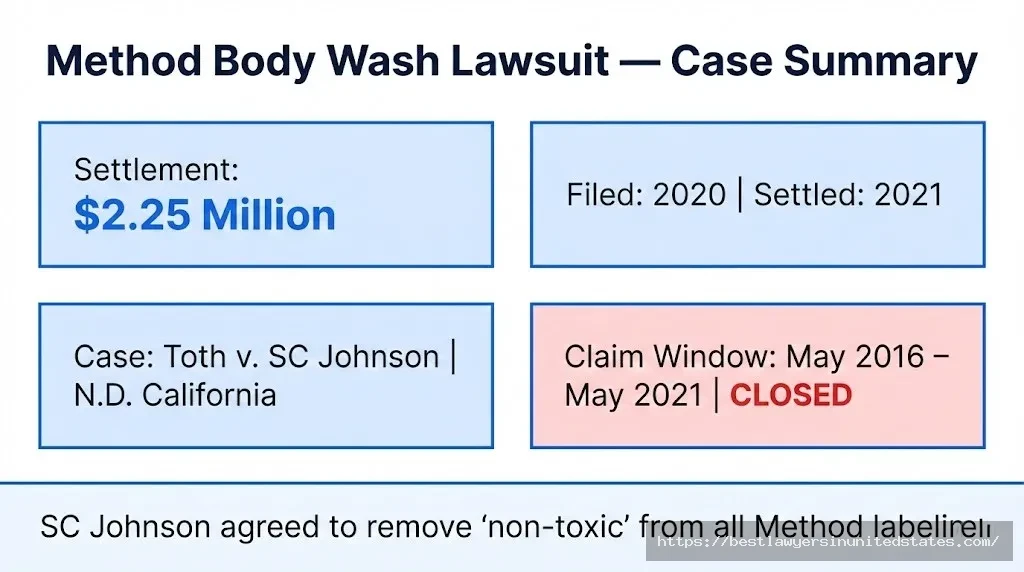
Lawsuit Overview
| Detail | Information |
|---|---|
| Case Name | Felicia Toth v. SC Johnson & Son Inc., et al. |
| Case Number | 3:20-cv-03553 |
| Court | U.S. District Court, Northern District of California |
| Filed | 2020 |
| Defendant | SC Johnson & Son Inc. (parent of Method Products, PBC) |
| Settlement Amount | $2.25 million |
| Claim Deadline | November 1, 2021 (now closed) |
| Max Payout Per Household | $10 without proof of purchase |
| Required Change | Method must stop using “non-toxic” labeling |
What Was the Method Lawsuit About?
Background
Method is a personal care and home cleaning brand founded in 2001 and acquired by SC Johnson in 2017. The brand built its identity around being a cleaner, greener alternative to conventional products — colorful bottles, plant-based marketing, and prominent claims like “non-toxic” and “naturally-derived” printed across their body washes, hand soaps, and household cleaners.
The problem, according to plaintiff Felicia Toth, was that those claims didn’t hold up. Toth, a California resident, argued that she paid a premium for Method products specifically because they were marketed as safe and natural — and that the ingredients inside told a different story.
The lawsuit covered Method body wash alongside other personal care and cleaning products in the line.
What Went Wrong
At the core of the case was a simple mismatch: the label said “non-toxic,” but the product contained ingredients that consumer safety groups and toxicologists consider to be synthetic, potentially irritating, or harmful to the environment. The plaintiffs argued that calling these products “non-toxic” was false advertising under consumer protection laws in all 50 states.
The case wasn’t about products that caused mass injury — it was about honesty in marketing. When you pay more for something because it claims to be safe and natural, you deserve to know if that claim is accurate.
Timeline of Key Events
| Date | Event | Details |
|---|---|---|
| 2001 | Method brand founded | Positioned as eco-friendly cleaning alternative |
| 2017 | SC Johnson acquires Method | Method becomes part of the SC Johnson portfolio |
| May 14, 2016 | Class period begins | Start of window for eligible purchases |
| 2020 | Class action filed | Felicia Toth files in N.D. California |
| 2021 | Settlement announced | SC Johnson agrees to $2.25 million settlement |
| May 13, 2021 | Class period ends | End of window for eligible purchases |
| October 18, 2021 | Opt-out/objection deadline | Last day to exclude yourself or object |
| November 1, 2021 | Claim filing deadline | Settlement now closed |
| Post-2021 | Method rebrands labeling | “Non-toxic” removed from packaging |
Who Filed the Lawsuit?
The lead plaintiff was Felicia Toth, a California consumer who purchased multiple Method products relying on their “non-toxic” representations. The case was brought against SC Johnson & Son Inc., the Wisconsin-based company that owns Method along with other well-known brands including Windex, Glade, Drano, Off!, and Mrs. Meyer’s.
The law firms representing the class were focused on consumer protection and false advertising claims under California law and parallel statutes across the country.
What Were the Allegations?
The lawsuit alleged that SC Johnson violated consumer protection laws by:
- Labeling products “non-toxic” when they contained ingredients capable of causing skin irritation, allergic reactions, or harm to marine life
- Using “natural” and “naturally-derived” language on products that included a significant proportion of synthetic chemicals
- Charging a premium price based on those misleading claims — consumers were effectively paying extra for safety promises the products couldn’t back up
- Failing to disclose that the products contained known sensitizers and synthetic preservatives
- Misleading consumers who specifically seek out safer products for health reasons, including people with sensitive skin, parents of young children, and environmentally conscious shoppers
Which Ingredients Were at the Center of the Lawsuit?
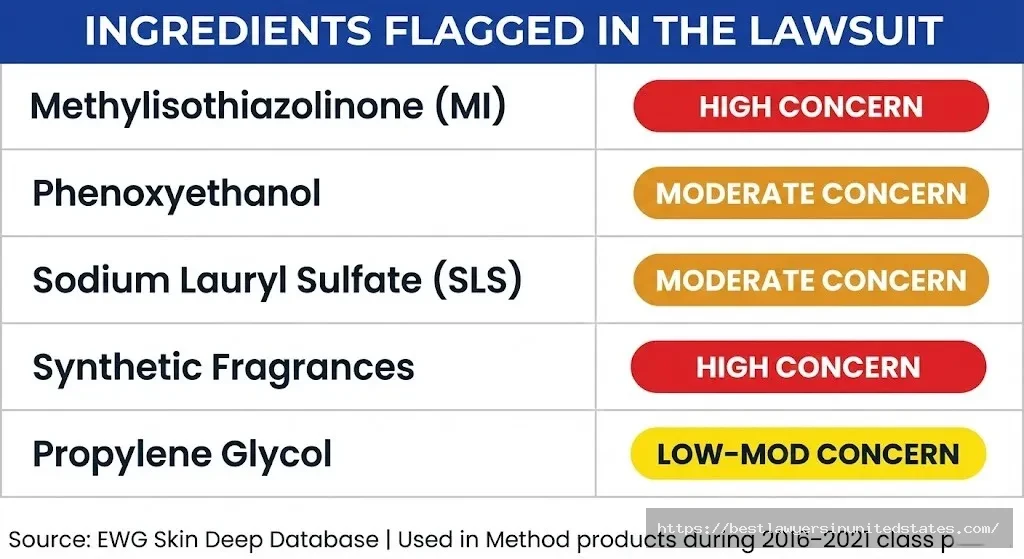
This is the part most articles skip over, and it’s actually the most useful information if you’re a regular Method customer.
| Ingredient | Found In | The Concern | EWG Safety Rating |
|---|---|---|---|
| Methylisothiazolinone (MI) | Multiple products | Synthetic preservative; known skin and respiratory sensitizer; can cause allergic contact dermatitis | High concern |
| Phenoxyethanol | Body wash, hand soap | Synthetic preservative; can irritate skin and eyes; concerns about nervous system effects at high exposure | Moderate concern |
| Sodium Lauryl Sulfate (SLS) | Body wash, hand soap | Surfactant that can strip skin barrier; irritating for sensitive skin | Moderate concern |
| Tocopheryl Acetate | Personal care products | Synthetic form of Vitamin E; not considered “natural” in the same way the label implied | Low–moderate concern |
| Propylene Glycol | Various | Synthetic humectant; can cause irritation in sensitive individuals | Low–moderate concern |
| Octylisothiazolinone | Method Daily Granite Cleaner | Preservative toxic to marine organisms; contradicts “eco-friendly” positioning | High concern (environmental) |
| Synthetic Fragrances | Most scented products | Catch-all term that can include allergens and undisclosed chemicals | Varies — often high concern |
The argument wasn’t that these ingredients are acutely dangerous in typical use. It’s that calling a product “non-toxic” when it contains known sensitizers, synthetic preservatives, and marine pollutants stretches that word beyond what a reasonable consumer would understand it to mean. Taylor Swift Copyright Lawsuits
Who Was Eligible for the Settlement?
Note: The claim deadline was November 1, 2021. This settlement is fully closed. The information below is for historical reference and to help you understand the scope of the case.
Eligibility at the Time
| Requirement | Details |
|---|---|
| Residency | Must be a U.S. resident |
| Purchase window | May 14, 2016 – May 13, 2021 |
| Purchase purpose | Personal use — not for resale |
| Product type | Must be a covered Method product with “non-toxic” labeling |
| Proof of purchase | Not required for the base $10 claim |
Covered Products
The settlement covered all sizes and fragrances of Method products that carried “non-toxic” labeling during the class period. This included:
- Method body wash
- Method hand soap (gel and foaming)
- Method dish soap
- Method all-purpose cleaner
- Method bathroom cleaner
- Method daily shower cleaner
- Other Method cleaning and personal care products bearing the “non-toxic” claim
Payout Structure (Historical)
| Claim Type | Amount | Proof Required |
|---|---|---|
| Standard claim | Up to $10 per household | No receipt needed |
| Higher claim with documentation | Potentially more | Itemized receipts, UPC codes, loyalty card records |
What Actually Changed After the Settlement?
This is arguably more valuable than the payout information, because it affects anyone who buys Method products today.
Labeling Changes
SC Johnson agreed as part of the settlement to stop using the word “non-toxic” on Method products and brand materials. If you look at Method packaging today, you’ll notice they’ve shifted to more specific language — phrases like “made without parabens or phthalates” rather than a blanket “non-toxic” claim. That’s a direct result of this case.
What Didn’t Change
The underlying formulas weren’t required to change. Method can still use methylisothiazolinone, phenoxyethanol, synthetic fragrances, and the other contested ingredients. The settlement only addressed the marketing language, not the chemistry.
SC Johnson also did not admit wrongdoing as part of the settlement — which is standard in civil class action resolutions. A settlement doesn’t mean a court found the products dangerous; it means both sides agreed to resolve the dispute rather than go to trial.
Industry Impact
The Method settlement was part of a broader wave of “greenwashing” lawsuits in the early 2020s. Similar cases were filed against Kellogg’s (for “healthy” cereal claims), Simple Green (all-purpose cleaner), and several personal care brands. Courts and regulators have become increasingly skeptical of vague environmental and wellness claims that aren’t backed by specific standards.
The FTC’s Green Guides — which govern how companies can make environmental marketing claims — were under review during this period, partly as a result of exactly these kinds of cases.
Are Method Body Wash Products Safe to Use?
This is the question most people searching for this topic actually want answered, and it’s worth addressing directly.
The short answer: For most people, yes. Method body wash is unlikely to cause serious harm when used as directed and rinsed off. The ingredients that triggered the lawsuit are present in trace amounts in a rinse-off product, which significantly reduces exposure.
The nuanced answer: If you have sensitive skin, eczema, allergies, or a history of reactions to fragrances or preservatives, you have legitimate reasons to be cautious. Methylisothiazolinone in particular has been flagged by dermatologists and organizations like the American Contact Dermatitis Society as a common allergen. The EU actually restricted MI in leave-on cosmetics in 2013 and has restricted its use in rinse-off products as well.
| Consumer Profile | Risk Level | What to Do |
|---|---|---|
| Average healthy adult | Low | Normal use is unlikely to cause problems |
| Sensitive skin / eczema | Low–moderate | Check for MI, fragrances; consider unscented alternatives |
| Known fragrance allergy | Moderate | Avoid scented Method products; check ingredient lists |
| Young children | Low–moderate | Opt for products specifically formulated and tested for kids |
| Environmental concerns | Varies | Check for MI (toxic to aquatic life); look for biodegradable alternatives |
What Should You Look for When Buying Body Wash Now?
Since the Method settlement taught us not to trust broad claims at face value, here’s a more practical framework.
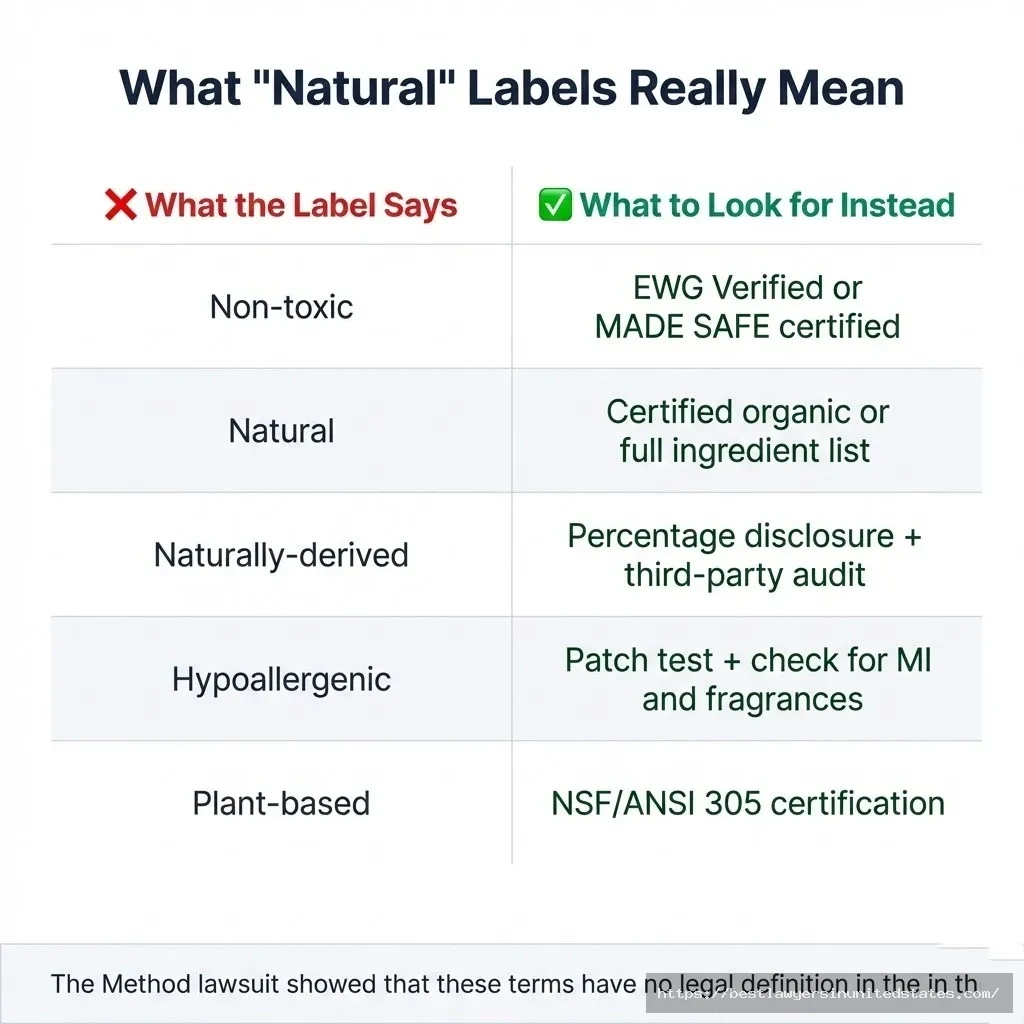
Label Claims vs. What They Actually Mean
| What the Label Says | What It Actually Means | What to Look For Instead |
|---|---|---|
| “Non-toxic” | Essentially unregulated; means nothing specific | Third-party certifications (EWG Verified, MADE SAFE) |
| “Natural” | No legal definition in personal care | Check the ingredient list directly |
| “Naturally-derived” | Could be 1% natural ingredients | Look for “certified organic” or specific certifications |
| “Hypoallergenic” | Not FDA-regulated; no standard definition | Patch test; check for known allergens |
| “Free from parabens/phthalates” | True, but can still contain other synthetic chemicals | Full ingredient review using EWG’s Skin Deep database |
| “Plant-based” | Some plant-derived ingredients; not necessarily all-natural | Look for percentage claims or certification |
Ingredients to Check For
If you have sensitive skin or want to avoid the ingredients that were contested in the Method lawsuit, scan the ingredient list for:
- Methylisothiazolinone (MI) or Methylchloroisothiazolinone (MCI) — synthetic preservatives, common allergens
- Sodium Lauryl Sulfate (SLS) — can disrupt skin barrier, especially with frequent use
- Phenoxyethanol — synthetic preservative; restricted to 1% in EU cosmetics
- “Fragrance” or “Parfum” — catch-all term that can include dozens of undisclosed chemicals
- Formaldehyde releasers (DMDM Hydantoin, Quaternium-15) — preservatives that release small amounts of formaldehyde over time
Useful Resources
- EWG Skin Deep Database (ewg.org/skindeep) — free ingredient safety ratings for thousands of personal care products
- MADE SAFE certification — one of the stricter third-party standards for personal care
- EWG Verified — products that meet EWG’s standards for ingredient transparency and safety
- Think Dirty app — scan barcodes to check ingredient safety ratings on the go
Similar Lawsuits Worth Knowing About
The Method case didn’t happen in isolation. It’s part of a pattern of consumer protection actions against brands making vague wellness and eco-friendly claims. Biote Lawsuit: 2026 Complete Guide
| Lawsuit | Defendant | Settlement | Issue |
|---|---|---|---|
| Method Products (Toth v. SC Johnson) | SC Johnson | $2.25 million | “Non-toxic” false labeling |
| Simple Green All-Purpose Cleaner | Sunshine Makers | $4.35 million | “Non-toxic,” “biodegradable” claims |
| Kellogg’s Cereals | Kellogg’s | $13 million | “Healthy,” “nutritious” labeling |
| Seventh Generation Products | Unilever | Various | “Natural,” “plant-based” claims |
| Honest Company Products | The Honest Company | $7.35 million | “Natural,” “safe” ingredient claims |
The through-line in all of these: companies marketing products to health-conscious consumers at a premium, using wellness language that turned out not to hold up under scrutiny. If you paid extra for a product because it was “natural” or “non-toxic,” you were the target consumer for these lawsuits.
Do You Need a Lawyer?
Since the Method settlement is closed, there’s no active class action to join right now. But that doesn’t mean you have no options.
If you had a personal injury or severe reaction to a Method product, that’s a separate category from the class action. Individual product liability claims aren’t subject to class settlement deadlines. Talk to a personal injury attorney if you believe a Method product caused you documented harm.
If you’re interested in current greenwashing lawsuits, class action attorneys actively monitor personal care and cleaning product companies. New cases get filed regularly. You can check sites like TopClassActions.com or ClassAction.org for open cases.
For general consumer questions about a product’s safety or labeling, you don’t need a lawyer — the EWG database and resources above will serve you better.
Frequently Asked Questions
What is the Method body wash lawsuit? It’s a class action filed in 2020 by California resident Felicia Toth against SC Johnson, Method’s parent company. The lawsuit alleged that Method products were falsely labeled “non-toxic” and “natural” when they contained synthetic and potentially irritating ingredients. SC Johnson settled for $2.25 million in 2021.
Is the settlement still open? Can I file a claim? No. The claim deadline was November 1, 2021. The settlement is fully closed and no new claims can be submitted.
How much did people get from the settlement? Up to $10 per household without proof of purchase. People with receipts or UPC codes could potentially claim more, depending on how many products they bought.
Did Method admit the products were dangerous? No. SC Johnson settled without admitting wrongdoing — which is standard practice in class action settlements. A settlement means the company agreed to pay rather than litigate; it’s not a finding of fault.
What changed as a result of the lawsuit? SC Johnson agreed to stop using the term “non-toxic” on Method products and marketing materials. The product formulas themselves were not required to change.
Are Method body wash products still on the market? Yes. Method continues to sell body wash and personal care products. The brand has updated its labeling language and now uses more specific claims rather than broad “non-toxic” statements.
Why did Method’s “non-toxic” claim matter legally? Because consumer protection laws in California and elsewhere prohibit false or misleading statements on product labels. When a claim influences a consumer’s decision to buy — and pay more — it has to be accurate. “Non-toxic” implies a specific safety standard that the ingredients didn’t support.
What ingredients were the problem? Primarily methylisothiazolinone (MI), phenoxyethanol, propylene glycol, tocopheryl acetate, and synthetic fragrances. These are synthetic ingredients that exist in many personal care products — but they disqualify a product from being genuinely “non-toxic” by any rigorous definition.
Is Method body wash safe for sensitive skin? It depends on your specific sensitivities. Methylisothiazolinone and synthetic fragrances are two of the most common contact allergens in personal care products. If you have eczema, known fragrance sensitivity, or a history of product reactions, check the ingredient list or choose a fragrance-free, MI-free alternative.
How is this different from a product recall? A recall happens when a product is found to cause actual physical harm and is pulled from shelves. This was a false advertising lawsuit — the claim was about deceptive marketing, not a defective or contaminated product. Method body wash was never recalled.
Are there other open lawsuits against Method or SC Johnson I should know about? Check TopClassActions.com and ClassAction.org for the most current filings. SC Johnson, as a large consumer products company, is regularly involved in litigation, though not always related to Method.
What should I use instead if I’m concerned? Look for products certified by EWG (Environmental Working Group), MADE SAFE, or NSF/ANSI 305. These certifications have actual standards. Products marketed by smaller brands like Branch Basics, Puracy, or Dr. Bronner’s tend to use simpler, more transparent ingredient lists — though you should always check for yourself.
Can I sue Method separately for a personal injury? If you experienced documented harm — a diagnosed allergic reaction, medical treatment, confirmed contact dermatitis — from a Method product, that may be a basis for an individual product liability claim, separate from the class action. Speak with a personal injury attorney for guidance specific to your situation.
What is greenwashing? Greenwashing is the practice of marketing a product as environmentally friendly, natural, or safe using vague or unsubstantiated claims. The Method lawsuit is considered a greenwashing case because the “non-toxic” and “natural” claims were not backed by rigorous standards — they were marketing language designed to appeal to eco-conscious consumers without genuine scientific support.
What does “non-toxic” actually mean legally? Not much. There is no federal regulatory standard in the U.S. that defines “non-toxic” for personal care or cleaning products. It’s essentially an unregulated marketing term — which is exactly why lawsuits like this one can be filed. The FTC’s Green Guides address some environmental marketing claims but don’t specifically define toxicity standards for personal care.
The Bottom Line
The Method body wash lawsuit is a closed chapter — the settlement was paid, the labeling changed, and new claims can’t be filed. But the case still matters for anyone who buys personal care products, because it illustrated something that applies to dozens of brands:
Wellness marketing language is often more about perception than precision. “Non-toxic,” “natural,” and “clean” are words designed to make you feel good about a purchase. They don’t have legal definitions. They don’t require third-party testing. And in Method’s case, they were used on products that contained synthetic preservatives linked to skin sensitization and environmental toxicity.
The most useful thing to come out of this lawsuit isn’t the settlement check — it’s the reminder to check the ingredient list yourself, use databases like EWG’s Skin Deep, and look for certifications that have actual standards behind them. That applies whether you’re buying Method, a competing “green” brand, or anything else promising to be safe, natural, or non-toxic.
This article is for informational purposes only and does not constitute legal advice. The Method settlement claim period closed on November 1, 2021. If you believe you have a personal injury claim related to a Method product, consult a licensed attorney in your state.