
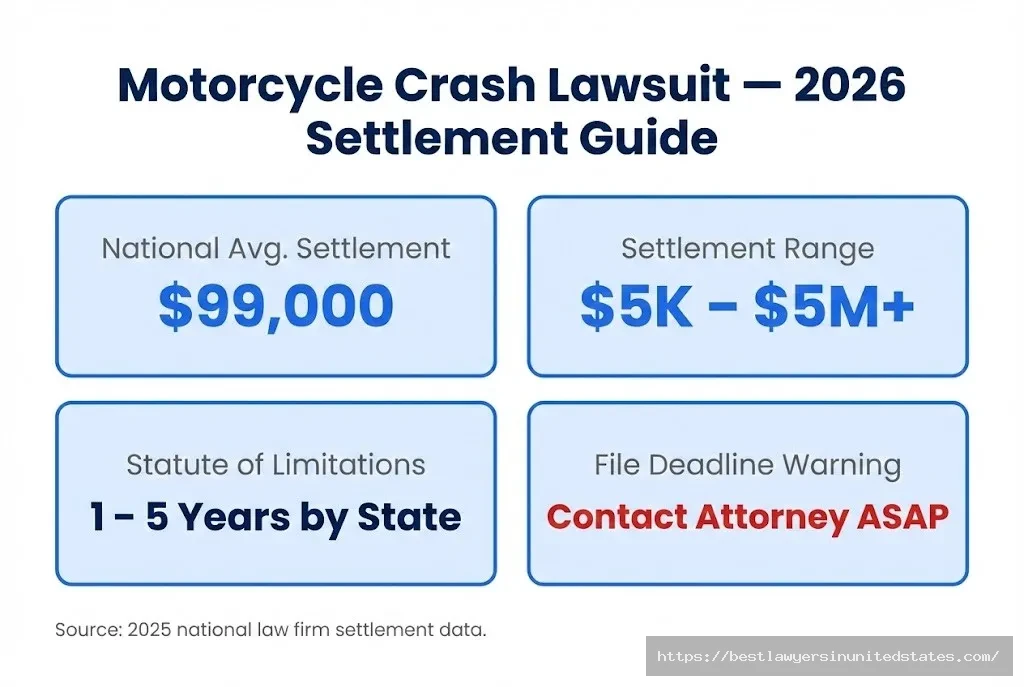
A motorcycle crash lawsuit is a personal injury legal claim filed against the driver, company, or government entity whose negligence caused your accident. If another party was at fault for your crash, you have the right to sue for medical bills, lost wages, pain and suffering, and more. Settlements for motorcycle accident lawsuits range from $5,000 for minor crashes up to several million dollars for catastrophic injuries — with the national average sitting around $99,000 as of 2025. The deadline to file (the statute of limitations) is typically two to three years from the date of your accident, but it varies by state and some deadlines are as short as six months.
Quick Answer: A motorcycle crash lawsuit lets you recover compensation from whoever caused your accident. The average payout is around $99,000, but serious injury cases frequently reach $500,000 or more. You typically have 1–5 years to file depending on your state — and the clock starts the day of your crash. Consult an attorney as soon as possible to protect your right to compensation.
This guide covers everything you need to know: how much your case might be worth, how the lawsuit process works step by step, what your deadline is by state, and what documentation you need to build a winning case. Negligent Security Lawsuit
What Is a Motorcycle Crash Lawsuit?
The Basics of Motorcycle Personal Injury Claims
A motorcycle crash lawsuit is a civil legal action you take against a party whose negligence caused you harm. Unlike a criminal case — where the government prosecutes a wrongdoer — a personal injury lawsuit is about your financial recovery. You’re asking a court (or an insurance company during settlement negotiations) to make you financially whole after someone else’s mistake cost you your health, your income, and your peace of mind.
Most motorcycle accident cases never actually go to trial. The vast majority settle out of court during negotiations between your attorney and the at-fault party’s insurance company. If those negotiations break down and a fair deal can’t be reached, your attorney files a formal complaint in court and the case proceeds toward trial.
Motorcyclists face unique challenges in these lawsuits. Juries sometimes carry biases against riders, assuming recklessness even when the accident wasn’t the rider’s fault. According to the National Transportation Safety Board, in 64% of multi-vehicle motorcycle crashes, the other driver caused the accident — not the rider. An experienced motorcycle accident attorney knows how to combat these biases with solid evidence.
Who Can You Sue?
You’re not limited to suing just the driver who hit you. Depending on the facts of your case, you may have claims against multiple parties.
| Potentially Liable Party | When They Can Be Sued | Example |
|---|---|---|
| At-fault driver | Driver caused the crash through negligence | Running a red light, failure to yield, distracted driving |
| Vehicle owner | Owner allowed an incompetent driver to use their car | Employer whose employee caused a crash on the job |
| Government agency | Dangerous road conditions caused or contributed to the crash | Pothole, missing guardrail, broken traffic light |
| Motorcycle manufacturer | Defective bike part contributed to the crash | Faulty brakes, tire blowout from manufacturing defect |
| Cargo company | Improperly secured cargo fell from a truck | Debris on highway from a loose load |
| Rideshare company | Uber/Lyft driver caused the crash | Lyft driver ran a stop sign and hit a motorcyclist |
Timeline of a Typical Motorcycle Crash Lawsuit
| Phase | Timeframe | What Happens |
|---|---|---|
| Crash and immediate aftermath | Day 0 | Accident occurs, emergency services called, police report filed |
| Medical treatment begins | Days 1–7+ | Hospitalization, surgery, diagnosis of injuries |
| Hire an attorney | First 1–4 weeks | Free consultation, attorney evaluates your case |
| Insurance claim filed | First 30 days | Claim submitted to at-fault driver’s insurer |
| Investigation and evidence gathering | Weeks 2–12 | Photos, witness statements, medical records collected |
| Demand letter sent | Months 1–3 | Attorney sends formal demand to insurance company |
| Settlement negotiations | Months 2–6 | Back-and-forth with insurance adjuster |
| Lawsuit filed (if needed) | Before statute of limitations | Formal complaint filed in court |
| Discovery | 6–18 months after filing | Both sides exchange evidence |
| Trial or final settlement | 1–3 years from accident | Case resolves either in court or via settlement |
| Payment received | Within weeks of settlement | Check or electronic payment issued |
Who Qualifies to File a Motorcycle Crash Lawsuit?
Quick Answer: You qualify to file a motorcycle crash lawsuit if another party’s negligence caused or contributed to your accident and you suffered damages as a result. You don’t have to be completely without fault — most states allow you to recover even if you were partially responsible.
Eligibility Requirements
| Requirement | Details | What You’ll Need to Show |
|---|---|---|
| Another party was negligent | Driver, entity, or manufacturer acted carelessly | Police report, witness statements, expert testimony |
| You suffered actual damages | Physical injuries, financial losses, or both | Medical records, bills, pay stubs showing missed work |
| You filed within the statute of limitations | Varies by state (typically 1–5 years) | Filing date vs. accident date |
| You are the injured party (or their representative) | Victim, parent of minor victim, or estate | ID, legal documentation if filing on behalf of another |
Who Qualifies by Accident Type
You likely qualify if:
- Another driver ran a red light or stop sign and hit you
- A car turned left in front of your motorcycle
- You were rear-ended at a stoplight
- You were sideswiped or forced off the road
- A truck’s cargo fell and caused your crash
- A road defect (pothole, missing signage) caused you to lose control
- A defective part on your motorcycle failed
You may still qualify even if:
- You weren’t wearing a helmet (though it may reduce your damages)
- You were slightly speeding (comparative negligence laws still allow partial recovery)
- You didn’t call 911 at the scene
- You delayed getting medical treatment
Who Does NOT Qualify?
You will not be able to file a successful lawsuit if:
❌ You were entirely at fault for the accident and no other party contributed
❌ The statute of limitations has expired in your state and no exception applies
❌ You signed a release of claims as part of a prior settlement for the same accident
❌ You have no damages — no injuries, no property damage, no financial losses
❌ The at-fault party is completely unknown and you have no uninsured motorist coverage
Comparative Negligence — What If You Were Partially at Fault?
Most states use some form of comparative negligence, which means even if you share blame for the crash, you can still recover compensation. Here’s how it works:
| Negligence System | States Using It | How It Affects Your Claim |
|---|---|---|
| Pure Comparative Fault | CA, NY, FL, MO, and others | You can recover even if 99% at fault, but recovery is reduced by your fault % |
| Modified Comparative (51% bar) | TX, CO, GA, PA, and others | You can recover if less than 51% at fault; recovery reduced by your fault % |
| Modified Comparative (50% bar) | ME, TN, WV, and others | You can recover if less than 50% at fault; recovery reduced by your fault % |
| Contributory Negligence | VA, NC, MD, DC, AL | You cannot recover anything if you’re even 1% at fault |
How Much Money Can You Get from a Motorcycle Crash Lawsuit?
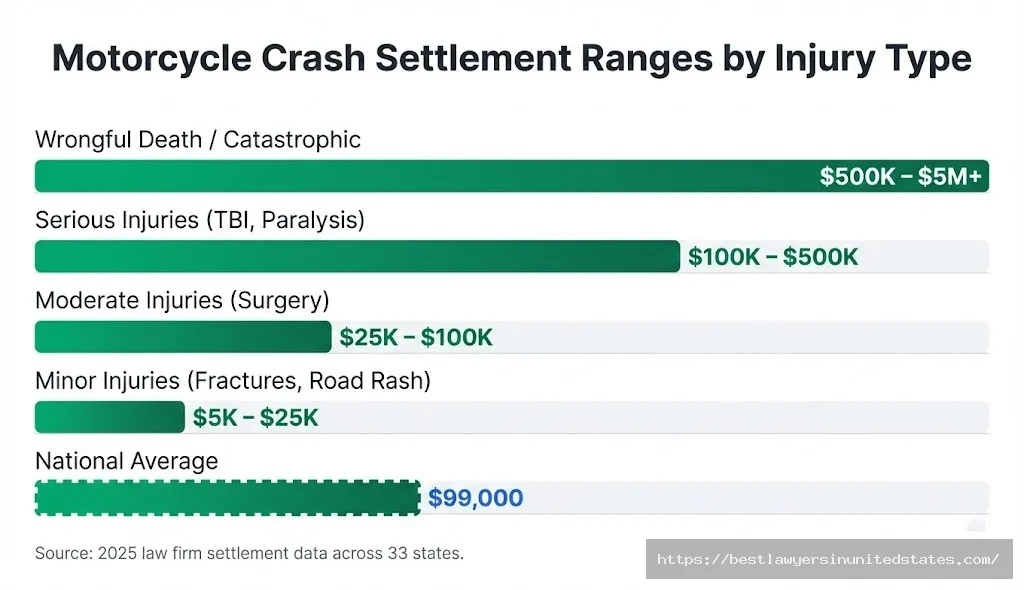
Quick Answer: Motorcycle accident settlements range from $5,000 for minor crashes to several million dollars for catastrophic injuries. The national average is approximately $99,000, though the median is closer to $49,000. Cases involving severe injuries — spinal cord damage, traumatic brain injury, or wrongful death — routinely reach $500,000 to $5 million+.
Settlement Ranges by Injury Type
| Injury Category | Typical Settlement Range | Examples |
|---|---|---|
| Minor injuries | $5,000 – $25,000 | Road rash, minor fractures, soft tissue injuries |
| Moderate injuries | $25,000 – $100,000 | Multiple fractures, moderate TBI, torn ligaments |
| Serious injuries | $100,000 – $500,000 | Permanent scarring, major fractures, disc herniation requiring surgery |
| Catastrophic injuries | $500,000 – $5,000,000+ | Spinal cord injury, severe TBI, amputation, paralysis |
| Wrongful death | $500,000 – $10,000,000+ | Death of a family member in the crash |
Average Settlements by State (2025 Data)
Settlement amounts vary significantly across states. Nevada leads with an average payout of approximately $11.6 million (driven by several massive verdicts), while states like Arizona average around $546,000 and Wisconsin averages $632,500. States like Alabama and Missouri also show high averages at $2.3 million and $2.1 million respectively, influenced by larger individual settlements. Crepe Erase Lawsuit
| State | Average Settlement | Median Settlement | Highest Known Settlement |
|---|---|---|---|
| Nevada | $11,642,250 | $3,060,000 | Extremely high (multiple multi-million verdicts) |
| Alabama | $2,281,412 | $950,000 | $25,000,000 |
| Missouri | $2,129,875 | $600,000 | $14,200,000 |
| Minnesota | $1,324,418 | $477,500 | $6,000,000 |
| Wisconsin | $632,500 | $362,500 | $2,800,000 |
| Arizona | $546,424 | $300,000 | $3,000,000 |
| Arkansas | $627,500 | $247,500 | $4,500,000 |
| California | ~$75,000 (trial avg.) | N/A | $10,000,000+ |
| National average | ~$99,000 | ~$49,000 | Varies widely |
Source: Data compiled from law firm studies and state-level case records, 2025.
What Types of Damages Can You Recover?
Your lawsuit can seek compensation in three categories.
Economic damages (the bills you can document):
- Past and future medical bills — hospitalization, surgery, physical therapy, medications, home health aides
- Lost wages during recovery
- Reduced future earning capacity if your injuries are permanent
- Motorcycle repair or replacement costs
- Damaged gear, clothing, and personal property
Non-economic damages (harder to quantify but very real):
- Pain and suffering — physical and ongoing
- Emotional distress and psychological trauma (PTSD, anxiety, depression)
- Loss of enjoyment of life — activities you can no longer do
- Loss of consortium — impact on your relationship with your spouse
Punitive damages (rare but significant):
- Awarded when the at-fault party’s conduct was especially reckless or malicious
- Road rage incidents, drunk driving crashes, and extreme negligence may qualify
- Can multiply your total award several times over
How Pain and Suffering Is Calculated
Most attorneys and insurance companies use the multiplier method: they add up your total economic damages, then multiply by a number between 1.5 and 5 depending on how severe and permanent your injuries are.
| Multiplier | When Applied | Example |
|---|---|---|
| 1.5x | Minor injuries, full recovery expected | $20,000 in medical bills → $30,000 total claim |
| 2x – 3x | Moderate injuries, partial recovery | $50,000 in bills → $100,000–$150,000 claim |
| 3x – 5x | Serious injuries, permanent limitations | $100,000 in bills → $300,000–$500,000 claim |
| 5x+ | Catastrophic injuries, life-altering impact | $200,000 in bills → $1,000,000+ claim |
How to File a Motorcycle Crash Lawsuit — Step by Step

⚠️ CRITICAL DEADLINE WARNING
Your deadline to file a lawsuit is determined by your state’s statute of limitations. Most states give you 2–3 years from the date of your accident. Some states (like Louisiana) give only 1 year. If you miss this deadline by even one day, you permanently lose your right to sue. No exceptions. Do not wait.
Step 1: Get Medical Treatment Immediately
Don’t skip the ER, even if you feel okay. Adrenaline masks pain — many serious injuries (internal bleeding, TBI, spinal damage) don’t feel severe right away. Going to the hospital does two things: it protects your health and creates an official medical record linking your injuries directly to the crash. Insurance companies will attack your claim if there’s a gap between the accident and your first medical visit.
Step 2: Gather Evidence at the Scene (If Possible)
If you’re physically able:
- Call 911 and wait for police — get a copy of the police report number
- Photograph everything: the scene, your injuries, the other vehicles, skid marks, road conditions, traffic signals
- Get names and contact information from all witnesses
- Note the other driver’s license plate, insurance information, and driver’s license number
- Do NOT give a recorded statement to the other driver’s insurance company
Step 3: Hire a Motorcycle Accident Attorney
Most motorcycle accident attorneys work on contingency — you pay nothing upfront and they take a percentage (typically 33%) only if you win. Get a free consultation with at least one attorney within the first few weeks of your accident. The earlier they get involved, the better they can preserve evidence. Contact [email protected] for attorney referrals in your area.
Step 4: Your Attorney Files an Insurance Claim and Sends a Demand Letter
Your attorney calculates your total damages, gathers all documentation, and sends a formal demand letter to the at-fault party’s insurance company. This letter states what happened, who was at fault, what you’re owed, and gives the insurer a deadline to respond.
Step 5: Negotiate a Settlement
The insurance company will almost certainly counter with a lower number. Your attorney negotiates on your behalf. This back-and-forth can take weeks to months. Most cases — roughly 95% of motorcycle accident lawsuits — settle at this stage without ever going to trial.
Step 6: File a Lawsuit If Negotiations Fail
If the insurance company won’t offer a fair settlement, your attorney files a civil complaint in court naming the defendant. This formally starts the lawsuit and signals you’re serious. Often, just filing the lawsuit prompts the other side to improve their offer.
Step 7: Discovery Phase
Both sides exchange evidence — medical records, accident reconstruction reports, expert witness opinions, depositions. This phase typically lasts 6–18 months.
Step 8: Trial or Final Settlement
The vast majority of cases settle before trial. If yours goes to trial, a jury decides whether the defendant was negligent and how much you’re owed. Trials can last days to weeks. If you win, the defendant (or their insurer) must pay the verdict.
Step 9: Receive Your Compensation
Once a settlement is agreed upon or a verdict is reached, payment typically arrives within 30–60 days. Your attorney deducts their fee and any case costs, and the remainder goes to you.
Filing Deadlines by State — Don’t Miss Yours
⚠️ Missing the statute of limitations means losing your case, period. The insurance company will file a motion to dismiss and the court will grant it.
| State | Statute of Limitations | Notes |
|---|---|---|
| California | 2 years | Applies to both personal injury and wrongful death |
| Florida | 2 years | Reduced from 4 years in March 2023; applies to negligence claims |
| Texas | 2 years | Strict — very few exceptions |
| New York | 3 years | Wrongful death: 2 years from date of death |
| Georgia | 2 years | Property damage only: 4 years |
| Michigan | 3 years | Both personal injury and wrongful death |
| Virginia | 2 years | Contributory negligence state — be especially careful |
| Pennsylvania | 2 years | |
| Illinois | 2 years | |
| Ohio | 2 years | |
| Colorado | 3 years | |
| Louisiana | 1 year | One of the shortest deadlines in the country |
| Minnesota | 6 years | One of the longest deadlines |
Factors that can extend your deadline:
- You were a minor at the time of the crash (deadline often pauses until you turn 18)
- The at-fault party fled the state
- You were mentally incapacitated after the accident
- The injury wasn’t immediately discoverable
- The defendant committed fraud that concealed your claim
Factors that can SHORTEN your deadline:
- The at-fault party is a government entity (often 6 months to 1 year, and you must file a formal notice of claim first)
- Special rules in some states for claims against certain defendants
What Documentation You Need to Build Your Case
Strong evidence wins motorcycle accident lawsuits. Start collecting and preserving everything immediately.
| Document | Why It Matters | Where to Get It | If You Don’t Have It |
|---|---|---|---|
| Police report | Official record of accident, citations issued | Local police department or online portal | Request it ASAP — usually available within 5–10 days |
| Medical records | Links injuries to the crash | Your treating doctors and hospitals | Attorney can subpoena records |
| Medical bills | Documents economic damages | Hospitals, doctors, pharmacies | Request itemized bills from all providers |
| Pay stubs / employer letter | Proves lost wages | Your employer’s HR department | Bank statements, tax returns as alternative |
| Photos of injuries and scene | Visual proof of severity and conditions | Your phone or police body cam footage | Witness photos, surveillance footage nearby |
| Witness statements | Third-party confirmation of what happened | Witnesses at the scene | Attorney’s investigator can track down witnesses |
| Motorcycle repair estimate | Documents property damage | Certified repair shop | Insurance adjuster’s assessment |
| Insurance information | Identifies who pays | From the other driver at the scene | DMV records, police report |
| Expert reports | Establishes fault and injury causation | Accident reconstruction firms, medical experts | Your attorney arranges these |
| Dashcam or surveillance footage | Objective proof of the crash | Your dashcam, nearby businesses | Attorney can send evidence preservation letters |
Current Landscape of Motorcycle Crash Lawsuits in 2026
What’s Changed in 2025–2026
Motorcycle accident litigation has seen several notable developments entering 2026.
Florida’s shortened deadline is still catching riders off guard. Florida reduced its personal injury statute of limitations from four years to just two years back in March 2023, and many riders are still unaware. If you had a crash in Florida in 2024, your deadline may be coming up in 2026 — check with an attorney immediately.
Insurance company tactics are more aggressive than ever. Insurers are increasingly using AI-driven tools to analyze your social media and find posts that contradict your injury claims. Be extremely careful about what you post online after a motorcycle accident.
Helmet laws and comparative fault: In states without universal helmet laws, insurers routinely try to use the absence of a helmet to reduce your compensation — even for injuries that had nothing to do with head protection. Courts are increasingly skeptical of this argument for non-head injuries.
Rideshare-involved crashes continue to rise. When an Uber or Lyft driver causes a motorcycle accident, liability can be complex depending on whether the driver had the app active and whether they had a passenger. These cases often involve higher insurance limits — Uber and Lyft carry $1 million in liability coverage while a driver is transporting a passenger.
How Motorcycle Crash Lawsuits Compare to Other Vehicle Accidents
| Lawsuit Type | Average Settlement | Key Challenge | Time to Resolve |
|---|---|---|---|
| Motorcycle crash | $49,000 – $99,000 (median/avg.) | Juror bias against riders | 6 months – 3 years |
| Car accident | $20,000 – $30,000 (typical) | Comparative fault disputes | 3–18 months |
| Truck accident | $200,000 – $500,000+ | Federal regulations, multiple defendants | 1–3 years |
| Bicycle accident | $10,000 – $100,000 | Fewer protections, infrastructure issues | 6 months – 2 years |
| Pedestrian accident | $50,000 – $500,000 | Severity of injuries | 6 months – 2 years |
| Wrongful death | $500,000 – $5,000,000+ | Multiple family claimants | 1–4 years |
Do You Need a Lawyer to File a Motorcycle Crash Lawsuit?
Quick Answer: You don’t legally need a lawyer, but not having one will almost certainly cost you money. Studies consistently show that injury victims with legal representation receive settlements 3x to 4x higher than those without — even after subtracting attorney fees.
What an Attorney Does That You Can’t Easily Do Yourself
An experienced motorcycle accident attorney doesn’t just fill out paperwork. They:
Prevent you from making costly mistakes. The number one mistake unrepresented riders make is giving a recorded statement to the other driver’s insurance company. Adjusters are trained to get you to say things that minimize your claim. Your attorney tells you exactly what to say and what not to say.
Accurately calculate your full damages. Most people underestimate what their case is worth. They forget to account for future medical care, reduced earning capacity, and non-economic damages. Attorneys know how to add these up correctly.
Fight for your actual settlement value. Insurance companies have massive legal teams whose job is to pay you as little as possible. An attorney with trial experience can credibly threaten to take the case to court — and insurers know it.
Handle expert witnesses. Accident reconstructionists, medical experts, and vocational specialists can dramatically increase the value of your claim. Attorneys have established relationships with these experts.
When You Might Handle It Yourself
If your accident was minor — a low-speed crash with no injuries, just a few hundred dollars in bike damage — it might not be worth hiring an attorney. In that case, you’d file a property damage claim directly with the at-fault driver’s insurance and negotiate the repair cost yourself.
For anything involving injuries, lost work, or medical treatment: get an attorney.
Getting Free Legal Help
Most motorcycle accident attorneys offer free consultations and work entirely on contingency — no fee unless you win. There’s no financial risk to calling one.
For attorney referrals in your area: [email protected]
Frequently Asked Questions About Motorcycle Crash Lawsuits
What is a motorcycle crash lawsuit?
Quick Answer: It’s a personal injury claim you file against whoever was responsible for causing your accident — typically another driver, but potentially a government agency, manufacturer, or employer.
When you’re hurt in a motorcycle accident that someone else caused, you have the legal right to seek financial compensation for everything you’ve lost: medical bills, wages, your bike, your ability to enjoy life, and more. The lawsuit can be settled through insurance negotiations or resolved at trial.
How long do I have to file a motorcycle accident lawsuit?
Quick Answer: In most states, 2–3 years from the date of the crash. Some states give only 1 year (Louisiana). Government entity claims can be as short as 6 months.
Don’t assume you have plenty of time. Evidence disappears, witnesses’ memories fade, and insurance companies know exactly how to run out the clock on unrepresented victims. Contact an attorney within weeks of your accident.
How much money can I get from a motorcycle accident settlement?
Quick Answer: As of late 2025, the average motorcycle accident settlement is $99,000, with law firms reporting payouts ranging from $66,000 to $185,000 depending on case factors. Cases involving serious injuries reach $500,000 to $5 million or more.
The amount you get depends on the severity of your injuries, who was at fault, the insurance coverage available, the quality of your evidence, and whether you have an experienced attorney.
What if the other driver didn’t have insurance?
Quick Answer: Your own uninsured motorist (UM) coverage may cover you. If you don’t have UM coverage, you can still sue the driver personally, though collecting can be difficult if they have no assets.
Always check whether you have UM or underinsured motorist (UIM) coverage on your own policy — this is one of the most valuable protections a motorcyclist can carry, and it’s often overlooked.
Do I need to prove the other driver was 100% at fault?
Quick Answer: No. In most states, you can recover compensation even if you were partially at fault — your damages are just reduced by your percentage of fault.
Only four jurisdictions (Virginia, North Carolina, Maryland, and Washington D.C.) use contributory negligence, where any fault on your part bars recovery entirely. In every other state, partial fault doesn’t disqualify you. Balance of Nature Lawsuit
What documents do I need to file a motorcycle lawsuit?
Quick Answer: Police report, medical records, medical bills, photos of the scene and injuries, witness contact information, and proof of lost wages.
Your attorney will help you gather everything you need. Don’t throw anything away — keep every receipt, bill, and correspondence related to the accident in a single folder.
What if I didn’t wear a helmet?
Quick Answer: You can still sue, but insurers may try to use the absence of a helmet to argue you contributed to your head injuries. This only applies to head injuries — for broken legs, road rash, or other injuries, the helmet argument is irrelevant.
Some states have no helmet laws, and in those states, insurers have less room to make this argument. Talk to your attorney about how helmet status affects your specific case.
How long does a motorcycle accident lawsuit take?
Quick Answer: Simple cases that settle out of court can resolve in 2–6 months. Cases that go to trial typically take 1–3 years from the date of the accident.
The biggest factors are the severity of your injuries, how cooperative the insurance company is, and whether your case requires extensive expert testimony. Your attorney can give you a realistic timeline after reviewing your case.
Will my motorcycle accident settlement be taxed?
Quick Answer: Generally, no. Compensation for physical injuries and medical expenses is typically not taxable under federal law. Punitive damages and interest on a settlement may be taxable.
Consult a tax professional about your specific situation, especially if your settlement includes wages, punitive damages, or emotional distress compensation unrelated to a physical injury.
What if I was a passenger on the motorcycle?
Quick Answer: As a passenger, you have an even stronger claim than the rider — you bear no responsibility for operating the bike, so fault arguments don’t apply to you the same way.
You can potentially file claims against the driver of the other vehicle, the motorcycle operator (if their negligence contributed), or both. Passengers are often entitled to the same categories of damages as riders.
What if my motorcycle was totaled?
Quick Answer: Property damage is a separate claim from your personal injury claim. You’re entitled to the fair market value of your motorcycle at the time of the crash, not what it would cost to buy a new one.
If the insurer’s estimate of your bike’s value seems too low, you can dispute it with comparable sale listings or an independent appraisal. Your attorney can handle this as part of the broader claim.
Can I sue a rideshare driver (Uber/Lyft) who caused my crash?
Quick Answer: Yes. Rideshare companies carry up to $1 million in liability coverage while a driver has a passenger in the car. Coverage is lower if the driver had the app on but no passenger.
Rideshare lawsuits are more complex because liability can involve the driver personally, the rideshare company, or both. An attorney with rideshare accident experience is particularly valuable in these cases.
What if a road defect caused my crash?
Quick Answer: You may be able to sue the government agency responsible for road maintenance. These claims involve strict deadlines — often 6 months or less — and require you to file a formal notice of claim before you can sue.
Government claims are time-sensitive and procedurally complex. Contact an attorney immediately if a pothole, missing guardrail, broken traffic signal, or other road condition contributed to your crash.
Should I accept the first settlement offer from the insurance company?
Quick Answer: Almost certainly not. First offers are almost always significantly lower than what your case is worth. Insurance companies start low and count on you accepting.
A good rule of thumb: if you received a quick offer within days of the crash, without any attorney involvement, it’s likely a fraction of what you’re owed. Have an attorney review any offer before you accept it. Once you sign a release, you can’t go back for more.
What if my injuries got worse over time?
Quick Answer: This is exactly why you shouldn’t rush to settle. If your injuries turn out to be more serious than initially apparent — delayed symptoms, worsening conditions — you want a settlement that accounts for future care.
Your attorney will typically recommend waiting until you’ve reached maximum medical improvement (MMI) before settling, so the full picture of your injuries is clear and your damages can be accurately calculated.
What happens if the at-fault driver dies after the accident?
Quick Answer: You file your claim against the at-fault driver’s estate and their insurance policy. The process is slightly more complex but your right to compensation doesn’t disappear.
Their insurance policy survives their death, and the estate is responsible for any damages not covered by insurance. An attorney can guide you through the process.
Can family members sue if their loved one was killed in a motorcycle crash?
Quick Answer: Yes. Wrongful death lawsuits can be filed by surviving spouses, children, and in some states, parents and other dependents. Compensation includes funeral costs, loss of financial support, and loss of companionship.
Wrongful death cases often result in some of the largest motorcycle accident settlements — frequently in the seven-figure range. One example involved a motorcyclist killed when a water pump flew off a passing truck and struck his bike — the family secured a $2.325 million pretrial settlement.
Where can I get free help with my motorcycle accident claim?
Quick Answer: Most motorcycle accident attorneys offer free consultations and work on contingency — you pay nothing unless they win your case.
Contact [email protected] for attorney referrals in your area. You can also review your state’s bar association directory for licensed attorneys near you.
Real Motorcycle Crash Settlement Examples
These examples show how different factors produce dramatically different outcomes.
| Case Details | Injuries | Settlement Amount | Key Factor |
|---|---|---|---|
| Car failed to yield, hit rider at intersection | Fractured pelvis, foot injury, road rash | $125,000 | Policy limits recovered; no UIM coverage |
| Commercial vehicle pulled in front of motorcyclist | Shoulder injury + other trauma | $6,000,000 | Commercial policy, clear liability, severe harm |
| Hit-and-run crash, rider struck from behind | Significant trauma, property damage | $850,000 | Uninsured motorist coverage was available |
| Water pump fell from truck, struck motorcycle | Fatal injuries (wrongful death) | $2,325,000 | Truck company clearly negligent |
| Motorcycle struck by van, ejected through windshield | Multiple severe fractures, PTSD | $1,000,000 | Defendant admitted liability quickly |
| Low-speed collision, minor injuries | Road rash, mild concussion | $5,000 – $10,000 | Minor damages, quick resolution |
| Taxi cut off scooter rider | Shoulder injury | $25,000 | Filed lawsuit after low initial offer |
Key Takeaways: What to Do After a Motorcycle Crash
If you’ve been in a crash, here’s your immediate action plan:
- Get emergency medical care — go to the ER even if you feel okay
- Call 911 and get a police report filed
- Document everything — photos, witness names, other driver’s info
- Don’t give a recorded statement to the other driver’s insurance company
- Hire a motorcycle accident attorney — free consultation, no upfront cost
- Know your deadline — find out your state’s statute of limitations immediately
- Keep every bill and receipt related to the accident and your recovery
- Don’t post about the accident on social media — insurers monitor this
- Don’t rush to settle — wait until the full extent of your injuries is clear
For attorney referrals and free case evaluation: [email protected]
