
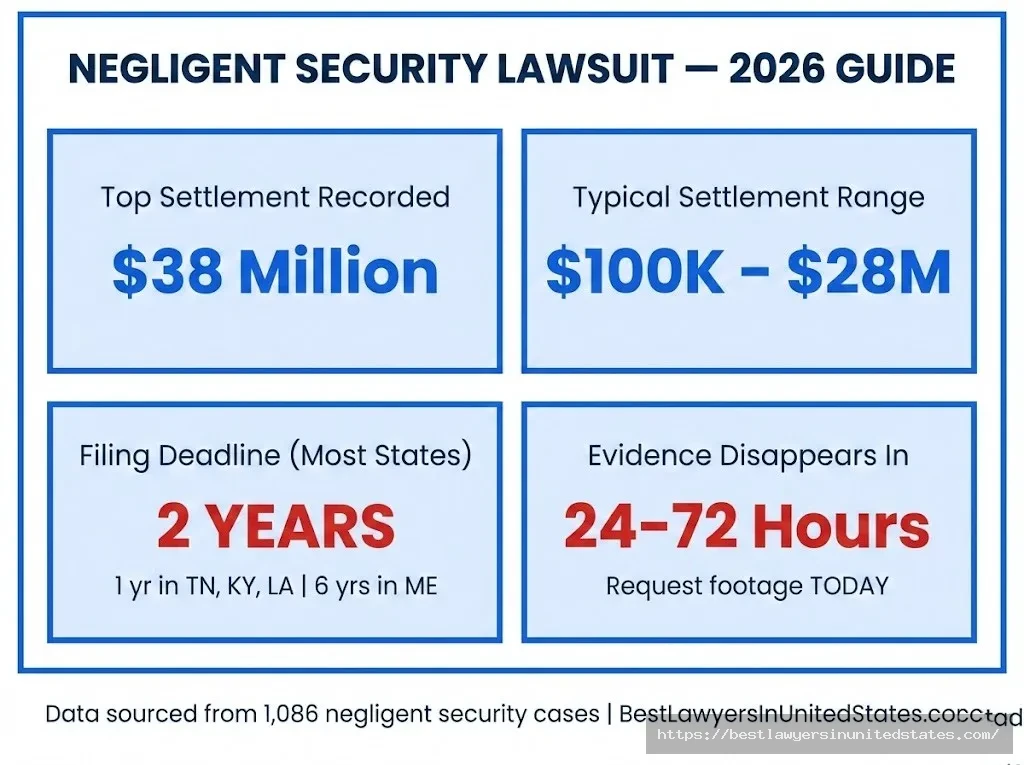
A negligent security lawsuit lets you hold a property owner legally responsible when their failure to provide adequate security led to your assault, robbery, shooting, rape, or other violent crime. These cases fall under premises liability law, and they’re more common — and more successful — than most people realize. Settlement amounts in proven cases have ranged from six figures to over $28 million, depending on the severity of injury and how clearly the property owner dropped the ball.
Quick Answer: If you were harmed on someone else’s property because of inadequate security — broken locks, poor lighting, no cameras, absent guards — you may have a valid negligent security claim. You typically have 1 to 4 years to file depending on your state, and the evidence window closes even faster. Act now.
This guide covers everything: what a negligent security lawsuit is, who qualifies, how much you can realistically expect to receive, how to build and file your case, and the deadlines you absolutely cannot miss.
What Is a Negligent Security Lawsuit?
The Core Legal Theory
A negligent security lawsuit is a civil claim against a property owner or business operator whose failure to maintain reasonable security measures made it possible for someone to harm you. It’s not about punishing the attacker — the criminal justice system handles that. It’s about making the property owner financially responsible because their negligence created the conditions for your injury.
This type of claim falls under premises liability law. Property owners owe legal visitors a duty of care — that means taking reasonable steps to prevent foreseeable harm, including crime. When they ignore a known risk, skip basic safety investments, or fail to fix obvious problems, and you get hurt as a result, they can be held liable.
The key word is foreseeable. Property owners aren’t expected to prevent every crime on earth. But if there’s been a pattern of violence at their parking lot, their building is in a documented high-crime area, or they’ve received complaints about broken security gates and done nothing — then a crime happening there is foreseeable, and they had a duty to act. Crepe Erase Lawsuit
Where These Cases Happen Most
Negligent security cases happen at any property where a business or owner has control over safety conditions:
- Apartment complexes and condominiums
- Hotels and motels
- Bars, nightclubs, and restaurants
- Retail stores, malls, and shopping centers
- Parking lots and parking garages
- Office buildings and warehouses
- Hospitals and healthcare facilities
- Schools and universities
- Gas stations and convenience stores
- ATM locations
What “Inadequate Security” Actually Means
Property owners and juries look at what reasonable security would have required under the circumstances. Common failures include:
- Broken or missing locks on doors and gates
- Non-functional or absent surveillance cameras
- No security guards or untrained guards
- Poor lighting in parking areas, hallways, or stairwells
- Failure to repair a known entry point used by prior intruders
- No intercom or controlled-access system in buildings with prior break-ins
- Ignoring prior crime complaints from tenants or customers
Negligent Security Lawsuit Overview
| Key Factor | Details |
|---|---|
| Legal Category | Premises Liability / Personal Injury |
| Who Can Be Sued | Property owners, landlords, businesses, security contractors |
| Standard of Proof | Preponderance of evidence (more likely than not) |
| Filing Deadline | 1 to 4 years depending on state (see table below) |
| Typical Settlement Range | $100,000 to $5+ million (varies by case) |
| Top Settlement Recorded | $38 million (Nevada verdict) |
| Most Common Crime Types | Assault (42%), sexual assault (26%), wrongful death (15%), robbery (9%) |
| Attorney Fees | Typically contingency — no upfront cost to you |
| Goes to Trial? | Most settle; ~10–15% go to trial |
The Four Elements You Must Prove to Win
To succeed in a negligent security lawsuit, you need to establish four legal elements. Your attorney handles this, but knowing what’s required helps you understand why evidence collection matters so much.
1. Duty of Care
The property owner had a legal obligation to keep you safe. This duty exists for legal visitors — customers, tenants, guests, and people doing business on the property. Trespassers are generally not owed the same duty, though some states still impose a basic duty of care toward them.
2. Breach of That Duty
The owner failed to take reasonable steps to protect against foreseeable crime. This might mean they skipped required security upgrades, ignored prior similar incidents, or fired their security staff to cut costs despite known risks.
3. Causation
The breach — not just the criminal’s actions — contributed to your harm. This is often the most contested part. Defense attorneys will argue the attacker, not the missing security camera, caused your injuries. Your attorney must show the security failure made the crime possible or more likely.
4. Damages
You suffered real, compensable harm — physical injuries, medical costs, emotional trauma, lost income, or death.
Who Qualifies to File a Negligent Security Lawsuit?
Quick Answer: You may qualify if you were a legal visitor (customer, tenant, guest) on someone else’s property, were harmed by a third party’s criminal act, and the property owner’s security failures contributed to that harm. You do NOT need to have caught the attacker or pressed criminal charges.
Eligibility Checklist
| Requirement | Details | Evidence That Helps |
|---|---|---|
| Legal visitor status | You were on the property lawfully — as a tenant, customer, or invited guest | Lease agreement, receipt, reservation, witness statements |
| Third-party criminal act | A person other than the property owner harmed you | Police report, hospital records, witness accounts |
| Foreseeable crime | Prior incidents or area crime statistics made the risk predictable | Police crime records, prior incident reports at property, news coverage |
| Security failure | The property lacked reasonable security measures | Photographs, maintenance records, surveillance footage, security logs |
| Resulting harm | You suffered physical, emotional, or financial injury | Medical records, therapy records, pay stubs showing lost income |
Types of Incidents That Qualify
Based on data from 1,086 analyzed negligent security cases, the distribution of claim types looks like this:
| Crime Type | % of Lawsuits | Common Locations |
|---|---|---|
| Assault and Battery | 42% | Bars, apartments, churches, ATMs |
| Sexual Assault / Rape | 26% | Hotels, parking garages, shopping centers |
| Wrongful Death | 15% | Apartment complexes, gas stations |
| Robbery | 9% | Hotels, retail stores, parking lots |
| False Imprisonment | 4% | Retail stores, hotels |
| Other (arson, carjacking, home invasion) | 4% | Varied |
Who Does NOT Qualify?
You may face challenges or disqualification if:
- You were trespassing on the property at the time of the incident
- The crime was a genuinely random, completely unforeseeable event with no prior similar history at the location
- You were partially or fully responsible for provoking the attack (comparative negligence rules vary by state)
- You waited too long and the statute of limitations in your state has expired
- The property was a government building and you missed a mandatory “notice of claim” deadline (often as short as 60–180 days)
How Much Money Can You Get? Settlement Amounts by Case Type
There’s no fixed payout chart for a negligent security lawsuit — every case is different. But published data from thousands of real cases gives us solid benchmarks.
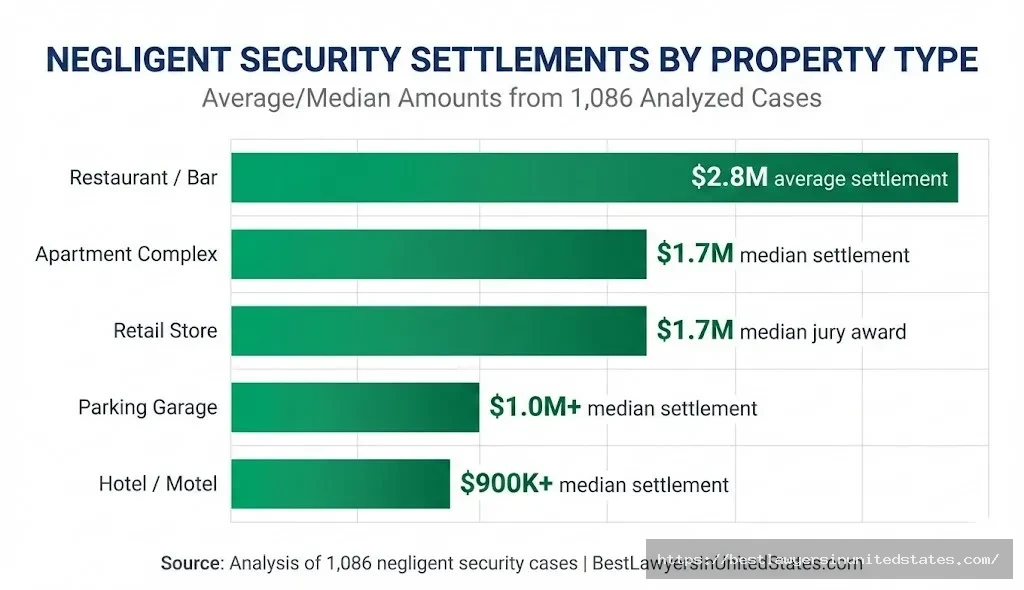
Settlement & Verdict Data by Property Type
| Property Type | Median Jury Award | Average Settlement | Notes |
|---|---|---|---|
| Apartment Complex | $1.5 million | $1.7 million | Highest responsibility for resident safety |
| Retail Store | $1.7 million | $1.2 million | Often robbery-related |
| Restaurant / Bar | $600,000 | $2.8 million | High settlement-to-verdict ratio |
| Hotel / Motel | $900,000+ | Varies widely | Strong duty of care to guests |
| Parking Garage | $1 million+ | $1 million+ | Common location for sexual assault cases |
Real Case Examples (Actual Settlements & Verdicts)
| Case Summary | Amount | Key Factor |
|---|---|---|
| Teen rendered quadriplegic in apartment shooting | $28.9 million | “Wholly inadequate” security despite prior crimes |
| Man paralyzed in apartment shooting | $10 million | History of violence at complex ignored |
| Man kidnapped and assaulted in parking garage | $4.4 million | Owner removed security barrier to cut costs |
| Georgia flea market wrongful death (vendor shot) | $6 million | Known violence, no security response |
| Nightclub shooting | $7 million | Failure to screen patrons or hire adequate staff |
| Nevada jury verdict | $38 million | Landmark case for inadequate property security |
| K-Mart parking lot abduction and rape | $600,000 | Prior similar incident ignored |
What Determines Your Specific Payout
| Factor | How It Affects Compensation |
|---|---|
| Severity of physical injury | Catastrophic injuries (paralysis, brain damage) drive multi-million dollar awards |
| Emotional trauma and PTSD | Documented psychological harm adds significant value |
| Medical expenses | All past and future treatment costs are recoverable |
| Lost income | Lost wages and reduced earning capacity are calculated and included |
| Foreseeability of the crime | Clearer prior warning = stronger case = higher value |
| Degree of negligence | Gross negligence or recklessness can trigger punitive damages |
| Your comparative fault | If you’re found partially responsible, your award may be reduced |
| Having an attorney | Studies show represented victims recover significantly more than those without |
Types of Damages You Can Recover
Economic damages (concrete, calculable losses):
- Medical bills: emergency care, surgery, hospitalization, physical therapy, counseling
- Future medical expenses if ongoing care is needed
- Lost wages during recovery
- Reduced future earning capacity
- Property damaged or stolen during the incident
- Funeral and burial costs in wrongful death cases
Non-economic damages (harder to quantify, but fully recoverable):
- Physical pain and suffering
- Emotional distress and psychological trauma (PTSD, anxiety, depression)
- Loss of enjoyment of life
- Disfigurement or permanent disability
Punitive damages (rare, but awarded in extreme cases): These punish property owners who showed willful disregard or intentional recklessness — for example, a landlord who kept renting units in a building with a broken security door after multiple prior assaults. Not available in every state. Balance of Nature Lawsuit
Filing Deadlines: You Cannot Wait
⚠️ CRITICAL: The statute of limitations is a hard deadline. Miss it, and your case is gone — no matter how strong the evidence is.

Statute of Limitations by State (Personal Injury / Premises Liability)
| State | Deadline | Notes |
|---|---|---|
| California | 2 years | Wrongful death also 2 years |
| Florida | 2 years | Changed from 4 years in 2023 |
| Texas | 2 years | Applies to premises liability |
| New York | 3 years | |
| Georgia | 2 years | |
| Nevada | 2 years | Per NRS § 11.190(4)(e) |
| Illinois | 2 years | |
| Tennessee | 1 year | One of the shortest |
| Kentucky | 1 year | |
| Louisiana | 1 year | |
| Maine | 6 years | One of the longest |
| Most other states | 2–3 years | Always verify with an attorney |
Special Deadlines to Know
| Situation | Deadline Rule |
|---|---|
| Claims against government entities | Notice of claim required in 60–180 days in most states |
| Minor victims | Clock typically pauses until they turn 18 |
| Mental incapacity | May toll (pause) the deadline in some states |
| Discovery rule | Some states start the clock when you discover the harm, not when it happened |
⚠️ SURVEILLANCE FOOTAGE DISAPPEARS IN DAYS. Most security systems overwrite footage within 24–72 hours. Even if you have months left on the statute of limitations, every day you wait could mean losing irreplaceable evidence. Contact an attorney — or at minimum send a written preservation demand to the property — as soon as possible.
How to Build and File Your Negligent Security Case
Step 1: Get Immediate Medical Care
Your health comes first. Get treated right away, even if injuries feel minor — adrenaline masks pain. Medical records documenting your injuries in detail from the day of the incident become foundational evidence.
Step 2: Call the Police and Get a Report
Contact law enforcement immediately. The police report creates an official record of the incident, the location, and initial observations. Ask for the report number and get a copy as soon as it’s available.
Step 3: Preserve Evidence Before It Disappears
Gather or request this evidence immediately:
- Photographs of the scene (broken lights, missing locks, damaged gates, blind spots with no cameras)
- Names and contact information of all witnesses
- Written demand to the property owner to preserve surveillance footage (send via certified mail that day)
- Your own contemporaneous notes about what happened and the conditions you observed
Step 4: Contact a Negligent Security Attorney
Most negligent security attorneys work on contingency — you pay nothing unless you win. A free consultation costs you nothing and could tell you in under an hour whether you have a case worth pursuing. An experienced attorney will:
- Send preservation letters to protect evidence
- Subpoena security logs and maintenance records
- Hire security experts to evaluate what the property should have had
- Investigate the property’s crime history
- Handle all negotiations with the insurance company
Step 5: Investigation and Evidence Gathering
Your legal team will collect:
| Document / Evidence | Why It Matters |
|---|---|
| Police report | Official record of the incident and crime scene |
| Medical records | Documents injury severity and treatment costs |
| Surveillance footage | Proves what security (or lack of it) existed |
| Property maintenance records | Shows if known problems were ignored |
| Prior incident logs | Establishes foreseeability of crime |
| Crime statistics for the area | Supports that crime was predictable |
| Witness statements | Corroborates your account |
| Security expert testimony | Establishes industry standard and how the property fell short |
| Employment records of security staff | May reveal inadequate training or staffing |
Step 6: Demand Letter and Negotiation
Once evidence is gathered and your medical treatment is complete (or your condition is stable), your attorney typically sends a demand letter to the property owner’s insurer. This kicks off settlement negotiations. Most negligent security cases resolve at this stage.
Step 7: File a Lawsuit If Needed
If the insurance company refuses a fair offer, your attorney files a lawsuit. This doesn’t necessarily mean going to trial — many cases settle during discovery or after depositions. Filing signals you’re serious and often accelerates settlement discussions.
Step 8: Trial (If No Settlement Is Reached)
If the case goes to trial, a jury decides liability and damages. Trial cases carry higher risk but also higher potential reward. Your attorney will advise you on whether trial makes strategic sense for your specific situation.
Defenses Property Owners Use — and How to Counter Them
Defense lawyers for property owners and their insurers use predictable arguments. Knowing these in advance helps you and your attorney prepare.
| Defense Argument | How to Counter It |
|---|---|
| “The crime was unforeseeable” | Show prior incidents at the property, crime statistics, and complaints the owner received |
| “We had adequate security” | Security expert testimony demonstrates industry standards the owner failed to meet |
| “The criminal is the only responsible party” | Courts recognize multiple parties can share responsibility; property owner created the conditions |
| “You were partly at fault” | Comparative negligence reduces your award but doesn’t eliminate it in most states |
| “You weren’t a legal visitor” | Receipts, reservations, lease agreements, or witness statements confirm your status |
Negligent Security vs. Similar Legal Claims
Understanding where your case fits helps you and your attorney frame it most effectively.
| Claim Type | Key Difference | Who Can Be Sued |
|---|---|---|
| Negligent Security | Property owner’s failure to prevent foreseeable crime | Property owner, landlord, business |
| General Premises Liability | Broader category (slip and fall, structural hazards) | Property owner |
| Negligent Hiring | Employer hired incompetent or dangerous security staff | Employer, security contractor |
| Negligent Supervision | Existing security staff was poorly monitored | Employer, security contractor |
| Assault / Battery | Direct claim against the attacker | The individual who attacked you |
| Wrongful Death | Fatal outcome version of any of the above | Property owner, attacker’s estate |
High-Profile Negligent Security Case Comparisons
| Case | Settlement / Verdict | Location | Key Failure |
|---|---|---|---|
| Apartment shooting (quadriplegic teen) | $28.9 million | Apartment complex | No guards despite prior shootings |
| Apartment shooting (paralyzed victim) | $10 million | Apartment complex | Prior violent crime history ignored |
| Parking garage kidnapping/assault | $4.4 million | Parking garage | Security barrier removed to save money |
| Flea market vendor shooting (wrongful death) | $6 million | Commercial market | Zero security despite high crime area |
| Nightclub shooting | $7 million | Bar/nightclub | No patron screening, inadequate staff |
| Nevada landmark verdict | $38 million | Not disclosed | Gross negligence, egregious security failures |
Do You Need a Lawyer?
Quick Answer: Yes — and the good news is you don’t pay unless you win.
Why Self-Representation Is a Bad Idea Here
Unlike a simple fender-bender, negligent security cases involve complex evidence, multiple defendants, corporate insurance adjusters, and specialized legal arguments. Insurance companies that represent property owners employ experienced claims teams whose job is to minimize what they pay you.
Studies consistently show unrepresented victims receive substantially lower settlements than those with attorneys. One reason: insurance adjusters know that self-represented claimants are unlikely to take a lowball offer to trial, so they have no incentive to negotiate fairly. Method Body Wash Lawsuit
What Contingency Fees Mean for You
Most negligent security attorneys work on a contingency fee basis — typically 33% of the settlement or 40% if the case goes to trial. You pay nothing upfront and nothing if you lose. Attorney fees only come out of the recovery, after you win.
When to Reach Out
Contact an attorney if:
- You were injured or a loved one was killed on someone else’s property
- The property had a known history of crime or visible security failures
- The incident happened within the last few years (or even longer — check your state)
- You’re being contacted by the property’s insurance company (do not give a recorded statement without legal counsel)
Frequently Asked Questions
What is a negligent security lawsuit?
Quick Answer: It’s a premises liability claim against a property owner whose inadequate security allowed a criminal to harm you.
It’s different from suing the attacker directly. The property owner — an apartment complex, hotel, retailer, bar — can be held liable when they knew or should have known crime was a risk on their property and failed to take reasonable steps to prevent it. The attacker is typically judgment-proof (has no money), but property owners carry liability insurance.
Who qualifies to file a negligent security lawsuit?
Quick Answer: Anyone legally on a property — tenant, customer, guest — who was harmed by a third party’s criminal act due to the property’s inadequate security.
You don’t have to have caught the attacker or pressed criminal charges. You don’t need a conviction. You need to show the property owner’s security failures contributed to your harm.
How much money can I get from a negligent security lawsuit?
Quick Answer: Settlements range widely — from under $100,000 for minor cases to over $28 million in extreme situations. Apartment complexes averaged $1.7 million in settlement data; retail stores averaged $1.2 million.
Your specific amount depends on: the severity of your injuries, whether the crime was clearly foreseeable, the strength of evidence showing the security failure, your lost income and future costs, and the jurisdiction where the case is heard.
What is the deadline to file a negligent security lawsuit?
Quick Answer: 1 to 4 years depending on your state. Most states use a 2-year window starting from the date of the incident.
Missing the statute of limitations permanently bars your claim, even if the evidence is overwhelming. States with 1-year deadlines include Kentucky, Tennessee, and Louisiana. Maine allows 6 years. California, Texas, Nevada, Georgia, and most others give you 2 years. Florida was 4 years but changed to 2 years in 2023.
If the property is government-owned, your deadline may be far shorter — sometimes 60 days to file a formal notice.
Do I need a lawyer to file a negligent security lawsuit?
Quick Answer: You’re not required to have one, but representing yourself against a property owner’s insurance company almost always results in a significantly lower settlement or a dismissed claim.
These cases require security expert witnesses, subpoenaed maintenance records, preservation demands for surveillance footage, and complex legal arguments about foreseeability. An experienced attorney handles all of this on contingency, meaning no cost to you unless you win.
What documents do I need for a negligent security case?
Quick Answer: Start with the police report and your medical records, then build from there.
A complete evidence package includes: police report, medical records and bills, photos of the scene, surveillance footage (request this immediately), witness contact information, any prior complaint records about security at the property, and documentation of your lost wages and ongoing treatment costs.
What if I don’t have any documentation?
Quick Answer: You can still move forward — an attorney can subpoena records you don’t have.
Property owners are required to maintain incident logs, maintenance records, and in many cases surveillance footage. Your attorney can demand these through the legal discovery process. The most important thing is to act quickly so footage isn’t overwritten and physical evidence isn’t repaired or destroyed.
What if surveillance footage was deleted?
Quick Answer: That may actually help your case.
If a property owner deleted footage after being put on notice, courts can draw a negative inference — meaning they can assume the footage showed something unfavorable to the owner. The moment you send a written preservation demand (certified mail, date-stamped), you put them on notice. Your attorney does this immediately after being hired.
When will I receive my settlement payment?
Quick Answer: Most cases settle within 6 months to 2 years; payment typically arrives within 30 to 60 days after a settlement agreement is signed.
More complex cases with multiple defendants or catastrophic injuries can take 2 to 4 years, particularly if they go to trial. Cases involving government defendants often take longer due to formal administrative processes.
How do I receive my settlement payment?
Quick Answer: By check or wire transfer, sent to your attorney’s trust account, who then distributes your portion after deducting fees and any liens.
Your attorney will provide a detailed settlement statement showing gross settlement, attorney fees, any medical liens repaid from proceeds, and your net recovery.
Can I file a negligent security lawsuit if I was also robbed or assaulted at a place I visited regularly?
Quick Answer: Yes. Being a repeat visitor to a property doesn’t reduce your right to sue, and in some cases it strengthens your claim by showing the property owner had even more reason to know of the risk.
Regular customers, long-term tenants, and frequent visitors actually benefit from the property owner’s greater familiarity with crime patterns at that location.
What if the criminal who attacked me was never caught?
Quick Answer: Your civil case against the property owner can proceed regardless of whether the attacker was identified or prosecuted.
Your lawsuit targets the property owner, not the criminal. The legal standard in civil court is “more likely than not” — far easier to meet than the “beyond reasonable doubt” standard in criminal court. An unidentified attacker has no bearing on whether the property’s security failures were responsible.
What if I was partly at fault for the incident?
Quick Answer: In most states, you can still recover — just at a reduced amount reflecting your percentage of responsibility.
Most states follow comparative negligence rules. If a jury finds you were 20% at fault and your damages are $500,000, you’d receive $400,000. A few states still use older contributory negligence rules where any fault can bar recovery — another reason to consult a local attorney.
Can family members sue if a loved one was killed?
Quick Answer: Yes. Wrongful death negligent security lawsuits are filed by surviving family members and can include funeral costs, lost financial support, and loss of companionship.
Wrongful death claims follow the same negligent security legal theory but allow close family members — typically spouse, children, or parents — to seek compensation for their own losses and the decedent’s pain and suffering prior to death.
Will my settlement be taxed?
Quick Answer: In most cases, no — compensatory damages for physical injuries are generally tax-free under IRS rules. Punitive damages are typically taxable.
Tax treatment can depend on the specific breakdown of your settlement. Consult a tax professional when you receive a significant payout, particularly if any portion is designated as lost wages or punitive damages.
What if the property where I was attacked is in a different state than where I live?
Quick Answer: The lawsuit is typically filed in the state where the property is located, regardless of your home state.
Your attorney doesn’t need to be licensed in your home state — they need to be licensed (or admitted pro hac vice) in the state where the incident happened. Many firms handle multi-state cases.
What if the property owner claims they had “reasonable” security?
Quick Answer: That’s for a jury to decide — and your security expert will tell a different story.
Property owners routinely argue their camera, one security guard, or basic lighting was sufficient. Your attorney will hire a certified security expert who will testify about what industry standards required given the location’s crime history, and specifically how the owner fell short.
Can I sue the security company separately from the property owner?
Quick Answer: Yes. If a third-party security firm was contracted to protect the property, they can be named as a co-defendant.
Claims against security companies often involve negligent hiring (they employed guards with criminal records or no training), negligent supervision (guards weren’t monitored or were asleep), or breach of contract with the property owner. These cases can involve multiple defendants, each with their own insurance policy.
What if I received a settlement offer from the property owner’s insurance company already?
Quick Answer: Do not accept it without talking to an attorney first.
Insurance companies often make quick, low offers to victims before they hire lawyers — specifically because they know represented victims recover far more. Accepting any settlement, even cashing a check, typically means signing away your right to pursue further compensation. Get a second opinion before you sign anything.
Where can I find a negligent security attorney?
Quick Answer: Most negligent security attorneys offer free consultations with no obligation. Search for premises liability or negligent security attorneys in the state where the incident occurred.
You can also contact: [email protected] for attorney referrals. Look specifically for attorneys who have handled premises liability or negligent security cases — not general personal injury lawyers — as the security expert network and specific legal arguments differ significantly.
What to Do Right Now — Action Checklist
⚠️ Time and evidence are your two biggest risks. This is what to do today:
- Get or confirm medical care — document every treatment
- Request a copy of the police report — note the report number
- Photograph the scene — lighting, locks, cameras (or lack of them), entry points
- Write down everything — your account of what happened while it’s fresh
- Identify witnesses — names and contact information
- Send a written preservation demand to the property for all surveillance footage (certified mail, same day if possible)
- Do not speak to the property’s insurance company without an attorney
- Do not post about the incident on social media
- Contact a negligent security attorney — free consultations are standard; contingency fees mean no upfront cost
- Act before your state’s deadline — but also before evidence disappears, which can happen in 24–72 hours
This guide provides general legal information only and is not legal advice. Negligent security laws vary by state. Consult a licensed attorney in the state where your incident occurred to understand your rights and deadlines. For attorney referrals, contact [email protected].
