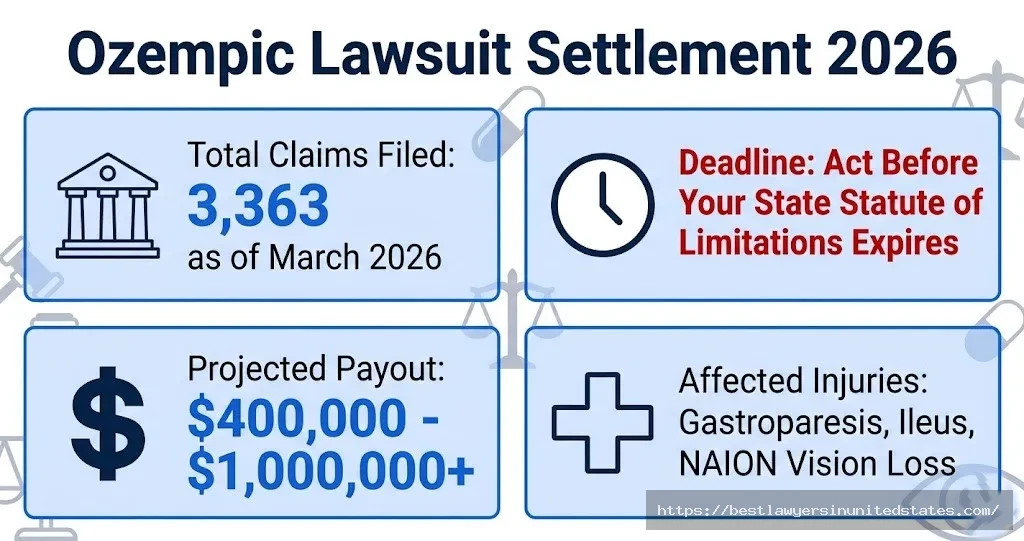
The Ozempic lawsuit is one of the biggest pharmaceutical litigations in the country right now. As of March 2026, more than 3,363 individual cases have been filed against Novo Nordisk, the maker of Ozempic, inside two separate federal multidistrict litigations.
People who suffered gastroparesis (stomach paralysis), intestinal blockage, or sudden vision loss after taking Ozempic may be entitled to significant compensation. Legal experts project individual payouts ranging from $400,000 to over $1 million, depending on injury severity.
No global settlement has been reached yet. Bellwether trials that will shape settlement values are expected in late 2026 and early 2027.
This article explains what the Ozempic lawsuits are about, who qualifies, how much you might recover, and exactly how to file a claim in 2026.
What Is the Ozempic Lawsuit?
The Ozempic lawsuit refers to thousands of individual injury claims filed against Novo Nordisk alleging the diabetes drug caused severe, undisclosed side effects.
Plaintiffs claim that Ozempic caused gastroparesis, bowel obstruction, and permanent vision loss. They further allege that Novo Nordisk failed to warn patients and doctors about these serious risks.
The first major case was filed in August 2023 by Jaclyn Bjorklund in Louisiana federal court, Case No. 2:23-cv-01020-JDC-KK. DOGE Transparency FOIA Lawsuit
| Key Detail | Information |
|---|---|
| Drug at Issue | Ozempic (semaglutide) |
| Manufacturer | Novo Nordisk |
| Main Allegations | Failure to warn, negligence, product liability |
| First Case Filed | August 2023 |
| Total Claims (March 2026) | 3,363 filed |
| Status | Active; no global settlement reached |
The lawsuits cover more than just Ozempic. Claims related to Wegovy, Rybelsus, Mounjaro, and Trulicity are part of the same legal action because all belong to the same drug class.
Class Action Lawsuit Ozempic: MDL vs. True Class Action
People searching for a “class action lawsuit against Ozempic” should understand a key distinction. Technically, there is no traditional class action lawsuit against Ozempic.
What exists instead is a Multidistrict Litigation (MDL). An MDL consolidates thousands of individual cases before one judge for pretrial efficiency. Each plaintiff still has their own separate case, their own attorney, and their own individual recovery.
In a true class action, all plaintiffs share one award. In the Ozempic MDL, your payout is based entirely on your specific injuries.
| Feature | Class Action | Ozempic MDL |
|---|---|---|
| Individual attorney | No | Yes |
| Separate case | No | Yes |
| Individual payout | Shared pool | Based on your injuries |
| How cases are handled | One trial | Individual bellwethers |
The reason people call it a “class action” is simply because that’s the familiar term. The MDL structure actually gives individual plaintiffs more control over their cases.
Lawsuit Against Ozempic: Who Is Being Sued and Why?
The primary defendant in the Ozempic lawsuit is Novo Nordisk, the Danish pharmaceutical company that manufactures Ozempic, Wegovy, and Rybelsus.
Eli Lilly, maker of Mounjaro and Trulicity, is also named as a defendant in related GLP-1 drug claims. Both companies are accused of knowing about serious side effect risks while aggressively marketing the drugs as safe.
Key legal claims against Novo Nordisk include:
- Failure to warn patients and doctors about gastroparesis and vision loss risks
- Negligent marketing, including off-label promotion for weight loss without adequate risk disclosure
- Product liability for defective pharmaceutical design
- Breach of warranty for misrepresenting the drug’s safety profile
In January 2025, the FDA updated Ozempic’s label to state the drug is “not recommended” in patients with severe gastroparesis. Plaintiffs argue this update confirms what Novo Nordisk allegedly knew years earlier.
Key Takeaway: Novo Nordisk and Eli Lilly are the primary defendants. Claims center on failure to warn and negligent marketing, not just the drug’s side effects themselves.
Ozempic Lawsuit Payout 2026: How Much Can You Get?
Ozempic lawsuit settlement amounts are projected between $400,000 and $700,000 for severe gastroparesis cases, with NAION vision loss claims potentially exceeding $1 million.
No actual payouts have been distributed yet. These are projections from legal analysts based on injury severity, comparable pharmaceutical litigations, and the cost of treatment.
Factors that will determine your individual payout include:
- Severity of injury: Was it temporary or permanent?
- Hospitalization: The average gastroparesis hospital stay costs $34,585
- Surgical intervention: Gallbladder removal significantly increases claim value
- Lost wages: Income lost during illness and recovery
- Whether you were using Ozempic on-label (for diabetes) or off-label (for weight loss)
| Injury Type | Projected Settlement Range |
|---|---|
| Mild gastroparesis, no surgery | $50,000 – $150,000 |
| Severe gastroparesis with hospitalization | $400,000 – $700,000 |
| Gastroparesis requiring gallbladder removal | $500,000 – $800,000 |
| NAION with partial vision loss | $500,000 – $1,000,000 |
| NAION with permanent blindness | $1,000,000+ |
These figures are legal projections, not guarantees. Actual values will depend on bellwether trial outcomes in late 2026.
Ozempic Lawsuit Who Qualifies: Eligibility Requirements
You may qualify for the Ozempic lawsuit if you took Ozempic or a related GLP-1 drug and then developed a serious, diagnosed medical condition.
The most common qualifying injuries are gastroparesis (stomach paralysis), ileus (bowel stoppage), intestinal obstruction, and NAION (a form of sudden vision loss).
Gastroparesis Eligibility Checklist:
- Took Ozempic, Wegovy, Rybelsus, Mounjaro, or Trulicity
- Developed persistent vomiting lasting 4 weeks or more
- Received a formal gastroparesis diagnosis from a doctor
- Required hospitalization or surgical treatment
NAION Vision Loss Eligibility Checklist:
- Took a GLP-1 drug including Ozempic or Wegovy
- Developed sudden, partial, or full vision loss in one or both eyes
- Received a clinical diagnosis of non-arteritic anterior ischemic optic neuropathy (NAION)
| Claim Type | Drug Used | Required Diagnosis | Additional Factor |
|---|---|---|---|
| Gastroparesis | Ozempic, Wegovy, Rybelsus, Mounjaro | Gastric emptying study confirmed | Hospitalization or surgery helps |
| NAION | Ozempic, Wegovy, Rybelsus | Eye doctor/neurologist confirmed NAION | Diabetics face 4x higher risk |
If you’re unsure whether your condition qualifies, the time to find out is now. Statute of limitations deadlines vary by state.
Ozempic Gastroparesis Lawsuit: What You Need to Know
Gastroparesis is the most common injury driving the Ozempic lawsuits. It means the stomach stops emptying properly, causing chronic nausea, severe vomiting, and dangerous weight loss.
Ozempic works by slowing gastric emptying. That mechanism is by design. But plaintiffs argue the drug caused permanent or extreme gastroparesis that was never adequately disclosed.
The drug’s label was updated in January 2025 to note the drug is “not recommended” for patients with severe gastroparesis. Lawyers argue this update came years too late for thousands of patients.
Symptoms that may support a gastroparesis claim include:
- Persistent vomiting and nausea lasting weeks or months
- Severe unintentional weight loss
- Inability to keep food down
- Hospitalization for dehydration or malnutrition
- Ileus (intestines stop moving) or intestinal obstruction
Think of the stomach like a drain. Ozempic was designed to slow the drain slightly to create fullness. The lawsuits allege that in some patients, it didn’t just slow the drain. It blocked it completely.
Key Takeaway: Gastroparesis is the injury at the center of MDL 3094. The January 2025 label update may actually strengthen plaintiffs’ failure-to-warn claims by confirming the risk. Blake Lively Lawsuit Against Justin Baldoni
Ozempic Vision Loss Lawsuit: The NAION Claims Explained
The Ozempic vision loss lawsuit involves a serious eye condition called non-arteritic anterior ischemic optic neuropathy, or NAION. This condition causes sudden, irreversible vision loss with no warning.
NAION occurs when blood flow to the optic nerve is interrupted. Patients can wake up one morning with partial or total blindness in one eye.
A February 2026 filing, Stottlemire v. Novo Nordisk Inc. (Case No. 2:26-cv-00671), specifically targets Novo Nordisk for failure to warn about NAION risk.
Key NAION lawsuit facts:
- Diabetics taking GLP-1 drugs face a 4-fold increased risk of NAION compared to non-users
- The condition affects approximately 1 in 10,000 GLP-1 drug users
- Vision loss from NAION is typically permanent and cannot be reversed with treatment
- NAION cases are consolidated in MDL 3163 in the Eastern District of Pennsylvania
If you experienced sudden vision loss or blurred vision while on Ozempic, Wegovy, or another GLP-1 drug, NAION may be the cause. These claims are handled in a separate MDL from the gastroparesis cases.
Ozempic MDL Lawsuit: How the Two MDLs Work
There are now two active Ozempic MDLs in federal court, and understanding the difference matters for your case.
MDL 3094 covers gastrointestinal injuries including gastroparesis, ileus, and intestinal obstruction. It is pending before Judge Karen Spencer Marston in the Eastern District of Pennsylvania. As of March 2026, this MDL contains 3,363 pending claims.
MDL 3163 was created specifically for NAION vision loss lawsuits. It is also before Judge Marston in the Eastern District of Pennsylvania. On February 23, 2026, Judge Marston entered a case management order establishing the plaintiffs’ executive committee for MDL 3163.
| MDL | Injury Type | Judge | Court | Status |
|---|---|---|---|---|
| MDL 3094 | Gastroparesis, ileus, bowel obstruction | Judge Karen Spencer Marston | E.D. Pennsylvania | 3,363 cases active |
| MDL 3163 | NAION vision loss | Judge Karen Spencer Marston | E.D. Pennsylvania | Early organization stage |
Both MDLs are in pretrial phases. Neither has reached a verdict or settlement as of March 2026. Bellwether trial dates are expected in late 2026 or early 2027.
Key Takeaway: Two separate MDLs are active. MDL 3094 handles stomach injuries. MDL 3163 handles vision loss. Filing in the right one matters for how your case is processed.
Class Action Lawsuit Against Ozempic: How MDL Structure Helps Plaintiffs
The MDL structure gives Ozempic plaintiffs a real advantage even without a traditional class action. Consolidated pretrial proceedings mean your case benefits from shared expert witnesses, pooled discovery, and coordinated legal strategy.
In practical terms, this cuts costs and accelerates timelines. Instead of each plaintiff hiring separate medical experts for hundreds of thousands of dollars, all plaintiffs in the MDL share that expense.
The MDL also creates negotiation pressure on Novo Nordisk. With 3,363+ cases in one court, the company faces far greater financial exposure than it would from scattered individual suits.
Benefits of the MDL structure for plaintiffs:
- Shared discovery lowers individual litigation costs
- Coordinated expert testimony on drug dangers
- Bellwether trials signal what juries think about the claims
- Pressure on Novo Nordisk to negotiate global settlements
State-level litigation is also growing. New Jersey courts are coordinating NAION claims against Novo Nordisk in what is called multicounty litigation (MCL), mirroring the federal MDL structure.
Ozempic Settlement Amount: Projections and Comparisons
No Ozempic settlement amounts have been officially confirmed as of March 2026. The litigation is still in its pretrial phase. But legal analysts have made specific projections based on comparable drug injury cases.
Legal experts estimate:
- Gastroparesis cases (no surgery): $50,000 to $150,000
- Severe gastroparesis (hospitalization, gallbladder removal): $400,000 to $700,000
- NAION cases (partial vision loss): $500,000 to $1,000,000
- NAION cases (permanent blindness): $1,000,000+
For comparison, the Vioxx MDL (a similar pharmaceutical mass tort against Merck) settled for $4.85 billion across 47,000 claimants. The average per-plaintiff payout was roughly $103,000, though severe injury claimants received far more.
The Ozempic litigation involves fewer but generally more severe injuries. That suggests individual payout values may trend higher than Vioxx on a per-case basis.
Attorney fees in these cases typically run 33 to 40 percent of the settlement. Attorneys work on contingency, meaning you pay nothing upfront.
Ozempic Lawsuit Eligibility: A Complete Breakdown
Ozempic lawsuit eligibility depends on three factors: which drug you took, what injury you developed, and whether you can document it medically.
You do not need to have taken Ozempic specifically. All GLP-1 receptor agonist drugs are covered, including Wegovy, Rybelsus, Mounjaro, and Trulicity.
You are likely eligible if:
- You took any GLP-1 drug after 2017 (when semaglutide was first approved)
- You developed a documented case of gastroparesis requiring hospitalization
- You experienced ileus or bowel obstruction linked to your GLP-1 use
- You were diagnosed with NAION during or after your GLP-1 treatment period
- Your doctor connected your injury to Ozempic or a related drug
You may face challenges if:
- You have pre-existing gastroparesis or a pre-existing eye condition
- You cannot produce medical records documenting the injury
- A significant amount of time has passed since your injury (statute of limitations risk)
| Qualifying Drug | Manufacturer | Covered Injury |
|---|---|---|
| Ozempic | Novo Nordisk | Gastroparesis, NAION |
| Wegovy | Novo Nordisk | Gastroparesis, NAION |
| Rybelsus | Novo Nordisk | Gastroparesis, NAION |
| Mounjaro | Eli Lilly | Gastroparesis |
| Trulicity | Eli Lilly | Gastroparesis |
Key Takeaway: You don’t have to have taken Ozempic specifically. Any GLP-1 drug user who developed documented gastroparesis or NAION vision loss may qualify.
Ozempic NAION Lawsuit: The Emerging Vision Loss Wave
NAION lawsuits against Novo Nordisk are accelerating fast in early 2026. These cases are separate from the gastroparesis litigation and are quickly growing in number.
NAION stands for non-arteritic anterior ischemic optic neuropathy. It is a condition where a portion of the optic nerve loses its blood supply suddenly, causing irreversible vision loss.
A 2024 study published in a peer-reviewed journal found that GLP-1 drug users had a significantly elevated risk of developing NAION compared to non-users. Novo Nordisk’s warning labels did not disclose this risk until very recently.
The Stottlemire case (filed February 3, 2026) is among the earliest class-style actions specifically targeting Ozempic’s failure to warn about NAION. The New Jersey Supreme Court is also allowing NAION cases to be grouped together in Novo Nordisk’s home state.
Key facts about NAION lawsuits:
- NAION vision loss is typically permanent and progresses without reversal
- Diabetics using GLP-1 drugs face 4 times the normal risk
- Estimated prevalence: 1 in 10,000 GLP-1 drug users
- Claims are centralized in MDL 3163 in the Eastern District of Pennsylvania
If you’ve lost vision in one or both eyes while on a GLP-1 drug, your claim belongs in MDL 3163, not MDL 3094.
How to File an Ozempic Lawsuit in 2026
Filing an Ozempic lawsuit in 2026 involves specific steps that your attorney handles, but knowing the process helps you prepare.
Step one is gathering your medical records. You need documentation proving you took an Ozempic or GLP-1 drug and that you received a formal diagnosis of gastroparesis, ileus, bowel obstruction, or NAION.
Step two is contacting an attorney who handles pharmaceutical mass tort cases. Most Ozempic attorneys work on contingency, meaning no upfront cost.
Step three is filing your individual complaint, which your attorney drafts. Once filed, your case will likely be transferred to the MDL in the Eastern District of Pennsylvania. Shannon Sharpe Lawsuit
What to collect before contacting an attorney:
- Prescriptions or pharmacy records showing you took a GLP-1 drug
- Medical records diagnosing gastroparesis, ileus, bowel obstruction, or NAION
- Hospital admission records and discharge summaries
- Records of any surgeries or specialist consultations
- Employment records if you lost income due to your illness
The discovery phase follows filing. Both sides exchange evidence. Then cases proceed toward bellwether trials or settlement negotiations.
Act quickly. Each state has its own statute of limitations for personal injury and product liability claims. Waiting too long can permanently disqualify your case.
Ozempic Lawsuit Update 2026: The Latest Developments
The Ozempic litigation moved significantly in early 2026. Here is what happened in the first quarter.
On February 3, 2026, plaintiff Robert J. Stottlemire filed a new NAION class action in Pennsylvania federal court (Case No. 2:26-cv-00671), alleging Novo Nordisk failed to warn about vision loss risks.
On February 23, 2026, Judge Karen Spencer Marston issued a case management order formally establishing the plaintiffs’ executive committee for MDL 3163, the NAION MDL. This is a sign the NAION litigation is shifting from organization to active litigation.
As of March 2026, MDL 3094 holds 3,363 pending cases. None have gone to trial yet. Bellwether trials are targeted for late 2026 to early 2027.
2026 Timeline at a Glance:
| Date | Development |
|---|---|
| January 2025 | FDA updates Ozempic label to restrict use in severe gastroparesis patients |
| February 3, 2026 | Stottlemire NAION class action filed in E.D. Pennsylvania |
| February 23, 2026 | Judge Marston issues case management order for NAION MDL 3163 |
| March 2026 | 3,363 total cases active in MDL 3094 |
| Late 2026 (targeted) | Bellwether trials expected to begin |
Reuters named GLP-1 drug litigation one of the top mass torts to watch in 2026. With use of these drugs still expanding, new cases are being filed every month.
Key Takeaway: Early 2026 brought significant organizational movement in both MDLs. The window to file is open now. Bellwether trials in late 2026 will set the tone for all future settlements.
Ozempic Failure to Warn Lawsuit: The Core Legal Theory
The failure-to-warn claim is the backbone of every Ozempic lawsuit. It is not enough for a drug to have dangerous side effects. Manufacturers must tell patients and doctors about those risks clearly and in time.
Plaintiffs argue that Novo Nordisk knew about the serious risks of gastroparesis and NAION but chose not to update its warning labels for years. They cite internal company research, published studies, and FDA communications as evidence.
The FDA’s addition of ileus warnings in September 2023 and the gastroparesis label update in January 2025 are being used by plaintiffs’ attorneys as admissions that these risks were real and known.
Core failure-to-warn allegations include:
- Novo Nordisk delayed adding gastroparesis warnings despite internal safety data
- The company aggressively marketed Ozempic and Wegovy for weight loss to patients without adequate risk education
- Prescribing physicians were not given sufficient safety information to make informed prescribing decisions
- Warning language, even after updates, still does not acknowledge that Ozempic may cause these conditions
Under U.S. product liability law, drug manufacturers have a duty to warn both prescribers and patients. A failure to do so, even if the drug itself was approved, can constitute legal negligence.
Lawsuit for Ozempic: What Damages Can You Recover?
Filing a lawsuit for Ozempic means seeking compensation for the real financial, physical, and emotional toll of your injury. Courts recognize several distinct categories of recoverable damages.
Economic damages are the most straightforward. They cover actual financial losses:
- Medical bills, including hospital stays averaging $34,585 per admission
- Future medical costs for ongoing treatment or complications
- Lost wages during recovery
- Costs of long-term disability or reduced earning capacity
Non-economic damages cover the human cost:
- Pain and suffering
- Emotional distress
- Loss of enjoyment of life
- Loss of companionship (for severe cases)
Punitive damages are a third category. Courts may award these when a company’s conduct was reckless or intentional. If plaintiffs can show Novo Nordisk knew about the risks and hid them deliberately, punitive damages could significantly increase the total payout.
| Damage Type | What It Covers |
|---|---|
| Medical expenses | Hospital stays, surgeries, ongoing treatment |
| Lost income | Wages lost due to illness and recovery |
| Future medical costs | Long-term care and complications |
| Pain and suffering | Physical pain, emotional trauma |
| Punitive damages | Punishment for corporate misconduct |
Most attorneys handling these cases take a contingency fee of 33 to 40 percent. You pay only if and when you win.
Frequently Asked Questions
Is there an Ozempic class action lawsuit in 2026?
Technically, no. The Ozempic lawsuits are organized as a Multidistrict Litigation (MDL), not a traditional class action. An MDL means each plaintiff has their own individual case and individual payout, rather than sharing a single award. As of March 2026, there are two active MDLs: MDL 3094 for GI injuries and MDL 3163 for NAION vision loss.
How much can I get from an Ozempic lawsuit settlement?
Legal experts project Ozempic settlements ranging from $400,000 to $700,000 for severe gastroparesis cases. NAION vision loss cases involving permanent blindness may exceed $1 million. No settlements have been officially confirmed yet; bellwether trials expected in late 2026 will establish actual values.
Who qualifies to file an Ozempic lawsuit?
You may qualify if you took Ozempic, Wegovy, Rybelsus, Mounjaro, or another GLP-1 drug and developed gastroparesis, ileus, bowel obstruction, or NAION vision loss. Medical documentation of your diagnosis is required, including prescriptions, hospital records, and specialist reports. Patients prescribed the drug both for diabetes and off-label for weight loss may qualify.
How do I file a lawsuit against Ozempic’s manufacturer?
Start by collecting your medical records and prescription history, then contact a pharmaceutical mass tort attorney. Your attorney will draft and file your complaint; your case will likely be transferred to MDL 3094 or MDL 3163 in the Eastern District of Pennsylvania. Most attorneys work on contingency, meaning there are no upfront fees to file.
What is the current status of the Ozempic MDL in 2026?
As of March 2026, MDL 3094 has 3,363 pending cases before Judge Karen Spencer Marston in the Eastern District of Pennsylvania. No global settlement has been reached and no cases have gone to trial. Bellwether trials, which will signal the value of all other cases, are expected in late 2026 or early 2027.
You Have Options. Use Them Now.
The Ozempic lawsuit is one of the most active pharmaceutical litigations in the country. Thousands of people who trusted this drug have filed claims. Many more still qualify but haven’t acted yet.
If you developed gastroparesis, bowel complications, or vision loss while taking Ozempic or any GLP-1 drug, your window to file is open right now.
Get your medical records. Contact an attorney who handles pharmaceutical mass torts. With bellwether trials targeting late 2026, this litigation is moving. The earlier you file, the stronger your position