
The DOGE transparency FOIA lawsuit is one of the most watched government accountability fights in recent U.S. history. Multiple watchdog groups are suing the Department of Government Efficiency to force it to release internal records under the Freedom of Information Act. As of early 2026, the case is still live and could define how much secrecy any future presidential entity can legally maintain.
This is not a class action with a payout. There is no settlement to claim. But the outcome affects every American who has a stake in knowing how billions of dollars in federal spending were cut, which agencies were gutted, and who made those calls behind closed doors.
The courts have already ruled, more than once, that DOGE is likely subject to FOIA. The Trump administration keeps appealing. Here is everything you need to know about where things stand right now.
What Is the DOGE Transparency FOIA Lawsuit About?
The DOGE transparency FOIA lawsuit refers to a group of legal challenges that seek access to records held by the Department of Government Efficiency. These lawsuits argue that the public has a legal right to know how DOGE operates, who works there, and what decisions it has made.
DOGE, formally called the U.S. DOGE Service (USDS), was established by President Trump after he returned to office. DOGE was tasked with overseeing efforts to dismantle government bureaucracy, slash excess regulations, cut wasteful expenditures, and restructure federal agencies.
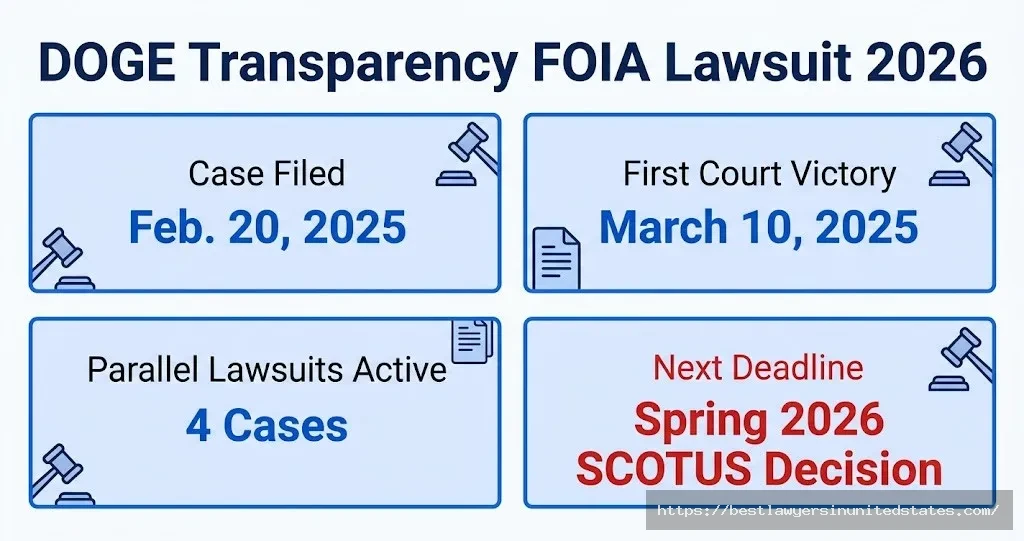
The problem is that DOGE did much of this work in secret. A cadre of largely unidentified actors in the so-called Department of Government Efficiency are controlling major government functions with no oversight or meaningful transparency into its operations.
Several nonprofit watchdog organizations filed formal FOIA requests. When DOGE refused to respond, those groups went to federal court. Blake Lively Lawsuit Against Justin Baldoni
| Case Name | Plaintiff | Filing Date | Court |
|---|---|---|---|
| CREW v. U.S. DOGE Service | Citizens for Responsibility and Ethics in Washington | Feb. 20, 2025 | U.S. District Court, D.C. |
| American Oversight v. U.S. Dept. of Gov’t Efficiency | American Oversight | Feb. 11, 2025 | U.S. District Court, D.C. |
| Center for Biological Diversity v. OMB | Center for Biological Diversity | Feb. 27, 2025 | U.S. District Court, D.C. |
| Burleigh & Frequency Forward v. FCC | Nina Burleigh, Frequency Forward | Feb. 2025 | U.S. District Court, D.C. |
Is DOGE Subject to FOIA?
This is the central legal question that every court is wrestling with. FOIA applies to federal agencies. It does not apply to purely advisory bodies within the Executive Office of the President.
Although Musk has repeatedly said in social media posts and statements to press that DOGE is “maximally transparent,” the White House moved the cost-cutting agency from the Office of Management and Budget and placed it under the umbrella of the Executive Office of the President, which is largely exempt from FOIA requests.
The government’s argument is simple: DOGE just advises the president. Advisory offices don’t have to comply with FOIA. Think of it like a doctor who recommends a treatment but doesn’t actually write the prescription. The doctor’s private notes aren’t public record.
The watchdog groups say that argument is wrong. DOGE didn’t just advise anyone. It fired federal employees, terminated contracts, and shut down agencies. That’s not advisory. That’s operational.
- DOGE reportedly directed the dismantling of the U.S. Agency for International Development
- DOGE personnel accessed sensitive data at the Social Security Administration and other agencies
- DOGE officials allegedly used encrypted and ephemeral messaging platforms like Signal and Slack, potentially in violation of federal record-keeping laws
Key Question: Does an entity that fires people and cancels contracts get to call itself merely advisory? Courts so far say: probably not.
CREW v. U.S. DOGE Service: Case Overview
CREW sued to require compliance with key records laws and asked that requested United States DOGE Service records be released no later than March 10, 2025. Federal law requires that the U.S. DOGE Service disclose its records under the Freedom of Information Act and preserve its records under the Federal Records Act.
CREW alleged that defendants wrongfully withheld records relating to DOGE and its activities in violation of FOIA and failed to meet obligations under the Federal Records Act.
The case was initially assigned to Judge Beryl A. Howell and later reassigned to Judge Christopher R. Cooper. CREW’s requests included communications from acting DOGE administrator Amy Gleason, a full employee list, and records of contracts recommended for cancellation.
| Detail | Info |
|---|---|
| Case Number | 1:25-cv-00511 (D.D.C.) |
| Filing Date | February 20, 2025 |
| Lead Plaintiff | Citizens for Responsibility and Ethics in Washington (CREW) |
| Primary Defendant | U.S. DOGE Service (USDS) |
| Other Defendants | OMB, National Archives, Russell Vought, Acting Archivist |
| Presiding Judge | U.S. District Judge Christopher R. Cooper |
Key Takeaway: CREW’s lawsuit, filed February 20, 2025, is the most closely followed DOGE transparency case and reached the U.S. Supreme Court twice within six months.
American Oversight’s DOGE FOIA Lawsuit
American Oversight filed its lawsuit nine days before CREW, making it the first formal FOIA legal challenge against DOGE. On February 11, 2025, American Oversight, a nonprofit organization committed to promoting transparency in government, filed a lawsuit against DOGE, OMB, and related entities challenging their failure to respond promptly to two FOIA requests.
Those two initial requests were tied to the sudden removal of 17 agency inspectors general. American Oversight submitted FOIA requests dated January 30, 2025 to the U.S. DOGE Service and OMB: one seeking internal communications related to the removal of inspectors general from 17 federal agencies, and another requesting records of communications between DOGE officials and members of Congress regarding those firings.
When OMB acknowledged the requests but failed to respond within the legal timeframe, American Oversight went to court. Through its complaint, American Oversight sought a court order compelling the defendants to expedite processing, a declaratory judgment affirming that the requested records must be disclosed, and injunctive relief to ensure FOIA compliance.
The American Oversight case later expanded. In April 2025, American Oversight filed another lawsuit against DOGE and several Trump administration officials to uncover the truth about DOGE’s influence over federal decision-making and ensure that government operations are subject to public scrutiny.
DOGE’s Agency Status Under Federal Law
The legal fight boils down to a single definition. Under 5 U.S.C. § 552(f)(1), FOIA applies to any federal “agency.” The law does not apply to units within the Executive Office of the President whose only job is to advise and assist the president.
DOGE is arguing courts may only rely on executive orders that establish part of the Executive Office of the President to determine whether DOGE is subject to FOIA. CLC’s brief argues that the history of FOIA does not require courts to simply accept the government’s assessment of what is or is not an agency for purposes of FOIA.
The counter-argument cuts to the heart of the matter. You can’t let the government decide for itself whether transparency laws apply to it. That would be like letting a company write its own audit.
Accepting the government’s interpretation would allow and incentivize presidents to create more entities similar to DOGE that can operate within a black box and avoid transparency laws.
Courts look at what an entity actually does, not just what it calls itself. And DOGE’s actions spoke louder than any label:
- Terminated federal employees across multiple agencies
- Canceled government contracts at massive scale
- Gained direct access to agency IT systems and databases
- Issued directives to agency heads about personnel and spending
Presidential Records Act vs. FOIA: The DOGE Argument
The Trump administration offered a secondary defense. Even if some DOGE records exist, those records might fall under the Presidential Records Act (PRA) rather than FOIA. The PRA governs records from the White House and restricts public access during and after a presidency. Trump officials argued that records from the government efficiency initiative fall under the Presidential Records Act, which can temporarily shield information from public scrutiny.
This matters because the two laws operate very differently.
| Law | Who It Covers | Public Access | Timing |
|---|---|---|---|
| FOIA (5 U.S.C. § 552) | Federal agencies | Immediate upon valid request | Any time during operations |
| Presidential Records Act (44 U.S.C. § 2201) | President’s office and advisors | Restricted; up to 12 years after presidency | After president leaves office |
| Federal Records Act (44 U.S.C. § 3101) | All federal agencies | Must be preserved; subject to FOIA | During and after operations |
The watchdog groups argue the PRA defense doesn’t work here. DOGE was not purely advising the president. It was making operational decisions that affected millions of Americans. Operational records belong under FOIA, not the PRA.
Key Takeaway: The PRA vs. FOIA battle is the administration’s most powerful legal shield, and courts have largely rejected it as a complete defense for DOGE’s operational records.
Judge Christopher Cooper’s March 2025 Ruling
U.S. District Judge Christopher Cooper found that DOGE is likely subject to FOIA and said that the task force’s actions demonstrate that it has “substantial authority over vast swathes of the federal government.”
Judge Cooper’s March 10, 2025 ruling was the first major judicial win for transparency advocates. The court concluded that USDS’s records would likely be covered by FOIA and that the public would be irreparably harmed by an indefinite delay in disclosure.
Cooper’s logic was direct. He pointed to three things DOGE had reportedly done that no purely advisory body could do: identify and terminate federal employees, dismantle federal programs, and cancel federal contracts. The Court determined that USDS likely operates as an agency subject to FOIA, pointing to its work to slash federal jobs, dismantle the U.S. Agency for International Development, and cull contracts.
The ruling ordered DOGE to begin expedited processing of CREW’s FOIA requests and to preserve all records pending the outcome of the case. On March 20, 2025, Judge Cooper denied DOGE’s motion to reconsider and kept the order in place.
| Ruling Date | Action | Outcome |
|---|---|---|
| March 10, 2025 | Preliminary injunction | DOGE likely subject to FOIA; expedited processing ordered |
| March 20, 2025 | Motion to reconsider denied | Original order upheld |
| April 15, 2025 | Expedited discovery granted | Depositions of Amy Gleason and others ordered |
DOGE FOIA Discovery Order and Supreme Court Involvement
The battle moved up the chain fast. After Judge Cooper granted CREW’s motion for expedited discovery on April 15, 2025, DOGE pushed back hard. Discovery would have forced DOGE to hand over internal documents, employee lists, and allow a deposition of acting administrator Amy Gleason.
The Trump administration had asked the justices to temporarily halt a district court’s order that allowed CREW to gather certain information from DOGE as part of its effort to determine whether the task force is an advisory panel that is outside FOIA’s scope or is an agency that is subject to the records law.
On May 23, 2025, in a brief order from Chief Justice John Roberts, the high court stayed the discovery process in the public records lawsuit against DOGE pending another order by the court.
Then on June 6, 2025, the full Supreme Court weighed in. The Supreme Court granted the government’s request to stay the portions of the discovery order that would have required the government to disclose internal recommendations and whether those recommendations were followed, stating that the order was overly broad and instructing the D.C. Circuit to narrow the order accordingly.
Three justices dissented: Sonia Sotomayor, Elena Kagan, and Ketanji Brown Jackson.
Key Takeaway: The Supreme Court’s June 2025 intervention did not declare DOGE exempt from FOIA. It only narrowed the scope of one discovery order, leaving the core legal question unresolved heading into 2026. Shannon Sharpe Lawsuit
What Documents Has DOGE Refused to Release?
This is the question most Americans actually want answered. What exactly is DOGE hiding?
Based on court filings and FOIA requests submitted by watchdog groups, the records being withheld or disputed include:
- A complete list of current and former DOGE employees and their roles
- Internal recommendations DOGE made to federal agencies about contract cancellations
- Communications between Amy Gleason and DOGE staff
- Records of which termination recommendations agencies actually followed
- Text messages and communications on Signal, WhatsApp, iMessage, and Slack
- Records of DOGE’s access to agency IT systems and sensitive databases
The FCC made no determination about DOGE’s status but issued DOGE representatives official email addresses, listed them in its public staff directory, and gave them access to personnel and broadband data. The FCC’s document production in the FOIA case, plaintiffs argue, reflects an agency working to contain what that access revealed.
The use of encrypted and disappearing messaging is particularly alarming to records advocates. DOGE reportedly moved employees off Slack and onto systems not subject to FOIA before the legal battles escalated. If those messages were not preserved, they may be gone permanently, regardless of how courts rule.
DOGE FCC FOIA Lawsuit 2026
While the main CREW case attracted most headlines, a separate and revealing FOIA fight broke out at the Federal Communications Commission. Plaintiffs Nina Burleigh and Frequency Forward filed a Freedom of Information Act request with the FCC in February 2025, seeking records of DOGE’s activities inside the Commission and communications between agency leadership and Elon Musk, SpaceX, and Starlink. After a year of incomplete production, they filed suit in U.S. District Court for the District of Columbia and are now seeking court-ordered discovery.
The FCC case revealed details that went beyond general transparency concerns. Court filings showed that external DOGE representatives were operating inside the FCC before their ethics clearances were finalized, and that at least one held financial interests in a Musk-controlled company.
Specifically, DOGE representative Tarak Makecha arrived at the FCC on or around March 17, 2025, and on the day he arrived, he signed a financial disclosure form acknowledging he held stock in Musk’s Tesla. The FCC’s ethics office did not sign off on his access until nine days later. In between, Makecha was already requesting FCC personnel data and broadband mapping information.
This timeline is significant. An individual with undisclosed financial interests in a company connected to DOGE’s leader was accessing sensitive government data before formal ethics clearance. The FCC FOIA lawsuit is trying to force those records into public view.
DC Circuit DOGE FOIA Ruling: December 2025
After the Supreme Court sent the case back to the D.C. Circuit in June 2025, proceedings continued at the appellate level through the rest of the year. The December 2025 ruling was a clear win for transparency advocates.
The DC Circuit unanimously denied DOGE’s effort to block discovery in CREW’s FOIA lawsuit. Under the appeals court’s order, CREW is entitled to the depositions of Acting DOGE Administrator Amy Gleason and another DOGE representative, as well as documents and sworn answers to CREW’s written questions.
Three judges. Unanimous. No dissent.
The court agreed that discovery is necessary to determine whether DOGE qualifies as a federal agency under FOIA. You can’t answer that question without facts. And to get facts, you need discovery.
Discovery will remain paused for at least 90 days to allow the government the opportunity to appeal to the Supreme Court.
That 90-day window puts a potential second Supreme Court appeal somewhere in early to mid 2026, right now.
| Stage | Date | Result |
|---|---|---|
| D.C. Circuit first appeal | May 2025 | Denied DOGE’s stay request |
| Supreme Court stay | May 23, 2025 | Roberts granted administrative stay |
| Supreme Court ruling | June 6, 2025 | Narrowed discovery order; sent back |
| D.C. Circuit ruling | December 18, 2025 | Unanimously upheld discovery rights |
| Next expected action | Early 2026 | Possible second Supreme Court appeal |
Key Takeaway: The December 2025 unanimous DC Circuit ruling is the strongest court endorsement yet that DOGE must face discovery, though the government still has one more appeal path available.
Elon Musk’s Transparency Claims vs. Reality
There is a painful irony at the center of this case. In April 2025, Elon Musk proclaimed DOGE to be “the most transparent organization in government ever.” That claim came while DOGE was simultaneously asking federal courts to block watchdog groups from seeing a single internal document.
DOGE’s stated goal of opening the operations of the federal government to public scrutiny is admirable, but it will fail if it can’t show the public it’s willing to practice what it preaches.
The gap between the stated mission and the legal tactics is wide. DOGE spent 2025 escalating to the Supreme Court twice to prevent depositions and document disclosures that any ordinary federal agency would simply handle through normal FOIA processing.
What the transparency claims don’t address:
- DOGE’s use of Signal and other ephemeral messaging apps to avoid records retention
- The delay of ethics clearances for DOGE representatives placed inside agencies
- The refusal to provide even a complete list of employees to CREW
- The blocking of Amy Gleason’s deposition through three separate court levels
The watchdog groups’ position is not that DOGE should release state secrets. They want basic operational records: who works there, what they recommended, and what happened as a result.
DOGE Federal Records Act Violations
The FOIA lawsuit is one track. The Federal Records Act (FRA) violations concern is running alongside it on a separate rail. The FRA requires federal agencies to preserve and properly maintain government records. It does not allow officials to conduct government business on personal devices or disappearing messaging apps and then pretend no record was created.
Reports surfaced that DOGE officials had unlawfully gained access to sensitive government systems, engaged in policy decision-making, and issued direct orders to federal employees, raising concerns about executive overreach and unauthorized influence. Further compounding transparency concerns, DOGE officials allegedly used encrypted and ephemeral messaging platforms like Signal and Slack, potentially in violation of federal record-keeping laws.
In American Oversight’s case, the court cited concerns that DOGE operated with unusual secrecy, may not have issued adequate litigation holds, and that many DOGE staff were unfamiliar with federal records retention obligations. A preservation order was issued April 2, 2025 specifically because of that concern.
If records were destroyed or allowed to disappear before preservation orders were in place, that is a separate legal problem that compounds the FOIA fight.
What Happens If DOGE Loses the FOIA Case?
A final ruling that DOGE is a federal agency subject to FOIA would set a historic precedent. It would mean:
- DOGE must process and respond to all pending FOIA requests from CREW, American Oversight, and others
- Internal communications, employee lists, and policy recommendations would become subject to public release
- Any future presidential task force or efficiency body with operational authority would likely face the same standard
- Records that were supposed to be preserved under the Federal Records Act would be subject to audit
Today’s ruling neither exempts DOGE from FOIA nor forecloses the possibility of future discovery. But by overturning the discovery order and sending the case back to the D.C. Circuit for further narrowing, the Supreme Court made clear that any inquiry into DOGE’s status will face an uphill battle.
That was written in June 2025. Since then, the D.C. Circuit has voted unanimously to resume discovery. The uphill battle is being climbed.
The flip side is equally significant. If courts ultimately decide DOGE is exempt as a presidential advisory body, it sets a template for future administrations to create powerful operational bodies with full government authority but zero public accountability. Think of it as a way to build a shadow cabinet that never has to answer FOIA requests.
DOGE FOIA Lawsuit 2026: Current Status and What Comes Next
As of March 2026, the DOGE FOIA litigation is in an active pause. After the D.C. Circuit’s December 18, 2025 unanimous ruling in favor of CREW, discovery was paused for at least 90 days to allow the government an opportunity to appeal to the Supreme Court.
That window puts the next major development in March or April 2026. The government can:
- Appeal again to the Supreme Court and request another stay
- Accept the D.C. Circuit ruling and allow discovery to proceed
- Seek a negotiated narrowing of the discovery scope with CREW
Parallel proceedings in the American Oversight case and the FCC FOIA lawsuit continue on separate tracks. DOGE is also set to officially sunset under the original executive order language at some point in 2026, which adds urgency: if DOGE ceases to exist before a final ruling, the legal questions about its records could become even more complicated.
| What to Watch in 2026 | Timeline |
|---|---|
| Government’s Supreme Court appeal deadline | March/April 2026 |
| Amy Gleason deposition (if discovery proceeds) | Spring/Summer 2026 |
| FCC FOIA discovery ruling | Ongoing |
| American Oversight v. DOGE proceedings | Ongoing |
| DOGE sunset date | Late 2026 per executive order |
The fight is not over. Not even close. Cash App Class Action Settlement
Frequently Asked Questions
What is the DOGE transparency FOIA lawsuit?
The DOGE transparency FOIA lawsuit is a group of legal cases filed by nonprofit watchdog groups seeking access to records from the Department of Government Efficiency. The main case is CREW v. U.S. DOGE Service, filed February 20, 2025 in federal court in Washington, D.C. These groups argue DOGE must comply with the Freedom of Information Act like any federal agency.
Has any court ruled that DOGE must comply with FOIA?
Yes. U.S. District Judge Christopher Cooper ruled on March 10, 2025 that DOGE is likely subject to FOIA and ordered expedited processing of records requests. The D.C. Circuit unanimously upheld the right to discovery in December 2025. The Supreme Court narrowed one discovery order in June 2025 but did not declare DOGE exempt from FOIA.
What documents is DOGE refusing to release?
DOGE has resisted releasing employee lists, internal contract cancellation recommendations, communications from Acting Administrator Amy Gleason, and records of which agency directives were followed. Court records also show DOGE withheld text messages from Signal, Slack, and other messaging platforms. The FCC FOIA case specifically seeks records related to DOGE representatives operating inside the FCC before their ethics clearances were finalized.
What did the Supreme Court decide about the DOGE FOIA case?
The Supreme Court issued two rulings in the DOGE FOIA dispute in 2025. On May 23, 2025, Chief Justice Roberts issued an administrative stay halting discovery temporarily. On June 6, 2025, the full Court narrowed the discovery order but did not resolve whether DOGE is an agency subject to FOIA, sending the case back to the D.C. Circuit.
What happens next in the DOGE FOIA lawsuit in 2026?
Following the D.C. Circuit’s unanimous December 2025 ruling, discovery was paused 90 days to allow a possible second Supreme Court appeal. If no appeal is filed, or the appeal is denied, depositions of DOGE officials and document production could resume in spring or summer 2026. A final ruling on whether DOGE is a federal agency subject to FOIA may not come until late 2026 or beyond.
The DOGE transparency FOIA lawsuit is not a class action and there are no payouts. But the outcome shapes something more fundamental: whether the public can ever know how one of the most powerful and secretive entities in recent government history actually operated.
Stay current. The next Supreme Court filing could come any day now. And with DOGE’s official sunset approaching later this year, the window to compel these records before they become even harder to access is narrowing fast.
If you care about government accountability, follow CREW and American Oversight for real-time case updates.
