
There are two separate Cash App class action lawsuit settlements you need to know about in 2026, and they involve very different amounts of money. One is a $15 million data breach settlement. The other is a $12.5 million spam text settlement.
The deadlines to file claims have passed for both. But if you submitted a claim, payments are either already in your account or on the way.
This guide breaks down both cases. You’ll learn who qualifies, how much claimants actually received, and how to check your payment status today.
What Is the Cash App Class Action Lawsuit Settlement?
The Cash App class action lawsuit settlement refers to legal agreements reached between Block, Inc. (Cash App’s parent company) and groups of consumers who say the company harmed them. Class Action Lawsuit Guide
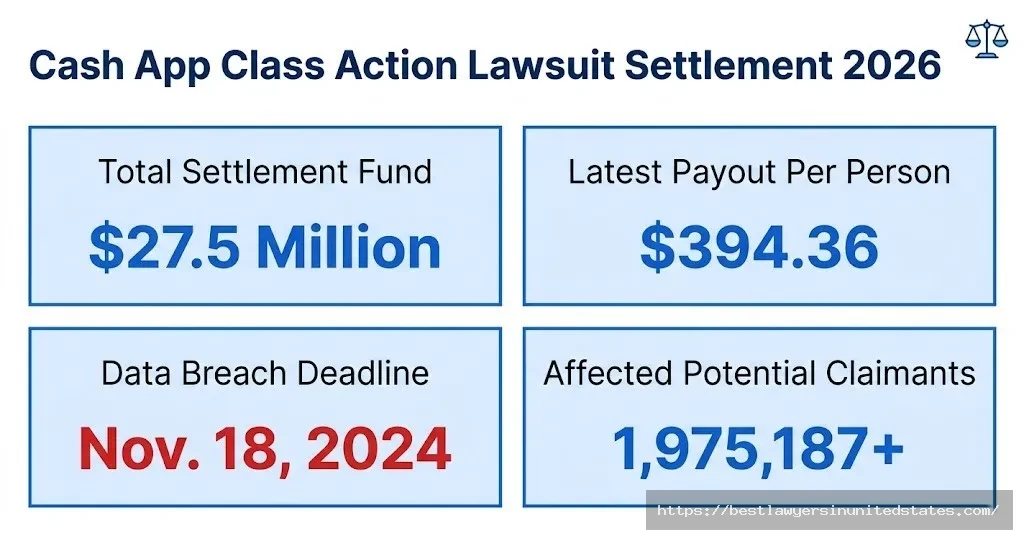
Two separate federal lawsuits drove these settlements. One involved a massive data breach. The other involved unsolicited referral text messages sent to Washington state residents without consent.
Together, the two settlements total $27.5 million in compensation funds.
| Settlement | Amount | Case Filed |
|---|---|---|
| Data Breach (Salinas v. Block) | $15 million | Northern District of California |
| Spam Texts (Bottoms v. Block) | $12.5 million | Western District of Washington |
| Combined Total | $27.5 million | Two separate federal courts |
Block denied wrongdoing in both cases. The company agreed to settle to avoid prolonged, costly litigation.
Neither settlement required Block to admit any fault. That’s standard practice in class action resolutions of this size.
The Two Cash App Settlement Lawsuits: A Side-by-Side Overview
Most websites only cover one of these cases. That creates real confusion for people trying to figure out which settlement applies to them.
Here is a clear, side-by-side breakdown of both active cases.
| Detail | Data Breach Settlement | Spam Text Settlement |
|---|---|---|
| Case Name | Salinas v. Block, Inc. | Bottoms v. Block, Inc. |
| Case Number | 22-cv-04823 (N.D. Cal.) | 2:23-cv-01969-MJP (W.D. Wash.) |
| Settlement Fund | $15 million | $12.5 million |
| Who Can Claim | U.S. Cash App users (2018-2024) | Washington state residents only |
| Claim Deadline | November 18, 2024 (closed) | October 27, 2025 (closed) |
| Final Approval | January 13, 2025 | December 2, 2025 |
| Payments Started | April 10, 2025 (electronic) | February 2, 2026 |
| Per-Person Payout | Up to $2,500; est. ~$200 | $394.36 per approved claimant |
The data breach case is a nationwide settlement. The spam text case only covers Washington state.
If you live outside Washington, the referral text settlement does not apply to you.
Cash App Referral Lawsuit Settlement: The $12.5 Million Spam Text Case
The cash app referral lawsuit settlement arose from a simple but legally significant feature: the Cash App Invite Friends program.
That program let users send pre-filled text messages to their contacts. The catch? The recipients never agreed to receive marketing messages from Cash App.
A Washington resident named Kimberly Bottoms filed suit in late 2023. She alleged that Block violated Washington’s Commercial Electronic Mail Act (CEMA) and the Washington Consumer Protection Act (CPA).
CEMA specifically prohibits sending unsolicited commercial texts to Washington residents without their prior, clear consent. Block argued that users sent the texts, not Cash App itself. The court disagreed enough to push the matter to settlement.
| Key Date | Event |
|---|---|
| November 14, 2019 | Start of class period |
| August 7, 2025 | End of class period |
| June 30, 2025 | Settlement motion filed |
| July 29, 2025 | Preliminary approval granted |
| October 27, 2025 | Claim filing deadline |
| December 2, 2025 | Final approval granted |
| February 2, 2026 | Payments distributed |
The class potentially included 1,975,187 Washington residents. Only a fraction filed valid claims. That drove the payout far above initial projections.
Key Takeaway: The Cash App class action involves two separate settlements totaling $27.5 million. The data breach case covers nationwide users; the spam text case is exclusively for Washington state residents.
Cash App Data Breach Settlement: The $15 Million Security Case
The Cash App data breach settlement stems from two serious security incidents that exposed customer data.
The first breach happened in April 2022. A former Cash App employee downloaded sensitive customer data without permission after leaving the company. The second breach occurred in September 2023. An unauthorized third party accessed accounts by exploiting recycled phone numbers.
The lawsuit, Salinas, et al. v. Block, Inc. and Cash App Investing, LLC, was filed in the Northern District of California. Plaintiffs argued that Block failed to adequately protect their financial and personal information.
Block agreed to pay $15 million to resolve the claims.
What types of harm were covered:
- Unauthorized access to Cash App or Cash App Investing accounts
- Fraudulent withdrawals or transfers
- Unresolved account errors linked to the breaches
- Out-of-pocket losses like credit monitoring costs, bank fees, and legal expenses
The settlement covered incidents between August 23, 2018, and August 20, 2024.
Final court approval came on January 13, 2025.
Electronic payments began on April 10, 2025. Paper checks went out starting April 20, 2025.
Who Qualifies for the Cash App Class Action Settlement?
Eligibility depends entirely on which settlement you’re asking about. There is no single universal answer here.
For the spam text settlement (Bottoms v. Block):
You must meet all three of these conditions:
- You received a Cash App referral text message between November 14, 2019, and August 7, 2025
- You were a Washington state resident at the time
- You did not clearly and affirmatively consent to receive that text
For the data breach settlement (Salinas v. Block):
You must meet at least one of these conditions:
- Your personal data was accessed without consent in the 2022 or 2023 breaches
- You experienced unauthorized withdrawals or transfers between August 23, 2018, and August 20, 2024
- You received a breach notification letter from Block in April 2022 or September 2023
| Qualifying Factor | Spam Text Case | Data Breach Case |
|---|---|---|
| Geographic requirement | Washington state only | Nationwide, U.S. residents |
| Time period | Nov. 2019 to Aug. 2025 | Aug. 2018 to Aug. 2024 |
| Proof required | None needed | Documentation of losses |
| Max payout | $394.36 flat | Up to $2,500 |
Both claim filing deadlines are now closed. Eligibility is only relevant if you filed before the cutoff. Google Android Cellular Data Lawsuit
Cash App Settlement Class Action Lawsuit Eligibility: The Specific Rules
Understanding the eligibility rules in detail matters for anyone checking whether their claim should have been approved.
For the spam text case, eligibility was self-certified. You did not need to prove you received the message. You simply confirmed the criteria under penalty of perjury. However, the settlement administrator had the right to investigate suspicious or fraudulent claims.
For the data breach case, eligibility was tiered based on documented harm.
Tier 1: Out-of-Pocket Losses
Claims required actual documentation such as bank statements, credit card bills, or invoices showing expenses tied to the breach. “Self-prepared” handwritten receipts were not accepted alone.
Tier 2: Lost Time
Claimants could also claim compensation for time spent dealing with breach-related issues, such as filing fraud reports or disputing charges.
What disqualified claimants:
- Filing under multiple Cash App accounts for the same incident
- Submitting claims without required documentation (data breach case)
- Not residing in Washington at the time of the texts (spam text case)
- Filing after the respective deadlines
The high rejection rate in the data breach case (roughly 94% of 667,000+ filed claims were not approved for payment) reflects how strict these documentation standards were.
Key Takeaway: Eligibility for the spam text case required only Washington residency and no prior consent to the texts. The data breach case required documented proof of harm, leading to a high rate of denied claims.
Cash App Lawsuit Payout: How Much Did Claimants Actually Receive?
The cash app lawsuit payout figures ended up very different from early estimates. That’s worth understanding clearly.
Spam Text Case ($12.5M settlement):
Early projections in September 2025 estimated payouts of $88 to $147 per person. Those estimates assumed that up to 5% of the 1.97 million class members would file claims.
The actual filing rate came in far lower than projected. As a result, each approved claimant received $394.36, more than double the high-end estimate.
Payments started on February 2, 2026.
Data Breach Case ($15M settlement):
Payouts in this case were more complex. The settlement allowed up to $2,500 per claimant for documented out-of-pocket losses.
Of the 667,000+ claims filed, approximately 40,380 were approved for payment. The total approved payout was approximately $5.6 million. That means the average payment per approved claimant ran close to $138 in practice.
| Settlement | Max Payout | Actual Avg Payout | Payments Began |
|---|---|---|---|
| Spam Text ($12.5M) | $394.36 flat | $394.36 | February 2, 2026 |
| Data Breach ($15M) | $2,500 for losses | ~$138 average | April 10, 2025 |
The wide gap between the $15M fund and $5.6M distributed reflects how many claims were denied for lack of documentation.
How Much Does the Cash App Settlement Pay Per Person?
This is the most searched question about both cases, and the answer surprises most people.
For the spam text settlement, the answer is simple. Every approved claimant gets exactly $394.36. That’s a flat payment, not a range.
For the data breach settlement, the payout varies based on what you claimed.
Payout breakdown for the data breach case:
- Out-of-pocket losses: Reimbursable up to $2,500 with proper documentation
- Transaction losses (fraud): Claimants with documented fraudulent withdrawals could claim those amounts back
- Lost time: Compensated at approximately $25 per hour for time spent resolving the breach
Most claimants without strong documentation received smaller amounts. The average approved payout was around $138 to $200 based on settlement administrator disclosures.
The key variable was documentation quality. Claimants who submitted police reports, bank statements, and credit monitoring receipts fared better. Pete and Gerry’s Eggs Lawsuit
Cash App Lawsuit Claim Form: Can You Still Submit One?
Both claim form deadlines are now closed. You cannot submit a new claim for either settlement.
The data breach claim deadline was November 18, 2024. The spam text claim deadline was October 27, 2025.
Missing either deadline means you are no longer eligible for a standard settlement payment.
However, a few limited options may still exist:
- Contact the settlement administrator directly. If you experienced a technical issue when filing, the administrator may review your case. For the data breach case, reach the Angeion Group at (866) 615-9740 or [email protected]. For the spam text case, contact the Bottoms Text Settlement Administrator at 877-540-7545.
- Check for automatic processing. Some class members who received direct breach notifications may have been automatically included without filing. Check your email for settlement notices.
- Consult the plaintiff law firms. The attorneys who handled both cases may have additional guidance for late filers with documented reasons for missing the deadline.
There is no guarantee that late submissions will be accepted. Both administrators have significant discretion here.
Key Takeaway: Claim deadlines for both Cash App settlements are firmly closed. The spam text deadline was October 27, 2025, and the data breach deadline was November 18, 2024.
Cash App Lawsuit Settlement Payment Status: How to Check in 2026
Checking your cash app lawsuit settlement payment status depends on which case you filed under.
For the spam text settlement (Bottoms v. Block):
Visit BottomsTextSettlement.com. Use your claim ID or the phone number you listed on your claim form. You can log in to see whether your claim was approved and whether payment has been issued.
Payments for this case began on February 2, 2026. If your claim was approved and you have not yet received payment, allow extra time for mail delivery if you selected a paper check.
For the data breach settlement (Salinas v. Block):
Visit cashappsecuritysettlement.com and use your claim ID. You can also call the settlement hotline at (866) 615-9740.
Electronic payments for this case began on April 10, 2025. Paper checks started going out on April 20, 2025.
What to do if you see no payment and have an approved claim:
- Confirm your payment method is still valid (bank account, Venmo, Zelle, or mailing address)
- Check your spam folder for any settlement communications
- Contact the administrator directly to flag your concern
Do not attempt to contact Cash App or Block directly about settlement payments. They are not administering the distributions.
Cash App Settlement Payment Date 2026: When Are Payments Going Out?
The cash app settlement payment date in 2026 applies specifically to the spam text settlement. That case received final approval in December 2025 and began payments on February 2, 2026.
The data breach settlement’s payments were already rolling out through 2025.
Here is a consolidated timeline of when money moved for each case:
| Event | Data Breach Case | Spam Text Case |
|---|---|---|
| Final court approval | January 13, 2025 | December 2, 2025 |
| Electronic payments start | April 10, 2025 | February 2, 2026 |
| Paper checks mailed | April 20, 2025 | February 2026 onward |
| Claims reviewed/approved | 40,380 of 667,000+ | Ongoing in 2026 |
| Net distribution fund | ~$5.6 million | ~$8.7 million |
If you were an approved spam text claimant, your $394.36 payment should have arrived or will arrive by late spring 2026 if not already received.
If you expected a data breach payment and have not received it, payment processing was completed starting April 2025. Check your claim status using your claim ID.
Cash App $15 Million Settlement Breakdown: Data Breach Specifics
The $15 million Cash App data breach settlement is more complex than any other settlement covered on this topic.
The two security incidents behind this case happened years apart. The first involved a former employee who, after leaving the company, downloaded Cash App Investing customer data including names, portfolio values, brokerage account numbers, and trading activity. That breach was disclosed by Block in April 2022.
The second breach, disclosed in September 2023, involved someone accessing accounts using recycled phone numbers. When a customer disconnects a phone number, that number can later be assigned to a different person. An unauthorized party exploited this to gain access to Cash App accounts.
What the $15 million covered:
- Reimbursement of out-of-pocket losses up to $2,500
- Compensation for fraud-related transaction losses
- Payment for lost time at roughly $25 per hour
- Commitment from Block to improve data security practices
Attorney fees, costs, and the class representatives’ awards were also drawn from the fund. According to court records, approximately $5.6 million of the total fund was distributed to the roughly 40,380 approved claimants.
The remaining funds, after legal fees and administration costs, were accounted for under the settlement agreement.
Key Takeaway: The $15 million data breach settlement covered two distinct security incidents from 2022 and 2023. Only about 6% of the 667,000+ filed claims were ultimately approved for payment.
Cash App $12.5 Million Settlement Final Numbers: The Real Payout
The $12.5 million spam text settlement produced a result that few people anticipated. Every approved claimant received $394.36, more than twice the original high-end estimate of $147.
Why did the payout end up so high?
Attorneys originally estimated that 5% of the 1.97 million potential class members would file claims. That would have meant roughly 98,000 claimants splitting the fund. The actual number of valid claims submitted was far lower.
With fewer claimants sharing the net fund, each person got more.
Where the $12.5 million actually went:
| Allocation | Amount |
|---|---|
| Attorney fees (awarded by court) | $3.1 million |
| Class representative (Kimberly Bottoms) | $10,000 |
| Administration costs | Covered from fund |
| Net to approved claimants | ~$8.7 million |
The court, under U.S. District Judge John Chun, found the settlement “fair, reasonable, and adequate” before dismissing the case on December 2, 2025.
The plaintiff’s law firms, including Terrell Marshall Law Group PLLC and Berger Montague PC, handled the case against Block’s defense counsel at Perkins Coie LLP.
Attorney Fees and Settlement Deductions: Where the Settlement Money Goes
Many people file a class action claim expecting the full settlement amount, divided evenly. That’s not how it works.
In both Cash App cases, fees and costs came out of the settlement fund before distributions to class members.
In the spam text case, the court awarded $3.1 million in attorney fees plus litigation costs from the $12.5 million fund. The named plaintiff, Kimberly Bottoms, received a $10,000 service award for her role in initiating and shepherding the case. Settlement administration expenses also reduced the gross fund.
The net result: approximately $8.7 million was available for distribution to approved claimants.
In the data breach case, similar deductions applied. Plaintiff counsel at Kantrowitz, Goldhamer & Graifman received a percentage of the $15 million fund as fees. Class representatives received service awards. Administrative costs covered the processing of over 667,000 claims.
Why this matters:
- The per-person payout is always lower than the headline settlement amount
- Class representatives typically receive larger individual awards for their time and legal risk
- Courts must approve all fee requests, but they routinely grant amounts that reduce the net distribution significantly
Understanding this structure prevents unrealistic expectations about payout amounts when you see the headline settlement total.
What Happens If Your Cash App Settlement Claim Was Denied?
Having your claim denied is frustrating, but it is not necessarily the end of the road.
For the data breach settlement, the claim denial rate was extremely high. Of more than 667,000 claims, only about 40,380 were approved. That means roughly 94% of filers received a denial or were flagged as ineligible.
The most common reasons for denial:
- Missing or insufficient documentation (no bank statements, police reports, or receipts)
- Failure to show a direct link between the breach and the claimed losses
- Duplicate claims filed across multiple accounts
- Incomplete claim forms
Steps to take after a denial:
- Review the denial notice. The administrator typically includes a reason code or explanation. Match it against what you submitted.
- Gather missing documentation. If your denial cited lack of proof, check whether you have any supporting documents you did not include.
- Contact the settlement administrator. Both cases have administrator hotlines. For the data breach: (866) 615-9740. For the spam text: 877-540-7545.
- Request a reconsideration. Some administrators accept supplemental documentation within a short window after denial.
There is no formal appeals process built into most class action settlements. Reconsideration is discretionary, not guaranteed.
Key Takeaway: Nearly 94% of data breach claims were denied, mostly for insufficient documentation. If your claim was rejected, contacting the settlement administrator directly is your first step.
Block Inc. and Cash App: The Company Behind Both Lawsuits
Both lawsuits name Block, Inc. as the defendant. Understanding who Block is helps explain why these cases attracted national attention.
Block, Inc. was founded by Jack Dorsey, co-founder of Twitter. The company operates several financial technology products, including Cash App, Square, and TIDAL. Cash App launched in 2013 and had grown to tens of millions of users by the time these lawsuits were filed.
Cash App Investing, LLC is a separate but related entity named as a co-defendant in the data breach case. It holds the brokerage functionality that some users accessed for stock and bitcoin trading.
Block is headquartered in San Francisco, California. Its revenue has consistently exceeded $17 billion annually in recent years.
| Company Fact | Detail |
|---|---|
| Parent company | Block, Inc. |
| Founded | 2013 (Cash App) |
| Founder | Jack Dorsey |
| Related defendant | Cash App Investing, LLC |
| Headquarters | San Francisco, CA |
| Data breach case court | Northern District of California |
| Spam text case court | Western District of Washington |
Block denied wrongdoing in both settlements. The company maintains that it complied with all applicable laws. Settling was a business decision, not an admission of liability.
Cash App Lawsuit Settlement 2026: Latest Updates
The most current cash app lawsuit settlement update as of March 2026 is this: the spam text settlement is actively paying out, and the data breach settlement has been in payment distribution for nearly a year.
Spam text settlement (as of March 2026):
Payments of $394.36 per claimant began on February 2, 2026. Approved claimants who chose electronic delivery received funds first. Paper check recipients should see payments arriving through spring 2026.
The claim form deadline passed on October 27, 2025. No new claims are being accepted.
Data breach settlement (as of March 2026):
Electronic payments started April 10, 2025. Paper checks began on April 20, 2025. Of the 667,000+ claims filed, approximately 40,380 were approved, totaling about $5.6 million in distributions.
The claim form deadline passed on November 18, 2024. No new claims are being accepted.
Are any new Cash App lawsuits active?
No new major class action against Cash App or Block has reached settlement stage as of March 2026. However, Block has faced regulatory scrutiny from the Consumer Financial Protection Bureau (CFPB) over fraud handling complaints. That is a separate matter from these two settlements.
Check cashappsecuritysettlement.com and BottomsTextSettlement.com for any updated distribution notices.
Frequently Asked Questions
How much will I get from the Cash App class action lawsuit settlement?
It depends on which settlement applies to you.
Approved claimants in the spam text case received exactly $394.36 each, with payments starting February 2, 2026.
In the data breach case, payments ranged from small amounts up to $2,500 based on documented losses, with the average approved payment running approximately $138 to $200.
Can I still file a claim for the Cash App settlement in 2026?
No. Both claim deadlines have passed.
The data breach claim deadline was November 18, 2024. The spam text claim deadline was October 27, 2025.
If you missed both deadlines, your only option is to contact the settlement administrators to inquire about late filing exceptions, which are not guaranteed.
How do I check my Cash App lawsuit settlement payment status?
For the spam text case, visit BottomsTextSettlement.com and use your claim ID or the phone number on your original filing.
For the data breach case, visit cashappsecuritysettlement.com or call (866) 615-9740.
Do not contact Cash App or Block directly; they do not manage settlement payments.
What are the two different Cash App class action settlements?
One is the $15 million data breach settlement covering U.S. users affected by security incidents between 2018 and 2024. The other is the $12.5 million spam text settlement covering Washington state residents who received unsolicited referral texts between 2019 and 2025.
They are separate lawsuits, separate courts, and separate payment processes.
Why did Block Inc. settle the Cash App lawsuits without admitting wrongdoing?
Settling without admitting fault is standard legal strategy for large companies in class action cases.
Admitting wrongdoing would expose Block to much larger liability in future litigation. By settling, Block resolved the claims for a defined amount while maintaining its legal position.
Courts still reviewed and approved both settlements as fair and adequate before granting final approval.
Both Cash App settlements are now in the payment distribution phase. The spam text settlement is paying out $394.36 per approved claimant. The data breach settlement finished its initial distributions in spring 2025.
If you filed a claim, check your status now using the official settlement websites. If your payment has not arrived, contact the administrator before distributions close out completely.
Time matters here. The sooner you verify your status, the sooner you can resolve any payment issues.
