
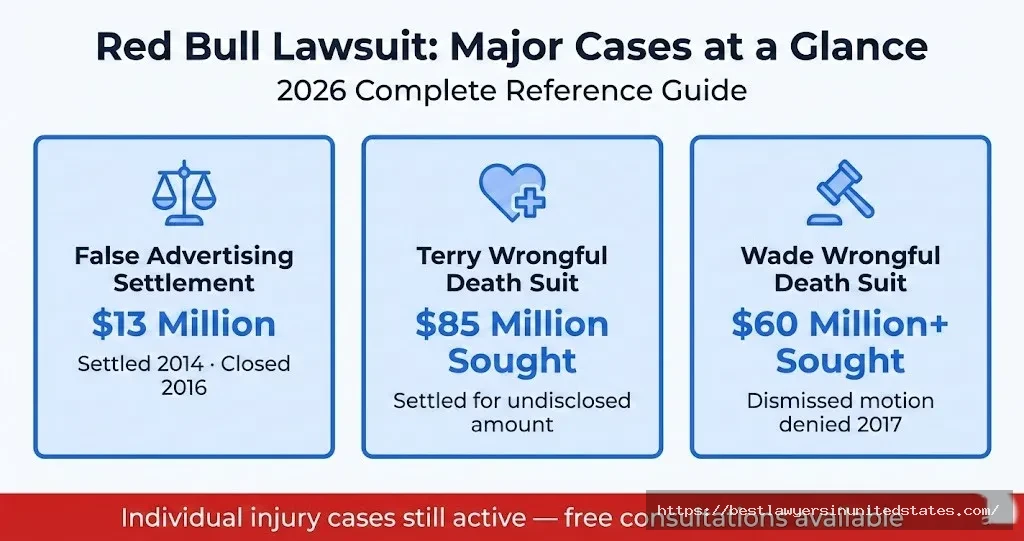
Red Bull has faced multiple lawsuits over the past two decades — from a landmark $13 million false advertising settlement to multi-million-dollar wrongful death cases alleging the drink contributed to heart attacks and fatalities. This guide covers every major Red Bull lawsuit in detail: what happened, who sued, what was at stake, and what the outcomes mean for you as a consumer today. adriana chechik lawsuit
Quick Answer: The most famous Red Bull lawsuit resulted in a $13 million settlement in 2014 over false advertising claims tied to the slogan “Red Bull Gives You Wings.” That settlement is now fully closed — all payments were distributed by 2016. However, separate wrongful death and personal injury lawsuits against Red Bull have continued, and attorneys are still reviewing new injury cases in all 50 states.
If you or a family member suffered a serious health event after drinking Red Bull, you may still have legal options through an individual personal injury claim — even though the class action window has long passed. Emotional Distress Lawsuit
What Is the Red Bull Lawsuit?
“Red Bull lawsuit” actually refers to several distinct legal actions filed against the company over the years. They fall into two broad categories:
- False advertising class action lawsuits — alleging Red Bull deceived consumers about the health and performance benefits of its drink
- Wrongful death and personal injury lawsuits — alleging Red Bull’s drink caused or contributed to heart attacks, aortic dissection, and death
These cases are very different in nature. The false advertising case involved millions of everyday consumers. The wrongful death cases involve individual plaintiffs whose family members died after consuming Red Bull.
Lawsuit #1: The False Advertising Class Action (Careathers v. Red Bull)
Background
This is the lawsuit most people are referring to when they search “Red Bull lawsuit.” It centered on one of the most famous marketing slogans in history: “Red Bull Gives You Wings.”
Benjamin Careathers, a New York resident, drank Red Bull for roughly 10 years. By his account, the drink never delivered the superior energy boost, improved mental performance, or enhanced physical capability that Red Bull’s advertising promised. He argued that Red Bull’s marketing went beyond harmless exaggeration — it was, in his view, outright deceptive fraud.
A second related case, Wolf et al. v. Red Bull GmbH, was filed separately and later consolidated. Together, these two class actions accused Red Bull of running an advertising campaign that misrepresented the functionality and safety of its energy drinks — charging a premium price for benefits that the science simply did not support.
The Core Allegation
The lawsuit’s central argument was straightforward: Red Bull markets its drink as a superior source of energy that boosts concentration, reaction speed, and physical performance. But the available scientific evidence showed no meaningful difference between drinking a Red Bull and drinking an ordinary cup of coffee or taking a caffeine tablet. Yet Red Bull charged significantly more.
As the lawsuit put it, Red Bull “persistently and pervasively” marketed its product as a superior energy source “worthy of a premium price” — despite the absence of genuine scientific support for those claims.
Red Bull also faced scrutiny over the studies it posted on its own website, which it claimed demonstrated the superiority of its drink. Plaintiffs argued those studies were not scientifically reliable, and that a regular 8.3-ounce can of Red Bull actually contained less caffeine than a comparable cup of coffee.
Legal Claims Filed
The lawsuits filed claims across several legal theories:
- Breach of express warranty
- Unjust enrichment
- Violations of multiple states’ consumer protection statutes
- Deceptive and fraudulent advertising
The $13 Million Settlement
Rather than fight the case to trial, Red Bull agreed to settle. The company denied any wrongdoing and maintained that its marketing had always been truthful and accurate. But it chose settlement, in its own words, “to avoid the cost and distraction of litigation.”
The settlement totaled $13 million, with $6.5 million placed into a consumer settlement fund.
| Category | Details |
|---|---|
| Total Settlement | $13 million |
| Consumer Settlement Fund | $6.5 million |
| Attorneys’ Fees & Costs | Remaining balance |
| Coverage Period | January 1, 2002 – October 3, 2014 |
| Who Was Eligible | Any U.S. resident who bought at least one Red Bull |
| No Proof of Purchase Required | Yes — self-certification under penalty of perjury was sufficient |
What Did People Actually Get Paid?
Eligible class members could choose from two options:
- A $10 cash reimbursement (sent as a check)
- Two free Red Bull products with a retail value of approximately $15
Because so many people filed claims — far more than anticipated — the actual payout was reduced. By January 2016, recipients began receiving checks worth approximately $4.25. A second round of smaller checks worth up to $2.01 went out in October 2016.
Timeline of the False Advertising Case
| Date | Event |
|---|---|
| January 1, 2002 | Start of class period (earliest qualifying purchase) |
| 2013 | Careathers v. Red Bull filed (Case No. 1:13-cv-00369, S.D.N.Y.) |
| 2013 | Wolf v. Red Bull GmbH filed (Case No. 1:13-cv-08008, S.D.N.Y.) |
| October 2014 | $13 million settlement reached |
| October 3, 2014 | End of class period (last qualifying purchase date) |
| October 9, 2014 | Settlement website launched; overwhelmed by traffic |
| May 2015 | Federal judge grants final approval of settlement |
| January 2016 | First round of settlement checks mailed (~$4.25) |
| October 2016 | Second round of smaller checks distributed (~$2.01) |
| Late 2016 | Settlement fully closed — no further claims accepted |
This settlement is now fully closed. No new claims can be filed.
Lawsuit #2: The Cory Terry Wrongful Death Case ($85 Million)
What Happened
On November 8, 2011, Cory Terry — a healthy 33-year-old Brooklyn, New York man — was playing basketball. He drank Red Bull before and during the game. He collapsed on the court and went into cardiac arrest. He was pronounced dead at Woodhull Medical and Mental Health Center.
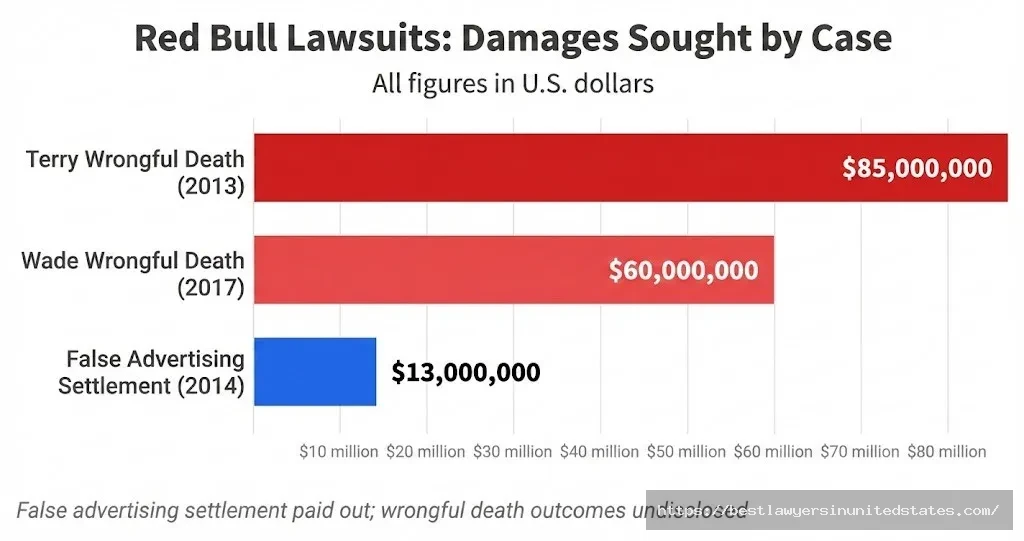
His family filed an $85 million wrongful death lawsuit against Red Bull in 2013, believed to be the first wrongful death suit ever filed against the company. The lawsuit alleged that Red Bull’s drink contained stimulants beyond simple caffeine — including taurine — that made it “more dangerous than what Red Bull lets on,” and that the company failed to warn consumers of the cardiovascular risks.
Key Allegations
- Red Bull contains combinations of ingredients (caffeine + taurine + B vitamins) that interact in ways more dangerous than caffeine alone
- Red Bull failed to adequately warn consumers about risks to people who exercise while consuming the drink
- Red Bull’s marketing downplayed or concealed the potential for serious cardiac events
- The company knew or should have known about cardiovascular risks based on prior adverse event reports to the FDA
Red Bull responded that its 8.4 oz can contained roughly 80mg of caffeine — about the same as a cup of coffee — and that health authorities around the world had concluded the drink was safe.
Outcome
The Terry case was reportedly settled for an undisclosed amount. The family did not receive a public judgment, and Red Bull did not publicly admit liability.
Lawsuit #3: The Wade Wrongful Death Case ($60 Million)
What Happened
William Jacob Wade was a 44-year-old man from Savannah, Georgia. A co-owner of a local antiques and auction business, he was described as a musician and artist. Wade consumed an average of four 12-ounce cans of Red Bull per day. On the day he died in August 2014, he had consumed two cans. An autopsy reported he died of aortic dissection — a tear in the inner layer of the body’s main artery — combined with hypertension and other heart complications.
In 2016–2017, his mother, Ann Edenfield Lemley, filed a wrongful death lawsuit in the U.S. District Court for the Southern District of Georgia, seeking over $60 million in damages (including $50 million in punitive damages and $35 million in other damages for causes ranging from wrongful death to strict product liability and design defect).
The 2017 Court Ruling
Red Bull tried to get the case thrown out. On May 16, 2017, U.S. District Judge Lisa Wood denied Red Bull’s motion to dismiss, ruling that the complaint adequately pled its claims. The court found that the plaintiff had sufficiently alleged fraud and that the case could move forward.
The lawsuit cited multiple scientific studies in its arguments:
| Study | Finding |
|---|---|
| 2008 Medical Journal of Australia | Caffeine and taurine in energy drinks combined with physical activity can cause coronary vasospasm |
| 2009 Royal Adelaide Hospital (Scott Willoughby) | Red Bull consumption can produce symptoms normally associated with cardiovascular disease |
| 2016 energy drink vs. caffeine study | Energy drinks caused QTc prolongation (linked to irregular heartbeat) and blood pressure spikes lasting nearly 6 hours; coffee raised blood pressure by only 1 point |
Allegations in the Wade Case
- Red Bull failed to conduct adequate testing and clinical research on its product’s safety
- Red Bull’s advertising represented the drink as safe when it was not
- The company failed to warn consumers about risks for heavy or regular users
- Red Bull knew or should have known about cardiovascular dangers and suppressed that knowledge
The final resolution of this case was not publicly reported, but the 2017 ruling was a significant setback for Red Bull’s effort to escape liability. Native Shampoo Lawsuit
All Major Red Bull Lawsuits: Side-by-Side Comparison
| Case | Filed | Claim Type | Amount Sought | Outcome |
|---|---|---|---|---|
| Careathers v. Red Bull | 2013 | False advertising (class action) | N/A | $13M settlement; closed 2016 |
| Wolf v. Red Bull GmbH | 2013 | False advertising (class action) | N/A | Consolidated with Careathers |
| Terry v. Red Bull | 2013 | Wrongful death (heart attack) | $85 million | Settled for undisclosed amount |
| Wade/Lemley v. Red Bull | 2016–17 | Wrongful death (aortic dissection) | $60+ million | Motion to dismiss denied 2017; outcome undisclosed |
| Grey Market Trademark Suit | 2024 | Trademark infringement (vs. gas station) | Injunction | Red Bull as plaintiff; ongoing |
What Red Bull Is Made Of — and Why It Matters Legally
Understanding Red Bull’s ingredients is central to understanding why these lawsuits keep happening. The drink contains:
| Ingredient | Amount (per 8.4 oz can) | Notes |
|---|---|---|
| Caffeine | 80 mg | Comparable to a standard cup of coffee |
| Taurine | 1,000 mg | Amino acid; occurs naturally in the body |
| B Vitamins (B3, B5, B6, B12) | Various | Involved in energy metabolism |
| Sugar (Sucrose/Glucose) | 27 grams | High; may cause cardiovascular strain |
| Sugar-Free Alternative | 0 grams sugar | Contains aspartame, sucralose, acesulfame |
The key issue that keeps appearing in lawsuits isn’t caffeine alone — it’s the combination of caffeine, taurine, sugar, and other compounds when consumed in large quantities or during physical exertion. Research has suggested this combination may affect the cardiovascular system differently than caffeine alone, which is the scientific core of most wrongful death suits.
Who Is Most at Risk from Energy Drinks?
This matters because it goes to the “failure to warn” claims at the heart of Red Bull’s legal battles. According to research and FDA adverse event data, the following groups face elevated risk:
- People with heart conditions or a family history of cardiac disease
- People with diabetes
- People with seizure disorders
- People taking stimulant medications (e.g., for ADHD)
- People on certain antidepressants or blood pressure medications
- Teens and young adults, whose cardiovascular systems may be more sensitive
- People who mix energy drinks with alcohol
- People who consume energy drinks during or immediately after intense exercise
Poison control centers received nearly 5,000 calls related to energy drink illness between 2010 and 2013. Emergency room visits attributed to caffeine overdose rose from 1,128 in 2005 to over 16,000 by 2008, with roughly 56% of those visits involving people aged 12–25.
Can You Still Sue Red Bull in 2026?
The class action false advertising settlement is closed — if you bought a Red Bull between 2002 and 2014 hoping to collect, that window closed over a decade ago.
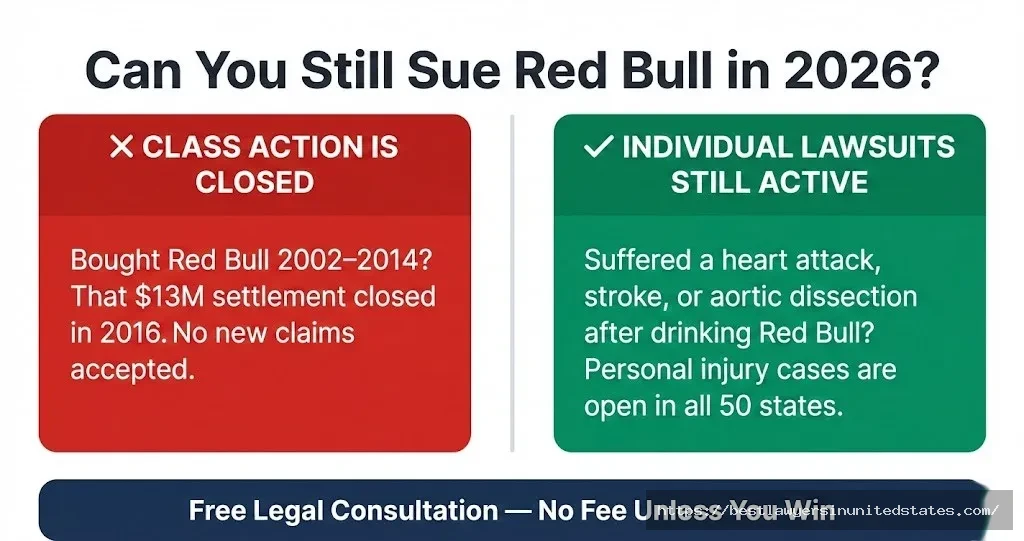
But individual personal injury lawsuits remain possible in the right circumstances. Attorneys are actively reviewing new cases in all 50 states for people who suffered:
- Heart attack
- Stroke
- Aortic dissection
- Seizure
- Cardiac arrhythmia
- Sudden death
…after consuming Red Bull, especially in large quantities or over an extended period.
You do not need to have been part of the class action to file an individual lawsuit. Personal injury cases are separate from class actions and are evaluated on their own facts.
What Would You Need to Show?
| Element | What It Means |
|---|---|
| Duty of care | Red Bull owed consumers a duty to make a reasonably safe product and warn of risks |
| Breach of duty | Red Bull failed to adequately warn about cardiovascular risks or misrepresented its safety |
| Causation | Red Bull’s product was a substantial contributing factor in your injury or your loved one’s death |
| Damages | You suffered measurable harm — medical bills, lost income, loss of a family member, etc. |
These are difficult cases to win, and outcomes depend heavily on individual facts: how much the person drank, their pre-existing health conditions, whether Red Bull’s warnings were adequate at the time, and more.
Do You Need a Lawyer?
For the closed class action — no, there’s nothing to file.
For a personal injury or wrongful death claim, you should absolutely consult an attorney before doing anything else. These cases are complex, statutes of limitations vary by state (typically 2–3 years from the date of injury or discovery of harm), and the window to sue may already be closing.
Most attorneys handling energy drink cases work on a contingency fee basis — meaning you pay nothing upfront and they only collect a fee if they win or settle your case.
To find legal help:
- Contact a personal injury attorney in your state who handles product liability cases
- Ask specifically about energy drink lawsuits and their experience with similar cases
- Most offer free initial consultations
Red Bull’s Legal Strategy: Why It Keeps Settling
Red Bull’s pattern across lawsuits is telling. The company almost universally chooses settlement over trial — even in cases where it insists on its innocence. There are practical reasons for this:
The science is not fully on Red Bull’s side. Multiple peer-reviewed studies have found that energy drinks affect cardiovascular health differently than coffee, and that combinations of caffeine and taurine can cause measurable cardiac changes. Going to trial means putting that science in front of a jury.
Red Bull markets heavily to young people. A jury seeing evidence that the company targets teens and young adults with a product linked to cardiac events is not a comfortable environment for any corporate defendant.
Settlements avoid precedent. By settling without admitting liability, Red Bull avoids creating court rulings that could be used against it in future cases. It’s a calculated legal and business decision. Jon Gruden Lawsuit Against the NFL
Frequently Asked Questions
What was the Red Bull lawsuit about?
The most well-known Red Bull lawsuit was a class action alleging that Red Bull falsely advertised its energy drink as providing superior performance, concentration, and energy compared to coffee — claims the plaintiffs said lacked scientific support. Red Bull settled for $13 million in 2014.
Can I still file a claim from the $13 million settlement?
No. That settlement closed in 2016. All payments have been distributed, and the settlement administrator is no longer accepting claims.
What did people actually receive from the settlement?
Eligible class members received either approximately $4.25 in cash or a comparable value in Red Bull products — much less than the initially advertised $10, because so many people filed claims that the fund was spread very thin.
What if I was injured by Red Bull — can I still sue?
Potentially yes, through an individual personal injury or wrongful death lawsuit — separate from the closed class action. Consult a personal injury attorney in your state as soon as possible, as statutes of limitations apply.
What health risks are associated with Red Bull?
Research has linked heavy or repeated energy drink consumption to elevated blood pressure, QTc prolongation (a cardiac rhythm change), increased heart rate, and in some cases, cardiac arrhythmia and aortic dissection. Risks are heightened in people with pre-existing heart conditions, during intense exercise, and when combined with alcohol or stimulant medications.
Did Red Bull admit wrongdoing in any lawsuit?
No. In the class action settlement, Red Bull explicitly denied wrongdoing and stated its marketing had always been truthful. In the wrongful death cases, outcomes were either undisclosed settlements or ongoing litigation — no public admission of liability has been made.
What was the “Red Bull Gives You Wings” lawsuit specifically about?
The slogan itself wasn’t necessarily the legal problem — courts recognize obvious marketing hyperbole. The issue was Red Bull’s broader claim that its drink delivered measurably superior energy, concentration, and physical performance compared to cheaper alternatives like coffee, and that this claim was backed by science when plaintiffs alleged it was not.
Who filed the false advertising class action?
Lead plaintiff Benjamin Careathers filed the first case in 2013 after a decade of drinking Red Bull without experiencing the benefits the company advertised. David Wolf and others filed the companion case. Morelli Law Firm was among the primary firms representing the class.
What is taurine and why does it matter in the lawsuits?
Taurine is an amino acid that occurs naturally in the body and is a key ingredient in Red Bull. Research has suggested that taurine combined with caffeine during physical exertion may produce cardiovascular effects more significant than caffeine alone — which is central to many wrongful death cases alleging that Red Bull’s unique ingredient combination posed undisclosed risks.
Are energy drink lawsuits still being filed?
Yes. Lawsuits against Red Bull, Monster, and other energy drink makers continue to be filed across the country. In addition to wrongful death and injury cases, more recent litigation has targeted energy drink companies over marketing to minors and caffeine content misrepresentation (as seen in 2024 cases against Prime Energy drink).
What happened in the Cory Terry case?
Cory Terry, a 33-year-old Brooklyn man, died of a heart attack in November 2011 after drinking Red Bull during a basketball game. His family filed an $85 million wrongful death lawsuit in 2013. The case reportedly settled for an undisclosed amount.
What happened in the William Wade case?
William Wade, a 44-year-old Savannah, Georgia man who consumed roughly four cans of Red Bull per day, died of aortic dissection in August 2014. His mother filed a $60+ million wrongful death suit. A federal judge denied Red Bull’s motion to dismiss in May 2017, but the final outcome was not publicly disclosed.
What should I do if I had a health problem after drinking Red Bull?
Seek medical attention first. Then document everything — your medical records, what you consumed, how much, and over what period. Contact a personal injury attorney for a free consultation as soon as possible, and do not wait — statutes of limitations in most states are 2–3 years from the date of injury.
Is Red Bull safe to drink?
For most healthy adults consuming it occasionally and in moderation, Red Bull is unlikely to cause serious harm. The risks become more significant for people with pre-existing health conditions, for heavy or daily users, for those who combine it with alcohol or stimulant medications, and for teenagers whose cardiovascular systems may be more vulnerable.
The Bottom Line
Red Bull’s legal history tells an important story about the energy drink industry’s relationship with consumer safety and honest marketing. The $13 million false advertising settlement established that even powerful brands can be held accountable for overpromising product benefits. The wrongful death cases — some still without fully disclosed outcomes — highlight more serious ongoing concerns about the cardiovascular risks of energy drinks, especially for vulnerable populations.
If you’re researching the Red Bull lawsuit because you had a personal health experience with the drink, the class action window is closed — but individual legal options may remain. Speak with a personal injury attorney to understand what options apply to your specific situation.
This article is for informational purposes only and does not constitute legal advice. For advice specific to your situation, please consult a licensed attorney in your state.

Comments