
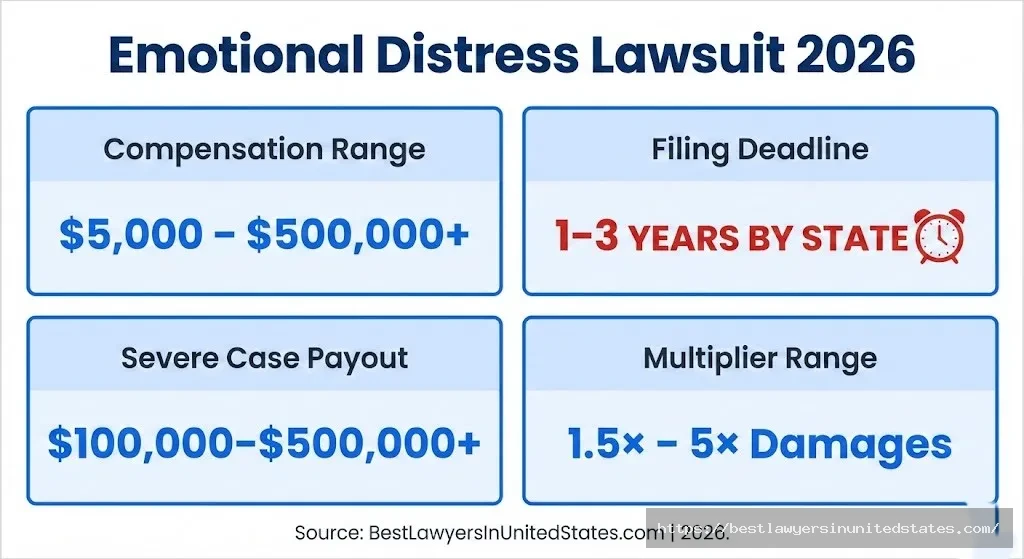
An emotional distress lawsuit lets you seek financial compensation for the psychological harm caused by someone else’s actions — whether that harm came from a car accident, workplace harassment, medical negligence, or deliberate misconduct. Settlements range from a few thousand dollars in minor cases to hundreds of thousands, or even millions, in severe ones. Your deadline to file depends on your state, but most people have 2–3 years from the date of the incident — and that clock starts ticking the moment it happens. adriana chechik lawsuit
Quick Answer: An emotional distress lawsuit is a legal claim for psychological suffering caused by another party’s negligence or intentional conduct. Compensation typically ranges from $5,000 to $500,000+, depending on severity, evidence, and your state. Most states give you 2–3 years to file. You do not need to have physical injuries to qualify in many states — but you do need solid documentation.
This guide covers everything: what qualifies, how much you can realistically expect, how to build your case, what evidence you need, state-by-state deadlines, and how to file. Read this before talking to anyone — including an attorney. Native Shampoo Lawsuit
What Is an Emotional Distress Lawsuit?
What Counts as Emotional Distress Under the Law
Emotional distress isn’t just feeling upset after a bad day. In personal injury law, emotional distress damages aim to compensate you for psychological harm — acknowledging that the impact of an accident or wrongful act extends beyond physical pain to include mental anguish and emotional suffering.
To qualify legally, your distress must be significant, documented, and directly connected to someone else’s actions. Courts look for real, lasting psychological harm — not temporary frustration or ordinary life stress.
Typical symptoms of emotional distress include panic attacks, social withdrawal, and physical symptoms like headaches or gastrointestinal issues tied directly to psychological burdens caused by personal injury or other wrongful acts.
The Two Types of Emotional Distress Claims
The legal system breaks down emotional distress into two primary categories: Intentional Infliction of Emotional Distress (IIED) and Negligent Infliction of Emotional Distress (NIED). Each type has its own set of standards and requirements.
| Claim Type | What It Means | Example | Burden of Proof |
|---|---|---|---|
| IIED – Intentional Infliction | Defendant deliberately caused your suffering | Workplace harassment, stalking, targeted abuse | High — must show extreme/outrageous conduct |
| NIED – Negligent Infliction | Defendant’s carelessness caused your suffering | Car accident PTSD, medical malpractice trauma | Lower — standard negligence rules apply |
| Bystander Claim | You witnessed harm to a loved one | Seeing a family member badly injured | Must be close relative and present at scene |
| Standalone Claim | Emotional harm without physical injury | Civil rights violations, severe harassment | Highest — requires strong documented evidence |
Understanding which type applies to your situation shapes your entire legal strategy and determines what you need to prove.
Who Gets Sued in These Cases
Emotional distress lawsuits can be filed against:
- Individuals — a negligent driver, an abusive partner, a harassing neighbor
- Employers and companies — for workplace discrimination, hostile environments, or wrongful termination
- Medical providers — for malpractice that caused lasting psychological harm
- Government entities — though special notice requirements and shorter deadlines often apply
- Product manufacturers — when a defective product caused trauma beyond physical injury
Who Qualifies to File an Emotional Distress Lawsuit?
Quick Answer: You may qualify if you suffered documented psychological harm — anxiety, depression, PTSD, or similar conditions — directly caused by someone else’s actions or negligence. You don’t always need physical injuries, but you do need evidence. The deadline in most states is 2–3 years from the incident.
Eligibility Requirements
| Requirement | What It Means | How You Prove It |
|---|---|---|
| Causation | Your distress was caused by the defendant’s actions | Medical timeline, incident reports, records |
| Severity | Your suffering is substantial, not trivial | Therapist/psychiatrist diagnosis and notes |
| Duration | Your distress has lasted or significantly impacted your life | Ongoing treatment records, personal journal |
| Defendant’s conduct | They acted negligently, recklessly, or intentionally | Police reports, witnesses, documented behavior |
| Documentation | You have evidence to support your claim | Medical records, therapy notes, expert testimony |
Pursuing emotional distress without a physical injury often comes with higher evidentiary requirements. That doesn’t mean you can’t win — it means you need to document more carefully from day one.
Common Situations That Qualify
You may have a valid claim if you experienced documented psychological suffering after:
- A serious car, truck, or motorcycle accident
- Workplace harassment, discrimination, or wrongful termination
- Medical malpractice or a botched procedure
- Sexual assault or domestic violence
- Witnessing a traumatic event involving a close family member
- A defective product injury with lasting psychological consequences
- Targeted stalking, threats, or deliberate harassment campaigns
- Wrongful death of a family member caused by negligence
Who Does NOT Qualify
You likely do not have a valid emotional distress claim if:
❌ Your distress is mild, brief, or a normal reaction to life events ❌ You cannot connect your suffering to a specific defendant’s actions ❌ You have zero documentation — no medical records, no therapist visits, nothing ❌ Your state requires physical injury and you have none (some states still apply this rule) ❌ You waited too long to file and your statute of limitations has expired ❌ Your suffering involves ordinary frustration, annoyances, or routine workplace stress
“Severe emotional distress” is not mild or brief; it must be so substantial or long lasting that no reasonable person in a civilized society should be expected to bear it.
Required Documentation Checklist
| Document | Why You Need It | Where to Get It | If You Don’t Have It |
|---|---|---|---|
| Mental health records | Proves diagnosis and treatment | Your therapist or psychiatrist | Start therapy immediately; records build over time |
| Medical records | Shows physical symptoms of distress | Your doctor’s office | Request all records related to stress-related conditions |
| Incident report/police report | Establishes what happened | Police department or employer HR | File one now if you haven’t |
| Personal journal | Shows day-to-day impact | Your own records | Start one today, dated entries |
| Witness statements | Corroborates your account | Family, friends, coworkers | Contact witnesses while memory is fresh |
| Employment records | Proves work impact | Employer HR / your own records | Gather pay stubs, performance reviews, time off records |
| Expert testimony | Lends credibility to your claim | Hired through your attorney | Your attorney arranges this |
How Much Money Can You Get from an Emotional Distress Lawsuit?
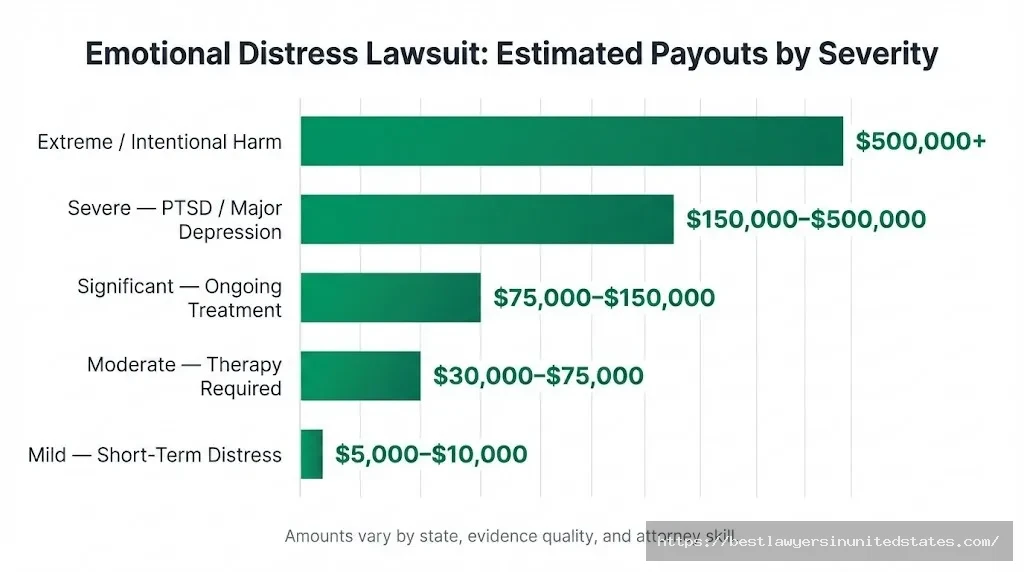
Quick Answer: Compensation ranges from a few thousand dollars for minor, short-term cases to $500,000 or more for severe, well-documented claims. There is no fixed formula — but the severity of your suffering, quality of your evidence, and your state’s laws are the three biggest factors.
Compensation Ranges by Severity
| Severity Level | Typical Settlement Range | What This Covers |
|---|---|---|
| Mild | $5,000 – $10,000 | Short-term anxiety, temporary sleep issues, resolves quickly |
| Moderate | $30,000 – $75,000 | Anxiety/depression requiring therapy, noticeable lifestyle disruption |
| Significant | $75,000 – $150,000 | Ongoing treatment, work impacts, relationship strain |
| Severe | $150,000 – $500,000+ | PTSD, major depression, long-term impairment |
| Extreme/Intentional | $500,000 – millions | Deliberate misconduct, egregious conduct, catastrophic psychological harm |
In California, there is no cap on emotional damages, with emotional distress settlements typically ranging from $5,000–$10,000 for mild cases to $100,000–$500,000+ for severe cases. Keller Williams Lawsuit
How Attorneys Calculate Your Damages
There are two main methods used to put a dollar value on emotional distress:
The Multiplier Method (most common) It works by adding up all the tangible or economic damages, like medical costs and lost wages, and then multiplying that sum by a given number, usually between 1.5 and 5. That total then becomes the overall settlement proposal.
The Per Diem Method Your attorney assigns a daily dollar rate to your suffering and multiplies it by the number of days you’ve suffered. For example, $150/day × 365 days = $54,750. This works especially well for cases where recovery has a clear endpoint.
Factors That Affect Your Payout
| Factor | How It Affects Your Award |
|---|---|
| Severity and duration | Longer, more intense suffering = higher compensation |
| Physical symptoms | Insomnia, headaches, weight loss strengthen claims |
| Medical treatment | More documented treatment = stronger evidence of real harm |
| Defendant’s conduct | Intentional or outrageous behavior leads to higher awards |
| State damage caps | Some states limit non-economic damages (especially medical malpractice) |
| Quality of evidence | Strong documentation is the single biggest variable |
| Your attorney’s skill | Experienced negotiators consistently secure higher settlements |
| Jury sympathy | In trials, how believable and consistent you appear matters enormously |
Several factors influence the final settlement amount in emotional distress claims, including the defendant’s willingness to participate in negotiations, the strength of the evidence presented, and potential negative publicity for the defendant.
State Damage Cap Comparison
| State | Cap on Non-Economic Damages? | Notes |
|---|---|---|
| California | No cap (most cases) | No limit in personal injury; some med mal caps apply |
| Alabama | No cap | Mental anguish treated as compensatory damages |
| Florida | Limited in some cases | Caps apply in medical malpractice; standard cases no cap |
| Texas | Caps in medical malpractice | $250K–$750K depending on defendant type |
| New York | No statutory cap | Jury determines fair amount |
| Pennsylvania | No cap | Juries have wide discretion |
Always check your state’s current laws — caps and rules change, and your attorney will know the current limits.
How to File an Emotional Distress Lawsuit — Step by Step
⚠️ DEADLINE WARNING: Most states give you only 1–3 years from the date of the incident to file. If you miss this window, you permanently lose your right to compensation — regardless of how strong your case is. Act now.

Step 1: Document Everything Starting Today
The moment you decide to pursue a claim, your documentation becomes your most valuable asset.
Start a daily journal recording how your distress affects you. Write entries like: “Today I couldn’t drive past the intersection where the accident happened. I had a panic attack and had to pull over for 20 minutes.” These specific, dated entries carry real weight in court and during settlement negotiations.
Step 2: Seek Professional Mental Health Treatment
See a therapist, psychologist, or psychiatrist as soon as possible. This serves two purposes: it helps you heal, and it creates the official medical record that your claim depends on.
Be completely honest about your symptoms. Don’t downplay what you’re experiencing. The more accurately your provider documents your condition, the stronger your legal case becomes.
Step 3: Gather All Incident-Related Evidence
Collect everything related to the event that caused your distress:
- Police reports or accident reports
- Medical records from any physical treatment
- Employer communications (for workplace claims)
- Emails, texts, or messages from the defendant (for harassment/IIED claims)
- Photos, videos, or security footage if available
- Names and contact information for witnesses
Step 4: Consult a Personal Injury Attorney (Free)
Most attorneys who handle emotional distress cases work on contingency — meaning you pay nothing unless you win. You will not be charged any legal fees for their efforts if your attorney is not able to obtain a verdict or settlement for your injury.
During your free consultation, bring all your documentation. The attorney will tell you honestly whether your case has merit and what it might be worth.
Step 5: Your Attorney Files the Complaint
Your attorney drafts and files a formal legal complaint with the appropriate court. This document identifies the defendant, describes what happened, explains how it caused your distress, and states what compensation you’re seeking.
Once filed, the defendant is formally served with notice of the lawsuit. The litigation process begins.
Step 6: Discovery Phase
Both sides exchange evidence. This includes:
- Depositions (recorded sworn testimony from you, the defendant, and witnesses)
- Document requests (medical records, communications, financial records)
- Interrogatories (written questions both parties must answer under oath)
- Expert witness designations
This phase typically takes 6–18 months, depending on complexity.
Step 7: Negotiation and Settlement
You’ll participate in mediation or settlement negotiations with the defendant’s legal team to attempt to resolve the case outside of court.
The vast majority of emotional distress lawsuits settle before trial — often between 85–95% of cases. Settlement is faster, less costly, and eliminates the uncertainty of a jury verdict.
Step 8: Trial (If No Settlement Is Reached)
If negotiations fail, your case goes to trial. Your attorney presents evidence, calls witnesses (including mental health experts), and argues for maximum compensation. A judge or jury then decides the outcome.
Step 9: Receive Your Award
If you win at trial or settle, your attorney receives the agreed amount and deducts their contingency fee (typically 33% pre-trial, 40% if it goes to trial). You receive the remainder.
Step-by-Step Filing Timeline
| Stage | Typical Timeframe | What Happens |
|---|---|---|
| Initial consultation | Week 1 | Attorney evaluates your case |
| Investigation & evidence gathering | Months 1–3 | Build your documentation |
| Complaint filed | Month 2–4 | Formal lawsuit begins |
| Discovery phase | Months 4–18 | Evidence exchange, depositions |
| Mediation/settlement talks | Months 12–24 | Negotiation attempts |
| Trial (if needed) | 18–36 months | Court proceedings |
| Payment received | After settlement/verdict | Typically within 30–60 days |
Your State’s Filing Deadline — Don’t Miss This
This is the most critical table in this guide. Missing your state’s statute of limitations means losing your right to compensation permanently.
| State | Filing Deadline | Notes |
|---|---|---|
| California | 2 years | IIED and NIED; discovery rule may extend |
| New York | 3 years (most cases) | Government entity claims require Notice of Claim within 90 days |
| Florida | 2 years | Applies to most personal injury including emotional distress |
| Texas | 2 years | Runs from date of incident |
| Alabama | 2 years | General personal injury statute |
| Tennessee | 1 year | One of the shortest in the country |
| Washington | 2 years | Runs from date of incident for IIED |
| Pennsylvania | 2 years | Standard personal injury limit |
| Illinois | 2 years | Strict enforcement |
| Oregon | 2 years | May be tolled for disabling mental conditions |
Special situations that can extend your deadline:
- Minors: For minors, the statute of limitations does not start until they reach the age of 18, allowing them to file until they are 20.
- Discovery rule: If you didn’t immediately know what caused your distress, the clock may start when you discovered (or reasonably should have discovered) the cause
- Continuing conduct: If the claim involves continuous conduct by the defendant, the statute of limitations may be tolled until the last incident occurs.
- Government defendants: Almost always require a shorter notice period — often 90–180 days before you can even sue
⚠️ Never assume you have more time than you think. Contact an attorney immediately to confirm your specific deadline.
Current Legal Landscape: 2026 Updates
Growing Recognition of Standalone Emotional Distress Claims
Courts across the country have steadily expanded recognition of emotional distress claims, even without accompanying physical injuries. Traditionally, courts were reluctant to allow claims for “pure” emotional harm unless there was a physical injury involved. Over time, however, exceptions have developed, and today many states permit standalone claims for emotional distress, especially in cases of intentional misconduct, severe negligence, or civil rights violations.
This is particularly significant for workplace harassment victims and civil rights plaintiffs, who may have suffered profound psychological harm with no visible physical injury.
Workplace Claims Rising
Emotional distress claims tied to workplace misconduct — harassment, discrimination, hostile environments, and retaliation — have grown significantly in recent years. Incidents in the workplace can cause profound emotional distress, impacting an employee’s mental state and general welfare. Harassment often triggers this distress, leading to conditions like anxiety, depression, or post-traumatic stress disorder.
Employees who report discrimination and then face retaliation have some of the strongest IIED claims in employment law.
Technology and AI in Case Preparation
AI and data analytics now offer valuable tools for personal injury lawyers — streamlining case preparation, providing data-driven insights for settlement proposals, and strengthening negotiation strategies for better client outcomes. This benefits plaintiffs whose attorneys use these tools to build more compelling, data-supported claims.
Comparison: Emotional Distress vs. Related Claims
| Claim Type | What You Prove | Typical Settlement | Common Scenario |
|---|---|---|---|
| Emotional Distress (IIED) | Outrageous intent + severe harm | $50K–$500K+ | Targeted workplace harassment |
| Emotional Distress (NIED) | Negligence + serious harm | $20K–$200K | Car accident PTSD |
| Pain & Suffering (general) | Physical + emotional harm | Varies widely | Personal injury cases |
| Punitive Damages | Extreme recklessness/malice | Can multiply award | Added on top of other damages |
| Loss of Consortium | Relationship harm from injury | $25K–$150K | Spouse impacted by victim’s trauma |
Do You Need a Lawyer to File an Emotional Distress Lawsuit?
Quick Answer: You don’t legally need a lawyer — but you almost certainly should hire one. Emotional distress cases are among the harder personal injury claims to prove, and experienced attorneys consistently win significantly higher settlements. Most work on contingency, so you pay nothing unless you win.
Why Legal Representation Matters in These Cases
Without representation, many victims accept low settlements or struggle to prove the full impact of their suffering. With the right lawyer, your story is more likely to be heard and your distress more fully recognized.
Insurance companies have experienced claims adjusters and defense attorneys whose entire job is to minimize what they pay you. Going in without legal representation is a significant disadvantage.
What a Good Attorney Does for Your Case
From the outset, your lawyer will conduct a thorough investigation by collecting and preserving all relevant evidence, consulting with medical and mental health experts, and identifying additional witnesses whose testimony can bolster your case. Attorneys ensure your claim meets strict notice requirements and is filed within applicable statutes of limitations, preventing any technical missteps that could jeopardize your recovery. Adriana Chechik Lawsuit
When to Definitely Get Legal Help
Consider it non-negotiable to hire an attorney if:
- Your distress involves PTSD, major depression, or other serious diagnosed conditions
- The incident involved intentional or egregious conduct
- The defendant is a large company, employer, or government entity
- Your case has any complexity — multiple defendants, unclear liability, disputed facts
- The insurance company has already offered a settlement (don’t accept without legal review)
- Government entities are involved (notice deadlines are extremely strict and short)
Finding Free Legal Help
Most personal injury attorneys offer free consultations and work on contingency — no upfront costs to you. Look for attorneys who specifically handle:
- Personal injury law
- Employment law (for workplace claims)
- Civil rights law (for discrimination/harassment claims)
You can search your state bar association’s lawyer referral service, or contact [email protected] for attorney referrals.
Frequently Asked Questions
What is an emotional distress lawsuit?
Quick Answer: A legal claim for psychological suffering caused by someone else’s negligent or intentional actions — covering conditions like PTSD, anxiety, depression, and mental anguish.
Emotional distress is legally defined as a highly unpleasant emotional reaction resulting in significant mental suffering. To file an emotional distress lawsuit, one must demonstrate that another party’s negligent or intentional actions caused their mental suffering.
Can I sue for emotional distress without physical injuries?
Quick Answer: Yes, in many states — but it’s harder. You’ll need strong documented evidence of your psychological harm.
It’s a common misconception that you need physical injuries to claim emotional distress. In reality, emotional distress is legally actionable, even without any bodily harm. However, standalone emotional distress claims without physical injury face higher evidentiary hurdles in most states.
How much can I get for emotional distress?
Quick Answer: Anywhere from a few thousand to several hundred thousand dollars, depending on severity and evidence.
Minor cases may result in compensation ranging from a few thousand to tens of thousands of dollars. More moderate cases often fall between $30,000 and $100,000. Severe cases may exceed $100,000, sometimes reaching several hundred thousand dollars. In rare, high-profile cases, awards have climbed into the millions.
How long do I have to file?
Quick Answer: Typically 2–3 years from the incident, but as short as 1 year in some states (like Tennessee). Check your state’s specific deadline immediately.
Most personal injury claims, including those for emotional distress, must be filed within 3 years of the injury. In some cases, such as when harm is not immediately discoverable or involves a minor, the statute may be extended.
What evidence do I need to prove emotional distress?
Quick Answer: Medical and therapy records, a personal journal, witness statements, and often expert testimony from a mental health professional.
The expertise of mental health professionals and testimonies from loved ones can greatly strengthen your case and potentially lead to a higher settlement amount. The more consistently you document your symptoms over time, the more credible your claim becomes.
How is emotional distress calculated?
Quick Answer: Usually through the multiplier method (economic damages × 1.5–5) or the per diem method (daily rate × number of days affected).
The multiplier used depends on severity. A case with severe, long-lasting PTSD might use a multiplier of 4 or 5. A moderate anxiety case might use 1.5 or 2.
What if my employer caused my emotional distress?
Quick Answer: You may have both an IIED claim and employment law claims (discrimination, harassment, retaliation) — potentially a stronger case than a personal injury claim alone.
Workplace emotional distress cases often involve multiple legal theories, and a combined approach can significantly increase compensation. Employment attorneys handle these cases on contingency too.
Will I have to go to court?
Quick Answer: Probably not. The vast majority of emotional distress cases settle before trial — but having an attorney who’s willing to go to court makes defendants settle for more.
Most cases resolve through negotiation or mediation. Trials are time-consuming and expensive for both sides, which creates strong pressure to settle.
How long does an emotional distress lawsuit take?
Quick Answer: Anywhere from several months (simple cases that settle quickly) to 3+ years (complex cases that go to trial).
Cases with clear liability and good documentation often settle in 6–18 months. The more contested the facts or the larger the claim, the longer the process typically takes.
Does emotional distress compensation get taxed?
Quick Answer: In most cases, compensation for physical injury and associated emotional distress is not taxable. Standalone emotional distress awards may be taxed differently.
The IRS generally excludes personal injury compensation from income — but the tax treatment of emotional distress depends on specifics. Consult a tax advisor before filing your returns after receiving a settlement.
What if the incident also caused physical injuries?
Quick Answer: Your emotional distress claim becomes significantly stronger and is typically included as part of your broader personal injury case.
Physical injuries create a foundation for emotional distress claims. Courts and juries readily accept that serious physical trauma naturally leads to psychological harm, which makes your claim more credible and your multiplier higher.
Can I file if I witnessed harm to a family member?
Quick Answer: Yes — this is called a “bystander claim” and is recognized in many states, particularly when you witnessed a traumatic event involving a close relative.
The bystander rule allows claims if a person witnesses harm to a relative or friend. Requirements vary by state, but most require you to be physically present, closely related to the victim, and to have suffered genuine psychological trauma as a result.
What if my emotional distress is from a car accident?
Quick Answer: Car accidents are one of the most common sources of emotional distress claims — PTSD, anxiety, and driving phobia after serious crashes are well-recognized by courts and insurers.
Claims of emotional distress are a critical aspect of personal injury lawsuits related to automobile accidents because they encompass the psychological consequences of the accident. Auto accidents may give rise to severe emotional reactions such as anxiety and PTSD, which can disrupt everyday activities.
What if the government caused my distress?
Quick Answer: You can still sue, but government claims have significantly shorter notice deadlines — sometimes as little as 90 days. Act immediately.
If the claim is against a government entity, you must file a Notice of Claim within 90 days of the incident. Missing these deadlines can mean losing your right to pursue a claim entirely.
What if my statute of limitations already passed?
Quick Answer: You may still have options — especially if your distress was so severe it prevented you from understanding your legal rights, or if you’re a minor, or if the conduct was ongoing.
In some cases, such as when harm is not immediately discoverable or involves a minor, the statute may be extended. Consult an attorney immediately — don’t assume you’ve run out of time without getting a professional opinion.
Can I file on my own without an attorney?
Quick Answer: Technically yes — but it’s not recommended. Insurance companies and defense attorneys are experienced at minimizing payouts to unrepresented claimants.
Filing pro se (without an attorney) in an emotional distress case is particularly risky because these claims are complex, subjective, and heavily dependent on how well evidence is presented. Most attorneys cost you nothing unless you win.
What happens if my claim is denied?
Quick Answer: Your attorney can appeal, push for trial, or explore other legal avenues. A denial at the insurance level doesn’t end your case.
Insurance company denials are not final decisions. Your attorney can file a lawsuit and let a judge or jury decide — which often motivates insurance companies to settle rather than face a trial.
How do I find an attorney for an emotional distress case?
Quick Answer: Search your state bar’s referral service, ask for personal recommendations, or contact [email protected]. Always choose someone with specific experience in personal injury or employment law.
Look for attorneys with demonstrated results in emotional distress, personal injury, or employment cases. Check reviews, ask about their case history, and confirm they work on contingency before signing anything.
Summary: What to Do Right Now
If you believe you have an emotional distress claim, the most important steps are time-sensitive. Start here:
- Check your state’s filing deadline — confirm your statute of limitations immediately
- See a mental health professional — start building your medical record today
- Document everything — begin a daily journal with specific, dated entries
- Preserve all evidence — save communications, reports, and incident records
- Consult a free attorney — most offer no-cost initial consultations and charge nothing unless you win
- Don’t talk to the defendant’s insurance company — without legal counsel, insurers routinely record and use your statements against you
The law recognizes that psychological harm is real — and it can be just as devastating as physical injury. You have the right to seek compensation. The question is whether you act before the clock runs out.
This article provides general legal information for educational purposes only. It is not legal advice. Laws vary significantly by state and individual circumstances. Always consult a licensed attorney in your jurisdiction before taking legal action.

Comments