Quick Answer Box
- A slander lawsuit is a civil defamation claim based on a false spoken statement that damaged someone’s reputation, career, or financial standing.
- Private individuals can qualify by showing the statement was false, published to at least one third party, and caused measurable harm; public figures must also prove actual malice.
- Verdicts in slander cases have ranged from $50,000 to over $350 million depending on the plaintiff’s status, the severity of reputational harm, and whether punitive damages were awarded.
Case Snapshot
| Detail | Information |
|---|---|
| Legal Category | Civil defamation tort (spoken form) |
| Governing Standard | New York Times Co. v. Sullivan, 376 U.S. 254 (1964); Gertz v. Robert Welch, Inc., 418 U.S. 323 (1974) |
| Typical Court | State trial court (county or district level); federal court where diversity jurisdiction applies |
| Statute of Limitations | 1 to 3 years depending on state (see state-by-state table below) |
| Damage Range | $50,000 to $350M+ (compensatory and punitive combined in high-profile cases) |
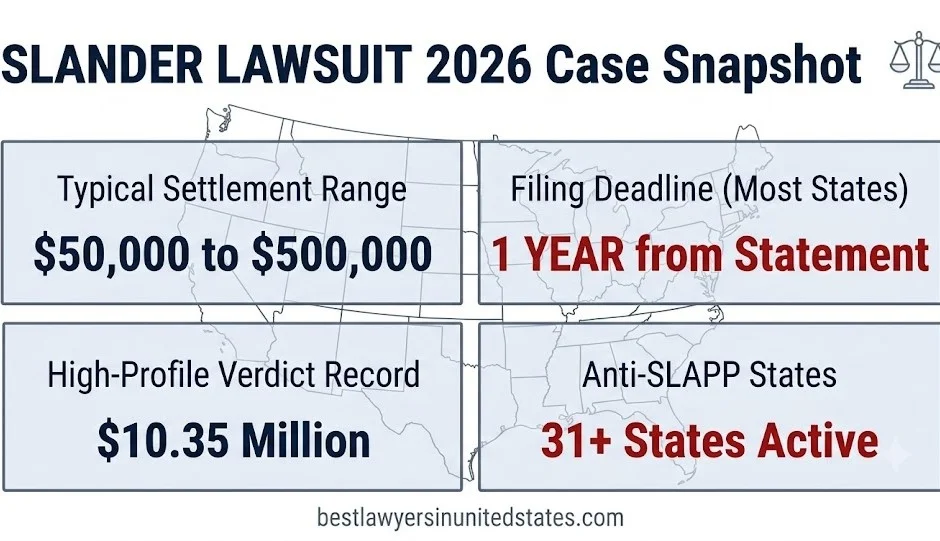
| Notable Recent Case | Depp v. Heard, Fairfax County Circuit Court, Case No. CL-2019-0007409, $10.35M compensatory and punitive verdict (2022) |
| Anti-SLAPP Risk | High in California, Texas, Washington D.C., and 31 other states with active statutes |
| Case Status | Active area of litigation nationwide as of 2026 |
A slander lawsuit gives a person whose reputation was damaged by a false spoken statement the legal right to demand compensation in civil court. These cases are harder to win than many plaintiffs expect, and they are easier to lose than most defendants assume. The evidentiary burden is specific, the timeline is measured in years not months, and the financial exposure on both sides is real.
Defamation litigation has expanded sharply since 2020. High-profile verdicts like the $10.35 million Depp v. Heard outcome and the $787.5 million Fox News settlement in the Dominion Voting Systems libel case raised public awareness of what reputational lawsuits can actually produce. Those cases were not typical, but they clarified the legal terrain for plaintiffs and defendants alike.
Understanding what makes a slander claim viable, what it costs, and what it realistically pays is the starting point for anyone considering litigation. The sections below move through each layer of that analysis in order.
What Is a Slander Lawsuit?
A slander lawsuit is a civil action brought against someone who made a false spoken statement that harmed the plaintiff’s reputation. Slander sits within the broader tort of defamation, which covers both spoken and written false statements.
The key word is “spoken.” That oral component is what separates slander from libel. Slander includes statements made in person, over the phone, in video calls, or in audio recordings where the primary medium was speech rather than text.
Courts treat slander claims under state tort law, and the standards vary. Federal constitutional law, specifically the First Amendment framework established by the U.S. Supreme Court, sets the outer limits that every state must respect.
Key distinctions:
- Slander: false spoken statement
- Libel: false written or published statement
- Defamation per se: statement so harmful that damages are presumed (e.g., accusing someone of a crime or serious sexual misconduct)
- Defamation per quod: statement that requires proof of specific economic harm
Attorney Insight: Attorneys handling these claims point to the per se versus per quod distinction as one of the most consequential early determinations in any slander case, because it directly controls what the plaintiff must prove at trial to recover damages.
What Counts as Slander Legally?
Slander, legally defined, requires more than an insult or a harsh opinion. The statement must be a false assertion of fact, not protected opinion or hyperbole.
Courts apply a reasonable-listener test. If a reasonable person hearing the statement would interpret it as a factual claim rather than exaggerated rhetoric, the defamation analysis proceeds. Statements made in obvious jest or clearly framed as speculation generally do not qualify.
The statement also must have been communicated to at least one person other than the plaintiff. That element is called “publication,” and it applies even when the audience is a single colleague or neighbor.
A statement qualifies as potential slander when it is:
- Spoken out loud (not written, typed, or texted)
- Factually false, not merely unflattering or unkind
- Communicated to at least one third party
- About a specific, identifiable person
- Capable of harming that person’s reputation in the community
A statement does not qualify when it is:
- Pure opinion clearly framed as subjective belief
- Rhetorical hyperbole that no reasonable listener would take as literal fact
- Truth, which is an absolute defense
- Protected by privilege (courtroom testimony, legislative speech, fair comment)
Attorney Insight: Attorneys handling these claims note that the line between protected opinion and actionable fact is where most pre-trial motions are won and lost, making the framing of the original statement critical to early case evaluation.
Slander vs. Libel Lawsuit: Key Differences
Slander and libel are both defamation claims, but they carry different evidentiary challenges and historically different damage presumptions. The distinction matters when evaluating which type of case you have.
Libel, because it involves written or recorded statements, is easier to prove and document. The statement exists. It can be entered into evidence directly. Slander, by contrast, is transient by nature. Proving exactly what was said, in what context, and to whom is frequently the central evidentiary challenge.
Several states historically required slander plaintiffs to prove “special damages,” meaning actual economic loss, unless the statement fell into the per se category. Libel plaintiffs in those same states could sometimes presume general damages without that economic proof requirement.
| Feature | Slander (Spoken) | Libel (Written/Published) |
|---|---|---|
| Medium | Oral, audio, verbal | Text, print, broadcast, online post |
| Evidence | Witness testimony, recordings | Document, screenshot, publication |
| Damage Presumption | Often requires proof of economic loss | General damages sometimes presumed |
| Defamation Per Se | Applies to both | Applies to both |
| Statute of Limitations | Varies by state (typically 1 to 2 years) | Varies by state (typically 1 to 3 years) |
| Common Defense | Truth, opinion, privilege | Truth, opinion, fair comment, wire service |
Attorney Insight: Attorneys handling these claims routinely advise clients that cases involving recorded audio or video of an oral statement are treated more like libel in practice, because the evidentiary foundation is identical regardless of the original medium.
Elements of a Slander Claim
Four elements must be established for a slander claim to survive dismissal and reach trial. Failure on any single element is grounds for the court to dismiss the case before a jury ever hears it.
The four elements, drawn from the Restatement (Second) of Torts Section 558, are recognized across every U.S. jurisdiction with state-specific variations:
Element 1: False Statement of Fact
The plaintiff must show the defendant made a statement that was objectively false and presented as fact, not opinion.
Element 2: Publication
The statement was communicated to at least one person other than the plaintiff. One witness is sufficient, but the plaintiff bears the burden of proving that communication occurred.
Element 3: Fault
Private individuals must show the defendant acted with at least negligence. Public figures and public officials must clear the higher “actual malice” bar: knowing falsity or reckless disregard for truth.
Element 4: Damages
The plaintiff suffered harm to reputation, career, relationships, or finances as a direct result of the false statement. For defamation per se categories, some states presume damages without requiring specific proof.
| Element | Standard for Private Person | Standard for Public Figure |
|---|---|---|
| False Statement | Required | Required |
| Publication | One third party minimum | One third party minimum |
| Fault | Negligence (at minimum) | Actual malice required |
| Damages | Provable harm or per se presumption | Actual damages typically required |
Attorney Insight: Attorneys handling these claims note that the damages element is where most winnable cases still fail at trial, because plaintiffs underestimate how much documented evidence of real-world harm the jury expects to see.
Proving Slander in Court
Proving slander at trial is a documentary and testimonial challenge unlike most civil litigation. The statement itself is gone the moment it is spoken. What remains is the recollection of witnesses and any recordings that captured it.
Plaintiffs build their evidentiary case around three categories of proof. First, direct evidence of what was said: eyewitness testimony, sworn depositions from people who heard the statement, and any audio or video recordings. Second, circumstantial evidence connecting the statement to specific reputational harm: lost business relationships, employment termination letters, written communications reflecting changed attitudes. Third, expert testimony in cases involving professional reputations or complex damages calculations.
Discovery in slander cases frequently targets the defendant’s communications before and after the alleged statement. Text messages, emails, and social media posts showing the defendant knew a statement was false before making it are among the most damaging evidence a plaintiff can uncover.
Evidence types ranked by courtroom effectiveness:
- Audio or video recording of the exact statement
- Multiple independent eyewitnesses who heard it
- Written records created shortly after (emails, texts referencing what was said)
- Evidence of economic harm directly tied to the statement
- Prior communications showing the defendant knew the statement was false
Attorney Insight: Attorneys handling these claims consistently identify the gap between “I know what was said” and “I can prove in court what was said” as the single most frequent reason a client’s otherwise strong case becomes a liability at trial.
Litigation Watch: The core challenge in any slander case is that the tort is built on a transient act, and the entire litigation then turns on reconstructing that act through documentation, witnesses, and economic harm evidence.
Actual Malice Standard in Slander Cases
The actual malice standard is the constitutional fault threshold that applies when the plaintiff is a public official or public figure. It was established by the U.S. Supreme Court in New York Times Co. v. Sullivan, 376 U.S. 254 (1964), and it remains controlling law today.
Actual malice does not mean spite or ill will in the everyday sense. It means the defendant either knew the statement was false at the time of making it or acted with reckless disregard for whether it was true or false. That is a high bar, and it was designed to be.
The Court reinforced and refined this framework in Gertz v. Robert Welch, Inc., 418 U.S. 323 (1974), drawing the critical line between public figures (who must prove actual malice for any damages) and private individuals (who need only prove negligence for at least actual damages). States may set a higher fault standard for private figures, but cannot set a lower one.
| Plaintiff Type | Required Fault Level | Source |
|---|---|---|
| Public official | Actual malice | NYT v. Sullivan (1964) |
| All-purpose public figure | Actual malice | Gertz (1974) |
| Limited-purpose public figure | Actual malice for related statements | Gertz (1974) |
| Private individual | Negligence (at minimum) | Gertz (1974) |
Attorney Insight: Attorneys handling these claims report that defendants in high-profile cases routinely file early motions to declare the plaintiff a public figure, because that single classification shifts the entire burden of proof and reduces the defendant’s litigation risk substantially.
Public Figure Slander Lawsuit
Public figures face the most demanding evidentiary threshold in slander litigation. Beyond proving the four standard elements, they must also demonstrate the defendant knew the statement was false or acted with reckless disregard for its truth.
That standard blocked most defamation claims against media organizations for decades. But the litigation landscape shifted after several high-profile cases produced record verdicts. The 2022 Depp v. Heard trial in Fairfax County Circuit Court, Case No. CL-2019-0007409, drew global attention. The jury awarded Johnny Depp $10 million in compensatory damages and $5 million in punitive damages, later reduced by Virginia’s statutory cap to $350,000 in punitive damages, for a total judgment of $10.35 million.
The case demonstrated that public figure plaintiffs can prevail when they bring sustained documentary evidence of knowing falsity.
What public figure slander plaintiffs must prove:
- The defendant made a false statement of fact (not opinion)
- The statement was published to third parties
- The defendant knew it was false or acted with reckless disregard for truth (actual malice)
- The plaintiff suffered actual, provable damages
Attorney Insight: Attorneys handling high-profile slander claims note that the actual malice standard, while demanding, can be met through the defendant’s own prior communications, internal documents, and deposition testimony showing knowledge of falsity before the statement was made.
Private Person Slander Claim
Private individuals hold the stronger litigation position in slander cases. They are not required to prove actual malice. Showing the defendant acted negligently in making or repeating a false statement is sufficient to reach trial and recover damages.
The tradeoff is that private-figure plaintiffs often have lower name recognition, which means the reputational harm can be harder to quantify in dollar terms. The harm is real, but demonstrating to a jury how a false statement cost a private person economically requires documented proof of lost income, damaged business relationships, or specific social or professional consequences.
Many private-figure slander cases arise in workplace, neighborhood, or community contexts. A false statement to an employer, a landlord, a school board, or a professional licensing body can inflict severe harm that meets the legal threshold even without a large media audience.
Common private-figure slander scenarios:
- False statements to an employer causing termination
- False accusations of criminal conduct made to neighbors or community members
- False professional misconduct allegations shared among industry peers
- False statements to lenders, landlords, or licensing authorities affecting financial standing
Attorney Insight: Attorneys handling private-figure slander claims note that documenting the chain of harm from statement to consequence is the clearest path to a strong damages presentation, and that plaintiffs should preserve all evidence of changed relationships immediately after the statement becomes known.
Litigation Watch: Public figure plaintiffs must prove actual malice, a constitutional standard set in 1964 and still controlling today, while private individuals need only show negligence, making their evidentiary burden substantially lower despite the often smaller scale of their cases.
How to Sue for Slander
Filing a slander lawsuit requires moving through a defined procedural sequence. The steps are not complex in isolation, but the timing and documentation requirements create real risk of case-ending errors for unprepared plaintiffs.
Step 1: Document the statement immediately.
Capture witness names, dates, locations, and any existing recordings. Wait, and memories fade. Courts expect timely documentation.
Step 2: Assess the statement against the four legal elements.
Before filing, a plaintiff and their attorney must evaluate falsity, publication, fault level, and damages with specificity.
Step 3: Issue a retraction demand where required.
Some states require or incentivize a formal retraction demand before filing. Skipping this step can limit available damages in jurisdictions like California, Florida, and Indiana.
Step 4: File the complaint in the correct court.
Most slander cases are filed in state trial court (county or district level). Federal court is available where diversity jurisdiction applies, meaning the parties are from different states and the amount in controversy exceeds $75,000.
Step 5: Anticipate anti-SLAPP exposure.
In states with strong anti-SLAPP laws, the defendant may file a special motion to strike early in the case, shifting the burden to the plaintiff to demonstrate a probability of prevailing.
Step 6: Proceed through discovery.
Depositions, document requests, and interrogatories are the tools for building the evidentiary record that the per-trial phase demands.
Attorney Insight: Attorneys handling these claims advise that the retraction demand step is chronically underused by unrepresented plaintiffs, and that skipping it in states where it affects damages can reduce the eventual recovery by tens of thousands of dollars.
Lawsuit for Slander: When Filing Makes Practical Sense
Not every qualifying slander case should be filed. The decision to pursue litigation turns on a realistic assessment of the damages available, the cost of the case, and the likelihood of collection.
A claim may be legally sound but financially irrational if the defendant has no assets to collect from and punitive damages are unlikely. Conversely, a claim against a business, employer, or media organization with identifiable assets and insurance coverage can produce meaningful recovery even on moderate damages.
Filing makes practical sense when at least three of these factors are present:
| Factor | Why It Matters |
|---|---|
| Documented economic harm | Gives the damages claim a hard number the jury can award |
| Identifiable defendant assets | Ensures any judgment is collectible |
| Strong witness or recording evidence | Reduces trial risk and increases settlement pressure |
| Per se statement category | Presumed damages reduce proof burden |
| Defendant is an entity (employer, org) | Insurance coverage makes recovery more likely |
| Single-event, clearly false accusation | Simplifies the falsity element at trial |
Attorney Insight: Attorneys handling these claims frequently identify cases where the legal merits are strong but the collection math is unfavorable, and advise clients that a pre-suit demand letter sometimes produces faster resolution at lower cost than full litigation.
Slander Lawsuit Damages
Slander lawsuit damages fall into four categories: compensatory, presumed, punitive, and nominal. The category that applies depends on the type of claim and the plaintiff’s status.
Compensatory damages cover actual proven losses. They include lost earnings and business revenue, medical or psychological treatment costs, and documented expenses caused by the defamatory statement.
Presumed damages apply in defamation per se cases. When the false statement accuses someone of a crime, a loathsome disease, professional incompetence, or serious sexual misconduct, many states allow the jury to presume reputational harm without requiring economic proof.
Punitive damages require showing the defendant acted with actual malice or deliberate, outrageous conduct. They are intended to punish and deter, and in the right case they can exceed compensatory damages by a wide margin.
Nominal damages are symbolic awards where the claim is proven but no actual harm is quantified. They are rare in slander cases.
| Damage Type | What It Covers | Who Qualifies |
|---|---|---|
| Compensatory | Lost income, medical costs, provable economic harm | All plaintiffs who prove harm |
| Presumed | General reputational harm without specific proof | Per se slander claimants in most states |
| Punitive | Punishment for malicious or reckless conduct | Plaintiffs proving actual malice or egregious conduct |
| Nominal | Token award where liability proven but harm unquantified | Rare; technically any successful plaintiff |
Attorney Insight: Attorneys handling these claims consistently note that juries in jurisdictions without punitive damage caps can award amounts that seem disproportionate to the compensatory evidence, which is why defendants frequently settle after a plaintiff survives summary judgment.
Slander Lawsuit Settlement Amounts
Slander lawsuit settlement amounts vary widely, and the absence of a public database for private settlements makes precise ranges difficult to publish with confidence. What court records and published verdicts do show is a pattern tied directly to plaintiff status, per se versus per quod classification, and the strength of actual malice evidence.
Published verdict and settlement data from recent high-profile cases:
| Case | Court | Year | Outcome | Amount |
|---|---|---|---|---|
| Depp v. Heard | Fairfax County Circuit Court, CL-2019-0007409 | 2022 | Jury verdict | $10.35M (compensatory + punitive, reduced) |
| Dominion v. Fox News | Delaware Superior Court, N22C-03-013 | 2023 | Settlement | $787.5M |
| McDougal v. Fox News | S.D.N.Y. | 2021 | Dismissed then settled | Confidential |
| Coral Ridge Ministries v. SPLC | M.D. Ala., 2:17-cv-00660 | 2022 | Dismissed on appeal | N/A |
Private-figure slander cases that settle before trial typically resolve between $50,000 and $500,000, based on published legal industry reports and jury verdict services. Cases with strong economic harm evidence and a per se statement category push toward the higher end.
Attorney Insight: Attorneys handling these claims note that most slander cases settle before trial, frequently after the plaintiff survives a motion for summary judgment, because that procedural milestone signals to the defense that the case has real trial merit.
Litigation Watch: Settlement amounts in slander cases are not random, they track predictably against the plaintiff’s documented economic loss, the defendant’s asset profile, and whether the case survived early dispositive motions intact.
Slander Lawsuit Cost and Fees
The cost of a slander lawsuit is a real barrier for many plaintiffs, and understanding the fee structure before filing is essential to making a rational litigation decision.
Most defamation attorneys offer contingency fee representation only in cases with strong damages projections. For cases where economic harm is modest, hourly or hybrid arrangements are more common, with rates ranging from $350 to $700 per hour for experienced defamation counsel in major markets.
Typical cost categories in a slander lawsuit:
| Cost Category | Estimated Range |
|---|---|
| Attorney fees (contingency) | 33% to 40% of recovery |
| Attorney fees (hourly) | $350 to $700/hour |
| Filing fees (state court) | $100 to $500 depending on jurisdiction |
| Process server / service | $50 to $200 per defendant |
| Expert witness fees | $5,000 to $50,000+ in complex cases |
| Deposition costs | $1,500 to $5,000 per deposition |
| Private investigator (evidence) | $1,000 to $10,000 |
Anti-SLAPP statutes in many states add a fee-shifting risk. If the plaintiff’s case is struck on an anti-SLAPP motion, the plaintiff may owe the defendant’s attorney fees. In California under Code of Civil Procedure Section 425.16, that fee award is mandatory.
Attorney Insight: Attorneys handling these claims advise that in states with strong anti-SLAPP statutes, the first strategic question is not “do we have a case” but rather “does the case survive anti-SLAPP exposure,” because losing that motion produces a double financial hit: dismissed case plus mandatory fee payment.
Slander Lawsuit Statute of Limitations
The statute of limitations is the filing deadline that permanently bars a slander claim if the plaintiff waits too long. Missing it ends the case regardless of how strong the underlying facts are.
Slander limitations periods are among the shortest in civil litigation. Most states set them at one to two years from the date the statement was made or, under the discovery rule, from when the plaintiff first knew or reasonably should have known about it.
Statute of Limitations by Selected State:
| State | Limitations Period | Discovery Rule? |
|---|---|---|
| California | 1 year (CCP § 340(c)) | Yes |
| Texas | 1 year (Tex. Civ. Prac. & Rem. Code § 16.002) | Limited |
| New York | 1 year (CPLR § 215(3)) | Limited |
| Florida | 2 years (Fla. Stat. § 95.11(4)(g)) | Yes |
| Illinois | 1 year (735 ILCS 5/13-201) | Yes |
| Pennsylvania | 1 year (42 Pa. C.S. § 5523(1)) | Yes |
| Georgia | 1 year (O.C.G.A. § 9-3-33) | Yes |
| Ohio | 1 year (Ohio Rev. Code § 2305.11(A)) | Yes |
| Michigan | 1 year (MCL § 600.5805(9)) | Yes |
| Virginia | 1 year (Va. Code § 8.01-247.1) | Yes |
Attorney Insight: Attorneys handling these claims report that the one-year default in most states means the window for viable litigation closes before many clients realize they have a claim, making early consultation with a defamation attorney a practical necessity rather than an optional step.
How Long Does a Slander Lawsuit Take?
A slander lawsuit from complaint filing to final resolution typically takes 18 months to four years in state court, depending on jurisdiction, docket congestion, and whether the case settles or goes to trial.
Cases in high-volume urban courts like Los Angeles Superior Court or the Southern District of New York can face 12 to 18 months of procedural delay before a trial date is set. Anti-SLAPP motions, where filed, add another four to eight months to the timeline because they generate a full briefing cycle and sometimes an interlocutory appeal.
Typical slander lawsuit timeline:
| Phase | Estimated Duration |
|---|---|
| Complaint filed to defendant’s answer | 30 to 60 days |
| Anti-SLAPP motion (where filed) | 4 to 8 months |
| Discovery period | 6 to 18 months |
| Summary judgment briefing | 3 to 6 months |
| Pre-trial motions and preparation | 2 to 4 months |
| Trial | 1 to 3 weeks |
| Post-trial motions and appeal | 6 to 18 months |
| Total estimated range | 18 months to 4+ years |
The Depp v. Heard case illustrates real timelines: the original complaint was filed in August 2019, and the jury returned its verdict in June 2022, nearly three years later, for a case that was vigorously litigated by well-funded parties.
Attorney Insight: Attorneys handling these claims note that most plaintiffs underestimate the timeline and the toll it takes, and that settlement discussions frequently accelerate after summary judgment, because both sides have a clearer view of their trial risk by that point.
Anti-SLAPP Laws and Slander
Anti-SLAPP statutes are designed to protect defendants from litigation intended to silence public participation rather than to vindicate genuine legal rights. They are a major strategic variable in slander cases, and they create substantial plaintiff-side risk in states where they apply broadly.
SLAPP stands for “Strategic Lawsuit Against Public Participation.” The anti-SLAPP mechanism allows a defendant to file a special motion to strike early in the case, before full discovery. The court then evaluates whether the defendant’s speech was connected to a public issue and whether the plaintiff has a probability of prevailing.
If the court grants the anti-SLAPP motion, the plaintiff’s case is dismissed and mandatory attorney fees typically follow. If the court denies it, the defendant can appeal immediately in most states, pausing the case during the appeal.
States with the strongest anti-SLAPP protections:
| State | Statute | Key Feature |
|---|---|---|
| California | CCP § 425.16 | Mandatory fee-shifting, interlocutory appeal |
| Texas | TCPA (Tex. Civ. Prac. & Rem. Code § 27.003) | Covers broad range of communications |
| Washington D.C. | D.C. Code § 16-5502 | One of the broadest scopes nationally |
| Oregon | ORS § 31.150 | Fee-shifting plus discovery stay |
| Nevada | NRS § 41.660 | Strong fee-shifting mechanism |
Attorney Insight: Attorneys handling slander cases in California and Texas specifically advise clients that anti-SLAPP exposure must be evaluated in the first attorney-client meeting, because the statute shapes every procedural decision that follows, including whether to file at all.
Litigation Watch: Anti-SLAPP statutes in California, Texas, and more than 30 other states give defendants an early procedural weapon that can terminate a slander case before discovery even begins, and they create mandatory fee-shifting liability for plaintiffs who lose the motion.
Defenses to a Slander Claim
Defendants in slander cases have a range of recognized legal defenses, and understanding them matters as much to plaintiffs evaluating their cases as to defendants preparing their responses.
Truth is the absolute defense. If the statement was true, no slander liability exists. Period. Courts do not award damages for accurate statements regardless of how damaging they were.
Privilege protects certain statements made in specific contexts. Absolute privilege covers testimony in judicial proceedings, statements by legislators on the floor of the legislature, and certain government communications. Qualified privilege covers statements made in good faith to protect a legitimate interest, such as an employer’s reference to a prospective employer, subject to the good faith requirement.
Opinion is protected by the First Amendment where the statement cannot be reasonably interpreted as stating actual fact. Courts assess the totality of the context: the precise language used, whether the statement is objectively verifiable, and the broader context in which it was made. Milkovich v. Lorain Journal Co., 497 U.S. 1 (1990), made clear there is no separate “opinion privilege,” but opinion-framed statements still receive contextual First Amendment protection.
Consent is a less common defense: if the plaintiff consented to the statement being made, the defamation claim fails.
Retraction does not eliminate liability but can reduce damages in states with retraction statutes.
| Defense | What It Requires | Effect If Successful |
|---|---|---|
| Truth | Showing the statement was substantially accurate | Complete defense, case dismissed |
| Absolute privilege | Qualifying context (courtroom, legislature) | Complete defense |
| Qualified privilege | Good faith, proper occasion, no excess | Shifts burden to plaintiff on malice |
| Opinion | Context shows no factual assertion | Bars liability |
| Consent | Plaintiff agreed to the statement | Bars liability |
| Retraction | Prompt, adequate correction | Reduces damages |
Attorney Insight: Attorneys handling slander defense note that qualified privilege is the most frequently litigated defense in workplace and professional-context cases, and that its success turns entirely on whether the plaintiff can produce evidence the defendant acted with malice or exceeded the scope of the privilege.
Slander Lawsuit by State
Slander lawsuits play out differently depending on the state where the case is filed. Each state sets its own statute of limitations, maintains its own anti-SLAPP rules, and in some cases imposes caps on punitive damages that directly affect what a plaintiff can realistically recover.
The states with the most active defamation dockets and the strongest plaintiff-side potential are generally those with large media markets, well-developed case law, and no punitive damage caps. New York, California, Florida, and Texas produce the highest volume of defamation litigation annually.
State-by-State Slander Litigation Comparison:
| State | SOL | Anti-SLAPP | Punitive Cap | Notes |
|---|---|---|---|---|
| California | 1 year | Strong (CCP § 425.16) | No statutory cap | Per se doctrine well developed |
| New York | 1 year | Moderate (CPLR § 3211) | No statutory cap | Single publication rule applies |
| Texas | 1 year | Strong (TCPA) | Capped (2x economic damages + $750K) | Fee-shifting on anti-SLAPP loss |
| Florida | 2 years | Moderate | No statutory cap | Retraction statute limits damages |
| Virginia | 1 year | Moderate | $350K punitive cap | Depp v. Heard venue; cap notable |
| Illinois | 1 year | Moderate | No statutory cap | Retraction statute applies |
| Georgia | 1 year | Limited | No statutory cap | Favorable to plaintiffs |
| Pennsylvania | 1 year | No statewide statute | No statutory cap | Active defamation docket |
Attorney Insight: Attorneys handling these claims frequently advise plaintiffs with multi-state exposure to conduct a choice-of-law analysis before filing, because the difference between Virginia’s $350,000 punitive damage cap and California’s uncapped punitive awards can be a case-defining variable.
Frequently Asked Questions
What is the difference between a slander lawsuit and a libel lawsuit?
Slander refers to defamation through spoken words; libel refers to defamation through written or published statements.
The legal elements are the same, but slander plaintiffs typically face a higher evidentiary burden because oral statements are transient and harder to document than written ones.
In practice, recorded oral statements are treated similarly to libel because the recording itself becomes direct evidence.
How much can you win in a slander lawsuit?
Slander lawsuit awards range from $50,000 to over $10 million depending on the plaintiff’s status, the severity of harm, and whether punitive damages apply.
Private-figure cases with documented economic harm typically settle in the $50,000 to $500,000 range before trial.
High-profile cases with actual malice evidence and strong jury sympathy have produced verdicts well above $10 million, as the 2022 Depp v. Heard outcome demonstrated.
How long do you have to file a slander lawsuit?
Most states set the slander statute of limitations at one year from the date the statement was made.
Florida allows two years; federal cases may vary by applicable state law.
Missing the deadline permanently bars the claim, regardless of how strong the facts are.
Can you sue for slander if the other person said it was their opinion?
The label “opinion” does not automatically protect a statement from slander liability.
Courts apply a contextual test: if a reasonable listener would interpret the statement as asserting fact rather than expressing belief, it is actionable even if the speaker framed it as opinion.
The U.S. Supreme Court confirmed this in Milkovich v. Lorain Journal Co., 497 U.S. 1 (1990).
Does a public figure have a harder time winning a slander lawsuit?
Public figures and public officials must prove “actual malice,” meaning the defendant knew the statement was false or acted with reckless disregard for its truth.
That standard, established in New York Times Co. v. Sullivan, 376 U.S. 254 (1964), is significantly harder to meet than the negligence standard that applies to private individuals.
However, high-profile plaintiffs have succeeded when they produced internal communications or depositions showing the defendant knew the truth before speaking.
What does a slander lawsuit cost to file?
Court filing fees for a slander lawsuit typically range from $100 to $500 in state court.
Total litigation costs, including attorney fees, expert witnesses, and deposition expenses, commonly run from $50,000 to $200,000 or more for cases that proceed to trial.
Contingency fee arrangements, where the attorney takes 33 to 40 percent of the recovery, are available in cases with strong damages projections but are not universal in defamation litigation.
Closing
A slander lawsuit is a viable legal remedy when a false spoken statement has caused documented harm to a person’s reputation, income, or professional standing. The legal framework is clear. The evidentiary burden is demanding. The financial exposure on both sides is real.
Anyone who believes they have a qualifying claim should act quickly. The one-year statute of limitations in most states closes the window fast. An attorney who focuses specifically on defamation litigation can assess the strength of the elements, the anti-SLAPP exposure in the relevant state, and the realistic damages picture before a single dollar is spent on filing fees.
The cases that succeed are the ones where the plaintiff understood the process before litigation began, not after.