
The Suboxone lawsuit is one of the largest pharmaceutical cases moving through federal courts in 2026. Thousands of people who took Suboxone Film for opioid addiction now say the drug destroyed their teeth, and they want Indivior to pay for it.
This article breaks down everything happening with the case right now. You’ll get the latest MDL updates, settlement projections, eligibility rules, filing deadlines, and step-by-step instructions on how to join.
Here’s a number that puts things in perspective. The FDA received reports of more than 300 dental adverse events linked to buprenorphine medications like Suboxone. Many patients lost multiple teeth. Some needed full mouth reconstructions costing $50,000 or more.
If you used Suboxone and your teeth paid the price, this is the guide you need.
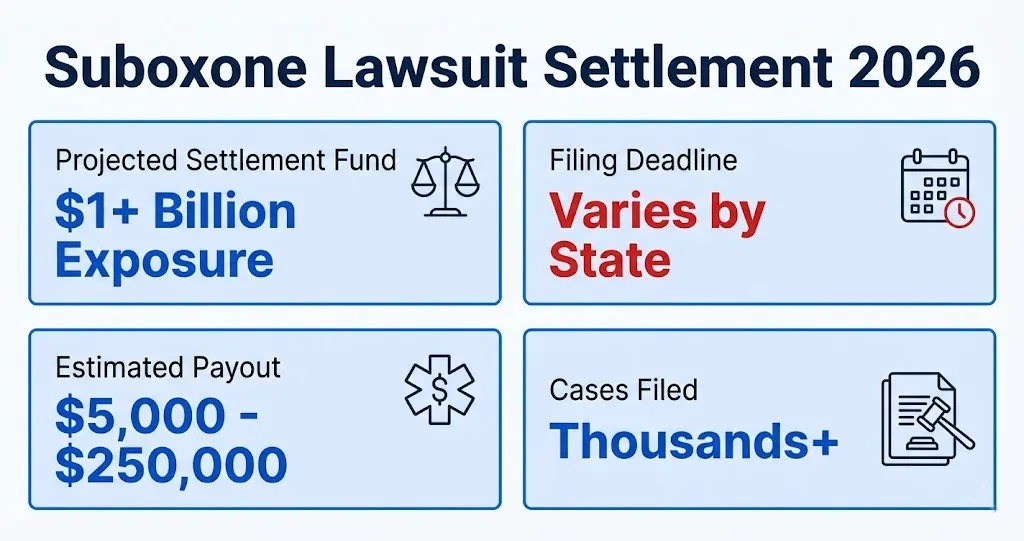
Suboxone Lawsuit
The Suboxone lawsuit refers to thousands of individual legal claims filed against Indivior Inc. by patients who suffered serious dental injuries after using Suboxone. These cases allege that Indivior knew its sublingual film could cause severe tooth decay but failed to warn patients or doctors.
Suboxone is a prescription medication that combines buprenorphine and naloxone. It dissolves under the tongue or against the cheek. That’s where the problem starts. The acidic formulation sits against teeth and gums, eating away at enamel over time.
Patients reported cavities, cracked teeth, infections, and complete tooth loss. Some needed dozens of dental procedures. Others required full dentures in their 30s and 40s.
| Detail | Info |
|---|---|
| Defendant | Indivior Inc. (formerly Reckitt Benckiser) |
| Product | Suboxone Sublingual Film |
| Main Allegation | Failure to warn about dental damage |
| Court | Northern District of Ohio |
| MDL Number | 3092 |
The lawsuit is not about whether Suboxone works for opioid addiction. It works. The legal issue is that Indivior allegedly hid the dental risks while making billions from the drug.
Suboxone Lawsuit Update 2026
As of 2026, the Suboxone litigation has entered a critical phase. Bellwether trials are either underway or imminent in MDL No. 3092, and both sides are preparing for potential settlement discussions.
The case has been consolidated in the U.S. District Court for the Northern District of Ohio. Consolidation happened because thousands of similar claims were filed across the country. Grouping them speeds up the pretrial process.
Key 2026 developments include:
- Bellwether case selections have been finalized, with initial trials expected to set the tone for settlement talks
- Expert discovery on dental causation is complete
- Indivior’s financial disclosures show the company has set aside reserves for litigation costs
- FDA’s 2022 safety warning about buprenorphine dental risks remains a central piece of evidence
The outcome of the first bellwether trials will likely determine whether Indivior pushes for a global settlement or fights case by case. Most legal analysts expect settlement talks to intensify in mid to late 2026.
Suboxone Tooth Decay Lawsuit
The Suboxone tooth decay lawsuit centers on one specific harm: the drug’s tendency to cause devastating dental damage. Patients are suing because Indivior did not adequately warn them that dissolving Suboxone Film in their mouths could rot their teeth.
The science behind it is straightforward. Suboxone Film has a low pH level, making it acidic. When placed under the tongue or against the cheek, it creates an acidic environment that weakens tooth enamel.
Over months and years of use, this leads to:
- Severe tooth decay and cavities
- Enamel erosion
- Tooth fractures and breakage
- Gum disease and infections
- Complete tooth loss requiring dentures or implants
The FDA issued a required label change in January 2022, forcing buprenorphine manufacturers to add dental risk warnings. Before that, Suboxone’s label said nothing about teeth. That gap between what Indivior knew and what it told patients is the heart of every claim.
Key Takeaway: The Suboxone lawsuit targets Indivior for hiding dental risks, and the 2026 bellwether trials will likely push the case toward settlement.
Lawsuit Against Suboxone
The lawsuit against Suboxone is really a lawsuit against the company behind it: Indivior Inc. Patients aren’t suing the drug itself. They’re suing the manufacturer for putting profits ahead of safety.
Indivior spun off from Reckitt Benckiser in 2014. Before the spinoff, Reckitt Benckiser developed and marketed Suboxone. Both entities face legal exposure, though Indivior carries the primary burden in current litigation.
The core legal claims include:
- Failure to warn: Indivior knew about dental risks but kept them off the label
- Negligence: The company didn’t conduct adequate studies on long-term dental effects
- Breach of warranty: Suboxone was marketed as safe when it wasn’t fully safe for dental health
- Strict product liability: The product had a design or warning defect
Internal documents suggest Indivior received dental injury reports for years before the FDA forced a label change. Plaintiffs’ attorneys argue this delay was deliberate because a dental warning could have hurt sales.
Suboxone generated over $1 billion in annual revenue at its peak. A dental warning might have pushed doctors toward alternative treatments. That financial motive is central to the negligence claims.
Suboxone Class Action Lawsuit
The term “Suboxone class action lawsuit” is widely searched, but it’s slightly misleading. The current Suboxone litigation is technically a multidistrict litigation (MDL), not a traditional class action.
The difference matters because it affects how you get paid. In a class action, everyone gets the same outcome. In an MDL, each person’s case is evaluated individually based on their specific injuries and damages.
| Feature | Class Action | MDL (Mass Tort) |
|---|---|---|
| Individual evaluation | No | Yes |
| Same payout for everyone | Usually yes | No, varies by case |
| Single trial for all | Yes | Bellwether trials set precedent |
| Opt-in required | Sometimes | Yes, you file individually |
| Settlement structure | One pool, equal shares | Tiered based on injury severity |
The Suboxone MDL (No. 3092) groups cases together for pretrial efficiency. Discovery, expert testimony, and motions are handled once rather than thousands of times. But when it comes time for trial or settlement, each plaintiff’s situation is weighed separately.
This is actually better for plaintiffs with serious injuries. If you lost 10 teeth, your case is worth far more than someone who had two cavities.
Is There a Suboxone Class Action
There is no certified class action for Suboxone dental claims as of 2026. The litigation is structured as a multidistrict litigation, or MDL, in the Northern District of Ohio.
Some people confuse MDLs with class actions because both involve many plaintiffs and one defendant. But they work differently in practice.
An MDL keeps each person’s claim separate. You file your own lawsuit. Your dental records, treatment history, and out-of-pocket costs are evaluated on their own merits. A class action would lump everyone together.
Why wasn’t this certified as a class action? Because dental injuries vary dramatically from person to person. One patient might have lost all their teeth. Another might have a few cavities. Treating them the same would be unfair to the person with worse injuries.
The MDL structure gives you a better shot at fair compensation. Your payout reflects your actual damage, not an average across thousands of claimants.
Key Takeaway: The Suboxone case is an MDL, not a class action. This means your payout depends on the severity of your own dental injuries, which benefits people with serious damage.
Who Qualifies for Suboxone Lawsuit
You may qualify for the Suboxone lawsuit if you took Suboxone Film and developed dental problems during or after treatment. The key requirement is a connection between Suboxone use and dental harm.
General qualification criteria include:
- You were prescribed Suboxone Film (sublingual or buccal form)
- You experienced tooth decay, tooth loss, cavities, fractures, or gum disease
- Your dental problems started or worsened after beginning Suboxone
- You had reasonably healthy teeth before starting the medication
- You incurred dental treatment costs as a result
People who used the tablet form of Suboxone may also qualify, but most cases focus on the film version. The film’s prolonged contact with oral tissues is the primary mechanism of dental damage.
| Qualification Factor | Details |
|---|---|
| Product Used | Suboxone Film (sublingual or buccal) |
| Dental Injury Required | Yes: decay, loss, fractures, erosion, infections |
| Pre-existing Dental Issues | Cases are stronger with healthy teeth before Suboxone |
| Time on Medication | Longer use strengthens the claim |
| Documentation Needed | Dental records, prescription history |
People with a history of methamphetamine use or severe pre-existing dental disease may face challenges. Indivior’s defense will argue those factors caused the damage, not Suboxone.
Suboxone Lawsuit Eligibility
Suboxone lawsuit eligibility depends on three main factors: what you took, what happened to your teeth, and whether you can prove the connection. Meeting all three gives you a strong case.
Factor 1: Medication History
You need proof that you were prescribed and took Suboxone. Pharmacy records, prescription logs, or medical charts showing buprenorphine/naloxone prescriptions all work.
Factor 2: Dental Injury
Your dental records must show problems that developed after you started Suboxone. The stronger cases involve tooth extractions, root canals, dental implants, or dentures. Minor cavities alone may not justify a claim.
Factor 3: Causation
Your dental problems need to be linked to Suboxone rather than other causes. If you had perfect teeth before Suboxone and needed 12 extractions after two years on the drug, that’s a strong causation argument.
Some things that could weaken eligibility:
- Heavy sugary diet or poor oral hygiene unrelated to medication
- Methamphetamine or other drug use known to damage teeth
- Pre-existing periodontal disease before starting Suboxone
- Inability to produce dental records from before treatment
Attorneys evaluate these factors during a free case review. Don’t assume you’re disqualified. Let a legal team assess your records.
Suboxone Dental Damage Claims
Suboxone dental damage claims cover a range of injuries from mild enamel wear to total tooth loss. The type and severity of your dental damage directly affects how much your claim is worth.
The most common dental injuries reported by Suboxone users include:
- Enamel erosion: The outer layer of teeth wears away, leaving them vulnerable
- Rampant cavities: Multiple teeth develop decay simultaneously
- Tooth fractures: Weakened teeth crack or break during normal use
- Root canals: Deep decay reaches the tooth’s nerve, requiring invasive treatment
- Tooth extractions: Teeth become unsalvageable and must be pulled
- Dentures or implants: Full or partial replacements needed after tooth loss
The financial burden is staggering. A single dental implant costs between $3,000 and $6,000. Full mouth reconstruction can exceed $50,000. Many Suboxone patients were already in financial difficulty due to addiction recovery, making these costs devastating.
Claims are typically organized into severity tiers. Higher-tier cases with more teeth lost and higher treatment costs receive larger settlements.
Key Takeaway: Your dental damage claim is evaluated individually. People who lost teeth or needed implants have the highest-value cases, while minor cavities result in smaller payouts.
Suboxone Lawsuit Evidence Needed
The evidence needed for a Suboxone lawsuit includes your dental records, prescription history, and proof of out-of-pocket costs. Strong documentation is the backbone of a winning claim.
Here’s what you should gather:
Medical and Prescription Records
- Prescription records showing Suboxone was dispensed to you
- Medical charts noting buprenorphine/naloxone treatment
- Dates you started and stopped taking Suboxone
- Pharmacy printouts or insurance claim records
Dental Records
- Records from before you started Suboxone (showing baseline dental health)
- Records from during and after Suboxone use (showing new problems)
- X-rays, treatment notes, and procedure summaries
- Dentist statements linking damage to acidic medication exposure
Financial Documentation
- Receipts and bills for dental procedures
- Insurance claim statements showing what was covered and what you paid
- Estimates for future dental work still needed
| Evidence Type | Why It Matters |
|---|---|
| Pre-Suboxone dental records | Proves your teeth were healthy before |
| Post-Suboxone dental records | Documents the damage timeline |
| Prescription records | Confirms you actually took Suboxone |
| Dental bills and receipts | Proves financial harm and out-of-pocket loss |
| Photos of dental damage | Visual proof for settlement negotiations |
If you don’t have every piece of evidence, an attorney can help obtain records. Pharmacies and dental offices keep records for years.
Suboxone Lawsuit Settlement Amounts
Suboxone lawsuit settlement amounts have not been officially announced as of 2026 because no global settlement has been reached yet. However, legal analysts project settlement values based on similar pharmaceutical cases and the severity of dental injuries involved.
Estimated per-person settlement ranges based on injury tier:
| Injury Tier | Description | Estimated Settlement |
|---|---|---|
| Tier 1 (Severe) | 10+ teeth lost, full dentures, implants needed | $100,000 to $250,000+ |
| Tier 2 (Moderate) | 5 to 9 teeth lost, multiple root canals, partial dentures | $50,000 to $100,000 |
| Tier 3 (Mild-Moderate) | 2 to 4 teeth affected, crowns, root canals | $20,000 to $50,000 |
| Tier 4 (Mild) | Enamel erosion, several cavities, fillings | $5,000 to $20,000 |
These are projections, not guarantees. The actual amounts will depend on bellwether trial outcomes and how aggressively Indivior negotiates.
For context, Indivior reported $1.1 billion in revenue for a recent fiscal year. The company has the resources to fund a substantial settlement. The question is whether bellwether trial results force them to the table or encourage them to fight.
Attorney fees typically run 33% to 40% of the settlement on a contingency basis. That means if you settle for $100,000, your attorney would take $33,000 to $40,000 and you’d keep the rest.
Suboxone Lawsuit Payout Per Person
The Suboxone lawsuit payout per person will vary widely based on individual dental damage. There is no flat payout amount because this is an MDL, not a class action with equal distributions.
Several factors determine your individual payout:
- Number of teeth affected: More teeth lost means a higher payout
- Type of dental treatment: Implants and dentures cost more than fillings
- Out-of-pocket expenses: How much you actually spent on dental care
- Duration of Suboxone use: Longer use may correlate with worse damage
- Pre-existing dental health: Healthy teeth before Suboxone strengthens your case
- Pain and suffering: Emotional distress and quality-of-life impact
Think of it like car insurance claims after a wreck. A fender bender pays less than a totaled car. If Suboxone totaled your teeth, your claim is worth significantly more.
Some legal analysts compare this litigation to the Zantac MDL and the 3M earplug litigation when projecting payouts. Those cases saw individual settlements ranging from a few thousand dollars to over $300,000 depending on injury severity.
If a global settlement fund is established, payouts would be distributed through a claims administrator using a point-based system. Points are assigned based on injury severity, treatment costs, and supporting evidence.
Key Takeaway: Individual Suboxone payouts could range from $5,000 for minor dental damage to $250,000 or more for severe tooth loss requiring full mouth reconstruction.
Suboxone Settlement Timeline
The Suboxone settlement timeline in 2026 depends heavily on bellwether trial results and whether Indivior decides to negotiate. Most legal experts expect meaningful settlement discussions to occur in the second half of 2026 or early 2027.
Here’s a projected timeline based on current case progress:
| Phase | Expected Timing |
|---|---|
| Bellwether case selections | Completed |
| Expert discovery completion | Completed |
| First bellwether trials | Mid 2026 |
| Settlement negotiations begin | Late 2026 |
| Global settlement agreement | Late 2026 to early 2027 |
| Claims process opens | 2027 |
| First payouts distributed | Mid to late 2027 |
Bellwether trials are test cases. A few representative plaintiffs go to trial first. The results signal to both sides what a jury thinks of the evidence. If Indivior loses big, they’ll be motivated to settle. If they win, they’ll push to fight more cases.
Patience is required. Pharmaceutical MDLs typically take 3 to 7 years from filing to payout. The Suboxone MDL was created in 2022, so a resolution timeline of 2026 to 2027 fits the normal pattern.
Once a settlement is reached, it still takes 6 to 12 months to process claims and distribute payments. Filing early gives you a head start in the queue.
Suboxone Lawsuit Deadline
The Suboxone lawsuit deadline depends on your state’s statute of limitations for product liability or personal injury claims. There is no single national deadline, but most states give you 2 to 3 years from when you discovered (or should have discovered) the connection between Suboxone and your dental damage.
| State | Statute of Limitations |
|---|---|
| California | 2 years from discovery |
| Texas | 2 years |
| New York | 3 years |
| Florida | 4 years (reduced to 2 years for claims after March 2023) |
| Ohio | 2 years from discovery |
| Pennsylvania | 2 years |
| Illinois | 2 years |
The discovery rule is important here. Your clock doesn’t necessarily start when you first took Suboxone. It starts when you knew or should have known that Suboxone caused your dental problems.
For many people, that date is January 2022, when the FDA added dental warnings to buprenorphine labels. If that’s your discovery date, your deadline could be as early as January 2024 to January 2025 depending on your state. That means some deadlines have already passed.
Don’t wait. If you haven’t filed yet, contact an attorney immediately. Some states have exceptions or tolling provisions that might extend your deadline, but you won’t know until a lawyer reviews your situation.
How to File a Suboxone Lawsuit
Filing a Suboxone lawsuit starts with a free case evaluation from an attorney who handles pharmaceutical litigation. You don’t pay anything upfront because these lawyers work on contingency.
Step-by-step filing process:
Step 1: Contact an Attorney
Reach out to a law firm that handles Suboxone cases. They’ll ask basic questions about your medication history and dental problems.
Step 2: Provide Documentation
Share your prescription records, dental records, and bills. The attorney’s team will help gather anything you’re missing.
Step 3: Case Evaluation
The attorney reviews your records and determines if your case is strong enough to file.
Step 4: File the Complaint
If you qualify, your attorney files a complaint in federal court. The case gets transferred to MDL No. 3092 in Ohio.
Step 5: Await Pretrial Proceedings
Your case joins the MDL. You wait for bellwether results and settlement negotiations. Your attorney keeps you updated.
Step 6: Settlement or Trial
You either accept a settlement offer or go to trial. Your attorney advises you on whether an offer is fair.
Cost to you upfront: $0. Attorneys take a percentage only if you win or settle. If you recover nothing, you owe nothing. That’s how contingency fee arrangements work.
Key Takeaway: Filing is free, and attorneys handle all the legal work. The biggest risk is waiting too long and missing your state’s deadline.
Suboxone Film Lawsuit
The Suboxone Film lawsuit specifically targets the sublingual film version of Suboxone because the film’s design creates prolonged contact with oral tissues. This extended exposure is what drives the dental damage.
Suboxone Film replaced the original Suboxone tablet in 2012. Indivior pushed doctors and patients away from the tablet and toward the film. The switch was profitable for Indivior because it extended their market exclusivity beyond the tablet’s patent expiration.
The film dissolves slowly against the tissue under your tongue or inside your cheek. During dissolution, the acidic formulation bathes surrounding teeth in a low-pH solution. Do that twice a day for months or years, and enamel doesn’t stand a chance.
Compare it to holding a lemon slice against your teeth for 10 minutes, twice daily. No dentist would recommend that. Yet Suboxone patients did something similar every time they took their medication, and nobody told them about the risk.
Key facts about Suboxone Film:
- Approved by FDA: 2010
- Active ingredients: Buprenorphine and naloxone
- Administration: Dissolves under tongue or against cheek
- Dissolution time: Approximately 5 to 10 minutes
- Dental warning added: January 2022 (12 years after approval)
That 12-year gap between approval and warning is the crux of the film lawsuit. Indivior had over a decade to study and disclose this risk. Plaintiffs argue they chose not to.
Suboxone MDL Update
The Suboxone MDL (No. 3092) is active and progressing in the Northern District of Ohio as of 2026. The case has moved past discovery and into the bellwether trial preparation phase.
MDL stands for multidistrict litigation. It’s a federal procedure that consolidates similar cases from across the country into one court for efficiency. The Suboxone MDL was established by the Judicial Panel on Multidistrict Litigation (JPML) in 2022.
Current MDL status as of 2026:
- Total cases filed: Thousands of individual claims consolidated
- Discovery phase: Complete for bellwether pool
- Expert reports: Filed by both plaintiff and defense dental experts
- Bellwether selections: Finalized
- Daubert challenges: Resolved (challenges to expert testimony admissibility)
- Trial schedule: Bellwether trials set for 2026
The bellwether process is the most important development right now. These test trials let both sides gauge jury reactions. Large plaintiff verdicts typically accelerate settlement. Defense verdicts slow things down.
Indivior has signaled through SEC filings that it’s prepared for potential settlement costs. The company added litigation reserves, which many legal observers read as a sign that Indivior expects to pay.
If settlement talks succeed, the MDL court will oversee a claims process. A settlement administrator would handle eligibility verification, point assignment, and payment distribution.
Key Takeaway: The MDL is in an advanced stage. Bellwether trials in 2026 will likely determine whether Indivior settles and for how much.
Frequently Asked Questions
How much money can I get from a Suboxone lawsuit?
Estimated payouts range from $5,000 to $250,000 or more depending on injury severity.
Severe cases involving full tooth loss and dentures or implants are at the high end.
No official settlement amounts have been set yet, as the case is still in the bellwether phase.
What is the deadline to file a Suboxone lawsuit in 2026?
The deadline depends on your state’s statute of limitations, which is typically 2 to 3 years from when you discovered Suboxone caused your dental damage.
Some deadlines may have already passed for certain claimants.
Contact an attorney as soon as possible to check your specific deadline.
Does Suboxone really cause tooth decay?
Yes. The FDA confirmed the dental risk in January 2022 by requiring buprenorphine manufacturers to add tooth decay warnings to their labels.
The acidic formulation of Suboxone Film erodes enamel during dissolution under the tongue.
Hundreds of adverse event reports documented severe dental damage in patients.
Is the Suboxone lawsuit a class action or mass tort?
The Suboxone litigation is a mass tort organized as a multidistrict litigation (MDL), not a class action.
Each plaintiff’s case is evaluated individually based on their specific dental injuries.
This structure allows people with severe damage to receive higher payouts than those with minor issues.
What evidence do I need to file a Suboxone claim?
You need dental records, prescription records, and documentation of dental expenses.
Records from before and after starting Suboxone are especially valuable.
An attorney can help you obtain records from pharmacies and dental offices if you don’t have them.
The Suboxone lawsuit in 2026 is at a turning point. Bellwether trials are set to reveal whether juries side with patients who lost their teeth to a drug that never warned them.
If you used Suboxone Film and suffered dental damage, now is the time to act. Gather your dental records, check your state’s filing deadline, and connect with an attorney for a free case review.
Waiting costs you nothing except options. Once your deadline passes, those options disappear.
