
The Trump White House ballroom lawsuit is a federal case filed by former President Donald Trump alleging improper construction and removal of historic fixtures from White House ballrooms. This high-profile legal battle targets federal officials over claimed violations of historic preservation laws during the Biden administration.
Trump is seeking millions in damages. He also wants court orders requiring restoration of the allegedly damaged spaces.
The case has drawn national attention because it involves the most famous residence in America. It raises serious questions about who controls White House renovations and what protections exist for historic features.
This guide breaks down everything you need to know about the lawsuit in 2026. You will learn about the specific claims, named defendants, damages sought, and where the case stands right now.
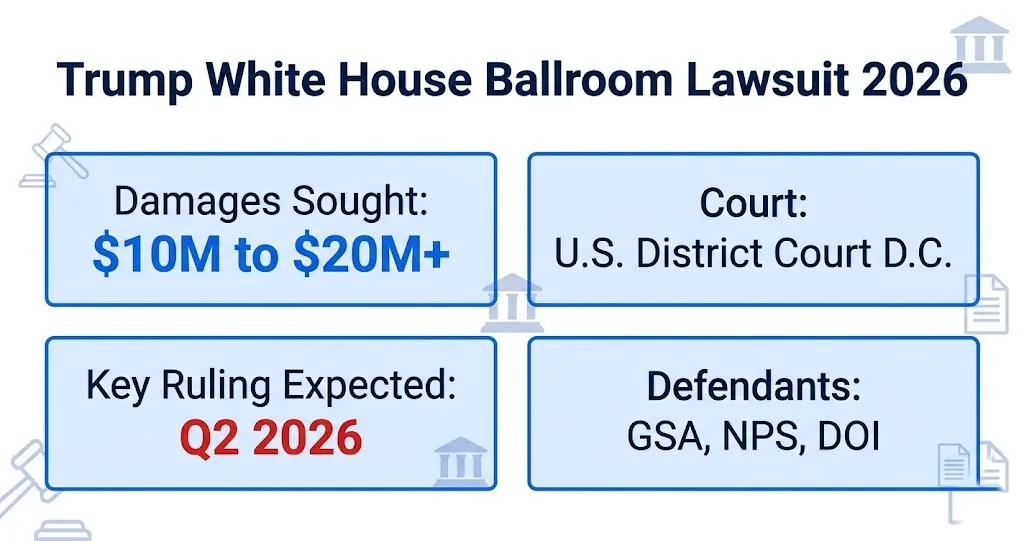
Trump White House Ballroom Lawsuit Overview
The Trump White House ballroom lawsuit is a federal civil case filed in U.S. District Court. Trump alleges that unauthorized construction work and fixture removal damaged historic White House ballrooms during the Biden administration.
This is not a criminal case. It is a civil lawsuit seeking money damages and restoration orders.
| Quick Facts | Details |
|---|---|
| Case Type | Federal civil lawsuit |
| Plaintiff | Donald J. Trump |
| Court | U.S. District Court, Washington D.C. |
| Year Filed | 2025 |
| Status in 2026 | Active litigation |
The lawsuit targets multiple federal agencies and officials. Trump claims they violated federal historic preservation requirements.
The case is unusual because former presidents rarely sue the federal government over White House matters. Legal experts are watching closely to see how courts handle claims about presidential residence modifications.
What Is the Trump White House Ballroom Lawsuit About
The Trump White House ballroom lawsuit is about alleged unauthorized changes made to historic rooms in the White House executive residence. Trump claims the Biden administration removed valuable chandeliers and conducted improper construction without following required procedures.
At its core, the lawsuit makes three main arguments.
First, Trump alleges that historic light fixtures were removed without proper authorization. Second, he claims construction work damaged original architectural features. Third, he argues federal preservation laws were ignored.
The Key Allegations:
- Removal of antique chandeliers from the East Room
- Unauthorized structural modifications to the State Dining Room
- Failure to consult the White House Historical Association
- Bypassing required preservation reviews
- Improper disposal of historic materials
Think of it like this: if someone renovated a national landmark without getting the right permits, neighbors would complain. Trump is essentially that neighbor, but with standing to sue as a former resident who claims personal harm.
The lawsuit does not involve criminal charges. No one is facing jail time. This is purely about civil liability and potential financial damages.
Trump White House Construction Lawsuit Details
The Trump White House construction lawsuit focuses on specific renovation projects conducted between 2021 and 2024. Court filings describe multiple construction activities that Trump claims violated federal law.
According to the complaint, workers removed original plasterwork from ballroom ceilings. They also allegedly replaced historic flooring with modern materials that do not match the original design.
| Construction Issue | Trump’s Claim |
|---|---|
| Ceiling modifications | Original plaster replaced without approval |
| Flooring changes | Historic wood floors covered or removed |
| Wall alterations | Period wallpaper and moldings damaged |
| Electrical updates | Fixture mounting points permanently altered |
The lawsuit names specific rooms: the East Room, the State Dining Room, and the Cross Hall. These are some of the most historically significant spaces in the White House.
Trump argues that proper preservation protocols require advance review by multiple agencies. He claims those reviews never happened or were improperly rushed.
Federal buildings with historic designations must follow strict guidelines. The White House has protections under multiple laws. Trump says those protections were ignored.
Trump Lawsuit White House Chandeliers Allegations
The Trump lawsuit includes detailed allegations about White House chandeliers that were allegedly removed improperly. These fixtures are among the most valuable items in the executive residence.
Trump claims that antique chandeliers dating back to the 19th century were taken down during Biden-era renovations. Some were allegedly damaged during removal.
Chandelier Allegations Summary:
- East Room chandeliers reportedly removed in 2022
- Some fixtures allegedly stored improperly
- Original mounting hardware supposedly destroyed
- Replacement fixtures described as historically inaccurate
- Chain of custody documentation allegedly missing
The chandeliers in question are not ordinary light fixtures. Some date back to the 1800s and carry significant historical value. Experts estimate their worth at hundreds of thousands of dollars each.
According to the lawsuit, proper removal of such fixtures requires specialized handlers. Trump claims the work was done by general contractors without proper expertise.
The White House has not publicly confirmed or denied these specific allegations. Government attorneys are expected to respond in their formal court filings.
Key Takeaway: Trump’s lawsuit centers on claims that unauthorized construction and chandelier removal during the Biden administration damaged historic White House ballrooms, with the case now actively moving through federal court in 2026.
White House Ballroom Renovation Lawsuit Claims
The White House ballroom renovation lawsuit claims fall into several legal categories. Trump is pursuing multiple theories to support his demand for damages and restoration.
The primary claim involves violation of the National Historic Preservation Act. This law requires federal agencies to consider effects on historic properties before taking action.
| Legal Claim | Basis |
|---|---|
| Preservation Act violation | Failure to complete required Section 106 review |
| Property damage | Physical harm to historic fixtures and materials |
| Breach of duty | Agencies failed to protect federal property |
| Declaratory judgment | Court determination that laws were violated |
Trump also claims the General Services Administration failed its oversight duties. The GSA manages federal buildings and must ensure preservation compliance.
Another claim targets the National Park Service. The Park Service has advisory authority over White House historic matters.
The lawsuit seeks both backward-looking relief, meaning compensation for damage already done, and forward-looking relief, meaning orders requiring proper restoration.
Each claim carries different evidence requirements. Trump’s legal team will need to prove specific procedural failures and demonstrate actual harm.
Who Is Being Sued in the Trump Ballroom Case
Multiple federal defendants are named in the Trump ballroom case. The lawsuit targets agencies and individuals in their official capacities.
The primary defendants include the General Services Administration and its administrator. The GSA oversees federal building management including the White House.
Named Defendants:
- General Services Administration
- GSA Administrator (official capacity)
- National Park Service
- Department of the Interior
- White House Chief Usher’s Office
- Individual officials involved in renovation decisions
Trump is not suing Joe Biden personally. The lawsuit targets federal agencies and officials in their government roles.
This matters for several reasons. Suing officials in their official capacity means any damages would come from government funds. Individual officials would not pay out of pocket.
The defendants will be represented by Department of Justice attorneys. DOJ lawyers handle lawsuits against federal agencies.
Some legal observers expected Trump to add more defendants as discovery proceeds. The complaint allows for amendments if new information emerges about who authorized the alleged construction work.
Trump Lawsuit Biden Administration Allegations
The Trump lawsuit makes several allegations against Biden administration decision-making. These claims focus on how renovation decisions were made and who approved them.
Trump alleges that Biden administration officials deliberately bypassed normal preservation review processes. The lawsuit suggests this was done to complete projects quickly before potential changes in administration.
| Allegation | Claimed Impact |
|---|---|
| Rushed approvals | Projects started without full review |
| Ignored expert advice | Historical consultants allegedly overruled |
| Poor documentation | Incomplete records of changes made |
| Political motivation | Timing allegedly linked to election concerns |
The lawsuit stops short of claiming criminal wrongdoing. It focuses on negligence and procedural failures rather than intentional misconduct.
However, the complaint does use language suggesting the decisions were reckless. Trump’s attorneys wrote that officials showed “deliberate indifference” to preservation requirements.
Biden administration officials have not publicly responded to these specific allegations. Government attorneys will present their defense in court filings.
Some legal analysts note that proving political motivation would be difficult. Courts generally defer to executive branch decisions about managing federal property.
Key Takeaway: The lawsuit names multiple federal agencies as defendants, with Trump alleging the Biden administration deliberately rushed renovations and bypassed required historic preservation review processes.
White House Historic Preservation Laws Violated
Trump claims several White House historic preservation laws were violated during the ballroom renovations. These laws create specific requirements for protecting historic federal properties.
The most important is the National Historic Preservation Act of 1966. Section 106 of this law requires federal agencies to consider effects on historic properties before undertaking projects.
Preservation Laws Cited:
- National Historic Preservation Act (Section 106)
- Executive Order 11593 (Protection of Cultural Environment)
- Secretary of Interior’s Standards for Historic Preservation
- National Environmental Policy Act (limited claims)
Section 106 requires a specific review process. Agencies must identify historic properties, assess potential effects, and consult with preservation officials.
Trump claims this process was either skipped entirely or conducted improperly. His lawsuit alleges that required consultations never occurred.
The White House is listed on the National Register of Historic Places. This designation triggers extra protections under federal law.
Executive Order 11593 adds another layer. It requires federal agencies to preserve and maintain historic properties under their control.
Trump’s attorneys argue these laws create enforceable obligations. They say failure to follow required procedures gives affected parties grounds to sue.
Trump Lawsuit Damages Sought
The Trump lawsuit seeks substantial financial damages for the alleged harm. Court filings outline several categories of compensation requested.
Trump is seeking compensatory damages covering the cost to restore damaged features. Estimates in the complaint suggest this could reach tens of millions of dollars.
| Damage Category | Estimated Range |
|---|---|
| Chandelier restoration | $2M to $5M |
| Architectural repairs | $5M to $15M |
| Historical consultation fees | $500K to $1M |
| Expert witness costs | $200K to $500K |
The lawsuit also seeks declaratory relief. This means Trump wants the court to officially state that laws were violated.
Injunctive relief is another request. Trump wants court orders requiring proper restoration of damaged spaces.
Here is what makes this case unusual: the White House belongs to the American people. Any damages paid would come from taxpayer funds administered by federal agencies.
Trump’s standing to seek personal damages is a legal question defendants may challenge. He lived in the White House, but ownership belongs to the federal government.
Some claims seek nominal damages for procedural violations. Even if actual harm is hard to prove, courts can award small amounts to acknowledge legal violations.
White House Ballroom Case Status 2026
The White House ballroom case status in 2026 shows active litigation with several completed and pending milestones. The case has moved beyond initial pleadings.
As of early 2026, the government has filed its response to Trump’s complaint. Federal attorneys are contesting several claims.
| Milestone | Status |
|---|---|
| Complaint filed | Complete |
| Government response | Filed |
| Motion to dismiss | Pending decision |
| Discovery | Not yet begun |
| Trial date | Not yet scheduled |
The government’s primary defense argues that Trump lacks standing to sue. Defendants claim a former president cannot sue over changes to federal property he no longer occupies.
Trump’s attorneys have responded that his unique former-resident status gives him standing. They cite potential harm to his legacy and historical reputation.
The court has not yet ruled on the standing question. This ruling could determine whether the case proceeds or gets dismissed early.
If the case survives the motion to dismiss, discovery will begin. Both sides will exchange documents and take depositions.
Key Takeaway: The case is in active litigation with the government arguing Trump lacks standing, while the court has not yet ruled on whether the lawsuit can proceed to discovery and trial.
Trump White House Lawsuit Court Date
The Trump White House lawsuit court date schedule includes several upcoming hearings. The case is being heard in U.S. District Court for the District of Columbia.
The next major court date involves oral arguments on the motion to dismiss. This hearing is expected in the first half of 2026.
Upcoming Court Dates:
- Motion to dismiss hearing: Expected Q1 or Q2 2026
- Discovery deadline (if case proceeds): Late 2026
- Summary judgment motions: Expected early 2027
- Trial (if necessary): Potentially late 2027 or 2028
The judge assigned to the case will set specific dates after ruling on preliminary motions. Schedules can change based on court workload and case complexity.
Federal court cases often take years to resolve. This case involves complicated factual and legal questions that require extensive proceedings.
Trump has requested an expedited schedule. His attorneys argue the historic damage continues while the case is pending.
Government attorneys want a normal timeline. They say rushing the case would prejudice their ability to prepare a defense.
Both sides must follow Federal Rules of Civil Procedure. These rules set minimum timeframes for various stages of litigation.
White House Ballroom Lawsuit Update 2026
The White House ballroom lawsuit update for 2026 shows several recent developments. The case has generated new filings and court activity.
Most significantly, the government filed a detailed motion to dismiss in late 2025. This motion challenges Trump’s standing and the legal basis for his claims.
2026 Developments:
- Government motion to dismiss filed
- Trump’s opposition brief submitted
- Amicus briefs filed by preservation groups
- Press coverage increased following new filings
- Court scheduling conference held
Several historic preservation organizations have filed friend-of-the-court briefs. Some support Trump’s position on preservation law violations. Others argue courts should not intervene in White House management.
The White House Historical Association has remained neutral in public statements. The organization works with every administration on preservation matters.
Media coverage has intensified as the 2026 election approaches. The lawsuit has become a topic in political commentary.
Both legal teams have hired additional experts. Trump’s side has retained historic preservation consultants. The government has engaged architectural historians to dispute damage claims.
No settlement discussions have been publicly reported. Both sides appear prepared for extended litigation.
Trump Federal Lawsuit 2026 Timeline
The Trump federal lawsuit 2026 timeline maps out expected case progression. Based on typical federal court procedures, here is what to expect.
| Phase | Expected Timing |
|---|---|
| Motion to dismiss ruling | Q2 2026 |
| Discovery period | Q3 2026 through Q1 2027 |
| Expert disclosures | Q2 2027 |
| Summary judgment | Q3 2027 |
| Trial (if needed) | Q4 2027 or Q1 2028 |
This timeline assumes no major delays or appeals. Either side could appeal unfavorable rulings, extending the case by months or years.
The motion to dismiss is the first critical checkpoint. If granted, the case ends unless Trump appeals. If denied, full discovery begins.
Discovery will be extensive. Both sides will seek internal emails, contractor records, and preservation assessments.
Depositions could include current and former White House staff. This creates logistical and political complications.
Federal judges have wide discretion in managing their calendars. The assigned judge’s approach will significantly affect timing.
Key Takeaway: The 2026 timeline centers on the motion to dismiss ruling expected in Q2 2026, with full discovery and potential trial stretching into 2027 or 2028 depending on how preliminary motions are decided.
Will Trump Win the White House Ballroom Lawsuit
Whether Trump will win the White House ballroom lawsuit depends on several uncertain legal factors. Both sides have credible arguments.
Trump’s strengths include specific factual allegations and documented preservation requirements. If he can prove procedures were skipped, courts may find liability.
Factors Favoring Trump:
- Clear statutory requirements under preservation laws
- Detailed allegations with specific examples
- Potential supporting evidence from White House records
- Public interest in historic preservation
Factors Against Trump:
- Standing questions about his right to sue
- Executive branch discretion over federal property
- Difficulty proving actual damages
- Political optics may not affect legal merits
The standing issue is the biggest early hurdle. Courts may decide a former president simply cannot sue over this type of claim.
Even if Trump has standing, proving damages is challenging. The White House still functions. Historic value is hard to quantify in dollars.
Legal experts are genuinely divided on likely outcomes. Some see strong preservation law claims. Others view the case as politically motivated with weak legal foundation.
Settlement remains possible at any stage. Both sides may prefer a negotiated resolution over years of litigation.
How Long Will the White House Ballroom Case Take
The White House ballroom case will likely take two to four years to fully resolve. Federal litigation of this complexity rarely moves quickly.
The earliest possible resolution would come from a successful motion to dismiss in 2026. This would end the case at the trial court level within months.
| Scenario | Estimated Duration |
|---|---|
| Dismissal granted | Ends Q2 2026 (plus appeals) |
| Settlement before trial | 12 to 18 months |
| Full trial with verdict | 2 to 3 years |
| Appeals after trial | Add 1 to 2 more years |
If the case proceeds through trial and appeals, final resolution might not come until 2028 or later.
Several factors could extend the timeline. Disputes over document production often cause delays. Scheduling conflicts with high-profile witnesses create complications.
The political calendar matters too. Court proceedings might be affected by election-year dynamics and potential changes in administration.
Historically, federal civil cases average about two years from filing to trial. Complex cases involving government defendants often take longer.
Trump is 78 years old in 2026. His legal team may push for faster resolution. Government attorneys have less urgency.
Frequently Asked Questions
What is the Trump White House ballroom lawsuit about?
The Trump White House ballroom lawsuit alleges unauthorized construction and removal of historic fixtures from White House ballrooms during the Biden administration.
Trump claims chandeliers were improperly removed and preservation laws were violated.
The case seeks money damages and court orders requiring restoration.
How much money is Trump seeking in the White House ballroom lawsuit?
Trump is seeking tens of millions of dollars in damages for restoration and repairs.
Specific estimates in court filings suggest $10 million to $20 million or more.
The exact amount will depend on expert assessments of damage and restoration costs.
Who are the defendants in the Trump ballroom lawsuit?
The defendants include the General Services Administration, National Park Service, and Department of the Interior.
Individual officials involved in renovation decisions are also named.
All defendants are sued in their official government capacities.
When is the next court date for the White House ballroom case?
The next major court date is the hearing on the motion to dismiss, expected in Q1 or Q2 2026.
The specific date will be set by the assigned judge.
Additional hearings will follow based on how the court rules on preliminary motions.
What happens if Trump wins the White House ballroom lawsuit?
If Trump wins, the court could order federal agencies to pay damages for restoration costs.
The court might also require specific restoration work to be completed.
A ruling for Trump could set precedent for future historic preservation lawsuits involving federal buildings.
Take Action Now
The Trump White House ballroom lawsuit is one of the most unusual federal cases in recent memory. It raises important questions about historic preservation and presidential residence management.
The case will likely take years to fully resolve. Key rulings on standing and dismissal are expected in 2026.
Stay informed as this high-profile legal battle unfolds. Bookmark this page for updates as new court filings and decisions come in.
