
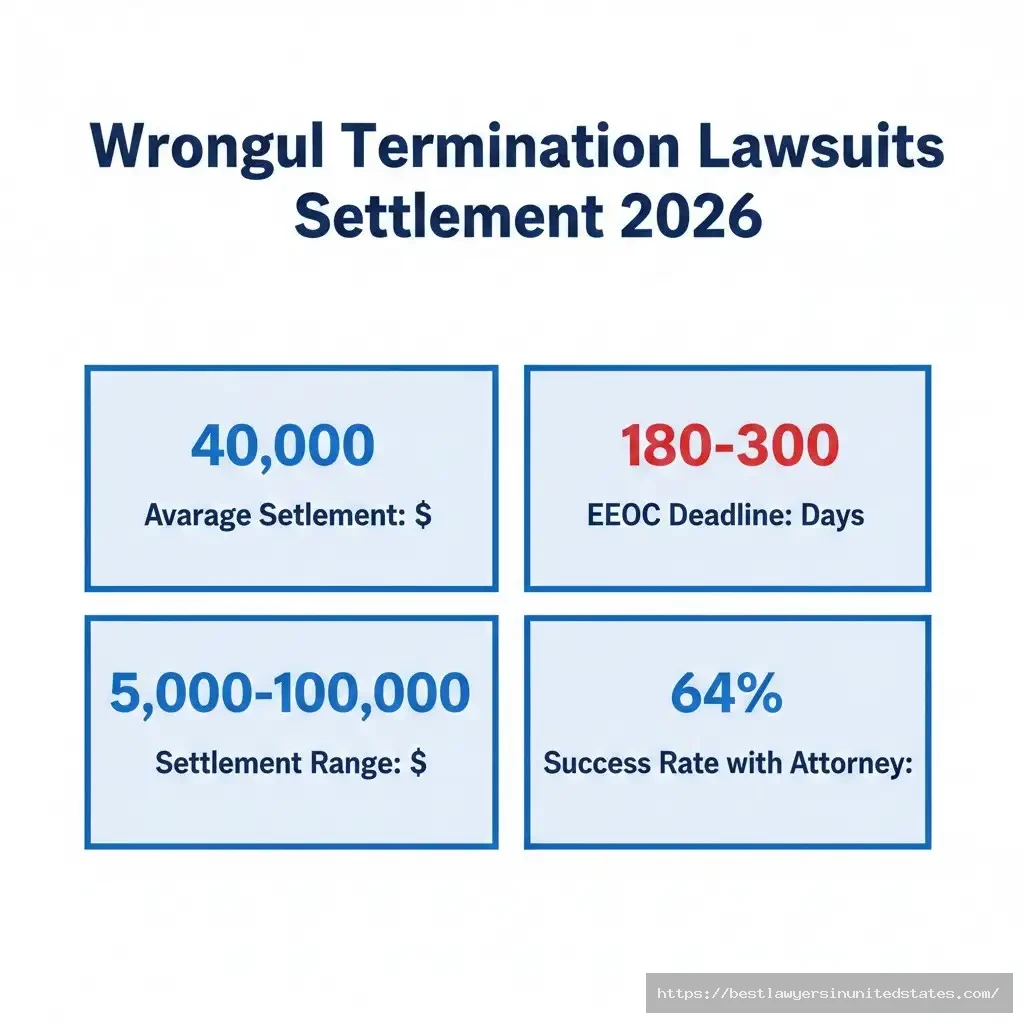
Wrongful termination lawsuits protect employees who were illegally fired from their jobs. If your employer fired you for discriminatory reasons, retaliation, or violation of employment laws, you can file a claim to recover lost wages and other damages. Settlement amounts typically range from $5,000 to $100,000, with some cases reaching over $1 million depending on circumstances.
Quick Answer: Wrongful termination occurs when an employer fires an employee in violation of federal or state laws, including discrimination, retaliation, breach of contract, or violation of public policy. You typically have 180 to 300 days to file a complaint with the EEOC for discrimination claims. Most cases settle for $5,000 to $80,000, though compensation varies based on lost wages, case strength, and whether you hire an attorney.
What Are Wrongful Termination Lawsuits?
Wrongful termination lawsuits arise when an employer illegally fires an employee. While most U.S. workers are “at-will” employees—meaning employers can fire them for almost any reason—there are important exceptions that protect workers from unlawful termination.
At-will employment doesn’t give employers free reign to fire anyone they want. Federal and state laws prohibit termination for specific illegal reasons. When an employer crosses these legal boundaries, the fired employee can file a wrongful termination lawsuit to seek compensation for their losses.
Understanding At-Will Employment
At-will employment is the default employment relationship in the United States. Under this doctrine, either the employer or employee can end the employment relationship at any time, with or without notice, and for any reason that’s not illegal.
However, at-will employment has significant limits. Employers cannot fire employees based on protected characteristics, in retaliation for legal activities, or in violation of employment contracts. These exceptions form the foundation of wrongful termination law.
Even in at-will employment states, employees have legal protections. If you were fired for an illegal reason, you have rights regardless of whether you had an employment contract.
Timeline of Wrongful Termination Laws
| Year | Major Development | Impact |
|---|---|---|
| 1964 | Title VII of Civil Rights Act passed | Prohibited employment discrimination based on race, color, religion, sex, and national origin |
| 1967 | Age Discrimination in Employment Act | Protected workers 40 and older from age-based discrimination |
| 1990 | Americans with Disabilities Act signed | Required reasonable accommodations and prohibited disability discrimination |
| 1993 | Family and Medical Leave Act enacted | Protected employees taking medical or family leave from retaliation |
| 2023 | Extended revival period for sexual harassment claims | California extended deadline to revive time-barred claims to December 31, 2026 |
| 2026 | Wrongful termination cases surge | Return to office mandates and increased workplace monitoring lead to 23% rise in claims |
What Makes a Termination “Wrongful”?
Not every unfair firing is illegal. Being terminated because your boss doesn’t like you or for poor performance isn’t wrongful termination unless there’s evidence of illegal motivation.
A termination becomes wrongful when it violates:
Federal or state anti-discrimination laws Retaliation protections for whistleblowers or complaints Employment contract terms Public policy (like firing someone for jury duty) Family and medical leave protections
The key difference between an unfair termination and a wrongful one is whether the firing broke the law. Wrongful termination claims require proof that your employer violated specific legal protections.
Who Qualifies for Wrongful Termination Lawsuits?
Quick Answer: You may qualify for a wrongful termination lawsuit if you were fired due to discrimination, retaliation, breach of contract, or violation of public policy. Most wrongful termination claims require filing with the EEOC or state agency first. You’ll need documentation proving the illegal reason for your termination.
Eligibility Requirements Checklist
| Requirement | Details | What You Need to Prove |
|---|---|---|
| Illegal Reason for Termination | Firing violated federal or state law | Evidence that protected characteristic or activity motivated firing |
| Protected Class or Activity | Member of protected group or engaged in legally protected activity | Documentation showing you fit protected category |
| Causation | Connection between protected status and termination | Timeline showing firing occurred after protected activity |
| Damages | You suffered financial or emotional harm | Lost wages, medical records, job search documentation |
| Timely Filing | Met deadlines for filing complaints | Filed within 180-300 days for EEOC claims |
| Employment Relationship | You were an employee, not independent contractor | Pay stubs, W-2 forms, employment contract |
| Employer Coverage | Employer subject to employment laws | Company has minimum number of employees (usually 15+) |
Types of Wrongful Termination Claims
Discrimination-Based Termination
Employers cannot fire employees based on protected characteristics. Federal law protects employees from discrimination based on:
Race or color National origin or ethnicity Religion or religious beliefs Sex, gender identity, or pregnancy Age (40 and older) Disability or perceived disability Genetic information
Many states offer additional protections. California, for example, also protects sexual orientation, marital status, and military/veteran status.
If you were fired shortly after your employer learned about a protected characteristic—like your pregnancy, disability, or religion—this timing can suggest discriminatory intent.
Retaliation for Protected Activities
Retaliation occurs when an employer fires you for exercising your legal rights. Protected activities include:
Filing a discrimination complaint with HR or the EEOC Reporting harassment or unsafe working conditions Participating in a workplace investigation Filing a workers’ compensation claim Taking FMLA leave or requesting accommodations Reporting illegal activities (whistleblowing) Organizing or joining a union Complaining about wage violations or unpaid overtime
Retaliation claims often have strong evidence when termination happens soon after the protected activity. Courts look at the timing and whether the employer’s stated reason for firing seems pretextual.
Breach of Employment Contract
If you have an employment contract specifying termination conditions, your employer must follow those terms. Contract breaches that constitute wrongful termination include:
Firing without the “cause” required by your contract Terminating before the contract period ends Not following disciplinary procedures outlined in the contract Violating severance terms or notice requirements
Employee handbooks can sometimes create implied contracts. If your handbook states specific termination procedures and your employer didn’t follow them, you might have a claim.
Violation of Public Policy
Public policy wrongful termination protects employees fired for reasons that violate public interest. These cases include termination for:
Serving on jury duty Voting or taking time off to vote Refusing to commit illegal acts Reporting employer’s illegal activities Exercising First Amendment rights (in public sector) Taking time off for military service
Public policy claims vary by state. Some states recognize broader public policy protections than others.
Constructive Discharge
Constructive discharge occurs when your employer made working conditions so intolerable that you had no choice but to resign. This is treated as wrongful termination if:
The working conditions were objectively unbearable Your employer deliberately created these conditions A reasonable person in your situation would have felt forced to resign The intolerable conditions related to illegal discrimination or harassment
Examples include severe sexual harassment, disability discrimination that prevents you from doing your job, or dangerous working conditions your employer refuses to fix.
Who Does NOT Qualify
You likely don’t have a wrongful termination claim if:
❌ You were fired for poor performance with documented evidence ❌ Your employer had legitimate business reasons for layoffs ❌ You violated clear company policies unrelated to protected activities ❌ You were an independent contractor (different legal protections apply) ❌ Your employer has fewer than the minimum employees required by law ❌ You missed all filing deadlines without good cause ❌ You resigned voluntarily without constructive discharge evidence
Being fired unfairly doesn’t always mean it was illegal. Unless the termination violated a specific law or contract, you might not have legal recourse through a wrongful termination lawsuit.
Required Documentation to Prove Your Claim
| Document Type | Why You Need It | Where to Find It | What If You Don’t Have It |
|---|---|---|---|
| Employment contract | Proves contract terms and breach | Your personnel file, HR records | Request from HR in writing |
| Performance reviews | Shows good performance contradicting stated reason | Your personnel file | Ask former coworkers to be witnesses |
| Termination letter | Official reason for firing | Given at termination | Document verbal conversation immediately |
| Emails and messages | Evidence of discrimination or retaliation | Your work email, saved messages | Request through discovery process |
| Pay stubs and W-2s | Proves wages and employment dates | Your records, employer | Request from payroll department |
| Company policies | Shows employer didn’t follow own procedures | Employee handbook | Publicly available or through discovery |
| Medical records | Supports disability, FMLA, or emotional distress claims | Your doctor, hospital | Get records from all treating physicians |
| Complaint records | Proves you reported issues before termination | HR records, EEOC filings | Written notes of verbal complaints |
How Much Money Can You Get from a Wrongful Termination Lawsuit?
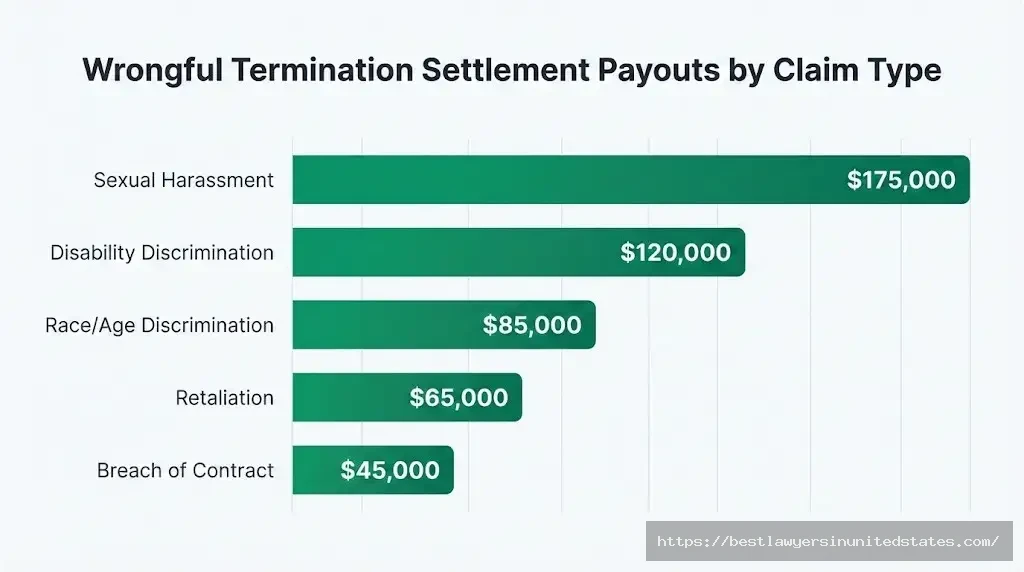
Quick Answer: Wrongful termination settlements typically range from $5,000 to $100,000, with the average around $40,000. Cases involving severe discrimination, high-earning executives, or punitive damages can reach mid-six or seven figures. Settlement amounts depend on lost wages, evidence strength, attorney representation, and whether you negotiate the first offer.
Settlement Amount Breakdown by Case Type
| Claim Type | Typical Settlement Range | Average Payout | Common Damages Included |
|---|---|---|---|
| Discrimination (race, gender, age) | $30,000 – $300,000 | $85,000 | Back pay, front pay, emotional distress, punitive damages |
| Retaliation | $20,000 – $150,000 | $65,000 | Lost wages, emotional distress, attorney fees |
| Breach of Contract | $15,000 – $100,000 | $45,000 | Unpaid wages, benefits, contract damages |
| Disability Discrimination | $40,000 – $500,000 | $120,000 | Medical costs, accommodations, future earnings loss |
| Sexual Harassment/Hostile Work Environment | $50,000 – $1,000,000+ | $175,000 | Therapy costs, emotional distress, punitive damages |
| FMLA Violation | $10,000 – $80,000 | $35,000 | Lost wages, benefits continuation |
| Whistleblower Retaliation | $75,000 – $2,000,000+ | $250,000 | Lost wages, reinstatement, punitive damages |
| Constructive Discharge | $25,000 – $200,000 | $70,000 | Lost wages, emotional distress, job search costs |
What Affects Your Settlement Amount
Your Income and Lost Wages
Higher earners receive larger settlements because lost wages form the foundation of most awards. Courts calculate:
Back pay: Wages from termination date to settlement or trial Front pay: Future earnings you would have made if still employed Benefits: Health insurance, retirement contributions, stock options Bonuses and commissions: Any variable compensation you lost
Someone making $150,000 annually will recover more than someone making $40,000, even with identical circumstances.
Strength of Your Evidence
Cases with strong documentation settle for significantly more. Evidence that increases settlement value:
Written proof of discrimination (emails, texts, recorded statements) Multiple witnesses who saw or heard discriminatory conduct Timeline showing termination immediately after protected activity Pattern of similar treatment toward other employees Employer’s shifting or contradictory reasons for firing Your strong performance reviews contradicting stated cause
The stronger your evidence, the more likely your employer will offer a higher settlement to avoid trial.
Whether You Have an Attorney
Hiring an attorney dramatically increases settlement amounts. Data shows:
Employees with attorneys average $48,800 in settlements Employees without attorneys average $19,200 in settlements Attorneys help you recover 150% more on average
Employers take represented employees more seriously. Attorneys know how to value claims properly, gather evidence effectively, and negotiate aggressively.
Your Negotiation Strategy
Settlement amounts jump significantly when you negotiate instead of accepting the first offer:
Employees who negotiated first offers: Average $41,500 Employees who accepted first offers: Average $19,200 Negotiating more than doubles your settlement
Employers expect negotiation. First offers are almost always lower than what they’re willing to pay.
Filing a Lawsuit vs. Settling Early
Filing a formal lawsuit increases settlement amounts by an average of $12,000. Once you file:
Discovery begins, giving you access to company documents Employer faces litigation costs and negative publicity Your negotiating position strengthens significantly Employer becomes more motivated to settle
Most wrongful termination lawsuits settle before trial, but filing the lawsuit creates pressure that increases your settlement.
Types of Damages You Can Recover
Economic Damages
Economic damages compensate for financial losses:
Lost wages from termination to settlement Salary differences if new job pays less Lost benefits (health insurance, 401k contributions) Job search expenses (resume services, interview travel) Signing bonuses or stock options you would have received Cost of COBRA or private health insurance
Economic damages are easier to calculate and prove than non-economic damages.
Non-Economic Damages
Non-economic damages compensate for intangible harm:
Emotional distress and mental anguish Anxiety, depression, or PTSD from the termination Damage to professional reputation Humiliation and embarrassment Loss of enjoyment of life Therapy and counseling costs
Courts and juries award non-economic damages when the termination caused significant emotional harm. Medical records from therapists or doctors strengthen these claims.
Punitive Damages
Punitive damages punish employers for especially egregious conduct and deter future violations. Courts award punitive damages when:
Employer acted with malice or reckless indifference Conduct was particularly offensive or shocking Employer showed pattern of similar illegal behavior Company ignored multiple complaints before terminating you
Punitive damages can be substantial but are relatively rare. Only about 10% of wrongful termination cases result in punitive damages awards.
Attorney Fees and Costs
Many employment laws allow you to recover attorney fees if you win. This means:
Employer pays your lawyer’s fees and costs Your settlement or award isn’t reduced by legal expenses Increases your actual recovery significantly
Attorney fee provisions encourage lawyers to take employment cases and help level the playing field against well-funded employers.
Settlement Timeline and Payment
| Stage | Timeline | What Happens |
|---|---|---|
| Termination | Day 0 | Employment ends, clock starts on filing deadlines |
| Initial consultation | Within 30 days | Meet with attorney to evaluate claim |
| EEOC filing | 30-180 days | File discrimination charge with EEOC |
| EEOC investigation | 6-12 months | Agency investigates, may attempt mediation |
| Right to sue letter | After investigation | EEOC issues permission to file lawsuit |
| Lawsuit filed | Within 90 days of letter | Attorney files complaint in court |
| Discovery phase | 6-18 months | Both sides exchange evidence |
| Settlement negotiations | Throughout process | Ongoing discussions with employer |
| Trial (if no settlement) | 1-3 years from filing | Case presented to judge or jury |
| Payment after settlement | 30-90 days | Employer pays agreed amount |
Most wrongful termination cases settle within 12 to 24 months from when you file the EEOC charge or lawsuit.
Recent 2026 Settlement Examples
In January 2026, a California jury awarded $52 million to five former employees in a whistleblower retaliation case, averaging over $10 million per plaintiff.
Recent settlements show that juries and employers recognize the serious harm wrongful termination causes. Strong cases with clear evidence continue to result in substantial awards.
How to File a Wrongful Termination Lawsuit – Step by Step
Quick Answer: Filing a wrongful termination lawsuit involves documenting your case, filing with the EEOC or state agency, consulting an attorney, and potentially filing a lawsuit after receiving a right-to-sue letter. You must file with the EEOC within 180-300 days for discrimination claims. Most cases settle before trial through negotiation.

⚠️ CRITICAL DEADLINES: Discrimination claims must be filed with the EEOC within 180 days in most states, or 300 days in states with their own employment discrimination agencies. Missing these deadlines can completely bar your claim. File as soon as possible after termination.
Complete Filing Process
Step 1: Document Everything Immediately
Start gathering evidence the moment you suspect wrongful termination:
Save all written communications. Download emails, text messages, and any written documentation from your employer before you lose access to company systems.
Write down verbal conversations. Create detailed notes about any verbal conversations, including date, time, location, who was present, and exact words used.
Collect performance records. Gather performance reviews, awards, commendations, and any evidence of positive job performance.
Identify witnesses. List coworkers who witnessed discriminatory conduct, your good performance, or have information supporting your claim.
Track financial losses. Keep records of lost wages, job search expenses, and costs you incurred due to termination.
Document everything while it’s fresh in your memory. Memories fade and evidence disappears over time.
Step 2: Request Your Personnel File
Most states require employers to provide personnel files when former employees request them:
Submit a written request to your employer’s HR department asking for your complete personnel file.
Specify what you want: employment contract, performance reviews, disciplinary records, termination letter, and any investigations.
Know your state’s deadline. Employers typically have 21-30 days to respond depending on state law.
Review carefully for inconsistencies, missing documentation, or evidence supporting your case.
Your personnel file often contains crucial evidence. Employers must provide it, and they know you’re likely building a case when you request it.
Step 3: Consult with an Employment Attorney
Meet with an experienced employment attorney before filing any claims:
Free consultations are common in wrongful termination cases. Many attorneys work on contingency, meaning they only get paid if you win.
Bring all documentation to the consultation. The more information you provide, the better the attorney can evaluate your case.
Ask about case strength and realistic settlement expectations. A good attorney will give you honest assessment.
Understand fee arrangements. Most wrongful termination attorneys work on contingency (typically 33-40% of recovery).
Get multiple opinions if you’re unsure. Talk to 2-3 attorneys to find the right fit.
Having an attorney increases your settlement by an average of 150% and more than doubles your chances of receiving compensation.
Step 4: File with the Appropriate Government Agency
Before filing most wrongful termination lawsuits, you must file with a government agency:
For discrimination or retaliation: File with the Equal Employment Opportunity Commission (EEOC) or your state’s fair employment agency
For wage violations: File with the Department of Labor or state labor department
For safety retaliation: File with Occupational Safety and Health Administration (OSHA)
For family/medical leave violations: File with the Department of Labor’s Wage and Hour Division
Your attorney will know which agency handles your specific type of claim. In some cases, you’ll file with multiple agencies simultaneously.
Step 5: EEOC Charge Filing Process
For discrimination and retaliation claims, the EEOC process works like this:
File your charge online, in person, or by mail. The EEOC has offices nationwide and accepts charges through their online portal.
Provide detailed information about what happened, including dates, names of decision-makers, and why you believe the termination was illegal.
Filing creates an automatic deadline. You have 180 days from termination in most states, or 300 days in “deferral states” with their own agencies.
EEOC investigates your charge. They’ll contact your employer, request documents, and may interview witnesses.
EEOC may offer mediation. Many charges settle through EEOC mediation without going to court.
Receive right-to-sue letter. After investigation (or immediately upon request), EEOC issues this letter allowing you to file in court.
The entire EEOC process typically takes 6-12 months, though you can request an immediate right-to-sue letter if you want to move faster.
Step 6: File Your Lawsuit in Court
After receiving your right-to-sue letter:
You have 90 days to file a federal discrimination lawsuit. This deadline is strict.
Your attorney prepares the complaint outlining facts, legal claims, and damages sought.
File with the appropriate court. Most wrongful termination cases go to federal district court or state superior court.
Serve your employer with the lawsuit through certified mail, sheriff, or professional process server.
Employer responds with an answer, typically denying your allegations.
Filing the lawsuit begins the formal legal process and puts significant pressure on your employer to settle.
Step 7: Discovery and Evidence Gathering
Once the lawsuit is filed, both sides exchange evidence:
Written discovery: Both sides submit interrogatories (written questions) that must be answered under oath.
Document production: Request relevant company documents like emails, personnel files, policies, and investigation records.
Depositions: Attorneys question witnesses and parties under oath. Your employer’s decision-makers will be deposed.
Expert witnesses: You might need economic experts to calculate damages or other specialists depending on your case.
Discovery typically takes 6-18 months and is where most cases settle. Once employers see the strength of your evidence, they become more motivated to negotiate.
Step 8: Settlement Negotiations
Settlement discussions happen throughout the process:
Employer makes initial offer. This is almost always lower than they’re willing to pay.
Never accept the first offer. Negotiation typically increases settlements by 115%.
Your attorney counters with higher demands based on your case’s value.
Mediation may occur. A neutral mediator helps both sides reach agreement.
Review settlement terms carefully. Settlements typically include confidentiality clauses and releases of all claims.
More than 95% of wrongful termination cases settle before trial. Settlement saves time, money, and guarantees recovery without trial risk.
Step 9: Trial (If No Settlement)
If settlement negotiations fail:
Trial preparation intensifies. Your attorney prepares witnesses, evidence, and legal arguments.
Jury selection (if you chose jury trial) or bench trial before a judge only.
Opening statements where each side previews their case.
Present evidence including documents, testimony, and expert opinions.
Closing arguments summarizing the case and asking for specific damages.
Verdict. Judge or jury decides if wrongful termination occurred and awards damages.
Trials are risky for both sides. Even strong cases can lose, and employers face potentially higher damages than settlement offers.
Step 10: Receive Your Payment
After settlement or judgment:
Settlement payments typically arrive 30-90 days after signing the agreement.
Judgment payments can take longer, especially if employer appeals.
Attorney takes their fee (typically 33-40% in contingency cases).
Settlement funds may be taxable. Lost wage portions are taxed as ordinary income; emotional distress damages may or may not be taxable.
Keep settlement agreement confidential if it includes confidentiality provisions.
Your settlement or award compensates for the illegal termination and helps you move forward financially.
Critical Filing Deadlines by Claim Type
| Claim Type | Deadline to File | Where to File | Notes |
|---|---|---|---|
| EEOC Discrimination | 180 days (300 in deferral states) | EEOC or state agency | Shortest deadline – file immediately |
| Federal Lawsuit after EEOC | 90 days from right-to-sue letter | Federal district court | Strict deadline, no extensions |
| California FEHA Claims | 3 years from discriminatory act | California Civil Rights Department | Must get right-to-sue before lawsuit |
| Breach of Contract | 2-4 years (varies by state) | State civil court | Check your state’s statute of limitations |
| Public Policy Violation | 2-3 years (varies by state) | State civil court | Varies significantly by jurisdiction |
| FMLA Violations | 2 years (3 for willful violations) | Federal district court or DOL | Can file directly in court |
| Wage and Hour Claims | 2-3 years (varies by state) | State labor board or court | Some states allow longer for willful violations |
| OSHA Whistleblower | 30 days | OSHA | Extremely short deadline |
Missing deadlines can destroy your case completely. File as soon as you recognize potential wrongful termination.
Common Filing Mistakes to Avoid
Waiting too long to file. Deadlines are strict. Don’t assume you have time.
Posting about your case on social media. Employers monitor social media and use posts against you.
Accepting severance without review. Severance agreements often include releases of legal claims. Have an attorney review before signing.
Not documenting expenses. Track all costs related to job search and termination.
Filing before consulting an attorney. Mistakes in initial filings can hurt your case later.
Exaggerating or lying. Credibility is everything. Stick to facts you can prove.
Not responding to EEOC requests. Missing EEOC deadlines can result in case closure.
Continuing to contact employer. All communication should go through attorneys once you have representation.
Current Wrongful Termination Lawsuit Trends (2026 Updates)
Latest Developments in Employment Law
Return-to-Office Mandates Spark New Claims
Companies requiring employees to return to offices after years of remote work face increased wrongful termination claims. Employees fired for refusing to return are filing disability discrimination claims (particularly for immunocompromised workers) and claims based on constructive discharge.
The number of wrongful termination cases has increased by 23% in early 2026 compared to 2025, largely driven by return-to-office conflicts.
AI and Algorithm Discrimination
New claims challenge AI-powered hiring and firing systems that allegedly discriminate based on protected characteristics. Several 2026 lawsuits claim automated performance management systems unfairly target older workers and employees with disabilities.
Courts are beginning to address how employers can be liable for discrimination when algorithms make termination decisions.
Expanded Disability Accommodation Claims
Post-pandemic, disability accommodation requests increased dramatically, particularly for mental health conditions and long COVID. Employers who terminate employees after accommodation requests face higher litigation risk in 2026.
EEOC data shows 43% of new discrimination lawsuits in 2024 included disability claims, up from 35% in 2020.
Extended Sexual Harassment Deadlines
California extended the deadline for filing previously time-barred sexual assault and harassment claims to December 31, 2027. This revival period also covers related wrongful termination and harassment claims, allowing victims more time to seek justice.
Recent High-Profile Cases (2026)
$52 Million Whistleblower Verdict
In January 2026, a California jury awarded $52 million to five employees fired for reporting illegal activities, averaging over $10 million per person. The verdict sends a strong message that retaliation against whistleblowers carries severe consequences.
Will Smith Wrongful Termination Lawsuit
In January 2026, violinist Brian King Joseph filed a lawsuit against Will Smith claiming sexual harassment, retaliation, and wrongful termination after reporting an incident to police. The case highlights how retaliation claims can arise even in entertainment industry settings.
Ohio State University Discrimination Case
Former football staffer Joseph Lyberger sued Ohio State University in February 2026 for sex-based discrimination and wrongful termination, claiming the university relied on gender stereotypes during its investigation. The case demonstrates reverse discrimination claims are viable when employers apply different standards based on sex.
What Employers Are Watching in 2026
Increased Wrongful Termination Litigation
Legal surveys show wrongful termination appeared as a standalone area of concern for employers in 2026, driven by:
Post-pandemic workplace adjustments Return-to-office mandates Performance management during economic uncertainty Prior accommodation requests or complaints creating heightened risk
Paid Leave Expansion
New state and local paid sick leave and family leave laws create additional compliance challenges. Employers terminating employees who take protected leave face increased retaliation claims.
States including Alaska, California, Connecticut, and Nebraska expanded paid leave requirements in 2025, with more changes coming in 2026.
Immigration Rights Notifications
Starting February 2026, California employers must provide employees with notices about their rights regarding immigration enforcement. Violations could support wrongful termination claims based on national origin discrimination.
Wrongful Termination vs. Other Employment Claims
How Wrongful Termination Compares to Similar Claims
| Claim Type | Key Difference | Average Settlement | Filing Process | Success Rate |
|---|---|---|---|---|
| Wrongful Termination | Illegal firing violating law or contract | $40,000 | EEOC or court depending on type | 30-40% receive compensation |
| Constructive Discharge | Forced to resign due to intolerable conditions | $70,000 | Same as wrongful termination | More difficult to prove |
| Retaliation | Fired for protected activity | $65,000 | EEOC then court | 35-45% receive compensation |
| Disability Discrimination | Fired due to disability or denied accommodation | $120,000 | EEOC then court | Strong if accommodation clearly denied |
| Sexual Harassment | Termination related to harassment | $175,000 | EEOC then court | Higher if severe or pervasive |
| Breach of Contract | Employer violated employment agreement | $45,000 | Directly to court | High if contract is clear |
When Multiple Claims Apply
Many wrongful termination cases include multiple legal theories:
Someone fired after reporting sexual harassment might have claims for:
- Sexual harassment (hostile work environment)
- Retaliation for reporting
- Wrongful termination
- Constructive discharge (if they quit due to harassment)
Filing multiple claims when appropriate strengthens your case and increases potential damages.
Do You Need a Lawyer for a Wrongful Termination Lawsuit?
Quick Answer: You don’t legally need a lawyer to file a wrongful termination claim, but hiring one increases your chances of success by more than 100% and raises your average settlement by 150%. Most wrongful termination attorneys work on contingency, so you pay nothing unless you win.
Filing Without a Lawyer
You can represent yourself (“pro se”) in wrongful termination cases:
EEOC charges are designed for individuals to file without attorneys Forms are available online through the EEOC website EEOC staff can answer basic procedural questions
However, only 30% of people without lawyers receive any compensation, compared to 64% of those with attorneys.
Benefits of Hiring an Attorney
Higher Settlements
- With attorney: Average $48,800
- Without attorney: Average $19,200
- Attorneys help you recover 154% more
Better Success Rates
- With attorney: 64% receive compensation
- Without attorney: 30% receive compensation
Strategic Advantages
- Attorneys know how to value claims properly
- They gather evidence effectively through discovery
- They negotiate aggressively with employers
- They prepare cases for trial if necessary
- They handle all legal procedures and deadlines
No Upfront Costs
- Most work on contingency (typically 33-40% of recovery)
- You pay nothing unless you win
- Attorney fees sometimes recoverable from employer under employment laws
When You Might Handle It Yourself
Consider handling your own EEOC charge if:
Your case is straightforward with clear evidence You only want to preserve your right to sue while you find an attorney You’re filing to meet a deadline while searching for representation Your damages are very small (under $5,000)
Even if you file the EEOC charge yourself, hire an attorney before filing a lawsuit or negotiating settlement.
How to Find the Right Attorney
Look for employment law specialists. General practice lawyers often lack the specific expertise wrongful termination cases require.
Check their track record. Ask about their experience with cases similar to yours and their success rate.
Understand fee arrangements. Most wrongful termination lawyers work on contingency, but get the agreement in writing.
Meet with several attorneys. Most offer free consultations. Compare their assessments of your case.
Ask about their approach. Some attorneys settle quickly while others are willing to take cases to trial.
The right attorney makes an enormous difference in both the amount you recover and the stress of going through the process.
Free Legal Resources
If you can’t afford an attorney:
Legal aid organizations provide free help to low-income individuals Bar association referral services can connect you with lawyers offering reduced fees Law school clinics sometimes handle employment cases for free EEOC assistance is always free for filing charges
Contact [email protected] for attorney referrals in your area.
Frequently Asked Questions
What is a wrongful termination lawsuit?
Quick Answer: A wrongful termination lawsuit is a legal claim filed when an employer illegally fires an employee in violation of federal or state laws, employment contracts, or public policy.
A wrongful termination lawsuit seeks compensation for employees who were fired for illegal reasons. While most employment is at-will, meaning employers can fire employees for almost any reason, they cannot terminate employees based on discrimination, retaliation, contract violations, or public policy violations. These lawsuits allow illegally terminated employees to recover lost wages, emotional distress damages, and sometimes punitive damages.
Who qualifies for a wrongful termination lawsuit?
Quick Answer: You may qualify if you were fired due to discrimination (race, age, gender, disability, etc.), retaliation for protected activities (filing complaints, taking FMLA leave), breach of employment contract, or violation of public policy.
To qualify, you must prove your termination violated a specific law or contract term. Simply being fired unfairly or without cause isn’t enough unless your employer broke the law. Common qualifying scenarios include being fired after reporting harassment, requesting disability accommodations, taking protected leave, refusing illegal activities, or because of your age, race, gender, or other protected characteristic.
How much money can I get from a wrongful termination lawsuit?
Quick Answer: Most wrongful termination settlements range from $5,000 to $100,000, with the average around $40,000. Cases involving severe discrimination, high-income employees, or punitive damages can reach $300,000 to over $1 million.
Settlement amounts depend on several factors: your salary and benefits (higher earners get more), strength of evidence, whether you hire an attorney (which increases settlements by 150%), and the type of claim. Discrimination cases average $85,000, while sexual harassment cases average $175,000. Your actual recovery depends on your specific circumstances and lost wages.
When is the deadline to file a wrongful termination claim?
Quick Answer: For discrimination claims, you must file with the EEOC within 180 days in most states, or 300 days in states with their own employment agencies. Other claims have deadlines ranging from 30 days to 3 years depending on the type.
Filing deadlines are strict and missing them can destroy your case. EEOC discrimination charges have the shortest deadlines at 180-300 days. OSHA whistleblower complaints must be filed within 30 days. Breach of contract and other claims typically have 2-3 year statutes of limitations, but this varies by state. Always file as soon as possible after recognizing wrongful termination.
How do I file a wrongful termination lawsuit?
Quick Answer: For discrimination claims, first file a charge with the EEOC within 180-300 days. After investigation, the EEOC issues a right-to-sue letter. You then have 90 days to file a lawsuit in court. Hiring an attorney significantly increases your chances of success.
The process starts with documenting your case and gathering evidence. For most claims, you must file with a government agency (like the EEOC) before going to court. The agency investigates and may offer mediation. If that doesn’t resolve the issue, they issue a right-to-sue letter allowing you to file in court. Most cases settle during negotiation without going to trial.
Do I need a lawyer to file a wrongful termination claim?
Quick Answer: No, you don’t legally need a lawyer, but hiring one more than doubles your chances of getting compensation and increases settlements by an average of 150%. Most wrongful termination attorneys work on contingency, so you only pay if you win.
While you can file EEOC charges yourself, employees with attorneys receive an average of $48,800 compared to $19,200 for those without lawyers. Attorneys know how to value claims, gather evidence, negotiate effectively, and handle complex legal procedures. Since most work on contingency (typically 33-40% of your recovery), you risk nothing by consulting one.
What documents do I need to prove wrongful termination?
Quick Answer: Key documents include your employment contract, performance reviews, termination letter, emails showing discriminatory conduct, pay stubs, and company policies. Written evidence of complaints you made before termination strengthens your case.
The stronger your documentation, the higher your settlement. Save all emails, text messages, and written communications before you lose access. Request your complete personnel file from HR. Document verbal conversations immediately with dates, times, and witnesses. Gather evidence showing your good performance and the employer’s shifting explanations for firing you.
What if I don’t have a receipt or written contract?
Quick Answer: You can still pursue a wrongful termination claim using other evidence like emails, witness statements, pay stubs, and verbal conversation notes. Many successful cases don’t involve written contracts.
Most employees are at-will without written contracts but still have legal protections. Employee handbooks can create implied contracts. Your pay stubs and tax forms prove employment. Witnesses can testify about discriminatory statements or your good performance. While written evidence is stronger, many cases succeed based on circumstantial evidence and testimony.
When will I receive payment from my wrongful termination settlement?
Quick Answer: Most wrongful termination cases settle within 12-24 months from when you file. After settlement, payment typically arrives within 30-90 days. Cases that go to trial can take 2-3 years or longer.
The timeline varies significantly. Simple cases with strong evidence might settle in 6-12 months. Complex cases with extensive discovery can take 18-24 months. Trial cases take 2-3 years or more. Once you agree to settlement terms, employers usually pay within 30-90 days after you sign the settlement agreement.
How will I receive my settlement payment?
Quick Answer: Most settlements are paid by check to your attorney’s trust account. Your attorney deducts their fee (typically 33-40%) and costs, then sends you the balance. Some settlements include structured payments over time.
Settlement agreements specify payment method. Large settlements might be structured as periodic payments rather than lump sums. Your attorney holds the money in trust, deducts agreed fees and costs, handles any liens (like unemployment benefits you must repay), then sends you the remaining amount.
Has my wrongful termination case been approved yet?
Quick Answer: “Approval” isn’t how wrongful termination cases work. Individual cases don’t get approved like class actions do. Your case progresses through filing, investigation, negotiation, and potentially trial.
Wrongful termination cases are individual lawsuits, not class actions with settlement approval processes. The EEOC investigates your charge and may find cause or no cause, but this doesn’t determine if you win. Most cases settle through negotiation between your attorney and the employer. There’s no formal “approval” — just settlement agreement or trial verdict.
Can I still sue if I signed a severance agreement?
Quick Answer: It depends on what you signed. Many severance agreements include releases of legal claims. If you signed a release, you likely can’t sue. Have an attorney review the agreement to determine if the release is enforceable.
Severance agreements often require you to waive the right to sue in exchange for severance pay. However, some releases are invalid if they don’t meet legal requirements (like giving you adequate time to consider them or allowing attorney review). The release might not cover claims that arose after you signed it. An attorney can review your severance agreement to determine your options.
What if I already threw away evidence or deleted emails?
Quick Answer: You can still pursue a case using other evidence like witness testimony, your notes, company records obtained through discovery, and circumstantial evidence. Act quickly to preserve any remaining evidence.
While losing evidence weakens your case, it’s not necessarily fatal. Your attorney can obtain evidence through the discovery process, including emails from company servers even if you deleted them. Witnesses can testify about what they saw or heard. Keep detailed notes of everything you remember. The sooner you act, the more evidence you can preserve.
Do I give up my right to sue separately if I file with the EEOC?
Quick Answer: No. Filing with the EEOC doesn’t give up your right to sue. In fact, for discrimination claims, you must file with the EEOC first before you can file a lawsuit in court.
The EEOC filing is required for most discrimination and retaliation claims. It doesn’t replace your right to sue — it’s a prerequisite. After the EEOC investigates (or immediately upon request), they issue a right-to-sue letter giving you permission to file in court. You maintain all your legal rights throughout the EEOC process.
What if I missed the filing deadline?
Quick Answer: Missing deadlines is serious and can bar your entire claim. However, there are rare exceptions for “equitable tolling” if you had a valid reason for missing the deadline. Consult an attorney immediately.
Courts rarely excuse missed deadlines, but exceptions exist if you were physically or mentally incapacitated, your employer actively misled you about deadlines, or you filed in the wrong forum due to reasonable confusion. You might have other claims not subject to the deadline you missed. See an attorney right away — waiting longer only makes things worse.
How do I check the status of my EEOC charge?
Quick Answer: Contact the EEOC investigator assigned to your case, check the EEOC’s online portal if you filed electronically, or call the EEOC office where you filed at 1-800-669-4000.
The EEOC assigns an investigator to each charge. You’ll receive a notice with their contact information. You can call or email them for updates. The EEOC process typically takes 6-12 months for investigation. If you don’t hear anything for several months, contact the investigator or EEOC office to check on progress.
What happens if my wrongful termination claim is denied?
Quick Answer: If the EEOC finds “no reasonable cause,” they still issue a right-to-sue letter allowing you to file in court. Many cases that the EEOC doesn’t pursue result in successful lawsuits or settlements.
EEOC “no cause” findings don’t mean you can’t win. The EEOC uses different standards than courts and often lacks resources for thorough investigations. Your attorney can obtain evidence through court discovery that wasn’t available to the EEOC. Many employees win cases or get settlements even after EEOC no-cause findings.
Will my wrongful termination settlement affect my taxes?
Quick Answer: Wages and back pay from settlements are taxed as ordinary income. Emotional distress damages are usually taxable. However, damages for physical injuries or sickness may be tax-free. Consult a tax professional about your specific settlement.
The IRS taxes different settlement components differently. Lost wage portions (back pay and front pay) are definitely taxable income subject to withholding. Emotional distress damages are generally taxable unless they stem from physical injury. Punitive damages are always taxable. Your settlement agreement should specify how much goes to each category. Consult a CPA to properly report settlement income.
Where can I find the official wrongful termination claim form?
Quick Answer: There’s no single “official” wrongful termination form. For EEOC discrimination charges, use the EEOC’s online portal or download their charge form. Court lawsuits require a complaint drafted by an attorney.
Different agencies and courts use different forms. The EEOC has an online intake questionnaire and charge form available at eeoc.gov. State agencies have their own forms. Court lawsuits require a formal legal complaint, which attorneys draft specifically for your case. The form you need depends on the type of claim and where you’re filing.
Can I file a wrongful termination lawsuit if I was on probation?
Quick Answer: Yes. Probationary status doesn’t eliminate legal protections against discrimination, retaliation, or other illegal termination. You have the same rights as any other employee.
Being on probation or having been employed for a short time doesn’t waive your legal rights. Employers cannot discriminate or retaliate against probationary employees any more than regular employees. The at-will employment doctrine applies to all employees, but it still doesn’t allow illegal firings. Your claim’s strength depends on evidence of illegal motivation, not your employment status.
What if I’m an independent contractor instead of an employee?
Quick Answer: Independent contractors have fewer protections than employees. Most employment discrimination and wrongful termination laws only cover employees. However, if you were misclassified as a contractor when you should have been an employee, you might still have claims.
True independent contractors generally can’t sue for wrongful termination under employment discrimination laws. However, many workers are misclassified as contractors when they should be employees. Courts look at factors like who controls your work, whether you can work for others, who provides tools, and how you’re paid. If you were really an employee despite the contractor label, you have the same rights as other employees.
How long does a wrongful termination lawsuit take?
Quick Answer: Most wrongful termination cases settle within 12-24 months. Cases going to trial take 2-3 years or longer. The EEOC investigation alone typically takes 6-12 months before you can file in court.
Timeline varies significantly by case complexity. Simple cases with strong evidence might settle in under a year. Complex cases with extensive discovery take 18-24 months. Trial cases take 2-3 years from filing to verdict, plus additional time for appeals. Most cases settle during negotiation or mediation before trial.
Can I get my job back through a wrongful termination lawsuit?
Quick Answer: Reinstatement is possible but uncommon. Most wrongful termination cases result in monetary settlements rather than getting your job back. Courts can order reinstatement, but employees usually prefer compensation instead.
While reinstatement is technically available, it’s rare in practice. The employment relationship is usually too damaged to repair. Most employees prefer monetary compensation that allows them to move on. However, if you want your job back and have a strong case, courts can order reinstatement as part of the remedy. Your settlement agreement can also include reinstatement if your employer agrees.
Final Thoughts on Wrongful Termination Lawsuits
Wrongful termination lawsuits protect employees from illegal firing practices. If you were terminated due to discrimination, retaliation, contract violations, or public policy violations, you have legal rights and potential remedies.
The most important steps are:
Act quickly. Deadlines are strict, especially for discrimination claims (180-300 days).
Document everything. Save emails, gather witnesses, and keep detailed notes.
Consult an attorney. Representation increases your settlement by 150% and more than doubles your success rate.
Don’t sign anything without review. Severance agreements often include releases of your legal claims.
Negotiate settlement offers. Never accept the first offer — negotiating doubles average settlements.
Most wrongful termination cases settle for $5,000 to $100,000, with higher amounts for severe cases. While no amount of money erases the harm of illegal termination, these lawsuits provide financial recovery and hold employers accountable for unlawful conduct.
If you believe you were wrongfully terminated, contact an employment attorney today. Most offer free consultations and work on contingency, so you risk nothing by exploring your legal options.
For attorney referrals in your area, contact [email protected].

Comments