
Domestic Partnership vs Marriage
Choosing between domestic partnership and marriage represents one of the most significant legal decisions you’ll make in a committed relationship. While both options provide legal recognition for couples, they differ substantially in terms of rights, benefits, tax treatment, and portability across state lines.
This comprehensive guide examines the critical distinctions between domestic partnerships and marriage, helping you understand which legal framework best serves your financial situation, lifestyle priorities, and long-term goals.
Whether you’re a same-sex couple, opposite-sex partners, or considering your options for strategic reasons, understanding these differences is essential for making an informed decision.
What Is Marriage? Legal Definition and Recognition
Marriage is a legally recognized union between two individuals that grants comprehensive rights and protections at both the federal and state levels.
Following the Supreme Court’s landmark decision in Obergefell v. Hodges (2015), marriage equality became the law throughout the United States, making marriage available to same-sex and opposite-sex couples nationwide.
Marriage provides universal legal recognition across all 50 states and is acknowledged by federal agencies including the Internal Revenue Service, Social Security Administration, and Department of Health.
When you obtain a marriage license from your county clerk’s office and complete the legal ceremony, your marital status is immediately recognized everywhere in the United States and in most countries internationally.
The federal government treats married couples as a single economic unit for tax purposes, estate planning, immigration, and federal benefit programs. This universal recognition represents marriage’s most significant advantage over alternative legal structures.
What Is a Domestic Partnership? Legal Framework Explained
A domestic partnership is a legally recognized relationship between two individuals who live together in a committed relationship but are not married. The legal definition and available rights vary significantly by state, as domestic partnerships are governed by state law rather than federal statute.
Domestic partnerships were originally created to provide legal protections for same-sex couples before marriage equality became law. Today, they serve various purposes for both same-sex and opposite-sex couples who prefer an alternative to traditional marriage.
States That Recognize Domestic Partnerships
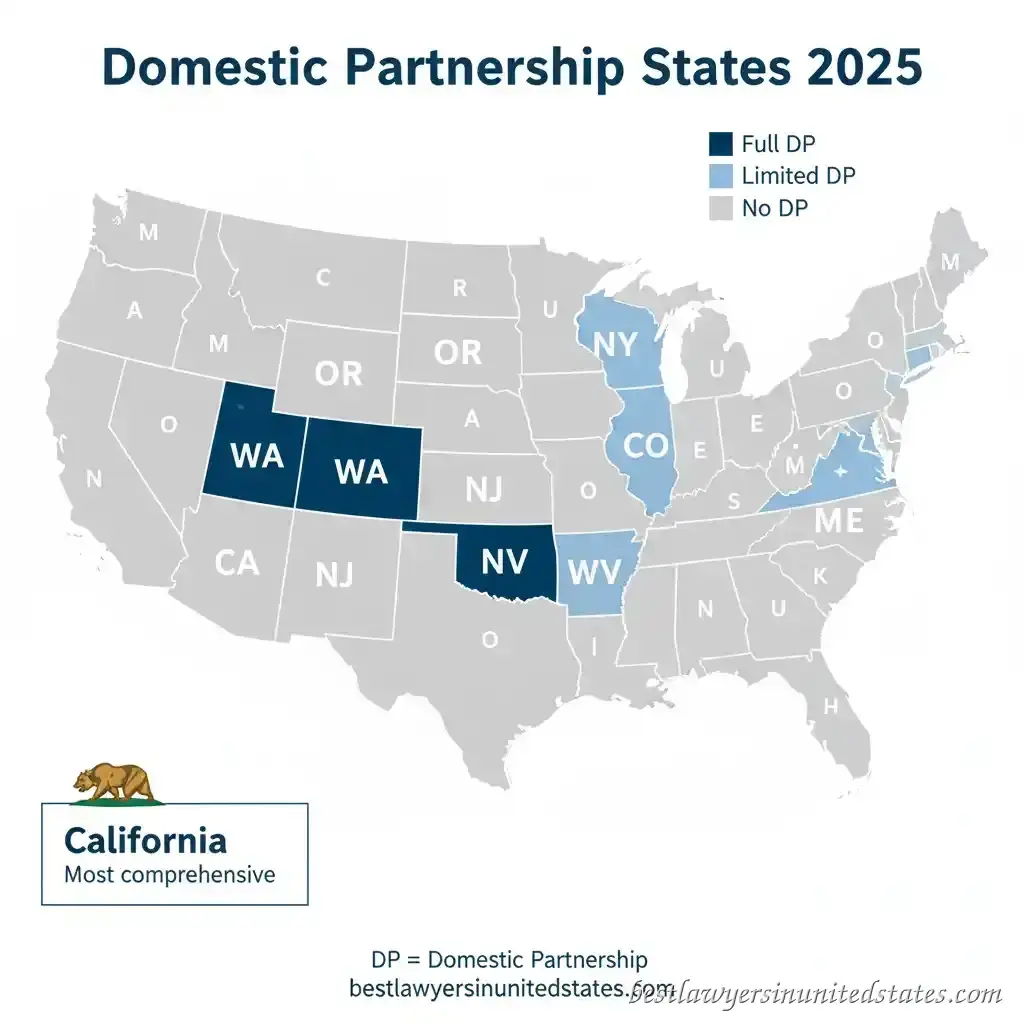
Domestic partnership registration is currently available in:
- California: Comprehensive domestic partnership rights under the California Family Code
- Oregon: Registered domestic partnerships with rights similar to marriage
- Washington State: State-registered domestic partnerships
- New Jersey: Civil unions and domestic partnerships
- New York: Limited domestic partnership recognition (primarily New York City)
- Colorado: Designated beneficiary agreements (similar framework)
- Several municipalities: Including cities in Florida, Minnesota, and other states
To establish a domestic partnership, couples typically file a Declaration of Domestic Partnership with the Secretary of State or local registry office. Requirements generally include cohabitation, shared residence, and meeting specific eligibility criteria that vary by jurisdiction.
Civil Union vs. Domestic Partnership
Civil unions represent another category of legal recognition, distinct from both marriage and domestic partnership. Civil unions provide state-level rights approximating marriage but lack federal recognition. New Jersey, Illinois, and several other states previously offered civil unions, though many have since transitioned to full marriage equality or phased out these programs.
The key distinction is that civil unions were designed to mirror marriage rights within a state, while domestic partnerships often provide a more limited subset of protections focused on healthcare decisions, property rights, and employment benefits.
Key Legal Differences Between Domestic Partnership and Marriage
Understanding the fundamental legal distinctions between these two frameworks is essential for making an informed choice.
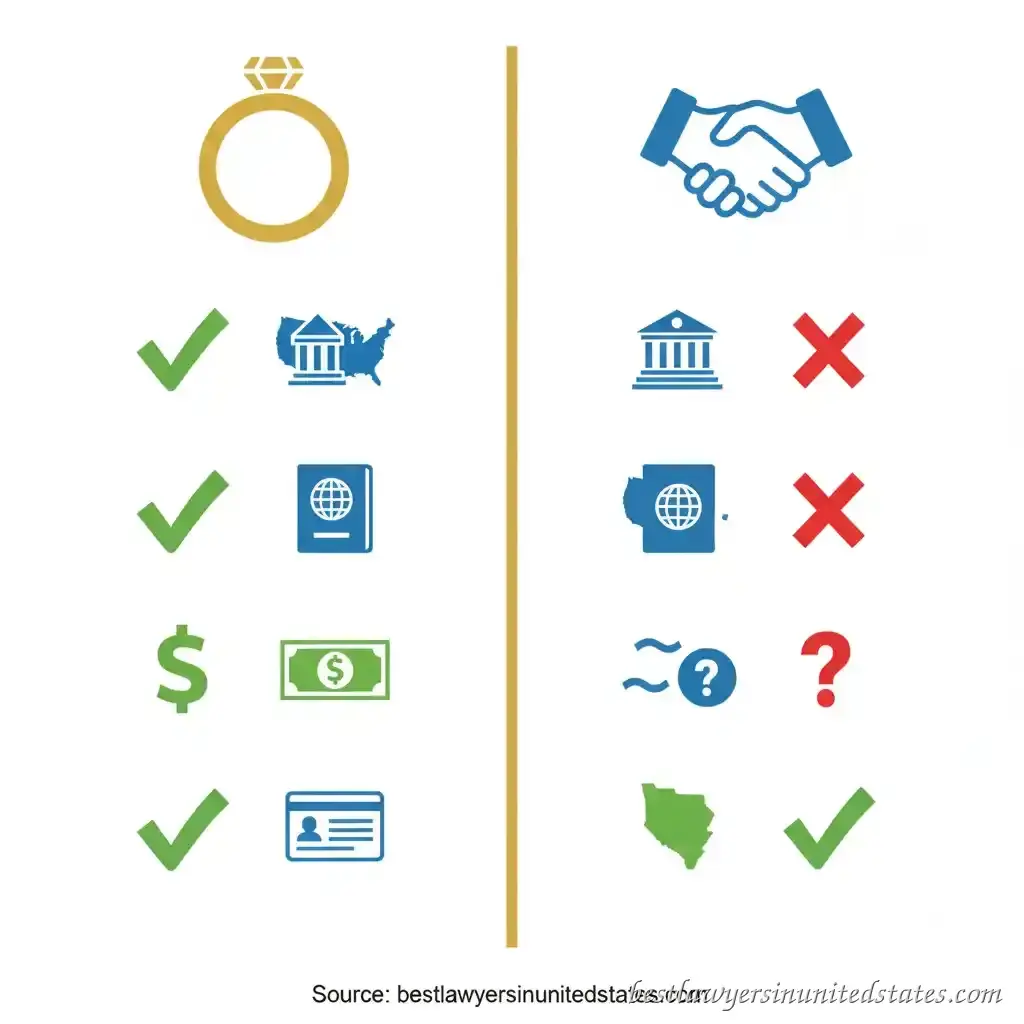
Federal Recognition and Benefits
Marriage: Fully recognized by all federal agencies, providing access to:
- Social Security survivor benefits
- Federal employee benefits through the Employee Retirement Income Security Act (ERISA)
- Military spouse benefits and housing allowances
- Immigration sponsorship for foreign-born partners
- Federal Family Medical Leave Act (FMLA) protections
Domestic Partnership: Not recognized at the federal level, meaning:
- No Social Security survivor or spousal benefits
- Limited or no federal employee benefit recognition
- No immigration sponsorship eligibility
- FMLA may not apply depending on employer policies
This federal recognition gap represents the most consequential difference between the two legal structures.
Interstate Portability and Recognition
Marriage certificates are recognized in all 50 states under the Full Faith and Credit Clause of the U.S. Constitution. When you marry in one state and move to another, your marital status automatically transfers.
Domestic partnerships face significant portability limitations. A California registered domestic partnership may not be recognized when you relocate to Texas, Florida, or other states without domestic partnership laws. This creates substantial complications for:
- Couples who relocate for employment
- Military families with frequent transfers
- Individuals with property in multiple states
- Retirees moving across state lines
If you’re a domestic partnership couple moving from a recognition state to a non-recognition state, you may lose access to hospital visitation rights, medical decision-making authority, and property protections until you either marry or establish alternative legal documents.
Property Rights and Community Property Laws
In community property states like California, Washington, and Texas, married couples automatically have equal ownership of property and income acquired during the marriage. Domestic partnerships in California receive similar treatment under state law, but these protections don’t extend beyond state borders.
Marriage provides:
- Automatic community property rights in applicable states
- Separate property protections
- Clear inheritance rights without a will
- Spousal protections during divorce proceedings
Domestic partnerships may provide similar state-level property rights where recognized, but couples should establish cohabitation agreements or other legal documents to ensure clarity, especially if relocating.
Tax Implications: Domestic Partnership vs Marriage
The tax treatment differences between domestic partnerships and marriage create significant financial implications that vary based on your income level, filing status, and state of residence.
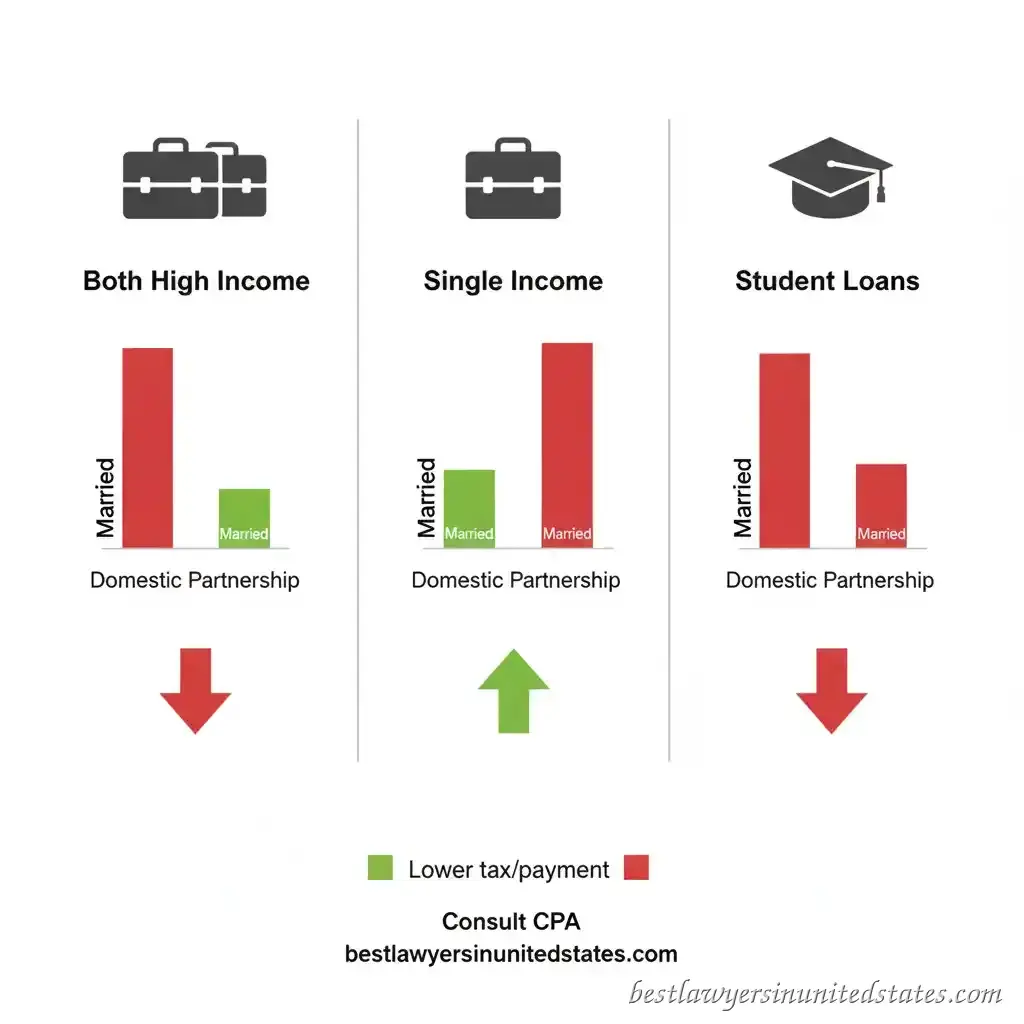
Federal Tax Treatment
Married Couples:
- File joint tax returns or married filing separately
- Access to unlimited marital deduction for gift and estate taxes
- Gift tax exemption between spouses (unlimited transfers)
- Estate tax portability (transferring unused exemption to surviving spouse)
- Potential marriage tax penalty for high-income dual-earner couples
- Potential marriage tax bonus for single-income or disparate-income households
Domestic Partners:
- Must file as single or head of household (federal returns)
- No marital deduction for gift or estate tax purposes
- Gifts between partners may be subject to gift tax
- No estate tax portability
- Each partner files separately regardless of income structure
State Tax Filing Considerations
In states like California that recognize domestic partnerships, registered domestic partners may be required to file state taxes as if married, while filing federal returns as single individuals. This creates administrative complexity and may require working with a tax advisor or CPA familiar with dual-status filing requirements.
Financial Impact Analysis
Consider these scenarios:
High-Income Dual Earners ($200,000+ combined): Marriage may trigger the “marriage tax penalty,” where filing jointly pushes income into higher brackets. Domestic partnership allows each partner to utilize lower individual brackets, potentially reducing overall tax liability.
Single-Income Households: Marriage provides substantial tax benefits through joint filing status, which often results in lower effective tax rates compared to the higher-earning partner filing as a single individual.
Estate Planning: The unlimited marital deduction allows married couples to transfer unlimited assets between spouses without gift or estate tax consequences. Domestic partners face potential tax liability on large transfers, as gifts exceeding the annual exclusion amount (currently $18,000 per year) may trigger gift tax reporting or use lifetime exemption amounts.
Rights and Benefits Comparison: What You Gain and Lose
| Benefit Category | Marriage | Domestic Partnership |
|---|---|---|
| Federal tax filing | Joint filing available | Single filing only |
| Social Security survivor benefits | Yes | No |
| Immigration sponsorship | Yes | No |
| Hospital visitation rights | Nationwide | State-dependent |
| Medical decision-making | Automatic spousal authority | May require power of attorney |
| Inheritance rights (no will) | Automatic spousal inheritance | State-dependent, often limited |
| Health insurance (employer) | Guaranteed spouse coverage | Imputed income may apply |
| FMLA leave | Federal protection | Employer discretion |
| Estate tax exemption | Unlimited marital deduction | No federal protection |
| Pension/retirement benefits | Survivor annuity rights | Limited or none |
Healthcare and Medical Decision-Making Authority
Married spouses automatically receive authority to make medical decisions if their partner becomes incapacitated. This includes hospital visitation rights, access to medical records under HIPAA, and life support decisions.
Domestic partners should establish:
- Durable power of attorney for healthcare
- HIPAA authorization forms
- Advanced healthcare directives
- Hospital visitation authorization
Without these documents, domestic partners may face challenges accessing their partner in emergency situations, particularly in states without domestic partnership recognition or in healthcare facilities that strictly interpret spousal rights.
Parental Rights and Custody Considerations
Marriage provides automatic parental presumption in most states. When a married couple has a child, both spouses are typically recognized as legal parents regardless of biological connection.
Domestic partners face more complex parental rights situations:
- Non-biological parents may need to complete second-parent adoption
- Custody disputes may not recognize both partners as legal parents
- Parental rights vary significantly by state
- Legal documentation is essential for protecting parental relationships
Couples raising children should prioritize establishing clear legal parental rights regardless of relationship status, but marriage provides stronger default protections.
Employer Benefits: The Imputed Income Issue
One of the most overlooked differences between marriage and domestic partnership involves employer-provided benefits, particularly health insurance coverage.
Health Insurance Coverage Differences
Employers that offer health benefits to domestic partners must treat the fair market value of that coverage as taxable income to the employee (imputed income) because the IRS doesn’t recognize domestic partners as spouses. This creates a significant financial impact:
Example: If employer-sponsored health insurance for a domestic partner costs $8,000 annually, that amount is added to your taxable income. At a 24% federal tax rate, this creates approximately $1,920 in additional federal tax liability, plus state taxes.
Married spouses receive health insurance coverage tax-free, as the IRS recognizes spousal benefits as non-taxable fringe benefits.
Retirement Plan and Pension Benefits
The Employee Retirement Income Security Act (ERISA) provides specific protections for spouses of retirement plan participants:
Marriage:
- Automatic survivor annuity protection for defined benefit pensions
- Spousal consent required for beneficiary changes
- Qualified joint and survivor annuity options
- Spousal rollover rights for inherited retirement accounts
Domestic Partnership:
- No automatic ERISA protections
- Partner must be explicitly designated as beneficiary
- No spousal rollover options for inherited retirement accounts
- May face immediate taxation on inherited retirement assets
These differences can result in hundreds of thousands of dollars in lost benefits over a lifetime, particularly for couples with substantial retirement savings or pension benefits.
Life Insurance and Disability Benefits
Group life insurance and disability benefits through employers typically extend to spouses automatically. Domestic partners may be eligible to designate their partner as a beneficiary, but coverage availability and imputed income rules vary by employer and insurance provider.
Why Straight Couples Choose Domestic Partnership
While domestic partnerships were created primarily for same-sex couples before marriage equality, opposite-sex couples increasingly choose domestic partnership for strategic reasons:
Financial and Tax Strategy
Some high-income couples benefit from filing separate tax returns and avoiding the marriage tax penalty. Domestic partnership allows couples to maintain legal protections at the state level while preserving favorable individual tax filing status at the federal level.
Student Loan Repayment Planning
Couples with significant student loan debt enrolled in income-driven repayment plans may benefit from domestic partnership. Because income-driven repayment calculations for married borrowers include spousal income (when filing jointly), remaining unmarried can result in substantially lower monthly payments and greater loan forgiveness over time.
Preserving Widow or Survivor Benefits
Individuals receiving survivor benefits from a deceased spouse’s Social Security, military pension, or other government program often lose these benefits upon remarriage. Entering a domestic partnership in states like California allows these individuals to formalize a new relationship while preserving critical income streams.
Medicaid Planning for Elderly Couples
Medicaid eligibility calculations treat married couples’ assets jointly, potentially disqualifying individuals from long-term care coverage. Some elderly couples choose domestic partnership or avoid formal legal recognition entirely to protect assets and maintain Medicaid eligibility while still formalizing their commitment.
Privacy and Autonomy Considerations
Marriage creates extensive public records including marriage certificates, property ownership changes, and court proceedings. Some couples prefer the relative privacy of domestic partnership, which typically involves less public documentation and may better align with philosophical preferences about relationship autonomy.
Asset Protection in High-Liability Professions
Professionals in high-liability fields such as medicine, law, or business ownership may benefit from the clearer asset separation that domestic partnership can provide. While marriage offers some asset protection mechanisms through tools like a prenuptial agreement, the automatic financial entanglement of marriage can create exposure in litigation scenarios.
Establishing a Domestic Partnership: Registration Process
The process for registering a domestic partnership varies by state but generally involves the following steps:
Eligibility Requirements
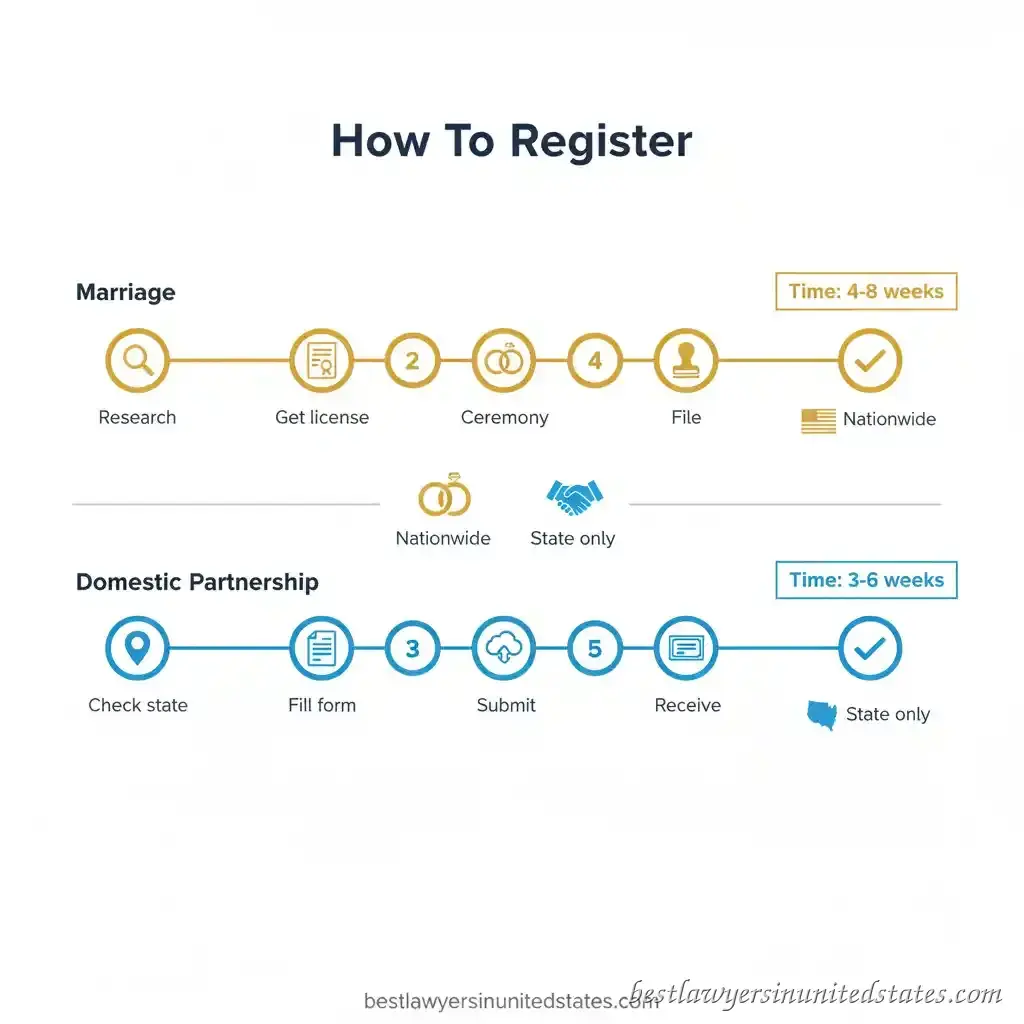
Most states require domestic partners to meet these criteria:
- Both partners are at least 18 years old (or meet state-specific age requirements)
- Neither partner is married or in another domestic partnership
- Partners are not related by blood in a way that would prevent marriage
- Partners share a shared residence and common household
- Partners are in a committed relationship and financially interdependent
Registration Steps
- Obtain the Declaration of Domestic Partnership form from your state’s Secretary of State office or local registry
- Complete the form with both partners present or with notarized signatures
- Provide required documentation, which may include:
- Proof of shared residence (lease, utility bills, mortgage documents)
- Government-issued identification for both partners
- Proof of age and single status
- Pay the registration fee, typically ranging from $25 to $100
- Submit the form to the appropriate state or local registry office
- Receive your Certificate of Domestic Partnership, which serves as proof of your legal status
Some jurisdictions allow online registration, while others require in-person filing with the county clerk’s office or state registry.
Dissolving a Domestic Partnership vs. Divorce
Termination of Domestic Partnership
Ending a domestic partnership is generally simpler than divorce, though requirements vary by state. Beyond dissolution and divorce, some couples may also explore annulment as an alternative legal option depending on their circumstances.
California: Registered domestic partners must follow dissolution procedures similar to divorce, including property division, support obligations, and court proceedings if the partnership lasted more than five years or involves children or significant property.
Other States: May allow simpler administrative termination by filing a termination notice with the Secretary of State, particularly for partnerships of short duration without children or substantial shared property.
The dissolution process typically involves:
- Filing a termination notice with the appropriate registry office
- Waiting period (typically six months in California)
- Property division according to state law
- Potential support obligations
- Court proceedings if disputes arise
Divorce Process for Married Couples
Divorce follows formal court proceedings in all states, involving:
- Filing a petition with the Superior Court or Family Court
- Formal service of divorce papers
- Disclosure of assets and financial information
- Negotiation or litigation of property division, support, and custody
- Final judgment of dissolution from the court
Marriage dissolution generally involves more complex legal procedures, longer timeframes, and higher legal costs compared to domestic partnership termination in most jurisdictions. Understanding the cost of divorce is essential when evaluating which legal framework best serves your long-term interests.
Converting Domestic Partnership to Marriage
Many couples begin with domestic partnership and later decide to marry. Understanding the conversion process and its implications is essential for proper planning.
Step-by-Step Conversion Process
- Maintain existing domestic partnership (no need to terminate before marriage in most states)
- Obtain a marriage license from your county clerk’s office
- Complete marriage ceremony with authorized officiant
- File marriage certificate with appropriate government office
- Notify relevant parties of marital status change:
- Employer Human Resources Department for benefits enrollment
- Insurance providers for policy updates
- Financial institutions for account designations
- Estate Planning Attorney for will and trust updates
Tax Implications During Conversion Year
The year you convert from domestic partnership to marriage creates unique tax considerations. You should:
- File as married for federal taxes beginning in the year you marry (IRS recognizes marital status as of December 31st)
- Recalculate tax withholding to reflect married filing status
- Consider whether joint filing or married filing separately provides better tax outcomes
- Adjust estimated tax payments if self-employed
- Consult with a CPA or tax advisor familiar with status changes
Timing Strategies for Optimal Conversion
Strategic timing of conversion can provide financial benefits:
End of Tax Year: Marrying in December allows you to file jointly for the entire tax year, maximizing potential tax benefits or avoiding them if the marriage penalty would apply.
Benefits Enrollment Period: Converting during your employer’s open enrollment period simplifies benefits transitions and allows immediate removal of imputed income for partner health coverage.
Estate Planning Alignment: Converting before anticipated inheritance or significant wealth transfer allows immediate access to unlimited marital deduction benefits.
State-Specific Guidance: Key Differences Across Jurisdictions
Domestic Partnership vs Marriage California
California offers the most comprehensive domestic partnership rights in the United States under the California Family Code. Registered domestic partners receive nearly identical state-level rights to married couples, including:
- Community property protections
- Inheritance rights
- Hospital visitation and medical decision-making
- Step-parent adoption processes
- Domestic violence protections
However, California domestic partners still lack federal benefit recognition, creating the fundamental limitation in Social Security, immigration, and federal tax treatment.
New York Domestic Partnership vs Marriage
New York does not have a statewide domestic partnership registry. New York City and some other municipalities offer limited domestic partnership registration, primarily providing:
- Hospital visitation rights within city facilities
- Some employer benefit recognition
- Limited property protections
New York domestic partnerships provide significantly fewer protections than California’s program, making marriage the preferred option for couples seeking comprehensive legal recognition in New York.
Texas, Florida, and Non-Recognition States
States including Texas and Florida do not recognize domestic partnerships established in other states. Couples moving to these jurisdictions should:
- Establish power of attorney documents for healthcare decisions
- Create cohabitation agreements for property protection
- Update beneficiary designations for all financial accounts
- Consider conversion to marriage for federal benefit protection
- Consult with a family law attorney about alternative legal protections
Immigration Implications: Critical Differences for International Couples
Immigration law creates one of the most significant practical distinctions between marriage and domestic partnership.
Marriage-Based Immigration Benefits
U.S. citizens and lawful permanent residents can sponsor foreign-born spouses for:
- K-1 fiancé visas (for marriages occurring in the U.S.)
- CR-1/IR-1 spousal immigrant visas
- Green card applications based on marriage
- Expedited citizenship pathways (three-year rule instead of five years)
The marriage-based immigration process provides a clear legal pathway for international couples to remain together in the United States.
Domestic Partnership Immigration Limitations
Domestic partnerships provide no federal immigration benefits. Partners in domestic partnerships cannot:
- Sponsor their partner for any visa category based on the relationship
- Include domestic partners in green card applications
- Utilize any expedited processing or special visa categories
International couples must pursue alternative visa categories such as employment-based sponsorship, investor visas, or other immigration pathways independent of their relationship status.
For couples with one foreign-born partner, this limitation alone often necessitates choosing marriage over domestic partnership regardless of other considerations.
Estate Planning: Domestic Partnership vs Marriage Considerations
Estate planning reveals substantial differences in asset protection, tax treatment, and inheritance rights between the two legal structures.
Unlimited Marital Deduction for Married Couples
The Internal Revenue Code provides married couples with an unlimited marital deduction, allowing spouses to transfer any amount of assets to each other during life or at death without triggering gift or estate tax. This creates powerful estate planning opportunities:
- Unlimited lifetime gifts between spouses
- Estate tax deferral until second spouse’s death
- Portability of unused estate tax exemption (currently $13.61 million per person in 2024)
- QTIP trusts and other sophisticated planning structures
Domestic Partnership Estate Planning Limitations
Domestic partners face the same estate and gift tax rules as unmarried individuals:
- Annual gift tax exclusion only ($18,000 per year in 2024)
- Gifts exceeding annual exclusion use lifetime exemption or trigger gift tax
- No portability of estate tax exemption between partners
- Estate transfers to surviving partner may be fully taxable
Example: A married person can leave a $20 million estate to their surviving spouse with no federal estate tax. A domestic partner leaving the same $20 million estate to their surviving partner would face estate tax on amounts exceeding the individual exemption (currently $13.61 million), potentially resulting in millions in tax liability.
Intestate Succession Differences
Dying without a will (intestate) creates different outcomes:
Marriage: State intestacy laws automatically provide substantial inheritance rights to surviving spouses, typically granting them priority over other family members and at least a portion of the estate.
Domestic Partnership: Intestacy laws in most states do not recognize domestic partners, meaning assets pass to blood relatives rather than the surviving partner unless explicitly designated through will, trust, or beneficiary designations.
Probate and Asset Transfer
Married couples benefit from:
- Simplified probate procedures for spousal transfers
- Automatic right of survivorship for jointly held property
- Homestead protections in many states
- Elective share rights preventing disinheritance
Domestic partners should establish comprehensive estate planning documents including wills, revocable living trusts, beneficiary designations, and transfer-on-death registrations to ensure asset transfers align with their intentions.
Pros and Cons: Making the Right Choice for Your Situation
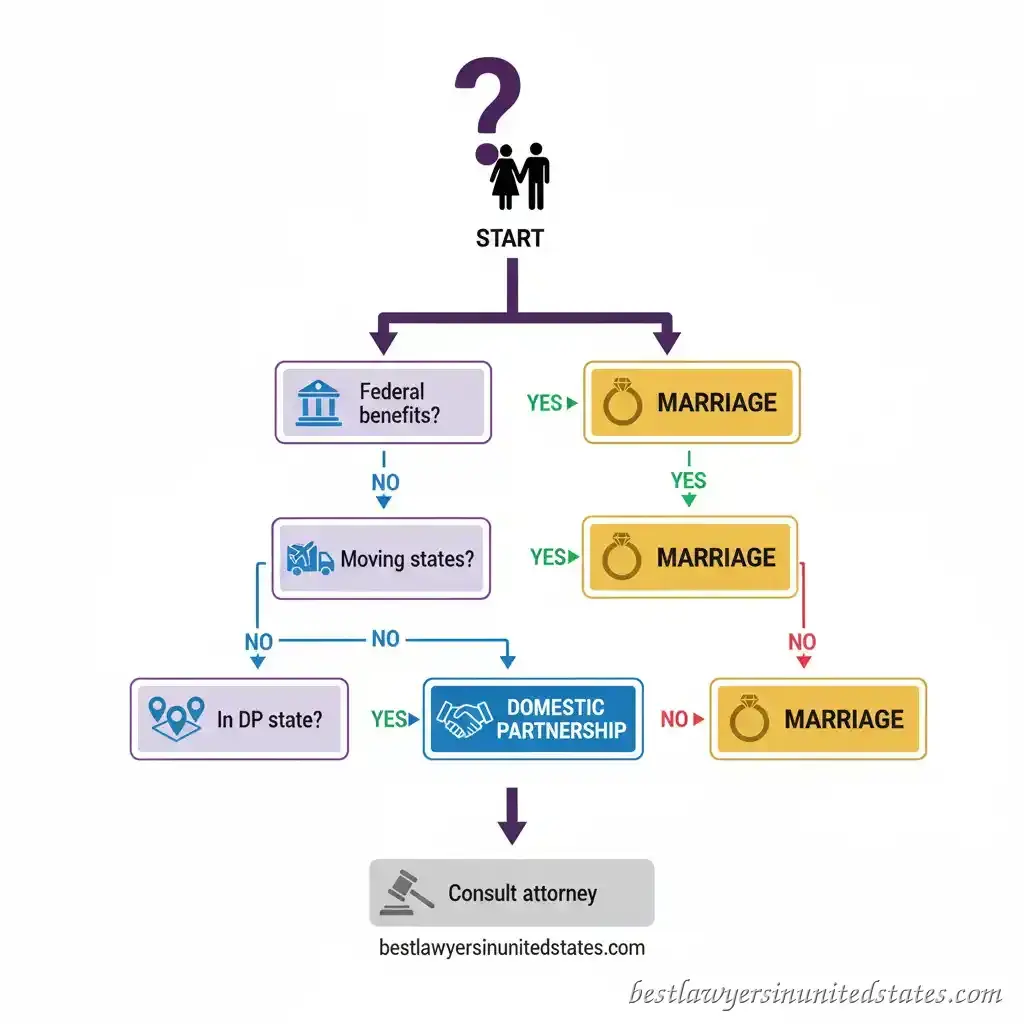
Advantages of Marriage
- Universal recognition across all states and federal agencies
- Federal benefits including Social Security, immigration, and tax advantages
- Stronger legal protections for children and parental rights
- Estate planning benefits through unlimited marital deduction
- Simplified legal procedures for property, healthcare, and financial decisions
- International recognition in most countries worldwide
Disadvantages of Marriage
- Potential marriage tax penalty for high-income dual-earner couples
- Loss of certain government benefits including widow/survivor benefit elimination upon remarriage
- More complex dissolution process requiring formal divorce proceedings
- Financial entanglement that may expose assets in litigation
- Public record creation with less privacy than alternatives
Advantages of Domestic Partnership
- State-level legal protections in recognition states
- Tax flexibility allowing separate federal filing
- Simpler dissolution in many jurisdictions
- Student loan repayment advantages for income-driven repayment plans
- Preservation of certain benefits that marriage would eliminate
- Alternative for couples philosophically opposed to marriage
Disadvantages of Domestic Partnership
- No federal recognition eliminating Social Security, immigration, and federal tax benefits
- Limited interstate portability creating complications when relocating
- Employer benefit taxation through imputed income
- Weaker parental rights requiring additional legal documentation
- Estate planning limitations without access to marital deduction
- Immigration impossibility for international couples
Historical Context and Future Outlook
The Evolution of Domestic Partnership Laws
Domestic partnerships emerged in the 1980s as municipalities and states sought to provide legal recognition for same-sex couples excluded from marriage. Berkeley, California established one of the first domestic partnership registries in 1984, followed by other progressive jurisdictions.
The Defense of Marriage Act (DOMA), passed in 1996, defined marriage as between one man and one woman for federal purposes, intensifying the need for alternative legal structures. States including California, Oregon, and Washington developed comprehensive domestic partnership programs providing state-level rights approximating marriage.
The Supreme Court’s decision in United States v. Windsor (2013) struck down Section 3 of DOMA, requiring federal recognition of same-sex marriages performed in states where legal. Two years later, Obergefell v. Hodges (2015) established marriage equality nationwide, guaranteeing same-sex couples’ right to marry in all states.
Current Trends and Legislative Changes
Following marriage equality, some states have phased out or limited domestic partnership programs, viewing them as unnecessary with universal marriage access. However, several states maintain these programs, recognizing that couples—both same-sex and opposite-sex—may prefer alternatives to marriage for various personal, financial, or philosophical reasons.
Recent legislative trends show:
- Maintenance of existing programs in California, Oregon, and Washington State
- Expanded eligibility to opposite-sex couples in some jurisdictions
- Focus on elder protections for seniors preserving government benefits
- Employer policy evolution toward more inclusive relationship recognition
Looking Ahead: Will Domestic Partnerships Remain Relevant?
Despite marriage equality, domestic partnerships are likely to remain relevant for several reasons:
Elder Couples: The senior population increasingly cohabits without marriage to preserve Social Security survivor benefits, pension protections, and Medicaid eligibility. Domestic partnership provides legal recognition without triggering benefit loss.
Strategic Financial Planning: As awareness grows of the marriage tax penalty, student loan repayment impacts, and other financial implications, more couples may deliberately choose domestic partnership for its distinct advantages.
Philosophical Preferences: Some couples view marriage as a religious or patriarchal institution and prefer secular alternatives that align with their values while still providing legal protections.
International Models: Many countries including France (PACS), Australia (de facto relationships), and others maintain alternative legal structures alongside marriage, suggesting multiple relationship recognition options serve legitimate societal needs.
The legal landscape will likely continue evolving, potentially expanding domestic partnership availability while marriage remains the default framework for most couples seeking comprehensive federal and state recognition.
Frequently Asked Questions
Is it better to be married or in a domestic partnership?
Marriage is generally advantageous for couples seeking comprehensive legal protections, federal benefits, and interstate recognition. Marriage provides Social Security survivor benefits, immigration sponsorship, estate tax benefits, and automatic recognition in all states.
However, domestic partnership may be preferable for couples who would lose government benefits through marriage, face marriage tax penalties, or prefer strategic separation of finances while maintaining state-level legal protections.
What are the disadvantages of a domestic partnership?
The primary disadvantages include lack of federal recognition (no Social Security benefits, immigration sponsorship, or federal tax benefits), limited interstate portability, imputed income taxation on employer health benefits, weaker default parental rights, and estate planning limitations without access to unlimited marital deduction.
Domestic partners typically need additional legal documentation to achieve protections that married couples receive automatically.
What is it called when you’re not married but live together for 7 years?
This common misconception refers to “common law marriage,” but simply living together for seven years (or any period) does not create a common law marriage in most states. Common law marriage requires mutual agreement to be married, cohabitation, and public representation as spouses. Only a handful of states recognize common law marriage, and time periods vary. Cohabitation without formal marriage or domestic partnership registration provides limited legal protections regardless of duration.
What does it mean to be in a domestic partnership relationship?
A domestic partnership is a legally recognized relationship between two committed partners who share a residence and have registered their relationship with a state or local government entity. Registered domestic partners receive specific legal rights and protections defined by state law, which may include property rights, medical decision-making authority, inheritance rights, and access to certain benefits. The specific rights vary significantly depending on the state where the partnership is registered.
What are the disadvantages of a domestic partnership?
The primary disadvantages include lack of federal recognition (no Social Security benefits, immigration sponsorship, or federal tax benefits), limited interstate portability, imputed income taxation on employer health benefits, weaker default parental rights, and estate planning limitations without access to unlimited marital deduction. Domestic partners typically need additional legal documentation to achieve protections that married couples receive automatically.
What is it called when you’re not married but live together for 7 years?
This common misconception refers to “common law marriage,” but simply living together for seven years (or any period) does not create a common law marriage in most states. Common law marriage requires mutual agreement to be married, cohabitation, and public representation as spouses.
What does it mean to be in a domestic partnership relationship?
A domestic partnership is a legally recognized relationship between two committed partners who share a residence and have registered their relationship with a state or local government entity. Registered domestic partners receive specific legal rights and protections defined by state law, which may include property rights, medical decision-making authority, inheritance rights, and access to certain benefits. The specific rights vary significantly depending on the state where the partnership is registered.
Why would a straight couple get a domestic partnership?
Opposite-sex couples choose domestic partnership for several strategic reasons: avoiding marriage tax penalties for high-income dual earners, preserving widow/survivor benefits from previous marriages, optimizing student loan repayment through income-driven plans, protecting Medicaid eligibility for long-term care, maintaining asset separation in high-liability professions, and philosophical preferences for alternatives to traditional marriage. Some couples also use domestic partnership as a transitional step before marriage.
Is a domestic partnership legal in every state?
No. Domestic partnership recognition varies significantly by state. Comprehensive statewide programs exist in California, Oregon, Washington State, New Jersey, and a few other jurisdictions. Some states offer no recognition at all, while others have limited municipal programs. Domestic partnerships registered in one state are not automatically recognized when you move to another state, unlike marriage which receives universal interstate recognition under federal constitutional principles.
Can you enter a marriage after being in a domestic partnership?
Yes. Couples can convert from domestic partnership to marriage at any time. The process involves obtaining a marriage license, completing a marriage ceremony, and filing the marriage certificate. In most states, you do not need to formally terminate the domestic partnership before marrying, as marriage automatically supersedes the previous domestic partnership status. Couples should notify employers, insurance providers, and financial institutions of the status change and consider tax implications for the conversion year.
Take the Next Step: Protecting Your Relationship and Future
Choosing between domestic partnership and marriage requires careful consideration of your unique circumstances, including your financial situation, employment benefits, family structure, relocation plans, and long-term goals. The decision impacts everything from daily healthcare decisions to estate planning, tax liability, and asset protection strategies.
Whether you choose marriage, domestic partnership, or another legal framework, establishing proper legal protections is essential. Even married couples benefit from comprehensive estate planning documents, while domestic partners require additional documentation to achieve comparable protections.
Schedule Your Consultation Today
A qualified family law attorney can help you:
- Evaluate which legal structure best serves your specific situation
- Understand state-specific rights and limitations
- Establish necessary legal documentation for healthcare, property, and parental rights
- Navigate complex tax implications and benefit coordination
- Plan for contingencies including relocation, dissolution, or status conversion
Don’t leave your legal protections to chance. Whether you’re considering domestic partnership, planning to marry, or evaluating conversion options, professional guidance ensures you make informed decisions that protect your relationship, finances, and future.
Contact an experienced family law attorney in your state to discuss your options and develop a comprehensive legal strategy tailored to your unique needs and goals.
This article provides general information about domestic partnerships and marriage but does not constitute legal advice. Laws vary significantly by state and change over time. Consult with a qualified family law attorney and tax advisor in your jurisdiction for guidance specific to your situation.
