
A DUI arrest in California triggers two separate cases. You face criminal charges in court and an automatic license suspension through the DMV. The penalties are severe. A first offense brings up to six months in jail, fines reaching $3,600, and a six-month license suspension.
California Vehicle Code Section 23152 makes it illegal to drive with a blood alcohol concentration of 0.08% or higher. For commercial drivers, the limit drops to 0.04%. Drivers under 21 face a zero-tolerance policy at 0.01% BAC.
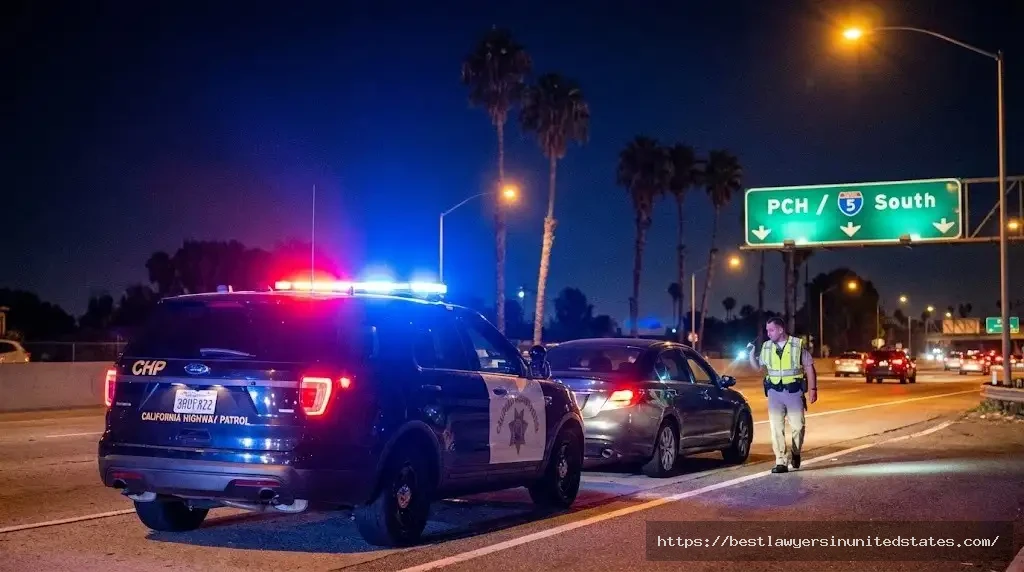
You have only 10 days from your arrest date to request a DMV hearing. Miss this deadline and your license suspends automatically. This article explains everything you need to know about California DUI laws in 2026.
What’s New in California DUI Laws for 2026
California expanded its ignition interlock device program statewide in 2026. All DUI offenders must now install an IID to regain driving privileges. This applies even to first-time offenders.
The state also increased penalties for DUI cases involving children under 14. Drivers face an additional 48 hours in jail and enhanced fines. California courts now require mandatory substance abuse treatment for all repeat offenders.
New diversion programs launched in Los Angeles, San Francisco, and San Diego counties. First-time offenders with no injuries or accidents may qualify. These programs offer reduced charges in exchange for completing intensive treatment.
Understanding California DUI Statutes
California prosecutes DUI cases under two distinct violations. Both fall under Vehicle Code Section 23152.
Vehicle Code 23152(a): Impaired Driving
This statute prohibits driving under the influence of alcohol or drugs. Prosecutors don’t need to prove a specific BAC level. They only need evidence that alcohol impaired your ability to drive safely.
Signs of impairment include erratic driving, failed field sobriety tests, or officer observations. Even with a BAC under 0.08%, you can still face charges under VC 23152(a).
Vehicle Code 23152(b): Per Se Violation
This law makes it illegal to drive with a BAC of 0.08% or higher. The prosecution doesn’t need to prove actual impairment. A chemical test showing 0.08% BAC or above is sufficient for conviction.
Most DUI arrests result in charges under both subsections. Prosecutors file both to strengthen their case.
Legal BAC Limits in California
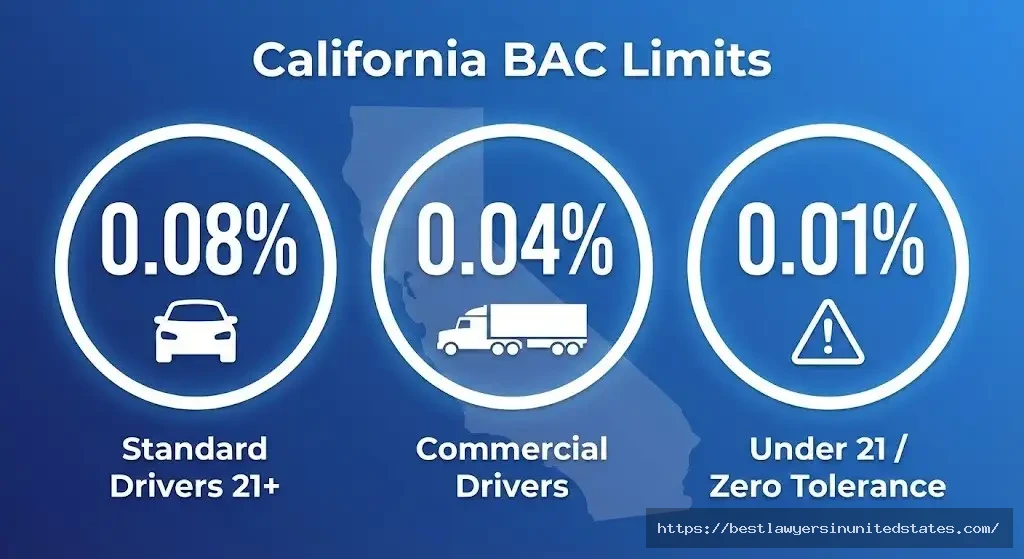
California sets different BAC limits based on driver type and age.
| Driver Category | Legal BAC Limit | Violation Code |
|---|---|---|
| Standard drivers (21+) | 0.08% | VC 23152(b) |
| Commercial drivers | 0.04% | VC 23152(d) |
| Drivers under 21 | 0.01% | VC 23136 |
| DUI probation | 0.01% | VC 23154 |
Commercial drivers lose their CDL for one year on a first offense. A second offense means a lifetime CDL ban.
Want to check if you’re over the limit? Use our BAC calculator to estimate your blood alcohol content based on drinks consumed, body weight, and time elapsed.
What Is the 3-Hour Rule in California?
California law requires chemical testing within three hours of driving. This rule appears in Vehicle Code Section 23152.
The three-hour window protects test accuracy. Blood alcohol levels change over time. Testing beyond three hours may produce unreliable results.
However, prosecutors can still use late test results. They must present expert testimony to extrapolate your BAC at the time of driving. Defense attorneys often challenge these calculations successfully.
If police tested you after three hours, contact a DUI attorney immediately. This timing issue creates strong grounds for dismissal.
DUI Penalties in California by Offense Level
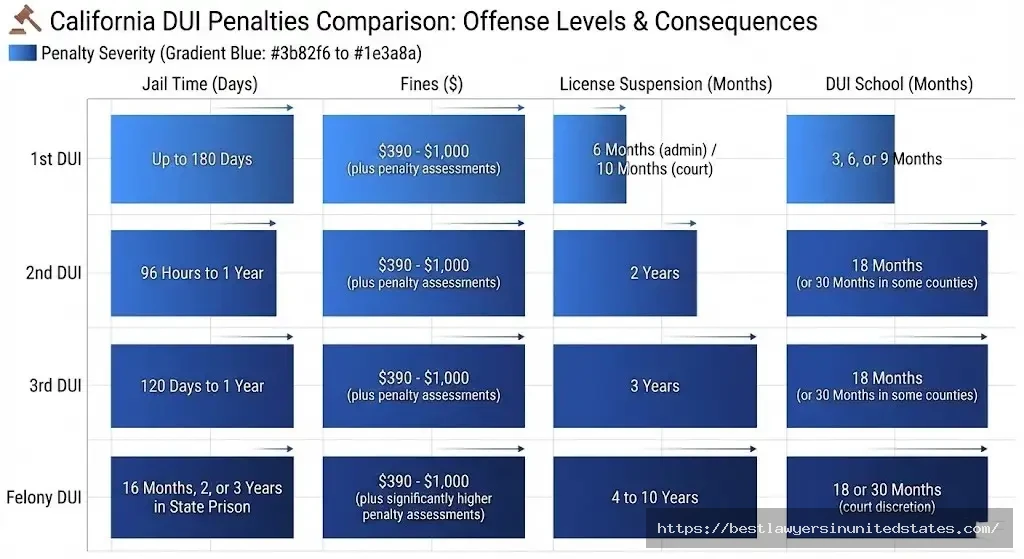
California DUI penalties increase dramatically with each offense. The lookback period is 10 years. Any DUI conviction within this timeframe counts as a prior offense.
First DUI Offense Penalties
A first-time DUI in California is typically a misdemeanor. Here’s what you face:
Jail Time: Up to six months in county jail. Most first offenders serve no jail time or get 48 hours. Some counties allow work release or electronic monitoring.
Fines: Base fine of $390 to $1,000. With penalty assessments, the total reaches $3,600 to $4,800. These assessments include court fees, state surcharges, and county penalties.
License Suspension: Six months through the DMV. You may qualify for a restricted license after 30 days with an ignition interlock device.
DUI School: Three-month program (30 hours). Cost ranges from $500 to $650. You must complete this before license reinstatement.
Probation: Three to five years of informal probation. Conditions include no driving with any measurable alcohol and submitting to chemical tests on demand.
Many first-time offenders in Los Angeles County complete their cases at the Metropolitan Courthouse or Airport Courthouse. San Francisco cases go through the Hall of Justice. Orange County handles DUI cases at the Harbor Justice Center or Central Justice Center.
Second DUI Offense Penalties
A second DUI within 10 years brings harsher punishment:
Jail Time: 96 hours to one year. Most counties require at least 10 days actual custody. Some offer work furlough programs.
Fines: $390 to $1,000 base fine. Total costs reach $4,000 to $6,000 with assessments.
License Suspension: Two years through DMV. After 12 months, you may apply for an IID-restricted license.
DUI School: 18-month or 30-month program. Costs range from $1,800 to $2,500.
Probation: Three to five years with stricter conditions.
The California Highway Patrol reports that second offenders face jail time in 78% of cases. Courts rarely grant probation without custody time.
Third DUI Offense Penalties
A third DUI remains a misdemeanor but carries severe consequences:
Jail Time: 120 days to one year. Expect at least 120 days in custody. San Diego County often requires the full six months.
Fines: $390 to $1,000 base. Total costs exceed $5,000 with all penalties.
License Suspension: Three years. You may get an IID-restricted license after 18 months.
DUI School: 30-month program. Total cost approaches $2,800.
Habitual Traffic Offender Status: The DMV designates you an HTO for three years.
Many counties require substance abuse treatment beyond standard DUI school. Sacramento County Probation Department monitors third offenders closely.
Felony DUI (Fourth Offense or Injury)
A fourth DUI within 10 years becomes a felony. DUI causing injury is also a felony under Vehicle Code Section 23153.
Prison Time: 16 months to three years in state prison. Injury cases bring up to four years, plus additional time for each victim.
Fines: $390 to $1,000 base. Injury cases add restitution to victims.
License Revocation: Four years minimum. Five years for injury DUI.
Felony Probation: Available in some counties instead of prison. Requires one year in county jail.
Strike Offense: Injury DUI causing great bodily injury counts as a strike under California’s Three Strikes Law.
Felony DUI cases are heard in Superior Court. Los Angeles processes these at the Clara Shortridge Foltz Criminal Justice Center. San Francisco handles felony DUI at the Hall of Justice.
Aggravating Factors That Increase Penalties
California law enhances DUI penalties for specific circumstances:
High BAC (0.15% or above): Longer DUI school, increased jail time. Many judges add extra conditions to probation.
Excessive Speed: Driving 20+ mph over the limit on surface streets or 30+ mph on highways adds mandatory jail time.
Refusal to Submit to Chemical Test: Additional 48 hours in jail. DMV adds one year to your suspension.
Child Under 14 in Vehicle: Enhanced penalties under Vehicle Code Section 23572. Minimum 48 hours jail, even for first offense.
Accident Causing Injury: Felony charges under VC 23153. Penalties include state prison and restitution.
DUI in a School Zone: Some counties file additional charges.
These enhancements stack. A first-time DUI with a high BAC and a child passenger can result in significant jail time.
California DUI Penalties Comparison Table
| Offense | Jail Time | Fines (Total) | License Suspension | DUI School |
|---|---|---|---|---|
| 1st DUI | Up to 6 months | $3,600-$4,800 | 6 months | 3 months |
| 2nd DUI | 96 hours to 1 year | $4,000-$6,000 | 2 years | 18 months |
| 3rd DUI | 120 days to 1 year | $5,000+ | 3 years | 30 months |
| 4th DUI (Felony) | 16 months to 3 years | $5,000+ | 4 years | 30 months |
| DUI with Injury (Felony) | 2-4 years | $5,000+ (plus restitution) | 5 years | 30 months |
Check Your BAC Level
Understanding your blood alcohol concentration helps you make informed decisions. BAC depends on several factors including weight, gender, drinks consumed, and time.
Not sure where you stand? Use our BAC calculator to estimate your blood alcohol content. This tool helps you understand how alcohol affects your body.
BAC Calculator
Estimate your Blood Alcohol Content
• Commercial Driver (CDL): 0.04% BAC
• Drivers Under 21: 0.00-0.02% BAC (Zero Tolerance)
• Enhanced Penalties: 0.15% BAC or higher in most states
Remember that even one drink can impair your driving ability. The only safe BAC for driving is 0.00%.
What Happens When You Get a DUI in California: Step-by-Step
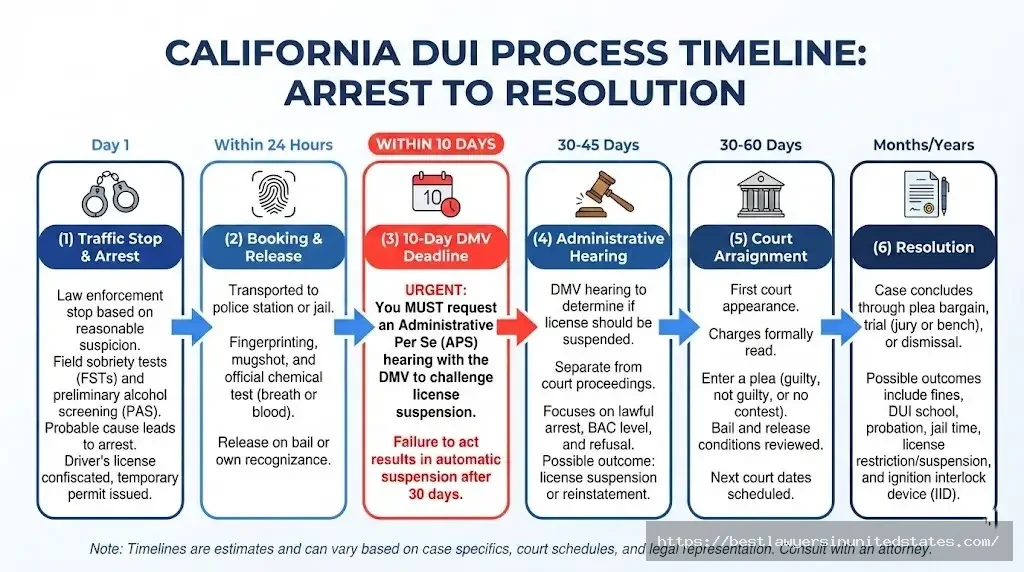
A DUI arrest follows a specific process. Understanding each stage helps you protect your rights.
The Traffic Stop and Field Sobriety Tests
California Highway Patrol and local police need reasonable suspicion to stop your vehicle. Common reasons include speeding, weaving, running red lights, or equipment violations.
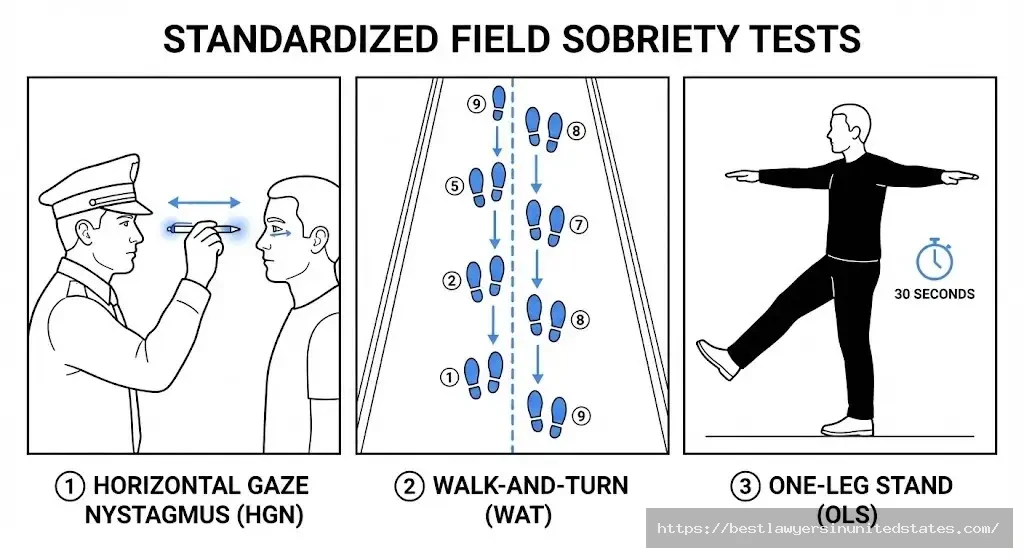
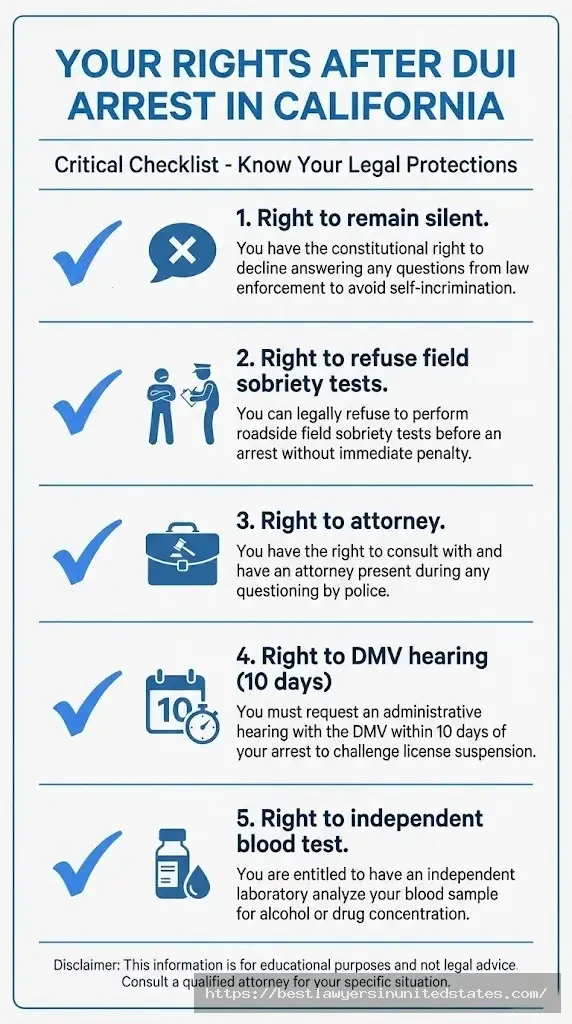
The officer will ask if you’ve been drinking. You have the right to remain silent. Politely decline to answer questions about drinking.
Field sobriety tests are voluntary. These include the walk-and-turn, one-leg stand, and horizontal gaze nystagmus (eye test). You can refuse these tests without penalty.
The preliminary alcohol screening (PAS) test is also voluntary for drivers over 21. This handheld breathalyzer occurs at the roadside. Refusal carries no consequences unless you’re under 21 or on DUI probation.
DUI Arrest Process
The officer arrests you if they believe you’re driving under the influence. They will read you the implied consent advisory. This explains your obligation to submit to chemical testing at the station or hospital.
You must choose between a breath or blood test. Breath tests provide immediate results. Blood tests take weeks but offer more opportunities for defense challenges.
Refusing chemical testing triggers an automatic one-year license suspension. A second refusal brings a two-year suspension. The DMV adds an extra year to any court-ordered suspension.
Commercial drivers and those under 21 cannot refuse PAS tests. Refusal results in immediate license suspension.
Booking and Bail
Police transport you to the local jail for booking. You’ll be photographed, fingerprinted, and searched. Your vehicle gets towed to an impound lot.
Most California counties release first-time DUI suspects on their own recognizance. This means no bail payment. You sign a promise to appear in court.
Repeat offenders or those with high BAC levels may require bail. Amounts range from $2,500 to $10,000. Los Angeles County typically sets bail at $5,000 for second offenses.
You’ll receive two important documents: a temporary license and a notice to appear. The temporary license is valid for 30 days.
DMV Administrative Hearing: The 10-Day Deadline
The DMV automatically suspends your license 30 days after arrest. You can prevent this by requesting an administrative hearing within 10 days.
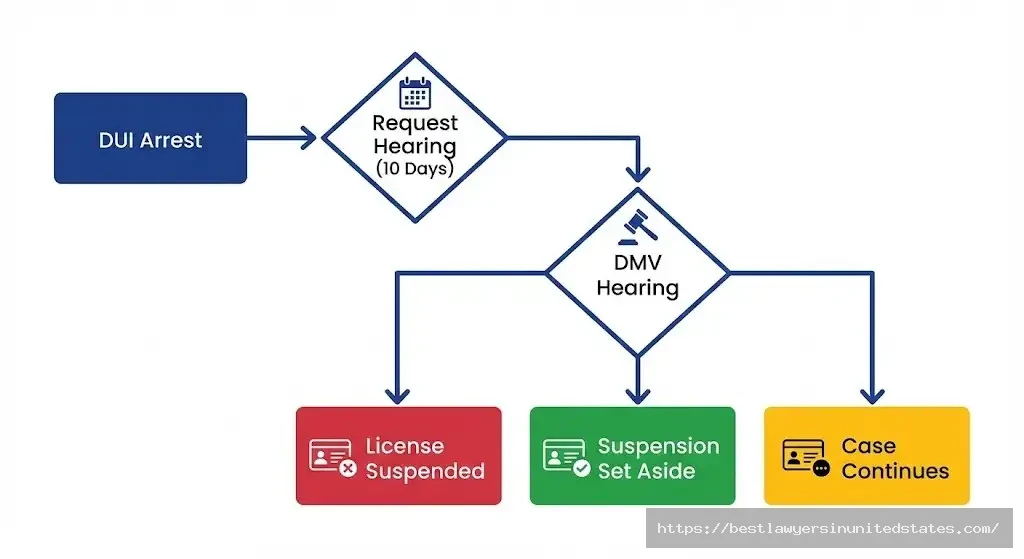
Mark this deadline on your calendar immediately. If you miss it, the suspension happens automatically. No exceptions.
Request the hearing by calling the DMV Driver Safety Office or submitting Form DS-367. Your attorney can handle this for you. The hearing request extends your driving privileges until the hearing concludes.
DMV hearings occur at Driver Safety Offices throughout California. Los Angeles drivers attend hearings in El Monte or Rancho Cucamonga. San Francisco hearings take place on Fell Street. San Diego handles hearings on Clairemont Mesa Boulevard.
The DMV hearing is separate from your criminal case. Different rules apply. The DMV only determines if your license should suspend. They examine three issues:
- Did the officer have reasonable cause to stop you?
- Was there probable cause for arrest?
- Was your BAC 0.08% or higher while driving?
You have the right to an attorney at this hearing. Having legal representation significantly improves your chances. Many DUI attorneys win DMV hearings by challenging test procedures or officer testimony.
Criminal Court Process
Your first court appearance is the arraignment. This occurs 30 to 45 days after arrest. You receive formal charges and enter a plea.

Most defendants plead not guilty at arraignment. The judge sets bail conditions and schedules pretrial conferences. You may appear through your attorney in misdemeanor cases.
Pretrial conferences allow your attorney to review evidence and negotiate with prosecutors. This includes police reports, video footage, and chemical test results. Cases in Los Angeles County Superior Court often require three to five pretrial hearings.
Many first-time DUI cases resolve through plea bargains. Common plea deals include reducing charges to wet reckless (Vehicle Code Section 23103.5) or dry reckless (VC 23103). These carry lighter penalties than DUI convictions.
If your case goes to trial, you can choose a jury trial or court trial. Jury trials in DUI cases take two to three days. The prosecution must prove guilt beyond a reasonable doubt.
BAC Testing and Your Rights
California law requires chemical testing after a DUI arrest. Understanding your rights during this process is critical.
Types of Chemical Tests
California offers three chemical testing options:
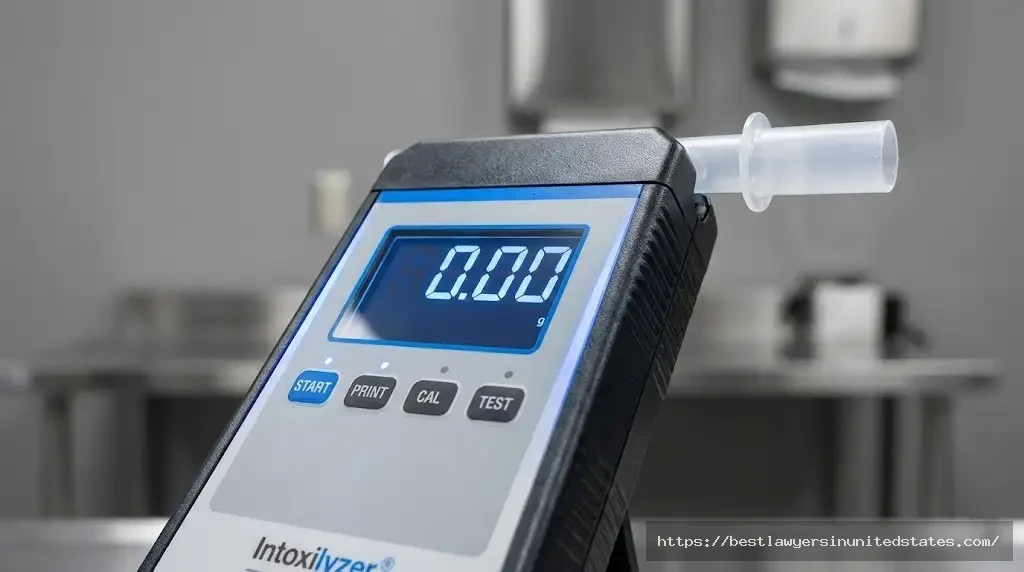
Breath Test: The most common choice. An Intoxilyzer or similar device measures alcohol in your breath. Results are available immediately. These machines require regular calibration and maintenance. Defense attorneys often obtain maintenance records to challenge accuracy.
Blood Test: A licensed technician draws blood at a hospital or jail. The sample goes to a crime lab for analysis. Results take four to six weeks. Blood tests measure alcohol and drugs. You can request an independent blood test split for your own analysis.
Urine Test: Rarely offered anymore. Urine tests are the least accurate option. Most counties stopped using them in 2024.
You choose which test to take. If the chosen test is unavailable, you must take another available test. Refusal to take any test results in automatic license suspension.
Can You Refuse a Breathalyzer in California?
You can refuse the roadside PAS test without penalty. This preliminary test happens before arrest. It’s voluntary for drivers over 21 not on DUI probation.
However, you cannot refuse chemical testing after arrest. California’s implied consent law requires all drivers to submit to testing. Your driver’s license serves as your consent.
Refusing the post-arrest chemical test brings serious consequences. The DMV suspends your license for one year minimum. This suspension runs regardless of your criminal case outcome. Prosecutors also use your refusal as evidence of guilt at trial.
A second refusal within 10 years triggers a two-year suspension. A third refusal brings three years.
Implied Consent Law Explained
California Vehicle Code Section 23612 establishes implied consent. By driving in California, you automatically consent to chemical testing if arrested for DUI.
The officer must read you the implied consent advisory. This warning explains the consequences of refusal. If the officer fails to provide this warning, your attorney can challenge the suspension.
The advisory states:
- You must submit to chemical testing
- Refusal will result in license suspension
- Refusal can be used against you in court
- You may choose between breath or blood
Commercial drivers face stricter rules. They must submit to testing when operating any vehicle, not just commercial ones.
Consequences of Test Refusal
Refusing chemical testing creates multiple problems:
DMV Consequences: Automatic license suspension for one to three years. No restricted license option for the first year. After 12 months, you may apply for an IID-restricted license.
Criminal Penalties: Prosecutors add mandatory jail time. First offense refusal brings 48 hours. Second offense brings 96 hours. These hours are in addition to standard DUI penalties.
Trial Impact: The judge instructs jurors that they can consider refusal as consciousness of guilt. This inference significantly strengthens the prosecution’s case.
Enhanced Charges: Some counties file refusal as a separate violation. This adds complexity to your case.
For cases involving DUI arrests in other states, you might find it helpful to compare how different jurisdictions handle these situations. Arizona DUI laws and Alabama DUI laws offer different approaches to chemical testing and refusal penalties.
How Accurate Are Breathalyzers?
Breathalyzer accuracy depends on proper maintenance and operation. These devices require calibration every 10 days or 150 uses. The California Department of Public Health oversees certification.
Several factors affect breathalyzer results:
Mouth Alcohol: Recent drinking, burping, or vomiting can trap alcohol in your mouth. This produces falsely high readings.
Medical Conditions: Acid reflux, GERD, and diabetes can affect results. These conditions create compounds the machine misreads as alcohol.
Radio Frequency Interference: Cell phones and police radios sometimes interfere with readings.
Operator Error: Officers must observe you for 15 minutes before testing. This prevents mouth alcohol contamination. Many officers skip this step.
Calibration Issues: Machines produce inaccurate results without proper maintenance. Your attorney can subpoena maintenance logs and calibration records.
Studies show breathalyzers have a margin of error between 0.005% and 0.02%. A reading of 0.08% could actually be 0.06% or 0.10%. This margin matters greatly in borderline cases.
License Suspension and Reinstatement
A DUI arrest triggers two separate license suspensions. Understanding both processes helps you maintain driving privileges.
How Long Is Your License Suspended?
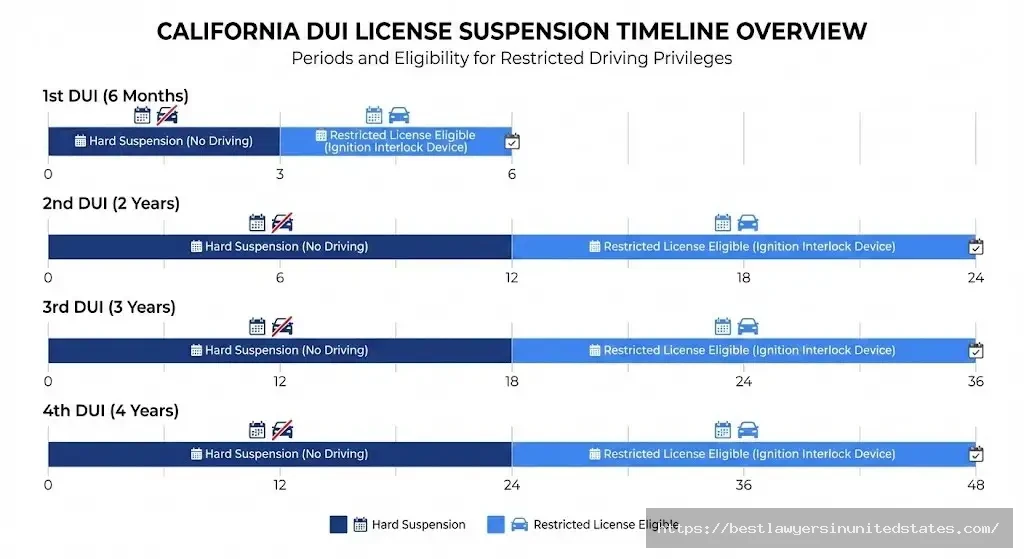
Suspension length depends on your offense level and whether you refused testing.
| Offense | DMV Suspension | Court Suspension | Total Impact |
|---|---|---|---|
| 1st DUI | 4 months | 6 months | 6 months (runs concurrent) |
| 1st DUI (refusal) | 1 year | 6 months | 1 year |
| 2nd DUI | 1 year | 2 years | 2 years |
| 2nd DUI (refusal) | 2 years | 2 years | 2 years |
| 3rd DUI | 1 year | 3 years | 3 years |
| 4th DUI | 1 year | 4 years | 4 years |
Suspensions from the DMV and court often overlap. The longer suspension controls. A first offense brings six months total, not 10 months.
DMV vs Court Suspension: What’s the Difference?
California separates DUI cases into administrative and criminal proceedings.
DMV Administrative Suspension: Starts 30 days after arrest unless you request a hearing. Based solely on BAC level or test refusal. Even if you win your criminal case, the DMV can suspend your license. Different burden of proof applies.
Court Suspension: Ordered by the judge after conviction. Based on criminal charges. Cannot begin until the criminal case concludes.
The two suspensions run simultaneously in most cases. You serve the longer period. However, refused chemical test suspensions run consecutively in some situations.
How to Request a DMV Hearing
Contact the DMV Driver Safety Office within 10 days of arrest. Call the number on your temporary license or submit Form DS-367 online.
Provide the following information:
- Your driver’s license number
- Date of arrest
- Arresting agency
- Whether you want an in-person or phone hearing
The DMV schedules hearings 30 to 60 days out. Your attorney can request continuances for additional preparation time.
Bring an attorney to your hearing. DMV hearing officers are not neutral. They work for the agency trying to suspend your license. An experienced DUI lawyer knows how to challenge their evidence.
The hearing examines police reports, chemical test results, and officer testimony. Your attorney can cross-examine the arresting officer and subpoena witnesses. Win rates improve significantly with legal representation.
Restricted Driver’s License Eligibility
California offers restricted licenses for most first offenders. You can drive to and from work, DUI school, and alcohol treatment.
First Offense Requirements:
- Complete 30-day hard suspension
- Enroll in DUI school
- Install ignition interlock device
- File SR-22 insurance
- Pay $125 reissue fee
You can apply for the restricted license at any DMV office. Bring proof of DUI school enrollment and IID installation. Los Angeles DMV offices process these requests at the Glendale, Van Nuys, and Santa Monica locations.
Second and Third Offenses: Must complete longer hard suspension periods before qualifying. Second offenders wait 12 months. Third offenders wait 18 months.
Refusal Cases: No restricted license option for the first 12 months. After one year, you can apply for an IID-restricted license.
Ignition Interlock Device (IID) Requirements
California requires IID installation for all DUI offenders seeking to drive. The device connects to your vehicle’s ignition system. You must blow into it before starting the car.
Installation: Choose from state-certified providers. Cost ranges from $75 to $150 for installation. Monthly fees run $60 to $90.
Mandatory Periods:
- First offense: Minimum 6 months
- Second offense: 1 year
- Third offense: 2 years
- Fourth offense: 3 years
The device requires rolling retests while driving. You must blow again every 5 to 15 minutes. Failure to comply triggers violations.
Common IID providers in California include:
- Smart Start (offices in Los Angeles, San Diego, Sacramento)
- Intoxalock (statewide service)
- LifeSafer (available in major cities)
- Guardian Interlock (Northern California focus)
The DMV receives monthly reports from your IID provider. Violations include failed tests, missed retests, or tampering. These violations extend your IID requirement and can result in new criminal charges.
Step-by-Step: How to Reinstate Your License
Getting your license back requires completing specific steps in order.
Step 1: Serve Your Suspension Period Wait until your full suspension or restriction period ends. Check your suspension end date on the DMV website or call the Driver Safety Office.
Step 2: Complete DUI School Finish all required DUI education classes. Obtain a Certificate of Completion (DL-107). The school sends this directly to DMV, but keep your copy.
Step 3: File SR-22 Insurance Contact your insurance company to file Form SR-22. This proves you carry minimum liability coverage. California requires SR-22 for three years after reinstatement.
Step 4: Pay Reinstatement Fees Pay the $125 reissue fee to the DMV. Additional fees may apply for DUI school processing ($50) and other administrative costs.
Step 5: Visit a DMV Office Schedule an appointment at your local DMV. Bring:
- Government-issued ID
- Proof of IID removal (if applicable)
- DUI school completion certificate
- SR-22 proof of insurance
- Payment for all fees
The DMV issues a new license immediately if everything is in order. Processing takes about 30 minutes. San Francisco residents can visit the Fell Street DMV. Los Angeles residents have multiple locations including Glendale and Culver City.
SR-22 Insurance Requirements
SR-22 is not insurance. It’s a certificate proving you carry minimum liability coverage. California requires SR-22 for three years after license reinstatement.
Your insurance company files Form SR-22 electronically with the DMV. Cost varies by provider. Expect SR-22 filing fees between $15 and $50.
DUI convictions increase insurance rates dramatically. Average increases range from 80% to 140%. A driver paying $1,200 annually might see rates jump to $2,400.
Shop around for SR-22 insurance. Rates vary significantly between companies. Some specialize in high-risk drivers and offer competitive pricing. Companies serving California DUI offenders include:
- Progressive
- The General
- GEICO
- Mercury Insurance
- 21st Century
If your SR-22 lapses, the DMV suspends your license immediately. The insurance company must notify DMV of any cancellations. Maintain continuous coverage for the full three-year period.
Calculate Your Total DUI Costs in California
DUI expenses extend far beyond court fines. The true cost includes legal fees, increased insurance, and various administrative charges.
Use our DUI cost calculator to estimate your total financial impact. This tool breaks down all expenses including fines, attorney fees, DUI school, and insurance increases.
DUI Cost Calculator
Estimate total DUI expenses by state and offense
Detailed Cost Breakdown
Payment Timeline
Bail bond, towing fees, car impound, attorney retainer
Initial court fines, DMV fees, DUI school enrollment, ignition interlock installation
Monthly probation fees, ignition interlock fees, DUI school payments, attorney balance
Insurance premium increases, license reinstatement, SR-22 filing fees
- Lost wages from missed work (court dates, jail time, DUI school) – $2,000-$10,000
- Job loss or difficulty finding employment – Varies
- Professional license suspension (doctors, lawyers, nurses, pilots) – Career ending
- Rideshare and transportation costs during suspension – $1,500-$5,000
- Travel restrictions and visa denials – Varies
- Security clearance loss – Career impact
- Child custody implications – Legal costs
- Rental car restrictions – Varies
- Personal relationships and mental health costs – Priceless
Fines and Court Fees
The base fine for DUI is $390 to $1,000. However, California adds multiple penalty assessments that increase the total significantly.
Penalty Assessments Include:
- State penalty assessment (100% of base fine)
- County penalty (70% of base fine)
- DNA collection fee ($20)
- Emergency medical services fee (varies by county)
- Court security fee ($40)
- Criminal conviction assessment ($35)
A $390 base fine becomes approximately $1,800 after assessments. Higher base fines reach $3,600 or more.
Additional court costs include:
- Booking fee: $100-$300
- Arrest fee: $50-$150
- Impound and towing: $400-$800
- License reissue fee: $125
Attorney Costs
Hiring a DUI attorney costs between $2,500 and $10,000 in California. Factors affecting price include:
- Case complexity
- Attorney experience
- Number of court appearances
- Whether the case goes to trial
Flat fees are common for first-offense misdemeanors. Expect $2,500 to $5,000 for standard representation. Complex cases or those going to trial cost $7,500 to $15,000.
Hourly rates range from $200 to $500 per hour. Most DUI cases require 10 to 20 hours of attorney time for basic representation.
Public defenders are available if you cannot afford an attorney. You must qualify based on income. Public defenders handle hundreds of cases simultaneously but provide competent representation.
Some counties charge public defender fees. Los Angeles County assesses $400. Orange County charges $500. These fees are waived if you’re truly indigent.
DUI School and Program Fees
California requires alcohol education programs for all DUI offenders. Costs vary by program length.
First Offense (AB 541): Three-month program, 30 hours of classes. Cost ranges from $500 to $650. Programs meet weekly for group sessions.
Second Offense (SB 38): 18-month program, approximately 52 hours. Total cost is $1,800 to $2,200. Includes individual counseling sessions.
Third Offense (SB 38): 30-month program, intensive treatment. Cost reaches $2,500 to $2,800. Requires regular drug testing and counseling.
Programs are licensed by the California Department of Health Care Services. Approved providers operate throughout the state. Find programs at www.dmv.ca.gov.
Some counties require additional treatment beyond DUI school. Substance abuse programs cost $50 to $200 per session. Many repeat offenders spend $3,000 to $5,000 on total treatment.
Insurance Rate Increases
DUI convictions label you a high-risk driver. Insurance companies respond with dramatic rate increases.
Average California insurance premium before DUI: $2,190 annually Average premium after DUI: $4,380 annually
The increase persists for three to five years. Some companies drop DUI offenders entirely. Finding new coverage can be challenging.
SR-22 filing requirements add $15 to $50 annually. However, the real cost comes from higher premiums. Over three years, expect to pay an additional $6,000 to $8,000 in insurance costs.
Total Cost Estimate by Offense
Here’s a realistic breakdown of total DUI costs in California:
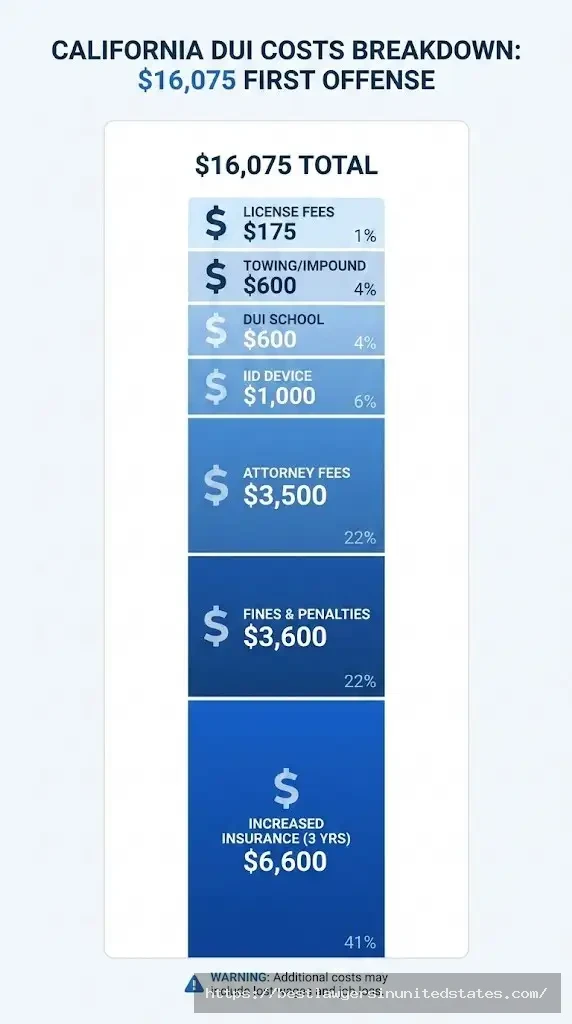
First Offense DUI:
- Fines and penalties: $3,600
- Attorney fees: $3,500
- DUI school: $600
- License reinstatement: $175
- Increased insurance (3 years): $6,600
- Ignition interlock device: $1,000
- Towing and impound: $600
- Total: $16,075
Second Offense DUI:
- Fines and penalties: $4,500
- Attorney fees: $5,000
- DUI school (18 months): $2,000
- License reinstatement: $175
- Increased insurance (3 years): $7,500
- Ignition interlock device: $1,500
- Towing and impound: $600
- Total: $21,275
Third Offense DUI:
- Fines and penalties: $5,500
- Attorney fees: $6,000
- DUI school (30 months): $2,800
- License reinstatement: $175
- Increased insurance (3 years): $8,500
- Ignition interlock device: $2,400
- Towing and impound: $600
- Total: $25,975
These figures don’t include lost wages from jail time or job loss. Many DUI offenders lose employment, especially those requiring driving for work.
Can Your DUI Case Be Dismissed in California?
California dismisses approximately 10% to 15% of DUI cases. Your chances improve significantly with experienced legal representation.
Dismissal Statistics in California
Dismissal rates vary by county. Los Angeles County dismisses about 12% of DUI cases. San Francisco shows similar rates at 11%. Orange County dismisses fewer cases at approximately 8%.
Factors affecting dismissal include:
- Quality of police work
- Breathalyzer maintenance records
- Officer testimony credibility
- Presence of video evidence
- Whether you hired an attorney
Cases with procedural errors or weak evidence get dismissed more frequently. First-time offenders with low BAC levels have better chances.
Common Grounds for Dismissal
Defense attorneys secure dismissals using several strategies:
Illegal Traffic Stop: Police need reasonable suspicion to stop your vehicle. Random stops or checkpoints without proper authorization violate your Fourth Amendment rights. If the stop was illegal, all evidence gets suppressed.
Improper DUI Checkpoint Procedures: California has strict checkpoint requirements. Police must publicize checkpoints in advance, use neutral selection methods, and provide adequate signage. Violations of these rules invalidate checkpoint arrests.
Rising Blood Alcohol Defense: Your BAC continues rising for 30 to 90 minutes after drinking stops. If police tested you long after driving, your BAC may have been below 0.08% while actually driving.
Contaminated Blood Sample: Blood samples require proper collection, storage, and testing. Chain of custody errors, contamination, or fermentation can produce false results.
Breathalyzer Calibration Issues: These devices need calibration every 10 days. Missing calibration records or improper maintenance creates grounds for dismissal.
Medical Conditions: Acid reflux, diabetes, and other conditions can produce false positive results on breath tests.
Officer Failed to Follow Protocol: Police must observe DUI suspects for 15 minutes before breath testing. This prevents mouth alcohol contamination. Officers frequently skip this requirement.
What Makes a DUI Case Weak?
Prosecutors struggle with certain types of DUI cases:
Low BAC (0.08-0.09%): Results this close to the legal limit fall within the breathalyzer margin of error. Defense attorneys argue the actual BAC was below 0.08%.
No Driving Witnessed: If police didn’t see you driving, they must prove you were the driver. Sleeping in a parked car cases often get dismissed.
Long Delay Between Driving and Testing: The three-hour rule creates problems for prosecutors. Extended delays weaken their case significantly.
Poor Field Sobriety Test Performance With Low BAC: Officers sometimes arrest people who fail field sobriety tests but blow under 0.08%. Medical conditions, age, or footwear explain poor performance.
Lack of Video Evidence: Dashboard cameras and body cameras provide strong evidence. Without video, the case relies solely on officer testimony. Juries question unsupported officer claims.
Conflicting Officer Statements: Police reports sometimes contradict officer testimony. These inconsistencies damage credibility.
Challenging BAC Test Results
Blood and breath test results can be challenged effectively.
Blood Test Challenges:
- Request independent testing of your blood sample
- Examine fermentation in the vial
- Review chain of custody documentation
- Check lab technician certifications
- Look for contamination during collection
Breath Test Challenges:
- Subpoena calibration records
- Review maintenance logs
- Examine officer training records
- Investigate radio frequency interference
- Check observation period compliance
Many California crime labs have faced scandals. The Los Angeles County Sheriff’s lab suspended operations in 2019 due to quality issues. San Francisco’s lab had certification problems in 2022. These issues provide strong grounds for challenging test results.
Illegal Stop or Arrest Issues
The Fourth Amendment protects against unreasonable searches and seizures. Police need specific legal justification to stop and arrest you.
Illegal Stop Examples:
- Anonymous tip without corroboration
- Stopping based on vehicle type or neighborhood
- No traffic violation or suspicious driving observed
- Pretextual stops (stopping for minor violations to investigate DUI)
Illegal Arrest Examples:
- Arrest without probable cause
- Field sobriety tests administered on unsuitable surface
- No chemical test offered
- Implied consent warning not provided
If your attorney proves an illegal stop, the judge suppresses all evidence. This usually results in dismissal. Similar protections exist in neighboring states, as detailed in our Arkansas DUI laws guide.
DUI Defense Strategies in California
Fighting DUI charges requires understanding both the evidence and available defenses.
Should You Hire a DUI Attorney?
Hiring an attorney significantly improves your outcome. Studies show represented defendants receive better plea deals and win more trials.
Benefits of Legal Representation:
- Knowledge of local courts and prosecutors
- Ability to challenge evidence effectively
- Experience negotiating favorable plea deals
- Understanding of DMV hearing procedures
- Access to expert witnesses
When an Attorney is Essential:
- Second or third offense
- Accident or injury involved
- BAC above 0.15%
- Refusal to submit to chemical testing
- Commercial driver’s license at risk
Many California DUI attorneys offer free consultations. Meet with several before deciding. Look for attorneys who focus primarily on DUI defense.
Wet Reckless vs DUI Conviction
Wet reckless (Vehicle Code Section 23103.5) is a reduced charge. Prosecutors offer this in cases with weaknesses.
Wet Reckless Benefits:
- Reduced fines ($145 to $1,000 base)
- Shorter probation (one to two years)
- Less jail time or none
- Shorter DUI school (6 weeks vs 3 months)
- No mandatory license suspension
Wet Reckless Disadvantages:
- Counts as prior DUI for 10 years
- Insurance rates still increase
- Still requires DUI school
- Stays on criminal record
A wet reckless conviction means you accepted alcohol was involved in reckless driving. It’s not available if you caused injury or had a very high BAC.
Dry Reckless: Vehicle Code Section 23103 with no alcohol allegation. This is even better than wet reckless. It doesn’t count as a prior DUI. However, prosecutors rarely offer dry reckless in clear DUI cases.
Plea Deal Considerations
Most DUI cases resolve through plea bargains. Prosecutors in California handle hundreds of cases. They offer deals to move cases quickly.
Common plea offers include:
- Wet reckless with reduced penalties
- DUI with minimum sentencing
- Dismissal of enhancements in exchange for plea
- Reduction from felony to misdemeanor
Evaluate plea offers carefully. Consider:
- Strength of the evidence against you
- Your criminal history
- Likelihood of winning at trial
- Cost of going to trial
- Impact on employment
Your attorney explains the pros and cons of each offer. Never accept a plea without consulting an experienced DUI lawyer.
Taking Your Case to Trial
DUI trials in California typically last two to three days. You can choose between jury trial or bench trial.
Jury Trial: Six or twelve jurors depending on misdemeanor or felony. Jurors must unanimously agree to convict. Defense attorneys prefer juries in cases involving sympathetic defendants.
Court Trial: Judge alone decides guilt. Faster than jury trial. Beneficial when legal issues dominate over factual disputes.
Trial Success Factors:
- Quality of prosecution’s evidence
- Officer credibility under cross-examination
- Availability of expert witnesses
- Video footage supporting your version
- Medical conditions explaining test results
Trials are expensive. Expect to pay $5,000 to $15,000 in additional attorney fees. However, acquittal means no conviction on your record.
Special DUI Circumstances in California
California law treats certain DUI situations differently.
Underage DUI (Under 21): Zero Tolerance Law
California enforces zero tolerance for drivers under 21. Vehicle Code Section 23136 makes it illegal to drive with any measurable alcohol in your system.
Zero Tolerance Thresholds:
- 0.01% or higher: Administrative license suspension
- 0.05% or higher: Criminal charges under VC 23140
- 0.08% or higher: Standard DUI charges under VC 23152
The 0.01% threshold catches drivers who had a single drink hours earlier. Mouthwash or cold medicine can trigger this level.
Underage DUI Penalties:
- One-year license suspension (first violation)
- $100 fine plus penalty assessments
- Alcohol education program
- Three-year suspension for BAC of 0.05% or higher
Parents often don’t realize underage DUI creates a criminal record. Even a 0.05% violation is a misdemeanor. This affects college applications and employment.
Commercial Driver (CDL) DUI
Commercial drivers face strict DUI standards. A CDL DUI conviction ends many trucking careers.
BAC Limits for CDL Holders:
- 0.04% while operating commercial vehicle
- 0.08% while operating personal vehicle
- 0.01% while on probation
CDL Suspension Periods:
- First offense: One year CDL disqualification
- Second offense: Lifetime CDL disqualification
- Hazmat endorsement offense: Three years minimum
The lifetime ban applies even if you drove your personal car. There’s no restricted CDL for work. You cannot drive commercially for any reason during disqualification.
After 10 years, you may petition to reinstate a lifetime ban. The DMV rarely grants these requests. Most commercial drivers lose their careers permanently after a second DUI.
DUI on a Bicycle or E-Scooter
California Vehicle Code Section 21200.5 prohibits cycling under the influence. This is a separate statute from vehicle DUI.
Bicycle DUI Penalties:
- $250 fine
- No jail time
- No license suspension
- No criminal record for standard DUI
Bicycle DUI is an infraction, not a misdemeanor. However, if you cause injury, prosecutors can file felony charges under different statutes.
E-Scooter DUI: Motorized scooters fall under standard DUI laws. Operating an e-scooter while intoxicated results in the same penalties as car DUI. This includes license suspension, fines, and potential jail time.
Skateboard DUI: Not illegal under California law. Skateboards aren’t vehicles under the Vehicle Code.
Sleeping in Your Car: Actual Physical Control
California law requires proof you drove while intoxicated. Sleeping in a parked car creates ambiguity.
Prosecutors must prove “actual physical control” of the vehicle. Factors courts consider:
- Were the keys in the ignition?
- Was the engine running?
- Where was the driver seated?
- Was the car on a roadway or parking lot?
- Could the car be driven without starting it?
Sitting in the driver’s seat with keys in the ignition establishes actual physical control. Even if the engine is off. Sleeping in the back seat with keys in your pocket is much safer legally.
Many people arrested while sleeping in cars get charges dismissed. The prosecution cannot prove when you drove. If you parked before becoming intoxicated, you violated no law.
DUI Checkpoints: Your Rights
California Supreme Court approved DUI checkpoints in Ingersoll v. Palmer. However, checkpoints must follow strict guidelines.
Legal Checkpoint Requirements:
- Supervisors decide checkpoint location (not officers in field)
- Neutral selection method (every car or every third car)
- Adequate lighting and warning signs
- Reasonable duration and location
- Public advance notice
Police must allow you to turn around before entering a checkpoint. They cannot stop you for avoiding it unless you commit a traffic violation.
Your Rights at Checkpoints:
- You must stop when directed
- Show license, registration, and insurance
- You don’t have to answer questions about drinking
- You can refuse field sobriety tests
- You must submit to chemical testing if arrested
Many Southern California checkpoints operate on weekends near downtown areas. Common locations include Pacific Coast Highway, Hollywood Boulevard, and Sunset Boulevard. San Diego runs frequent checkpoints in the Gaslamp Quarter.
Out-of-State DUI Impact
A California DUI conviction affects your driving privileges nationwide. The Interstate Driver’s License Compact shares conviction information between 45 states.
Your home state learns about California DUI convictions. They may suspend your license under their laws. California reports all DUI convictions to other states within 30 days.
If you hold a California license but get a DUI in another state, California will suspend your license. The suspension period matches California law, not the other state’s penalties.
Non-Compact States: Georgia, Massachusetts, Michigan, Tennessee, and Wisconsin don’t participate fully. However, they still share serious violations like DUI.
Commercial drivers face uniform nationwide penalties. A DUI in any state disqualifies your CDL across all states.
Your 72-Hour Action Plan After DUI Arrest
Taking immediate action improves your case outcome significantly.
First 24 Hours:
Contact a DUI attorney immediately. Most offer free consultations. Don’t wait until your court date.
Gather your arrest documents. You need the temporary license, notice to appear, and any citations. Make copies of everything.
Write down everything you remember about the arrest. Include details about what you drank, when you stopped drinking, the traffic stop, field sobriety tests, and booking. Memory fades quickly.
Avoid discussing your case on social media or with anyone except your attorney. Prosecutors monitor social media for admissions.
Within 10 Days:
Request your DMV administrative hearing. This is your most critical deadline. Call the Driver Safety Office at the number on your temporary license or file online. Your attorney can handle this.
Obtain police reports through your attorney. These reports contain the officer’s version of events and chemical test results.
Within 30 Days:
Enroll in DUI school if required for a restricted license. Don’t wait for court orders. Early enrollment shows responsibility.
Get SR-22 insurance quotes. Shop multiple companies for the best rates. You’ll need this for license reinstatement.
Schedule a consultation with a DUI attorney if you haven’t already. Many offer payment plans.
Before Court Date:
Complete any substance abuse evaluation if recommended by your attorney. Being proactive helps in plea negotiations.
Gather character references. Letters from employers, community leaders, or family members help at sentencing.
Take photographs of the arrest location if relevant to your defense. Document road conditions, signage, or checkpoint setup.
Obtain medical records if you have conditions affecting BAC tests. Diabetes, GERD, or other conditions matter for your defense.
DMV Hearing Preparation:
Your attorney will handle most preparation. However, you should review your statement to police and your recollection of events.
Be truthful with your attorney about what happened. They cannot defend you effectively without knowing the facts.
DUI Expungement in California
Expungement allows you to withdraw your guilty plea and dismiss the case. This doesn’t erase the conviction but provides some relief.
Eligibility Requirements
California Penal Code Section 1203.4 governs expungement. You must meet all requirements:
- Completed probation successfully
- Paid all fines and restitution
- Not currently charged with another offense
- Not on probation for another offense
- No prison time served for this offense
You cannot expunge a DUI if you served prison time. However, county jail time doesn’t disqualify you.
Most people complete probation three to five years after conviction. You can request early termination if you’ve met all conditions for at least 12 months.
How to Expunge a DUI
The expungement process takes three to five months.
Step 1: Obtain a copy of your court records. Visit the courthouse where you were convicted. Los Angeles cases can be obtained at the Clerk’s Office in the courthouse that handled your case.
Step 2: File Form CR-180 (Petition for Dismissal). This form is available at the court clerk’s office or online.
Step 3: Serve the district attorney’s office with a copy of your petition. You must follow proper service procedures.
Step 4: Attend the hearing. The judge reviews your petition and probation compliance. Prosecutors can object.
Step 5: Receive the court order. If granted, the judge sets aside your conviction and dismisses the case.
Cost for filing is approximately $150. Attorneys charge $1,000 to $2,500 to handle expungement petitions.
Does Expungement Remove It From Your Record?
Expungement provides limited relief. The conviction remains on your record but shows as dismissed.
What Expungement Does:
- Allows you to legally state you weren’t convicted (in most situations)
- Helps with employment applications
- Removes some professional licensing barriers
- Provides peace of mind
What Expungement Doesn’t Do:
- Doesn’t erase the conviction from criminal databases
- Doesn’t remove it from DMV records
- Still counts as prior DUI for 10 years
- Still appears on background checks (but shows dismissed)
- Doesn’t restore gun rights
- Must still be disclosed to state licensing boards
Government agencies, law enforcement, and professional licensing boards still see expunged convictions. However, private employers typically view expungement favorably.
Frequently Asked Questions
What is the penalty for a DUI in California?
First offense penalties include up to six months jail, $3,600 in fines, six-month license suspension, and three months of DUI school. Second and third offenses bring longer jail time and license suspensions.
What are the new DUI laws in California for 2026?
California expanded its statewide ignition interlock device program in 2026. All DUI offenders must install an IID to maintain driving privileges. New diversion programs also launched in major counties.
Do you lose your license immediately after a DUI in California?
Your physical license is confiscated at arrest. Police issue a temporary license valid for 30 days. The DMV suspends your license after 30 days unless you request an administrative hearing within 10 days.
Will I go to jail for my first DUI in California?
Most first-time offenders serve no jail time or receive alternative sentencing like house arrest. However, you face up to six months in county jail. Aggravating factors like high BAC or accidents increase jail likelihood.
How much does a first DUI cost in California?
Total costs range from $15,000 to $20,000. This includes fines ($3,600), attorney fees ($3,500), DUI school ($600), and increased insurance ($6,600 over three years).
Can you refuse a breathalyzer in California?
You can refuse the preliminary roadside test before arrest. However, refusing chemical testing after arrest triggers automatic one-year license suspension and mandatory jail time.
How long does a DUI stay on your record in California?
DUI convictions remain on your criminal record permanently. For DMV purposes, DUI counts as a prior offense for 10 years. Insurance companies consider it for three to five years.
What percent of DUI cases get dismissed in California?
Approximately 10% to 15% of DUI cases get dismissed. Dismissal rates vary by county and depend heavily on whether you hire an attorney.
Is jail time mandatory for a second DUI in California?
Yes. Second DUI convictions require minimum 96 hours in jail. Most counties impose 10 days or more. Some offer work furlough or electronic monitoring.
How accurate are breathalyzer tests?
Breathalyzers have a margin of error between 0.005% and 0.02%. Accuracy depends on proper calibration, maintenance, and operator training. Medical conditions and mouth alcohol also affect results.
What makes a DUI case weak?
Weak cases include low BAC near 0.08%, no video evidence, improper testing procedures, long delays between driving and testing, or illegal traffic stops.
Can a first-time DUI be dismissed in California?
Yes. First-time DUI cases get dismissed due to illegal stops, improper testing, rising blood alcohol defenses, or weak evidence. Hiring an attorney significantly improves dismissal chances.
How long are you on probation after a DUI in California?
DUI probation typically lasts three to five years. Conditions include no driving with any measurable alcohol, submitting to chemical tests on demand, and committing no new offenses.
What is the legal alcohol limit in California?
The legal limit is 0.08% BAC for drivers 21 and over. Commercial drivers face a 0.04% limit. Drivers under 21 cannot exceed 0.01% BAC under zero tolerance laws.
Do I need an SR-22 to reinstate my license in California?
Yes. All DUI offenders must file SR-22 insurance to reinstate their license. You must maintain SR-22 for three years after reinstatement.
How long does a DUI affect your car insurance in California?
Insurance companies consider DUI convictions for three to five years. Expect rate increases of 80% to 140% during this period.
What happens if you get a DUI in California and move to another state?
Your California DUI follows you to other states through the Interstate Driver’s License Compact. Your new state can suspend your license based on the California conviction.
Is a DUI a felony in California?
Fourth DUI offenses within 10 years are felonies. DUI causing injury is also a felony under Vehicle Code Section 23153. First through third offenses are typically misdemeanors.
Can I drive for work with a suspended license after a DUI?
No. You cannot drive for work during suspension. You may qualify for a restricted license allowing work-related driving after completing specific requirements including IID installation.
What should I do immediately after being arrested for a DUI?
Request a DMV hearing within 10 days, contact a DUI attorney immediately, document everything you remember about the arrest, and avoid discussing your case on social media.
Need Legal Help? Contact an experienced California DUI attorney at [email protected] for a free consultation.
