
Indiana calls drunk driving “OWI” (Operating While Intoxicated), not DUI. A first offense OWI in Indiana carries up to one year in jail, fines up to $5,000, and a license suspension of 90 days to two years. Indiana also enforces a separate 180-day administrative suspension through the Bureau of Motor Vehicles if your BAC tests at 0.08% or higher.
Indiana’s OWI laws under Indiana Code § 9-30-5-1 apply anywhere you operate a vehicle—including private property like parking lots and driveways. The state uses a lifetime lookback period for repeat offenses, meaning a third OWI becomes a Level 6 felony regardless of how long ago your prior convictions occurred.
Breaking news for 2026: Indiana’s House Bill 1119 established legal THC limits for marijuana DUI, effective July 1, 2025. Indiana now enforces specific nanogram thresholds for cannabis impairment alongside traditional alcohol limits.
Understanding Indiana OWI Laws
What is OWI in Indiana?
Indiana uses “OWI” (Operating While Intoxicated) as the official legal term instead of DUI or DWI. You’ll also see “OVWI” (Operating a Vehicle While Intoxicated) used interchangeably in court documents and Indiana Code statutes.
Under IC 9-30-5-1, you commit an OWI when you operate a vehicle while:
- Your BAC is 0.08% or higher
- You’re under the influence of alcohol
- You’re under the influence of any controlled substance
- You have a Schedule I or II controlled substance in your system
“Operating” means more than just driving. Indiana courts define operating as being in actual physical control of a vehicle. You can face OWI charges while sitting in a parked car with the engine running or even with keys in the ignition.
Can You Get an OWI on Private Property in Indiana?
Quick Answer: Yes. Indiana law allows OWI charges on private property including parking lots, driveways, and private roads.
Unlike some states that limit DUI enforcement to public roadways, Indiana Code § 9-30-5-1 applies to all locations. Police regularly arrest drivers for OWI in:
- Shopping center parking lots
- Apartment complex driveways
- Private residential streets
- Bar and restaurant parking areas
- Gas station lots
Real example: Marion County courts upheld an OWI conviction for a driver arrested in their own driveway in 2024.
Indiana BAC Limits for 2026
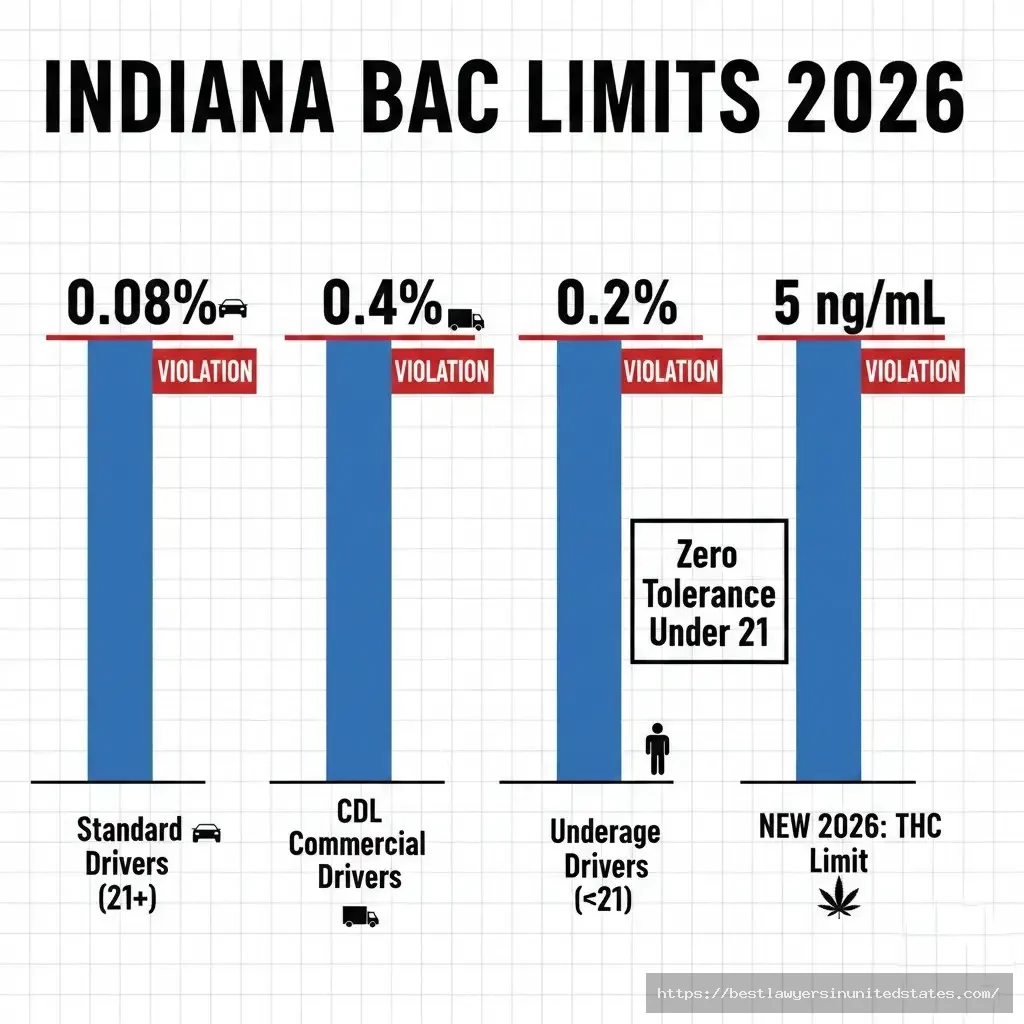
Indiana enforces different BAC limits based on driver type:
| Driver Category | Legal BAC Limit | Penalty Threshold |
|---|---|---|
| Standard (21+) | 0.08% | Criminal OWI |
| CDL Drivers | 0.04% | License disqualification |
| Under 21 | 0.02% | Administrative penalties |
| THC (as of 2026) | 5 ng/mL | Criminal OWI |
Zero tolerance policy: Any detectable amount of a Schedule I or II drug triggers criminal charges, regardless of impairment level.
Not sure where you stand? Check your estimated BAC with our BAC calculator before getting behind the wheel.
BAC Calculator
Estimate your Blood Alcohol Content
• Commercial Driver (CDL): 0.04% BAC
• Drivers Under 21: 0.00-0.02% BAC (Zero Tolerance)
• Enhanced Penalties: 0.15% BAC or higher in most states
NEW: 2026 THC DUI Laws (House Bill 1119)
Indiana’s House Bill 1119 went into effect July 1, 2025, establishing the state’s first legal THC limit for marijuana DUI cases.
The new standard:
- 5 nanograms per milliliter (ng/mL) of THC in blood = legal limit
- Applies to all drivers regardless of medical marijuana status
- Measured through blood tests, not roadside screening
How enforcement works in 2026:
- Officer observes impaired driving
- Roadside oral fluid test shows positive for THC
- Blood draw at medical facility measures exact ng/mL
- Results above 5 ng/mL = criminal OWI charge
Indiana’s roadside oral fluid testing program expanded statewide in 2025 to detect marijuana impairment. State Police trained over 400 Drug Recognition Experts specifically for cannabis OWI cases.
Important note: THC can remain detectable in your system for days or weeks after use. Regular users may test positive even when not currently impaired.
Indiana OWI Penalties by Offense
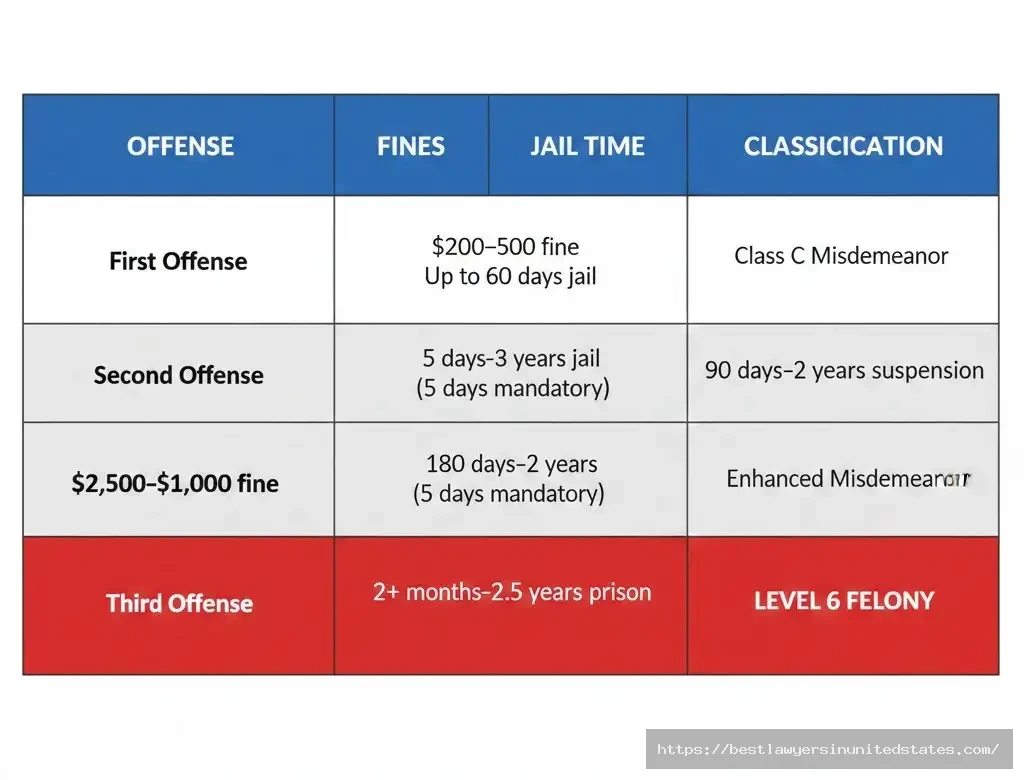
First Offense OWI Indiana
A first OWI in Indiana is a Class C misdemeanor with serious consequences split between criminal court and the Bureau of Motor Vehicles.
Criminal Penalties:
| Penalty Type | Range | Typical Sentence |
|---|---|---|
| Jail time | Up to 60 days | 0-7 days (first offense) |
| Fines | Up to $500 | $200-$400 |
| Court costs | $185 minimum | $300-$500 total |
| Probation | Up to 1 year | 6-12 months |
BMV Administrative Penalties:
- License suspension: 90 days to 2 years
- Pre-conviction suspension: 180 days (if BAC 0.08%+)
- Ignition interlock: Possible but not mandatory
- SR-22 insurance: Required for 3 years
Additional requirements:
- Substance abuse evaluation ($150-$300)
- Victim impact panel attendance ($50-$75)
- DUI education program ($200-$350)
How Likely is Jail Time for First DUI Indiana?
Quick Answer: Most first-time OWI offenders in Indiana serve little to no jail time if no aggravating factors exist.
Your likelihood of jail time depends on these factors:
Low jail risk (suspended sentence likely):
- BAC between 0.08%-0.14%
- No accident or property damage
- No prior criminal record
- Completed substance abuse evaluation before court
- Hired an attorney
Higher jail risk (7-60 days possible):
- BAC 0.15% or higher
- Refused chemical testing
- Minor passenger in vehicle
- Caused accident with injuries
- Multiple prior arrests (any type)
Marion County statistics (2025): 68% of first-time OWI defendants received suspended sentences with probation. Only 12% served actual jail time exceeding 7 days.
Hamilton County statistics (2025): Stricter enforcement resulted in 34% of first offenders serving at least one weekend in jail.
What is the 48-Hour Rule in Indiana?
Quick Answer: The “48-hour rule” refers to Indiana’s requirement that arrestees appear before a judge within 48 hours of arrest for an initial hearing.
Under Indiana Code § 35-33-7-4, police must bring you before a judge within 48 hours of your OWI arrest (excluding weekends and holidays). This initial hearing covers:
- Formal reading of charges
- Bail determination
- Appointment of public defender (if eligible)
- Setting of future court dates
What happens during the 48-hour period:
- 0-4 hours: Booking, fingerprinting, breath/blood test
- 4-8 hours: Sobering period in holding cell
- 8-12 hours: Release on own recognizance (most first offenses)
- Up to 48 hours: Detention if bail required
Exception: If arrested on Friday evening, your initial hearing may not occur until Monday, technically exceeding 48 hours but legally permissible.
Most first-time OWI defendants post bond or are released within 12 hours. The 48-hour clock ensures you’re not held indefinitely without formal charges.
Second Offense OWI Indiana
A second OWI within Indiana’s lifetime lookback period escalates penalties significantly.
Criminal Penalties:
| Penalty Type | Range | Mandatory Minimum |
|---|---|---|
| Jail time | 5 days to 3 years | 5 days |
| Fines | Up to $10,000 | $500 |
| Court costs | $300-$600 | $300 |
| Probation | Up to 2 years | 1 year |
BMV Penalties:
- License suspension: 180 days to 2 years
- Ignition interlock: Mandatory for hardship license
- SR-22 insurance: 3-5 years
Key difference from first offense: Jail time is mandatory. Judges cannot suspend the full 5-day minimum sentence. Most second offenders serve 5-30 days depending on circumstances.
Enhancement factors that increase penalties:
- BAC 0.15%+ adds up to 1 year jail
- Endangering a person adds Level 6 felony charges
- Minor passenger triggers Stephanie’s Law enhancements
Third Offense OWI Indiana
A third OWI in Indiana becomes a Level 6 felony, Indiana’s most common felony classification.
Felony Penalties:
| Penalty Type | Level 6 Felony Range | Typical Sentence |
|---|---|---|
| Prison time | 6 months to 2.5 years | 1-1.5 years |
| Fines | Up to $10,000 | $2,500-$5,000 |
| Court costs | $500-$800 | $600+ |
| Probation | Up to 3 years | 2-3 years |
BMV Penalties:
- License suspension: 2 years minimum
- Habitual traffic violator (HTV) designation
- SR-22 insurance: 5 years minimum
- Ignition interlock: Mandatory for any driving privileges
Felony consequences beyond penalties:
- Loss of voting rights (until sentence completion)
- Cannot own firearms
- Difficulty obtaining employment
- Loss of professional licenses
- Ineligibility for federal student aid
Indiana’s lifetime lookback: Your third OWI is a felony even if your prior convictions occurred 20+ years ago. Indiana does not have a “washout” period that erases old convictions.
Fourth DUI in Indiana
A fourth OWI in Indiana carries Level 6 felony charges with habitual offender enhancements.
Enhanced Penalties:
| Penalty Type | Range | Habitual Offender Addition |
|---|---|---|
| Prison time | 1-6 years | +3 years possible |
| Fines | Up to $10,000 | Additional $5,000 |
| License | Suspension | 10 years to lifetime |
Indiana courts view fourth-time offenders as serious public safety threats. Most receive actual prison time rather than suspended sentences.
Habitual offender status: Three or more OWI convictions trigger automatic habitual traffic violator (HTV) designation. This adds:
- 10-year license suspension
- Automatic jail time for driving while suspended
- Permanent notation on driving record
Lake County example (2024): A 47-year-old defendant with four OWIs received 4 years in Indiana Department of Correction plus lifetime license suspension.
Indiana OWI Legal Process
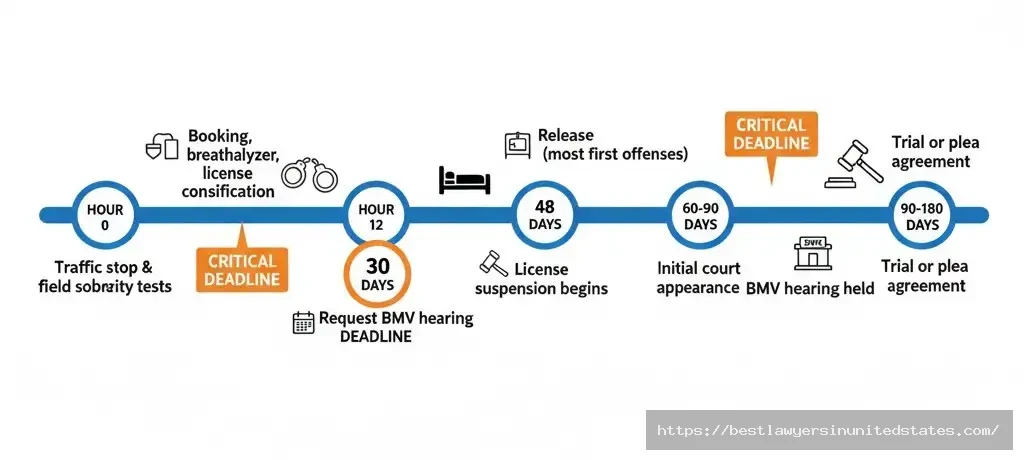
What Happens After You’re Arrested?
The first 24-48 hours after an Indiana OWI arrest follow a specific timeline:
Hour 0-1: Traffic Stop and Field Tests
- Officer observes traffic violation or erratic driving
- Requests license and registration
- Notes physical signs: bloodshot eyes, slurred speech, alcohol odor
- Administers field sobriety tests (walk-and-turn, one-leg stand, HGN)
Hour 1-2: Roadside Testing
- Portable breath test (PBT) – not admissible in court but justifies arrest
- Roadside oral fluid test for drugs (Indiana-specific program)
- Handcuffs and transport to jail
Hour 2-4: Booking Process
- Fingerprinting and photographing
- Miranda rights reading
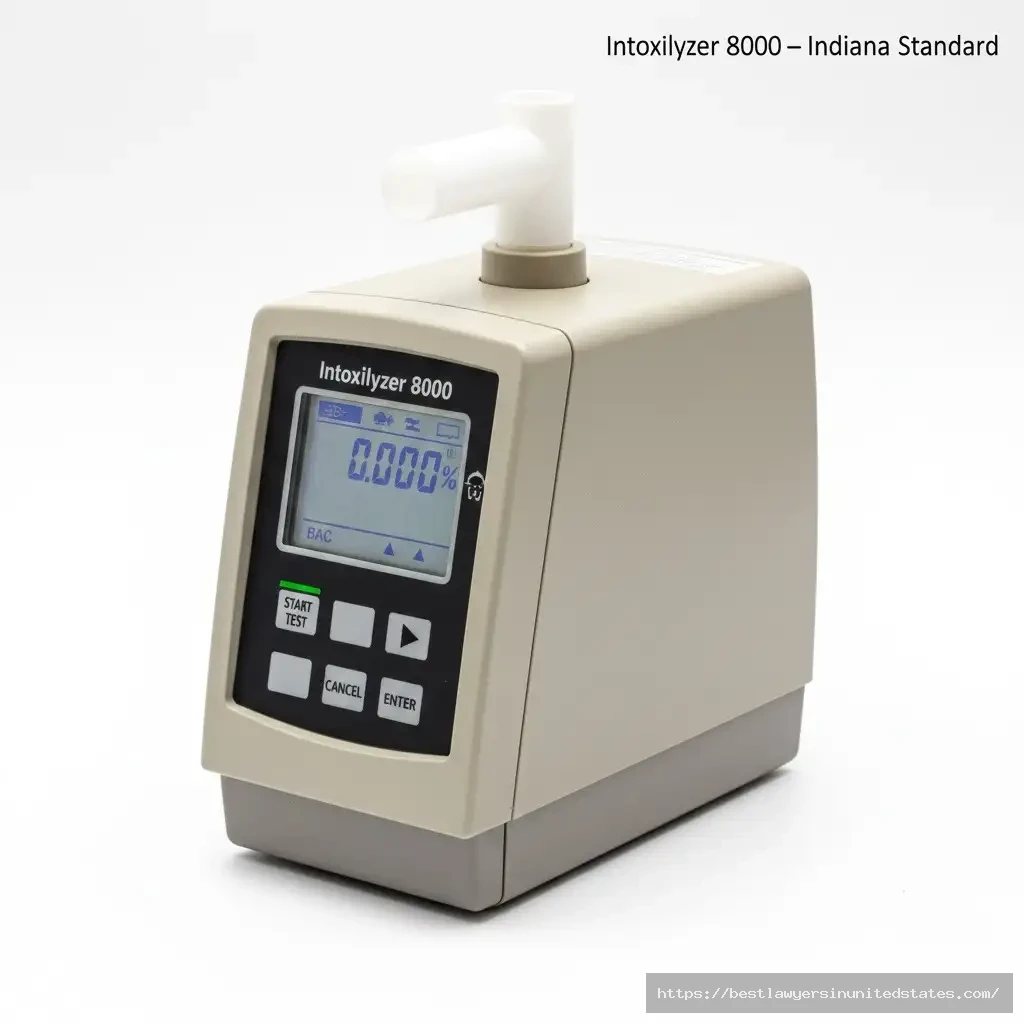
- Official breathalyzer test (Intoxilyzer 8000)
- Blood draw if suspected drug use
- License confiscation
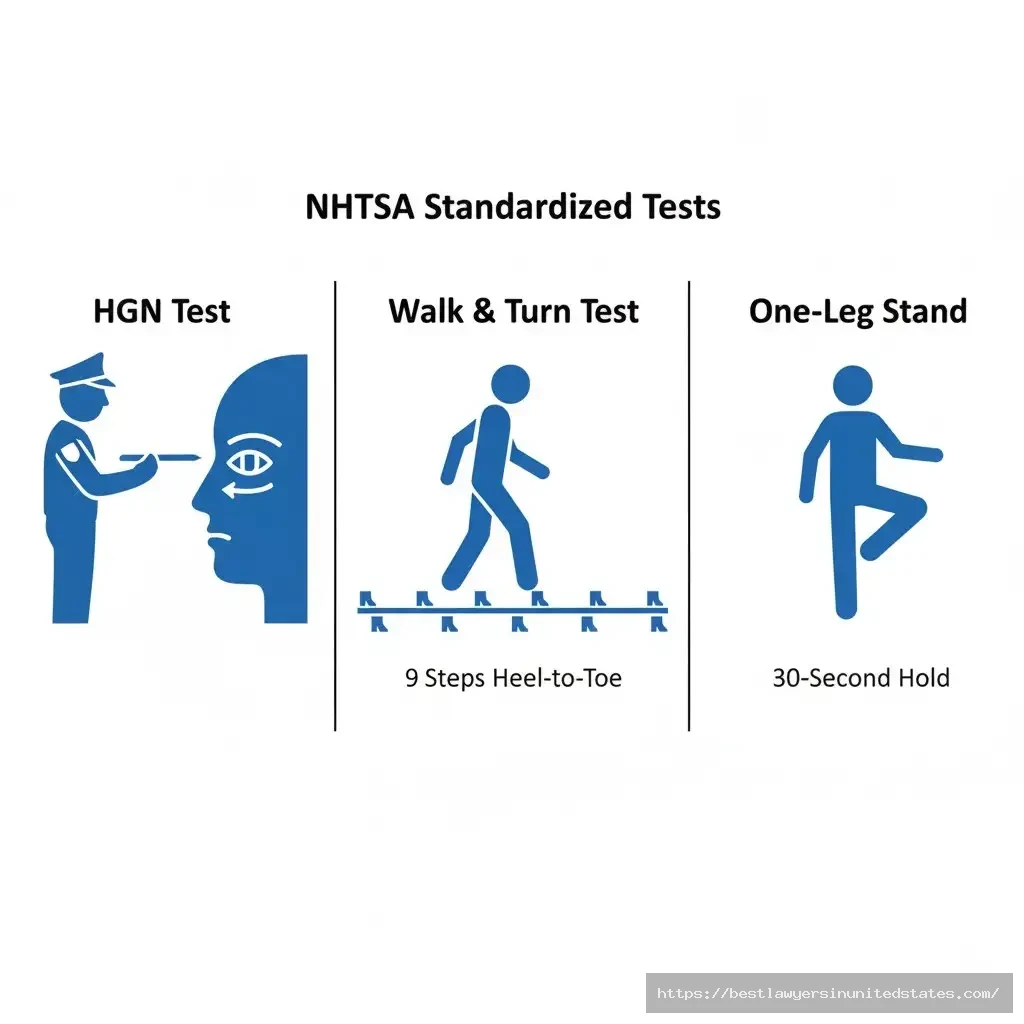
Hour 4-12: Post-Arrest
- Sobering period in holding cell
- Bond hearing (if required)
- Release on own recognizance (most first offenses)
- Court date notification
Within 48 hours:
- Initial hearing before judge
- Formal charges filed
- Public defender appointment (if eligible)
Indiana’s Roadside Oral Fluid Testing Program
Indiana uses roadside oral fluid testing as one of few states with a statewide drug detection program.
How the test works:
- Officer suspects drug impairment
- Collects saliva sample using oral swab
- Tests for: THC, cocaine, methamphetamine, opiates, amphetamines
- Results in 5-10 minutes
- Positive result = probable cause for arrest
Drugs detected and detection windows:
| Substance | Detection Window | Threshold |
|---|---|---|
| THC (marijuana) | 4-6 hours | 25 ng/mL |
| Cocaine | 24-48 hours | 20 ng/mL |
| Methamphetamine | 24-48 hours | 50 ng/mL |
| Opiates | 24-36 hours | 40 ng/mL |
Legal challenges: Defense attorneys successfully challenge oral fluid tests by:
- Questioning proper administration procedures
- Highlighting false positive rates
- Showing contamination from recent mouth use
- Proving lack of impairment despite positive test
Indiana State Police trained 400+ officers in oral fluid testing protocols in 2025. The program expanded to all 92 counties in 2026.
Indiana Implied Consent Law
Every Indiana driver automatically agrees to chemical testing when accepting a driver’s license under IC 9-30-6.
What implied consent means:
If a police officer arrests you for OWI and requests a breath, blood, or urine test, you must comply. Refusing triggers automatic penalties separate from any criminal charges.
Refusal consequences:
| Offense | Refusal Penalty | Failed Test Penalty |
|---|---|---|
| 1st refusal | 1-year suspension | 180-day suspension |
| 2nd refusal | 2-year suspension | 1-year suspension |
| Prior OWI + refusal | 2-year suspension | 1-year suspension |
Critical point: Refusal penalties apply even if prosecutors drop your OWI charges or you’re found not guilty at trial.
Can Police Force You to Take a Test?
You cannot be physically forced to provide a breath or blood sample without a warrant. However, Indiana officers increasingly obtain warrants for blood draws in serious cases.
When forced blood draws happen:
- Accidents with serious injuries
- Suspected drug impairment
- Refusal combined with prior OWI convictions
- Evidence of extremely high BAC
Warrant process:
- Officer calls on-call judge (usually takes 30-60 minutes)
- Judge reviews probable cause affidavit
- Warrant issued if probable cause exists
- Medical professional draws blood at hospital
Marion County statistics (2025): Prosecutors obtained blood draw warrants in 34% of OWI refusal cases, up from 18% in 2023.
How Refusal Affects Your Case
Refusing chemical testing creates both advantages and severe disadvantages:
Potential advantages:
- No BAC evidence for prosecution to use
- Forces state to prove impairment through observations only
- May result in reduced charges if evidence is weak
Severe disadvantages:
- 1-year automatic suspension (vs 180 days for failed test)
- Prosecutors use refusal as “consciousness of guilt” evidence
- Juries view refusal negatively at trial
- Blood warrant may produce evidence anyway
- BMV suspension very difficult to challenge
Monroe County case example (2024): Jury convicted defendant of OWI after prosecutor emphasized his test refusal 17 times during trial. Defendant received harsher sentence specifically due to refusal.
BMV Administrative Suspension vs Criminal Court
Indiana OWI defendants face two separate legal battles:
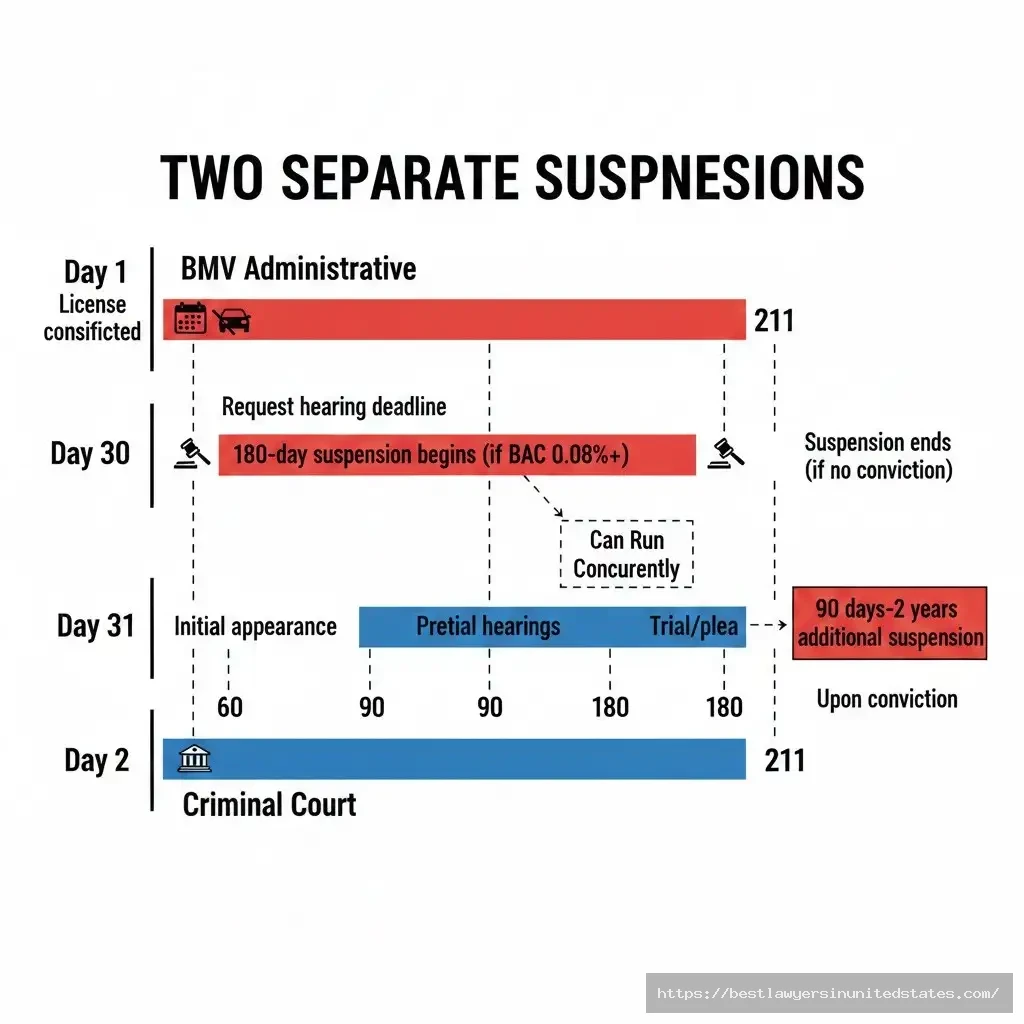
1. BMV Administrative Suspension
- Automatic 180-day suspension if BAC 0.08%+
- Begins 30 days after arrest
- Separate from criminal case
- Must request hearing within 30 days to contest
2. Criminal Court Case
- OWI charges filed by prosecutor
- Can result in additional suspension upon conviction
- May occur months after arrest
- Separate penalties from BMV action
Key insight: You can win your criminal case but still lose your license through BMV suspension. Both battles must be fought independently.
Timeline example:
| Day | BMV Process | Criminal Process |
|---|---|---|
| 1 | License confiscated | Arrest, booking |
| 2-30 | Request hearing window | Initial court appearance |
| 31 | Suspension begins (if no hearing) | Pretrial negotiations begin |
| 60-90 | BMV hearing held | Discovery, motion hearings |
| 90-180 | Suspension continues | Trial or plea agreement |
Special Driving Privileges in Indiana
Indiana offers “specialized driving privileges” for work, medical, and education purposes during suspension.
Eligibility requirements:
- Completed substance abuse evaluation
- Installed ignition interlock device
- Obtained SR-22 insurance
- Filed petition with BMV
- Paid reinstatement fee ($250-$500)
Allowed driving:
- Work commute (direct route only)
- Medical appointments
- Court-ordered programs
- Educational classes
Not allowed:
- Recreational driving
- Running errands
- Driving for employment (Uber, delivery, etc.)
Cost: $150 filing fee + $75-150/month ignition interlock + higher insurance rates
Violation consequences: Driving outside permitted hours/locations = additional criminal charges for driving while suspended.
Indiana OWI Defense Strategies
Can a DUI Be Dismissed in Indiana?
Quick Answer: Yes, Indiana OWI charges can be dismissed based on procedural errors, lack of probable cause, or insufficient evidence.
Common dismissal grounds:
1. Illegal traffic stop
- Officer lacked reasonable suspicion to initiate stop
- Anonymous tip without corroboration
- Stopped based solely on leaving bar parking lot
2. Failed implied consent procedure
- Officer didn’t read implied consent warning properly
- Testing occurred beyond reasonable time
- Chemical test administered by unqualified person
3. Breathalyzer problems
- Device not calibrated within required timeframe
- Operator lacked proper certification
- Subject not observed for required 15-minute period
- Mouth alcohol from reflux or dental work
4. Field sobriety test issues
- Tests administered on uneven surface
- Medical conditions affecting balance
- Improper instructions given
- Officer not trained in standardized procedures
5. Lack of probable cause for arrest
- Officer arrested before gathering sufficient evidence
- No observed impairment beyond legal driving
- BAC under 0.08% with no other evidence
Tippecanoe County example (2025): Judge dismissed OWI case after defense proved breathalyzer wasn’t calibrated for 11 months, violating Indiana State Department of Health regulations.
How to Beat an OWI in Indiana
1. Challenge the Traffic Stop
Officers must have reasonable suspicion of a traffic violation or criminal activity to initiate a stop.
Weak reasons for stops (often successfully challenged):
- “Weaving within lane” without crossing lines
- Driving too slowly without other factors
- Leaving bar parking lot
- Late-night driving in “high DUI area”
Valid reasons:
- Speeding, running red light, or other traffic violation
- Crossing lane lines multiple times
- Stopping in roadway without reason
- Hitting curb or other objects
2. Question Test Accuracy
Indiana breathalyzer results can be challenged through:
15-minute observation period requirement:
- Officer must observe you continuously for 15 minutes before testing
- No eating, drinking, smoking, or vomiting allowed
- Ensures mouth alcohol doesn’t inflate results
Calibration records:
- Intoxilyzer 8000 must be calibrated every 120 days
- Maintenance records often contain gaps
- Improper calibration = inadmissible results
Rising BAC defense:
- Your BAC was under 0.08% while driving
- Continued absorbing alcohol after stopping
- Testing occurred 30-90 minutes post-driving
- Results don’t reflect your BAC while operating vehicle
3. Medical Condition Defenses
Certain medical conditions mimic signs of intoxication:
- Diabetes (breath smells like alcohol, confusion)
- GERD/acid reflux (mouth alcohol in breath test)
- Neurological conditions (poor balance, slurred speech)
- Fatigue from sleep apnea
- Anxiety disorders (nervousness, shaking)
Hendricks County case (2024): Jury acquitted defendant after doctor testified his Type 1 diabetes produced false positive on breathalyzer due to ketones in breath.
OWI Plea Bargains in Indiana
Unlike states with statutory “wet reckless” reductions, Indiana doesn’t have formal alternative charges for OWI plea bargains.
Possible negotiated outcomes:
1. Reduced OWI (first offense only)
- From Class C misdemeanor to infraction
- Reduces jail exposure
- Still counts as prior OWI for future offenses
2. Reckless Driving
- Class B misdemeanor (6 months jail max)
- Doesn’t count as OWI
- Preserves CDL in some cases
- Rare, requires weak prosecution evidence
3. Deferred Prosecution
- Complete probation terms
- Charges dismissed upon successful completion
- Available only in select counties
- Usually requires first offense with no aggravating factors
Hamilton County statistics (2025): Only 8% of OWI defendants received plea bargains to reckless driving. Marion County: 12%. Most plead to amended OWI with reduced penalties.
When prosecutors offer deals:
- BAC close to 0.08% (0.08-0.09%)
- First offense with clean record
- Problems with evidence or testing
- Defendant completed treatment before court
- No accident or property damage
Learn what your case might cost with our DUI cost calculator, then consult with an attorney about negotiation options.
DUI Cost Calculator
Estimate total DUI expenses by state and offense
Detailed Cost Breakdown
Payment Timeline
Bail bond, towing fees, car impound, attorney retainer
Initial court fines, DMV fees, DUI school enrollment, ignition interlock installation
Monthly probation fees, ignition interlock fees, DUI school payments, attorney balance
Insurance premium increases, license reinstatement, SR-22 filing fees
- Lost wages from missed work (court dates, jail time, DUI school) – $2,000-$10,000
- Job loss or difficulty finding employment – Varies
- Professional license suspension (doctors, lawyers, nurses, pilots) – Career ending
- Rideshare and transportation costs during suspension – $1,500-$5,000
- Travel restrictions and visa denials – Varies
- Security clearance loss – Career impact
- Child custody implications – Legal costs
- Rental car restrictions – Varies
- Personal relationships and mental health costs – Priceless
Indiana OWI Costs Breakdown
Total Cost of an OWI in Indiana
Most first-time OWI defendants in Indiana pay $3,500-$10,000 total when accounting for all direct and indirect costs.
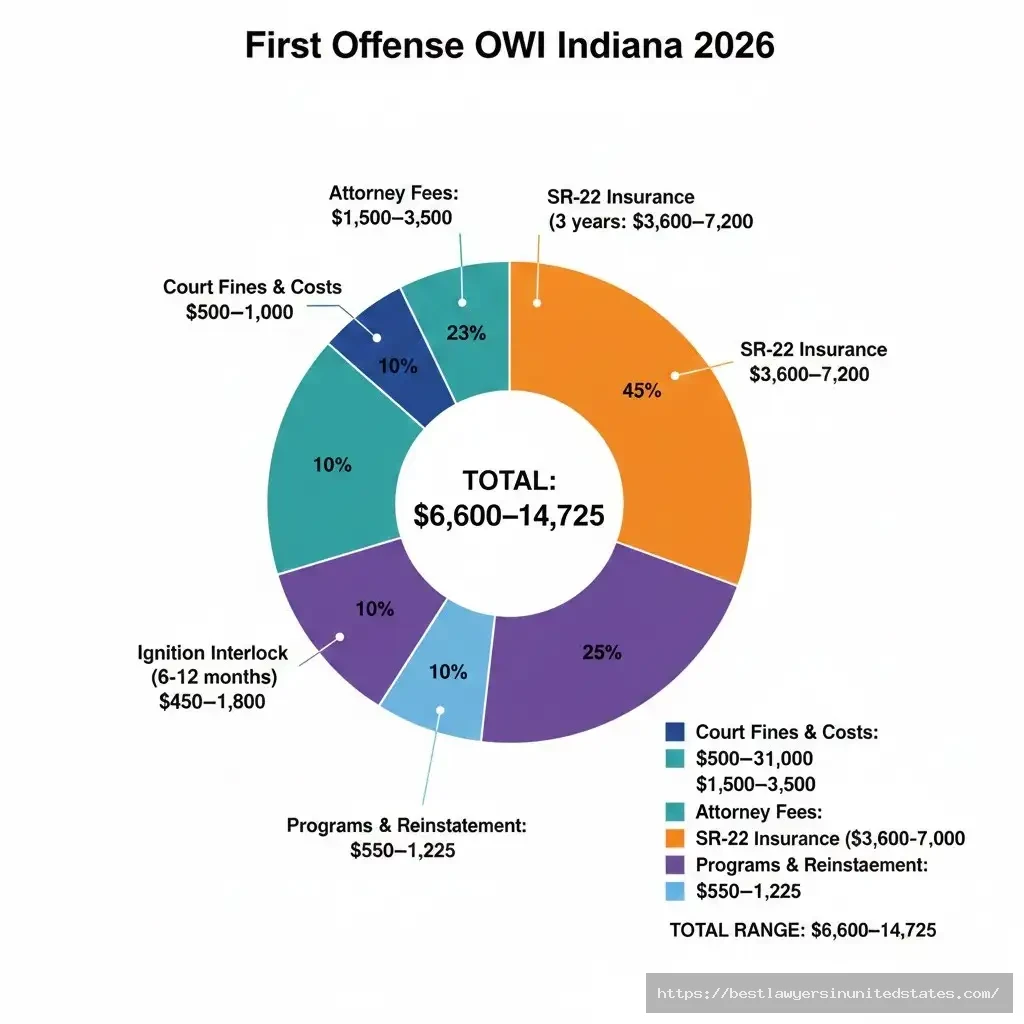
Immediate costs (first 90 days):
| Cost Category | Amount | When Due |
|---|---|---|
| Bail/bond | $0-$1,500 | Day 1 |
| Towing/impound | $150-$400 | Within 3 days |
| Attorney retainer | $1,500-$3,500 | Week 1-2 |
| Court fines | $200-$500 | At conviction |
| Court costs | $300-$500 | At conviction |
Ongoing costs (6 months – 3 years):
| Cost Category | Monthly Cost | Duration | Total |
|---|---|---|---|
| SR-22 insurance increase | $100-$200 | 36 months | $3,600-$7,200 |
| Ignition interlock | $75-$150 | 6-12 months | $450-$1,800 |
| Probation fees | $25-$50 | 12 months | $300-$600 |
One-time program fees:
| Program | Cost | Requirement |
|---|---|---|
| Substance abuse evaluation | $150-$300 | Mandatory |
| DUI education program | $200-$350 | Mandatory |
| Victim impact panel | $50-$75 | Usually required |
| License reinstatement | $250-$500 | After suspension |
Calculate your specific costs: Use our DUI cost calculator to estimate your total financial impact based on your offense level and county.
Court Fines and Costs
Indiana separates fines (punishment) from costs (administrative fees).
Criminal fines by offense:
| Offense Level | Fine Range | Typical Amount |
|---|---|---|
| First (Class C misdemeanor) | $0-$500 | $200-$400 |
| Second (enhanced) | $500-$10,000 | $750-$2,000 |
| Third (Level 6 felony) | $500-$10,000 | $2,500-$5,000 |
Mandatory court costs (2026):
- Filing fees: $135
- Public defender fee: $50 (if appointed)
- Jury costs: $50 (if trial)
- Probation administrative fee: $100
- Total: $300-$500 minimum
Allen County costs breakdown:
- Court costs: $400
- Probation setup: $100
- Drug/alcohol testing: $25/test
- Electronic monitoring: $10/day (if required)
Attorney Fees in Indiana
OWI attorney fees vary significantly by case complexity and location.
First offense (no aggravating factors):
- Flat fee: $1,500-$2,500
- Includes: court appearances, plea negotiation, one BMV hearing
- Does not include: trial preparation, expert witnesses
First offense with complications:
- Flat fee: $2,500-$5,000
- Complications: accident, injury, high BAC (0.15%+), refusal
- May include trial representation
Felony OWI (third offense+):
- Retainer: $5,000-$10,000
- Hourly billing after retainer exhausted
- Often requires $7,500-$15,000 total
Hourly rates in Indiana (2026):
- Indianapolis: $250-$400/hour
- Fort Wayne: $200-$325/hour
- Smaller cities: $150-$250/hour
Payment plans: Most Indiana OWI attorneys offer payment plans requiring 30-50% down and monthly payments over 6-12 months.
When public defenders are available:
- Income under 125% of federal poverty level
- Must apply through court
- Quality varies significantly by county
SR-22 Insurance Requirements
Indiana requires SR-22 insurance (high-risk proof of financial responsibility) for most OWI convictions.
What SR-22 is:
- Certificate proving you carry minimum liability insurance
- Filed by your insurance company with Indiana BMV
- Required for 3-5 years depending on offense
How SR-22 affects insurance costs:
| Before OWI | After OWI (SR-22) | Annual Increase |
|---|---|---|
| $1,200/year | $3,600-$4,800/year | +$2,400-$3,600 |
Three-year total increase: $7,200-$10,800
Getting SR-22 coverage:
- Contact insurance company after conviction
- Company files SR-22 with BMV ($25-$50 filing fee)
- Must maintain continuous coverage
- Any lapse triggers automatic license suspension
- After 3 years, request SR-22 removal
Companies offering SR-22 in Indiana:
- State Farm
- Progressive
- The General
- Bristol West
- National General
Cost-saving tip: Shop multiple insurers. SR-22 rates vary dramatically between companies. Some quotes differ by $1,500+/year.
Ignition Interlock Costs
Indiana requires ignition interlock devices for certain OWI offenders and as a condition for specialized driving privileges.
Installation and monthly fees (2026):
| Fee Type | Amount | When Charged |
|---|---|---|
| Installation | $75-$150 | One-time |
| Monthly monitoring | $75-$100 | Every 30 days |
| Calibration visits | $0 (included) | Every 30 days |
| Removal fee | $50-$75 | End of requirement |
Total 6-month cost: $525-$825 Total 12-month cost: $975-$1,425
How the device works:
- Installed in your vehicle’s starter system
- Must blow into device to start car
- Random “rolling retests” while driving
- Records all attempts (passed and failed)
- Downloads data at monthly calibration
Approved vendors in Indiana:
- Intoxalock
- Smart Start
- LifeSafer
- Guardian Interlock
Violations that extend requirement:
- Failed startup test
- Missed rolling retest
- Tampering with device
- Attempting to have another person blow
Hidden Costs of an Indiana OWI
Beyond direct penalties, Indiana OWI convictions create expensive hidden costs:
Employment impact:
- Lost wages during jail time: $500-$5,000
- Job loss risk (professional licenses, CDL): $10,000-$50,000/year
- Reduced earning potential with criminal record: 10-20% lifetime
Transportation costs:
- Uber/Lyft during suspension (6-24 months): $200-$600/month
- Specialized driving privileges filing: $150
- Extra vehicle for spouse: $3,000-$10,000
Educational impact:
- Loss of federal student aid eligibility
- Professional school rejection
- Scholarship revocation
Professional licenses:
- Teacher license suspension hearings: $2,000-$5,000
- Nursing license defense: $3,000-$7,500
- Attorney disciplinary proceedings: $5,000-$15,000
Family law impact:
- Child custody modification proceedings: $3,500-$10,000
- Supervised visitation requirements: $50-$100/visit
Total hidden costs (conservative estimate): $5,000-$20,000 for first offense, potentially much higher with job loss or professional license issues.
Long-Term Consequences
How Long Does a DUI Stay on Your Record in Indiana?
Quick Answer: An OWI conviction stays on your Indiana criminal record permanently unless you successfully petition for expungement.
Three types of records:
1. Criminal Court Record
- Duration: Lifetime (permanent)
- Visible to: Employers, landlords, licensing boards
- Location: County clerk where convicted
- Also in: MyCase Indiana (public search)
2. BMV Driving Record
- Duration: Lifetime for OWI convictions
- Visible to: Insurance companies, employers (CDL jobs)
- Cannot be removed even after expungement
3. Background Check Databases
- Duration: 7-10 years (most employment checks)
- Federal law limits: 7 years for non-convictions
- No limit for convictions over $75,000 salary positions
MyCase Indiana Public Records:
Indiana’s online court system (MyCase) makes all court records publicly searchable. Anyone can search by your name and find:
- All charges filed (even if dismissed)
- Court appearances and outcomes
- Sentences and fines
- Probation violations
Employer access: 92% of Indiana employers conduct criminal background checks. OWI convictions appear on:
- Standard background checks: 7-10 years
- Government positions: Lifetime
- Healthcare/education: Lifetime
- CDL positions: Lifetime
Indiana DUI Expungement
Indiana’s “Second Chance Law” allows expungement of certain criminal records, including some OWI convictions.
Eligibility timeline:
| Conviction Type | Waiting Period | Requirements |
|---|---|---|
| Class C misdemeanor OWI | 5 years | No new arrests |
| Level 6 felony OWI | 8 years | No new arrests |
| Multiple OWIs | 10 years | Extremely difficult |
Requirements for expungement:
- Completed all sentence terms (jail, probation, fines)
- Paid all court costs and restitution
- No pending criminal charges
- No new arrests during waiting period
- File petition in conviction county
What expungement does:
- Seals court records from public view
- MyCase Indiana removes case from search
- Can legally answer “no” to conviction questions (most jobs)
- Restores voting rights for felonies
What expungement does NOT do:
- Remove from BMV driving record
- Restore firearm rights (requires separate process)
- Erase from law enforcement databases
- Prevent use as prior offense for future OWI
Filing process:
- Obtain conviction records from court clerk
- Complete expungement petition (form provided by court)
- File petition with court ($157 filing fee)
- Serve notice to prosecutor
- Wait 30-60 days for hearing
- Attend hearing (prosecutor may object)
- Judge decides based on circumstances
Success rates:
- First-offense misdemeanor OWI: 75-85%
- Multiple convictions: 30-40%
- Felony OWI: 50-60%
Cost: $157 filing fee + $500-$2,000 attorney fees (recommended but not required)
Allen County example (2025): Court denied expungement for defendant with two OWI convictions despite meeting 10-year requirement, citing “public safety concerns.”
Employment Impact and Fair Chance Act
Indiana’s Fair Chance Act (IC 22-5-4-11) provides limited protections for people with criminal records.
What the law requires:
- Employers cannot ask about criminal history on initial application
- Must conduct individualized assessment before denying employment
- Consider nature of offense, time elapsed, and job relevance
What the law does NOT protect:
- Positions requiring professional licenses
- Jobs with vulnerable populations (children, elderly)
- Positions with federal background check requirements
- CDL and transportation jobs
OWI-specific employment concerns:
Automatic disqualification positions:
- CDL driver (any OWI conviction)
- School bus driver
- Healthcare positions with medication access
- Jobs requiring company vehicle use
- Positions requiring professional liability insurance
Difficult but possible:
- Teaching (case-by-case review by licensing board)
- Nursing (often requires BON hearing)
- Law enforcement
- Government contractors with security clearances
Less impact:
- Retail, food service, warehouse work
- Construction, manufacturing
- Office administration (non-driving)
Disclosure strategies:
If asked about convictions:
- Answer honestly (lying disqualifies you permanently)
- Brief explanation: “I made a mistake in [year], completed all requirements, and have had no issues since”
- Emphasize steps taken: treatment, counseling, clean record since
- Redirect to qualifications and work history
Insurance Impact Beyond SR-22
OWI convictions affect insurance far beyond the SR-22 requirement period.
Rate increases by offense:
| Offense | Rate Increase | Duration | 10-Year Impact |
|---|---|---|---|
| First OWI | +200-300% | 3-5 years | $12,000-$18,000 |
| Second OWI | +300-400% | 5-7 years | $18,000-$28,000 |
| Third+ OWI | +400-500% | 7-10 years | $24,000-$35,000 |
After SR-22 expires:
- Rates remain elevated 40-60% for additional 3-5 years
- Gradually decrease 10-15% per year
- May never return to pre-OWI rates with same company
Policy cancellation risk:
- 35% of insurers non-renew policies after first OWI
- 65% drop coverage after second OWI
- Third OWI = assigned risk pool (highest rates)
Strategies to minimize costs:
- Shop annually: Insurers weigh OWIs differently
- Increase deductibles: Lower premiums by raising deductibles to $1,000-$2,000
- Drop comprehensive/collision on older vehicles
- Bundle policies: Home + auto can reduce rates 20-30%
- Usage-based insurance: Prove safe driving with telematics
Monroe County example (2024): Driver’s insurance increased from $1,400/year to $4,200/year after first OWI. After 5 years and shopping multiple insurers, found coverage for $2,600/year (still 85% higher than pre-OWI).
Special Circumstances
CDL DUI in Indiana
Commercial driver’s license holders face stricter BAC limits and severe career consequences for OWI convictions.
CDL BAC limits:
| Situation | BAC Limit | Penalty |
|---|---|---|
| Operating CMV | 0.04% | 1-year CDL disqualification |
| Operating personal vehicle | 0.08% | 1-year CDL disqualification |
| Transporting hazmat | 0.04% | 3-year disqualification |
| Second OWI (any vehicle) | Any BAC | Lifetime disqualification |
Critical rule: Indiana CDL holders lose their commercial license for OWI even if driving their personal vehicle. A Saturday night OWI in your own car costs you your CDL.
Federal FMCSA rules (49 CFR 383.51):
- First CDL OWI: 1-year disqualification (cannot be reduced)
- Second CDL OWI: Lifetime disqualification (can petition after 10 years)
- Refusing test in CMV: Same as OWI conviction
No hardship license for CDL: Unlike regular licenses, you cannot obtain specialized driving privileges for commercial driving. A CDL disqualification means no commercial driving whatsoever.
State-by-state reporting: Indiana reports all OWI convictions to your home state CDL registry. You cannot escape disqualification by getting licensed in another state.
Career impact:
- Average CDL driver salary in Indiana: $55,000/year
- Retraining for new career: $3,000-$10,000
- Lost lifetime earnings: $250,000-$500,000
Elkhart County case (2024): Truck driver with 22-year clean record lost CDL and $68,000/year job after first OWI in personal vehicle. Company terminated employment within 48 hours despite 15 years of service.
Underage DUI in Indiana (Under 21)
Indiana enforces zero tolerance for drivers under 21 with IC 9-30-5-1 and IC 9-30-5-2.
Zero tolerance standard:
- BAC 0.02%-0.07%: Administrative violation (not criminal)
- BAC 0.08%+: Full criminal OWI charge
Administrative penalties (BAC 0.02%-0.07%):
| Penalty Type | First Violation | Second Violation |
|---|---|---|
| License suspension | 60 days | 1 year |
| Reinstatement fee | $150 | $250 |
| Required programs | 8-hour education | Substance abuse treatment |
Criminal OWI charges (BAC 0.08%+): Under-21 drivers face same penalties as adults PLUS:
- Automatic license suspension until age 21
- Ineligibility for specialized driving privileges
- Notification to parents/guardians
- College financial aid complications
Educational consequences:
High school:
- Suspension from sports/extracurriculars
- Loss of parking privileges
- School discipline (varies by district)
College:
- Federal student aid suspension (drug convictions)
- Scholarship revocation (especially athletics)
- Greek life probation/expulsion
- Internship/job offer rescission
Parent/guardian liability: Indiana’s “social host” law (IC 7.1-5-7-17) holds parents criminally liable for providing alcohol to minors, even their own children.
Penalties for parents:
- Class B misdemeanor: Up to 180 days jail
- Fines up to $1,000
- Civil liability for any resulting injuries/death
Monroe County example (2024): Parents faced criminal charges and $85,000 civil judgment after son (age 19) left their house party and caused accident. Parents admitted to “looking the other way” regarding alcohol.
OWI with Child Endangerment (Stephanie’s Law)
Indiana’s “Stephanie’s Law” (IC 9-30-5-2.5) enhances OWI penalties when a child under 18 is a passenger.
Enhanced charges:
- Automatic Level 6 felony (even for first offense)
- Additional 30 days to 2.5 years prison
- Mandatory substance abuse treatment
- DCS (Department of Child Services) investigation
Stephanie’s Law penalties:
| Base Offense | Without Child | With Child Passenger |
|---|---|---|
| First OWI | Class C misdemeanor | Level 6 felony |
| Second OWI | Enhanced misdemeanor | Level 6 felony (enhanced) |
| Third OWI | Level 6 felony | Level 5 felony |
Child Services involvement:
- Automatic DCS investigation
- Possible removal of children from home
- Substantiated child neglect report
- Family case plan requirements
- Supervised visitation during case
Custody modification risk:
OWI with child endangerment gives the other parent strong grounds for:
- Emergency custody modification
- Supervised visitation only
- Loss of overnight parenting time
- Substance abuse treatment requirements
Hamilton County case (2024): Mother with first-offense OWI and two children in vehicle received:
- 1-year prison sentence (suspended)
- 2 years probation
- 90-day inpatient treatment
- 6 months supervised visitation only
- DCS oversight for 2 years
Name origin: Law named for Stephanie Hirth, killed by drunk driver in Vanderburgh County in 2008. Driver had child in vehicle during crash.
OWI Causing Injury or Death
OWI cases involving injuries or fatalities trigger Indiana’s most severe penalties.
OWI Causing Serious Bodily Injury:
- Level 5 felony: 1-6 years prison
- Fines up to $10,000
- 2-year license suspension minimum
- Mandatory restitution to victim
OWI Causing Death:
- Level 4 felony: 2-12 years prison
- Fines up to $10,000
- Lifetime license suspension possible
- Civil wrongful death liability
“Serious bodily injury” definition (IC 35-31.5-2-292):
- Creates substantial risk of death
- Causes serious permanent disfigurement
- Causes protracted loss or impairment of function of bodily member or organ
Sentencing enhancements:
- Prior OWI convictions add 1-5 years
- BAC 0.15%+ adds up to 2 years
- Fleeing scene adds 2-6 years
Civil liability:
Criminal penalties are only part of consequences. Victims/families can sue for:
- Medical expenses: $50,000-$500,000+
- Lost wages: $100,000-$1,000,000+
- Pain and suffering: $250,000-$2,000,000+
- Punitive damages: 3x compensatory damages
Insurance coverage limits:
- Minimum liability in Indiana: $25,000 per person
- Average serious injury claim: $200,000-$800,000
- Personal assets at risk above policy limits
Tippecanoe County case (2023): Driver with 0.16% BAC caused crash killing two people. Received:
- Criminal: 16 years prison (Level 4 felony x2, consecutive)
- Civil: $4.2 million judgment to families
- Driver’s future wages garnished 25% for life
Finding Legal Help in Indiana

When to Hire an Indiana OWI Attorney
Situations requiring immediate attorney consultation:
Mandatory attorney scenarios:
- BAC 0.15% or higher
- Second or subsequent OWI
- Accident with injuries or property damage
- Child passenger in vehicle
- Commercial driver’s license at risk
- Professional license implications (teacher, nurse, attorney)
Strongly recommended scenarios:
- First offense with complications
- You refused chemical testing
- Police made procedural errors
- Breathalyzer results disputed
- Prior criminal record
- Immigration concerns (non-citizens)
Possible self-representation (not recommended):
- First offense, BAC barely over 0.08%
- Pleading guilty with no negotiation
- Public defender appointed but inadequate
Cost of not hiring attorney:
- Higher fines and longer jail sentences
- Missed suppression opportunities
- Longer license suspension
- Permanent criminal record (failed expungement)
- Lost specialized driving privileges
- Future enhanced penalties
Marion County statistics (2025): Defendants with private attorneys received jail time in 15% of first-offense cases. Pro se (self-represented) defendants received jail time in 47% of cases.
What to Look for in an Indiana DUI Lawyer
Essential qualifications:
- OWI-specific experience
- Handles 50+ OWI cases yearly
- Familiar with local judges and prosecutors
- Certified in field sobriety testing (NHTSA standards)
- Knowledge of breathalyzer science
- Indiana BMV experience
- Separate from criminal defense
- Different procedures and standards
- Critical for license suspension defense
- Local court knowledge
- Regular practice in your county
- Relationships with local prosecutors
- Knows judge’s sentencing patterns
- Familiar with county-specific programs
Red flags to avoid:
- Guarantees specific outcomes
- No OWI-specific experience
- Practices mainly in other states
- Poor online reviews from OWI clients
- Communication issues during consultation
Questions to ask during consultation:
- How many OWI cases have you handled in [Your County]?
- What percentage go to trial vs plea agreements?
- Will you handle my case personally or delegate to associate?
- Do you handle BMV hearings or refer out?
- What is your fee structure and payment options?
- What is realistic outcome based on my facts?
Finding attorneys:
- Indiana State Bar Association referral service
- Find DUI Lawyers in Indiana – Free Consultation
- County bar association referrals
- Martindale-Hubbell ratings
- AVVO reviews (verify authenticity)
Average Attorney Costs in Indiana
Attorney fees vary significantly by location, experience, and case complexity.
Indianapolis metro (Marion, Hamilton, Hendricks counties):
| Service Level | First Offense | Second Offense | Felony (Third+) |
|---|---|---|---|
| Budget attorney | $1,500-$2,000 | $2,500-$3,500 | $5,000-$7,500 |
| Mid-tier attorney | $2,500-$4,000 | $4,000-$6,000 | $7,500-$12,500 |
| Top-tier attorney | $4,000-$7,500 | $6,000-$10,000 | $12,500-$20,000 |
Mid-size cities (Fort Wayne, Evansville, South Bend):
| Service Level | First Offense | Second Offense | Felony |
|---|---|---|---|
| Budget | $1,200-$1,800 | $2,000-$3,000 | $4,000-$6,000 |
| Mid-tier | $2,000-$3,000 | $3,000-$5,000 | $6,000-$10,000 |
| Top-tier | $3,000-$5,000 | $5,000-$8,000 | $10,000-$15,000 |
Small cities and rural counties:
| Service Level | First Offense | Second Offense | Felony |
|---|---|---|---|
| Budget | $1,000-$1,500 | $1,800-$2,500 | $3,500-$5,000 |
| Mid-tier | $1,500-$2,500 | $2,500-$4,000 | $5,000-$8,000 |
| Top-tier | $2,500-$4,000 | $4,000-$6,000 | $8,000-$12,000 |
What’s typically included in flat fee:
- Initial consultation
- Court appearance (usually 2-4 hearings)
- Plea negotiation
- One BMV administrative hearing
- Sentencing preparation
What costs extra:
- Trial preparation and trial: +$2,500-$10,000
- Expert witnesses: $1,500-$5,000 each
- Private investigators: $75-$150/hour
- Additional BMV appeals: $500-$1,500
- Expungement petition: $500-$1,500
Payment plans:
Most Indiana OWI attorneys offer:
- 30-50% down payment
- Remaining balance over 6-12 months
- Must be paid in full before trial
- Credit card payment options
- Some accept legal financing (15-25% APR)
Public defender eligibility:
Indiana provides public defenders if:
- Income below 125% federal poverty level ($18,075 for individual in 2026)
- Facing jail time (not just fines)
- Apply through court at initial hearing
Public defender concerns:
- Heavy caseloads (150-300 cases each)
- Limited time for individual cases
- May pressure quick pleas
- Less experience with complex OWI defenses
Frequently Asked Questions
Is OWI a Felony in Indiana?
Quick Answer: OWI becomes a Level 6 felony in Indiana on your third offense or if you cause serious bodily injury, regardless of prior convictions.
Misdemeanor OWI (first and second offense):
- First offense: Class C misdemeanor
- Second offense: Enhanced Class A misdemeanor (if certain factors)
- Penalties: Maximum 1 year county jail
Felony OWI scenarios:
| Situation | Felony Level | Prison Range |
|---|---|---|
| Third offense | Level 6 | 6 months – 2.5 years |
| Serious bodily injury | Level 5 | 1-6 years |
| Death of another person | Level 4 | 2-12 years |
| Child endangerment | Level 6 | 6 months – 2.5 years |
Lifetime lookback: Indiana counts all prior OWI convictions regardless of age. A conviction from 30 years ago still counts toward felony enhancement.
What is the Penalty for DUI in Indiana?
Quick Answer: First-offense OWI penalties in Indiana include up to 60 days jail (usually suspended), fines up to $500, court costs of $300-$500, license suspension of 90 days to 2 years, and mandatory alcohol programs.
Complete first offense penalties:
Criminal court:
- Jail: Up to 60 days (usually suspended for first offense)
- Fines: $200-$500
- Court costs: $300-$500
- Probation: 6-12 months
BMV:
- Administrative suspension: 180 days (if BAC 0.08%+)
- Criminal suspension: 90 days-2 years (upon conviction)
- Reinstatement fee: $250-$500
Mandatory programs:
- Substance abuse evaluation: $150-$300
- DUI education: $200-$350
- Victim impact panel: $50-$75
Total first-offense cost: $3,500-$10,000 including attorney fees and increased insurance.
Can You Get a DUI on Private Property in Indiana?
Quick Answer: Yes. Indiana OWI laws apply to private property including parking lots, driveways, and private roads under IC 9-30-5-1.
Indiana’s OWI statute does not limit enforcement to public roads. You can be arrested for OWI:
Common private locations for OWI arrests:
- Your own driveway
- Apartment complex parking lots
- Shopping center parking areas
- Restaurant and bar parking lots
- Private neighborhood streets
- Construction sites
- Farm property
Legal reasoning: Indiana courts interpret “operate a vehicle while intoxicated” to apply anywhere, not just public highways. The public safety risk exists regardless of location.
Exceptions (very limited):
- Entirely on your own property with no access to public roads
- Property with locked gates preventing public access
- Must prove no possibility of reaching public roads
Madison County case (2023): Court upheld OWI conviction for driver arrested in Walmart parking lot at 2 AM. Defense argued store was closed and lot was “private property.” Court ruled parking lot accessible from public road satisfied statute.
What is the Lookback Period for DUI in Indiana?
Quick Answer: Indiana uses a lifetime lookback period for OWI convictions. All prior OWI convictions count toward felony enhancement regardless of how long ago they occurred.
How lifetime lookback works:
| Your History | Today’s Charge | Classification |
|---|---|---|
| First OWI: 2000 | OWI in 2026 | Second offense (enhanced) |
| First: 1995, Second: 2005 | OWI in 2026 | Third offense (Level 6 felony) |
| Three OWIs: 1990s | OWI in 2026 | Fourth offense (habitual offender) |
Comparison to other states:
- California: 10-year lookback
- Florida: Lifetime
- Illinois: Lifetime
- Michigan: Lifetime
- Ohio: 10-year lookback
Why lifetime lookback matters:
- Old convictions still trigger felony charges
- Cannot wait out prior convictions
- Even 30-year-old OWI counts
- Only expungement removes (partially)
Expungement effect on lookback:
Expunged OWI convictions:
- ❌ Still count for future OWI charges
- ❌ Remain on BMV record
- ✅ Sealed from public/employers
- ✅ Can answer “no” to conviction questions (non-OWI context)
Porter County case (2024): Defendant convicted of Level 6 felony OWI based on prior convictions from 1998 and 2007. Court rejected argument that 28-year-old conviction should not count.
What is Stephanie’s Law in Indiana?
Quick Answer: Stephanie’s Law (IC 9-30-5-2.5) enhances OWI charges to a Level 6 felony when a child under 18 is a passenger in the vehicle, regardless of whether it’s your first offense.
Named after: Stephanie Hirth, killed by an intoxicated driver who had a child passenger in Vanderburgh County (2008).
How the law works:
Normal first OWI: Class C misdemeanor
- Up to 60 days jail
- $500 maximum fine
First OWI with child passenger (Stephanie’s Law): Level 6 felony
- 6 months to 2.5 years prison
- Up to $10,000 fine
- Permanent felony record
Child Services involvement:
- Automatic DCS investigation
- Possible emergency removal of children
- Substantiated child neglect report
- Family case plan requirements
Custody impact:
- Other parent can seek emergency modification
- Supervised visitation likely during case
- Loss of overnight parenting time
- Court-ordered treatment programs
Additional “child endangerment” enhancement: If you cause injury to the child passenger:
- Level 5 felony: 1-6 years prison
- Aggravated child endangerment charges possible
- Extended DCS oversight
Johnson County example (2024): Mother arrested for first OWI with 4-year-old daughter in back seat. Received:
- Level 6 felony conviction
- 18 months prison (suspended)
- 2 years probation
- 6 months inpatient treatment
- Supervised visitation only for 1 year
How Long Do You Lose Your License for DUI in Indiana?
Quick Answer: First OWI in Indiana results in 180-day administrative suspension plus 90 days to 2 years criminal suspension, which may run concurrently, for a total of 180 days to 2 years depending on circumstances.
License suspension timeline by offense:
| Offense | BMV Administrative | Court Criminal | Typical Total |
|---|---|---|---|
| First OWI | 180 days | 90 days-2 years | 180 days-1 year |
| First OWI (refusal) | 1 year | 90 days-2 years | 1-2 years |
| Second OWI | 1 year | 180 days-2 years | 1-2 years |
| Third OWI (felony) | 2 years | 2 years minimum | 2-10 years |
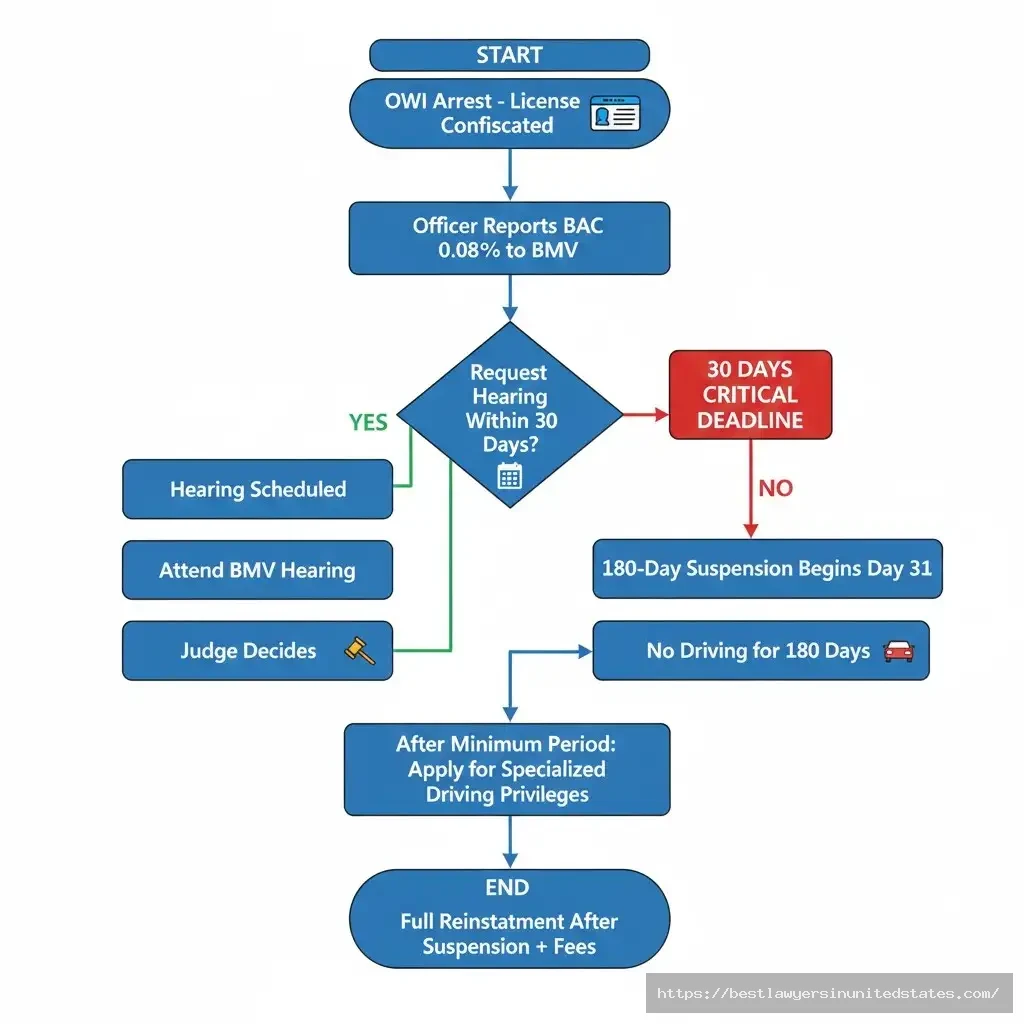
Two separate suspensions:
- BMV administrative suspension (automatic):
- Begins 30 days after arrest
- Based solely on BAC 0.08%+ or refusal
- Separate from criminal case
- Must request hearing within 30 days to challenge
- Criminal court suspension (upon conviction):
- Begins when judge orders
- Based on OWI conviction
- May run concurrently with administrative
- Usually starts after BMV suspension
Specialized driving privileges:
Available after serving minimum suspension:
- First offense: After 30 days (with ignition interlock)
- Second offense: After 90 days
- Third offense: After 180 days
Reinstatement requirements:
- Complete full suspension period
- Pay reinstatement fee ($250-$500)
- Provide SR-22 insurance
- Pay all court fines and costs
- Complete ordered programs
Hardship license timeline:
| Step | Timeline | Action Required |
|---|---|---|
| Arrest | Day 0 | License confiscated |
| Administrative hearing | Day 10-30 | Must request to challenge |
| Suspension begins | Day 31 | Cannot drive legally |
| Hardship eligibility | Day 31+ | Can apply with requirements |
| Install interlock | Day 35-40 | Required for hardship |
| Hardship granted | Day 45-60 | Limited driving permitted |
Can DUIs Be Expunged in Indiana?
Quick Answer: Yes, Indiana allows expungement of OWI convictions after 5 years for misdemeanors and 8 years for felonies, but the conviction remains on your BMV driving record permanently.
Eligibility requirements:
Misdemeanor OWI (first/second offense):
- 5 years since conviction date
- All sentence terms completed
- No pending criminal charges
- No new arrests during 5-year period
Felony OWI (third+ offense):
- 8 years since conviction date
- All sentence terms completed
- No pending charges
- Clean record for 8 years
What expungement accomplishes:
✅ Does:
- Seals court records from public
- Removes from MyCase Indiana search
- Can legally answer “no” to conviction questions (most jobs)
- Restores voting rights (felonies)
❌ Does NOT:
- Remove from BMV driving record
- Prevent use as prior offense for future OWI
- Erase from law enforcement databases
- Restore firearm rights (requires separate petition)
- Help with professional licensing (boards still see)
Cost and process:
- Filing fee: $157
- Attorney fees: $500-$2,000 (recommended)
- Timeline: 3-6 months
- Hearing: Prosecutor may object
Success rates (2025 data):
- First offense misdemeanor: 80-85% granted
- Second offense misdemeanor: 60-70%
- Felony OWI: 50-60%
- Multiple felonies: 25-35%
Common denial reasons:
- New arrests during waiting period
- Unpaid fines or restitution
- Employment involving children/vulnerable adults
- Recent probation violations
- Prosecutor demonstrates ongoing public safety concern
Monroe County case (2024): Court granted expungement for 2016 misdemeanor OWI but defendant discovered conviction still appeared on BMV driving record accessed by insurance company, resulting in continued high rates.
Key Deadlines and Next Steps
Critical Deadlines After Indiana OWI Arrest
Missing these deadlines can result in automatic penalties or lost rights:
| Deadline | Action Required | Consequence of Missing |
|---|---|---|
| 30 days | Request BMV administrative hearing | Suspension goes into effect automatically |
| 30 days | License suspension begins | Driving privileges lost |
| 48 hours | Initial court appearance | Warrant issued for arrest |
| 10 days | Request specialized driving privileges | Delayed eligibility |
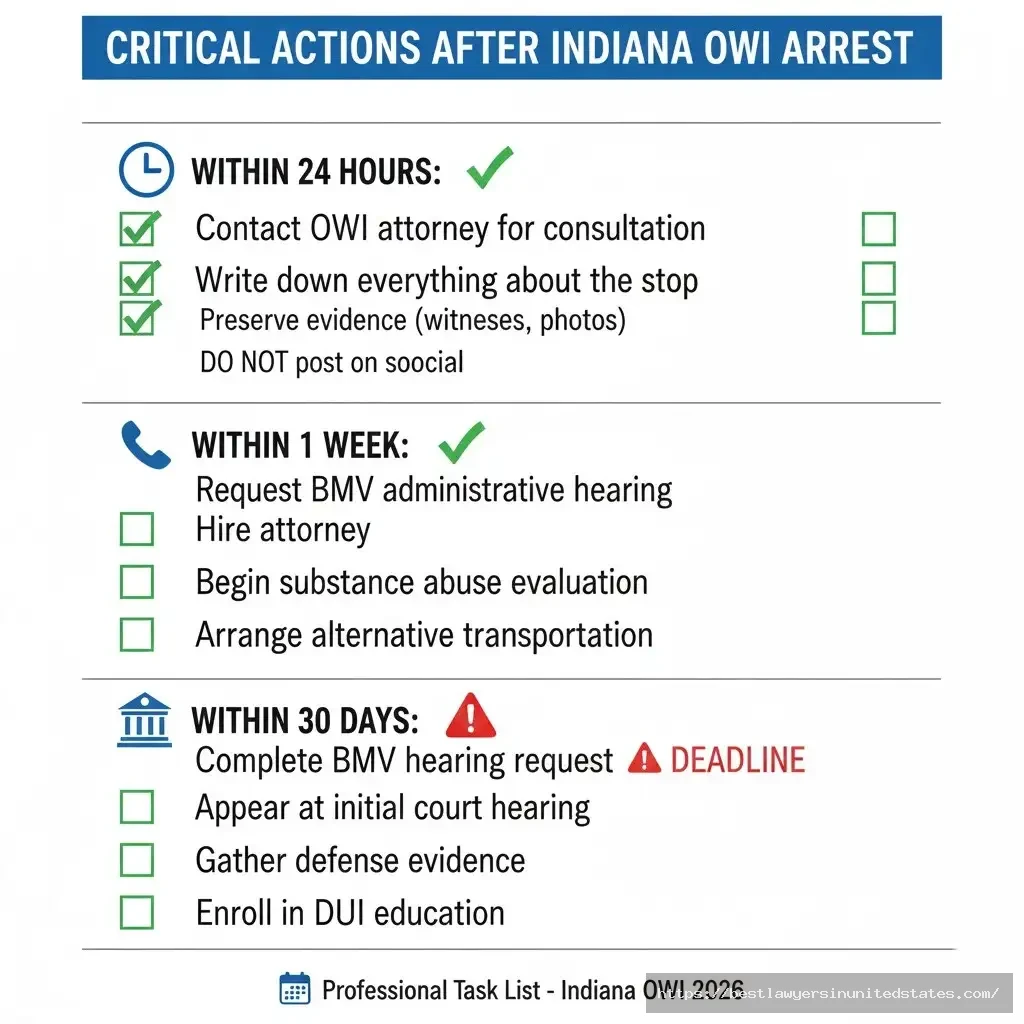
Immediate actions (first 72 hours):
- Within 24 hours:
- Contact an OWI attorney for consultation
- Write down everything you remember about the stop
- Preserve evidence (witness contact info, photos, receipts showing sobriety)
- Do NOT post about arrest on social media
- Within 1 week:
- Request BMV administrative hearing (if challenging suspension)
- Hire attorney
- Begin substance abuse evaluation process
- Arrange alternative transportation
- Within 30 days:
- Complete administrative hearing request
- Appear at initial court hearing
- Begin gathering defense evidence
- Enroll in DUI education program (shows good faith)
Resources for Indiana OWI Defendants
Indiana Bureau of Motor Vehicles:
- Main office: 100 N Senate Ave, Indianapolis, IN 46204
- Phone: (317) 233-6000
- Website: in.gov/bmv
- License status: myBMV online portal
Indiana Criminal Justice Institute:
- Traffic Safety Division
- Phone: (317) 234-3165
- DUI education program locator
- Victim impact panel information
MyCase Indiana:
- Website: mycase.in.gov
- Search your court records
- View upcoming hearing dates
- Access case documents online
County court locations (major cities):

Marion County (Indianapolis):
- City-County Building, 200 E Washington St
- Traffic Court: (317) 327-4740
Lake County (Gary/Hammond):
- Lake Criminal Courts, 2293 N Main St, Crown Point
- Phone: (219) 755-3680
Allen County (Fort Wayne):
- Allen County Courthouse, 715 S Calhoun St
- Phone: (260) 449-7241
St. Joseph County (South Bend):
- County-City Building, 227 W Jefferson Blvd
- Phone: (574) 235-9635
Approved ignition interlock providers in Indiana:
- Intoxalock: (800) 523-0523
- Smart Start: (800) 880-3394
- LifeSafer: (800) 634-3077
- Guardian Interlock: (866) 251-4855
SR-22 insurance resources:
- Progressive: Specialized high-risk division
- The General: Budget SR-22 options
- State Farm: Some agents write SR-22
- Bristol West: High-risk specialist
DUI education programs by region:
Search “Indiana certified substance abuse programs” for county-specific providers. Most counties have 2-5 approved programs.
Conclusion
Indiana’s OWI laws carry serious consequences that extend far beyond fines and jail time. A first offense brings license suspensions, insurance increases totaling $7,000-$15,000, employment complications, and a permanent criminal record. Third offenses trigger Level 6 felonies with prison time and lifetime impacts on your career, professional licenses, and financial security.
Most important takeaways:
- Indiana uses “OWI” terminology with a 0.08% BAC limit (0.04% for CDL, 0.02% under 21)
- New 2026 THC laws establish 5 ng/mL limit for marijuana DUI
- Lifetime lookback period means old convictions always count
- Third OWI is always a Level 6 felony
- License suspensions run separately through BMV and courts
- Total costs range from $3,500-$10,000 for first offense
- Expungement available after 5-8 years but doesn’t clear BMV record
Next steps if arrested:
- Contact an Indiana OWI attorney within 24 hours
- Request BMV administrative hearing within 30 days
- Do NOT discuss your case on social media or with anyone except your attorney
- Begin substance abuse evaluation immediately
- Arrange transportation during license suspension
Get help now:
Estimate your total costs with our DUI cost calculator and connect with experienced Indiana OWI attorneys who can evaluate your specific situation.
Find DUI Lawyers in Indiana – Free Consultation
Remember: An OWI arrest is not a conviction. Many defendants successfully challenge charges or negotiate reduced penalties with proper legal representation. The decisions you make in the first 30 days after arrest significantly impact your case outcome.
