
Quick Answer: Iowa calls it OWI (Operating While Intoxicated), not DUI. First offense brings a serious misdemeanor, 48-hour jail minimum, $1,250 fine, and 180-day license revocation under Iowa Code 321J.2.
Iowa stands apart from other states with unique OWI laws. The state uses “OWI” terminology, enforces a critical 2-hour testing rule, and offers deferred judgment for eligible first-time offenders. Understanding these Iowa-specific rules can dramatically affect your case outcome.
This guide breaks down Iowa Code Chapter 321J penalties, the temporary restricted license process, and defense strategies based on Iowa’s actual legal framework.
Check Your BAC Level in Iowa
Not sure if you’re over Iowa’s 0.08% legal limit? Our calculator shows where you stand.
BAC Calculator
Estimate your Blood Alcohol Content
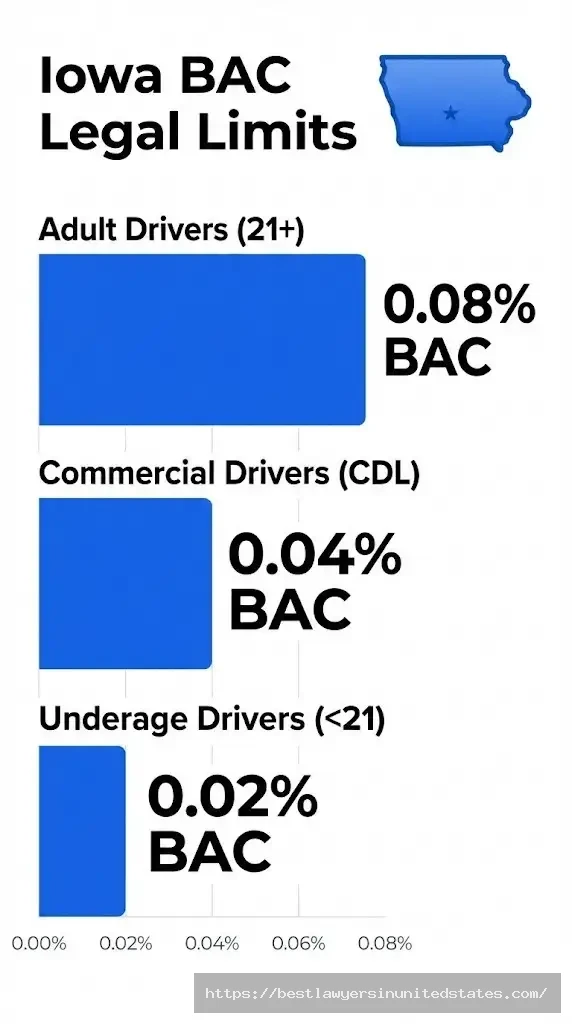
• Commercial Driver (CDL): 0.04% BAC
• Drivers Under 21: 0.00-0.02% BAC (Zero Tolerance)
• Enhanced Penalties: 0.15% BAC or higher in most states
Learn more: BAC Calculator
What Is OWI in Iowa? (Not DUI)
Iowa law uses “OWI” (Operating While Intoxicated) instead of DUI or DWI. This isn’t just different terminology. Iowa Code 321J.2 defines OWI more broadly than many states define DUI.
Three Ways to Commit OWI in Iowa
You commit OWI in Iowa under Iowa Code 321J.2(1) if you operate a motor vehicle:
1. Under the influence of alcohol, drugs, or both (Iowa Code 321J.2(1)(a))
- No specific BAC required
- Officer observations of impairment sufficient
- Includes prescription medications
2. With BAC of .08% or higher (Iowa Code 321J.2(1)(b))
- “Per se” violation
- Test result alone proves guilt
- No additional impairment evidence needed
3. With ANY controlled substance present (Iowa Code 321J.2(1)(c))
- Any detectable amount
- Includes marijuana metabolites
- Zero tolerance for controlled substances
| Violation Type | Evidence Required | BAC Level |
|---|---|---|
| Under the Influence | Officer observations, FSTs | Any level |
| Per Se Alcohol | Chemical test | .08% or higher |
| Controlled Substance | Blood/urine test | Any detectable amount |
Key difference from other states: Iowa’s “any amount” rule for controlled substances means trace amounts found days after use can trigger OWI charges, even with zero impairment.
What “Operating” Means Under Iowa Law
Iowa courts define “operate” as immediate physical control of a vehicle with the engine running or in motion. You can be arrested for OWI while sitting in a parked car if the engine runs.
You’re “operating” even if:
- Parked with engine running
- Sitting in driver’s seat with keys in ignition
- Vehicle stuck in ditch with engine on
Understanding the Iowa 2-Hour Rule
The 2-hour rule under Iowa Code 321J.2(12) creates a critical window for chemical testing. This unique Iowa law affects both criminal cases and license revocations.
How the 2-Hour Rule Works
Chemical tests taken within 2 hours of driving create a legal presumption. The test results are presumed to reflect your BAC while operating the vehicle.
Iowa Code 321J.2(12)(a) states: “The alcohol concentration established by the results of an analysis of a specimen of the defendant’s blood, breath, or urine withdrawn within two hours after the defendant was driving… is presumed to be the alcohol concentration at the time of driving.”
What Happens After 2 Hours
If police don’t offer a chemical test within 2 hours, critical consequences follow:
- License cannot be revoked for test refusal (Iowa Code 321J.6(2))
- Test results lose presumptive value
- Prosecution must prove BAC through expert testimony
- Defense gains significant leverage
Timeline example:
- 10:00 PM: Police stop
- 10:15 PM: Officer arrests for OWI
- 12:15 AM: 2-hour deadline passes
- 12:30 AM: Police finally offer breath test
- Result: License suspension for refusal doesn’t apply
When the Clock Starts
The 2-hour period begins when you were last operating the vehicle, not when police arrive. Courts examine when you actually drove, not arrest time.
Critical for defense: If you were sitting in a parked car when police arrived, your attorney must establish exactly when you stopped driving.
First Offense OWI in Iowa: Penalties & Process

A first OWI in Iowa is a serious misdemeanor under Iowa Code 321J.2(2)(a). The consequences extend far beyond fines and jail time.
Criminal Penalties for First Offense
| Penalty Type | Requirement | Details |
|---|---|---|
| Classification | Serious misdemeanor | Criminal record |
| Jail Time | 48 hours minimum | Up to 1 year maximum |
| Fine | $1,250 | Court may waive up to $625 |
| Surcharges | Additional fees | 30% surcharge + DARE fees |
| Court Costs | Varies by county | Typically $200-500 |
Mandatory jail time: Iowa requires 48 hours minimum. The court can accommodate work schedules but cannot eliminate this requirement under Iowa Code 321J.2(3)(a).
Fine Reduction Option
Iowa law lets courts waive up to $625 of the $1,250 fine if you obtain a temporary restricted license. This creates a financial incentive to apply for restricted driving privileges.
Community service alternative: Courts can order unpaid community service instead of some fine amounts under Iowa Code 321J.2(2)(a)(2).
License Consequences: First Offense
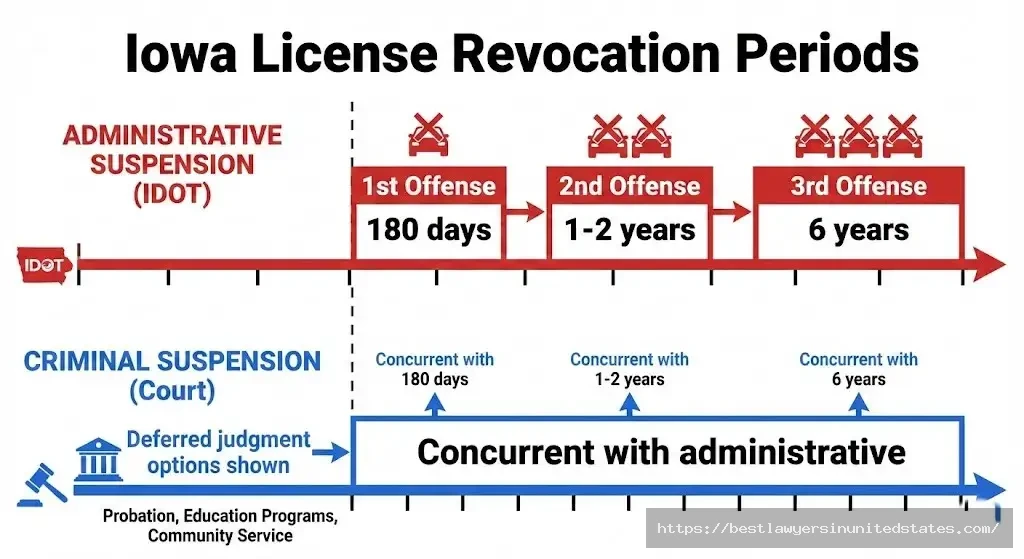
Iowa Department of Transportation (IDOT) revokes your license for 180 days minimum on a first OWI conviction.
Revocation period depends on BAC:
| BAC Level | Accident? | TRL Eligibility | IID Required? |
|---|---|---|---|
| .08-.10 | No | Immediate | No |
| .08-.10 | Yes | 30-day wait | Yes |
| .10-.15 | No | Immediate | Yes |
| .15+ | Any | 30-day wait | Yes |
Learn more about license suspension in other states like Illinois and California.
Required Programs for First Offense
Iowa Code 321J.2(2)(a)(4) mandates three programs:
1. Substance abuse evaluation
- Required before sentencing
- Cost: $150-300 (defendant pays)
- Conducted by certified evaluator
2. Course for drinking drivers
- 12-week program minimum
- Cost: $400-600
- Must attend all sessions
3. Reality education program (if available)
- Iowa-specific prevention program
- Focuses on DUI consequences
- Not available in all counties
Total program costs: Expect $800-1,200 for all required programs in addition to fines and court costs.
Am I Eligible for Deferred Judgment in Iowa?
Deferred judgment offers first-time offenders a chance to avoid conviction. Iowa Code 321J.2(3)(b) allows courts to defer judgment, but strict eligibility rules apply.
How Deferred Judgment Works
With deferred judgment, you plead guilty but the court doesn’t enter judgment. You serve probation instead. Upon successful completion, the court discharges you without entering a conviction.
Key benefit: No conviction appears on your criminal record after discharge (Iowa Code 907.3).
Critical limitation: Deferred judgment still counts as a prior offense for future OWI charges under Iowa Code 321J.2(8)(b).
Six Disqualifying Factors
You’re ineligible for deferred judgment if ANY of these apply:
| Disqualifying Factor | Iowa Code | Why It Matters |
|---|---|---|
| BAC exceeded .15 | 321J.2(3)(b)(2)(a) | High BAC shows serious impairment |
| Previous OWI conviction | 321J.2(3)(b)(2)(b) | Not truly first-time offender |
| Previous deferred judgment | 321J.2(3)(b)(2)(c) | Already received this opportunity |
| Refused chemical test | 321J.2(3)(b)(2)(d) | Non-cooperation weighs against leniency |
| Caused bodily injury | 321J.2(3)(b)(2)(e) | Injury elevates seriousness |
| Child passenger violation | 321J.2(3)(b)(2)(f) | Enhanced penalty situation |
Most common disqualifier: BAC over .15 automatically bars deferred judgment, even for true first-time offenders with no other aggravating factors.
Deferred Judgment Eligibility Checklist
Check if you qualify:
- ✅ First OWI arrest ever
- ✅ BAC was .15 or lower (not .16 or higher)
- ✅ No previous deferred judgment for OWI in any state
- ✅ Submitted to chemical testing when requested
- ✅ No injuries to others occurred
- ✅ No passengers under 14 in vehicle
All six must be YES to qualify. If even one is NO, you’re ineligible under Iowa law.
What Happens During Deferred Judgment
If the court grants deferred judgment:
Year 1: Supervised probation
- Monthly reporting to probation officer
- Random alcohol/drug testing
- Complete all required programs
- Pay all fines and costs
Completion: After fulfilling conditions
- Court discharges without entering judgment
- No conviction on criminal record
- Still counts as prior for future OWI
Violation: If you violate probation
- Court can revoke deferral
- Enter original conviction
- Impose full sentencing
Civil penalty: Courts must assess a civil penalty equal to the criminal fine when granting deferred judgment under Iowa Code 321J.2(3)(b)(1).
Second Offense OWI in Iowa
A second OWI within 12 years becomes an aggravated misdemeanor under Iowa Code 321J.2(2)(b). Penalties increase substantially and deferred judgment is not available.
Criminal Penalties: Second Offense
| Penalty Type | Requirement | Notes |
|---|---|---|
| Classification | Aggravated misdemeanor | More serious than first |
| Jail Time | 7 days minimum | Up to 2 years maximum |
| Fine | $1,875-$6,250 | No reduction option |
| License Revocation | 1-2 years | Depends on test/refusal |
| Programs | All required | Same as first offense |
Mandatory 7-day minimum: Iowa Code 321J.2(3)(d) requires seven consecutive days unless the court finds “undue hardship.” Even then, you must serve 48-hour segments.
Jail Alternative: 48-Hour Segments
Courts can break jail time into 48-hour segments if:
- Consecutive days cause undue hardship, OR
- Jail space isn’t available within 4 months
You must also perform community service when serving segments.
Second Offense License Revocation
| Scenario | Revocation Period | TRL Eligibility | IID Required |
|---|---|---|---|
| Failed test | 1 year (conviction) | After 1 year | Yes |
| Refused test | 2 years | After 1 year | Yes |
| Conviction only | 2 years | After 1 year | Yes |
Critical timing: You’re ineligible for any temporary restricted license for one full year after revocation begins under Iowa Code 321J.4(2).
Vehicle Impoundment
For second offense, courts may order your vehicle impounded or immobilized under Iowa Code 321J.4B(5)(b). This adds significant costs and inconvenience beyond other penalties.
Compare these penalties to second DUI penalties in Florida and Arizona.
Third Offense OWI: Class D Felony
A third OWI within 12 years is a Class D felony under Iowa Code 321J.2(2)(c). You face prison time and a felony criminal record.
Felony Penalties and Prison Time
| Penalty Component | Requirement | Maximum |
|---|---|---|
| Classification | Class D felony | Permanent felony record |
| Prison | 30 days mandatory minimum | 5 years indeterminate term |
| Fine | $3,125 minimum | $9,375 maximum |
| License Revocation | 6 years | No TRL for 2 years |
| Programs | All required | Same requirements |
Mandatory 30-day minimum: Iowa Code 321J.2(5)(a) requires 30 consecutive days incarceration. Courts cannot suspend this minimum.
Two Sentencing Options
Option 1: Prison commitment
- Committed to Department of Corrections
- Serve time in state prison facility
- Assigned based on risk assessment
Option 2: Suspended sentence
- Court suspends prison commitment
- Must serve 30-day minimum in county jail
- Eligible for community treatment under Iowa Code 907.6
Most third-offense defendants receive suspended sentences with county jail time rather than prison commitment.
Six-Year License Revocation
IDOT revokes your license for six years on third offense OWI. You cannot apply for any temporary restricted license for two full years under Iowa Code 321J.4(6).
After two years:
- May apply for TRL
- Must install ignition interlock device
- Must prove completion of substance abuse treatment
- Must maintain SR-22 insurance
Long-Term Consequences of Felony OWI
A Class D felony conviction carries consequences beyond sentencing:
You permanently lose the right to:
- ❌ Own or possess firearms
- ❌ Vote (until rights restored)
- ❌ Serve on a jury
- ❌ Hold certain professional licenses
Employment impacts:
- Background checks reveal felony
- Many employers exclude felons
- Professional licenses may be revoked
- Security clearances denied
Housing impacts:
- Public housing restrictions
- Private landlords often reject felons
- Loan approval difficulties
Federal impacts:
- Student loan eligibility reduced
- Some government benefits restricted
- International travel limitations
Iowa Temporary Restricted License (TRL): Complete Guide
Iowa’s temporary restricted license lets you drive for work, school, and medical appointments during a revocation. Eligibility depends on your BAC level and whether an accident occurred.
TRL Eligibility by BAC Level
Iowa Code 321J.4 creates a complex matrix based on BAC and accident involvement:
| BAC Level | Accident? | Immediate TRL? | Waiting Period | IID Required? |
|---|---|---|---|---|
| .08-.10 | No | Yes | None | No |
| .08-.10 | Yes | No | 30 days | Yes |
| .10-.15 | No | Yes | None | Yes |
| .10-.15 | Yes | No | 30 days | Yes |
| .15+ | Any | No | 30 days | Yes |
Key rule: Any BAC over .10 requires an ignition interlock device, even if you’re eligible for immediate TRL.
How to Apply for TRL
Step 1: Within 10 days of arrest
- Request administrative hearing with IDOT
- Contest the revocation or accept it
- Hearing determines final revocation period
Step 2: After eligibility period
- Complete substance abuse evaluation
- Show proof of SR-22 insurance
- Pay $200 TRL application fee
Step 3: Install ignition interlock (if required)
- Choose IDOT-approved vendor
- Installation cost: $100-150
- Monthly monitoring: $75-100
Step 4: Submit TRL application
- Mail to IDOT Driver Services
- Include proof of IID installation (if required)
- Include SR-22 certificate
- Include evaluation completion
Processing time: IDOT typically processes TRL applications within 10-14 days.
What You Can Drive With TRL
Iowa temporary restricted licenses allow driving only for:
Approved purposes:
- ✅ To and from work
- ✅ During work hours (if driving is essential)
- ✅ To and from school/college
- ✅ Medical appointments
- ✅ Substance abuse treatment programs
- ✅ Court-ordered activities
Not allowed:
- ❌ Personal errands
- ❌ Social activities
- ❌ Grocery shopping
- ❌ Visiting friends/family
- ❌ Recreation
Violation consequences: Driving outside permitted purposes makes you guilty of driving under revocation, which carries separate criminal penalties.
Ignition Interlock Device Requirements
If your BAC exceeded .10 or an accident occurred, you must install an IDOT-approved ignition interlock device.
How IID works:
- You blow into device before starting car
- Device requires periodic “rolling retests” while driving
- Device records all attempts and violations
- Data downloaded monthly and sent to IDOT
Violation triggers:
- BAC over .025 at startup
- Failed rolling retest
- Tampering attempts
- Missing service appointments
Monthly costs:
- Device lease: $75-100
- Calibration/monitoring: $50
- Total: $125-150 per month
Approved vendors in Iowa:
- Smart Start
- Intoxalock
- Guardian Interlock
Compare Iowa’s IID requirements to Colorado’s regulations and Connecticut’s program.
Iowa Implied Consent Law: Testing & Refusal
Iowa’s implied consent law under Iowa Code 321J.6 means you automatically agree to chemical testing when you accept an Iowa driver’s license.
When Implied Consent Applies
Police can invoke implied consent only when specific conditions exist:
Required before testing:
- Peace officer has reasonable grounds for OWI
- Triggering event occurs:
- Lawful arrest for OWI, OR
- Accident causing injury/death, OR
- Refused preliminary breath test, OR
- PBT showed .08 or higher
Timeline requirement: Officer must request test within 2 hours of when you were driving (Iowa’s 2-hour rule).
Implied Consent Warning
Before requesting a chemical test, officers must read the implied consent advisory under Iowa Code 321J.8:
Warning includes:
- Refusal triggers automatic license revocation
- Refusal carries harsher penalties than test failure
- Test results determine revocation length
- You have right to additional independent test
Officers must give this warning before asking you to submit to testing.
What Happens If You Refuse Testing
Refusing a chemical test triggers immediate administrative consequences:
| Offense | Refusal Penalty | Test Failure Penalty |
|---|---|---|
| First refusal | 1-year revocation | 180-day revocation |
| Second refusal | 2-year revocation | 1-year revocation |
| Third+ refusal | 2-year revocation | Varies |
Plus criminal penalties: You still face OWI criminal charges even if you refuse testing. Prosecutors use your refusal as evidence of “consciousness of guilt.”
TRL Waiting Periods After Refusal
If you refuse testing, you must wait longer before applying for temporary restricted license:
First refusal:
- 90-day waiting period
- Then may apply for TRL
- Must install ignition interlock device
Second or subsequent refusal:
- 1-year waiting period
- Then may apply for TRL
- Must install ignition interlock device
Compare: Test failure lets most first offenders get immediate TRL (depending on BAC level).
Can Police Force You to Take a Test?
Police cannot physically force you to provide breath or blood samples without a warrant under Iowa law.
Exception for accidents: Iowa Code 321J.10A allows warrantless blood draws when:
- Accident causes death or serious injury
- You’re under arrest for OWI
- Blood test would produce evidence of intoxication
- Medical personnel perform draw in reasonable manner
- Emergency situation threatens evidence destruction
Warrant procedures: Officers increasingly obtain telephonic search warrants for blood draws in serious cases under Iowa Code 321J.10.
Your Right to Independent Testing
Iowa law gives you the right to additional chemical testing at your own expense after completing the official test.
How it works:
- Request independent test after official test
- You pay for independent test
- Choose your own lab
- Results admissible in court
Defense attorneys sometimes use independent test results to challenge state testing procedures.
Learn how implied consent works in Delaware and Alaska.
Types of Chemical Tests in Iowa
Iowa law authorizes three types of chemical tests: blood, breath, or urine. The peace officer chooses which type you take.
Breath Testing (Most Common)
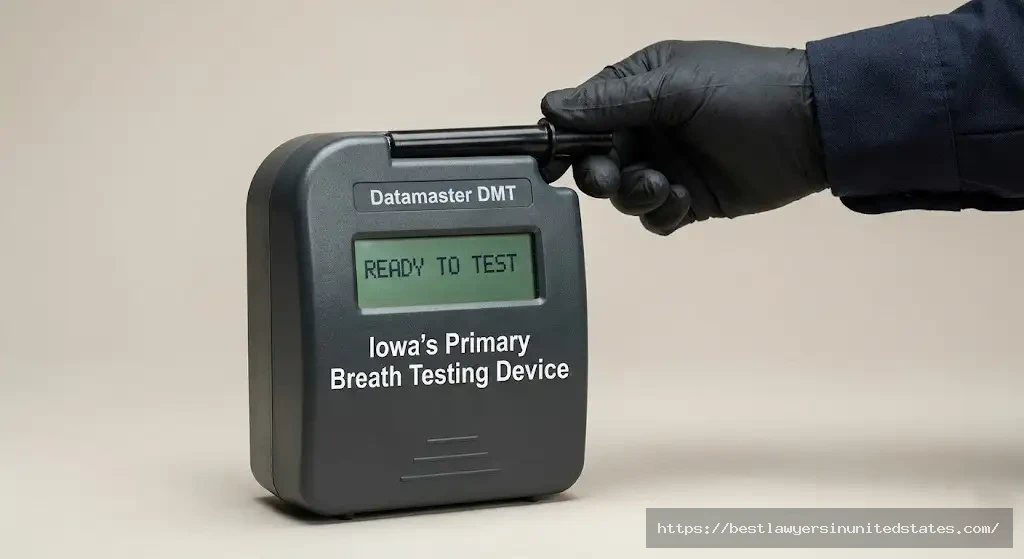
Most Iowa OWI arrests involve breath testing on devices like the Datamaster DMT.
How breath testing works:
- Officer observes you for 15 minutes (no eating, drinking, smoking)
- You blow into machine for several seconds
- Machine analyzes breath alcohol
- Results print immediately
Iowa uses these breath machines:
- Datamaster DMT (most common)
- Intoxilyzer models (some departments)
Margin of error: Iowa Code 321J.2(14) requires prosecutors to subtract the margin of error from test results. If the adjusted result falls below .08, it can’t prove per se OWI.
Blood Testing
Blood tests measure alcohol in your bloodstream directly. Police typically request blood tests when they suspect drug impairment or in serious accidents.
Blood test procedures:
- Only qualified medical personnel can draw blood
- Must use sterile equipment
- Blood preserved in vials with preservative
- Sent to Iowa Division of Criminal Investigation lab
Analysis timeline: Blood test results take 4-8 weeks, much longer than breath tests.
Urine Testing (Rare)
Urine tests are rarely used in Iowa OWI cases. Police may request urine tests when suspecting drug use and blood draws aren’t practical.
Limitations: Urine tests show drug presence but don’t indicate current impairment level.
OWI with Controlled Substances or Drugs
Iowa Code 321J.2(1)(c) makes it illegal to drive with any amount of a controlled substance in your system. This “zero tolerance” rule catches many drivers by surprise.
Any Amount Means Any Amount
Unlike alcohol’s .08 BAC threshold, controlled substances have no minimum level. Any detectable amount violates Iowa law.
Substances covered:
- Marijuana (THC metabolites)
- Cocaine
- Methamphetamine
- MDMA/Ecstasy
- Heroin/opiates
- Prescription controlled substances (when not prescribed)
Critical issue: THC metabolites remain detectable in urine for weeks after marijuana use. You can be arrested for OWI days after using marijuana, even with zero impairment.
Prescription Drug Defense
Iowa Code 321J.2(11) provides an affirmative defense if:
✅ Drug was prescribed for you ✅ You took it as prescribed ✅ You followed pharmacy labeling directions ✅ No evidence of alcohol consumption ✅ Doctor didn’t direct you to refrain from driving
Burden of proof: You must prove all five elements to use this defense.
Common problem: Many prescriptions include warnings like “may cause drowsiness” or “use caution when driving.” These warnings can defeat your defense.
How Police Detect Drug Impairment
Officers look for drug impairment indicators during OWI investigations:
Physical signs:
- Pupil size (dilated or constricted)
- Nystagmus (eye jerking)
- Muscle tremors
- Excessive sweating or dry mouth
Behavioral signs:
- Paranoia or confusion
- Excessive talking or silence
- Disorientation to time/place
- Unusual coordination issues
Drug Recognition Expert (DRE): Some Iowa police have specialized training to identify drug impairment. They conduct 12-step evaluations including pupil measurements and vital signs.
Underage OWI: Zero Tolerance in Iowa
Iowa enforces zero tolerance for drivers under 21 under Iowa Code 321J.2A. Any BAC of .02 or higher triggers penalties.
Underage OWI Penalties
| Violation | License Action | Duration | Criminal Charge? |
|---|---|---|---|
| BAC .02-.07 | Revocation | 60 days (1st) / 90 days (2nd) | No (civil only) |
| BAC .08+ | Revocation | Same as adult OWI | Yes (criminal) |
| Test refusal | Revocation | 1 year (1st) / 2 years (2nd) | No |
No TRL allowed: Underage drivers cannot obtain any temporary restricted license during the revocation period for .02 violations under Iowa Code 321J.20(2).
Required Youth Programs
Minors convicted of OWI must participate in youthful offender substance abuse awareness programs under Iowa Code 321J.25:
Program components:
- Educational program on alcohol/drug dangers
- Substance abuse evaluation
- Counseling if recommended
- Parent/guardian involvement
Cost: Parents pay $150-300 for youth programs.
Parental Notification
Iowa Code 321J.2B requires law enforcement to notify parents or guardians when a driver under 18 is:
- Arrested for OWI
- Receives deferred judgment for OWI
- Has license revoked for chemical test failure
- Has license revoked for test refusal
School notification: Schools also receive notification for underage OWI violations.
Extended Revocations for Minors
If you’re under 18 when your license is revoked, the revocation lasts until you turn 18 OR until the normal revocation period ends, whichever is longer under Iowa Code 321J.4(7).
Example:
- 17-year-old convicted of first OWI
- Normal revocation: 180 days
- Turns 18 in 90 days
- Actual revocation: 270 days (until 18th birthday + 180 days)
OWI Causing Injury or Death
Iowa imposes enhanced penalties when OWI causes injury or death under Iowa Code 707.6A.
OWI Causing Serious Injury
Classification: Class D felony
Penalties:
- Up to 5 years prison
- $750-$7,500 fine
- Plus all standard OWI penalties
- 1-year additional license revocation
“Serious injury” defined: Bodily injury creating substantial risk of death, serious permanent disfigurement, or loss of function of body part.
OWI Causing Death (Vehicular Homicide)
Classification: Class B felony
Penalties:
- Up to 25 years prison (mandatory maximum sentence)
- Standard felony fines
- 6-year license revocation
- 2-year minimum before TRL eligibility
No deferred judgment: Defendants charged with OWI causing serious injury or death are ineligible for deferred judgment under Iowa Code 907.3.
Victim Restitution Requirements
Iowa Code 321J.2(13) requires courts to order restitution to victims for:
- Medical expenses
- Property damage
- Lost wages
- Funeral expenses (in death cases)
- Pain and suffering
No dollar limit: Unlike some states, Iowa places no cap on restitution amounts for OWI victims.
Calculate Your Total OWI Costs in Iowa
An OWI conviction costs far more than court fines. Calculate your complete financial impact.
DUI Cost Calculator
Estimate total DUI expenses by state and offense
Detailed Cost Breakdown
Payment Timeline
Bail bond, towing fees, car impound, attorney retainer
Initial court fines, DMV fees, DUI school enrollment, ignition interlock installation
Monthly probation fees, ignition interlock fees, DUI school payments, attorney balance
Insurance premium increases, license reinstatement, SR-22 filing fees
- Lost wages from missed work (court dates, jail time, DUI school) – $2,000-$10,000
- Job loss or difficulty finding employment – Varies
- Professional license suspension (doctors, lawyers, nurses, pilots) – Career ending
- Rideshare and transportation costs during suspension – $1,500-$5,000
- Travel restrictions and visa denials – Varies
- Security clearance loss – Career impact
- Child custody implications – Legal costs
- Rental car restrictions – Varies
- Personal relationships and mental health costs – Priceless
Details: DUI Cost Calculator
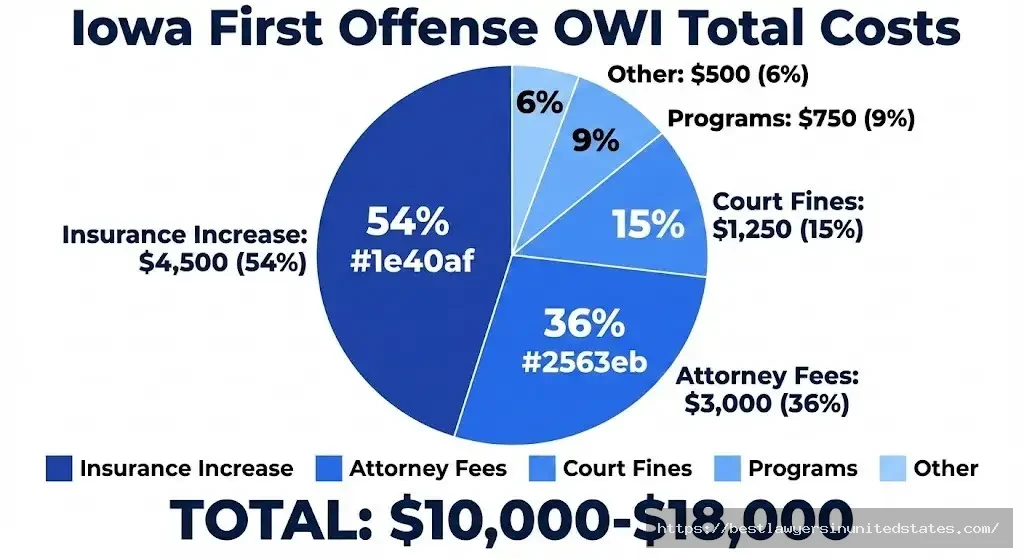
Breaking Down Iowa OWI Costs
First Offense Cost Breakdown
| Cost Category | Amount | Notes |
|---|---|---|
| Court fine | $625-$1,250 | Can be reduced |
| Court costs | $200-$500 | Varies by county |
| Surcharges | $375+ | 30% + DARE fees |
| Attorney fees | $1,500-$5,000 | Depends on complexity |
| Substance abuse eval | $150-$300 | Mandatory |
| DUI school | $400-$600 | 12-week program |
| License reinstatement | $200 | IDOT fee |
| SR-22 insurance filing | $15-$50 | Annual filing |
| Insurance rate increase | $3,000-$6,000 | 3-5 years elevated rates |
| TRL application | $200 | If you apply |
| Ignition interlock | $1,500-$1,800 | If BAC > .10 (1 year) |
| TOTAL FIRST OFFENSE | $8,000-$18,000 | Over 1-3 years |
Second Offense Cost Breakdown
| Cost Category | Amount | Notes |
|---|---|---|
| Court fine | $1,875-$6,250 | No reduction option |
| Court costs | $200-$500 | Varies by county |
| Surcharges | $500-$1,875 | Based on fine |
| Attorney fees | $3,000-$7,500 | More complex |
| Programs | $600-$1,000 | Same as first |
| License reinstatement | $200 | After 1-2 years |
| SR-22 (3 years) | $45-$150 | Annual filings |
| Insurance increase | $6,000-$12,000 | 5+ years elevated |
| Ignition interlock (1 year) | $1,500-$1,800 | Mandatory |
| Vehicle impoundment | $500-$2,000 | If court orders |
| TOTAL SECOND OFFENSE | $14,000-$32,000 | Over 2-5 years |
Hidden Costs Often Overlooked
Lost wages:
- Court appearances: 3-6 days minimum
- Jail time: 2-7 days (minimum sentences)
- DUI school: 12+ weeks
- Lost hourly wages add up
Employment impacts:
- Job loss risk
- Reduced advancement opportunities
- Cannot drive for work without TRL
Transportation alternatives:
- Uber/Lyft during revocation
- $20-$50 per day typical
- Annual cost: $7,000-$18,000
Travel restrictions:
- Canada entry denial
- Some countries reject OWI convictions
- International travel complications
For cost comparisons, see Georgia DUI costs and Hawaii DUI expenses.
Iowa OWI Arrest Process: What to Expect
Step 1: Traffic Stop and Investigation
Officer pulls you over for:
- Traffic violation
- Equipment problem
- Erratic driving
- OWI checkpoint
Officer observes:
- Odor of alcohol
- Bloodshot eyes
- Slurred speech
- Open containers
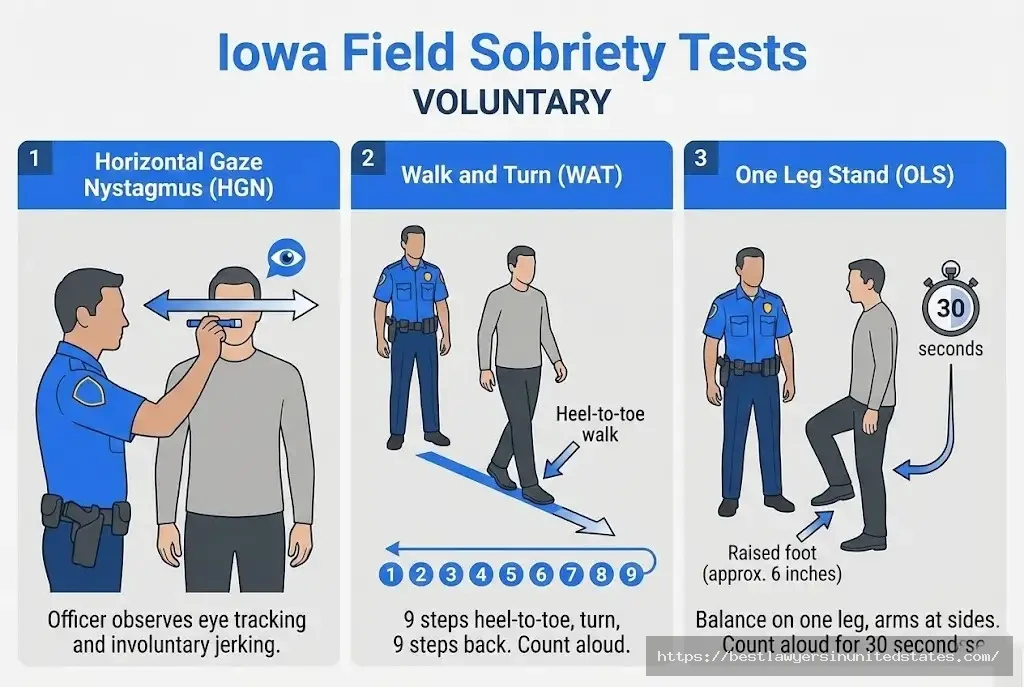
Step 2: Field Sobriety Tests
Officer requests you perform standardized field sobriety tests:
Horizontal Gaze Nystagmus (HGN):
- Follow pen/light with eyes
- Officer looks for eye jerking
Walk and Turn:
- Walk 9 steps heel-to-toe
- Turn and return
- Tests balance and following instructions
One Leg Stand:
- Stand on one foot
- Count for 30 seconds
- Tests balance
You can refuse FSTs: Iowa law doesn’t require you to perform field sobriety tests. Refusal carries no automatic penalties.
Step 3: Preliminary Breath Test (PBT)
Officer may request roadside breath screening. This portable device gives approximate BAC.
PBT limitations:
- Results NOT admissible at trial
- Used only to establish probable cause
- Less accurate than station breathalyzer
Refusal triggers implied consent: If you refuse PBT, officer can immediately invoke implied consent and request evidential testing.
Step 4: Arrest
If officer has probable cause, you’re arrested for OWI:
- Handcuffed
- Searched
- License confiscated
- Vehicle towed
- Transported to jail
Step 5: Chemical Testing at Station
At jail or hospital, officer reads implied consent advisory and requests breath, blood, or urine test.
Your choices:
- Submit to test (remember the 2-hour rule)
- Refuse test (triggers automatic license revocation)
Step 6: Booking and Release
Booking process:
- Fingerprints taken
- Photo taken
- Personal property inventoried
- Background check run
Release options:
- Released on own recognizance (most first offenses)
- Post bail (if required)
- Held until arraignment (serious cases)
Typical holding time: 4-12 hours for first offense OWI arrests.
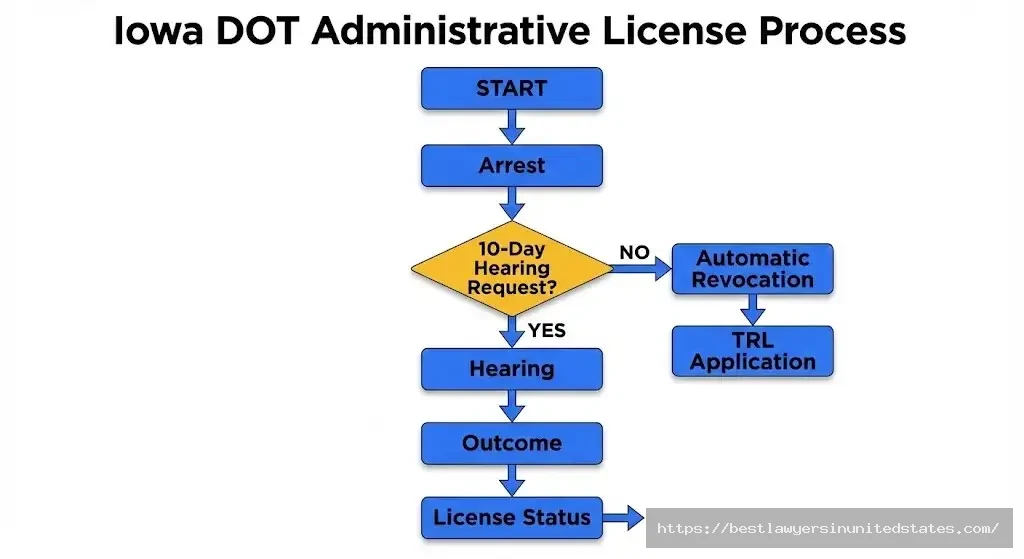
Step 7: IDOT Administrative Action
Within days of arrest:
- Officer forwards paperwork to Iowa DOT
- IDOT issues notice of revocation
- You have 10 days to request administrative hearing
- Revocation takes effect after hearing or if you don’t request one
Fighting an Iowa OWI Charge: Defense Strategies

Challenge the Traffic Stop
Was the initial stop legal? Officer needs reasonable suspicion to pull you over.
Invalid stop reasons:
- Anonymous tip without corroboration
- Hunch or profile
- Stopping everyone at checkpoint
- Pre-textual stops (pulling over for minor violations to investigate OWI)
Valid stop reasons:
- Observed traffic violation
- Equipment violation
- Erratic driving
- Valid checkpoint procedures
If stop was illegal: All evidence gathered after illegal stop gets suppressed.
Challenge the 2-Hour Rule Violation
Did officer offer testing within 2 hours of when you drove?
Timeline defense strategies:
- Establish exact time you stopped driving
- Show delays in investigation
- Prove test occurred after 2-hour window
- Argue license revocation doesn’t apply
Critical evidence:
- Time you parked (if applicable)
- Timestamps on police reports
- Time test was offered (not completed)
- Body camera footage
Challenge Field Sobriety Tests
FSTs are subjective and influenced by many factors:
Medical conditions affecting FSTs:
- Inner ear problems
- Leg/knee/ankle injuries
- Back problems
- Neurological conditions
Environmental factors:
- Uneven pavement
- Poor lighting
- Weather conditions
- Tight or unusual clothing
Officer training issues:
- Did officer follow NHTSA standardized procedures?
- Was officer certified?
- Did officer properly instruct you?
Challenge Breath Test Results
Breath tests can be challenged on multiple grounds:
Machine calibration:
- Was device properly maintained?
- When was last calibration?
- Are maintenance records available?
Testing procedures:
- Did officer observe 15-minute waiting period?
- Did you burp, vomit, or eat during observation?
- Was mouth clear of foreign substances?
Biological factors:
- Body temperature (fever raises BAC reading)
- Acid reflux or GERD
- Residual mouth alcohol
- Breathing patterns
Radio frequency interference (RFI):
- Police radios near device
- Cell phones
- Other electronic equipment
Challenge Controlled Substance Testing
For drug OWI charges, challenge the testing:
Prescription defense:
- Show valid prescription
- Prove you took medication as prescribed
- Demonstrate doctor didn’t prohibit driving
Old drug use:
- THC metabolites persist weeks
- Test shows past use, not current impairment
- Challenge relevance to driving ability
Challenge Deferred Judgment Denial
If you meet all criteria but court denied deferred judgment:
Common issues:
- BAC calculation errors (margin of error)
- Prior conviction should be expunged
- Challenge out-of-state equivalent
- Prove no bodily injury occurred
Iowa OWI Defenses That Usually Fail
Defenses that typically don’t work:
- “I only had two beers”
- “I felt fine to drive”
- “I wasn’t actually driving”
- “Officer was mean to me”
- “I have to drive for work”
Better focus: Attack procedural errors, testing accuracy, and legal technicalities.
Iowa Administrative Hearing: Contesting License Revocation
You have 10 days from arrest to request an administrative hearing with IDOT. This hearing is separate from criminal court.
What the Hearing Decides
The administrative hearing determines only:
- Did officer have reasonable grounds for OWI arrest?
- Did testing/refusal occur as officer claims?
- Was implied consent properly invoked?
Hearing does NOT decide:
- Whether you’re guilty of OWI
- Whether you were actually impaired
- Whether you should receive criminal penalties
Limited Issues at Hearing
Iowa Code 321J.13 restricts hearing issues to:
For test refusal cases:
- Did officer have reasonable grounds?
- Did triggering event occur?
- Was implied consent advisory given?
- Did you refuse testing?
For test failure cases:
- Did officer have reasonable grounds?
- Did test show .08 or higher?
- Was testing done within 2 hours?
- Were procedures followed?
Hearing Procedures
Timeline:
- Request hearing within 10 days
- Hearing scheduled within 20 days
- Temporary permit issued until hearing
At the hearing:
- Conducted by IDOT administrative law judge
- Officer testifies (usually by phone)
- You can testify
- You can present evidence
- Attorney representation allowed
Possible outcomes:
- Revocation sustained (officer wins)
- Revocation rescinded (you win)
- Modified revocation period (rare)
Appealing Hearing Decision
If you lose administrative hearing:
- Appeal to Iowa District Court within 30 days
- Court reviews for legal errors
- Court doesn’t retry facts
- You need attorney for appeal
Most appeals fail: Courts give deference to IDOT’s findings unless clear legal error occurred.
Iowa OWI and SR-22 Insurance
An OWI conviction requires you to file SR-22 insurance for several years.
What Is SR-22?
SR-22 is not insurance. It’s a certificate your insurance company files with Iowa DOT proving you carry minimum liability coverage.
Minimum coverage required:
- $20,000 bodily injury per person
- $40,000 bodily injury per accident
- $15,000 property damage
How Long You Need SR-22 in Iowa
| OWI Offense | SR-22 Duration |
|---|---|
| First OWI | 2 years from conviction |
| Second OWI | 5 years from conviction |
| Third+ OWI | Until license reinstated |
Critical: SR-22 period doesn’t start until after your license is reinstated, not from conviction date.
SR-22 Filing Costs
Filing fee: $15-$50 annually Insurance premium increase: $1,500-$3,000 annually
Total 2-year cost: $3,000-$6,000 extra for insurance
If Your SR-22 Lapses
If your insurance cancels SR-22 filing:
- Insurance company notifies Iowa DOT
- Your license gets suspended immediately
- You must refile SR-22
- You may face additional penalties
Keep SR-22 active: Pay insurance premiums on time. Don’t let coverage lapse.
Which Companies Offer SR-22 in Iowa
Not all insurance companies file SR-22. Companies that do:
- State Farm
- Progressive
- The General
- GEICO
- Farmers
Compare rates. SR-22 filing alone doesn’t determine price.
See how SR-22 works in Alabama and Indiana.
How Long Does OWI Stay on Your Iowa Record?
Criminal Record
OWI convictions stay on your Iowa criminal record permanently unless expunged.
Iowa doesn’t allow expungement of OWI convictions. Unlike some other offenses, you cannot petition to expunge or seal an OWI conviction under Iowa law.
Exception: Deferred judgment can be sealed after discharge. Iowa Code 907.9 allows petition to expunge deferred judgment records, but most OWI deferred judgments specifically exclude this option.
Driving Record
Iowa DOT maintains your driving record. OWI convictions appear for:
12 years for enhancement purposes
- Prior OWIs count as previous offenses
- Used to determine if current charge is 2nd or 3rd offense
- Iowa Code 321.12(4) sets 12-year look-back
Permanently for DOT purposes
- Older convictions still appear on full record
- May affect future license applications
- Used for habitual offender determinations
Background Checks
Employers, landlords, and others can see OWI convictions on background checks indefinitely.
Shows up on:
- ✅ Criminal background checks (all OWIs)
- ✅ Employment applications
- ✅ Professional license applications
- ✅ Apartment/rental applications
- ✅ Volunteer screening
- ✅ School admissions
Doesn’t show on:
- ❌ Deferred judgment (after discharge)
- ❌ Dismissed charges
- ❌ Not guilty verdicts
Iowa OWI Court Process Timeline

Week 1-2: Arraignment
First court appearance, typically within 2 weeks of arrest.
At arraignment:
- Judge reads charges
- You enter plea (guilty, not guilty, no contest)
- Court sets bail/release conditions
- Next court date scheduled
Most defendants plead not guilty at arraignment to preserve options.
Week 2-8: Discovery and Investigation
Your attorney gathers evidence:
- Police reports
- Breath/blood test results
- Video footage
- Witness statements
- Calibration records
- Officer training records
Your attorney also:
- Files motions to suppress evidence
- Negotiates with prosecutor
- Investigates defense strategies
Week 8-16: Pre-Trial Motions
Court hears legal challenges:
- Motion to suppress illegal stop
- Motion to suppress test results
- Motion to dismiss charges
- Motion for deferred judgment
Outcome determines case direction:
- Evidence suppressed → strong negotiating position
- Motions denied → trial or plea likely
Week 16-24: Plea Negotiations or Trial
Most cases resolve through plea bargain:
- Negotiate reduced charge
- Argue for deferred judgment
- Discuss sentencing recommendations
If no agreement reached:
- Case goes to trial
- Jury trial (if requested) or bench trial
- Typically lasts 1-2 days for simple OWI
After Conviction: Sentencing
If convicted or plead guilty:
- Pre-sentence investigation
- Substance abuse evaluation
- Sentencing hearing (usually 2-4 weeks after conviction)
- Court imposes penalties
Total timeline: First offense OWI cases typically take 3-6 months from arrest to sentencing.
Finding a DUI Lawyer in Iowa

When You Need an Attorney
Hire attorney immediately if:
- BAC was .15 or higher
- This is second or subsequent OWI
- Accident caused injury or death
- Commercial driver’s license holder
- Professional license at risk
- Prior criminal record
May handle without attorney:
- First offense
- BAC under .10
- No accident
- Strong desire for deferred judgment
- Very limited budget
Reality: Even first offenders benefit from attorney representation. The cost of conviction far exceeds attorney fees.
What Iowa OWI Attorneys Cost
| Service Level | Cost Range | What’s Included |
|---|---|---|
| Limited representation | $1,000-$2,000 | Arraignment, basic plea |
| Full representation | $2,500-$5,000 | Investigation, negotiation, trial prep |
| Complex cases | $5,000-$10,000+ | Serious injury, felony, trial |
Payment plans: Most Iowa OWI attorneys offer payment plans.
Questions to Ask OWI Attorneys
About their experience:
- How many OWI cases have you handled?
- What percentage go to trial?
- What’s your success rate with deferred judgments?
- Are you familiar with [your county] court procedures?
About your case:
- What defenses apply to my situation?
- Should I fight or negotiate?
- What’s realistic outcome?
- What will this cost total?
About communication:
- Who handles my case (attorney or associate)?
- How quickly do you respond?
- Can I reach you after hours?
- How often will you update me?
Iowa OWI Attorney Resources
Iowa State Bar Association
- Lawyer referral service
- Phone: (515) 243-3179
- Website: iowabar.org
County Bar Associations:
- Polk County Bar (Des Moines)
- Linn County Bar (Cedar Rapids)
- Scott County Bar (Davenport)
- Black Hawk County Bar (Waterloo)
Free consultations: Most Iowa OWI attorneys offer free initial consultations. Talk to 2-3 before deciding.
[Find DUI Lawyers in Iowa – Free Consultation] Email: [email protected]
Iowa OWI FAQs
Is Iowa a zero tolerance state for OWI?
Quick Answer: Yes for drivers under 21. Iowa enforces zero tolerance with penalties for any BAC of .02 or higher for underage drivers.
Iowa Code 321J.2A creates separate underage OWI provisions. Adult drivers (21+) face standard .08 BAC limit, but anyone under 21 with BAC of .02-.079 receives civil penalties and license revocation.
Zero tolerance also applies to controlled substances for all ages. Any detectable amount violates Iowa Code 321J.2(1)(c) regardless of driver age.
Can I get a DUI on a bike in Iowa?
Quick Answer: No. Iowa OWI law applies only to motor vehicles, not bicycles.
Iowa Code 321J.2 specifically requires operation of a “motor vehicle.” Bicycles, skateboards, rollerblades, and other non-motorized transportation don’t qualify.
However, you can be charged with public intoxication (Iowa Code 123.46) if you’re drunk on a bicycle in public. This is a simple misdemeanor with fines up to $105.
Electric bikes: Iowa law is unclear on electric bicycles. Some prosecutors argue powered e-bikes qualify as motor vehicles.
What’s the difference between OWI and DUI in Iowa?
Quick Answer: No difference. Iowa uses “OWI” (Operating While Intoxicated) instead of “DUI” (Driving Under the Influence), but they mean the same offense.
Iowa switched to “OWI” terminology in the 1980s when rewriting drunk driving laws. The term “operating” covers more situations than “driving” including sitting in a parked car with the engine running.
Other states using “OWI”:
- Wisconsin
- Michigan
- Indiana
Most states still use “DUI” or “DWI” terminology, but the offenses are substantially similar across states.
Can I refuse a breathalyzer test in Iowa?
Quick Answer: Yes, but refusal triggers automatic 1-year license revocation and cannot help your criminal case.
You have the legal right to refuse chemical testing under Iowa law. However, refusal carries harsher administrative penalties than failing the test:
- First refusal: 1-year revocation (vs. 180 days for test failure)
- Second refusal: 2-year revocation
Plus prosecutors use your refusal as evidence at trial. Juries typically view refusal negatively, assuming you refused because you knew you’d fail.
Exception: If police don’t offer testing within 2 hours of when you drove, your license cannot be revoked for refusal under Iowa’s 2-hour rule.
How long is license suspended for first DUI in Iowa?
Quick Answer: 180 days minimum for first OWI conviction, but you may qualify for temporary restricted license immediately depending on your BAC.
Iowa DOT revokes (not suspends) your license for minimum 180 days on first OWI under Iowa Code 321J.4(1). However, temporary restricted license eligibility depends on your BAC:
- BAC .08-.10 (no accident): Immediate TRL eligibility
- BAC .08-.10 (accident): 30-day wait for TRL
- BAC .10-.15: Immediate TRL with ignition interlock
- BAC .15+: 30-day wait for TRL with ignition interlock
Test refusal: 1-year revocation with 90-day wait before TRL eligibility.
Can you get a DUI expunged in Iowa?
Quick Answer: No. Iowa law does not allow expungement of OWI convictions.
Once convicted of OWI in Iowa, the conviction stays on your criminal record permanently. You cannot petition for expungement or sealing under Iowa Code 901C (Iowa’s expungement statute).
Deferred judgment exception: If you receive deferred judgment and successfully complete probation, you’re discharged without conviction. This is NOT technically expungement, but the case can sometimes be sealed under Iowa Code 907.9.
Pardons: Iowa governor can grant pardons, but this doesn’t erase the conviction. It only forgives the offense. The conviction still appears on background checks with notation “pardoned.”
How much does a first offense DUI cost in Iowa?
Quick Answer: $8,000-$18,000 total when you include fines, attorney fees, insurance increases, and programs.
Court costs alone are just the beginning:
- Court fine: $625-$1,250
- Attorney: $1,500-$5,000
- Programs: $600-$900
- SR-22 insurance increase: $3,000-$6,000 (over 2 years)
- Ignition interlock: $0-$1,800 (if BAC >.10)
- Lost wages, transportation, other hidden costs
Use our DUI Cost Calculator to estimate your specific situation.
Can I get OWI dismissed in Iowa?
Quick Answer: Rare, but possible if police made significant legal errors or violated your rights.
OWI charges get dismissed when:
- Illegal traffic stop (no reasonable suspicion)
- Test offered after 2-hour window
- Implied consent improperly invoked
- Chemical test results unreliable/inadmissible
- Prosecution lacks evidence to prove operation
Most cases don’t get dismissed. Expect to negotiate reduced charges, deferred judgment, or reduced penalties instead.
Your best chance: Hire experienced Iowa OWI attorney immediately to identify defensible issues.
Do I have to do field sobriety tests in Iowa?
Quick Answer: No. You can politely refuse field sobriety tests with no automatic penalties in Iowa.
Field sobriety tests are voluntary in Iowa. Unlike chemical testing (breath/blood), no law requires you to perform roadside FSTs.
If you refuse FSTs:
- Officer may arrest based on other evidence
- Refusal cannot be used against you at trial
- License revocation doesn’t apply
- No separate penalty
However: Officer can still request preliminary breath test. Refusing PBT allows officer to immediately invoke implied consent for evidential chemical testing.
What is deferred judgment for OWI in Iowa?
Quick Answer: Deferred judgment lets first-time offenders complete probation and avoid conviction, but strict eligibility rules apply.
With deferred judgment under Iowa Code 907.3, you plead guilty but the court doesn’t enter conviction. Instead, you serve probation (typically 1 year). Upon successful completion, the court discharges you without entering judgment.
Key benefits:
- No conviction on criminal record
- Avoid some employment consequences
- May avoid professional license issues
Critical limitation: Deferred judgment still counts as prior offense for any future OWI charges under Iowa Code 321J.2(8)(b).
Eligibility requirements: Must meet all six criteria outlined in Iowa Code 321J.2(3)(b). Most important: BAC must be .15 or lower.
Does Iowa have OWI checkpoints?
Quick Answer: Yes. Iowa allows OWI/sobriety checkpoints if police follow specific constitutional procedures.
Iowa law permits checkpoints under these conditions:
- Neutral formula for stopping vehicles (every car, every 5th car, etc.)
- Adequate warning signs and lighting
- Minimal detention time
- Supervisory approval for checkpoint location
Your rights at checkpoints:
- Answer basic questions (license, registration)
- Refuse to answer where you’re going/coming from
- Refuse field sobriety tests
- Cannot refuse chemical testing if arrested
Common checkpoint locations:
- Interstate highways near Iowa border
- Major routes during holidays (New Year’s, 4th of July)
- College town areas during school events
Can you get OWI on private property in Iowa?
Quick Answer: Yes. Iowa OWI law applies anywhere vehicles operate, including private property like parking lots and driveways.
Iowa Code 321J.2 doesn’t limit OWI to public roads. Courts have upheld OWI convictions for:
- Walmart parking lots
- Bar parking lots
- Apartment complex driveways
- Farm property
- Private roads
Exception: You probably can’t be charged with OWI inside your own garage unless the vehicle is capable of being moved.
Key factor: “Operating” occurs anywhere you have immediate physical control of a motor vehicle with engine running or vehicle in motion.
How does Iowa OWI affect CDL drivers?
Quick Answer: CDL holders face permanent or long-term CDL disqualification for OWI, even first offense in personal vehicle.
Federal law imposes harsh penalties on commercial drivers:
First OWI (any vehicle):
- 1-year CDL disqualification
- 3-year disqualification if transporting hazmat
- Conviction in commercial vehicle: lifetime disqualification possible
Second OWI:
- Lifetime CDL disqualification
- May apply for reinstatement after 10 years
Lower BAC threshold: CDL drivers face OWI charges at .04 BAC when operating commercial vehicles.
Personal vehicle: Even OWI in your personal car disqualifies your CDL.
What’s the legal limit for BAC in Iowa?
Quick Answer: .08% for drivers 21 and over, .04% for commercial drivers, .02% for drivers under 21.
| Driver Type | BAC Limit | Violation |
|---|---|---|
| Adult (21+) | .08% | OWI per se |
| CDL driver | .04% | CDL disqualification |
| Under 21 | .02% | Civil penalty (zero tolerance) |
| Under 21 | .08% | Criminal OWI |
“Per se” means: BAC at or above limit proves OWI without any other evidence of impairment.
Below limits: You can still be charged with OWI based on observed impairment even if BAC is under .08%.
Use our BAC Calculator to estimate your level.
Iowa OWI Resources and Contacts
Iowa Department of Transportation (IDOT)
Driver Services
- Address: 6310 SE Convenience Blvd, Ankeny, IA 50021
- Phone: (515) 244-8725
- Website: iowadot.gov
- Hours: Monday-Friday, 8:00 AM – 4:30 PM
Services:
- License reinstatement
- TRL applications
- SR-22 filings
- Driver record requests
Iowa District Courts by County
Polk County (Des Moines)
- Address: 500 Mulberry St, Des Moines, IA 50309
- Phone: (515) 286-3772
Linn County (Cedar Rapids)
- Address: 930 1st St SW, Cedar Rapids, IA 52404
- Phone: (319) 892-5400
Scott County (Davenport)
- Address: 400 W 4th St, Davenport, IA 52801
- Phone: (563) 326-8783
Black Hawk County (Waterloo)
- Address: 316 E 5th St, Waterloo, IA 50703
- Phone: (319) 833-3331
Find all Iowa courts: iowacourts.gov
Substance Abuse Evaluation Providers
Iowa Substance Abuse Information Center
- Phone: (866) 242-4111
- Website: idph.iowa.gov
- Free referrals to certified evaluators
Major providers:
- Community-based correctional facilities (all counties)
- Local community colleges (driving courses)
- Private treatment centers
Free Legal Help Resources
Iowa Legal Aid
- Phone: (800) 532-1275
- Website: iowalegalaid.org
- Serves low-income Iowans
Iowa State Bar Association Lawyer Referral
- Phone: (515) 243-3179
- First 30-minute consultation: $25
Public Defender offices (if you qualify financially)
- Appointed only for criminal charges
- Does not handle administrative license matters
Support Groups
Alcoholics Anonymous (Iowa)
- Website: aa-iowa.org
- Find meetings across Iowa
- Many courts require AA attendance
MADD (Mothers Against Drunk Driving) Victim Services
- Phone: (877) 623-3435
- Support for victims of drunk driving
Iowa Highway Safety Resources
Governor’s Traffic Safety Bureau
- Website: iowadot.gov/mvd/ovs
- Iowa OWI statistics and programs
- Educational materials
NHTSA Region 7 (Iowa)
- Kansas City regional office
- Federal highway safety programs
Key Takeaways: Iowa OWI Laws
Iowa is different:
- Uses “OWI” not DUI
- Enforces strict 2-hour testing rule
- Offers deferred judgment for eligible first offenders
- Requires ignition interlock based on BAC level
First offense reality:
- Serious misdemeanor
- 48-hour minimum jail (cannot be waived)
- $1,250 fine (may reduce $625)
- 180-day license revocation
- Total cost: $8,000-$18,000
Get temporary license:
- Eligibility depends on BAC level
- Apply immediately if under .10 (no accident)
- 30-day wait if BAC over .15 or accident
- Must install ignition interlock if BAC over .10
Critical deadlines:
- 10 days: Request administrative hearing
- 2 hours: Chemical testing window for license revocation
- 30 days: Typical arraignment
When to hire attorney:
- Always recommended, even first offense
- Essential if BAC over .15
- Mandatory if second offense or felony
- Critical for deferred judgment eligibility
Defense strategy:
- Challenge 2-hour rule compliance
- Contest traffic stop legality
- Question breath test accuracy
- Argue for deferred judgment eligibility
Remember: Iowa Code Chapter 321J governs all OWI offenses. Understanding Iowa’s unique rules dramatically improves your case outcome.
For legal representation, contact experienced Iowa OWI attorneys immediately after arrest.
[Find DUI Lawyers in Iowa – Free Consultation] Email: [email protected]
