
Facing DUI charges in Kansas? You need to understand K.S.A. 8-1567, which defines driving under the influence as operating a vehicle with a BAC of 0.08% or higher. Kansas has unique DUI laws including a lifetime look-back period for felonies, a one-time diversion program, and a critical 14-day deadline for administrative hearings.
Kansas treats DUI seriously. First offenses are Class B misdemeanors with fines up to $1,000 and possible jail time. Third offenses can become felonies if you have any prior DUI within 10 years. The state runs two separate proceedings against you: criminal court and Kansas Department of Revenue administrative suspension.
This guide covers everything about Kansas DUI laws in 2026, including penalties by offense, the diversion program, license suspension timelines, and defense strategies.
What Constitutes DUI in Kansas?
Kansas defines DUI under K.S.A. 8-1567. You commit this offense when operating a vehicle with a BAC of 0.08% or higher, or when under the influence of alcohol or drugs to a degree that makes you incapable of safely driving.
Kansas BAC Limits by Driver Type
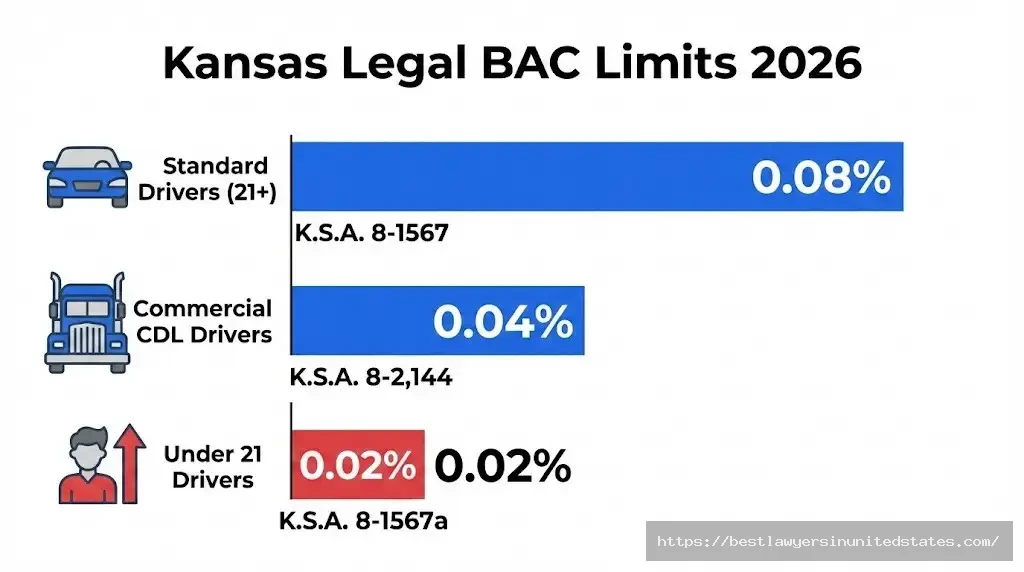
Kansas enforces different BAC thresholds based on your license type and age.
| Driver Type | BAC Limit | Law Reference |
|---|---|---|
| Standard (21+) | 0.08% | K.S.A. 8-1567(a)(1) |
| Commercial (CDL) | 0.04% | K.S.A. 8-2,144 |
| Under 21 | 0.02% | K.S.A. 8-1599 |
Critical point: Kansas uses a “per se” standard. Police don’t need to prove impairment if your BAC meets these thresholds.
Not sure if you’re over Kansas’s legal limit? Check your estimated BAC level using our BAC calculator to understand how alcohol affects your body.
BAC Calculator
Estimate your Blood Alcohol Content
• Commercial Driver (CDL): 0.04% BAC
• Drivers Under 21: 0.00-0.02% BAC (Zero Tolerance)
• Enhanced Penalties: 0.15% BAC or higher in most states
Two Ways Kansas Proves DUI
Kansas prosecutors can charge you under two different theories:
Per Se DUI: Your BAC tested at or above the legal limit within three hours of driving. The state doesn’t need to prove impairment. Chemical test results showing 0.08% or higher are enough for conviction.
Impairment-Based DUI: Officers observed signs of impairment like failed field sobriety tests, erratic driving, slurred speech, or bloodshot eyes. The state must prove you were incapable of safely operating a vehicle.
Key difference: You can face conviction even with a BAC below 0.08% if prosecutors prove impairment through officer testimony and field sobriety test results.
What “Operating” Means in Kansas
Kansas law uses the term “operating” rather than “driving.” Recent Kansas Supreme Court cases (State v. Darrow, 304 Kan. 710) clarified this means actual movement of the vehicle.
You can be charged with DUI for:
- Driving on any public or private road
- Sitting in a running vehicle with keys in ignition
- Attempting to start your vehicle while intoxicated
Exception: Simply sitting in a parked car with keys nearby doesn’t constitute “operating” unless you attempt to start the engine or move the vehicle.
Kansas DUI Penalties by Offense
Kansas DUI penalties increase significantly with each conviction. The state counts all DUI convictions and diversion agreements from July 1, 2001, forward when determining your offense level.
First Offense DUI in Kansas
First-time DUI is a Class B nonperson misdemeanor under K.S.A. 8-1567(b)(1)(A).
Penalties include:
- Jail time: 48 consecutive hours to 6 months (or 100 hours public service at court’s discretion)
- Fines: $750 to $1,000 minimum
- License suspension: 30 days (test failure) or 1 year (test refusal)
- Court costs: Additional $200-$500
- Alcohol evaluation: Required before sentencing
| Penalty Type | Minimum | Maximum |
|---|---|---|
| Imprisonment | 48 hours | 6 months |
| Public Service | 100 hours | N/A |
| Fine | $750 | $1,000 |
| License Suspension | 30 days | 1 year |
Critical deadline: You must serve at least 48 consecutive hours in jail or complete 100 hours of public service before any probation, parole, or sentence reduction.
Good news: First offenders may qualify for Kansas DUI diversion, which can result in no criminal conviction on your record.
Kansas DUI Diversion Program (First Offense)
Kansas offers a one-time diversion program that allows first-time DUI offenders to avoid a criminal conviction. Successful completion means no DUI conviction appears on your record.
Who Qualifies for Kansas DUI Diversion?
Eligibility requirements:
- First-time DUI offender (no prior DUIs or diversions ever)
- No felony convictions on record
- Did not cause an accident with injuries
- BAC typically must be below specific threshold (varies by county)
- Must be 18 years or older
Critical point: You can only enter DUI diversion once in your lifetime under K.S.A. 8-1567(i)(6). Even if you completed diversion 20 years ago, you cannot use it again.
CDL holders: Commercial drivers are NOT eligible for diversion according to Kansas Attorney General Opinion 2003-32.
How Kansas DUI Diversion Works
The diversion process typically takes 12-18 months from approval to completion.
Step-by-step timeline:
- Within 30 days of arrest: Your attorney requests diversion from the prosecutor
- 30-60 days: Prosecutor reviews your criminal history and case facts
- Court hearing: Judge approves or denies diversion agreement
- 12-18 months: Complete all diversion requirements
- Upon completion: Case dismissed with no conviction
During diversion you must:
- Pay all supervision fees (typically $25-$50 monthly)
- Complete alcohol evaluation and follow treatment recommendations
- Attend DUI education classes
- Perform community service hours (varies by county)
- Maintain good behavior with no new arrests
- Submit to random drug/alcohol testing
Kansas Diversion Program Costs
| Cost Category | Amount |
|---|---|
| Diversion filing fee | $200-$400 |
| Monthly supervision fees | $25-$50 x 12-18 months |
| Alcohol evaluation | $100-$200 |
| DUI education classes | $300-$500 |
| Community service | Free (time only) |
| Attorney fees | $2,000-$4,000 |
| Total diversion cost | $1,500-$3,000 (plus attorney) |
Budget tip: Plan for $2,000-$3,000 in total costs beyond your attorney fees. Payment plans are often available through the court.
What Happens If You Violate Diversion?
Violating your diversion agreement returns your case to active prosecution. Common violations include:
- New criminal arrest during diversion period
- Failing to complete required classes or treatment
- Positive alcohol or drug test
- Missing supervision appointments
- Not paying required fees
Consequence: The prosecutor can immediately file charges and your original DUI case proceeds to trial. You lose the opportunity for dismissal and face full conviction penalties.
Expungement After Kansas DUI Diversion
Successfully completing diversion makes you eligible for immediate expungement. Under Kansas expungement law, diversion dismissals can be expunged right after completion.
To expunge your Kansas DUI diversion:
- Wait until court formally dismisses your case
- File expungement petition with district court
- Pay filing fees (typically $176-$195)
- Attend expungement hearing
Result: The arrest and case disappear from your criminal record. Background checks won’t show the DUI.
Second Offense DUI in Kansas
Second DUI within any timeframe is a Class A nonperson misdemeanor under K.S.A. 8-1567(b)(1)(B).
Penalties increase substantially:
- Jail time: 90 days to 1 year
- Minimum confinement: 120 hours (at least 48 hours must be actual imprisonment)
- Fines: $1,250 to $1,750
- License suspension: 1 year minimum
- Alcohol evaluation and treatment: Mandatory
| Penalty | Second Offense Requirement |
|---|---|
| Minimum confinement | 120 hours total |
| Actual imprisonment | 48 consecutive hours minimum |
| Fine range | $1,250-$1,750 |
| License suspension | 1 year |
| Community corrections | $250 assessment to state |
Work Release and House Arrest for Second DUI
Kansas allows work release or house arrest programs after serving 48 consecutive hours in jail. The 2025 legislative update changed how credit is calculated.
Hour-for-hour credit system:
- First 120 hours: Receive hour-for-hour credit
- After 120 hours: Receive day-for-day credit (unless court orders otherwise)
- Electronic monitoring required for house arrest
- Must remain in residence except for approved work hours
Example: You serve 48 hours in jail, then enter work release for 72 more hours. You’ve now completed the 120-hour minimum. Additional time counts day-for-day toward any longer sentence.
Third Offense DUI in Kansas
Third DUI is where Kansas law gets complex. Whether it’s a misdemeanor or felony depends on your prior conviction timeline.
Third DUI as Misdemeanor
If your prior convictions occurred MORE than 10 years ago, third DUI remains a Class A nonperson misdemeanor under K.S.A. 8-1567(b)(1)(C).
Penalties:
- Jail time: 90 days to 1 year
- Minimum confinement: 30 days (48 consecutive hours must be imprisonment)
- Fines: $1,750 to $2,500
- License suspension: 1 year
- Post-release supervision: Mandatory 1 year after imprisonment
Third DUI as Felony
If ANY prior DUI conviction occurred within the past 10 years, third DUI becomes a Severity Level 6 nonperson felony under K.S.A. 8-1567(b)(1)(D).
Felony penalties:
- Classification: Severity Level 6 nonperson felony
- Jail time: 90 days to 1 year
- Minimum confinement: 30 days (48 consecutive hours imprisonment)
- Fines: $1,750 to $2,500
- License suspension: 1 year minimum
- Post-release supervision: Mandatory 1 year
| Third DUI Type | Classification | Look-Back Period |
|---|---|---|
| Misdemeanor | Class A | Priors over 10 years old |
| Felony | Severity Level 6 | Any prior within 10 years |
Critical point: Kansas uses a lifetime look-back to count prior offenses, but the 10-year window determines felony status. A DUI from 15 years ago still counts toward your offense number but won’t trigger felony status by itself.
Mandatory Post-Conviction Supervision
Third DUI offenders face mandatory one-year supervision after completing jail time. This requirement applies to both misdemeanor and felony convictions.
Supervision includes:
- Regular meetings with Community Correctional Services or Court Services
- Substance abuse treatment through Kansas Department for Aging and Disability Services
- Random drug and alcohol testing
- Employment verification
- Monthly supervision fees
Violation consequences: Breaking supervision rules can return you to jail for the remainder of your original sentence plus the remaining supervision period.
Fourth and Subsequent DUI Offenses in Kansas
Fourth or subsequent DUI is automatically a Severity Level 6 nonperson felony under K.S.A. 8-1567(b)(1)(E), regardless of how much time passed between offenses.
Enhanced penalties:
- Jail time: 90 days to 1 year minimum (court may impose longer sentences)
- Minimum confinement: 30 days (72 consecutive hours must be actual imprisonment)
- Fine: $2,500 (not a range, but fixed amount)
- License suspension: 1 year minimum, possible permanent revocation
- Post-release supervision: Mandatory 1 year
Critical change: Fourth offense requires 72 consecutive hours imprisonment (not 48) before work release or house arrest eligibility.
Kansas DUI Penalties Chart 2026
| Offense | Class | Jail | Fine | License | Notes |
|---|---|---|---|---|---|
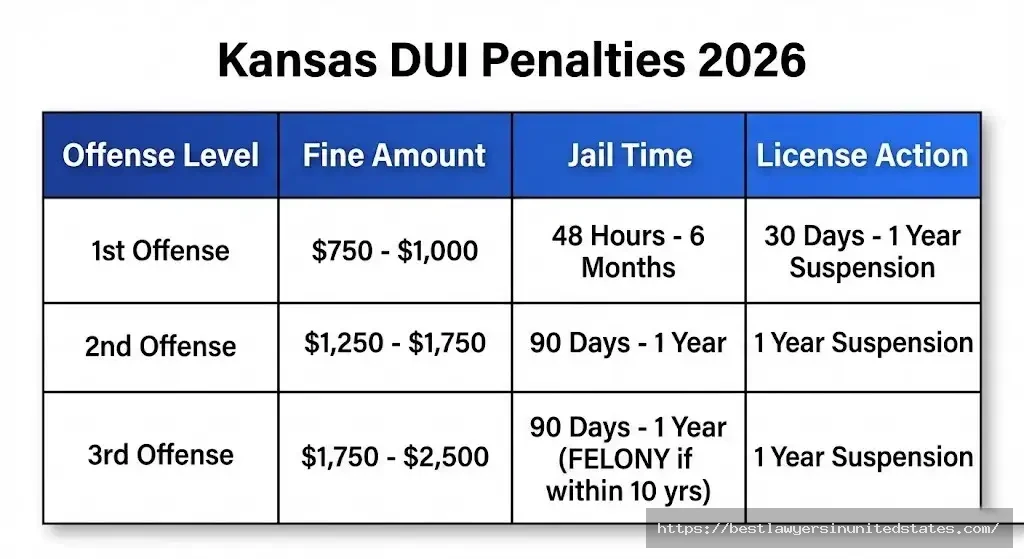
| 1st | Class B misd. | 48 hrs-6 mos | $750-$1,000 | 30 days-1 yr | Diversion eligible |
| 2nd | Class A misd. | 90 days-1 yr | $1,250-$1,750 | 1 year | 120 hrs minimum confinement |
| 3rd (no prior in 10 yrs) | Class A misd. | 90 days-1 yr | $1,750-$2,500 | 1 year | 30 days minimum |
| 3rd (prior in 10 yrs) | Level 6 felony | 90 days-1 yr | $1,750-$2,500 | 1 year | Felony conviction |
| 4th+ | Level 6 felony | 90 days-1 yr | $2,500 | 1 year+ | 72 hrs minimum imprisonment |
Enhancement: Any DUI with a child under 18 in the vehicle adds one month of consecutive imprisonment under K.S.A. 8-1567(c).
Check Your Estimated Kansas DUI Costs
Wondering what a Kansas DUI will actually cost you? Calculate your total expenses including fines, court costs, attorney fees, and insurance increases.
Use our DUI cost calculator to estimate your complete financial impact based on your specific situation.
DUI Cost Calculator
Estimate total DUI expenses by state and offense
Detailed Cost Breakdown
Payment Timeline
Bail bond, towing fees, car impound, attorney retainer
Initial court fines, DMV fees, DUI school enrollment, ignition interlock installation
Monthly probation fees, ignition interlock fees, DUI school payments, attorney balance
Insurance premium increases, license reinstatement, SR-22 filing fees
- Lost wages from missed work (court dates, jail time, DUI school) – $2,000-$10,000
- Job loss or difficulty finding employment – Varies
- Professional license suspension (doctors, lawyers, nurses, pilots) – Career ending
- Rideshare and transportation costs during suspension – $1,500-$5,000
- Travel restrictions and visa denials – Varies
- Security clearance loss – Career impact
- Child custody implications – Legal costs
- Rental car restrictions – Varies
- Personal relationships and mental health costs – Priceless
Total Cost of a Kansas DUI
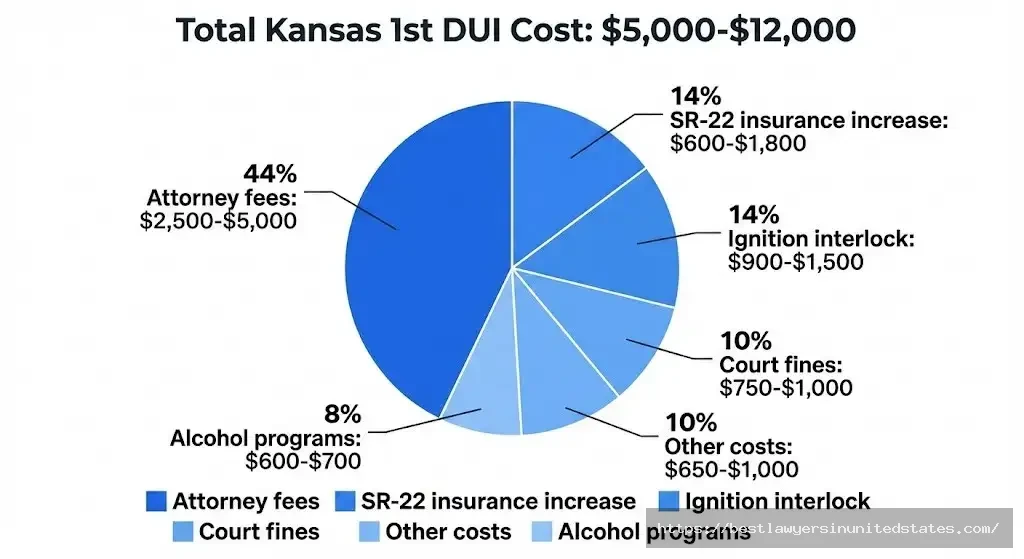
Financial consequences extend far beyond court fines. Here’s what first-time offenders typically spend.
| Cost Category | Amount | Notes |
|---|---|---|
| Attorney fees | $2,500-$5,000 | More for trial |
| Court fines | $750-$1,000 | Mandatory minimum |
| Court costs | $200-$500 | Filing and processing |
| Alcohol evaluation | $100-$200 | Required assessment |
| DUI education | $300-$500 | State-approved program |
| Treatment programs | $500-$2,000 | If recommended |
| Ignition interlock | $70-$150/month | 6-12 months typical |
| SR-22 insurance filing | $25-$50 | One-time fee |
| Insurance increase | $500-$1,500/year | 3-5 years |
| License reinstatement | $100 | Kansas DMV fee |
| Lost wages | Varies | Jail time, court dates |
| Total first offense | $5,000-$12,000+ | Over 3 years |
Second and third offenses: Costs typically double due to longer jail time, higher fines, extended ignition interlock requirements, and increased insurance premiums.
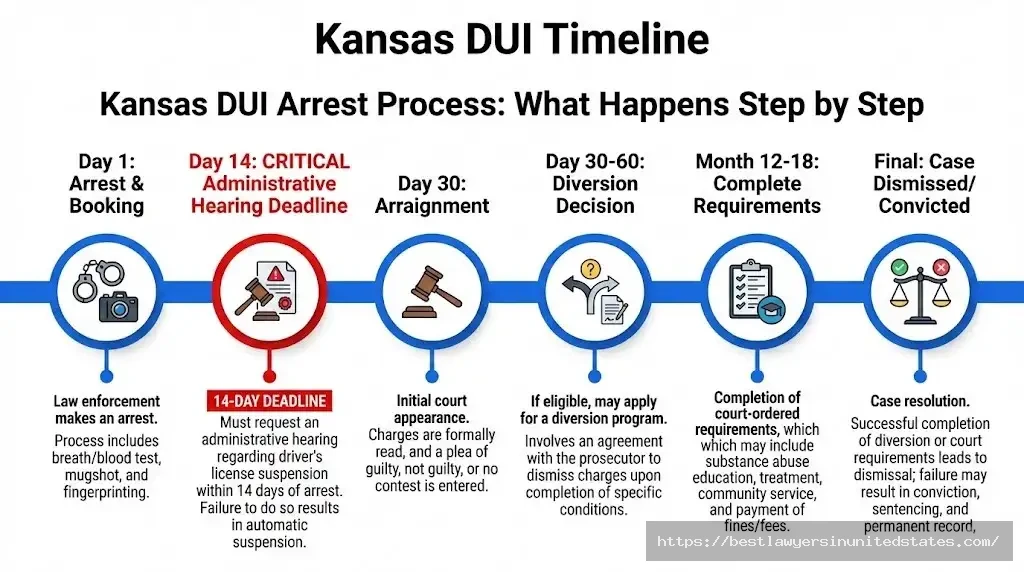
Kansas DUI Arrest Process: What Happens Step by Step
Understanding the Kansas DUI arrest process helps you protect your rights and make informed decisions.
Traffic Stop and Field Sobriety Tests
Kansas law requires reasonable suspicion for officers to stop your vehicle. Common reasons include:
- Weaving between lanes or crossing center line
- Speeding or driving too slowly
- Equipment violations (broken taillight, expired tags)
- Leaving bar parking lot late at night
- DUI checkpoint (legal in Kansas)
At the stop, officers look for:
- Odor of alcohol
- Bloodshot or glassy eyes
- Slurred speech
- Open containers
- Fumbling with license and registration
Are Field Sobriety Tests Mandatory in Kansas?
No. Field sobriety tests are voluntary in Kansas. You can politely decline without automatic penalties.
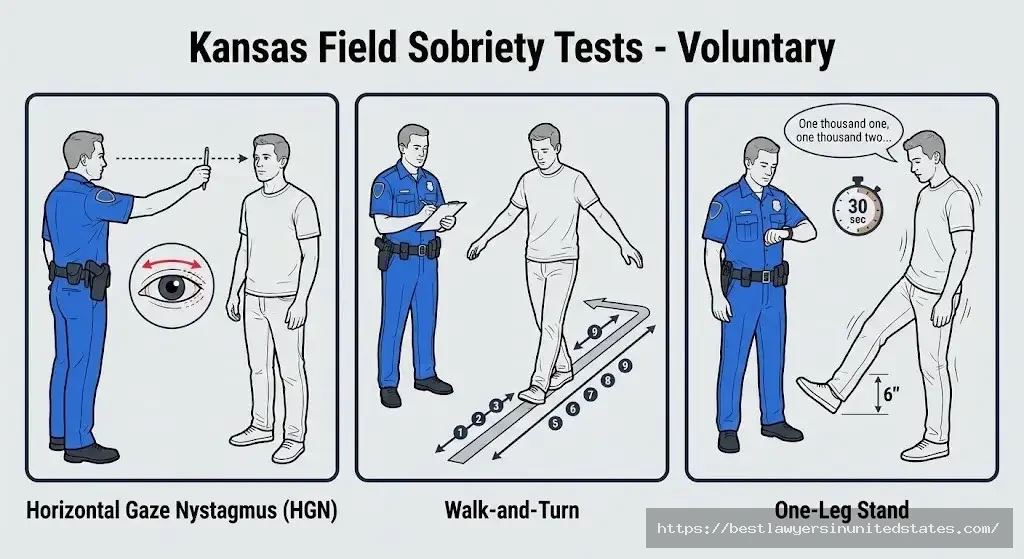
Common Kansas field sobriety tests:
- Horizontal Gaze Nystagmus (HGN) – following a pen with your eyes
- Walk-and-turn – nine steps heel-to-toe, turn, return
- One-leg stand – balance on one foot for 30 seconds
Why officers want you to perform them: Field sobriety test “failures” give prosecutors evidence of impairment even if your BAC is under 0.08%.
Defense strategy: Poor performance can result from medical conditions, injuries, nervousness, uneven surfaces, or poor instructions. Many DUI attorneys advise declining these tests.
Preliminary Breath Test (PBT) at Roadside
Officers may request a preliminary breath test using a portable device at the traffic stop. This differs from the official chemical test at the station.
Kansas PBT facts:
- Voluntary (you can refuse without penalty)
- Results generally NOT admissible in court
- Used only to establish probable cause for arrest
- Refusing doesn’t trigger automatic license suspension
Critical point: Refusing the roadside PBT is different from refusing the official chemical test after arrest. Roadside refusal carries no suspension penalty.
DUI Arrest and Chemical Testing
If officers believe they have probable cause, they arrest you for DUI and transport you to the police station or jail for official chemical testing.
Kansas gives you three testing options:
- Breath test (most common)
- Blood test
- Urine test (least common)
Officers typically choose breath testing unless circumstances require blood draws (serious accidents, suspicion of drug use, or unconscious drivers).
Kansas Implied Consent Law: Testing and Refusal
Every Kansas driver automatically consents to chemical testing when they obtain a license. This “implied consent” under K.S.A. 8-1001 activates upon lawful DUI arrest.
What Officers Must Tell You Before Testing
Kansas law requires officers to read you an implied consent advisory before requesting a chemical test. The advisory must explain:
You will be informed that:
- Refusing the test results in automatic 1-year license suspension
- Test failure results in 30-day suspension (first offense)
- You have the right to request an independent test at your own expense
- Refusal can be used as evidence against you in court
Critical point: If officers fail to properly advise you of these rights, your attorney may challenge the test results or refusal in court.
What Happens If You Refuse Chemical Testing in Kansas?
Refusing chemical testing triggers harsher administrative penalties than failing the test. The consequences are immediate and separate from any criminal DUI case.
| Offense | Refusal Penalty | Test Failure Penalty |
|---|---|---|
| 1st refusal | 1-year suspension | 30-day suspension |
| 2nd refusal | 2-year suspension | 1-year suspension |
| 3rd+ refusal | 3-year suspension | 1-year suspension |
Critical difference: First-time refusal means losing your license for 12 months compared to only 30 days for test failure.
Can Police Force You to Take a Test?
Officers cannot physically force you to provide a breath sample without a warrant. However, Kansas law now allows officers to obtain warrants for blood draws in DUI cases.
Warrant exceptions:
- Serious accidents involving injuries or death
- Suspected drug impairment (breath tests don’t detect drugs)
- Driver unconscious or unable to consent
- Prior DUI convictions on record
Once officers obtain a warrant: Refusal to comply becomes obstruction. Medical personnel can draw blood, and test results are fully admissible.
Your Right to Independent Testing
Kansas law under K.S.A. 8-1004 gives you the right to request additional testing at your own expense after completing the official test.
How independent testing works:
- Complete the state’s official chemical test first
- Request independent testing immediately
- Police must provide reasonable opportunity
- You pay for transportation and testing costs
- Use results to challenge state’s evidence
Strategic use: If your independent test shows a lower BAC than the state’s test, your attorney can argue the state’s equipment was inaccurate or improperly calibrated.
How Refusal Affects Your Criminal Case
Beyond license suspension, refusing chemical testing creates evidence problems for both sides.
Prosecution advantages:
- Can tell the jury you refused testing
- Argues refusal shows “consciousness of guilt”
- No BAC number to dispute or challenge
- Relies on officer observations and field sobriety tests
Defense advantages:
- No BAC evidence to explain or overcome
- Can’t prove you were over 0.08%
- Must prove impairment through observations only
- Breath test machine errors become irrelevant
Trade-off: You avoid giving the state concrete BAC evidence but face a full year without a license and jury inference of guilt.
The Critical 14-Day Administrative Hearing Deadline
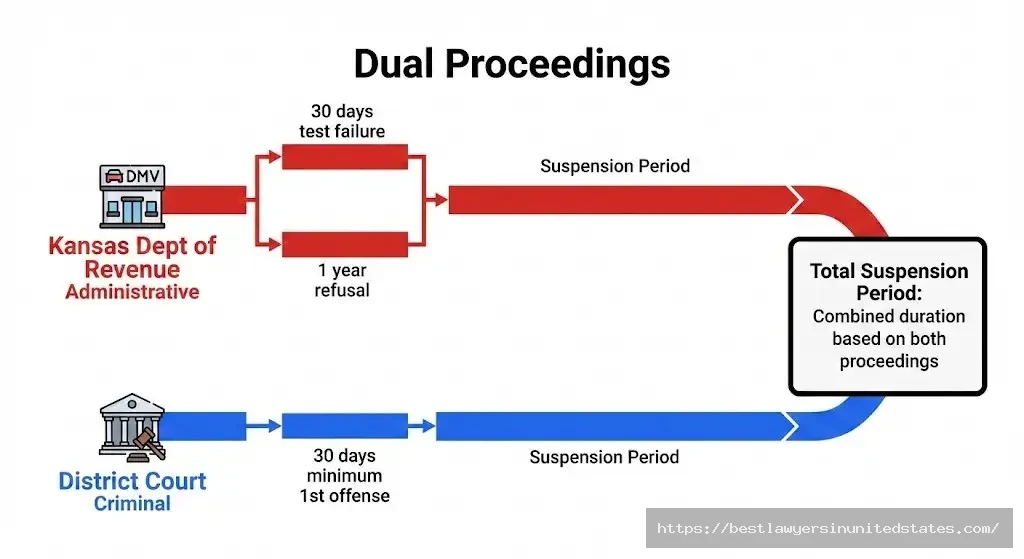
Kansas runs two separate DUI proceedings: criminal court AND Kansas Department of Revenue administrative suspension. Missing the 14-day deadline for an administrative hearing means automatic license suspension.
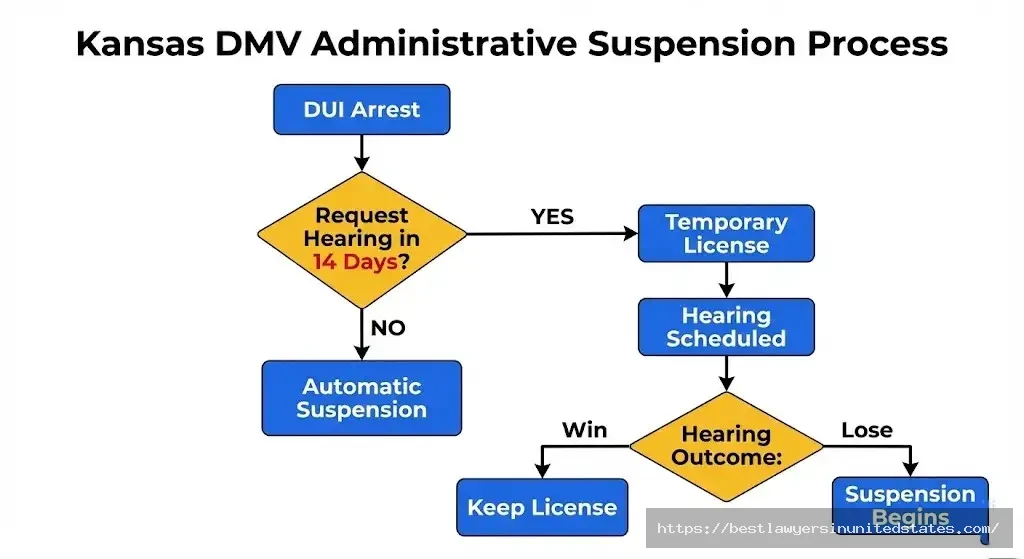
Understanding Kansas’s Dual DUI System
Criminal case (Kansas District Court or Municipal Court):
- Prosecutor charges you with DUI violation
- You face jail time, fines, probation
- Determines criminal conviction on your record
- Separate from license suspension
Administrative case (Kansas Department of Revenue):
- Handles only driver’s license suspension
- No jail time or criminal penalties
- Suspension happens even if criminal case dismissed
- Must be challenged within 14 days
Critical point: Winning your criminal case doesn’t automatically restore your license. You must fight both proceedings separately.
How to Request a Kansas Administrative Hearing
You have exactly 14 days from arrest to request an administrative hearing with the Kansas Department of Revenue.
Step-by-step process:
- Within 14 days of arrest: Submit written hearing request to Kansas Department of Revenue
- Include required information: Your name, license number, arrest date, requesting officer’s name
- Pay filing fee: Check current fee with Kansas Department of Revenue
- Receive temporary license: Valid until hearing decision
- Attend hearing: Present evidence and testimony
Mailing address: Kansas Department of Revenue Driver Control Bureau PO Box 12021 Topeka, KS 66612-2021
Online option: Check Kansas Department of Revenue website for online hearing requests (availability varies).
What Happens at Kansas Administrative Hearings
Administrative hearings focus only on four issues. The hearing officer decides whether:
- Probable cause existed for the traffic stop and arrest
- You were operating the vehicle
- Officer properly advised you of implied consent warnings
- You refused testing or tested over the legal limit
What administrative hearings DON’T address:
- Whether you’re guilty of criminal DUI
- Defenses to impairment
- Officer’s subjective observations
- Whether you deserve leniency
Hearing outcome: If you win, you keep your license (but criminal case continues). If you lose, suspension begins immediately.
Missing the 14-Day Deadline
Failing to request a hearing within 14 days means you automatically forfeit your opportunity to challenge the suspension.
What happens:
- Administrative suspension takes effect automatically
- No hearing granted
- No temporary license issued
- No ability to present evidence
- Criminal case proceeds separately
Timeline example:
- Day 1: Arrested for DUI
- Day 14: Final day to request administrative hearing
- Day 15: Miss deadline, automatic suspension begins
- Day 30: Criminal case still pending, already lost license administratively
Kansas License Suspension and Reinstatement
Kansas DUI penalties include both administrative and criminal license suspensions that can run concurrently or consecutively.
Administrative Suspension Timeline
Kansas Department of Revenue imposes automatic administrative suspensions immediately upon test failure or refusal.
| Test Result | 1st Offense | 2nd Offense | 3rd+ Offense |
|---|---|---|---|
| Test failure | 30 days | 1 year | 1 year |
| Test refusal | 1 year | 2 years | 3 years |
Suspension begins: On the date officer serves you the DC-27 notice of suspension, typically at arrest. You receive a temporary permit valid until the suspension start date (usually 30 days).
Criminal Court Suspension
If convicted of DUI, Kansas courts impose separate license suspensions under K.S.A. 8-1014.
Criminal suspension periods:
- First DUI conviction: 30 days minimum, up to 1 year
- Second DUI conviction: 1 year minimum
- Third DUI conviction: 1 year minimum
- Fourth+ DUI conviction: 1 year minimum, possible lifetime revocation
Court discretion: Judges determine whether criminal suspension runs concurrent (same time) or consecutive (added) to administrative suspension.
Getting a Restricted License in Kansas
Kansas offers Employment or Program-Restricted Driver’s Licenses that allow limited driving during suspension periods.
Eligibility for Kansas Restricted Licenses
You may qualify after:
- Completing minimum suspension period (varies by offense)
- Installing ignition interlock device in all vehicles
- Paying reinstatement fees
- Submitting SR-22 insurance certificate
- Having valid reason (employment, education, medical)
Minimum suspension before eligibility:
- First offense: 30 days for test failure, 90 days for refusal
- Second offense: 180 days
- Third offense: 1 year
How to Apply for Kansas Restricted License
Application steps:
- Serve minimum suspension period based on offense level
- Complete alcohol evaluation through state-approved provider
- Enroll in DUI education program (if required)
- Install ignition interlock device in vehicle(s)
- Obtain SR-22 insurance from your insurance company
- Submit application to Kansas Department of Revenue with fees
Required documentation:
- Completed Application for Restricted License (form available online)
- Employer letter or school enrollment verification
- Proof of ignition interlock installation
- SR-22 insurance certificate
- Payment for reinstatement and restricted license fees
Processing time: Typically 2-4 weeks after submission.
Restricted License Limitations
Kansas restricted licenses allow driving only for specific approved purposes.
Approved activities typically include:
- Driving to and from work
- Driving during work hours (if job requires)
- Medical appointments
- DUI education classes or treatment programs
- Court-ordered obligations
- Religious services (varies by case)
Restrictions you must follow:
- Cannot drive between certain hours (if specified)
- No recreational driving or running errands
- Ignition interlock required in all vehicles you operate
- Must carry restricted license and ignition interlock documentation
- Subject to random compliance checks
Violation consequences: Driving outside restricted privileges results in immediate license revocation and possible additional criminal charges.
Kansas Ignition Interlock Device Requirements
Kansas requires ignition interlock devices for most DUI offenders seeking restricted licenses or reinstatement.
What Is an Ignition Interlock Device?
An ignition interlock device (IID) is a breathalyzer connected to your vehicle’s ignition system. You must blow into the device to start your car, and it periodically requires “rolling retests” while driving.
How it works:
- Blow into device before starting vehicle
- Vehicle starts only if BAC registers below programmed limit (typically 0.025%)
- Device requires random retests while driving (you have 5-6 minutes to pull over and retest)
- All tests are recorded and reported to Kansas Department of Revenue
- Tampering or failing tests triggers violations
When Kansas Requires Ignition Interlock
| Offense | IID Requirement | Duration |
|---|---|---|
| 1st DUI | Required for restricted license | Until reinstatement (typically 6-12 months) |
| 2nd DUI | Mandatory | 1 year minimum |
| 3rd DUI | Mandatory | 1-2 years |
| 4th+ DUI | Mandatory | 2-3 years minimum |
Note: Some first-time offenders who complete diversion may avoid ignition interlock requirements. Check with your attorney about your specific situation.
Kansas-Approved Ignition Interlock Providers
Kansas maintains a list of approved ignition interlock device providers. You must choose from this list for your device to satisfy court requirements.
Major approved providers in Kansas:
- LifeSafer Ignition Interlock
- Smart Start Ignition Interlock
- Intoxalock
- Guardian Interlock Systems
- Alcohol Detection Systems
Installation locations: Most providers have installation centers in Wichita, Overland Park, Topeka, Kansas City, and other major cities throughout Kansas.
Ignition Interlock Costs in Kansas
| Cost Item | Amount | Frequency |
|---|---|---|
| Installation fee | $70-$150 | One-time |
| Monthly monitoring | $70-$100 | Every month |
| Calibration | $0-$30 | Every 30-60 days |
| Removal fee | $50-$100 | One-time |
| 12-month total | $1,000-$1,500 | Full year |
Financial assistance: Low-income individuals may qualify for reduced rates. Contact providers directly about indigent programs.
Ignition Interlock Violations
Failing to comply with ignition interlock requirements triggers serious consequences.
Common violations:
- Failing a startup or rolling retest
- Missing scheduled calibration appointments
- Tampering with the device
- Having someone else blow into device
- Removing or disconnecting device
- Driving vehicles without installed devices
Violation penalties:
- Extended ignition interlock requirement period
- Restricted license revocation
- Additional suspension time
- Criminal charges for tampering
- Increased monitoring frequency
Critical point: Each violation typically adds 30-90 days to your total ignition interlock requirement.
SR-22 Insurance in Kansas
Kansas requires SR-22 insurance certificates after DUI convictions to prove you maintain minimum liability coverage.
What Is SR-22 Insurance?
SR-22 isn’t actual insurance. It’s a certificate your insurance company files with Kansas Department of Revenue proving you carry required liability coverage.
Kansas minimum liability requirements:
- $25,000 bodily injury per person
- $50,000 bodily injury per accident
- $25,000 property damage per accident
How Long You Need SR-22 in Kansas
| Situation | SR-22 Duration |
|---|---|
| First DUI conviction | 3 years |
| Second DUI conviction | 5 years |
| Driving while suspended | 3 years |
| Test refusal | 1 year (during suspension) |
Duration begins: From the date Kansas Department of Revenue files the SR-22, not from arrest or conviction date.
Early termination: Not available in Kansas. You must maintain SR-22 for the full required period.
SR-22 Insurance Costs
Filing fee: $25-$50 one-time charge to file the SR-22 certificate with Kansas Department of Revenue.
Insurance premium increases: The DUI conviction (not the SR-22 itself) dramatically raises your rates.
Typical Kansas insurance increases after DUI:
- Before DUI: $100/month average
- After DUI: $150-$250/month average
- Increase: 50-150% higher premiums
- Duration: 3-5 years until driving record improves
Annual extra cost: $600-$1,800 more per year for insurance after DUI.
Maintaining Kansas SR-22 Coverage
Critical requirements:
- Never let insurance policy lapse or cancel
- Pay all premiums on time
- Maintain coverage for full required period
- Notify Kansas DMV immediately if you change insurance companies
Lapse consequences: Your insurance company must notify Kansas Department of Revenue within 10 days if your policy cancels. Kansas immediately suspends your license until you file a new SR-22 and pay reinstatement fees.
Example timeline:
- Day 1: Insurance cancels
- Day 10: Insurance notifies Kansas Department of Revenue
- Day 11: Kansas suspends your license
- You must: File new SR-22, pay reinstatement fee ($100), restart SR-22 clock
License Reinstatement After Kansas DUI
Reinstating your Kansas driver’s license after DUI suspension requires completing multiple steps and paying various fees.
Eligibility for Kansas License Reinstatement
You can apply for reinstatement when you’ve:
- Completed full suspension period (administrative + criminal)
- Served all jail time and probation
- Paid all court fines and costs
- Completed required alcohol evaluation and treatment
- Finished DUI education programs
- Installed ignition interlock (if required)
- Obtained SR-22 insurance certificate
- Paid reinstatement fees
Kansas License Reinstatement Process
Step-by-step reinstatement:
- Verify suspension end date
- Contact Kansas Department of Revenue Driver Control Bureau
- Confirm all suspensions have expired
- Check for any holds or additional requirements
- Complete compliance requirements
- Finish alcohol evaluation and treatment (if ordered)
- Complete DUI education program
- Install ignition interlock device (if required)
- Obtain proof of completion for all programs
- Get SR-22 insurance
- Contact your insurance company
- Request SR-22 filing with Kansas Department of Revenue
- Verify filing completed successfully
- Pay reinstatement fees
- Application fee: $100 for DUI reinstatement
- Additional fees may apply for multiple violations
- Payment accepted by mail, online, or in person
- Visit Kansas DMV office
- Bring all completion certificates
- Provide SR-22 proof
- Pass vision test
- Pay driver’s license renewal fee
- Have new photo taken
- Receive new license
Processing time: Same day if all requirements met at DMV office. Mail applications take 2-3 weeks.
Kansas DMV Reinstatement Fees
| Fee Type | Amount |
|---|---|
| DUI reinstatement application | $100 |
| Driver’s license renewal | $31-$56 (varies by duration) |
| Ignition interlock certification | Included |
| SR-22 filing | $25-$50 (through insurance company) |
| Total typical fees | $156-$206 |
Additional costs for:
- Multiple offenses
- Out-of-state violations
- Commercial driver’s license
- Expired license during suspension
Common Kansas Reinstatement Issues
Reinstatement denied or delayed for:
- Outstanding court fines or costs
- Uncompleted alcohol treatment programs
- Missing DUI education certificates
- SR-22 insurance lapse
- New violations during suspension period
- Child support arrears (unrelated but causes license holds)
Resolution: Contact Kansas Department of Revenue Driver Control Bureau at (785) 296-3671 to identify specific holds and requirements.
Kansas Zero Tolerance Law for Drivers Under 21
Kansas enforces strict zero tolerance laws under K.S.A. 8-1599 for drivers under age 21. Any detectable alcohol results in penalties.
What Is Kansas Zero Tolerance Law?
Kansas zero tolerance means drivers under 21 cannot operate vehicles with BAC of 0.02% or higher. This threshold is one-fourth the adult limit.
Why 0.02% instead of 0.00%:
- Accounts for naturally occurring alcohol in food
- Allows margin of error in testing equipment
- Prevents false positives from mouthwash or medication
One drink typically exceeds 0.02%: A single beer, glass of wine, or shot of liquor will put most people under 21 over this threshold.
Zero Tolerance Penalties in Kansas
Underage DUI carries separate penalties from adult DUI under K.S.A. 8-1599, even for BAC between 0.02% and 0.079%.
| BAC Level | Charge | Penalties |
|---|---|---|
| 0.02%-0.079% | Zero tolerance violation | 30-day suspension, $200-$500 fine, alcohol classes |
| 0.08%+ | Standard DUI | Full adult DUI penalties plus zero tolerance |
First zero tolerance violation:
- 30-day license suspension
- $200-$500 fine plus court costs
- 8-hour alcohol education program
- Possible community service (varies by county)
- No jail time (unless also charged with standard DUI)
Second zero tolerance violation:
- 1-year license suspension
- $500-$1,000 fine
- Ignition interlock required
- Substance abuse evaluation and treatment
College Students and Zero Tolerance
Kansas zero tolerance law creates serious consequences for college students who may not realize the strict BAC threshold.
Common scenarios:
- Drinking at fraternity/sorority events
- Having one beer at dinner before driving
- Morning-after residual alcohol from previous night
- Using alcohol-based mouthwash or breath freshener
College-specific impacts:
- Loss of campus parking privileges
- Difficulty getting to internships or jobs
- Scholarship eligibility questions
- Professional school application complications
- Student conduct violations (separate from criminal)
Athletic implications: College athletes may face additional NCAA and team sanctions beyond legal penalties.
Kansas CDL DUI Laws for Commercial Drivers
Commercial driver’s license holders face stricter Kansas DUI laws and harsher penalties due to federal Motor Carrier Safety Administration regulations.
CDL BAC Limits in Kansas
Kansas enforces lower BAC thresholds for commercial drivers under K.S.A. 8-2,144.
| Vehicle Type | BAC Limit | Notes |
|---|---|---|
| Commercial vehicle | 0.04% | While operating CMV |
| Personal vehicle | 0.08% | When driving personal car |
Critical point: The 0.04% limit applies only when operating a commercial vehicle. Driving your personal car off-duty uses the standard 0.08% threshold.
“In use” definition: You’re considered operating a CMV if you’re in the driver’s seat with the vehicle running, even if parked.
CDL Disqualification Periods in Kansas
CDL suspensions are separate from regular driver’s license suspensions and often much longer.
First CDL DUI offense:
- CDL disqualification: 1 year minimum
- Regular license: Subject to standard DUI suspension
- Hauling hazmat: 3-year CDL disqualification
Second CDL DUI offense:
- CDL disqualification: Lifetime ban
- Reinstatement possibility: After 10 years (not guaranteed)
- Requirements: Prove rehabilitation, complete treatment
| Offense | CMV Operated | Personal Vehicle | Hauling Hazmat |
|---|---|---|---|
| 1st DUI | 1 year CDL ban | 1 year CDL ban | 3 year CDL ban |
| 2nd DUI | Lifetime CDL ban | Lifetime CDL ban | Lifetime CDL ban |
Out-of-state violations: Kansas counts DUI convictions from other states when determining CDL disqualification periods.
No Diversion for CDL Holders
Critical limitation: Kansas does NOT allow CDL holders to enter DUI diversion programs according to Kansas Attorney General Opinion 2003-32.
Why CDL holders are excluded:
- Federal Motor Carrier Safety Administration regulations
- Public safety concerns with professional drivers
- Higher duty of care expected from commercial operators
- Cannot avoid conviction record required for interstate commerce
Impact: CDL holders face conviction on first offense with no opportunity to keep their record clean through diversion.
Employment Impact for Kansas CDL Holders
DUI convictions end most commercial driving careers immediately.
Employment consequences:
- Immediate firing from driving position
- Federal law prohibits driving during disqualification
- Most trucking companies refuse to hire drivers with DUI history
- Insurance companies won’t cover drivers with DUI convictions
- Background checks reveal DUI for 10+ years
Alternative options:
- Career change to non-driving position
- Wait 10 years and petition for CDL reinstatement
- Accept non-CMV positions requiring only regular license
- Consider training for new career field
Kansas DUI Defense Strategies
Multiple defense strategies can challenge Kansas DUI charges. The right approach depends on your case facts.
Challenging the Traffic Stop
Kansas law requires reasonable suspicion for officers to stop your vehicle. Without it, the entire case may be dismissed.
Common invalid stop reasons:
- Anonymous tip without corroboration
- Driving through high-crime area without violations
- Leaving bar parking lot without traffic violations
- Following too closely when maintaining safe distance
- Crossing fog line once on rural road
Valid stop reasons:
- Weaving between lanes multiple times
- Speeding or running red light
- Equipment violations (broken taillight)
- DUI checkpoint (with proper procedures)
Kansas case law: State v. Pollman (286 Kan. 881) requires reasonable suspicion based on specific articulable facts, not mere hunches.
If stop was invalid: Your attorney files a motion to suppress all evidence gathered after the illegal stop. This typically results in dismissal.
Questioning Chemical Test Accuracy
Kansas breath test machines require strict maintenance and calibration to produce reliable results. Many DUI cases involve testing equipment problems.
Common breath test issues:
- Machine not calibrated within required timeframe
- Operator not properly certified
- Failure to observe defendant for required period before testing
- Radio frequency interference from electronics
- Mouth alcohol contamination from recent drinking
- Medical conditions affecting results (GERD, diabetes)
Kansas breath test requirements:
- 15-minute observation period before testing
- Machine calibration every 120 days minimum
- Certified operator must administer test
- Two samples within 0.02% of each other required
Blood test challenges:
- Chain of custody breaks
- Improper storage causing fermentation
- Contamination during collection
- Lab errors in analysis
- Delayed testing affecting accuracy
Defense strategy: Your attorney obtains maintenance records, calibration logs, and operator certifications. Any discrepancies can exclude test results.
Implied Consent Violations
Kansas law requires specific warnings before chemical testing. Failure to properly advise you creates defense opportunities.
K.S.A. 8-1001 mandates officers inform you:
- Test refusal results in 1-year suspension
- Test failure results in 30-day suspension (first offense)
- You may request independent testing at own expense
- Refusal can be used as evidence in court
Kansas case law: State v. Luft (248 Kan. 911) requires complete and accurate implied consent warnings. Missing even one element means suppressing test results.
Common violations:
- Officer gives incomplete warnings
- Warnings given after testing already completed
- Officer prevents access to independent testing
- Warnings given while defendant too intoxicated to understand
Result: If warnings were improper, your attorney can exclude both test results and refusal from evidence.
Field Sobriety Test Challenges
Kansas officers use standardized field sobriety tests, but many factors beyond intoxication affect performance.
National Highway Traffic Safety Administration (NHTSA) standards require:
- Proper instructions given before each test
- Demonstrations showing correct performance
- Level surface for testing
- Adequate lighting
- Testing area free from distractions
- Officer trained in administration and scoring
Medical conditions affecting tests:
- Inner ear problems affecting balance
- Knee, hip, or ankle injuries
- Back problems
- Neurological conditions
- Eye conditions affecting nystagmus
- Obesity or advanced age
Environmental factors:
- Uneven pavement or gravel
- Poor lighting conditions
- Bad weather (wind, rain, cold)
- Traffic nearby causing distraction
- Improper footwear (high heels, boots)
Kansas case law: State v. Witte (251 Kan. 313) established that horizontal gaze nystagmus testing requires proper foundation showing officer training and test administration.
Defense approach: Your attorney identifies procedural violations, medical explanations, or environmental factors explaining poor test performance without impairment.
Procedural Errors and Rights Violations
Kansas DUI cases require specific procedures. Violations can lead to reduced charges or dismissal.
Common procedural errors:
- Miranda warnings not given before custodial questioning
- Illegal search of vehicle without warrant or consent
- Evidence collected after illegal arrest
- Failure to file charges within statute of limitations
- Discovery violations (prosecutor hiding favorable evidence)
- Witness unavailability for trial
Miranda requirements: Officers must read your rights before asking questions after arrest. This doesn’t apply to routine booking questions (name, address, date of birth).
Search warrant issues: Police need reasonable suspicion for traffic stops and probable cause for arrests. They need warrants for vehicle searches unless you consent or they see evidence in plain view.
Discovery rights: Prosecutors must provide all evidence to your attorney, including:
- Police reports and dash cam videos
- Breath test machine maintenance records
- Officer training certifications
- Witness statements
- Blood test lab results
Speedy trial rights: Kansas requires trial within set timeframes. Excessive delays can violate your constitutional rights.
Kansas DUI Statute of Limitations
Kansas sets time limits for filing DUI charges. Missing these deadlines means prosecutors lose the ability to charge you.
Criminal DUI Statute of Limitations
Misdemeanor DUI (first and second offenses): 2 years from offense date under K.S.A. 21-5107(d).
Felony DUI (third and subsequent offenses): 5 years from offense date under K.S.A. 21-5107(b).
Calculation begins: On the date you allegedly committed the DUI offense, not the arrest date or test date.
Tolling exceptions:
- Time while you’re out of state doesn’t count
- Pending charges for other offenses may extend deadline
- Diversion agreements may pause statute of limitations
Example timeline:
- June 1, 2024: DUI offense occurs
- June 15, 2024: Arrest made
- June 1, 2026: 2-year statute of limitations expires for misdemeanor
- June 1, 2029: 5-year statute expires for felony
Effect of expired statute: If prosecutors file charges after the deadline, your attorney moves to dismiss for violation of statute of limitations. Case dismissed.
Administrative Suspension No Statute Limitation
Kansas Department of Revenue administrative license suspensions have no statute of limitations. The state can suspend your license years after the DUI arrest.
Why no time limit: Administrative suspensions are civil penalties, not criminal prosecution. Different rules apply.
Practical limitation: The 14-day deadline to request an administrative hearing acts as an effective time limit. Missing this deadline means automatic suspension regardless of when it’s processed.
Kansas DUI Expungement: Clearing Your Record
Kansas allows expungement of some DUI convictions after waiting periods. Successful expungement removes the conviction from public background checks.
Can Kansas DUI Be Expunged?
Yes, but with restrictions. Kansas law permits expungement of most DUI convictions after completing requirements and waiting periods.
Eligible for expungement:
- First-time DUI misdemeanor convictions
- DUI diversion dismissals (immediate eligibility)
- Some second-time DUI misdemeanors (longer wait)
NOT eligible for expungement:
- Felony DUI convictions (third and subsequent)
- Multiple DUI convictions (more than two)
- DUI causing serious injury or death
- Commercial vehicle DUI with CDL disqualification
DUI Diversion Expungement in Kansas
Successfully completing Kansas DUI diversion makes you eligible for immediate expungement of the arrest and diversion record.
Diversion expungement timeline:
- Complete diversion: Finish all requirements
- Court dismisses case: Judge formally dismisses charges
- File expungement petition: Immediately after dismissal
- Court hearing: Usually 30-60 days after filing
- Expungement granted: Record sealed from public
Cost for diversion expungement:
- Court filing fee: $176
- Service of process: $20-$30
- Attorney fees: $500-$1,500 (optional)
- Total: $700-$1,700
What expungement covers: Arrest record, court case, diversion agreement. Law enforcement keeps sealed records but they’re removed from public background checks.
What expungement doesn’t cover: Kansas Department of Revenue driving record. The administrative suspension remains visible to insurance companies and employers requiring driving.
Non-Diversion DUI Conviction Expungement
Kansas requires waiting periods before expunging actual DUI convictions.
First DUI misdemeanor conviction: 3 years after completing sentence, probation, and paying all fines.
Second DUI misdemeanor conviction: 5 years after completing sentence (if eligible at all).
Waiting period begins: After you complete ALL sentence requirements:
- Finish jail time or probation
- Pay all fines and court costs
- Complete alcohol treatment programs
- Fulfill ignition interlock requirements
- Serve full license suspension
Example timeline:
- January 2024: DUI conviction
- February 2024: Complete 48 hours jail
- February 2024-February 2025: 12 months probation
- February 2025: Complete all requirements
- February 2028: Eligible to file expungement (3 years later)
Kansas Expungement Process
Step-by-step expungement:
- Verify eligibility
- Confirm waiting period completed
- Check for additional convictions that may disqualify
- Obtain complete court records
- Gather required documents
- Court docket sheet
- Judgment and sentence documents
- Proof of completion (probation discharge, fine receipts)
- Kansas Bureau of Investigation criminal history
- File expungement petition
- Complete appropriate forms for your county
- File with district court clerk in county of conviction
- Pay filing fees
- Serve copies on prosecutor and law enforcement
- Attend court hearing
- Prosecutor may object
- Judge considers factors: time passed, rehabilitation, public interest
- Present evidence of clean record since conviction
- Receive court order
- If granted, judge signs expungement order
- Clerk sends orders to law enforcement agencies
- Records sealed within 30 days
Denial possibilities: Courts can deny expungement if you have subsequent convictions, failed to complete all sentence requirements, or committed new offenses during waiting period.
What Kansas DUI Expungement Covers
Records that get expunged:
- Court case files and docket entries
- Arrest records
- Conviction records in court systems
- Law enforcement reports (sealed, not destroyed)
Records that REMAIN visible:
- Kansas Department of Revenue driving record
- Commercial driver history (federal requirement)
- NCIC databases (for law enforcement use)
- Some government agency background checks
Employment background checks: Private employers using standard background checks won’t see expunged DUI. Government agencies, law enforcement positions, and jobs requiring security clearances may still access sealed records.
Kansas Expungement Costs
| Expungement Cost | Amount |
|---|---|
| Court filing fee | $176-$195 (varies by county) |
| Service of process | $20-$50 |
| KBI criminal history | $20 |
| Certified court documents | $10-$20 per document |
| Attorney fees (optional) | $1,000-$2,500 |
| Total DIY cost | $226-$285 |
| Total with attorney | $1,200-$2,800 |
Do you need an attorney? Expungement is possible without legal representation, but attorneys navigate objections and present stronger cases at hearings.
Frequently Asked Questions About Kansas DUI
Can a DUI be dismissed in Kansas?
Quick answer: Yes, Kansas DUI charges can be dismissed through diversion programs, successful defense motions, or plea negotiations, but this requires proper legal strategy.
DUI dismissals happen several ways in Kansas. First-time offenders who qualify for diversion and complete all requirements get their case dismissed with no conviction. Your attorney can also file motions to dismiss if police violated your rights, conducted illegal stops, or failed to follow proper procedures.
Some cases are dismissed when evidence problems prevent prosecution. This includes breath test machine malfunctions, missing calibration records, or unavailable witnesses. Prosecutors occasionally dismiss charges in exchange for pleading to reduced offenses like reckless driving.
What happens after your first DUI in Kansas?
Quick answer: First DUI in Kansas means arrest, possible 48 hours jail or 100 hours community service, $750-$1,000 fines, 30-day to 1-year license suspension, and potential eligibility for diversion programs.
After arrest, police transport you to jail for booking and chemical testing. You typically post bond within 24 hours. Within 14 days you must request an administrative hearing to challenge license suspension.
Your first court appearance (arraignment) happens within 30 days. The judge reads charges and you enter a plea. Most first-time offenders plead not guilty initially and hire attorneys to explore diversion eligibility or defense options.
If convicted without diversion, you face minimum 48 hours jail (or 100 hours community service), $750-$1,000 fines, alcohol evaluation, DUI classes, and license suspension. Total costs including attorney fees typically reach $5,000-$10,000 for more details on these costs, check our DUI cost calculator.
How long does a DUI stay on your record in Kansas?
Quick answer: Kansas DUI convictions remain on your criminal record permanently unless expunged, but affect insurance rates for 3-5 years and count toward enhanced penalties for lifetime.
DUI convictions never automatically disappear from Kansas records. They stay on your criminal background permanently until you successfully petition for expungement. First-time misdemeanor DUIs can be expunged 3 years after completing your sentence.
For insurance purposes, companies typically look back 3-5 years when calculating rates. Your rates remain elevated during this period but eventually return to normal if you maintain a clean record.
Kansas uses a lifetime look-back period for counting prior DUIs toward enhanced penalties. A DUI from 20 years ago still counts as your first offense when calculating penalties for a new DUI, though it may not trigger felony status unless within 10 years.
Is a DUI a felony in Kansas?
Quick answer: Third DUI becomes a felony in Kansas if any prior conviction occurred within 10 years; fourth DUI is automatically a felony regardless of timeframe under K.S.A. 8-1567.
First and second DUI offenses in Kansas are misdemeanors. Third DUI conviction remains a misdemeanor if all prior DUIs happened more than 10 years ago. But if any prior DUI occurred within the past 10 years, third offense escalates to Severity Level 6 felony.
Fourth and subsequent DUI convictions are always felonies in Kansas, no matter how much time passed between offenses. This follows Kansas’s lifetime look-back period for counting prior convictions.
Felony DUI brings enhanced penalties including longer jail sentences, permanent license revocation possibilities, felony conviction status affecting employment and housing, and mandatory post-release supervision.
What is the best defense against a DUI in Kansas?
Quick answer: The best Kansas DUI defense depends on your case specifics, but common successful strategies include challenging illegal traffic stops, questioning breath test accuracy, and proving implied consent violations.
Challenging the traffic stop works when officers lacked reasonable suspicion. If your attorney proves the stop was illegal, the judge suppresses all evidence and typically dismisses charges.
Questioning chemical test accuracy exploits breath test machine problems. Missing calibration records, uncertified operators, improper observation periods, or equipment malfunctions can exclude BAC results.
Proving implied consent violations means officers failed to properly warn you about testing consequences. Kansas law requires specific warnings before testing. Missing any required element means suppressing test results or refusal evidence.
Field sobriety test challenges highlight medical conditions, environmental factors, or procedural errors explaining poor performance without intoxication. Many conditions unrelated to alcohol affect balance and coordination.
Can you refuse a breathalyzer in Kansas?
Quick answer: Yes, you can refuse chemical testing in Kansas, but refusal triggers automatic 1-year license suspension for first offense compared to only 30 days for test failure under K.S.A. 8-1025.
Kansas implied consent law means you automatically agreed to testing when you obtained your license. Refusing activates consequences under K.S.A. 8-1025 immediately.
First-time refusal results in 1-year license suspension from Kansas Department of Revenue. This is separate from any criminal DUI penalties and happens whether or not prosecutors eventually convict you.
Refusing prevents giving the state BAC evidence but creates other problems. Prosecutors tell juries about your refusal and argue it shows consciousness of guilt. You also lose your license for a full year instead of just 30 days.
Roadside preliminary breath tests are different. Those are voluntary and refusing doesn’t trigger automatic suspension. The mandatory testing happens at the station after arrest.
How much does a Kansas DUI lawyer cost?
Quick answer: Kansas DUI attorneys typically charge $2,500-$5,000 for first-offense representation, with costs increasing to $5,000-$10,000+ for cases going to trial or involving felony charges.
Attorney fees vary based on case complexity. Simple first-offense cases with diversion eligibility cost less than contested trials. Most attorneys charge flat fees for DUI defense rather than hourly rates.
First offense without trial averages $2,500-$3,500. This typically includes arraignment, diversion negotiations, and court appearances. Second offense or cases requiring motions cost $3,500-$5,000.
Trial preparation and jury trial add significant costs, typically $5,000-$10,000 total. Felony DUI cases require more attorney time and often cost $7,500-$15,000.
Payment plans are common. Many DUI attorneys accept partial payment upfront with remaining balance over 3-6 months.
Will I go to jail for first DUI in Kansas?
Quick answer: Yes, Kansas law requires minimum 48 consecutive hours jail time for first DUI conviction, though courts may substitute 100 hours of community service at their discretion under K.S.A. 8-1567(b)(1)(A).
First-time DUI carries mandatory minimums in Kansas. You must serve either 48 consecutive hours in jail OR complete 100 hours of public service. This is non-negotiable even with plea agreements.
Courts often allow community service instead of jail for first offenders with clean records. You’ll likely avoid jail if you hire an attorney, show remorse, complete alcohol evaluation before sentencing, and have no prior criminal history.
Entering diversion eliminates jail time entirely. Successful diversion completion means no conviction and no jail requirement.
Aggravating factors increase jail likelihood: high BAC (over 0.15%), accidents causing property damage, children in vehicle, or prior criminal history. These situations make judges less likely to substitute community service.
Is your license suspended immediately after a DUI in Kansas?
Quick answer: No, Kansas gives you a temporary driving permit valid until administrative suspension takes effect, typically 30 days after arrest, but you must request an administrative hearing within 14 days to challenge it.
Officers confiscate your physical license at arrest and issue form DC-27, which serves as a temporary license. This temporary permit remains valid for 30 days or until your administrative hearing decision, whichever comes later.
The 14-day deadline to request an administrative hearing is critical. Submit your hearing request to Kansas Department of Revenue within this window to extend your temporary driving privileges until the hearing occurs and a decision is made.
Missing the 14-day deadline means automatic suspension begins 30 days from arrest with no opportunity to challenge it administratively. Your only option becomes fighting the criminal DUI case.
Criminal court suspensions are separate and begin upon conviction. These can run concurrent or consecutive to administrative suspensions.
What is the statute of limitations for DUI in Kansas?
Quick answer: Kansas prosecutors must file misdemeanor DUI charges within 2 years and felony DUI charges within 5 years from the offense date under K.S.A. 21-5107.
The statute of limitations begins on the date of the alleged DUI offense, not the arrest date. If police arrested you three months after the incident, prosecutors still have 2 years from the incident date.
First and second offense DUI (misdemeanors) have 2-year statutes of limitations. Third offense misdemeanor DUI also has 2 years. But third offense felony DUI and fourth or subsequent offenses have 5-year statutes.
Time while you’re out of state doesn’t count toward the statute of limitations. If you left Kansas for 6 months, that time is added to the deadline.
Once charges are filed within the deadline, the statute of limitations no longer applies. The case can proceed regardless of how much time passes between filing and trial.
How long does it take to get your license back after DUI in Kansas?
Quick answer: Kansas license reinstatement takes 30 days minimum for first offense test failure, 1 year for refusal, plus time to complete alcohol programs and install ignition interlock devices before applying.
Minimum suspension periods before eligibility:
- First offense test failure: 30 days
- First offense refusal: 1 year (90 days before restricted license)
- Second offense: 1 year
- Third offense: 1 year
After serving the minimum, you must complete requirements before reinstating: alcohol evaluation, DUI education, SR-22 insurance, ignition interlock installation, and payment of all fines and reinstatement fees.
The actual reinstatement process takes 2-4 weeks after submitting your application to Kansas Department of Revenue. Visiting a DMV office in person can complete the process same-day if you bring all required documentation.
Restricted licenses are available earlier in some cases. First offenders who refused testing can apply for restricted licenses after 90 days with ignition interlock installed.
Kansas DUI Resources and Contacts
Kansas Department of Revenue Driver Control Bureau
Mailing address: Kansas Department of Revenue Driver Control Bureau PO Box 12021 Topeka, KS 66612-2021
Phone: (785) 296-3671
Website: https://www.ksrevenue.gov/dmv.html
Services:
- Administrative hearing requests
- License reinstatement applications
- Ignition interlock device requirements
- SR-22 insurance verification
- Driving record requests
Kansas Courts
Find your district court: Kansas courts operate in 31 judicial districts. Locate your specific court based on the county where you received your DUI.
Major Kansas DUI courts:
- Johnson County District Court (Olathe)
- Sedgwick County District Court (Wichita)
- Wyandotte County District Court (Kansas City)
- Shawnee County District Court (Topeka)
Kansas Courts website: https://www.kscourts.org/
Kansas Legal Resources
Kansas Bar Association Lawyer Referral Service Phone: (785) 234-5696 Website: https://www.ksbar.org/
Kansas Legal Services (for low-income residents) Phone: 1-800-723-6953 Website: https://www.kansaslegalservices.org/
Kansas Substance Abuse Treatment
Kansas Department for Aging and Disability Services Phone: (785) 296-3959 Website: https://www.kdads.ks.gov/
Treatment provider search: Contact KDADS for approved alcohol evaluation and treatment providers in your area.
Find Kansas DUI Lawyers
Need legal representation for your Kansas DUI case? We connect you with experienced DUI attorneys throughout Kansas who offer free consultations.

Contact us: Email: [email protected]
Coverage areas:
- Wichita DUI lawyers
- Overland Park DUI attorneys
- Kansas City DUI defense
- Topeka DUI lawyers
- Lawrence DUI attorneys
- All Kansas counties
2024-2025 Kansas DUI Law Changes
Kansas updated K.S.A. 8-1567 with changes effective July 1, 2025. Understanding these modifications helps if you face current DUI charges.
Work Release Credit Calculation Changes
The 2025 amendments modified how courts calculate credit for work release and house arrest programs, particularly for second and third offenses.
New calculation method:
- First 120-240 hours: Hour-for-hour credit
- After reaching minimum hours: Day-for-day credit
- Courts can override and require hour-for-hour for full term
Previous system: Counted confinement hours differently based on work release or house arrest days.
Impact on defendants: Provides clearer guidelines but potentially extends actual time served for some defendants who previously benefited from day-for-day credit earlier in their sentence.
Supervision Requirement Updates
Third offense felony DUI convictions now have modified post-release supervision requirements under the 2025 amendments.
Changes to supervision:
- Supervision agency selection based on risk assessment tools
- Expanded multidisciplinary treatment team requirements
- Kansas Department for Aging and Disability Services now coordinates substance abuse treatment (previously Department of Corrections)
Why it matters: Treatment coordination shifted agencies to improve rehabilitation outcomes and reduce recidivism among repeat DUI offenders.
Funding Mechanism Changes
K.S.A. 8-1567(q)(2) transferred alcohol and drug abuse treatment funds from Department of Corrections to Kansas Department for Aging and Disability Services effective July 1, 2025.
This administrative change:
- Consolidates treatment services under one agency
- Improves coordination between courts and treatment providers
- Maintains the $250 assessment from each DUI fine for community corrections
Practical effect: Defendants face the same costs but work with different state agencies for treatment program coordination.
What to Do After Kansas DUI Arrest
Time-sensitive deadlines follow Kansas DUI arrests. Taking immediate action protects your rights and improves case outcomes.
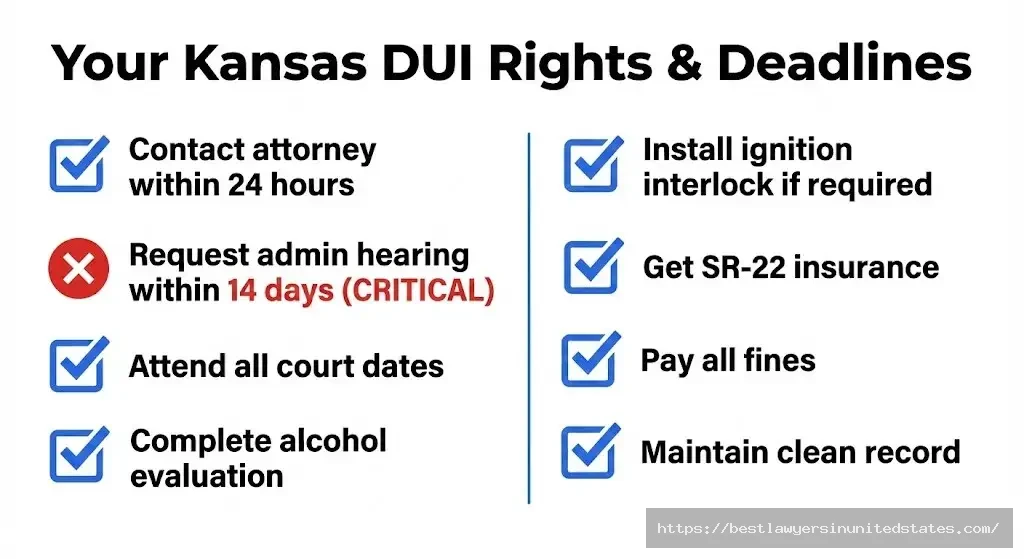
Within 24 Hours of Arrest
Contact a DUI attorney immediately. Most Kansas DUI lawyers offer free consultations and can begin working on your case right away. Early attorney involvement makes significant difference in outcomes.
Document everything you remember:
- Exact location and time of stop
- Why officer said they stopped you
- What you told officer about drinking
- Field sobriety tests performed
- What officer said during arrest
- Names of any witnesses present
Don’t discuss your case: Avoid talking about your arrest on social media, with friends, or with anyone except your attorney. These conversations can become evidence.
Within 14 Days of Arrest
Request administrative hearing with Kansas Department of Revenue. This critical deadline cannot be extended or excused.
Submit your hearing request by:
- Mail: Kansas Department of Revenue, Driver Control Bureau, PO Box 12021, Topeka, KS 66612-2021
- Fax: Check current fax number on DC-27 form
- In person: Kansas DMV office (least common method)
Include in your request:
- Full name and driver’s license number
- Date and location of arrest
- Arresting officer’s name
- Request for administrative hearing
Within 30-60 Days
Arraignment: Your first court appearance where the judge reads charges and you enter your plea. Your attorney typically handles this appearance.
Plea options:
- Not guilty (most common initially)
- Guilty (rarely advisable without negotiations)
- No contest (similar consequences to guilty)
Attorney begins work:
- Reviewing police reports and videos
- Examining breath test machine records
- Interviewing witnesses
- Researching legal defenses
- Negotiating with prosecutor about diversion or plea agreements
Before Case Resolution
Complete alcohol evaluation: Kansas requires this before sentencing or diversion approval. Getting it done early shows responsibility and may influence prosecutor decisions.
Attend all court dates: Missing court appearances results in warrant issuance and bond forfeiture. Your attorney may handle some appearances without you present.
Follow all bond conditions: Typical requirements include no new arrests, no alcohol consumption, and regular check-ins with pretrial services.
Final Thoughts on Kansas DUI Laws
Kansas DUI laws in 2026 combine strict penalties with opportunities for first-time offenders through diversion programs. Understanding your options and acting quickly after arrest makes enormous difference in outcomes.
The 14-day administrative hearing deadline and diversion eligibility window require immediate attention. Don’t wait weeks to consult an attorney. Early legal representation increases your chances of avoiding conviction, minimizing penalties, and protecting your driving privileges.
Kansas treats repeat offenders harshly with felony charges after third offense (if within 10 years) and lifetime look-back periods. If you face DUI charges, take them seriously regardless of your prior record.
Remember that Kansas runs two separate proceedings against you: criminal court and administrative license suspension through Kansas Department of Revenue. You must fight both battles to fully protect your rights and privileges.
For more information about Kansas legal matters, explore:
- Kansas divorce costs and procedures
- Iowa OWI laws (neighboring state)
- Colorado DUI laws (neighboring state)
Need immediate legal help? Email: [email protected]
