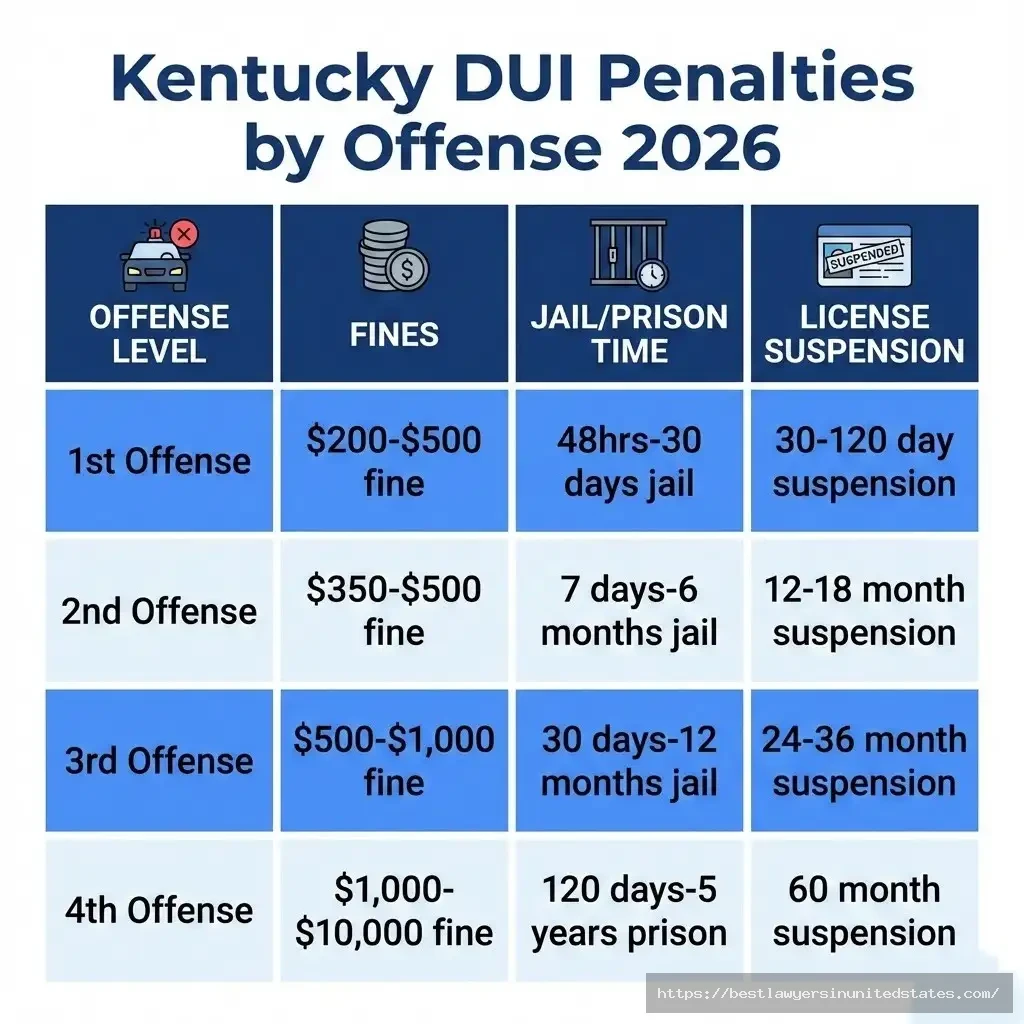
Quick Answer: Kentucky DUI penalties start at $200-$500 fines and 48 hours jail for first offense. Fourth offense becomes a Class D felony with 120 days to 5 years prison time. Kentucky uses a 10-year lookback period, longer than most states.
Getting arrested for DUI in Kentucky triggers two separate legal battles. You face criminal charges in District Court and an administrative license suspension through the Kentucky Transportation Cabinet. Both proceedings move forward simultaneously, even if criminal charges get dismissed.

Kentucky Revised Statutes § 189A.010 defines DUI as operating a vehicle with a blood alcohol content (BAC) of .08% or higher. Officers can also arrest you for impairment below .08% if they document signs of intoxication. This applies to alcohol, marijuana, prescription drugs, and illegal substances.
Check Your BAC Level
Not sure if you’re over Kentucky’s .08% legal limit? Use our BAC calculator to estimate your blood alcohol content based on drinks consumed, body weight, and time elapsed.
BAC Calculator
Estimate your Blood Alcohol Content
• Commercial Driver (CDL): 0.04% BAC
• Drivers Under 21: 0.00-0.02% BAC (Zero Tolerance)
• Enhanced Penalties: 0.15% BAC or higher in most states
What Makes Kentucky DUI Laws Different?
Kentucky’s DUI statutes contain several unique provisions not found in neighboring states.
The 10-Year Lookback Period
Kentucky counts prior DUI convictions for 10 years when determining penalties. Most states use 5-7 year lookback periods. Your fourth DUI within 10 years becomes a Class D felony, even if three previous convictions occurred years apart.
Example: A DUI in 2016, another in 2019, and a third in 2023 all count toward enhancement if you get arrested again in 2026.
The 2-Hour Testing Rule
Kentucky law requires officers to conduct BAC testing within 2 hours of driving or being in physical control of a vehicle. Test results obtained after the 2-hour window face serious admissibility challenges in court.
Key defense point: Delays in testing caused by hospital visits, equipment malfunctions, or transportation issues can invalidate results. Defense attorneys frequently challenge late tests.
Portable Breathalyzer Tests Are Inadmissible
Kentucky courts don’t allow portable breathalyzer test (PBT) results as evidence. Officers use roadside PBTs to establish probable cause for arrest, but only official breath or blood tests taken at the station count in court.
You can refuse the roadside PBT without penalty. The implied consent law only applies to post-arrest testing at the police station or medical facility.
Kentucky BAC Limits by Driver Type
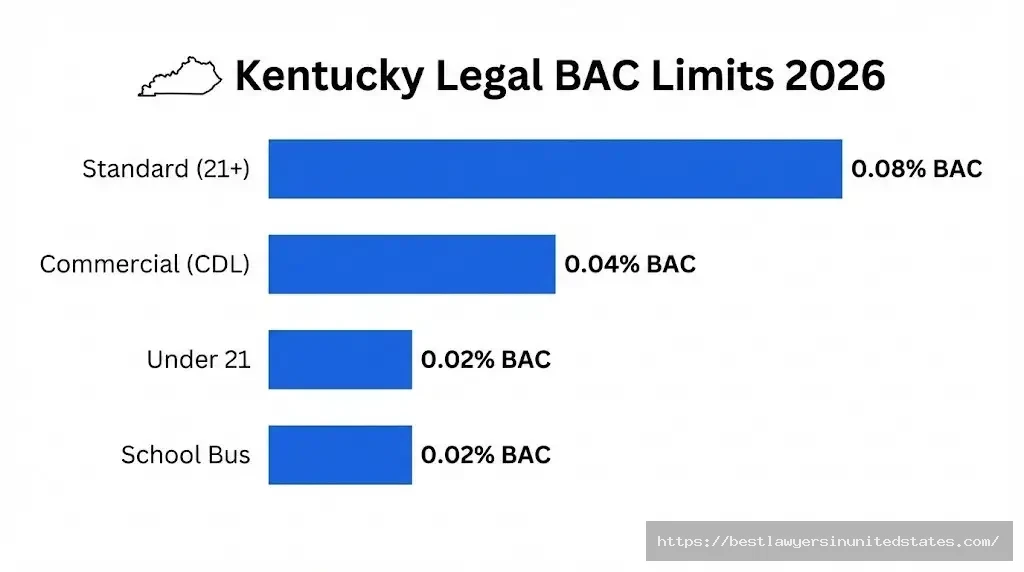
| Driver Type | Legal BAC Limit | Violation Consequences |
|---|---|---|
| Standard (21+) | 0.08% | Criminal DUI charges |
| Commercial (CDL) | 0.04% | Even in personal vehicle |
| Under 21 | 0.02% | Zero tolerance policy |
| School bus drivers | 0.02% | Enhanced penalties |
Commercial drivers face CDL disqualification even when driving personal vehicles. A .04% BAC while off-duty still triggers a 1-year CDL suspension for first offense.
First Offense DUI Penalties in Kentucky
Kentucky treats first-time DUI as a Class B misdemeanor. Penalties increase dramatically with aggravating factors.
Standard First Offense Penalties
| Penalty Type | Minimum | Maximum |
|---|---|---|
| Jail time | 48 hours | 30 days |
| Fines | $200 | $500 |
| Court costs | $185 | $185 |
| License suspension | 30 days | 120 days |
| Community service | 48 hours | 30 days |
Key point: Judges can substitute community service for jail time on first offense. You must complete 48 hours of community service if granted this option.
Mandatory Requirements for First Offense
All first-time offenders must complete:
- Substance abuse evaluation – $150-$300
- DUI education program – $300-$500
- Victim impact panel – $50-$100
- SR-22 insurance filing – 3 years minimum
When First Offense Becomes Aggravated
Kentucky increases first offense penalties for aggravating circumstances:
Aggravating factors:
- BAC of .15% or higher (double the legal limit)
- Child under 12 years old in vehicle
- Causing accident with injuries
- Excessive speed (30+ mph over limit)
- Refusal to submit to BAC testing
Aggravated first offense penalties:
- Minimum 4 days jail (no community service substitution)
- Fines increase to $500-$1,000
- Mandatory ignition interlock device
- Extended license suspension up to 6 months
Second Offense DUI in Kentucky (Within 10 Years)
Second DUI conviction within 10 years escalates to mandatory jail time.
| Penalty Category | Second Offense |
|---|---|
| Jail time | 7 days to 6 months (mandatory) |
| Fines | $350-$500 |
| Court costs | $185 |
| License suspension | 12-18 months |
| Community service | 10-30 days |
| Ignition interlock | Mandatory for reinstatement |
Critical difference: You cannot avoid jail time for second offense. Courts must impose minimum 7 days incarceration. Community service substitution does not apply.
Second Offense Requirements
- 90-day minimum substance abuse treatment program
- Ignition interlock device for minimum 12 months
- SR-22 insurance for 3 years
- Victim impact panel attendance
- Mental health evaluation if ordered
Hardship license eligibility: You must wait 12 months before applying. Ignition interlock device installation is mandatory for hardship license approval.
Third Offense DUI in Kentucky
Third DUI within 10 years remains a misdemeanor but carries substantially harsher penalties.
Third Offense Penalties
| Penalty Type | Amount/Duration |
|---|---|
| Jail time | 30 days to 12 months |
| Fines | $500-$1,000 |
| License suspension | 24-36 months |
| Ignition interlock | 24-48 months |
| Treatment program | 12-month minimum |
No early release: Third offense requires serving full jail sentence. Good time credits and work release programs typically don’t apply.
Third Offense Consequences
- Permanent notation on driving record
- Vehicle may be impounded for 90 days
- Mandatory alcohol monitoring bracelet (SCRAM) in some counties
- Professional license review for doctors, lawyers, nurses
- Concealed carry license suspended (see below)
Fourth Offense DUI – Class D Felony
Fourth DUI conviction within 10 years becomes a Class D felony in Kentucky.
Fourth Offense Felony Penalties
| Penalty Component | Requirement |
|---|---|
| Prison time | 120 days to 5 years |
| Mandatory minimum | 120 days (no early release) |
| Fines | $1,000-$10,000 |
| License revocation | 60 months (5 years) |
| Ignition interlock | 5 years after reinstatement |
| Substance abuse | Long-term treatment mandatory |
Felony conviction means:
- Cannot vote while incarcerated
- Cannot own firearms
- Cannot serve on jury
- Limited employment opportunities
- Professional licenses revoked
- Federal student aid restrictions
No statute of limitations: Kentucky has no time limit for prosecuting felony DUI cases. Misdemeanor DUI must be charged within 1 year of offense.
Implied Consent Law in Kentucky
Every driver in Kentucky automatically consents to BAC testing when accepting a driver’s license. KRS § 189A.105 creates this “implied consent.”
What the Law Requires
Officers must read you the implied consent warning before requesting breath, blood, or urine testing. The warning explains refusal consequences exceed failure consequences.
The warning states:
- You have the right to refuse testing
- Refusal triggers automatic license suspension
- Refusal suspension is longer than failure suspension
- You can request independent testing after official test
Refusal vs. Failure Penalties
| Situation | First Offense | Second Offense |
|---|---|---|
| Refuse test | 6-month suspension | 18-month suspension |
| Fail test | 30-120 day suspension | 12-18 month suspension |
Key point: Refusing costs you 3-6 extra months of suspension compared to failing the test.
Can Police Force Testing?
Officers cannot physically force you to provide breath or blood samples without a warrant. However, Kentucky State Police increasingly obtain telephonic warrants for blood draws in cases involving:
- Accidents with injuries
- Minors in vehicle
- Multiple prior DUI convictions
- Refusal with aggravating circumstances
Search warrant exception: Courts consistently uphold forced blood draws with valid warrants. Warrants usually arrive within 1-2 hours of refusal.
Independent Testing Rights
Kentucky law allows you to request additional testing at your own expense after completing the official test. Officers must provide reasonable opportunity to contact an attorney and arrange independent testing.
Time limit: You must request independent testing within 2 hours of the official test. Most defense attorneys recommend hospital blood draws for accuracy comparison.
Two Separate Suspensions
The administrative suspension runs independently from any criminal court suspension. Even if charges get dismissed, the administrative suspension remains active unless successfully challenged at hearing.
Critical deadline: You have 20 days from arrest to request an administrative hearing. Missing this deadline makes the suspension automatic with no appeal.
How Much Does a DUI Cost in Kentucky?
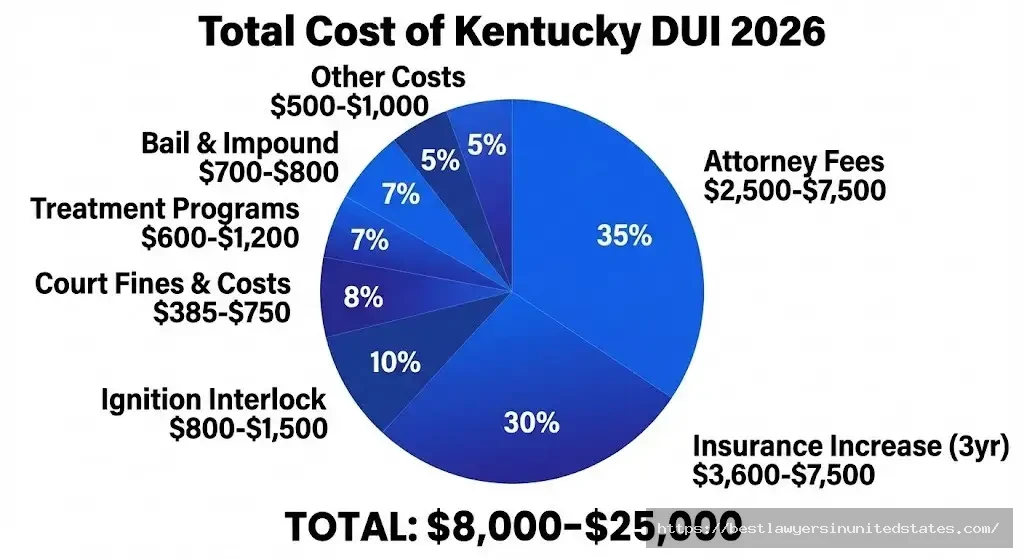
Calculate your total DUI costs using our Kentucky-specific calculator.
DUI Cost Calculator
Estimate total DUI expenses by state and offense
Detailed Cost Breakdown
Payment Timeline
Bail bond, towing fees, car impound, attorney retainer
Initial court fines, DMV fees, DUI school enrollment, ignition interlock installation
Monthly probation fees, ignition interlock fees, DUI school payments, attorney balance
Insurance premium increases, license reinstatement, SR-22 filing fees
- Lost wages from missed work (court dates, jail time, DUI school) – $2,000-$10,000
- Job loss or difficulty finding employment – Varies
- Professional license suspension (doctors, lawyers, nurses, pilots) – Career ending
- Rideshare and transportation costs during suspension – $1,500-$5,000
- Travel restrictions and visa denials – Varies
- Security clearance loss – Career impact
- Child custody implications – Legal costs
- Rental car restrictions – Varies
- Personal relationships and mental health costs – Priceless
Immediate Arrest Costs
Costs you face within 24-48 hours:
| Cost Item | Amount |
|---|---|
| Bail bond | $500-$2,500 |
| Bail bondsman fee | 10% of bail ($50-$250) |
| Vehicle towing | $150-$300 |
| Impound storage | $30-$50 per day |
County variations: Jefferson County (Louisville) and Fayette County (Lexington) typically set bail at $1,000-$2,000 for first offense. Rural counties often use $500-$1,000 bail.
Court and Legal Costs
| Expense Category | Cost Range |
|---|---|
| Court fines | $200-$500 (1st offense) |
| Court costs | $185-$250 |
| Public defender | $200-$500 |
| Private attorney | $2,500-$7,500 |
| Expert witnesses | $500-$2,000 |
Attorney fee factors: Complex cases involving accidents, injuries, or prior convictions cost $5,000-$10,000+. Simple first-offense cases run $1,500-$3,000.
License and Driving Costs
| Item | Cost |
|---|---|
| Administrative hearing fee | $50 |
| License reinstatement | $40 |
| Hardship license application | $20 |
| Ignition interlock installation | $100-$200 |
| Ignition interlock monthly | $75-$125 |
| Ignition interlock removal | $50-$100 |
Ignition interlock total: Expect $800-$1,500 for 12-month requirement.
Treatment and Education Costs
| Requirement | Typical Cost |
|---|---|
| Substance abuse evaluation | $150-$300 |
| DUI education program | $300-$500 |
| Substance abuse treatment | $1,000-$5,000+ |
| Victim impact panel | $50-$100 |
| Drug/alcohol screening | $20-$50 per test |
Kentucky requires completion of all treatment before license reinstatement. Payment plans available through most providers.
Insurance Impact
SR-22 filing requirements:
- 3-year minimum requirement
- $15-$50 one-time filing fee
- Policy cannot lapse or suspension restarts
Rate increases after DUI:
| Coverage Type | Average Increase |
|---|---|
| Full coverage | 80-100% increase |
| Liability only | 60-80% increase |
| Annual cost increase | $1,200-$2,500 |
| 3-year total impact | $3,600-$7,500 |
Rate recovery: Most Kentucky insurers reduce rates after 3-5 years if no additional violations occur. DUI stays on insurance record for 5 years.
Total First Offense Cost Breakdown
Conservative estimate: $8,000-$12,000 Average case: $12,000-$18,000
Complex cases: $18,000-$30,000+
Cost factors increasing total:
- Private attorney vs. public defender (+$2,000-$7,000)
- Jury trial vs. plea bargain (+$3,000-$8,000)
- Accident with property damage (+$5,000-$20,000)
- Injuries involved (+$10,000-$50,000+)
- Lost wages during jail time (varies)
Kentucky License Suspension Timeline
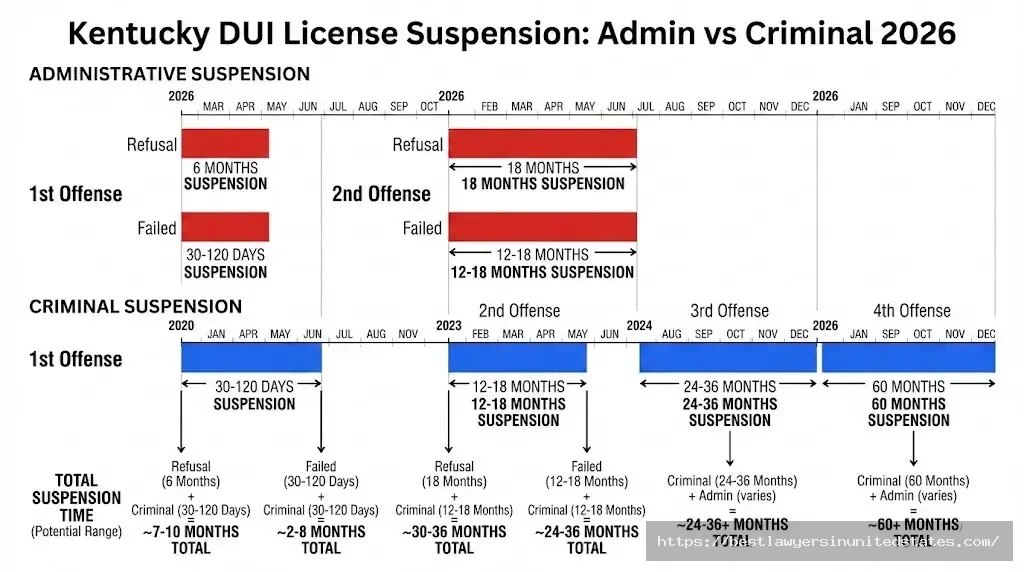
Kentucky separates license suspension into administrative and criminal components.
Administrative License Suspension (ALS)
The Kentucky Transportation Cabinet suspends your license immediately after arrest if you:
- Refuse BAC testing, OR
- Test at .08% or higher
| Offense | Refusal Suspension | Failed Test Suspension |
|---|---|---|
| 1st offense | 6 months | 30-120 days |
| 2nd offense | 18 months | 12-18 months |
| 3rd offense | 24 months | 24-36 months |
| 4th offense+ | 36 months | 60 months |
Temporary permit: Officers issue a pink temporary permit valid for 20 days. This permits driving until the administrative hearing or permit expiration.
Criminal Court Suspension
Judges impose additional license suspension upon conviction:
| Offense Level | Court Suspension |
|---|---|
| 1st conviction | 30-120 days |
| 2nd conviction | 12-18 months |
| 3rd conviction | 24-36 months |
| 4th conviction | 60 months |
Consecutive suspensions: Administrative and criminal suspensions run consecutively, not concurrently. First offense can total 2-8 months without driving privileges.
The 20-Day Deadline
Critical action required: You must request an administrative hearing within 20 days of arrest to challenge the suspension.
How to request hearing:
- Complete hearing request form
- Submit to Kentucky Transportation Cabinet
- Include $50 filing fee
- Keep proof of mailing/delivery
Missing the deadline: Suspension becomes automatic with no right to challenge.
Hardship License Eligibility
Kentucky allows hardship licenses (also called restricted licenses) for work, school, and medical purposes.
Eligibility requirements:
| Offense | Waiting Period | IID Required? |
|---|---|---|
| 1st offense | 30 days | Yes |
| 2nd offense | 12 months | Yes |
| 3rd offense | 24 months | Yes |
| 4th offense | 60 months | Yes |
Permitted travel with hardship license:
- Direct route to/from work
- Direct route to/from school
- Medical appointments
- Court-ordered programs
- Child care (if documented)
Not permitted:
- Grocery shopping
- Social events
- Non-essential errands
- Recreational driving
Kentucky Ignition Interlock Program (KIIP)
The Kentucky Ignition Interlock Program requires approved devices for hardship licenses and post-suspension driving.
How the device works:
- Blow into device before starting car
- Random rolling retests while driving
- Data downloads at monthly service appointments
- Violations reported to Transportation Cabinet
Approved device manufacturers in Kentucky:
- Draeger Interlock
- LifeSafer
- Smart Start
- Intoxalock
Installation locations: Approved service centers operate in Louisville, Lexington, Bowling Green, Owensboro, Paducah, Covington, and other cities.
Violation consequences:
- Missed retest = additional 6 months requirement
- Failed test = hearing and possible extension
- Tampering = criminal charges and suspension
License Reinstatement Process
Steps to reinstate Kentucky license:
- Complete full suspension period – No early reinstatement for good behavior
- Pay all fines and court costs – Get certified payment records
- Complete all treatment programs – Submit completion certificates
- Obtain SR-22 insurance – Insurance company files electronically
- Pay $40 reinstatement fee – At County Clerk or Circuit Court Clerk office
- Pass vision test – Required for some suspensions
- Retake written/driving test – Required after long suspensions
Processing time: 3-5 business days after submitting all documents. Check status online at drive.ky.gov.
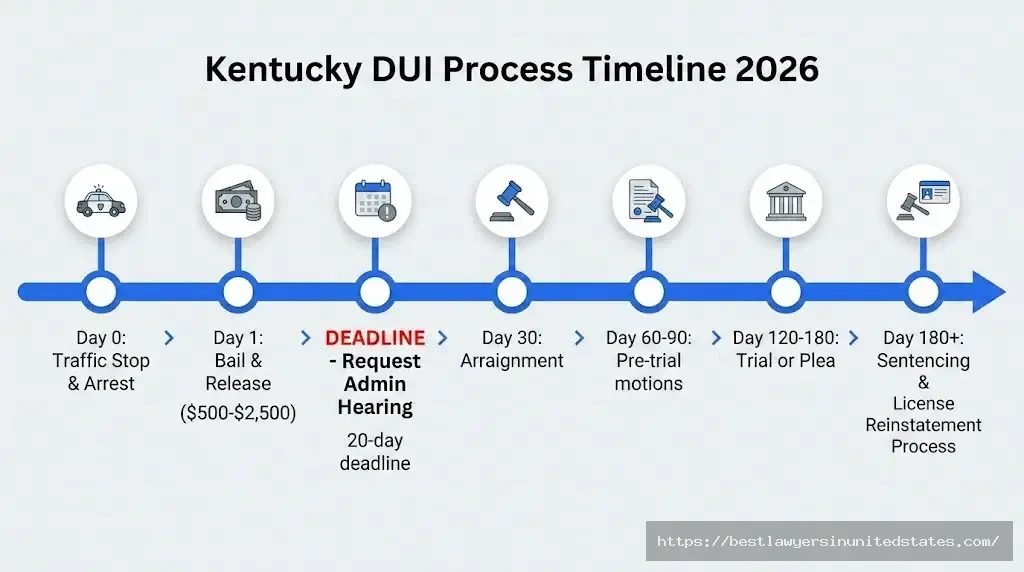
The Kentucky DUI Arrest Process
Understanding each arrest stage helps you protect your rights.
Initial Traffic Stop
Officers need reasonable suspicion to stop your vehicle. Common reasons include:
Traffic violations:
- Speeding or erratic speed
- Weaving within lane or crossing lines
- Failure to signal
- Running red light/stop sign
- Broken headlight or taillight
Driving pattern indicators:
- Wide turns
- Driving too slowly
- Following too closely
- Nearly hitting objects
- Stopping inappropriately
Not sufficient alone: Anonymous tips require officer observation of suspicious driving before valid stop.
Field Sobriety Tests (FSTs)
Officers typically administer three standardized tests:

Horizontal Gaze Nystagmus (HGN):
- Officer watches your eyes track a pen or finger
- Checks for involuntary jerking (nystagmus)
- Most reliable FST according to NHTSA
Walk-and-Turn:
- Walk heel-to-toe along straight line
- Turn and walk back
- Officers watch for balance, steps, turns
One-Leg Stand:
- Stand on one foot for 30 seconds
- Count out loud
- Officers note swaying, hopping, arm use
Your rights during FSTs:
- You can refuse all field sobriety tests
- No penalty for refusing roadside tests
- Officers use refusal to support probable cause
- Medical conditions may affect test performance
Portable Breathalyzer Test (PBT)
Officers offer a handheld breath test device at the roadside.
Important facts about PBTs:
- Results are NOT admissible in Kentucky courts
- Used only to establish probable cause for arrest
- You can refuse without penalty
- Different from official station breath test
Why officers use PBTs: Quick probable cause establishment even though results can’t be used as evidence at trial.
Arrest and Miranda Rights
Officers must read Miranda rights before custodial interrogation. However, they don’t need Miranda warnings for:
- Pre-arrest questions during traffic stop
- Field sobriety test instructions
- PBT administration
- Booking questions (name, address, etc.)
When Miranda matters: Statements made during interrogation without Miranda warnings get suppressed at trial.
Booking and Bail
Booking process includes:
- Fingerprints and photos
- Background check
- Property inventory
- Temporary cell placement
- Bail determination
Bail amounts in major Kentucky counties:
| County | Typical First Offense Bail |
|---|---|
| Jefferson (Louisville) | $1,000-$2,000 |
| Fayette (Lexington) | $1,000-$2,000 |
| Kenton (Covington) | $500-$1,500 |
| McCracken (Paducah) | $500-$1,000 |
| Warren (Bowling Green) | $750-$1,500 |
Higher bail factors: Prior criminal record, out-of-state residence, accident with injuries, or flight risk concerns increase bail amounts to $5,000-$10,000.
The 20-Day Administrative Hearing Deadline
Most critical deadline: Request administrative hearing within 20 days to challenge license suspension.
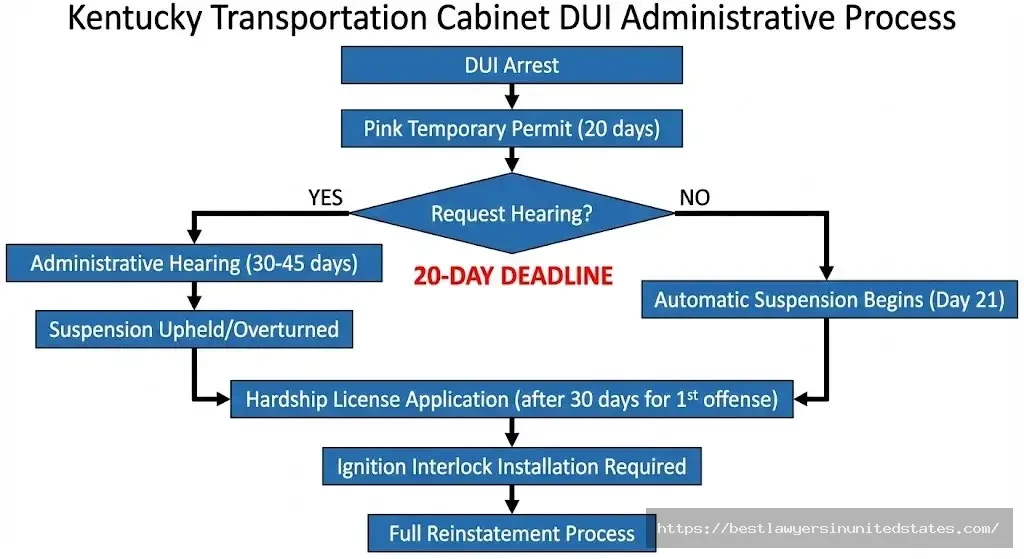
Hearing request process:
- Download form from drive.ky.gov or get at Circuit Court Clerk
- Complete all sections accurately
- Include $50 filing fee (check or money order)
- Submit to Kentucky Transportation Cabinet
- Keep mailing receipt as proof
What happens at hearing:
- Hearing officer reviews arrest circumstances
- Officer must prove lawful stop and probable cause
- You can present evidence and testimony
- Decision typically issued within 10 days
Winning the hearing: Successful challenges result in license reinstatement with no suspension. However, criminal charges proceed separately.
Kentucky DUI Checkpoint Laws
DUI checkpoints (sobriety checkpoints) are legal in Kentucky when properly conducted.
Checkpoint Legal Requirements
Kentucky courts uphold checkpoints only when they meet strict criteria:
Required procedures:
- Supervisor must approve checkpoint plan in advance
- Clear written guidelines for stopping vehicles
- Adequate warning signs and lighting
- Neutral formula for vehicle selection (every car, every 3rd car, etc.)
- Minimal detention time
- Safety considerations for public and officers
Common checkpoint locations in Kentucky:
- Interstate exits near downtown Louisville and Lexington
- Holiday weekends (New Year’s, July 4th, Labor Day)
- Major events (Kentucky Derby, Thunder Over Louisville)
- High-DUI corridors identified by state data
Your Rights at Checkpoints
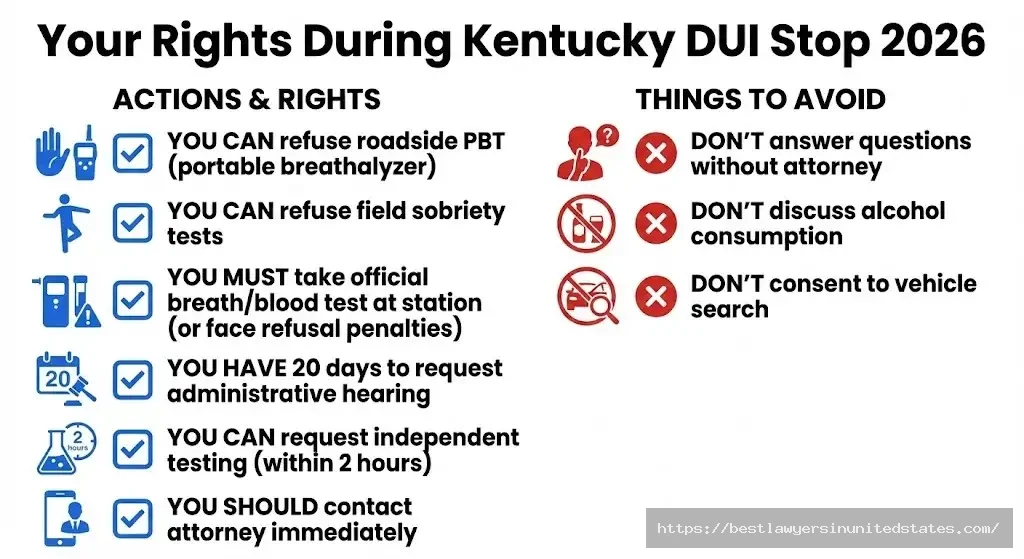
You must:
- Stop when directed by officers
- Provide license, registration, and insurance
- Answer basic identification questions
You can:
- Refuse field sobriety tests
- Refuse portable breath tests
- Refuse vehicle searches (without warrant or probable cause)
- Ask if you’re free to leave
You should NOT:
- Attempt to avoid checkpoint by illegal turn
- Refuse to stop
- Become confrontational
- Lie to officers
Avoiding Checkpoints Legally
Legal avoidance: You can turn around before entering checkpoint if you:
- Don’t violate traffic laws
- Don’t drive erratically
- Make safe, normal turn
Common mistake: Officers often position observation posts before checkpoints. Abrupt turns or illegal maneuvers give officers reasonable suspicion for traffic stops.
How to Beat a DUI in Kentucky
Several defense strategies succeed in Kentucky DUI cases.
Challenging the Traffic Stop
Officers need reasonable suspicion to stop your vehicle. Stops without legal justification lead to case dismissal.
Successful stop challenges:
- Anonymous tip without officer observation
- Checkpoint not meeting legal requirements
- Stop based on racial profiling
- Following too closely by itself
- Weaving within lane on curved roads
Key evidence: Dashcam and body camera footage often prove stops lack reasonable suspicion.
The 2-Hour Rule Defense
KRS § 189A.103 requires testing within 2 hours of driving or being in physical control.
When delays benefit defense:
- Hospital transport delayed testing past 2 hours
- Broken breathalyzer machine required alternative
- Officer waited for backup before transport
- Booking delays pushed test beyond window
Defense argument: Body metabolizes alcohol over time. Tests after 2 hours don’t accurately reflect BAC while driving.
Breathalyzer Calibration Issues
Kentucky requires quarterly calibration checks on all breath testing devices. Defense attorneys frequently subpoena maintenance records.
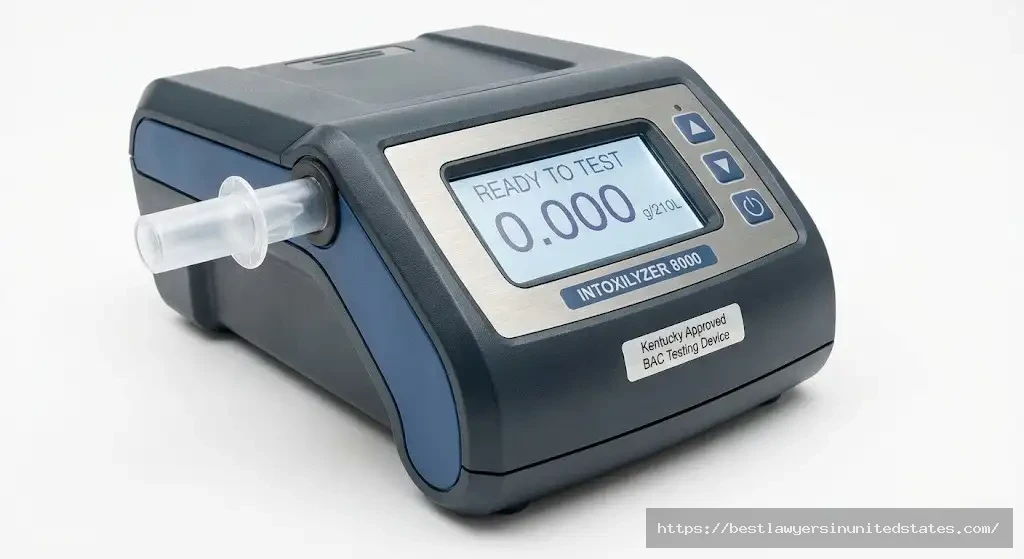
Calibration problems leading to suppression:
- Missed calibration appointments
- Failed accuracy checks
- Improper maintenance documentation
- Simulator solution beyond expiration date
- Operator certification expired
Breathalyzer models in Kentucky:
- Intoxilyzer 8000 (most common)
- DataMaster DMT
- Alco-Sensor IV (preliminary screening)
Blood Test Chain of Custody
Blood sample handling follows strict protocols. Any break in chain of custody can invalidate results.
Required chain of custody steps:
- Licensed phlebotomist draws blood
- Proper vial with preservative used
- Sample sealed and labeled
- Storage at proper temperature
- Transport to accredited lab
- Analysis by certified technician
- Result reporting to court
Defense investigations: Attorneys request complete chain of custody documentation showing every person who handled sample with dates and times.
Medical Conditions Affecting Tests
Certain medical conditions produce false positive results or affect test performance.
Conditions affecting breath tests:
- Diabetes (acetone in breath mimics alcohol)
- GERD/acid reflux (brings stomach alcohol to mouth)
- Hypoglycemia (low blood sugar)
- Asthma inhalers (contain alcohol)
Conditions affecting field sobriety tests:
- Inner ear problems
- Leg injuries or arthritis
- Neurological disorders
- Vision problems
- Obesity
- Age over 65
Supporting evidence: Medical records, doctor testimony, and medical expert witnesses establish these defenses.
Miranda Violations
Statements made during custodial interrogation without Miranda warnings get suppressed.
Common Miranda violations:
- Officer questioning during transport before reading rights
- Continued questioning after suspect invokes right to attorney
- Coercive interrogation tactics
- Failure to re-advise after significant time gap
What gets suppressed: Incriminating statements about alcohol consumption, time of last drink, awareness of intoxication.
Illegal Searches
Officers need probable cause or your consent to search your vehicle.
Illegal search scenarios:
- Search before arrest without probable cause
- Search after refusal and no warrant
- Search of trunk or closed containers without cause
- Extending stop unreasonably to wait for K-9
Fruit of poisonous tree: Evidence from illegal searches gets suppressed at trial.
When Can a DUI Be Dismissed in Kentucky?
Several circumstances lead to DUI case dismissal.
Insufficient Evidence
Prosecutors must prove guilt beyond reasonable doubt. Cases get dismissed when:
Missing elements:
- No proof of operating vehicle
- No reliable BAC evidence
- Conflicting officer testimony
- Lost or destroyed evidence
- Witnesses unavailable
Example: DUI arrest where officers found defendant sleeping in parked car with engine off. Prosecution cannot prove “operation” of vehicle.
Procedural Errors
Cases dismissed for violations of defendant’s rights or court procedures:
Common procedural grounds:
- Speedy trial violation (cases languishing over 1 year)
- Discovery violations by prosecution
- Brady violations (withholding exculpatory evidence)
- Violation of plea agreement terms
Officer Misconduct
Serious officer misconduct can result in dismissal:
Dismissal-worthy misconduct:
- Perjury or false testimony
- Evidence tampering
- Illegal search or seizure
- Excessive force during arrest
Diversion Programs
First-time offenders may qualify for pretrial diversion in some Kentucky counties.
Diversion requirements:
- No prior DUI convictions
- No accident with injuries
- Complete supervision period (typically 12 months)
- Substance abuse treatment
- Random drug/alcohol testing
- Pay all fees and costs
Diversion result: Case dismissed upon successful completion. No criminal conviction on record.
County availability: Jefferson County, Fayette County, and some other urban counties offer diversion. Rural counties typically don’t have formal programs.
Seth’s Law: Kentucky’s 2025 DUI Updates
Recent searches indicate changes to Kentucky DUI laws in 2025. Seth’s Law references appear in search data.
What We Know About 2025 Changes
As of early 2026, Kentucky has implemented recent DUI law modifications affecting:
Potential changes (verify with Kentucky Transportation Cabinet):
- Enhanced penalties for repeat offenders
- Modified ignition interlock requirements
- Updated testing procedures
- Strengthened checkpoint protocols
Legislative reference: House Bill 220 and related DUI legislation passed in recent sessions.
Best source for updates: Check the Kentucky Legislature website at legislature.ky.gov for enacted DUI legislation.
How New Laws Affect Your Case
Grandfather clauses: Most penalty enhancements apply only to offenses committed after effective date. Prior convictions sentenced under old law remain unchanged.
Attorney knowledge: Hiring experienced Kentucky DUI attorneys ensures your defense accounts for recent law changes.
Special Circumstances in Kentucky DUI Cases
DUI with Child in Vehicle
Driving under the influence with a child under 12 years old in the vehicle creates aggravated DUI in Kentucky.
Enhanced penalties:
- Mandatory minimum 4 days jail (first offense)
- Fines increase to $500-$1,000
- Extended license suspension
- Automatic Child Protective Services (CPS) investigation
- Possible child endangerment charges (separate offense)
CPS investigation process:
- Agency receives notification from law enforcement
- Home visit and interview within 24-48 hours
- Assessment of child safety
- Possible removal if immediate danger found
- Court proceedings if abuse/neglect suspected
Long-term impact: CPS findings remain on record and may affect custody disputes, fostering, or employment with children.
Commercial Drivers (CDL) and DUI
Commercial driver’s license holders face stricter BAC limits and harsher disqualification periods.
| Offense | CDL Disqualification | Personal License |
|---|---|---|
| First .04% BAC | 1 year | Separate criminal suspension |
| Second .04% BAC | Lifetime | Separate criminal suspension |
| Hazmat endorsement | Immediate revocation | Permanent with conviction |
| School bus drivers | Enhanced penalties | Separate review |
Critical points for CDL holders:
- .04% BAC limit applies even in personal vehicle
- Refusal triggers same disqualification as failure
- Out-of-state DUI reported to Kentucky
- Federal regulations more restrictive than state law
Hardship CDL: Kentucky does not issue hardship commercial licenses. CDL disqualification means you cannot drive commercially during suspension period.
Lifetime disqualification reduction: After 10 years, you may apply to reduce lifetime ban to 10-year disqualification. Requires completion of approved rehabilitation program.
Underage DUI (Under 21)
Kentucky enforces zero tolerance for underage drinking and driving.
Underage BAC limits:
- .02% or higher triggers DUI charges
- .08% or higher prosecuted as adult DUI
- Any detectable amount may result in charges
Underage first offense penalties:
| Penalty Type | Amount |
|---|---|
| Fine | $100-$500 |
| License suspension | 30-180 days |
| Community service | 20-80 hours |
| Alcohol education | Mandatory |
| Substance abuse eval | Required |
College impact: DUI conviction can result in:
- Loss of scholarships
- Suspension from school
- Dismissal from athletic teams
- Denial of financial aid
- Career limitations (teaching, law, medicine)
Parental notification: Courts notify parents/guardians of all underage DUI charges and convictions.
Marijuana and Drug DUI
Kentucky has no specific THC limit for marijuana DUI. Prosecutors must prove impairment through other evidence.
How police detect drug impairment:
- Drug Recognition Expert (DRE) evaluation
- Blood testing for drug metabolites
- Field sobriety test performance
- Officer observations of behavior
- Physical symptoms (red eyes, odor, speech)
Prescription medication DUI: Legal prescriptions do not provide defense. Kentucky law prohibits driving while impaired by any substance, including:
- Pain medications (opioids)
- Anxiety medications (benzodiazepines)
- Sleep medications (Ambien, etc.)
- Muscle relaxers
Blood vs. urine testing:
- Blood tests detect active THC (recent use)
- Urine tests detect THC metabolites (use within days/weeks)
- Courts prefer blood tests for accuracy
Defense challenges: THC metabolites remain in system long after impairment ends. Defense attorneys challenge whether positive test proves impairment while driving.
Out-of-State DUI Affecting Kentucky License
Kentucky participates in the Driver License Compact and reports to the National Driver Register.
How out-of-state DUI affects you:
- Other states report conviction to Kentucky
- Kentucky treats out-of-state DUI same as in-state
- Counts toward 10-year lookback period
- Triggers suspension on Kentucky license
- Insurance rates increase
States not in compact: Georgia, Massachusetts, Michigan, Tennessee, and Wisconsin have limited participation. However, most states share serious violations like DUI.
Multiple state licenses: You cannot avoid consequences by obtaining license in another state. All states check national databases before issuing licenses.
How Long Does a DUI Stay on Your Record in Kentucky?
DUI convictions remain on your criminal record permanently in Kentucky.
Criminal Record Impact
Conviction remains forever: Kentucky does not automatically remove DUI convictions from criminal records, regardless of time passed.
Record access:
- Law enforcement sees full record
- Employers see record through background checks
- Courts see record for sentencing enhancements
- Insurance companies access driving record
Employment Background Checks
Most Kentucky employers conduct criminal background checks. DUI appears on:
7-year background checks:
- Standard pre-employment screening
- Credit-related positions
- Security clearances
10-year background checks:
- Law enforcement positions
- Government jobs
- Healthcare positions
- Jobs involving driving
Lifetime checks:
- Professional licenses (doctors, lawyers, nurses)
- Teaching certificates
- Financial industry positions
How to address DUI on applications:
- Be honest if asked about convictions
- Explain circumstances briefly
- Emphasize rehabilitation and changes made
- Provide character references
Insurance Record Duration
DUI remains on insurance record for 3-5 years in Kentucky. Most insurers:
- Check 3-year driving record for standard policies
- Check 5-year record for high-risk drivers
- Drop surcharges after 5 years without violations
Rate recovery timeline:
| Years Since DUI | Average Rate Impact |
|---|---|
| 0-1 years | 80-100% increase |
| 1-3 years | 60-80% increase |
| 3-5 years | 30-50% increase |
| 5+ years | Returns to normal (if clean record) |
DUI Expungement in Kentucky
Kentucky allows expungement of some DUI convictions under specific conditions.
Expungement Eligibility
Misdemeanor DUI expungement:
- Must wait 5 years from completion of sentence
- Only one misdemeanor expungement lifetime
- All fines, costs, and restitution paid in full
- No pending charges
- No other convictions during waiting period
Felony DUI: Generally not eligible for expungement. Fourth-offense felony DUI conviction remains on record permanently.
Exceptions: Dismissed charges, acquittals, and diverted cases may be expunged immediately.
Expungement Process Step-by-Step
1. Wait required period – 5 years from completion of all sentence requirements (jail, probation, treatment)
2. Obtain court documents:
- Certified copy of judgment
- Proof of completion of all requirements
- Payment records for fines and costs
3. File petition in District Court:
- Use form AOC-497 (available at courts or aoc.ky.gov)
- File in county where conviction occurred
- Include $100-$500 filing fee (varies by county)
4. Serve notice:
- County Attorney must receive notice
- Victims entitled to notice for some cases
- Allow 60-day objection period
5. Attend hearing:
- Judge reviews petition and objections
- Prosecutors may argue against expungement
- Your attorney presents why expungement warranted
6. Receive order:
- Judge grants or denies petition
- Order sent to Kentucky State Police
- Records sealed within 30-60 days
Expungement Costs
| Expense | Amount |
|---|---|
| Court filing fee | $100-$500 |
| Service of process | $20-$50 |
| Attorney fees | $500-$1,500 |
| Court reporter (if needed) | $150-$300 |
| Total cost | $600-$2,000 |
What Expungement Does (and Doesn’t Do)
What gets sealed:
- Court records from public access
- Kentucky State Police records
- Administrative agency records
- Background check results
What remains:
- FBI records (federal databases)
- Internal law enforcement databases
- Insurance company records may retain information
- Internet articles or news reports not removed
Employment questions: After expungement, you can legally answer “no” to questions about criminal convictions in most situations. Exceptions include:
- Law enforcement applications
- Jobs working with vulnerable populations
- Professional licenses requiring disclosure
Concealed Carry Impact in Kentucky
DUI convictions affect concealed carry licenses under Kentucky law.
When DUI Affects Gun Rights
First DUI conviction:
- No impact on concealed carry license
- Can still carry concealed weapons
- Gun ownership rights unaffected
Second DUI conviction:
- Concealed Carry Deadly Weapons (CCDW) license suspended
- Must surrender license within 7 days
- Cannot carry concealed weapons
- Gun ownership rights remain (can possess at home)
Third or subsequent DUI:
- Permanent CCDW revocation
- Cannot reapply for concealed carry license
- Gun ownership rights remain unless felony conviction
Constitutional Carry Exception
Kentucky enacted constitutional carry in 2019, allowing concealed carry without license for those legally entitled to possess firearms.
Impact of DUI on constitutional carry:
- First DUI: No impact
- Second DUI: Cannot carry concealed (violation is misdemeanor)
- Felony DUI: Cannot possess firearms at all
Restoration Process
After second DUI:
- Wait 5 years from completion of sentence
- Petition for CCDW license restoration
- Demonstrate rehabilitation
- Pay $25 restoration fee
Factors courts consider:
- Completion of treatment programs
- No subsequent violations
- Character references
- Employment stability
Travel Restrictions After Kentucky DUI
DUI conviction creates international travel complications.
Canada Entry Denied
Canada treats DUI as serious criminal offense equivalent to felony. DUI conviction makes you inadmissible to Canada.
Timeline for Canada entry:
- During probation: Automatic denial
- 5 years after completion: May apply for rehabilitation
- 10 years after completion: Deemed rehabilitated (may enter without application)
Temporary Resident Permit (TRP): Allows single entry to Canada for specific purpose. Costs $200 CAD and requires application several months in advance.
Criminal Rehabilitation: Permanent solution allowing future entries. Requires:
- $1,000 CAD application fee
- 5 years since completion of sentence
- Evidence of rehabilitation
- 12-18 month processing time
Other Countries with DUI Restrictions
Countries that may deny entry for DUI:
- Mexico (at border agent discretion)
- United Arab Emirates
- Japan (for some offenses)
- Australia (visa applications ask about convictions)
- New Zealand
- China
European Union: Most EU countries don’t automatically deny entry for DUI, but visa applications ask about criminal history.
Best practice: Check entry requirements for specific country well before travel. Consider consulting immigration attorney for complex situations.
Avoiding a DUI in Kentucky
Prevention strategies help avoid the costs and consequences of DUI.
Understanding Your Limits
Most people cannot accurately judge their own intoxication level. Use our BAC calculator to estimate blood alcohol content.
General BAC guidelines:
| Drinks (12oz beer, 5oz wine, 1.5oz liquor) | BAC Range (average 170lb male) |
|---|---|
| 1 drink | .02% |
| 2 drinks | .04% |
| 3 drinks | .08% |
| 4 drinks | .10% |
| 5 drinks | .12% |
Factors affecting BAC:
- Body weight (lower weight = higher BAC)
- Gender (women reach higher BAC faster)
- Food consumption (food slows absorption)
- Time span (one drink per hour metabolizes)
- Medication interactions
Myth: Sobering up techniques DON’T work:
- Coffee doesn’t reduce BAC
- Cold showers don’t speed metabolism
- Fresh air doesn’t eliminate alcohol
- Food after drinking has minimal effect
Only time reduces BAC: Body metabolizes approximately one standard drink per hour. No shortcuts exist.
Safe Transportation Alternatives
Rideshare services:
- Uber and Lyft operate in Louisville, Lexington, Northern Kentucky
- Cost: $10-$30 for most local trips
- Available 24/7 in urban areas
- Much cheaper than DUI consequences
Traditional taxis:
- zTrip (Louisville, Lexington)
- Local taxi companies in smaller cities
- May require advance call in rural areas
Public transportation:
- TARC (Louisville) – buses run until midnight weekdays
- Lextran (Lexington) – limited night service
- TANK (Northern Kentucky) – connects to Cincinnati
Designated driver:
- Agree before drinking who stays sober
- Rotate responsibility among friend group
- Many bars offer free soft drinks for designated drivers
Stay overnight:
- Hotels near entertainment districts
- Friend’s house
- Sleep in car (parked safely, keys outside vehicle)
Kentucky DUI Prevention Programs
Drive Safe Holiday Program:
- Free or reduced Uber/Lyft rides on major holidays
- Partners with local bars and restaurants
- Check with local AAA chapters
MADD programs:
- Victim impact panels
- Youth education programs
- Information at madd.org
Local law enforcement initiatives:
- Saturation patrols during holidays
- Increased DUI checkpoints
- Public awareness campaigns
Frequently Asked Questions
Is a DUI a felony in Kentucky?
Quick Answer: Fourth DUI within 10 years becomes a Class D felony in Kentucky. First through third offenses are misdemeanors.
Kentucky uses a 10-year lookback period to count prior DUI convictions. Your fourth conviction within that window escalates to felony status, carrying 120 days to 5 years in prison. Felony DUI creates permanent consequences including firearm restrictions, voting rights loss during incarceration, and professional license revocation.
How likely is jail time for first DUI in Kentucky?
Quick Answer: First DUI in Kentucky requires minimum 48 hours jail or 48 hours community service. Most judges allow community service substitution for first offense without aggravating factors.
Aggravating circumstances change this calculation. BAC of .15% or higher, child in vehicle, accidents with injuries, or excessive speed typically result in actual jail time even for first offense. Expect minimum 4 days jail for aggravated first offense. Judges rarely grant community service for aggravated charges.
What is the 2-hour rule for DUI in Kentucky?
Quick Answer: Kentucky requires BAC testing within 2 hours of driving or being in physical control of a vehicle. Tests conducted after 2 hours face admissibility challenges.
KRS § 189A.103 establishes this requirement to ensure test accuracy. Body metabolizes alcohol over time, so delayed testing may not reflect BAC while driving. Defense attorneys frequently challenge late tests, especially when delays stem from hospital visits, equipment malfunctions, or officer errors. Courts may exclude test results obtained significantly after the 2-hour window.
Can you refuse a breathalyzer in Kentucky?
Quick Answer: You can refuse, but refusal triggers 6-month license suspension for first offense, compared to 30-120 days for failing the test.
Kentucky’s implied consent law means you agreed to testing when accepting your driver’s license. Refusal carries harsher administrative penalties than failure. However, refusal eliminates the most damaging evidence against you. Some attorneys recommend refusal, others advise testing. The decision depends on individual circumstances and should be made with attorney consultation if possible.
How long do you lose your license for a DUI in Kentucky?
Quick Answer: First offense DUI results in 30-120 day criminal suspension plus 30-120 day administrative suspension. Refusal causes 6-month administrative suspension.
License suspension varies by:
- Offense number (second = 12-18 months, third = 24-36 months)
- Whether you refused or failed testing (refusal = longer)
- Administrative vs. criminal suspension (separate proceedings)
- Judge’s discretion within statutory ranges
Hardship licenses become available after waiting periods: 30 days for first offense, 12 months for second, 24 months for third.
How much is bail for a DUI in Kentucky?
Quick Answer: First offense DUI bail typically ranges from $500-$2,000 depending on county. Jefferson County (Louisville) and Fayette County (Lexington) average $1,000-$2,000.
Rural counties often set lower bail ($500-$1,000) while urban areas charge more. Factors increasing bail include:
- Prior criminal record
- Out-of-state residence
- Accident with injuries
- High BAC (.15% or above)
- Refusal to cooperate with police
Aggravated circumstances or prior DUI convictions can push bail to $5,000-$10,000.
What are the new DUI laws in Kentucky 2025?
Quick Answer: Recent Kentucky legislation includes enhanced penalties for repeat offenders and modified ignition interlock requirements under provisions commonly referenced as Seth’s Law.
House Bill 220 and related legislation modified DUI penalties and procedures. Specific changes include strengthened enforcement mechanisms and updated testing protocols. For most current information, check the Kentucky Legislature website at legislature.ky.gov or consult with a Kentucky DUI attorney familiar with recent statutory changes.
Is an aggravated DUI a felony in Kentucky?
Quick Answer: Aggravated DUI remains a misdemeanor for first through third offense. Only fourth offense DUI becomes a felony in Kentucky.
However, aggravated DUI carries enhanced misdemeanor penalties including:
- Mandatory minimum jail time (4 days minimum)
- Higher fines ($500-$1,000)
- Extended license suspension
- Mandatory ignition interlock device
Aggravating factors include BAC .15% or higher, child under 12 in vehicle, causing accident with injuries, or excessive speed.
How many DUIs is a felony in Kentucky?
Quick Answer: Fourth DUI conviction within 10 years becomes a Class D felony in Kentucky.
Kentucky’s 10-year lookback period means all DUI convictions within that timeframe count toward enhancement. Your fourth conviction carries:
- 120 days to 5 years prison (mandatory 120-day minimum)
- $1,000-$10,000 fines
- 60-month license revocation
- Permanent felony record
- Firearm ownership restrictions
No statute of limitations exists for prosecuting felony DUI in Kentucky.
Can a DUI be dismissed in Kentucky?
Quick Answer: Yes, DUI charges can be dismissed for insufficient evidence, illegal stops, procedural errors, or suppressed test results. Successful defense requires experienced attorney.
Common dismissal grounds include:
- Illegal traffic stop without reasonable suspicion
- Failed breathalyzer calibration
- Blood test chain of custody breaks
- Testing conducted after 2-hour window
- Miranda violations
- Officer misconduct
First-time offenders in some counties may qualify for pretrial diversion programs resulting in dismissal upon successful completion.
How much does a DUI lawyer cost in Kentucky?
Quick Answer: Kentucky DUI attorneys charge $1,500-$3,000 for simple first-offense cases. Complex cases involving accidents, injuries, or trial cost $5,000-$10,000+.
Attorney fees depend on:
- Case complexity
- Number of prior offenses
- Whether case goes to trial
- Evidence suppression motions required
- County location
- Attorney experience level
Public defenders available for those who qualify financially, typically charging $200-$500 court-appointed counsel fee. Find DUI lawyers in Kentucky for free consultation.
How long does a DUI stay on your record in Kentucky?
Quick Answer: DUI conviction remains on your Kentucky criminal record permanently. It appears on background checks for 7-10 years for employment purposes and affects insurance for 3-5 years.
Kentucky does not automatically remove DUI convictions. Expungement possible for first-offense misdemeanor DUI after 5-year waiting period. Felony DUI generally cannot be expunged and remains visible indefinitely on criminal background checks.
Can you get a DUI expunged in Kentucky?
Quick Answer: First-offense misdemeanor DUI can be expunged after 5 years from completion of sentence. Costs $600-$2,000 total. Felony DUI cannot be expunged.
Expungement requirements:
- 5-year waiting period from end of probation
- All fines and costs paid in full
- No new criminal charges
- Only one misdemeanor expungement allowed lifetime
- File petition in District Court with $100-$500 fee
Successful expungement seals court records from public view. You can legally deny conviction on most employment applications after expungement.
Does a DUI show up on a background check in Kentucky?
Quick Answer: Yes, DUI convictions appear on Kentucky background checks for 7-10 years for employment screening. Law enforcement and professional licensing boards see conviction permanently.
Background check scope determines visibility:
- 7-year checks: Most employment screening
- 10-year checks: Government jobs, healthcare, education
- Lifetime checks: Law enforcement, professional licenses
Expungement removes DUI from public background checks but may still appear on FBI databases and internal law enforcement systems.
Do you lose your license immediately after a DUI in Kentucky?
Quick Answer: Yes, Kentucky officers confiscate your physical license at arrest. You receive a pink temporary permit valid for 20 days while awaiting administrative hearing.
License suspension begins after:
- 20-day temporary permit expires, OR
- Administrative hearing upholds suspension, OR
- You don’t request hearing within 20 days
Criminal court suspension begins upon conviction, running separately from administrative suspension. Both suspensions may apply consecutively, resulting in longer total suspension period.
What is a hardship license in Kentucky?
Quick Answer: Hardship license (restricted license) allows driving to work, school, and medical appointments during suspension. Requires ignition interlock device and 30-day minimum waiting period for first offense.
Eligibility timeline:
- First offense: 30-day wait
- Second offense: 12-month wait
- Third offense: 24-month wait
Permitted travel with hardship license limited to:
- Direct route to/from employment
- School attendance
- Medical appointments
- Court-ordered programs
Violations of hardship license restrictions result in revocation and extended suspension.
How much does a DUI increase insurance in Kentucky?
Quick Answer: Kentucky auto insurance rates increase 80-100% after DUI conviction, averaging $1,200-$2,500 additional cost per year for 3-5 years. Total 3-year impact: $3,600-$7,500.
SR-22 filing requirement adds to costs:
- 3-year minimum SR-22 requirement
- $15-$50 one-time filing fee
- Higher premiums for high-risk insurance
Rates typically return to normal 5 years after DUI if no additional violations occur. Shopping multiple insurance companies helps find lower rates after DUI. Calculate your DUI costs including insurance increases.
Can you get a CDL with a DUI in Kentucky?
Quick Answer: First-time DUI results in 1-year CDL disqualification. Second DUI causes lifetime CDL disqualification in Kentucky. No hardship commercial licenses available.
Commercial drivers face:
- .04% BAC limit even in personal vehicle
- Mandatory disqualification (no hardship CDL)
- Lifetime ban after second offense
- Possible 10-year reduction of lifetime ban after rehabilitation
Consider career change if commercial driving is primary livelihood, as DUI essentially ends CDL driving career after second offense.
What happens if you get a DUI with a child in the car?
Quick Answer: DUI with child under 12 in vehicle creates aggravated DUI with mandatory 4-day jail minimum, higher fines, and automatic Child Protective Services investigation.
Enhanced penalties include:
- Minimum 4 days jail (no community service option)
- Fines increase to $500-$1,000
- Extended license suspension
- Separate child endangerment charges possible
- CPS investigation and potential removal
Long-term consequences affect custody arrangements, visitation rights, and employment with children. CPS findings remain on record indefinitely.
How does a DUI affect your concealed carry license?
Quick Answer: First DUI has no impact on concealed carry. Second DUI triggers concealed carry license suspension. Third DUI results in permanent concealed carry revocation in Kentucky.
Gun rights impact:
- First DUI: No effect on CCDW or gun ownership
- Second DUI: CCDW suspended, must surrender within 7 days
- Third+ DUI: Permanent CCDW revocation
- Felony DUI: Cannot possess firearms at all
Restoration possible 5 years after second DUI completion with rehabilitation demonstration.
Kentucky DUI Resources

Substance Abuse Treatment Programs
Kentucky requires state-approved treatment programs for license reinstatement.
Major providers:
- Comprehend Inc. (statewide locations)
- Bluegrass.org (Lexington area)
- The Brook (Louisville, Lexington)
- NorthKey Community Care (Northern Kentucky)
- Seven Counties Services (Louisville metro)
Cost range: $500-$5,000+ depending on:
- Outpatient vs. inpatient
- Program duration
- Insurance coverage
- Income-based sliding scale
DUI Education Programs
State-approved DUI education satisfies court requirements.
Program requirements:
- 10-20 hours of education
- Topics: alcohol effects, legal consequences, risk assessment
- Cost: $300-$500
- Available online and in-person
Approved providers: Check Kentucky Transportation Cabinet website for current list of approved programs.
Legal Resources
Kentucky Bar Association:
- Lawyer referral service: 502-564-3795
- Online search: kybar.org
- Free consultation programs
Public Defender offices:
- Louisville: 502-574-3300
- Lexington: 859-246-2800
- Covington: 859-292-6528
- Paducah: 270-575-7200
Legal Aid:
- Legal Aid Network of Kentucky: 502-584-1254
- Eligibility based on income (typically 125% of federal poverty level)
Support Groups
Alcoholics Anonymous (AA):
- Louisville: 502-582-1849
- Lexington: 859-276-9956
- Northern Kentucky: 859-291-1131
- Meetings throughout Kentucky at aa-ky.org
SMART Recovery:
- Science-based alternative to 12-step programs
- Online and in-person meetings
- smartrecovery.org
Mothers Against Drunk Driving (MADD):
- Victim support services
- Court support programs
- Online resources at madd.org
Conclusion
Kentucky DUI laws impose serious consequences starting with first offense. The 10-year lookback period, 2-hour testing rule, and strict commercial driver provisions make Kentucky’s DUI laws stricter than many neighboring states.
Understanding your rights during traffic stops, the 20-day administrative hearing deadline, and available defense strategies significantly impacts case outcomes. Whether you face first-offense charges or multiple convictions, consulting an experienced Kentucky DUI attorney provides the best chance for favorable results.
Prevention remains the most effective strategy. Use rideshare services, designated drivers, or stay overnight rather than risking the $8,000-$25,000 cost and life-changing consequences of DUI conviction.
Take action immediately if arrested:
- Request administrative hearing within 20 days
- Consult DUI attorney before any court appearance
- Document all arrest circumstances while memory is fresh
- Begin researching treatment programs and hardship license requirements
Contact Kentucky DUI lawyers for free consultation on your specific situation.