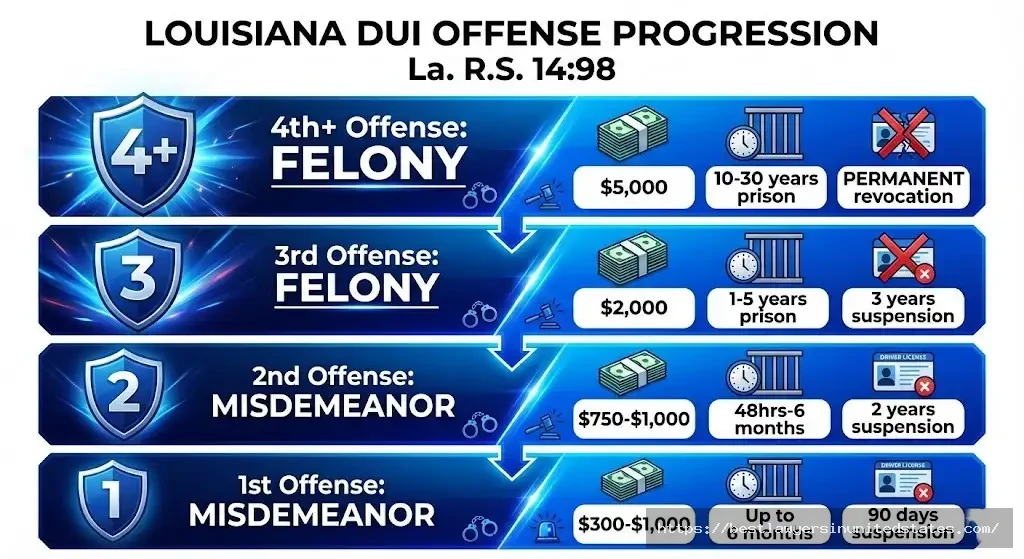
Louisiana enforces some of the strictest DUI laws in the South under Louisiana Revised Statute 14:98. A first-offense DUI carries fines up to $1,000, up to 6 months in jail, and license suspension for 90 days. The state uses a 10-year lookback period for repeat offenses, and your third DUI becomes a felony with mandatory prison time.
This guide covers everything you need to know about Louisiana DUI laws in 2026, including exact penalties, court procedures, and costs.
What Is a DUI in Louisiana?
Louisiana law defines DUI as “Operating While Intoxicated” under La. R.S. 14:98. You commit a DUI when you operate any vehicle while under the influence of alcohol, drugs, or controlled substances that substantially impair your driving ability.
Key point: Louisiana uses “OWI” in the statute, but everyone calls it DUI or DWI. They all mean the same thing.
Louisiana’s Legal Definition
The law recognizes two ways to prove DUI:
Impairment-based DUI: Officers observe signs of impairment like slurred speech, failed field sobriety tests, or erratic driving. Your BAC doesn’t matter if the officer can prove impairment.
Per se DUI: Your BAC meets or exceeds the legal limit. The prosecutor doesn’t need to prove actual impairment.
What Counts as “Operating” a Vehicle?
You don’t need to be driving to get charged. Louisiana courts have convicted people who were:
- Sitting in a parked car with keys in the ignition
- Sleeping in the driver’s seat with the engine running
- Pushing a broken-down vehicle on the shoulder
Critical point: If you have the ability to make the vehicle move, you’re “operating” it under Louisiana law.
DUI vs DWI in Louisiana: Is There a Difference?
No. Louisiana law uses the term “Operating While Intoxicated” (OWI) in La. R.S. 14:98, but people use DUI and DWI interchangeably. All three terms refer to the same crime and carry identical penalties.
Quick Answer: DUI, DWI, and OWI are the same offense in Louisiana. The statute says OWI, but courts, police, and lawyers use all three terms.
Why the Confusion?
Other states separate DUI and DWI into different offenses with different penalties. Texas, for example, treats DWI as more serious than DUI. Louisiana doesn’t make this distinction.
Key takeaway: Whether your ticket says DUI, DWI, or OWI, you face the same charges and penalties under La. R.S. 14:98.
Louisiana BAC Limits You Need to Know
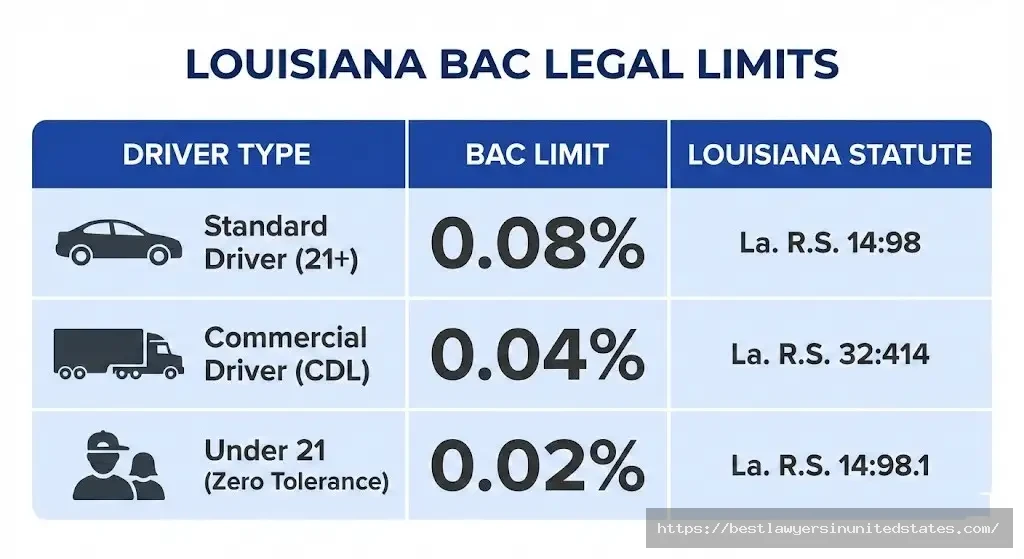
Louisiana sets different BAC limits based on your age and license type. Exceeding these limits triggers an automatic “per se” DUI charge, even if you show no signs of impairment.
| Driver Type | BAC Limit | Louisiana Law |
|---|---|---|
| Standard (21+) | 0.08% | La. R.S. 14:98 |
| Commercial Driver | 0.04% | La. R.S. 32:414 |
| Under 21 | 0.02% | La. R.S. 14:98.1 |
How Police Measure Your BAC
Louisiana law allows three testing methods:
- Breath test: Most common, uses Intoxilyzer device
- Blood test: Required for suspected drug DUI or serious accidents
- Urine test: Rarely used, mainly for drug detection
Important: Louisiana’s implied consent law requires you to submit to testing when arrested. Refusal triggers automatic penalties separate from your DUI charge.
Want to estimate your BAC? Use our BAC Calculator to see how drinks affect your blood alcohol level.
BAC Calculator
Estimate your Blood Alcohol Content
• Commercial Driver (CDL): 0.04% BAC
• Drivers Under 21: 0.00-0.02% BAC (Zero Tolerance)
• Enhanced Penalties: 0.15% BAC or higher in most states
Zero Tolerance for Underage Drivers
Louisiana’s 0.02% limit for drivers under 21 means practically any alcohol consumption violates the law. One beer typically produces a BAC around 0.02-0.03%.
Exception: Louisiana allows underage drivers to consume alcohol for religious ceremonies, medical purposes, or in their parent’s home. These exceptions don’t apply to driving.
1st Offense DUI Louisiana: What You’re Facing
Your first DUI in Louisiana is a misdemeanor, but the penalties still impact your life significantly. Louisiana judges have discretion within statutory ranges, meaning your actual sentence depends on factors like your BAC level and whether you caused an accident.
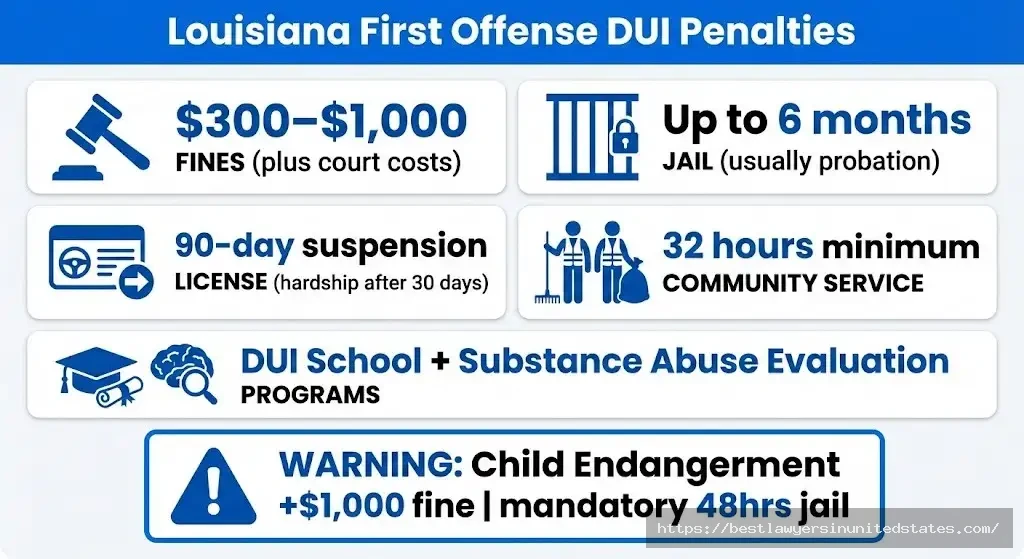
First Offense DUI Penalties
| Penalty Type | Range | Notes |
|---|---|---|
| Fines | $300-$1,000 | Plus court costs |
| Jail Time | Up to 6 months | Can substitute community service |
| License Suspension | 90 days | Hardship license available after 30 days |
| Ignition Interlock | Not required | Judge may order |
| Community Service | 32 hours minimum | If no jail time |
Quick Answer: First-offense DUI in Louisiana costs $300-$1,000 in fines, up to 6 months jail, and 90-day license suspension. Most first-timers avoid jail through probation and community service.
Jail Time Reality
Most first-offense DUI defendants in Louisiana don’t serve jail time. Judges typically order:
- Probation for 1-2 years
- Substance abuse evaluation
- DUI education program
- Community service
Exception: Judges impose jail time for aggravating factors like high BAC (0.15+), accidents causing injury, or child endangerment.
License Suspension Timeline
Your Louisiana license suspension happens in two phases:
Administrative suspension: Starts immediately upon arrest if you fail or refuse testing. The Louisiana Office of Motor Vehicles (OMV) handles this separately from your criminal case.
Criminal suspension: Begins after conviction. This runs consecutively with any administrative suspension you already served.
Critical deadline: You have 30 days to request an OMV administrative hearing to challenge your suspension.
Can You Get a Hardship License?
Yes. After 30 days of your 90-day suspension, you can apply for a hardship license through the Louisiana OMV. This restricted license allows you to drive to:
- Work or school
- Medical appointments
- Court-ordered programs
Cost: $95 application fee plus proof of SR-22 insurance.
Child Endangerment Enhancement
If a child under 12 was in your vehicle during the DUI, Louisiana adds mandatory penalties:
- Additional $1,000 fine
- Mandatory 48 hours in jail (no suspension)
- Community service requirement doubles
Important: This enhancement applies even for first offenses.
2nd Offense DUI Louisiana: Penalties Get Serious
Your second DUI within 10 years in Louisiana remains a misdemeanor, but penalties increase substantially. Judges have less discretion, and mandatory minimums become unavoidable.
Second Offense DUI Penalties
| Penalty Type | Range | Mandatory Minimum |
|---|---|---|
| Fines | $750-$1,000 | $750 |
| Jail Time | 30 days to 6 months | 48 hours |
| License Suspension | 2 years | No reduction |
| Ignition Interlock | Required | Entire restriction period |
| Home Incarceration | Available | As alternative to jail |
| Community Service | 30 days minimum | If no jail |
Quick Answer: Second-offense DUI in Louisiana requires at least 48 hours jail, $750-$1,000 fines, and 2-year license suspension with mandatory ignition interlock.
What’s Different from First Offense?
Mandatory jail time: You cannot avoid the 48-hour minimum through probation. Judges typically sentence 30-90 days but may allow:
- Home incarceration with ankle monitor
- Weekend jail sentences
- Work release programs
Ignition interlock required: You must install an ignition interlock device for the entire restricted license period. This adds $75-$150 monthly costs.
Longer suspension: Your 2-year suspension has no early hardship license option. After 1 year, you can apply for a restricted license with ignition interlock.
The 10-Year Lookback Period
Louisiana counts your second offense as “repeat” only if it occurs within 10 years of your first. After 10 years, your record “cleanses” for sentencing purposes.
Example: First DUI in 2015, second DUI in 2026 = treated as second offense (within 10 years). First DUI in 2015, second DUI in 2027 = treated as first offense (beyond 10 years).
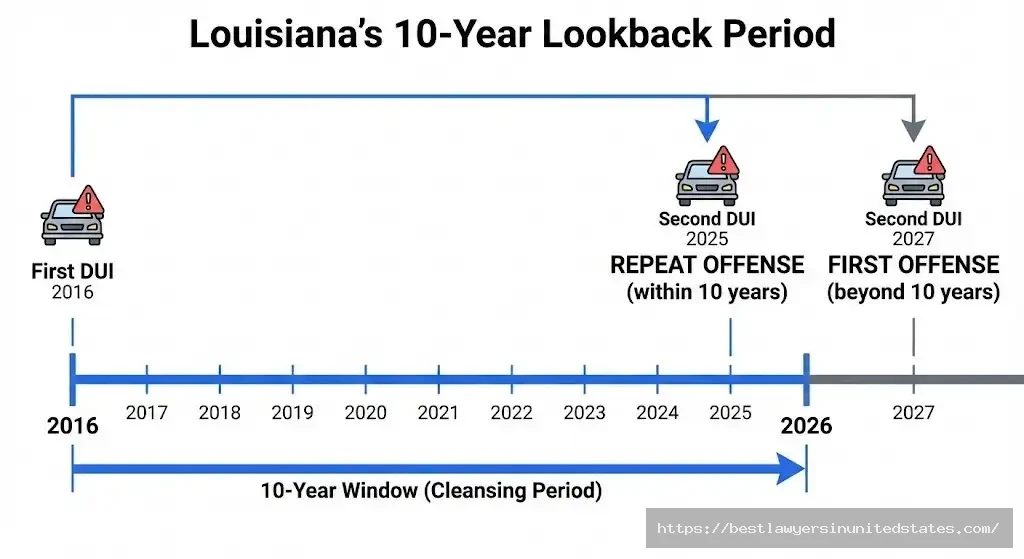
Important: The cleansing period only affects criminal sentencing. Your OMV driving record still shows all DUIs permanently.
Can You Get Home Incarceration?
Yes. Louisiana judges often substitute home incarceration for jail time on second offenses. Requirements include:
- GPS ankle monitor ($10-15 daily fee)
- Employment or school enrollment
- No prior violent offenses
- Judge’s discretion
Cost reality: Home incarceration costs you $300-450 monthly while avoiding jail.
3rd Offense DUI Louisiana: When It Becomes a Felony
Your third DUI within 10 years in Louisiana elevates to a felony under La. R.S. 14:98. This criminal record follows you permanently and carries mandatory prison time.
Third Offense Felony DUI Penalties
| Penalty Type | Range | Mandatory Minimum |
|---|---|---|
| Fines | $2,000 | $2,000 |
| Prison Time | 1-5 years | 1 year |
| License Suspension | 3 years | No reduction |
| Ignition Interlock | Required | 3 years minimum |
| Home Incarceration | Available | Judge’s discretion |
| Substance Abuse Program | Required | Residential treatment |
Quick Answer: Third-offense DUI in Louisiana is a felony requiring at least 1 year in prison, $2,000 fine, and 3-year license suspension. You’ll have a permanent felony record.
Felony Consequences Beyond Penalties
A Louisiana DUI felony impacts your life beyond prison and fines:
Employment: Many employers won’t hire convicted felons, especially for jobs requiring driving or professional licenses.
Housing: Landlords can legally refuse to rent to felons in Louisiana.
Voting rights: You cannot vote while incarcerated or on parole in Louisiana. Rights restore automatically after sentence completion.
Gun rights: Federal law prohibits felons from owning firearms permanently.
Professional licenses: Louisiana licensing boards (nursing, teaching, law, etc.) may revoke or deny licenses.
Can You Avoid Prison Time?
Limited options exist, but judges rarely grant them for third-offense felony DUI:
Residential treatment program: Some parishes offer 6-12 month inpatient substance abuse treatment as alternative to prison. You live at the facility and must complete the program.
Home incarceration: Rarely granted for felony DUI but technically available with ankle monitor and strict conditions.
Early release: Louisiana’s prison overcrowding sometimes leads to early release after serving minimum sentence.
The 3-Year License Suspension
Your third DUI triggers a 3-year full suspension with no hardship license option. After 2 years, you can apply for a restricted license requiring:
- Completed substance abuse treatment
- Ignition interlock installation
- SR-22 insurance
- Clean record during suspension
- $95 OMV application fee
Reality check: Most third-offense DUI defendants in Louisiana don’t drive legally for 2+ years.
4th Offense DUI Louisiana and Beyond
Your fourth DUI within 10 years in Louisiana increases felony penalties significantly. The law treats you as a habitual offender with addiction issues requiring incarceration.
Fourth+ Offense Felony DUI Penalties
| Penalty Type | Range | Mandatory Minimum |
|---|---|---|
| Fines | $5,000 | $5,000 |
| Prison Time | 10-30 years | 10 years |
| Hard Labor | Required | With imprisonment |
| License Revocation | Permanent | No reinstatement |
| Ignition Interlock | N/A | Cannot drive |
| Parole Restrictions | Applies | After minimum served |
Quick Answer: Fourth-offense DUI in Louisiana requires at least 10 years in prison with hard labor, $5,000 fine, and permanent license revocation.
What “Hard Labor” Means
Louisiana’s “hard labor” sentence means you serve time in state prison performing manual work. This differs from parish jail and includes:
- Road maintenance crews
- Agricultural work at Louisiana State Penitentiary
- Prison maintenance and construction
Location: Most fourth-offense DUI defendants serve time at Louisiana State Penitentiary (Angola) or other state facilities, not local parish jails.
Can You Ever Drive Again?
Technically no. Louisiana revokes your license permanently after a fourth DUI. However, limited options exist:
Post-sentence petition: After serving your full sentence (including parole), you can petition Louisiana courts for limited driving privileges. Success is rare and requires:
- Completed sentence including parole
- 5+ years without violations
- Proof of rehabilitation
- Substance abuse treatment completion
- Ignition interlock installation agreement
Reality: Most fourth-offense DUI defendants in Louisiana never legally drive again.
Fifth and Subsequent Offenses
Louisiana law doesn’t distinguish fifth, sixth, or subsequent DUIs from fourth offenses. All carry the same 10-30 year prison range. However:
- Judges typically impose longer sentences
- Parole boards view additional offenses negatively
- Prosecutors may pursue habitual offender enhancements
Maximum penalty: Louisiana law caps DUI sentences at 30 years regardless of offense number.
Louisiana DUI Penalties Summary
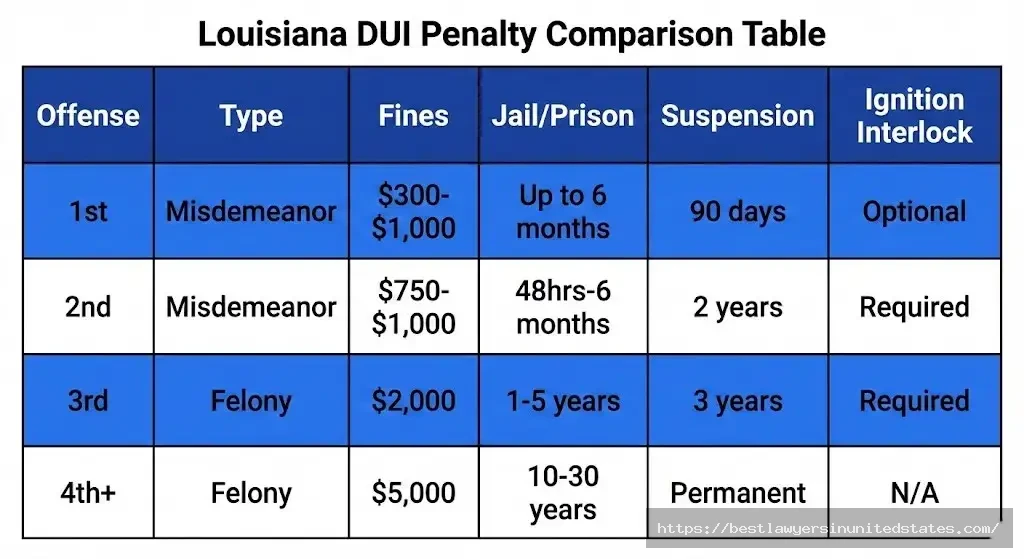
This table compares all Louisiana DUI offense levels to help you understand the escalation:
| Offense | Type | Fines | Jail/Prison | Suspension | Ignition Interlock |
|---|---|---|---|---|---|
| 1st | Misdemeanor | $300-$1,000 | Up to 6 months | 90 days | Optional |
| 2nd | Misdemeanor | $750-$1,000 | 48 hrs-6 months | 2 years | Required |
| 3rd | Felony | $2,000 | 1-5 years | 3 years | Required |
| 4th+ | Felony | $5,000 | 10-30 years | Permanent | N/A |
Important notes:
- All penalties increase if child under 12 was in vehicle
- High BAC (0.15+) often increases sentences
- Accidents causing injury add separate charges
- 10-year lookback period applies to all offenses
Louisiana Implied Consent Law Explained
Every driver in Louisiana automatically consents to chemical testing when accepting their license under La. R.S. 32:661. This “implied consent” activates when an officer arrests you for suspected DUI.
What Happens When You’re Arrested
Louisiana officers must follow specific procedures:
1. Officer reads implied consent warning: The officer explains that Louisiana law requires you to submit to testing. The warning states that refusal triggers automatic license suspension.
2. You choose to test or refuse: You can refuse, but consequences start immediately.
3. Testing occurs (if you consent): Officers typically use a breath test (Intoxilyzer machine). Blood tests require a warrant unless you consent.
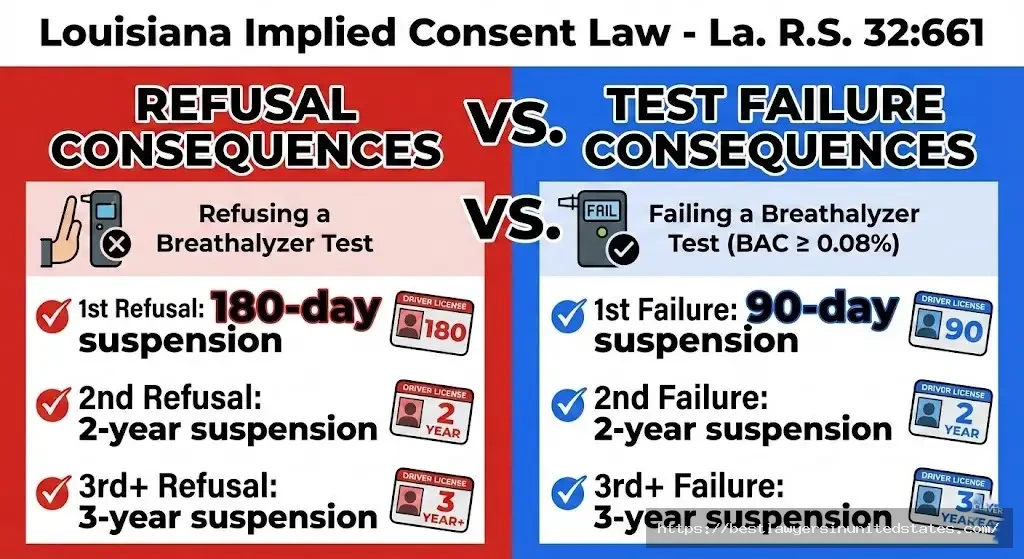
Refusal Penalties vs. Test Failure
| Offense | Refusal Suspension | Test Failure Suspension |
|---|---|---|
| 1st | 180 days | 90 days |
| 2nd | 2 years | 2 years |
| 3rd+ | 3 years | 3 years |
Critical point: Refusing your first DUI test doubles your license suspension from 90 to 180 days.
Can You Refuse the Breathalyzer?
Yes, but Louisiana law makes refusal more painful than taking the test. When you refuse:
Immediate consequences:
- Officer documents refusal in police report
- OMV suspends your license administratively
- You receive a temporary driving permit (30 days)
- Prosecutors use refusal as “consciousness of guilt” evidence
Criminal consequences:
- Refusal doesn’t prevent DUI charges
- Juries view refusal negatively at trial
- Officers may still obtain warrant for blood draw
- Your refusal admission is evidence against you
The Warrant Exception
Louisiana officers increasingly obtain search warrants for blood draws when suspects refuse testing. The warrant process takes 30-90 minutes via phone or computer. Once the judge signs the warrant:
- Police can force blood draw
- You cannot refuse
- Results become evidence
- Your original refusal still counts
Bottom line: Refusal only delays testing in serious cases. It doesn’t prevent it.
Two Separate Suspensions
Louisiana’s administrative refusal suspension runs independently from any criminal court suspension:
OMV administrative suspension: Starts 30 days after arrest. Happens whether or not you’re convicted of DUI.
Criminal court suspension: Starts after conviction. Runs consecutively (added to) any administrative suspension.
Example: You refuse the test (180-day OMV suspension) and get convicted of first DUI (90-day court suspension) = 270 total days without license.
Can You Challenge the Suspension?
Yes. You have 30 days to request an OMV administrative hearing to challenge your suspension. Common defenses include:
- Officer lacked probable cause for arrest
- Officer didn’t properly read implied consent warning
- You weren’t actually driving
- Medical condition prevented testing
Reality: Most challenges fail unless clear procedural errors occurred.
Estimate the total financial impact of your Louisiana DUI with our DUI Cost Calculator.
DUI Cost Calculator
Estimate total DUI expenses by state and offense
Detailed Cost Breakdown
Payment Timeline
Bail bond, towing fees, car impound, attorney retainer
Initial court fines, DMV fees, DUI school enrollment, ignition interlock installation
Monthly probation fees, ignition interlock fees, DUI school payments, attorney balance
Insurance premium increases, license reinstatement, SR-22 filing fees
- Lost wages from missed work (court dates, jail time, DUI school) – $2,000-$10,000
- Job loss or difficulty finding employment – Varies
- Professional license suspension (doctors, lawyers, nurses, pilots) – Career ending
- Rideshare and transportation costs during suspension – $1,500-$5,000
- Travel restrictions and visa denials – Varies
- Security clearance loss – Career impact
- Child custody implications – Legal costs
- Rental car restrictions – Varies
- Personal relationships and mental health costs – Priceless
License Suspension and Administrative Hearings
Louisiana operates two parallel suspension systems that confuse most DUI defendants: administrative (OMV) and criminal (court). Understanding both is critical to protecting your driving privileges.
Administrative vs. Criminal Suspensions
Administrative suspension (OMV):
- Triggers automatically upon arrest
- Based on test failure or refusal
- Louisiana Office of Motor Vehicles controls
- Happens whether or not you’re convicted
- Starts 30 days after arrest
Criminal suspension (court):
- Requires conviction
- Part of your sentence
- Judge imposes during sentencing
- Starts after administrative suspension ends
- Runs consecutively with admin suspension
Louisiana OMV Administrative Hearing Process
You have 30 days from arrest to request an administrative hearing to challenge your suspension. Missing this deadline means automatic suspension with no appeal.
How to request a hearing:
- Complete OMV Form DPSMV 2255
- Submit to Louisiana OMV within 30 days
- Pay $50 filing fee (non-refundable)
- OMV schedules hearing within 30-60 days
What happens at the hearing:
- OMV hearing officer (not a judge) presides
- You can bring attorney
- Officer who arrested you testifies
- You present evidence and witnesses
- Decision issued within 10 days
Defenses That Work
Louisiana administrative hearings focus on procedural compliance, not guilt:
Effective defenses:
- Officer lacked probable cause for stop
- Officer didn’t observe you driving
- Implied consent warning wasn’t properly given
- Testing equipment wasn’t calibrated correctly
- You have medical condition affecting test results
Ineffective defenses:
- “I only had two beers”
- “I wasn’t impaired”
- “The officer was rude”
- Character witness testimony
Reality: About 10-15% of Louisiana administrative hearings result in suspension reversal.
Getting a Hardship License
Louisiana allows restricted “hardship” licenses for specific purposes during suspension:
| Offense | Waiting Period | Restrictions | Requirements |
|---|---|---|---|
| 1st DUI | 30 days | Work, school, medical | SR-22 insurance, $95 fee |
| 2nd DUI | 1 year | Work, medical | Ignition interlock, SR-22 |
| 3rd DUI | 2 years | Work, medical | Treatment completion, IID |
What you can drive to:
- Employment (including job searching)
- School or vocational training
- Medical appointments for self or dependents
- Court-ordered programs (DUI school, counseling)
- Religious services
What you cannot drive for:
- Grocery shopping
- Social visits
- Recreation
- Running errands
How to Apply for Hardship License
Step-by-step process:
- Wait required period: 30 days (1st offense), 1 year (2nd offense), or 2 years (3rd offense)
- Gather documents:
- Proof of SR-22 insurance
- Employment verification letter
- Court documents showing DUI conviction
- Substance abuse evaluation (if required)
- Visit Louisiana OMV office:
- Complete hardship license application
- Pay $95 application fee
- Submit all required documents
- Take new license photo
- Install ignition interlock (if required):
- Use OMV-approved provider
- Provide installation proof to OMV
- Pay installation ($75-150) plus monthly fees ($75-100)
Processing time: Louisiana OMV typically issues hardship licenses within 5-10 business days.
Out-of-State Drivers
Louisiana’s DUI suspension affects your home state license through the Driver’s License Compact. Most states honor Louisiana’s suspension and impose their own penalties.
What happens:
- Louisiana notifies your home state DMV
- Your home state typically suspends your license
- You face penalties in both states
- You cannot get a Louisiana license to avoid suspension
Exception: Wisconsin, Georgia, Massachusetts, Michigan, and Tennessee don’t fully participate in the compact. Check your home state’s specific rules.
Ignition Interlock Device Requirements
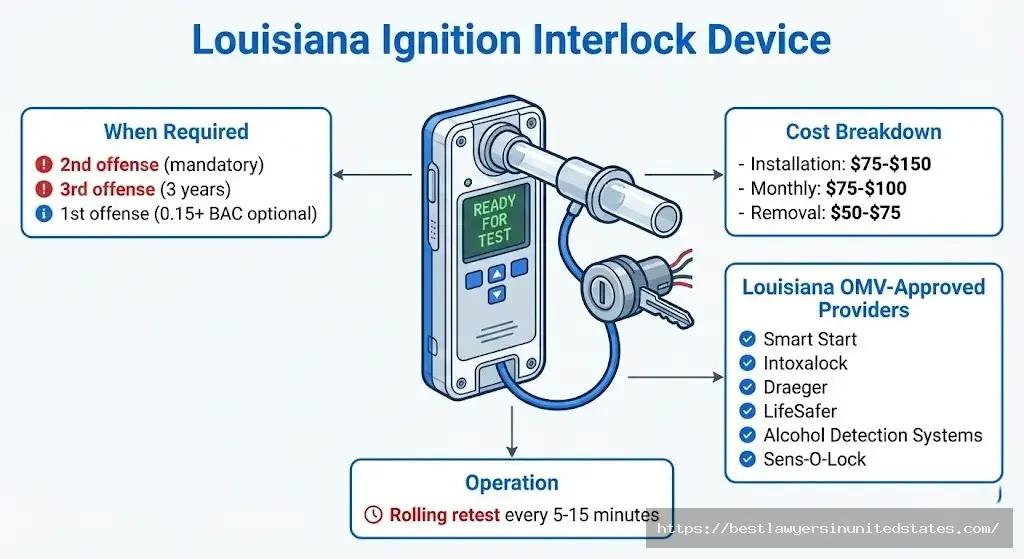
Louisiana requires ignition interlock devices (IID) for second and subsequent DUI offenses. The device prevents your vehicle from starting if it detects alcohol on your breath.
When IID Is Required
| Offense | Requirement | Duration |
|---|---|---|
| 1st DUI | Optional | Judge’s discretion |
| 2nd DUI | Mandatory | Entire restricted license period |
| 3rd DUI | Mandatory | 3 years minimum |
| 4th+ DUI | N/A | License revoked permanently |
High BAC exception: Judges often order IID even for first offenses if your BAC exceeded 0.15%.
How Ignition Interlock Works
Starting your vehicle:
- Blow into the device before starting engine
- Device analyzes your breath for alcohol
- If BAC is under 0.025%, vehicle starts
- If BAC exceeds 0.025%, vehicle won’t start
While driving:
- Device requires “rolling retests” every 5-15 minutes
- You must pull over safely and blow again
- Failing a rolling retest triggers alarm and logs violation
- Vehicle won’t shut off, but violation reports to OMV
Device features:
- Camera records who’s blowing (prevents others from starting car)
- GPS tracks all trips
- Logs all tests and violations
- Reports data to OMV monthly
Louisiana-Approved IID Providers
Louisiana OMV approves specific ignition interlock companies. Using non-approved providers violates your sentence.
OMV-approved providers:
- Smart Start
- Intoxalock
- LifeSafer
- Guardian Interlock
- Draeger Interlock
Services they provide:
- Device installation
- Monthly calibration and maintenance
- Violation reporting to OMV
- Device removal after requirement ends
Ignition Interlock Costs
| Cost Item | Amount | Frequency |
|---|---|---|
| Installation | $75-150 | One-time |
| Monthly lease | $75-100 | Every month |
| Calibration | Included | Monthly visit |
| Removal | $50-75 | One-time |
| Lockout reset | $50-100 | If violated |
Example 2-year requirement: $75 installation + ($85 × 24 months) + $50 removal = $2,165 total
Financial assistance: Some Louisiana parishes offer IID subsidies for low-income defendants. Ask your attorney or probation officer.
IID Violations and Consequences
Louisiana monitors your IID data closely. Common violations include:
Major violations:
- Failing breath test (BAC 0.025+)
- Tampering with device
- Disconnecting device
- Missing calibration appointments
- Having someone else blow into device
Consequences:
- OMV extends your IID requirement
- Court may add jail time
- Your restricted license gets revoked
- You start over on waiting periods
Critical: One IID violation can add 6-12 months to your requirement.
Getting IID Removed
After completing your required IID period:
- Visit IID provider: Schedule removal appointment
- Get removal certificate: Provider gives proof of completion
- Submit to OMV: File removal certificate with Louisiana OMV
- Pay removal fee: $50-75 to provider
- Verify with OMV: Confirm IID requirement removed from record
Processing time: 5-10 business days after OMV receives your removal certificate.
Louisiana DUI Costs: Complete Breakdown
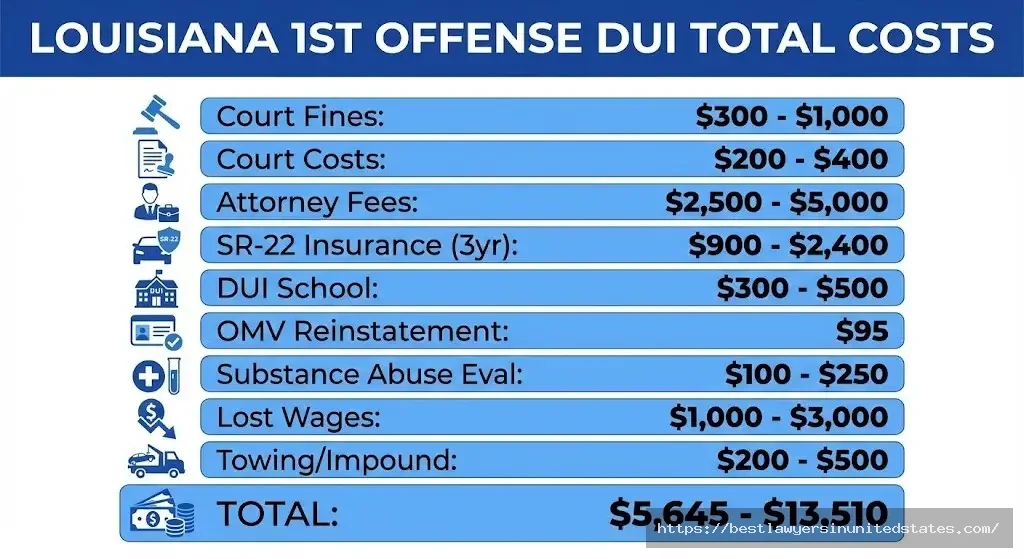
Louisiana DUI costs extend far beyond the fine printed on your ticket. The total financial impact typically ranges from $5,000 to $25,000 for first offenses and increases substantially for repeat DUIs.
Itemized Cost Breakdown
| Cost Category | 1st Offense | 2nd Offense | 3rd Offense (Felony) |
|---|---|---|---|
| Court Fines | $300-1,000 | $750-1,000 | $2,000 |
| Court Costs | $200-400 | $300-500 | $500-800 |
| Attorney Fees | $2,500-5,000 | $3,500-7,500 | $5,000-15,000 |
| Bail Bond | $300-1,000 | $500-2,000 | $2,000-5,000 |
| OMV Reinstatement | $95 | $95 | $95 |
| SR-22 Insurance | $300-800/year | $500-1,200/year | $800-2,000/year |
| DUI School | $300-500 | $400-600 | $500-800 |
| Substance Abuse Eval | $100-250 | $150-300 | $200-400 |
| Ignition Interlock | Optional | $2,000-2,500/2yr | $3,000-3,500/3yr |
| Probation Fees | $40-60/month | $50-75/month | N/A (prison) |
| Community Service Admin | $50-100 | $50-100 | $100-200 |
| Lost Wages | $1,000-3,000 | $2,000-5,000 | $20,000-100,000+ |
| Towing & Impound | $200-500 | $300-700 | $400-1,000 |
| TOTAL ESTIMATED | $5,645-13,510 | $10,545-22,675 | $34,695-129,795+ |
Hidden Costs Nobody Mentions
Insurance rate increases: Louisiana auto insurance companies raise rates 40-100% after DUI conviction. This increase lasts 3-5 years.
Example: Your $1,200 annual premium becomes $2,000-2,400 annually = $4,000-6,000 extra over 5 years.
Professional license impacts: Louisiana licensing boards may fine or suspend your professional license (nursing, teaching, CDL, real estate, etc.).
Rideshare costs: Without a license, you’ll spend $500-2,000+ monthly on Uber, Lyft, or taxis to get to work.
Job loss: Many Louisiana employers fire employees after DUI conviction, especially if driving is required. Lost wages often exceed all other DUI costs combined.
Attorney Fee Reality Check
Louisiana DUI attorney fees vary based on case complexity:
Uncontested first offense: $2,500-4,000
- Negotiates plea agreement
- Handles OMV hearing
- Guides you through process
Contested first offense (trial): $5,000-10,000
- Investigation and discovery
- Expert witnesses
- Trial preparation and trial
Second offense: $3,500-7,500
- More complex negotiations
- Mandatory minimum management
- IID and treatment coordination
Felony (third+) offense: $5,000-20,000+
- Felony court procedures
- Prison alternative negotiations
- Appeals if necessary
Payment plans: Most Louisiana DUI attorneys offer payment plans. Expect 25-50% down, remainder over 3-6 months.
Ways to Reduce DUI Costs
Public defender: If you qualify financially, Louisiana provides free public defenders. Income limits apply (typically under $25,000 annually).
Payment plans: Courts allow payment plans for fines and costs. Request at sentencing.
Community service substitution: Judges often substitute community service for fines at $10-15 per hour worked.
IID financial assistance: Some Louisiana parishes subsidize ignition interlock costs for low-income defendants.
Pro bono legal services: Louisiana State Bar Association maintains a list of attorneys doing free DUI consultations.
Use our DUI Cost Calculator to estimate your specific situation.
Louisiana DUI Expungement Under Article 894
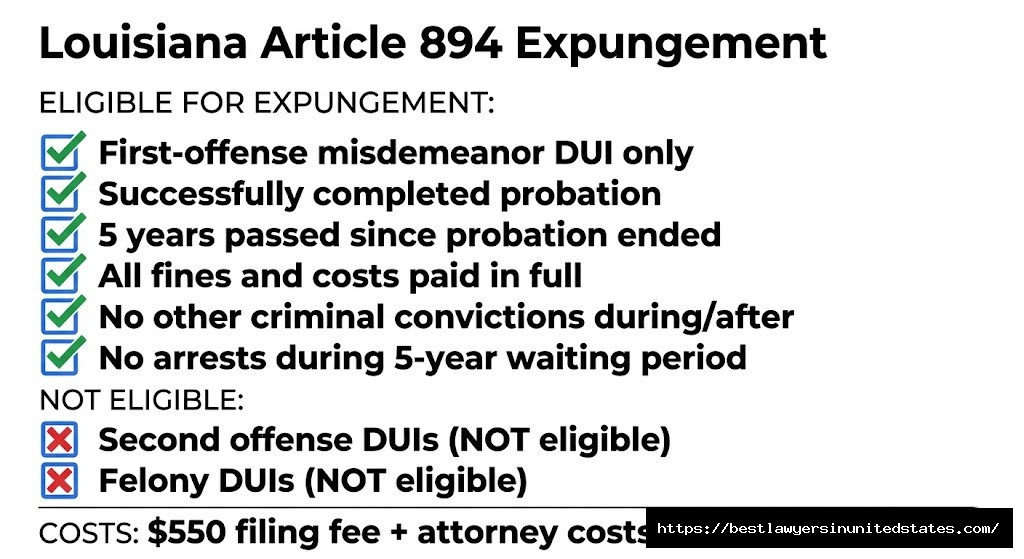
Louisiana allows limited DUI expungement under Louisiana Code of Criminal Procedure Article 894. This process seals your record from public view but doesn’t erase it completely.
Who Qualifies for Article 894 Expungement
Eligibility requirements:
- First-offense misdemeanor DUI only (no felonies)
- Successfully completed probation
- Paid all fines and costs
- Completed all court-ordered programs
- 5 years passed since probation ended
- No other criminal convictions during or after probation
- Not arrested for any offense during 5-year waiting period
Automatic disqualifiers:
- Second or subsequent DUI
- Felony DUI (third+ offense)
- Probation violation during original sentence
- Other criminal charges pending
- Failed to complete DUI school or treatment
What Article 894 Does and Doesn’t Do
What expungement does:
- Seals court records from public databases
- Removes conviction from most background checks
- Allows you to legally answer “no” on job applications asking about convictions
- Removes conviction from Louisiana court websites
What expungement doesn’t do:
- OMV driving record still shows DUI permanently
- FBI database retains record
- Law enforcement can still see conviction
- Prosecutors count expunged DUI if you get arrested again
- Professional licensing boards may still see it
Critical point: Louisiana DUI expungement helps with employment but doesn’t restore your driving record.
Article 894 Expungement Process
Step-by-step:
- Wait 5 years: Count from your probation end date, not conviction date
- Gather documents:
- Original court judgment
- Probation completion certificate
- Payment receipts for all fines
- Program completion certificates
- FBI background check
- File petition:
- Complete Louisiana expungement forms
- File in parish where convicted
- Pay $550 filing fee
- Serve notice on District Attorney
- Court hearing:
- Judge reviews your petition
- DA may oppose (rare for first DUI)
- You or your attorney appear in court
- Judge grants or denies expungement
Timeline: 3-6 months from filing to completion.
Cost of Louisiana DUI Expungement
| Expense | Cost |
|---|---|
| Court filing fee | $550 |
| FBI background check | $18 |
| Process server | $50-100 |
| Attorney fees (if used) | $750-1,500 |
| Certified copies | $25-50 |
| TOTAL | $893-2,218 |
DIY option: Louisiana allows you to file expungement petitions yourself without an attorney. However, procedural mistakes can delay or derail your petition.
Alternative: First Offender Diversion
Some Louisiana parishes offer pre-conviction diversion programs that avoid DUI conviction entirely:
Typical requirements:
- First offense only
- No prior criminal history
- Complete DUI school before trial
- Substance abuse treatment
- Probation for 6-12 months
- All fines and costs paid
Benefit: Charges dismissed upon completion. No conviction on your record to expunge later.
Availability: Not all Louisiana parishes offer diversion. Orleans Parish, East Baton Rouge Parish, and Jefferson Parish have programs. Ask your attorney.
Louisiana DUI Checkpoints: Know Your Rights
Louisiana law allows DUI checkpoints (sobriety checkpoints) under specific guidelines established by Louisiana courts and the U.S. Supreme Court. Understanding your rights at checkpoints protects you without creating suspicion.
Are Louisiana DUI Checkpoints Legal?
Yes. Louisiana courts approved DUI checkpoints in State v. Humphrey, holding they’re constitutional if police follow proper procedures.
Requirements for legal checkpoints:
- Supervisors (not field officers) select location
- Neutral mathematical formula determines which cars stop (every 3rd car, every 5th car, etc.)
- Clearly marked with lights and signs
- Brief stops (under 1 minute for sober drivers)
- Public notice in advance (sometimes)
What Police Can and Cannot Do
| Police CAN | Police CANNOT |
|---|---|
| Ask for license and registration | Search your car without cause |
| Look in plain view through windows | Order you out without cause |
| Ask if you’ve been drinking | Detain you without suspicion |
| Request field sobriety test | Force you to answer questions |
| Smell for alcohol odor | Search trunk without consent |
Critical distinction: Brief checkpoint stop requires no suspicion. Extended detention requires probable cause.
How to Handle a Louisiana DUI Checkpoint
Step-by-step approach:
- Slow down and stop: Attempting to avoid a checkpoint gives officers reasonable suspicion to pursue you
- Roll down window, provide documents: Have license, registration, and insurance ready. Hand them to officer.
- Be polite but brief: Answer basic identification questions only. Use short, direct answers.
- Don’t volunteer information: Officers ask “Have you been drinking?” You can politely decline: “I prefer not to answer questions.”
- Decline field sobriety tests: Louisiana allows you to refuse roadside tests. They’re voluntary and designed for failure.
- Know when you’re detained: If officers say “you’re free to go,” leave immediately. If not, you’re detained and need to cooperate with basic requests.
What Happens If Police Smell Alcohol?
Alcohol odor gives Louisiana officers probable cause to investigate further:
What officers will do:
- Ask you to exit vehicle
- Observe your balance and coordination
- Request field sobriety tests
- Ask about alcohol consumption
- Look for open containers
Your options:
- Comply with exit request (not optional)
- Refuse field sobriety tests (they’re voluntary)
- Refuse to answer questions (politely)
- Request attorney if arrested
Reality check: Police interpret refusals as signs of intoxication. However, field sobriety tests provide evidence against you. Choose carefully.
Can You Avoid DUI Checkpoints?
Legally avoiding checkpoints is permissible:
Legal avoidance:
- Turn before reaching checkpoint (if you see it early)
- Take alternate route you normally use
- Use checkpoint notification apps like Waze
Illegal avoidance:
- Illegal U-turns
- Traffic violations to escape
- Pulling into private property to hide
Important: Officers watch for avoidance behavior. Legal turns before checkpoints won’t create suspicion. Panicked evasion gives officers reasonable suspicion to stop you anyway.
Louisiana Checkpoint Locations
Louisiana State Police and parish sheriffs run checkpoints at:
- Major holidays (Mardi Gras, New Year’s Eve, July 4th)
- Friday and Saturday nights (10 PM – 3 AM)
- High-traffic corridors (I-10, I-12, Airline Highway)
- Entertainment districts (Bourbon Street area, downtown Baton Rouge)
Public notice: Some Louisiana agencies announce checkpoint locations in advance. Others don’t. Louisiana law doesn’t require advance notice.
Challenging Illegal Checkpoint Stops
If police violated checkpoint procedures, your attorney can challenge the stop:
Common violations:
- No supervisory approval for location
- Officers arbitrarily selected which cars to stop
- Insufficient lighting or signage
- Officers detained you without probable cause
- No neutral stopping pattern used
Remedy: Judge suppresses all evidence from illegal checkpoint stop. Prosecutors often dismiss charges without evidence.
What to Do After a Louisiana DUI Arrest
The actions you take in the first 24-48 hours after arrest significantly impact your case outcome. Follow this timeline to protect your rights and driving privileges.
Immediate Actions (First 24 Hours)
At the police station:
- Cooperate with booking: Provide identification, fingerprints, and mugshot. Don’t resist or argue.
- Post bail quickly: Louisiana sets bail for DUI at $300-1,500 for first offense. Pay it or call a bail bondsman to get released.
- Don’t discuss your case: Police may ask questions. Exercise your right to remain silent except for basic identification.
- Document everything: Write down exactly what happened while memory is fresh. Include:
- Time and location of stop
- Officer’s statements
- Tests you took or refused
- Witnesses present
After release:
- Contact a Louisiana DUI attorney: Most offer free consultations. Call within 24 hours while details are fresh.
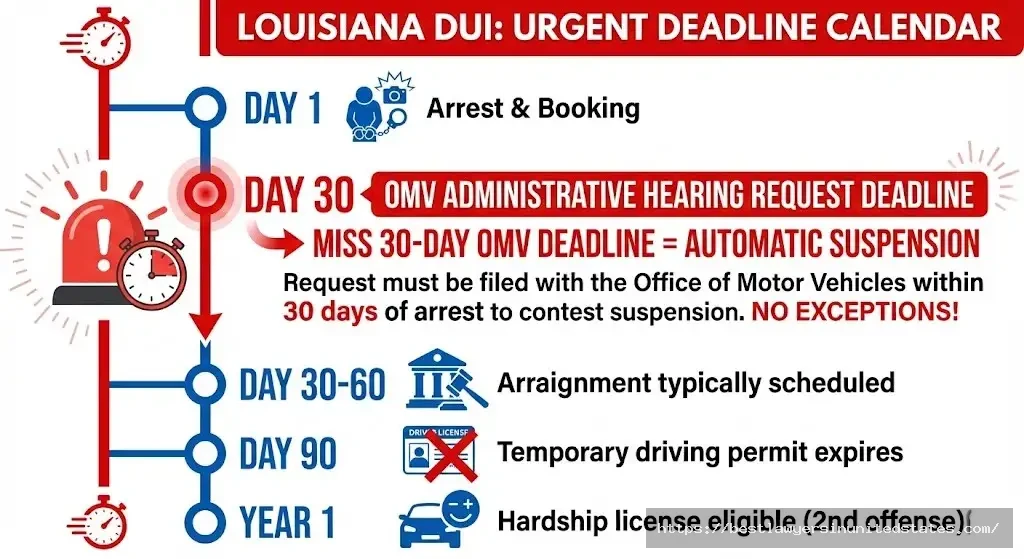
- Request OMV administrative hearing: You have 30 days, but acting immediately protects your rights. Attorney can file this for you.
- Take photos of arrest location: Document road conditions, lighting, checkpoint signs, or other relevant scene details.
Critical Deadlines You Cannot Miss
| Deadline | Action Required | Consequence of Missing |
|---|---|---|
| 30 days | Request OMV hearing | Automatic license suspension, no appeal |
| 60 days | Arraignment (usually) | Warrant issued for arrest |
| 90 days | Complete DUI school (if ordered) | Probation violation |
| 15 days | Install ignition interlock (if ordered) | License suspension continues |
Most critical: The 30-day OMV hearing deadline. Missing this means your license suspends automatically with no chance to challenge it.
What Your Attorney Will Do
Louisiana DUI attorneys focus on three areas:
1. OMV administrative hearing (first 30 days):
- File hearing request with OMV
- Challenge basis for arrest
- Cross-examine arresting officer
- Present evidence for driving privileges
2. Criminal case investigation:
- Review police reports and dash cam footage
- Challenge breathalyzer calibration records
- Interview witnesses
- Identify procedural violations
3. Negotiations or trial:
- Negotiate reduced charges with prosecutor
- Seek diversion program admission
- Prepare for trial if necessary
- Handle all court appearances
Questions to Ask Your DUI Attorney
Before hiring a Louisiana DUI lawyer, ask:
- How many DUI cases have you handled in [parish name]? Local experience with specific judges and prosecutors matters.
- What’s your success rate? Ask about dismissals, reduced charges, and trial wins.
- Will you handle my case personally? Some firms assign cases to junior attorneys.
- What’s included in your fee? Clarify if OMV hearing, trial, and appeals cost extra.
- What’s your strategy for my specific case? Generic answers suggest inexperience.
- Can you get my charges reduced or dismissed? Honest lawyers won’t guarantee outcomes but will explain realistic possibilities.
Common Mistakes That Hurt Your Case
Don’t:
- Discuss your case on social media (prosecutors monitor Facebook, Instagram)
- Miss court dates or probation appointments
- Continue drinking or using drugs during pending case
- Contact the alleged victim in accident cases
- Drive on suspended license
- Ignore OMV hearing deadline
- Hire the cheapest attorney without checking credentials
Do:
- Follow attorney’s advice exactly
- Complete all court-ordered programs promptly
- Document your compliance with conditions
- Maintain employment and stable housing
- Save all receipts related to your case
Louisiana DUI Court Process Timeline
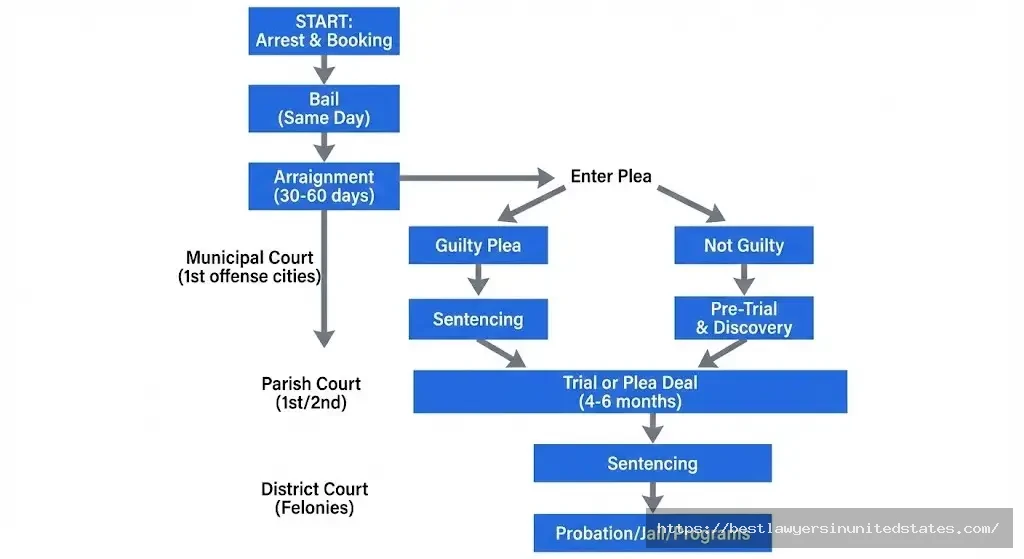
Understanding Louisiana’s DUI court process helps you prepare for each stage and avoid surprises. The process differs slightly between misdemeanor (1st and 2nd offense) and felony (3rd+ offense) cases.
Misdemeanor DUI Process (1st and 2nd Offense)
Stage 1: Arrest and Booking (Day 1)
- Police arrest you for suspected DUI
- Transport to parish jail for booking
- Fingerprinting, mugshot, and property inventory
- Bail set ($300-1,500 typically)
- Release after posting bail (usually same day)
Stage 2: Arraignment (30-60 days)
- First court appearance
- Judge reads charges against you
- You enter plea (guilty, not guilty, no contest)
- Public defender appointed if you qualify
- Trial date set if you plead not guilty
- Typical duration: 5-10 minutes
What to do: Dress professionally. Bring attorney if hired. Don’t discuss case facts in courthouse.
Stage 3: Pre-Trial Motions and Discovery (60-120 days)
- Your attorney files motions to suppress evidence
- Prosecutor provides evidence (police reports, breathalyzer results)
- Your attorney investigates case
- Negotiations for plea deal occur
- Court hearings on motions
Stage 4: Plea Negotiations or Trial (120-180 days)
If accepting plea deal:
- Meet with prosecutor and judge
- Formalize agreement in writing
- Judge accepts or rejects deal
- Sentencing occurs immediately or scheduled separately
If going to trial:
- Jury selection (half day)
- Prosecutor presents case (1-2 days)
- Your attorney presents defense
- Closing arguments
- Jury deliberation and verdict
- Sentencing scheduled if guilty
Stage 5: Sentencing (Same day or 30 days later)
- Judge imposes penalties within statutory range
- You receive probation conditions in writing
- OMV suspension begins
- Court orders DUI school, treatment, community service
Felony DUI Process (3rd+ Offense)
Felony cases follow similar steps but in different courts with longer timelines:
Differences from misdemeanor:
- Bond hearing required (higher bail $2,000-10,000)
- Grand jury indictment (formal charging document)
- District Court handles case (not municipal or parish court)
- Longer discovery period (6-12 months)
- More formal trial procedures
- Sentencing separate from conviction (30-60 days later)
Louisiana Courts That Handle DUI Cases
Louisiana’s court system can confuse defendants:
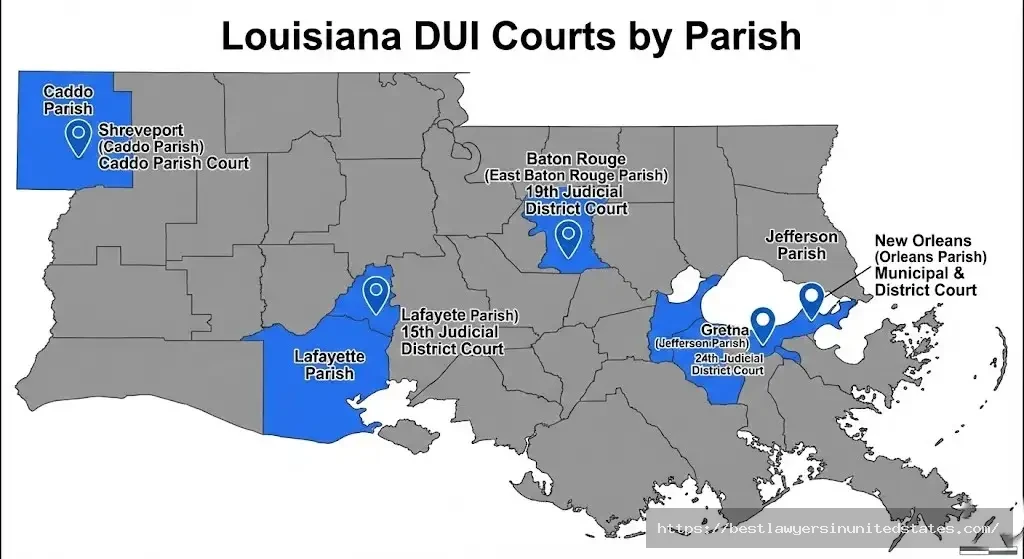
Municipal Courts (First offense, cities):
- Handle misdemeanors within city limits
- Examples: New Orleans Municipal Court, Baton Rouge City Court
- Less formal procedures
- No jury trials available
Parish Courts (First and second offense):
- Handle misdemeanors outside municipal boundaries
- Examples: East Baton Rouge Parish Court, Jefferson Parish Court
- Intermediate formality
- Jury trials available
District Courts (Felony, serious misdemeanors):
- Handle all felony DUIs (3rd+ offense)
- Examples: 19th Judicial District Court (East Baton Rouge), Orleans Parish Criminal District Court
- Most formal procedures
- Jury trials standard
Location matters: Your arrest location determines which court hears your case. Louisiana has 64 parishes with different courts and procedures.
Typical Timeline Summary
| Case Type | Total Duration | Key Milestone |
|---|---|---|
| First offense (plea deal) | 3-6 months | Usually resolved at arraignment or shortly after |
| First offense (trial) | 6-12 months | Trial scheduled 4-6 months after arraignment |
| Second offense | 6-12 months | Similar to first but more negotiations |
| Felony (plea deal) | 6-12 months | Grand jury adds 2-3 months |
| Felony (trial) | 12-24 months | Complex cases take longer |
Louisiana court delays: Budget cuts have created backlogs in many Louisiana parishes. Your case may take longer than these estimates, especially in Orleans Parish and Caddo Parish.
Louisiana DUI and Employment: What You Need to Know
A Louisiana DUI conviction impacts your employment in ways that extend beyond the obvious. Understanding these consequences helps you prepare and protect your career.
Will Your Employer Find Out?
Probably yes. Louisiana employers discover DUI convictions through:
Background checks: Most employers run criminal background checks. Louisiana court records are public and searchable online.
Driving record checks: Employers requiring driving run MVR (motor vehicle record) checks with Louisiana OMV. Your DUI appears permanently.
License suspension issues: Missing work because you can’t drive raises questions from employers.
Jail time: First-offense jail time is short, but missing work triggers employer inquiries.
Jobs That Require Disclosure
Louisiana law requires DUI disclosure for certain positions:
Mandatory disclosure professions:
- CDL (commercial driver’s license) holders – Federal law requires immediate reporting
- School bus drivers – Louisiana law prohibits DUI convictions
- Healthcare workers with professional licenses (nurses, physicians, pharmacists)
- Teachers and education professionals
- Law enforcement and security
- Childcare workers
- Aviation workers (pilots, mechanics, air traffic controllers)
Licensing board consequences: Louisiana professional licensing boards may:
- Require ethics courses
- Impose probation
- Suspend license temporarily
- Require substance abuse treatment
- Fine you ($500-5,000)
Example: Louisiana State Board of Nursing investigates every DUI conviction. Expect 6-18 months of monitoring and required treatment.
Can You Get Fired for a DUI?
Louisiana is at-will employment: Employers can fire you for any legal reason, including DUI conviction. However:
When firing is likely:
- Your job requires driving
- You work with children or vulnerable populations
- You miss multiple days due to court/jail
- Your license suspension prevents job duties
- You violated company policy on criminal conduct
When firing is less likely:
- First-time offense
- Your job doesn’t require driving
- You disclose proactively and take responsibility
- You maintain excellent work performance
- You have no prior disciplinary issues
CDL Holders: Harsh Federal Rules
Louisiana CDL holders face federal disqualification rules that exceed regular DUI penalties:
Federal CDL disqualification:
- First DUI in personal vehicle: 1 year CDL disqualification
- First DUI in commercial vehicle: 1 year CDL disqualification
- Second DUI (any vehicle): Lifetime CDL disqualification
- Refusal to test: Same as DUI conviction
No hardship CDL: Louisiana cannot issue restricted CDL for work purposes. Federal law prohibits it.
Louisiana adds: State penalties plus federal disqualification run concurrently. You serve both, not the longer of the two.
How to Minimize Employment Impact
If you’re employed:
- Tell your employer first: Proactive disclosure demonstrates responsibility. Employers respect honesty over discovering it themselves.
- Emphasize your plan: Explain you’re hiring an attorney, completing programs, and taking responsibility.
- Document compliance: Show your employer program completion certificates, clean drug tests, and positive actions.
- Request FMLA (if eligible): Family Medical Leave Act may cover substance abuse treatment time off.
- Propose solutions: Offer rideshare for work transportation, adjusted schedule for court dates, or job modifications if possible.
If you’re job searching:
- Know what employers can see: Order your own background check to know what shows up.
- Be honest on applications: Lying about criminal history justifies immediate termination if discovered.
- Explain briefly and positively: “I made a mistake, took responsibility, completed all requirements, and learned from it.”
- Consider expungement: Article 894 expungement removes conviction from most background checks after 5 years.
- Target employers carefully: Some industries (healthcare, education, transportation) scrutinize DUIs more than others.
Finding a Louisiana DUI Attorney
Hiring the right Louisiana DUI attorney significantly impacts your case outcome. Louisiana’s complex DUI laws and parish-specific court procedures require local expertise.
When You Need a DUI Attorney
Always hire an attorney for:
- Second or subsequent DUI (mandatory jail time)
- Felony DUI (3rd+ offense with prison time)
- Accidents involving injury or property damage
- High BAC (0.15+) with enhanced penalties
- Refusal cases (more complex defense needed)
- CDL holders (federal disqualification rules apply)
- Professional license holders (licensing board consequences)
Consider hiring an attorney for:
- First offense if you want to fight the charge
- Cases with unclear facts or procedural errors
- When you need to preserve your driving privileges
- If you’re worried about conviction impact on career
When you might not need an attorney:
- First offense with clear guilt and no aggravating factors
- You plan to plead guilty and accept standard penalties
- You qualify for public defender and court appoints one
What Louisiana DUI Attorneys Cost
| Service Level | Cost Range | What’s Included |
|---|---|---|
| Free consultation | $0 | Initial case review, strategy discussion |
| Guilty plea (1st offense) | $1,500-3,000 | Arraignment, sentencing, OMV hearing |
| Negotiated plea (1st) | $2,500-5,000 | Investigation, negotiations, OMV hearing |
| Trial (1st offense) | $5,000-10,000 | Full trial, expert witnesses, OMV hearing |
| Second offense | $3,500-7,500 | Complex negotiations, mandatory minimums |
| Felony (3rd+ offense) | $5,000-20,000+ | Grand jury, trial, appeals if needed |
Payment plans: Most Louisiana DUI attorneys offer payment plans:
- 25-50% down payment required
- Remainder over 3-6 months
- Some accept credit cards
- A few allow pay-as-you-go for extended cases
Questions to Ask During Consultation
About their experience:
- How many DUI cases have you handled in [specific parish]?
- What percentage of your practice is DUI defense?
- Have you handled cases with [your judge’s name]?
- What’s your track record with the local prosecutor’s office?
About your case: 5. What defenses do you see in my case? 6. What’s the realistic best and worst outcome? 7. Should I go to trial or negotiate a plea? 8. Can you get my charges reduced or dismissed?
About the process: 9. Will you personally handle my case or delegate to associates? 10. How quickly will you respond to my questions? 11. What’s your strategy for the OMV hearing? 12. Do you have relationships with local judges and prosecutors?
About costs: 13. What’s included in your quoted fee? 14. What costs extra (trial, appeals, expert witnesses)? 15. Do you offer payment plans? 16. What happens if I can’t make payments?
Red Flags to Avoid
Don’t hire attorneys who:
- Guarantee specific outcomes (“I’ll get this dismissed”)
- Pressure you to hire immediately without reviewing facts
- Quote significantly lower fees than others (you get what you pay for)
- Have no specific DUI experience in Louisiana
- Haven’t practiced in your parish
- Can’t explain their strategy clearly
- Seem disorganized or miss appointments
Good signs to look for:
- Louisiana State Bar Association membership
- Positive reviews from actual DUI clients
- Clear explanation of process and realistic outcomes
- Prompt response to your consultation request
- Professional office and support staff
- Detailed fee agreement in writing
Finding Louisiana DUI Attorneys
Resources to locate attorneys:
- Louisiana State Bar Association referral service (800-421-5722)
- Parish bar association websites
- Avvo, Martindale-Hubbell, Super Lawyers directories
- Courthouse observations (watch lawyers in court)
- Referrals from friends who used DUI lawyers
Parish-specific considerations:
- Orleans Parish (New Orleans): High volume, need experienced trial lawyers
- East Baton Rouge Parish: Strict judges, need negotiation skills
- Jefferson Parish: Prosecutor plea policies differ from Orleans
- Smaller parishes: Local connections matter more than big cities
Public Defenders in Louisiana
If you cannot afford an attorney, Louisiana provides public defenders:
Eligibility: Income typically under 125% of federal poverty level (approximately $20,000 for individual, $27,000 for family of 2)
Application: Request public defender at arraignment. Judge determines eligibility.
Quality: Louisiana public defenders are experienced criminal attorneys handling hundreds of cases annually. They know local courts well but have heavy caseloads.
Limitations: Public defenders focus on best plea deals due to volume. Trials are rare unless facts strongly favor you.
Frequently Asked Questions About Louisiana DUI Laws
How long does a DUI stay on your record in Louisiana?
Quick Answer: A DUI stays on your criminal record permanently in Louisiana unless expunged under Article 894. Your driving record also shows the DUI permanently for OMV purposes.
Louisiana doesn’t automatically remove DUI convictions after any time period. The conviction remains on your criminal record forever unless you successfully expunge it under Louisiana Code of Criminal Procedure Article 894.
For expungement eligibility, you must wait 5 years after completing probation for a first-offense misdemeanor DUI. Second and felony DUIs cannot be expunged.
Your Louisiana OMV driving record shows the DUI permanently. Even if you expunge your criminal conviction, the OMV record remains. Insurance companies and employers checking your MVR will see it.
The 10-year “cleansing period” only affects future criminal sentencing. After 10 years, a new DUI is sentenced as a first offense instead of second. However, both convictions remain on your permanent record.
What is the penalty for first offense DUI in Louisiana?
Quick Answer: First-offense DUI in Louisiana carries $300-1,000 fines, up to 6 months jail (usually probation), 90-day license suspension, and required DUI school.
Louisiana law sets these ranges for first DUI under La. R.S. 14:98:
- Fines: $300 minimum to $1,000 maximum
- Jail: 10 days to 6 months (judges usually suspend sentence for probation)
- License suspension: 90 days
- Community service: 32 hours if no jail time
Additional costs include court costs ($200-400), attorney fees ($2,500-5,000), DUI school ($300-500), and insurance increases.
Most first-time offenders avoid actual jail through probation, community service, and program completion. However, aggravating factors like high BAC (0.15+), accidents, or child endangerment can trigger jail sentences even for first offenses.
Can you refuse a breathalyzer test in Louisiana?
Quick Answer: Yes, you can refuse Louisiana’s breathalyzer test, but refusal triggers automatic 180-day license suspension compared to 90 days for test failure on first offense.
Louisiana’s implied consent law (La. R.S. 32:661) requires you to submit to testing when arrested for DUI. However, you physically can refuse.
Consequences of refusal:
- Administrative license suspension (180 days first refusal vs. 90 days test failure)
- Prosecutors use refusal as evidence of “consciousness of guilt”
- Police may obtain warrant for blood draw anyway
- Refusal doesn’t prevent DUI charges or conviction
Officers increasingly obtain telephonic warrants for forced blood draws within 30-90 minutes of refusal. Once they have a warrant, you cannot refuse.
The calculation depends on your BAC. If you know you’re significantly over the limit (0.15+), refusal might help your case despite the harsher suspension. If you’re borderline (0.08-0.10), taking the test may be better. Consult an attorney before deciding.
How much does a DUI cost in Louisiana?
Quick Answer: First-offense DUI in Louisiana costs $5,000-13,000 total when including fines, attorney fees, insurance increases, and all related expenses over 3 years.
Detailed cost breakdown:
- Court fines: $300-1,000
- Court costs: $200-400
- Attorney fees: $2,500-5,000
- Bail: $300-1,000
- DUI school: $300-500
- SR-22 insurance increase: $300-800 annually for 3 years
- OMV reinstatement: $95
- Lost wages from court appearances: $500-2,000
- Towing and impound: $200-500
Second offense costs $10,000-23,000 due to mandatory ignition interlock ($2,000-2,500), higher fines, and increased attorney fees.
Third-offense felony DUI costs $35,000-130,000+ when including attorney fees ($5,000-20,000) and lost wages from prison time.
Use our DUI Cost Calculator for personalized estimates based on your situation.
Is a DUI a felony in Louisiana?
Quick Answer: Louisiana DUI becomes a felony on your third offense within 10 years under La. R.S. 14:98. First and second offenses are misdemeanors.
Louisiana’s DUI offense escalation:
- 1st offense: Misdemeanor
- 2nd offense (within 10 years): Misdemeanor
- 3rd offense (within 10 years): Felony
- 4th+ offense (within 10 years): Felony with enhanced penalties
Third-offense felony DUI carries 1-5 years prison (mandatory 1-year minimum), $2,000 fine, and 3-year license suspension. Fourth offense increases to 10-30 years prison with hard labor.
The 10-year lookback period matters. If more than 10 years pass between offenses, your new DUI is sentenced as a first offense, not a repeat. However, Louisiana prosecutors can still present prior convictions to the judge for sentencing consideration.
How long do you lose your license for DUI in Louisiana?
Quick Answer: Louisiana suspends licenses for 90 days (1st DUI), 2 years (2nd DUI), 3 years (3rd DUI), or permanently (4th+ DUI).
| Offense | Full Suspension | Hardship Eligible | Requirements |
|---|---|---|---|
| 1st DUI | 90 days | After 30 days | SR-22 insurance |
| 2nd DUI | 2 years | After 1 year | Ignition interlock, SR-22 |
| 3rd DUI | 3 years | After 2 years | Treatment completion, IID |
| 4th+ DUI | Permanent | Never (technically) | Post-sentence petition only |
These suspensions are separate from administrative suspensions for test refusal. If you refuse the breathalyzer, add 180 days (1st), 2 years (2nd), or 3 years (3rd+) to the criminal suspension.
Louisiana allows hardship licenses for work, school, and medical needs after waiting the required period. Apply through Louisiana OMV with proof of SR-22 insurance and employment.
What are the new DUI laws in Louisiana for 2025-2026?
Quick Answer: Louisiana’s 2025 legislative session increased ignition interlock requirements and enhanced penalties for repeat offenders, effective August 2025.
Key changes in Louisiana DUI laws:
- Expanded ignition interlock requirements for first-time offenders with BAC 0.15+
- Mandatory ignition interlock for all second offenses (previously judge’s discretion in some cases)
- Increased OMV reinstatement fees from $75 to $95
- Enhanced child endangerment penalties (doubled fines)
- New DUI enforcement task force funding for Louisiana State Police
Louisiana also implemented stricter SR-22 insurance monitoring. Insurance companies must now notify OMV within 10 days if SR-22 coverage lapses, triggering immediate license suspension.
The Legislature considered but didn’t pass proposals to lower felony threshold to second offense or increase ignition interlock periods. These may return in future sessions.
Can you get a DUI expunged in Louisiana?
Quick Answer: Yes, but only first-offense misdemeanor DUIs qualify for expungement under Louisiana Article 894 after 5 years. Second offenses and felonies cannot be expunged.
Expungement eligibility requirements:
- First offense only (no prior or subsequent convictions)
- Successfully completed probation
- 5 years passed since probation ended
- All fines and costs paid
- No arrests during 5-year waiting period
- Misdemeanor conviction (not felony)
The expungement process costs $550 court filing fee plus attorney fees ($750-1,500) and takes 3-6 months. After expungement, your conviction is sealed from public view but remains on Louisiana OMV driving records permanently.
Louisiana prosecutors rarely oppose first-offense DUI expungements if you meet all eligibility requirements and demonstrate rehabilitation.
Do you go to jail for first DUI in Louisiana?
Quick Answer: Louisiana law allows up to 6 months jail for first DUI, but most defendants get probation instead of actual jail time.
First-offense DUI sentencing reality:
- 85-90% of first-time offenders receive probation with suspended jail sentence
- Judges order community service (32 hours) instead of jail
- Probation typically lasts 1-2 years
- DUI school and substance abuse evaluation required
Situations where judges impose jail time on first offense:
- BAC significantly over limit (0.15+)
- Accidents causing injury or significant property damage
- Child under 12 in vehicle
- Prior criminal record (even non-DUI)
- Hostile behavior toward police
- Failure to appear in court
Even when judges order jail time, many allow weekend sentences or work release programs so you can maintain employment.
What happens at a Louisiana DUI checkpoint?
Quick Answer: Louisiana DUI checkpoints involve brief stops where officers check licenses, observe for impairment signs, and may request sobriety tests if they detect alcohol.
Typical Louisiana DUI checkpoint procedure:
- You approach marked checkpoint with lights and signs
- Officer stops your vehicle using neutral formula (every 3rd car, etc.)
- Officer asks for license and registration
- Officer looks for signs of impairment (alcohol odor, slurred speech, bloodshot eyes)
- Sober drivers proceed within 1-2 minutes
- Suspected impaired drivers move to secondary inspection area
At secondary inspection, officers may:
- Ask if you’ve been drinking
- Request field sobriety tests
- Conduct breathalyzer screening
- Arrest you if probable cause exists
Your rights at checkpoints:
- You must stop and provide license
- You can refuse to answer questions beyond identification
- You can refuse field sobriety tests (they’re voluntary)
- You can refuse preliminary breath test (not post-arrest test)
Legal checkpoint avoidance (turning before checkpoint) is permissible. Illegal evasion (U-turns, traffic violations) creates reasonable suspicion justifying a stop.
Contact a Louisiana DUI Attorney Today
Louisiana DUI charges threaten your license, finances, and freedom. The state’s 10-year lookback period, mandatory penalties for repeat offenses, and complex OMV procedures make professional legal help essential.
Critical actions to take now:
- Request OMV administrative hearing within 30 days
- Consult with an experienced Louisiana DUI attorney
- Document all evidence from your arrest
- Complete court-ordered programs promptly
- Protect your driving privileges through hardship license
Find DUI Lawyers in Louisiana – Free Consultation
Email: [email protected]
Louisiana’s DUI laws change regularly through legislative sessions and court decisions. Stay informed about updates affecting your case and rights. The information in this guide represents Louisiana law as of 2026 but may not cover every situation.
This article provides general information about Louisiana DUI laws and should not be considered legal advice. Every DUI case involves unique facts and circumstances. Consult with a licensed Louisiana attorney for advice specific to your situation.
Related Louisiana Legal Resources: