
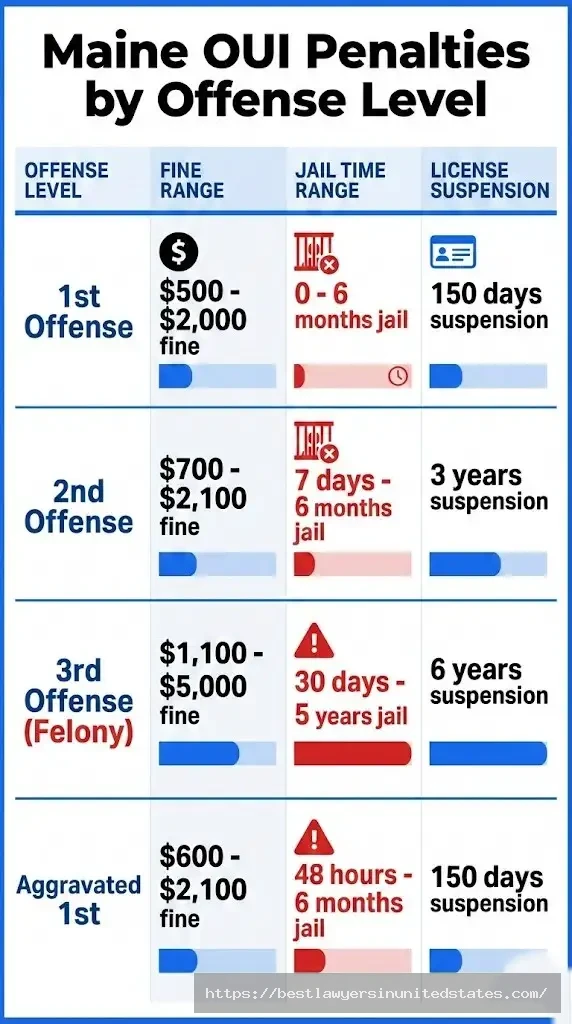
Maine uses “OUI” (Operating Under the Influence) instead of “DUI” as the official legal term. Under Maine Title 29-A § 2411, you commit OUI when you operate a vehicle with a blood alcohol content of 0.08% or higher, or while impaired by drugs or alcohol. First-time offenders face fines starting at $500, up to 6 months in jail, and a 150-day license suspension.
This guide covers everything you need to know about Maine’s OUI laws, from arrest procedures to court processes. You’ll learn the exact penalties, understand the difference between criminal and administrative OUI, and discover how Maine’s system differs from other states.
Check Your BAC Level
Not sure if you’re over Maine’s 0.08% legal limit? Use our BAC calculator to estimate your blood alcohol content based on drinks consumed, body weight, and time elapsed.
BAC Calculator
Estimate your Blood Alcohol Content
• Commercial Driver (CDL): 0.04% BAC
• Drivers Under 21: 0.00-0.02% BAC (Zero Tolerance)
• Enhanced Penalties: 0.15% BAC or higher in most states
Understanding OUI vs DUI in Maine
Why Maine Uses “OUI” Instead of “DUI”
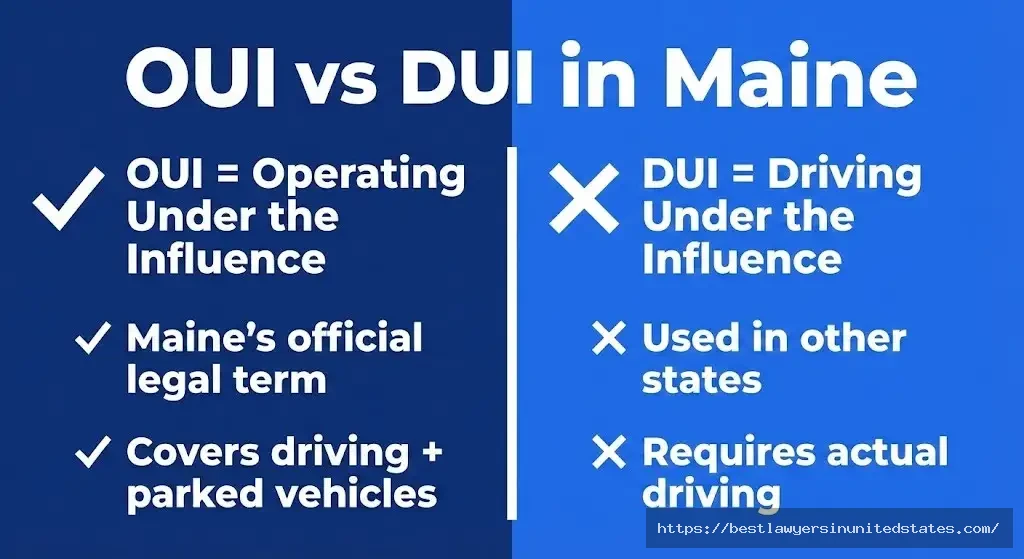
Maine law officially calls drunk driving “OUI” rather than “DUI.” The terms mean slightly different things. DUI stands for “Driving Under the Influence,” while OUI means “Operating Under the Influence.”
The word “operating” covers more situations than “driving.” You can get charged with OUI in Maine even if your car isn’t moving. Sitting in the driver’s seat with keys in the ignition counts as “operating” under Maine law.
What “Operating Under the Influence” Means Legally
Maine Title 29-A § 2411 defines OUI broadly. You commit OUI when you operate any motor vehicle:
- With a BAC of 0.08% or higher
- While impaired by alcohol to any degree
- While impaired by drugs (illegal or prescription)
- While impaired by a combination of alcohol and drugs
Key point: Maine law doesn’t require actual driving. Operating includes being in physical control of the vehicle with the ability to start or move it.
Criminal OUI vs Standard OUI: The Critical Difference
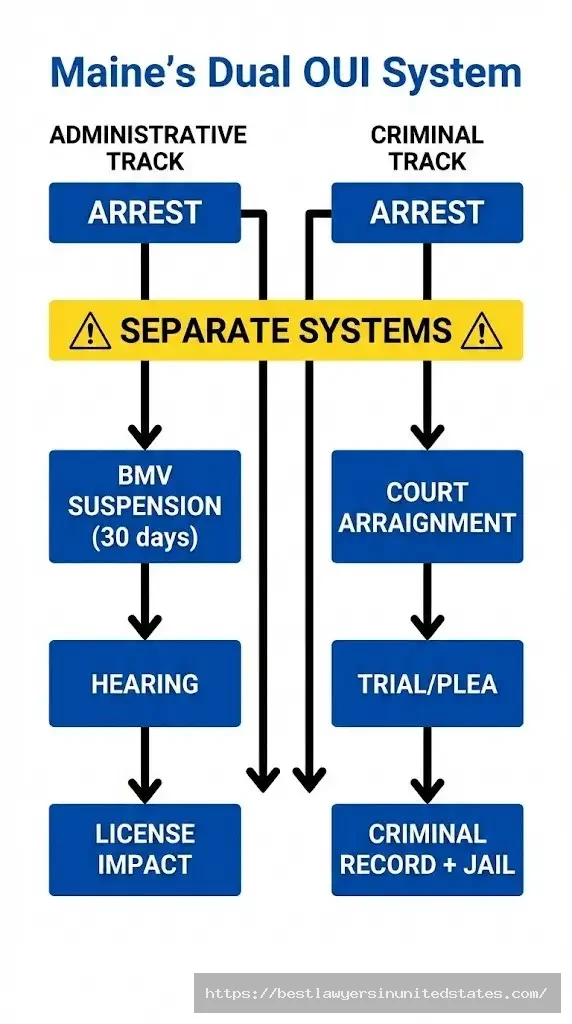
Maine handles OUI cases through two separate systems that run simultaneously.
Standard (Administrative) OUI:
- Handled by Maine Bureau of Motor Vehicles (BMV)
- License suspension starts automatically
- No criminal conviction required
- Focuses on protecting public safety
Criminal OUI:
- Handled by Maine District Court
- Can result in jail time and criminal record
- Requires prosecution beyond reasonable doubt
- Focuses on punishment and deterrence
Critical point: You face both systems at once. Winning your criminal case doesn’t automatically restore your license. You must fight each battle separately.
Maine OUI Laws: Title 29-A § 2411 Explained
What is the Legal BAC Limit in Maine?
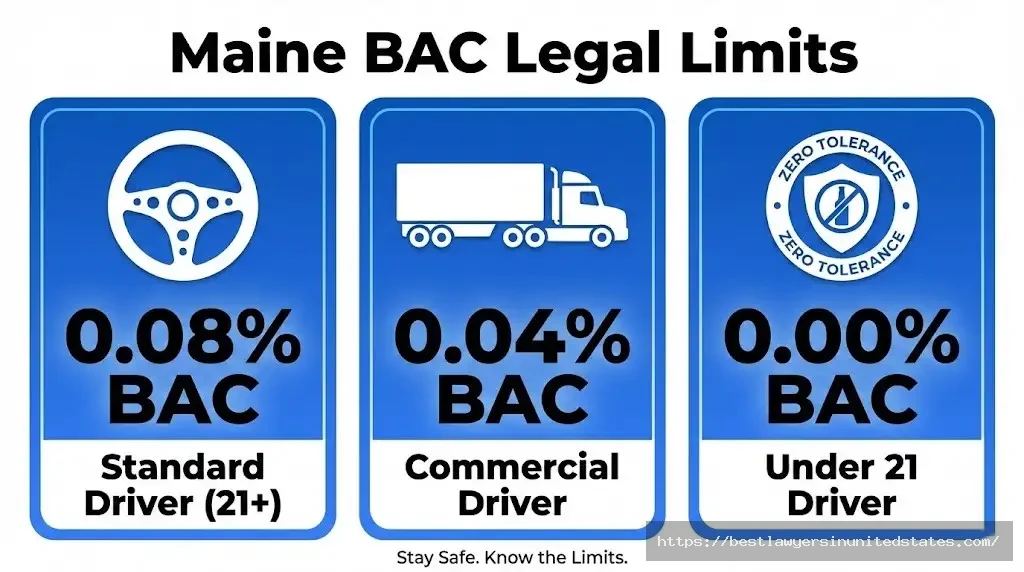
Maine sets different BAC limits for different driver types:
| Driver Type | BAC Limit | Violation |
|---|---|---|
| Standard (21+) | 0.08% | OUI |
| Commercial drivers | 0.04% | OUI |
| Drivers under 21 | 0.00% | Zero tolerance |
Important: You can get charged with OUI even below 0.08% if police observe impaired driving behavior. The BAC limit provides a clear legal standard, but impairment alone justifies arrest.
Maine’s Implied Consent Law (Title 29-A § 2453)
Maine’s implied consent law under Title 29-A § 2453 states that every driver automatically agrees to chemical testing when operating a vehicle in Maine. This consent kicks in the moment police arrest you for suspected OUI.
What happens during testing:
- Officer reads warning: Police must inform you of the consequences of refusing
- You choose: Breath, blood, or urine test (officer decides which type)
- Refusal triggers penalty: Automatic license suspension begins
- Test results matter: Failed tests lead to both criminal charges and license suspension
Refusal penalties vs test failure:
| Offense | Refusal Suspension | Failed Test Suspension |
|---|---|---|
| 1st offense | 275 days | 150 days |
| 2nd offense | 18 months | 3 years |
| 3rd offense | 4 years | 6 years |
Critical deadline: Refusing the test results in longer suspensions than failing it. The refusal suspension runs separately from any criminal court penalties.
Zero Tolerance for Drivers Under 21
Maine enforces strict zero tolerance laws under Title 29-A § 2411(1-D) for drivers under 21. Any detectable amount of alcohol triggers penalties.
Underage OUI penalties:
- License suspension: 30 days minimum
- Fine: $200 minimum
- Alcohol education program mandatory
- Court costs and fees
Exception: Religious ceremonies where alcohol consumption is part of traditional practices don’t violate zero tolerance laws.
First Offense OUI in Maine
Penalties for First-Time OUI Offenders
First-time OUI in Maine carries mandatory minimum penalties under Title 29-A § 2411(5). Courts cannot reduce these minimums even with plea bargains.
Standard first offense penalties:
| Penalty Type | Minimum | Maximum |
|---|---|---|
| Fine | $500 | $2,000 |
| Jail time | 0 days | 6 months |
| License suspension | 150 days | 150 days |
| Court costs | $300 | $300 |
Additional requirements:
- Alcohol education program completion ($300-$500)
- Substance abuse treatment if ordered ($1,000-$3,000)
- License reinstatement fee ($50)
- Increased insurance rates for 3 years
Administrative License Suspension (30 Days)
Maine’s Bureau of Motor Vehicles suspends your license administratively before your court case even starts. This happens automatically at arrest.
Timeline:
- Day 1: Police confiscate your license at arrest
- Days 1-10: You receive temporary driving permit
- Day 10: Temporary permit expires
- Day 30: Administrative suspension begins if you don’t request hearing
- Day 45: Typical hearing date if requested
Critical deadline: You have 10 days from arrest to request a BMV administrative hearing. Miss this deadline and you lose your right to challenge the administrative suspension.
Can a First Offense OUI Be Dismissed in Maine?
Yes, first offense OUI charges can be dismissed, but success depends on specific case facts. Common grounds for dismissal include:
Legal defenses:
- Illegal traffic stop without reasonable suspicion
- Improper field sobriety test administration
- Breathalyzer machine not properly calibrated
- Blood sample chain of custody broken
- Officer failed to read implied consent warning
Statistics: Maine courts dismiss roughly 15-20% of first offense OUI cases based on procedural errors or lack of evidence.
Realistic expectations: Most first offense cases result in conviction or plea bargain rather than outright dismissal. Strong evidence like breathalyzer results over 0.15% makes dismissal unlikely.
First Offense OUI Plea Bargain Options
Maine prosecutors often offer plea bargains for first offenders with no prior criminal record. Common plea deals include:
Typical plea agreements:
- Reduced fine in exchange for guilty plea
- Suspended jail time with probation
- Alternative sentencing (community service)
- Early license reinstatement with IID
What prosecutors want:
- Quick case resolution
- Court cost savings
- Guaranteed conviction
- Defendant completes treatment
When plea bargains work best:
- BAC between 0.08% and 0.12%
- No accident or property damage
- No children in vehicle
- Clean driving record
- Cooperative at arrest
Aggravated OUI in Maine: Enhanced Penalties
What Makes an OUI “Aggravated” in Maine?
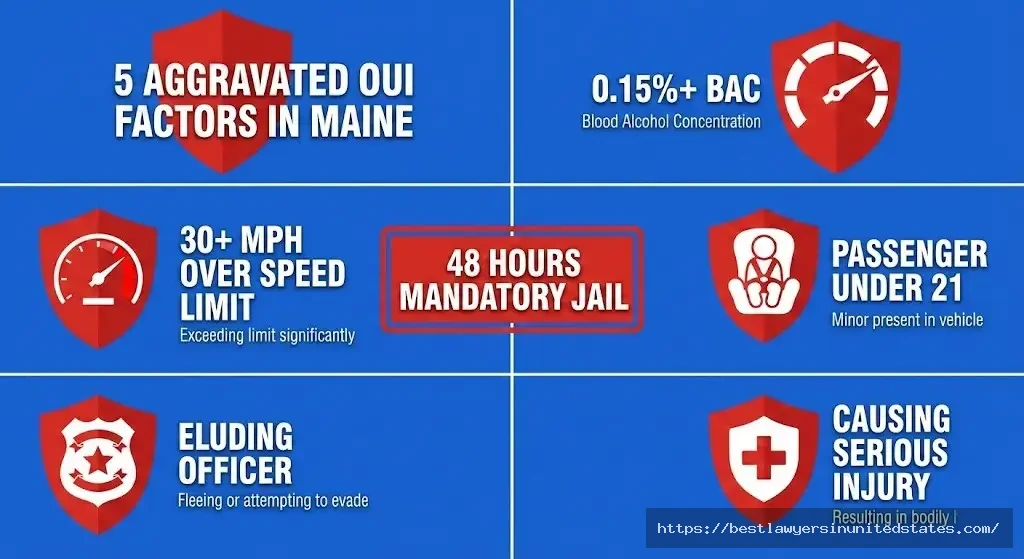
Maine Title 29-A § 2411(1-A) defines aggravated OUI with specific criteria. Any one of these factors elevates a standard OUI to aggravated:
Aggravating factors:
| Factor | Threshold | Impact |
|---|---|---|
| High BAC | 0.15% or higher | Mandatory jail time |
| Excessive speed | 30+ mph over limit | Enhanced penalties |
| Passenger under 21 | Any child present | Separate child endangerment charge possible |
| Eluding officer | Fleeing police | Additional criminal charges |
| Causing injury | Serious bodily harm | Felony charges possible |
| Prior OUI conviction | Within 10 years | Mandatory minimums increase |
Critical point: Multiple aggravating factors don’t stack additional penalties. The highest applicable penalty level applies.
Aggravated OUI Penalties
Aggravated OUI under Maine law carries mandatory minimums that judges cannot reduce:
| Penalty Type | Minimum | Maximum |
|---|---|---|
| Fine | $600 | $2,100 |
| Jail time | 48 hours | 6 months |
| License suspension | 150 days | 150 days |
| IID required | 150 days | 150 days |
Additional consequences:
- 48-hour jail minimum must be served (no suspended sentence)
- Alcohol treatment program mandatory
- Higher insurance rates for 5+ years
- Some employers refuse to hire with aggravated OUI
High BAC special rule: BAC of 0.15% or higher triggers mandatory 48-hour jail sentence even for first offense. Judges have no discretion to waive this requirement.
Second and Third Offense OUI Laws in Maine
Second Offense OUI Penalties
Maine treats second OUI offenses within 10 years as repeat offenses under Title 29-A § 2411(6). Penalties increase substantially.
Second offense mandatory minimums:
| Penalty Type | Minimum | Maximum |
|---|---|---|
| Fine | $700 | $2,100 |
| Jail time | 7 days | 6 months |
| License suspension | 3 years | 3 years |
| IID required | 3 years | 3 years |
Key differences from first offense:
- Mandatory 7-day jail sentence (no suspended sentence)
- 3-year license suspension (no exceptions)
- Ignition interlock device required for full 3 years
- Higher insurance rates that last 5-10 years
Work permit available: After serving 18 months of suspension, you can apply for hardship license with IID installed.
Third Offense OUI (Felony)
Third OUI conviction within 10 years becomes a Class C felony in Maine. This creates a permanent criminal record with serious consequences.
Third offense penalties:
| Penalty Type | Minimum | Maximum |
|---|---|---|
| Fine | $1,100 | $5,000 |
| Jail time | 30 days | 5 years |
| License suspension | 6 years | Permanent |
| IID required | 6 years | Permanent |
Felony consequences beyond penalties:
- Cannot vote while incarcerated
- Cannot possess firearms
- Difficulty finding employment
- Professional license revocation possible
- Some housing applications denied
- Federal student aid restrictions
Permanent revocation possible: The Secretary of State can permanently revoke your license after third offense. You must prove rehabilitation to ever drive again.
Is an OUI a Felony in Maine?
When OUI Becomes a Felony
Maine classifies OUI as misdemeanor or felony based on specific circumstances:
OUI remains a misdemeanor when:
- First or second offense within 10 years
- No serious injury or death resulted
- No child endangerment charges added
- BAC below 0.15% (typically)
OUI becomes a Class C felony when:
- Third offense within 10 years
- OUI causes serious bodily injury
- OUI causes death (manslaughter charges)
- Child under 12 suffers injury
Misdemeanor vs Felony OUI Charges
The classification dramatically affects both penalties and long-term consequences:
| Aspect | Misdemeanor OUI | Felony OUI |
|---|---|---|
| Maximum jail | 6 months | 5 years |
| Maximum fine | $2,100 | $5,000 |
| Permanent record | Yes | Yes |
| Voting rights | Retained | Lost while incarcerated |
| Gun ownership | Retained | Permanently lost |
| Employment impact | Moderate | Severe |
| Housing impact | Minimal | Significant |
Long-Term Consequences of Felony OUI
Felony OUI convictions create obstacles that last far beyond court sentences:
Employment barriers:
- Background checks reveal felony permanently
- Professional licenses often revoked (medical, law, education)
- Government jobs typically unavailable
- Many private employers refuse to hire felons
Civil rights restrictions:
- Cannot possess firearms or ammunition
- Cannot vote while incarcerated or on probation
- Cannot serve on jury duty
- Cannot hold public office in some cases
Financial consequences:
- Federal student loans denied or suspended
- Some apartment complexes refuse felons
- Car insurance rates increase 200-300%
- Some banks refuse accounts to felons
New Maine OUI Laws in 2026
Recent Legislative Changes
Maine’s 131st Legislature passed several OUI-related bills that took effect in 2026. These changes modified penalties and procedures.
Key 2026 updates:
- Ignition interlock device requirements expanded
- First-time offenders now eligible for alternative sentencing
- Administrative hearing deadlines shortened to 10 days
- Out-of-state license suspension reporting improved
LD 1847 (Effective January 2026): This law requires all OUI offenders to install ignition interlock devices, including first-time offenders. Previously, first offenders could avoid IID with restricted license.
How New Laws Affect First-Time Offenders
First-time OUI offenders face new requirements under 2026 legislation:
Before 2026:
- IID optional for first offense
- Could get work permit without IID
- 150-day suspension minimum
After 2026:
- IID mandatory for all offenders
- Work permit requires IID installation
- 150-day suspension unchanged
- Alternative sentencing programs expanded
Financial impact: Mandatory IID adds $2,500-$3,500 to first offense costs (installation, monthly fees, removal).
Changes to Ignition Interlock Device Requirements
Maine now requires ignition interlock devices for all OUI convictions under the 2026 amendments to Title 29-A § 2508.
New IID rules:
| Offense | IID Duration | Early Removal? |
|---|---|---|
| 1st | 150 days minimum | No |
| 2nd | 3 years minimum | After 18 months with clean record |
| 3rd+ | 6 years minimum | After 3 years with clean record |
Cost breakdown:
- Installation: $150-$200
- Monthly monitoring: $75-$100
- Calibration (every 60 days): $50-$75
- Removal: $75-$100
- Total first year: $1,200-$1,500
How it works: The device requires a breath sample before the engine starts. If BAC exceeds 0.02%, the vehicle won’t start. Random retests occur while driving.
How Long Does an OUI Stay on Your Record in Maine?
Criminal Record Duration
Maine OUI convictions create permanent criminal records. No automatic expungement exists for OUI under Maine law.
Record retention:
- Court records: Permanent
- Police records: Permanent
- FBI database: Permanent
- Background checks: Permanent
Exception: Maine allows petition for record sealing in very limited circumstances after 10+ years. Requirements include:
- No subsequent criminal charges
- All fines and restitution paid
- Judge approval required
- Not available for felony OUI
Driving Record Impact (10 Years for Insurance)
Your Maine driving record maintained by the Bureau of Motor Vehicles shows OUI convictions differently:
BMV record timeline:
- OUI conviction: Appears for 10 years
- License points: Remain 10 years
- Insurance lookback: 10 years typical
- Employment checks: See full criminal history
Insurance rate impact:
| Years After Conviction | Rate Increase |
|---|---|
| Years 1-3 | +80-150% |
| Years 4-6 | +50-80% |
| Years 7-10 | +25-50% |
| After 10 years | Returns to normal |
Critical point: Even after 10 years, the criminal record remains. Only the insurance industry stops counting it after 10 years.
OUI Expungement Options in Maine
Maine law makes OUI expungement extremely difficult. Title 15 § 2003 governs criminal record sealing.
Current limitations:
- No automatic expungement for any OUI
- Cannot seal records less than 10 years old
- Cannot seal felony OUI convictions
- Must prove exceptional circumstances
- Judge has full discretion to deny
Realistic expectations: Fewer than 5% of OUI record sealing petitions succeed in Maine courts. Judges rarely find “exceptional circumstances” for OUI cases.
Alternative: Focus on license reinstatement and insurance rate reduction rather than record sealing. These provide more practical benefits.
Maine OUI Arrest Process
What Happens During an OUI Traffic Stop
Maine OUI arrests follow standardized procedures under state law and training protocols. Understanding the process helps you protect your rights.
Traffic stop sequence:
- Initial stop: Officer needs reasonable suspicion (speeding, weaving, expired tags)
- Contact: Officer approaches, asks for license and registration
- Observation: Officer notes alcohol odor, bloodshot eyes, slurred speech
- Questions: “Where are you coming from?” “Have you been drinking?”
- Field sobriety tests: Officer requests roadside tests
- Arrest decision: Based on observations and test performance
- Chemical test: At police station or roadside
Your rights during stop:
- Remain silent except providing license/registration
- Politely decline to answer questions about drinking
- Decline field sobriety tests (not mandatory)
- Request attorney before questioning
Field Sobriety Tests in Maine
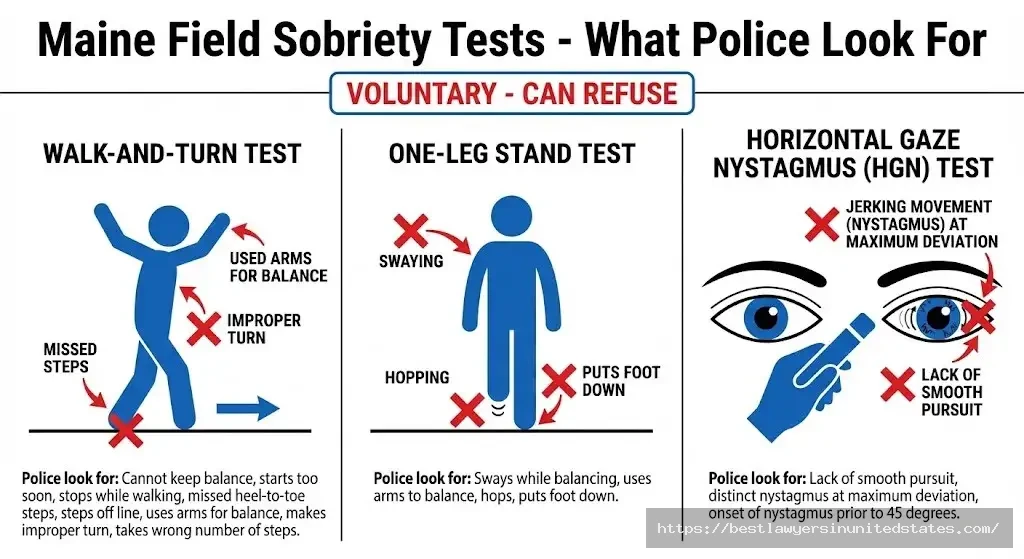
Maine law enforcement uses standardized field sobriety tests developed by the National Highway Traffic Safety Administration. These tests are voluntary.
Three standard tests:
| Test | What It Measures | Failure Indicators |
|---|---|---|
| Horizontal Gaze Nystagmus | Eye tracking | Jerking eye movement |
| Walk and Turn | Balance, coordination | Missing steps, using arms for balance |
| One Leg Stand | Balance, attention | Swaying, hopping, putting foot down |
Important facts:
- You can refuse field sobriety tests
- Refusal cannot be used against you in court
- Tests are designed for failure (sober people fail 30% of time)
- Medical conditions affect performance
- Poor weather/road conditions skew results
Critical point: Refusing field sobriety tests does not trigger license suspension like refusing chemical tests does. These are separate issues.
Chemical Testing: Breathalyzer and Blood Tests
Maine uses Intoxilyzer 8000 breathalyzer machines at police stations. These devices must meet strict calibration and maintenance requirements.
Testing procedure:
- 15-minute observation: Officer watches you before testing
- Warning: Implied consent warning read
- First breath sample: You blow into machine
- Second sample: Duplicate test required
- Results: Printed immediately
Blood test procedure:
- Used when breath test unavailable
- Medical professional draws blood
- Sample sent to Maine State Crime Lab
- Results take 4-6 weeks
- You can request independent test
Accuracy issues that help your defense:
- Machine not calibrated within 30 days
- Officer not certified to operate machine
- You weren’t observed for full 15 minutes
- Mouth alcohol from burping or GERD
- Blood sample chain of custody broken
Refusing a Breathalyzer: Consequences Under Implied Consent
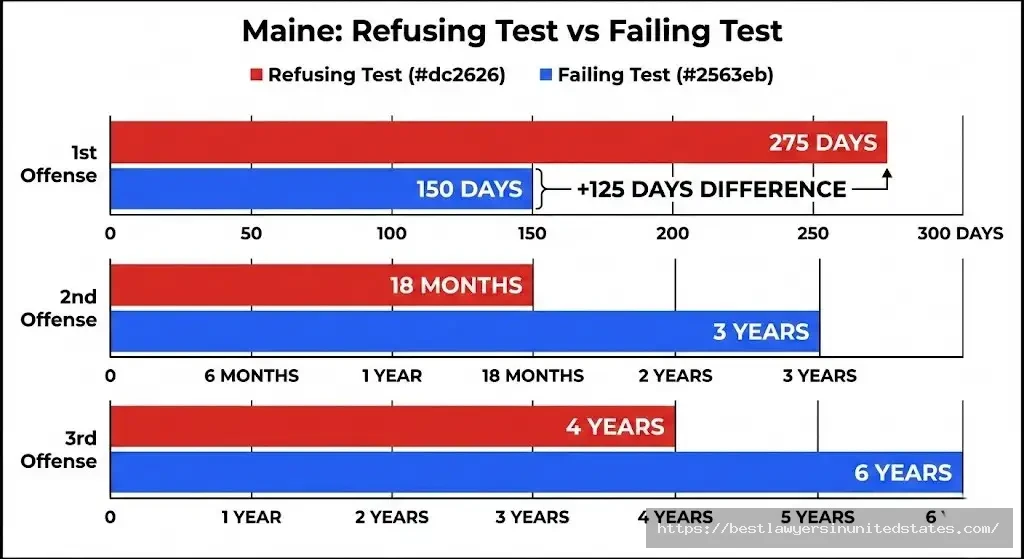
Maine’s implied consent law under Title 29-A § 2453 makes refusal costly. The penalties often exceed failing the test.
Refusal consequences:
| Offense | Refusal Suspension | Failed Test Suspension | Difference |
|---|---|---|---|
| 1st | 275 days | 150 days | +125 days longer |
| 2nd | 18 months | 3 years | Shorter for refusal |
| 3rd+ | 4 years | 6 years | Shorter for refusal |
What counts as refusal:
- Explicitly saying “no” to test
- Failing to provide adequate breath sample
- Delay tactics to sober up
- Conditional refusal (“only if my lawyer is present”)
Cannot be used in criminal trial: Maine courts generally prohibit prosecutors from mentioning test refusal to juries. However, administrative suspension still applies.
OUI Bail Conditions in Maine
Maine judges set bail conditions at arraignment based on flight risk and public safety. OUI cases typically result in personal recognizance release.
Standard OUI bail conditions:
- Zero alcohol consumption
- Random alcohol testing
- No operation of motor vehicle
- Attend all court dates
- Surrender passport for felony OUI
- GPS monitoring (rare, serious cases only)
Bail amounts:
- First offense: Personal recognizance (no money)
- Second offense: $500-$1,000 cash bail
- Third offense: $1,000-$5,000 cash bail
- Injury accident: $5,000-$25,000 cash bail
Violation consequences: Breaking bail conditions can result in bail revocation, immediate arrest, and harsher sentencing.
Fighting an OUI Charge in Maine
How to Get Out of an OUI in Maine
Successfully fighting Maine OUI charges requires attacking weak points in the prosecution’s case. No guaranteed “way out” exists, but strong defenses win cases.
Winning strategies:
- Challenge the traffic stop: Officer lacked reasonable suspicion
- Question field sobriety tests: Tests improperly administered
- Attack chemical test results: Machine errors, operator mistakes
- Prove rising BAC: You were under 0.08% while driving
- Show medical conditions: GERD, diabetes affect breath tests
Realistic success rates:
- Outright dismissal: 10-15% of cases
- Reduced charges: 30-40% of cases
- Acquittal at trial: 20-25% of contested cases
- Conviction: 30-40% of cases
Common OUI Defenses
Maine OUI attorneys use specific legal defenses based on case facts:
Improper stop defense:
- Officer lacked reasonable suspicion
- Random checkpoint violated procedure
- Stop based on anonymous tip without corroboration
Faulty breathalyzer defense:
- Machine not calibrated within 30 days
- Officer not certified to operate device
- 15-minute observation period not completed
- Mouth alcohol from GERD or belching
Medical conditions affecting tests:
- Inner ear problems affect balance tests
- Knee/hip injuries prevent walk-and-turn
- Asthma affects breath sample adequacy
- Diabetes creates false-positive breath results
Rising BAC defense:
- BAC below 0.08% while driving
- Alcohol absorbed after driving stopped
- Test delayed 30+ minutes after arrest
Critical evidence to preserve:
- Dash camera footage
- Body camera footage
- Calibration records
- Officer training records
- Medical records proving conditions
Working with a Maine OUI Attorney
Hiring experienced OUI counsel significantly improves case outcomes. Maine attorneys familiar with local courts and prosecutors negotiate better deals.
What good attorneys do:
- File BMV hearing request within 10-day deadline
- Obtain all discovery (videos, reports, test results)
- Challenge administrative suspension at BMV hearing
- Negotiate with prosecutors for reduced charges
- File pre-trial motions to suppress evidence
- Prepare for trial if necessary
Attorney costs in Maine:
| Service | Cost Range |
|---|---|
| First offense representation | $2,500-$5,000 |
| Second offense | $5,000-$8,000 |
| Felony OUI | $10,000-$25,000 |
| Trial representation | +$5,000-$15,000 |
When to hire attorney:
- Immediately after arrest (before 10-day BMV deadline)
- Before making any statements to police
- Before pleading at arraignment
- Definitely for second or third offense
OUI Plea Bargain Strategies
Maine prosecutors have authority to offer plea bargains but maintain consistent policies. Understanding what they want helps negotiations.
What prosecutors consider:
- Your BAC level (lower is better)
- Accident or property damage (none is better)
- Prior criminal record (clean is better)
- Cooperation at arrest (respectful is better)
- Court costs savings from avoiding trial
Common plea offers:
- Reduced fine in exchange for quick guilty plea
- Suspended jail time with probation
- Alternative sentencing (community service, treatment)
- Early IID removal with clean record
When to reject plea offers:
- Strong defense case with evidence suppression likely
- BAC result questionable due to machine errors
- Officer testimony contradicted by video
- Prosecution missing key evidence
Negotiation leverage:
- Clean driving record for 10+ years
- Completed alcohol treatment before court
- Stable employment requiring driving
- Strong family support system
License Suspension and Reinstatement
Administrative License Suspension (ALS)
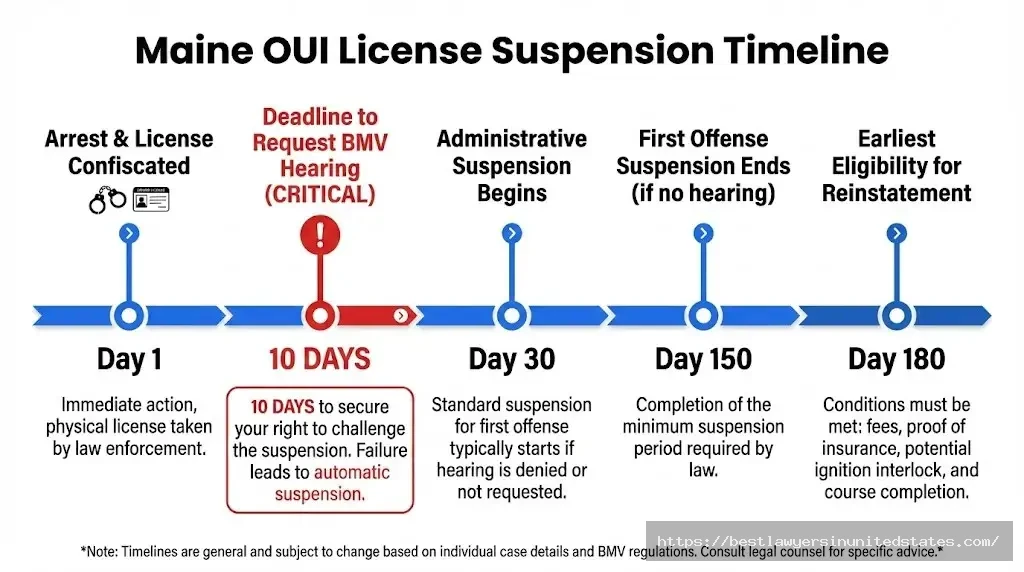
Maine’s Bureau of Motor Vehicles suspends licenses administratively separate from criminal court proceedings. This dual system confuses many defendants.
How ALS works:
- Arrest triggers suspension: Automatic process begins
- 10-day deadline: Request hearing to challenge suspension
- Temporary permit: Valid until hearing or 30 days
- Hearing scheduled: Typically 30-45 days after request
- Suspension begins: On hearing date if you lose
ALS suspension lengths:
| Circumstance | Suspension Period |
|---|---|
| Failed breath test (1st) | 150 days |
| Refused test (1st) | 275 days |
| Failed test (2nd) | 3 years |
| Refused test (2nd) | 18 months |
Critical deadline: You must request BMV hearing within 10 days of arrest. Miss this deadline and you lose your right to challenge the suspension.
BMV Hearing Process
Administrative hearings at Maine BMV follow different rules than criminal trials. Lower burden of proof makes winning harder.
Hearing procedures:
- Held at BMV office or by phone
- Hearing examiner decides (not judge)
- Police report admissible without officer present
- Burden of proof: Preponderance of evidence (51%)
- Attorney representation recommended
What BMV must prove:
- Officer had reasonable suspicion for stop
- Officer had probable cause for arrest
- You were properly informed of implied consent
- You failed test or refused
Your defenses:
- Challenge probable cause for arrest
- Question test accuracy or procedure
- Prove medical condition affected test
- Show officer failed to follow procedures
Success rate: Only 20-30% of BMV hearings result in suspensions being overturned. The hearing primarily serves to preserve issues for criminal trial.
Hardship License (Work Permit) Eligibility
Maine allows hardship licenses for work, school, and medical appointments after serving partial suspension. Requirements vary by offense level.
First offense eligibility:
- Serve 30 days of 150-day suspension
- Install ignition interlock device
- Provide employer letter proving need
- Pay $50 reinstatement fee
- Show proof of SR-22 insurance
Second offense eligibility:
- Serve 18 months of 3-year suspension
- Install IID for remaining period
- Complete alcohol treatment program
- Attend victim impact panel
- Pay all court fines and fees
Permitted driving with hardship license:
- Direct route to/from work
- Work-related driving during employment
- Medical appointments for self or dependents
- Court-ordered obligations
- Alcohol treatment programs
Restrictions:
- No recreational driving
- No driving between 2am-5am (unless work shift)
- Must carry permit and employer letter always
- IID violations revoke permit immediately
SR-22 Insurance Requirements in Maine
Maine requires SR-22 certificates of financial responsibility after OUI conviction. This high-risk insurance filing proves you maintain coverage.
SR-22 basics:
- Not insurance itself, but proof of insurance
- Filed by your insurance company with BMV
- Required for license reinstatement
- Must maintain for 3 years minimum
Cost impact:
| Insurance Factor | Increase After OUI |
|---|---|
| Base premium | +80-150% |
| SR-22 filing fee | $25-$50 (one-time) |
| Annual increase | $1,500-$3,000 |
| Three-year total | $4,500-$9,000 |
Getting SR-22:
- Contact insurance company
- Request SR-22 filing
- Pay filing fee ($25-$50)
- Company files electronically with Maine BMV
- You receive copy for records
Maintaining SR-22:
- Pay all premiums on time
- Cannot let coverage lapse even one day
- Insurance company notifies BMV of cancellation
- Lapse triggers immediate license suspension
- Must start suspension period over if lapsed
Ignition Interlock Device (IID) Installation
Maine’s 2026 law requires all OUI offenders to install ignition interlock devices. The device prevents vehicle operation if alcohol is detected.
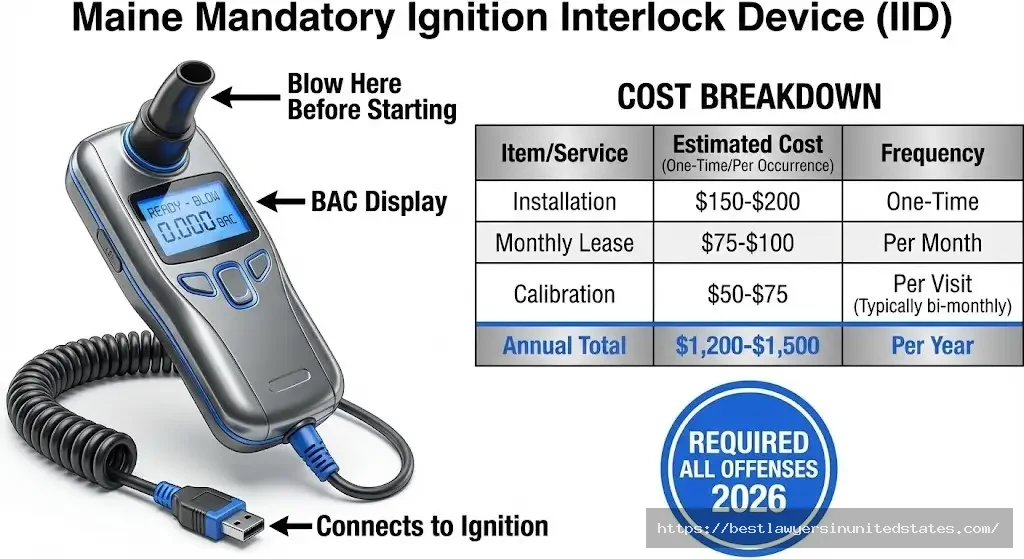
How IID works:
- Pre-start test: Blow into device before starting engine
- Pass requirement: BAC must be below 0.02%
- Random retests: Device requires breath samples while driving
- Data logging: Records all tests and violations
- Monthly reporting: Provider downloads data for BMV review
Installation process:
- Choose state-approved provider
- Schedule installation appointment
- Provider calibrates device for your vehicle
- Training on proper use provided
- Monthly calibration required
IID costs:
| Expense | Amount |
|---|---|
| Installation | $150-$200 |
| Monthly lease | $75-$100 |
| Calibration (every 60 days) | $50-$75 |
| Removal | $75-$100 |
| Annual total | $1,200-$1,500 |
Approved providers in Maine:
- LifeSafer
- Smart Start
- Intoxalock
- Guardian Interlock
How to Reinstate Your License After OUI
License reinstatement in Maine requires completing multiple steps and paying various fees. The process takes 30-60 days even after suspension ends.
Reinstatement checklist:
- Serve full suspension period
- Calendar days, not driving days
- No early reinstatement unless hardship license
- Complete alcohol education
- 8-hour class for first offense
- 20-hour program for repeat offenders
- Cost: $300-$500
- Obtain SR-22 insurance
- Contact insurance company
- Pay SR-22 filing fee
- Maintain for 3 years minimum
- Pay reinstatement fee
- $50 first offense
- $75 second offense
- $100 third offense
- Install ignition interlock device
- Required for all offenses under 2026 law
- Provider files installation notice with BMV
- Visit BMV office
- Bring completed documentation
- Pass vision test
- New license photo taken
Total reinstatement time: 2-4 weeks from completing requirements to receiving new license.
Out-of-State Drivers and Maine OUI Laws
How Maine OUI Affects Your Home State License
Maine reports all OUI convictions to your home state through the Interstate Driver’s License Compact. Your home state then applies its own penalties.
Compact reporting:
- Maine BMV notifies your home state within 30 days
- Home state treats conviction as if it occurred there
- Home state penalties apply in addition to Maine penalties
- Most states use 10-year lookback period
Example scenarios:
Florida resident arrested in Maine:
- Maine suspends driving privileges in Maine for 150 days
- Florida suspends Florida license for same period
- Must complete Maine requirements before Florida reinstates
- Florida treats as first offense on Florida record
New York resident with Maine OUI:
- Maine suspension: 150 days
- New York suspension: 90 days minimum
- New York requires victim impact panel
- SR-22 required in both states
Interstate Driver’s License Compact
The Interstate Driver’s License Compact shares conviction information among 45 member states. Only Wisconsin, Georgia, Massachusetts, Michigan, and Tennessee don’t participate fully.
How compact affects you:
- Cannot “hide” Maine OUI from home state
- Cannot get license in new state to avoid suspension
- All member states honor other states’ suspensions
- Cannot drive in any compact state during suspension
Non-resident license rules:
- Maine cannot suspend your home state license
- Maine can only suspend your privilege to drive in Maine
- Home state determines whether to suspend based on Maine conviction
Traveling Through Maine with an OUI Conviction
Previous OUI convictions create complications when traveling through Maine. Out-of-state convictions affect your Maine driving privileges.
If you have OUI from another state:
- Maine may suspend your privilege to drive in Maine
- Depends on whether offense counts as OUI under Maine law
- Administrative hearings required to challenge
- Cannot drive in Maine until resolved
If you have Maine OUI:
- Cannot drive in Maine during suspension period
- Being stopped while suspended: Class D crime
- Penalties: Additional 6 months suspension, $500-$1,000 fine
- Rental cars: Companies check suspension status
Critical point: Don’t assume you can drive through Maine during suspension. Border checks and random stops catch suspended drivers regularly.
Maine OUI Courts and Legal Resources
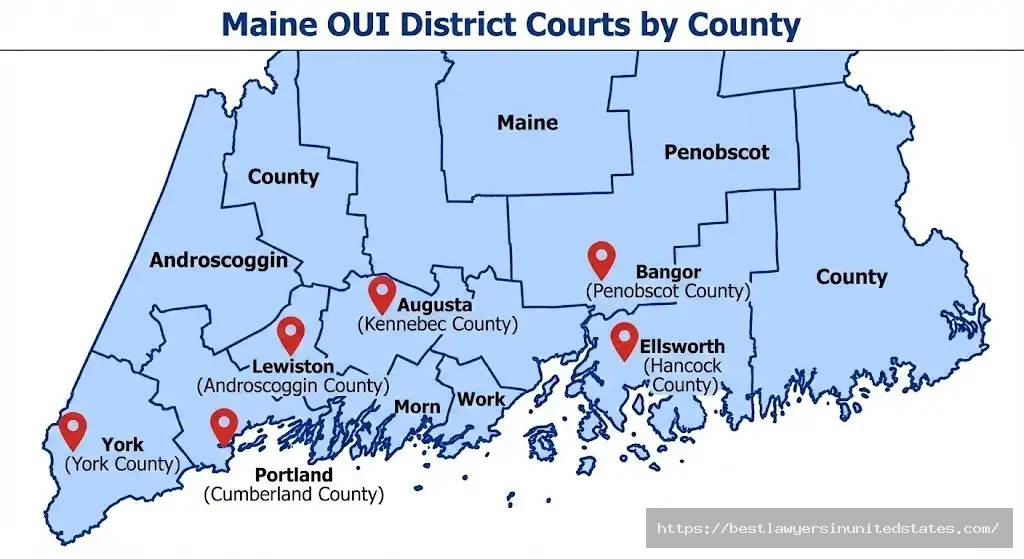
Where OUI Cases Are Heard (District Courts by County)
Maine District Courts handle all OUI prosecutions. Your case location depends on where the arrest occurred.
Major district courts handling OUI cases:
Cumberland County (Portland area):
- Portland District Court
- 205 Newbury Street, Portland, ME 04101
- Handles arrests in Portland, South Portland, Westbrook, Gorham
York County (Southern Maine):
- York County District Court
- 11 Chases Pond Road, York, ME 03909
- Handles arrests in York, Kittery, Kennebunk, Wells, Sanford
Kennebec County (Augusta area):
- Augusta District Court
- 95 State Street, Augusta, ME 04330
- Handles arrests in Augusta, Waterville, Winthrop
Penobscot County (Bangor area):
- Bangor District Court
- 73 Hammond Street, Bangor, ME 04401
- Handles arrests in Bangor, Orono, Old Town, Brewer
Hancock County (Bar Harbor area):
- Ellsworth District Court
- 50 State Street, Ellsworth, ME 04605
- Handles arrests in Bar Harbor, Ellsworth, Mount Desert Island
Androscoggin County (Lewiston/Auburn):
- Lewiston District Court
- 71 Lisbon Street, Lewiston, ME 04240
- Handles arrests in Lewiston, Auburn, Lisbon
Maine Bureau of Motor Vehicles Contact Information
Maine Bureau of Motor Vehicles handles all administrative license suspensions and reinstatements. Contact them for BMV hearings and license issues.
BMV headquarters:
- Address: 29 State House Station, Augusta, ME 04333
- Phone: (207) 624-9000
- Hours: Monday-Friday, 8:00 AM – 5:00 PM
- Website: maine.gov/sos/bmv
Administrative hearings:
- Request hearing within 10 days of arrest
- Mail request to: BMV Hearings, 29 State House Station, Augusta, ME 04333
- Or call: (207) 624-9000 ext. 52114
- Online form: Available at maine.gov/sos/bmv
License reinstatement:
- Phone: (207) 624-9000
- In-person: Any BMV branch office
- Required documents: SR-22, completion certificates, payment
Branch offices:
- Augusta: 242 State Street
- Bangor: 395 Griffin Road
- Portland: Multiple AAA locations authorized
- Lewiston: 171 Lisbon Street
Finding OUI Arrest Records in Maine
Maine OUI arrest records are public information. Multiple sources provide access to arrest and conviction data.
Where to find records:
Maine State Police:
- Phone: (207) 624-7200
- Records division: (207) 624-7009
- UCR reports show DUI statistics by county
County Sheriff’s offices:
- Cumberland County: (207) 774-1444
- York County: (207) 324-1113
- Each county maintains local arrest logs
Court records:
- Maine Judicial Branch website
- Search by name at courts.maine.gov
- Docket entries show case status
Online databases:
- Maine Public Access to Court Records (PACE)
- Maine.gov arrest records database
- Third-party background check sites
Requesting your own record:
- Mail request to: Maine State Police, State Bureau of Identification, 45 Commerce Drive, Augusta, ME 04333
- Include $25 fee and fingerprint card
- Receive complete criminal history
Calculate Your Total DUI Costs in Maine
Use our DUI cost calculator to estimate the complete financial impact of an OUI conviction in Maine.
DUI Cost Calculator
Estimate total DUI expenses by state and offense
Detailed Cost Breakdown
Payment Timeline
Bail bond, towing fees, car impound, attorney retainer
Initial court fines, DMV fees, DUI school enrollment, ignition interlock installation
Monthly probation fees, ignition interlock fees, DUI school payments, attorney balance
Insurance premium increases, license reinstatement, SR-22 filing fees
- Lost wages from missed work (court dates, jail time, DUI school) – $2,000-$10,000
- Job loss or difficulty finding employment – Varies
- Professional license suspension (doctors, lawyers, nurses, pilots) – Career ending
- Rideshare and transportation costs during suspension – $1,500-$5,000
- Travel restrictions and visa denials – Varies
- Security clearance loss – Career impact
- Child custody implications – Legal costs
- Rental car restrictions – Varies
- Personal relationships and mental health costs – Priceless
Court Fines and Fees
Maine OUI convictions carry mandatory minimum fines that courts cannot reduce. Additional court costs apply to every case.
Mandatory fines by offense:
| Offense | Minimum Fine | Maximum Fine | Court Costs |
|---|---|---|---|
| 1st | $500 | $2,000 | $300 |
| 2nd | $700 | $2,100 | $300 |
| 3rd+ | $1,100 | $5,000 | $300 |
| Aggravated 1st | $600 | $2,100 | $300 |
Additional fees:
- Victim impact panel: $50
- Substance abuse evaluation: $200-$400
- Lab fees (blood test): $100
- Probation supervision: $20/month
Attorney Costs
Hiring experienced OUI counsel significantly increases case costs but improves outcomes. Maine attorney fees vary by case complexity.
Typical attorney fees:
| Service | Cost Range |
|---|---|
| First offense (plea) | $2,500-$5,000 |
| First offense (trial) | $5,000-$10,000 |
| Second offense | $5,000-$8,000 |
| Felony OUI | $10,000-$25,000 |
| BMV hearing only | $500-$1,000 |
Fee structures:
- Flat fee: Common for straightforward cases
- Hourly rate: $200-$400 per hour for complex cases
- Retainer: Usually required upfront
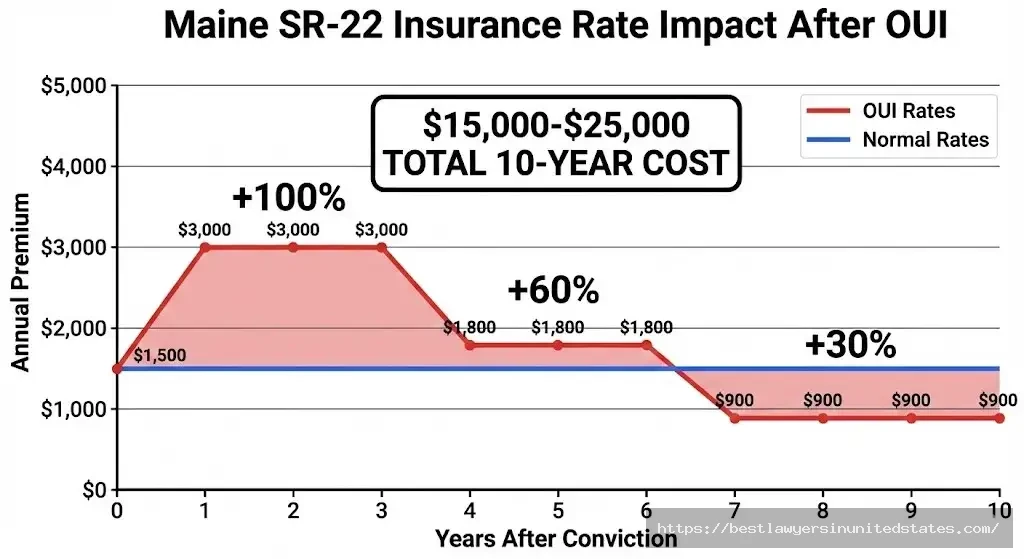
Increased Insurance Premiums
Maine OUI convictions cause car insurance rates to skyrocket for years. The total cost often exceeds all other penalties combined.
Average insurance increases:
| Years After OUI | Rate Increase | Annual Extra Cost |
|---|---|---|
| Years 1-3 | +100% | $2,000-$3,000 |
| Years 4-6 | +60% | $1,200-$1,800 |
| Years 7-10 | +30% | $600-$900 |
10-year insurance cost: $15,000-$25,000 additional premiums
How to reduce insurance costs:
- Shop multiple insurance companies
- Complete defensive driving course
- Maintain clean record after OUI
- Consider high-deductible policy
- Bundle home and auto insurance
IID Installation and Monitoring Fees
Maine’s mandatory ignition interlock device requirement adds substantial ongoing costs to OUI convictions.
IID cost breakdown:
| Expense | First Year | Subsequent Years |
|---|---|---|
| Installation | $150-$200 | N/A |
| Monthly lease | $900-$1,200 | $900-$1,200 |
| Calibration (6x/year) | $300-$450 | $300-$450 |
| Removal | $75-$100 | N/A |
| Total | $1,425-$1,950 | $1,200-$1,650 |
Duration by offense:
- 1st offense: 150 days minimum ($600-$800)
- 2nd offense: 3 years ($3,600-$4,900)
- 3rd offense: 6 years ($7,200-$9,800)
License Reinstatement Fees
Restoring your Maine driving privileges requires multiple payments to different agencies.
Reinstatement fee breakdown:
| Fee Type | Amount |
|---|---|
| BMV reinstatement fee | $50-$100 |
| SR-22 filing fee | $25-$50 |
| Alcohol education program | $300-$500 |
| Treatment program (if ordered) | $1,000-$3,000 |
| New license fee | $30 |
| Vision test | $15 |
Total reinstatement costs: $1,420-$3,695 depending on requirements
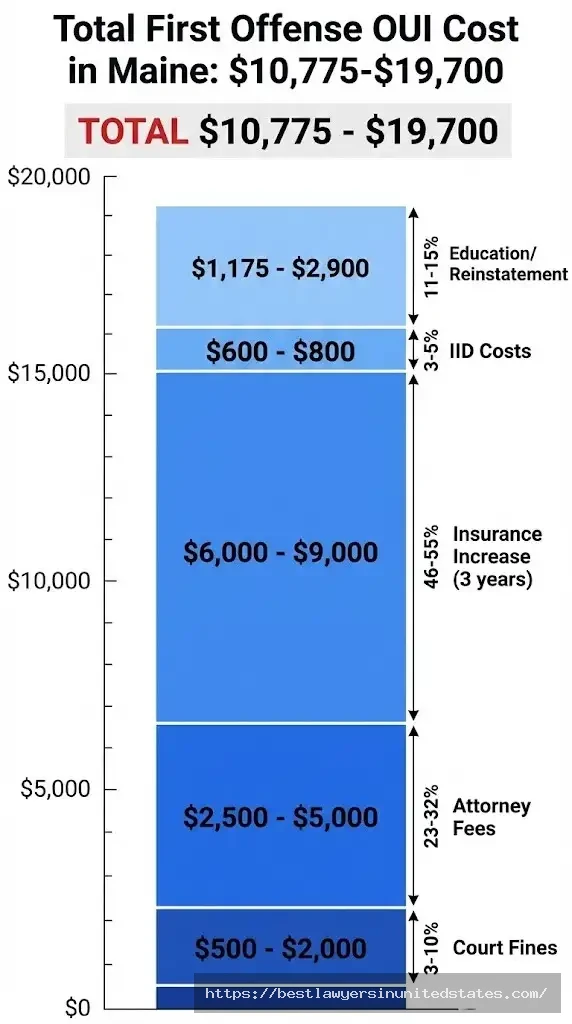
Total First Offense OUI Cost Estimate
Adding all expenses reveals the true financial burden of Maine OUI conviction. First-time offenders face substantial costs.
Complete cost breakdown:
| Cost Category | Amount Range |
|---|---|
| Court fine | $500-$2,000 |
| Court costs | $300 |
| Attorney fees | $2,500-$5,000 |
| Alcohol education | $300-$500 |
| IID (150 days) | $600-$800 |
| SR-22 filing | $25-$50 |
| License reinstatement | $50 |
| Insurance increase (3 years) | $6,000-$9,000 |
| Lost wages (court/jail) | $500-$2,000 |
| TOTAL FIRST OFFENSE | $10,775-$19,700 |
Second offense total: $25,000-$45,000
Third offense total: $40,000-$75,000+
Open Container Laws in Maine
Maine’s Open Container Statute
Maine Title 29-A § 2112 prohibits open containers of alcohol in vehicles. This law applies separately from OUI statutes.
Open container definition:
- Any alcoholic beverage container with broken seal
- Partially consumed beer, wine, or liquor
- Mixed drinks in cups
- Empty bottles still containing residue
Where law applies:
- Driver and passenger areas of vehicle
- Does not apply to trunk
- RVs and motorhomes: Law applies only to driver/front passenger area
Who can be charged:
- Driver receives citation even if passenger possesses container
- Passengers can also be charged individually
- Both can be charged simultaneously
Penalties for Open Container Violations
Maine treats open container violations as traffic infractions, not crimes. Penalties are less severe than OUI but still create problems.
Open container penalties:
- Fine: $50-$200
- No jail time
- No license suspension
- Traffic violation (not criminal record)
- Insurance rates may increase slightly
Enhanced penalties if combined with other violations:
- Open container + OUI: Aggravating factor for sentencing
- Open container + minor in vehicle: Child endangerment possible
- Open container + accident: Evidence of impairment
Exceptions to open container law:
- Passengers in commercial transportation (buses, limos)
- Passengers in living quarters of RV
- Containers in trunk or behind last upright seat
Frequently Asked Questions
What is criminal OUI in Maine?
Quick Answer: Criminal OUI in Maine refers to Operating Under the Influence prosecuted as a crime in district court, which can result in jail time, fines, and a permanent criminal record.
Maine handles OUI through two separate systems. The administrative system (BMV) suspends your license automatically. The criminal system prosecutes you in district court for the OUI offense itself under Title 29-A § 2411.
Criminal OUI requires the prosecutor to prove beyond reasonable doubt that you operated a vehicle while impaired or with BAC over 0.08%. Conviction creates a permanent criminal record that appears on background checks. Courts cannot seal or expunge OUI convictions in Maine.
Can you get an OUI expunged in Maine?
Quick Answer: No, Maine law does not allow OUI conviction expungement. OUI remains on your permanent criminal record for life.
Maine Title 15 § 2003 governs criminal record sealing. The law explicitly excludes OUI convictions from expungement eligibility. Your OUI conviction will appear on background checks permanently.
Some limited exceptions exist after 10+ years for very minor first offenses, but judges rarely grant these petitions. Fewer than 5% succeed. The better strategy focuses on license reinstatement and moving forward rather than pursuing record sealing.
How much does an OUI cost in Maine?
Quick Answer: First offense OUI in Maine costs $10,775 to $19,700 total, including fines, attorney fees, insurance increases, and IID expenses.
The largest cost comes from increased insurance premiums. Your rates increase 80-150% for three years, adding $6,000-$9,000 to your total expenses. Second offense costs rise to $25,000-$45,000. Third offense felony OUI exceeds $40,000-$75,000.
Use our DUI cost calculator to estimate your specific situation.
Do I need a lawyer for a first offense OUI?
Quick Answer: Yes, hiring an experienced OUI attorney improves outcomes significantly, even for first offenses. Attorneys win dismissals in 15-20% of first offense cases.
First offense OUI in Maine carries mandatory minimum penalties that judges cannot reduce. However, skilled attorneys challenge evidence, negotiate better plea deals, and protect your rights at BMV hearings.
The 10-day deadline to request administrative hearing makes immediate attorney consultation critical. Missing this deadline costs you the right to challenge your license suspension. Attorney fees of $2,500-$5,000 often save far more in reduced insurance costs and penalties.
What happens if I refuse a breathalyzer in Maine?
Quick Answer: Refusing a breathalyzer in Maine results in 275-day license suspension for first offense, which is 125 days longer than failing the test (150-day suspension).
Maine’s implied consent law under Title 29-A § 2453 makes refusal costly. Your license suspends automatically through BMV administrative process. This suspension runs separately from any criminal court penalties.
Refusal cannot be mentioned to juries in criminal trial, but prosecutors can use it in plea negotiations. The administrative suspension begins 30 days after arrest unless you request a hearing within 10 days.
Can I get a hardship license after an OUI?
Quick Answer: Yes, Maine allows hardship licenses after serving 30 days of first offense suspension, but you must install an ignition interlock device and prove work necessity.
Hardship licenses (work permits) in Maine permit driving only for:
- Direct route to and from employment
- Work-related driving during employment hours
- Medical appointments for yourself or dependents
- Court-ordered obligations
You must provide employer letter verifying your need to drive. Second offense requires serving 18 months before hardship eligibility. All hardship licenses require IID installation at your expense ($1,200-$1,500 annually).
Conclusion: Protecting Your Rights After a Maine OUI
Maine OUI laws create serious consequences that last years beyond your court date. First offense convictions cost $10,000-$20,000 when you include insurance increases. License suspensions prevent work and daily activities. Criminal records affect employment permanently.
Understanding Maine’s dual system—administrative BMV suspension and criminal prosecution—helps you fight both battles effectively. The 10-day deadline to request BMV hearing represents your most critical deadline. Miss it and you lose your right to challenge the administrative suspension.
Focus your defense efforts on three key areas: challenging the traffic stop legality, questioning chemical test accuracy, and negotiating favorable plea terms. Experienced Maine OUI attorneys win dismissals in 15-20% of cases and secure reduced charges in 30-40%.
Remember that refusing chemical testing triggers longer license suspension than failing the test. Your refusal suspension (275 days first offense) exceeds the failed test suspension (150 days) by over four months.
Find OUI Lawyers in Maine – Free Consultation
Facing OUI charges in Maine? Experienced local attorneys can help protect your rights and fight for better outcomes.
Email: [email protected]
