
Quick Answer: Minnesota DUI laws use a four-degree system based on aggravating factors. First-time offenders face 90 days to 1 year license revocation, $1,000-$14,000 fines, and possible jail time. Minnesota’s 2025 law changes extended the look-back period to 20 years and made ignition interlock mandatory for most repeat offenders.

Minnesota treats impaired driving seriously. In 2024, police made 26,923 DWI arrests and alcohol contributed to 142 traffic deaths. The state employs both administrative penalties (license revocation, plate impoundment) and criminal charges (misdemeanors to felonies) under Minnesota Statutes Chapters 169A and 171.
What Makes Minnesota DWI Laws Different?
Minnesota stands apart from most states in three major ways.
The Four-Degree Classification System
Minnesota classifies DWI offenses from fourth-degree (misdemeanor) to first-degree (felony) based on aggravating factors, not just the number of offenses. This system determines your criminal penalties before you ever go to court.
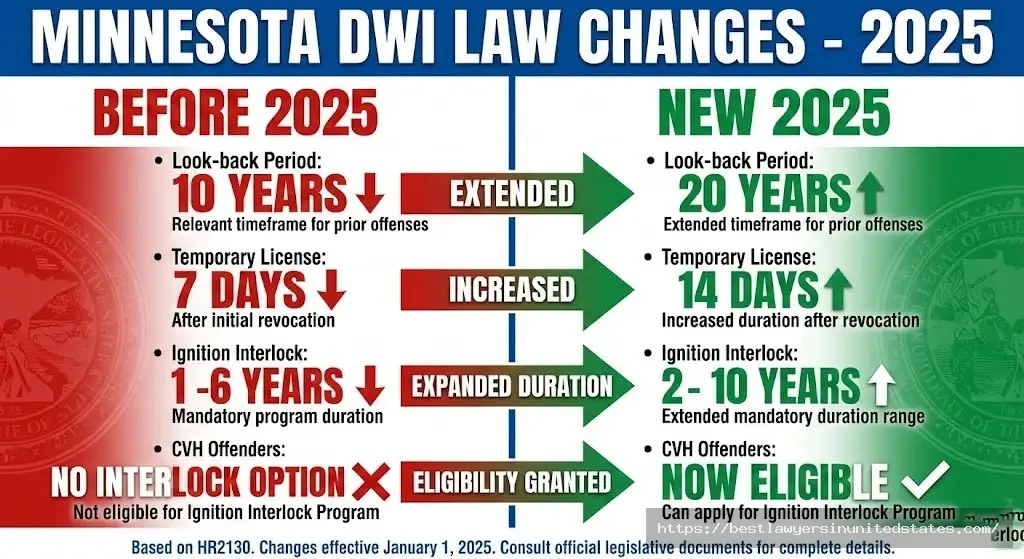
2025 Law Changes That Affect Everyone
The Minnesota Legislature passed sweeping DWI reforms in 2025 through HR2130. The look-back period jumped from 10 years to 20 years, meaning a DWI from 2006 still counts against you in 2026. Temporary licenses now last 14 days instead of 7 days, giving you more time to request a hearing.
Whiskey Plates Are Real
Minnesota issues special W-prefixed license plates to certain DWI offenders. Only Minnesota and Ohio prominently use this plate impoundment system. The State v. Henning decision means police cannot stop you solely because of whiskey plates, but the visible marker remains.
Minnesota BAC Limits and Testing Laws
Quick Answer: Minnesota’s legal limit is 0.08% for drivers 21+, 0.04% for commercial drivers, and 0.02% for drivers under 21. School bus drivers face zero tolerance for any detectable alcohol.

Different Limits for Different Drivers
| Driver Type | BAC Limit | Statute |
|---|---|---|
| Standard (21+) | 0.08% | § 169A.20 |
| Commercial Vehicle | 0.04% | § 169A.20 |
| Under 21 | 0.02% | § 169A.20 |
| School Bus | 0.00% | § 171.3215 |
Not sure where you stand? Check your estimated BAC level:
BAC Calculator
Estimate your Blood Alcohol Content
• Commercial Driver (CDL): 0.04% BAC
• Drivers Under 21: 0.00-0.02% BAC (Zero Tolerance)
• Enhanced Penalties: 0.15% BAC or higher in most states
Important: The 0.08% limit applies at the time of driving or within two hours after. Officers can arrest you even if your BAC rises above the limit only after you stopped driving.
What Counts as Impaired Driving
Minnesota law prohibits driving under these conditions per § 169A.20:
- Under the influence of alcohol, controlled substances, or intoxicating substances
- BAC of 0.08% or more
- Any amount of Schedule I or II controlled substances in your body (except marijuana)
- Under the influence of cannabis products
- BAC of 0.04% or more in a commercial vehicle
Physical Control Without Driving
You can face DWI charges without actually driving. Minnesota courts define “physical control” broadly.

State v. Fleck (2010): A jury convicted a person sleeping behind the wheel with keys in the console. The Minnesota Supreme Court upheld this conviction.
Frisch v. State (2014): A person standing 15-20 feet from a running vehicle with keys in the ignition had physical control.
State v. Henderson (2017): A passenger who grabbed and turned the steering wheel exercised physical control.
Safe practice: If you need to rest in your car, put keys in the trunk, sit in the back seat, and keep the engine off.
Understanding Minnesota’s Four DWI Degrees
Minnesota assigns a degree to each DWI based on aggravating factors present at arrest. This degree determines criminal penalties before conviction.
The Three Aggravating Factors
- Prior qualified impaired driving incident within 10 years (20 years under 2025 law)
- BAC of 0.16% or higher
- Child under 16 in vehicle (driver must be 36+ months older)
How Degrees Break Down
| Degree | Classification | Aggravating Factors | Max Penalty |
|---|---|---|---|
| 4th Degree | Misdemeanor | 0 factors | 90 days jail, $1,000 fine |
| 3rd Degree | Gross Misdemeanor | 1 factor OR test refusal | 364 days jail, $3,000 fine |
| 2nd Degree | Gross Misdemeanor | 2 factors OR refusal + 1 factor | 364 days jail, $3,000 fine |
| 1st Degree | Felony | 4+ DWI incidents in 10 years OR prior felony DWI/CVO | 7 years prison, $14,000 fine |
Real-World Degree Examples
Example 1 – Fourth Degree: First-time DWI with 0.10% BAC and no passengers. Clean record means no aggravating factors.
Example 2 – Third Degree: First-time DWI with 0.18% BAC. The 0.16%+ reading creates one aggravating factor.
Example 3 – Second Degree: Second DWI in 8 years with 0.12% BAC. One prior + normal BAC would be third degree, but if you refuse testing, that adds the second factor.
Example 4 – First Degree: Fourth DWI arrest in 9 years automatically triggers felony charges regardless of BAC or other factors.
Minnesota DWI Penalties and Fines
Criminal Penalties by Degree
| Offense | Jail Time | Fines | Mandatory Minimum |
|---|---|---|---|
| 1st DWI (4th degree) | Up to 90 days | Up to $1,000 | None |
| 2nd in 10 years | Up to 364 days | Up to $3,000 | 30 days (48 hours jail minimum) |
| 3rd in 10 years | Up to 364 days | Up to $3,000 | 90 days (30 days jail minimum) |
| 4th in 10 years (felony) | Up to 7 years | Up to $14,000 | 180 days (30 days jail minimum) |
| 5th+ in 10 years | Up to 7 years | Up to $14,000 | 1 year (60 days jail minimum) |
Key point: Courts can stay (postpone) execution of jail sentences and place you on probation with conditions including ignition interlock, REAM monitoring, or intensive supervision.
Penalty Assessment for High BAC
Judges may add a penalty assessment up to $1,000 for BAC of 0.16% or higher under § 169A.276. This comes on top of standard fines and court costs.
Chemical Dependency Assessment Required
Every DWI conviction requires a chemical use assessment before sentencing. The county administers this evaluation to determine if you need treatment.
Costs:
- Assessment fee: Paid directly to provider (typically $100-$200)
- Court assessment charge: $25
- Repeat violation surcharge: Additional $5 if within 5 years
For repeat offenses within 10 years or first offenses with 0.16%+ BAC, courts must order the recommended treatment level.
Minnesota License Revocation Periods
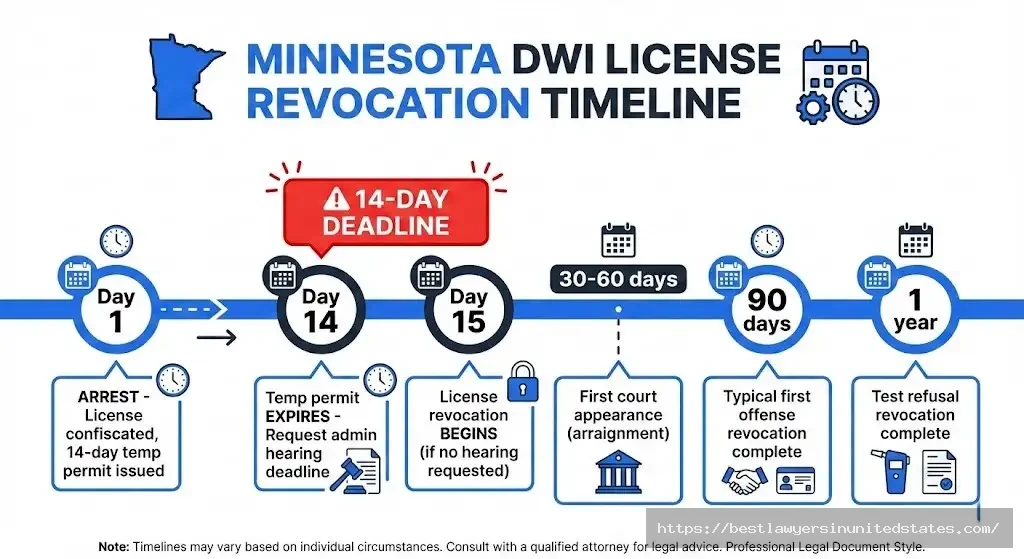
Quick Answer: First-time test failure with BAC under 0.16% triggers 90-day revocation. Test refusal brings 1-year revocation. License loss starts 14 days after arrest with a temporary permit.
First Offense Revocation (No Prior in 20 Years)
| Violation | Administrative Revocation | After Conviction |
|---|---|---|
| Test failure, 21+, BAC under 0.08% | 90 days | 30 days |
| Test failure, under 21 | 180 days | 180 days |
| Test failure, BAC 0.16%+ | 1 year | 1 year |
| Test refusal | 1 year | 90 days |
Critical deadline: You get a temporary license valid for 14 days after arrest. Request an administrative hearing within this window or accept the revocation.
Repeat Offense Revocation
For any second offense within 20 years or third+ lifetime offense, Minnesota requires ignition interlock program completion before license reinstatement. You cannot simply wait out the revocation period.
The revocation length depends on successful interlock participation:
| Prior Violations | Interlock Duration | Statute |
|---|---|---|
| 1 in 20 years | 2 years | § 171.306 |
| 2 lifetime | 6 years | § 171.306 |
| 3+ lifetime | 10 years | § 171.306 |
The 20-Year Look-Back Change
Before 2025, Minnesota counted priors only within 10 years. HR2130 doubled this period to 20 years effective January 2025.
Real impact: A DWI from January 2006 still counts as a prior in January 2026. This significantly increases the number of people facing mandatory ignition interlock.
Minnesota Implied Consent Law
Every Minnesota driver consents to chemical testing by accepting their license under § 169A.51. This “implied consent” kicks in upon arrest for suspected DWI.
Breath Tests vs. Blood/Urine Tests
Breath tests: Officers can require breath samples without a warrant (Birchfield v. North Dakota, 2016). You must comply or face test refusal charges.
Blood/urine tests: Officers need a search warrant signed by a judge (State v. Thompson, 2016). Refusing after a valid warrant is issued remains a crime.
The Implied Consent Advisory
Before requesting a breath test, officers must read the implied consent advisory explaining:
- Testing is mandatory under Minnesota law
- Test refusal is a crime
- You have the right to consult an attorney before testing
- Refusal triggers license revocation
Test Refusal Penalties
| Offense | License Revocation | Criminal Charge |
|---|---|---|
| 1st refusal | 1 year | Gross misdemeanor |
| 2nd refusal | Varies | Gross misdemeanor |
| 3rd+ refusal | Varies | Gross misdemeanor |
Critical point: Test refusal adds an aggravating factor to your DWI charge, automatically elevating it to third-degree even if you have no priors.
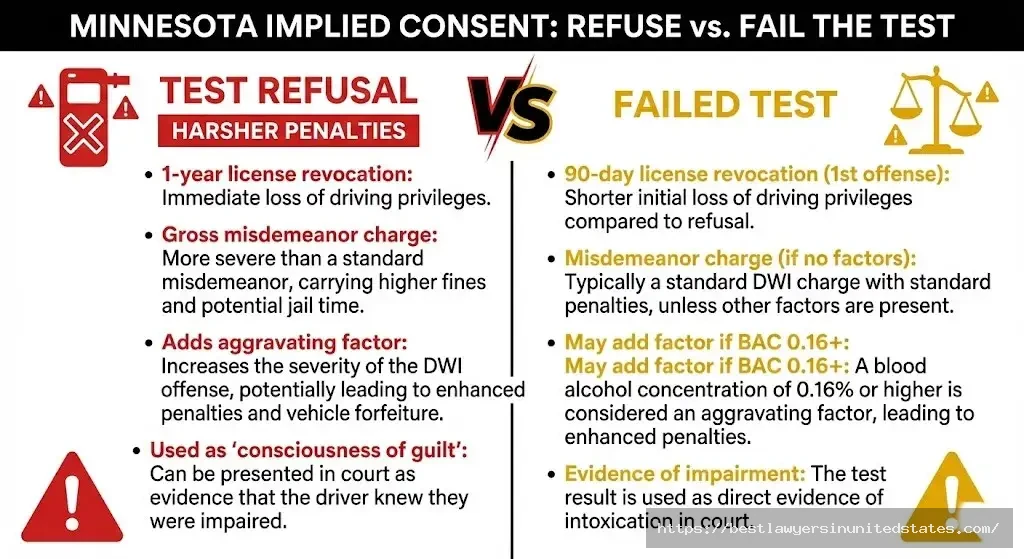
Refusal vs. Failure Comparison
Refusing often brings harsher consequences than failing:
- Failed test, first offense: 90-day revocation
- Refused test, first offense: 1-year revocation
- Failed test, BAC 0.16%+: Adds 1 aggravating factor
- Refused test: Adds 1 aggravating factor plus gross misdemeanor charge
Building Probable Cause for Testing
Officers follow a three-phase process before demanding chemical tests:
Phase 1 – Vehicle in Motion:
- Observe driving behavior (weaving, speed, traffic violations)
- Form reasonable suspicion to initiate traffic stop
Phase 2 – Personal Contact:
- Smell of alcohol
- Bloodshot/watery eyes
- Slurred speech
- Open containers visible
Phase 3 – Pre-Arrest Screening:
- Standard Field Sobriety Tests (SFST)
- Preliminary Breath Test (PBT)
- Establish probable cause for arrest
Important: PBT results cannot be admitted at trial but form basis for arrest. SFST performance can be described in court.
Minnesota’s 2025 Ignition Interlock Program Changes
Minnesota overhauled its ignition interlock requirements in 2025. Most repeat offenders must now complete the program to regain full driving privileges.

Who Must Use Ignition Interlock
Not required:
- First-time offenders with no priors in 20 years (can wait out revocation)
Required:
- Anyone with 1+ prior DWI in past 20 years
- Anyone with 2+ lifetime DWI offenses
- All Criminal Vehicular Homicide (CVH) offenders
- All Criminal Vehicular Operation (CVO) offenders
Interlock Duration Requirements
DWI-Related Violations
| Prior Violations | Interlock Duration | Can Opt Out? |
|---|---|---|
| None (or 1 prior 20+ years ago) | Not required | Yes – wait out revocation |
| 1 in 20 years | 2 years | No |
| 2 lifetime | 6 years | No |
| 3+ lifetime | 10 years | No |
CVH/CVO Offenses
| Harm Level | Prior Violations | Interlock Duration |
|---|---|---|
| Bodily/Substantial Bodily | None | 2 years |
| Bodily/Substantial Bodily | 1 prior | 5 years |
| Bodily/Substantial Bodily | 2 priors | 8 years |
| Bodily/Substantial Bodily | 3+ priors | 10 years |
| Great Bodily Harm | None | 6 years |
| Great Bodily Harm | 1 prior | 8 years |
| Great Bodily Harm | 2+ priors | 10 years |
| Death | None | 6 years |
| Death | 1 prior | 15 years |
| Death | 2+ priors | Lifetime |
2025 change: CVH offenders can now participate in ignition interlock. Previously they faced permanent revocation with no interlock option.
How Ignition Interlock Works
The device connects to your vehicle’s ignition system. You provide a breath sample before starting the engine. The vehicle won’t start if the device detects alcohol.
Rolling retests: The device randomly requests breath samples while driving (typically every 15-30 minutes). You have several minutes to pull over safely and provide a sample.
Camera verification: Devices photograph you during each test to prevent others from providing samples.
Data logging: The device records all tests, violations, and GPS location (if court-ordered).
Violation Consequences
| Violation Type | Consequence |
|---|---|
| BAC 0.02%+ detected | Entire interlock period restarts |
| Tampering with device | Misdemeanor charge + period restarts |
| Driving without interlock | Gross misdemeanor charge + period restarts |
| Failed breath test (BAC under 0.02%) | Logged but doesn’t restart period |
| Skipped rolling retest | Logged violation |
Critical rule: You must have zero failed tests in the final 90 days of your interlock period. Any failure during this window extends your requirement.
Employer Vehicle Exception
You can drive an employer-owned vehicle without ignition interlock during work hours under § 171.306, subd. 4. Requirements:
- Employer must provide written consent
- Limited to normal course of employment
- Cannot drive employer vehicle for personal use
- Employer must be notified of your interlock requirement
Interlock Costs
| Cost Category | Amount | Frequency |
|---|---|---|
| Device installation | $75-$150 | One-time |
| Monthly monitoring | $75-$100 | Every month |
| Monthly calibration | $25-$50 | Every 30-60 days |
| Device removal | $50-$75 | One-time |
| 2-year program total | $2,400-$3,600 | Full period |
| 6-year program total | $6,000-$9,000 | Full period |
| 10-year program total | $10,000-$15,000 | Full period |
Indigent discounts: Low-income participants may qualify for reduced rates through approved providers. Contact the Minnesota Department of Public Safety for eligibility requirements.
Reinstatement fee: You pay $680 after completing interlock to reinstate full driving privileges. Under 2025 changes, you no longer pay this upfront to enter the program.
Minnesota Whiskey Plates Explained
Minnesota issues special license plates to certain DWI offenders under § 169A.60. These plates begin with the letter “W” and signal to law enforcement that the registered owner has a DWI history.

When You Get Whiskey Plates
Plate impoundment triggers when you commit a DWI with any aggravating factor:
- 1+ prior DWI in past 10 years
- BAC 0.16% or higher
- Child under 16 in vehicle (driver 36+ months older)
- Driving with cancelled license (inimical to public safety)
Who gets plates: The impoundment applies to the vehicle driven during the offense AND any vehicle registered to the offender (solely or jointly).
How Plate Impoundment Works
At arrest, the officer issues a plate impoundment order effective immediately:
If vehicle accessible:
- Officer physically removes plates OR
- Officer applies permanent invalidation sticker
Temporary permit issued:
- Valid 14 days if you own the vehicle
- Valid 45 days if you don’t own the vehicle
Getting new plates: You or the registered owner can apply for specially-coded W-prefix plates under § 169A.60, subd. 13.
Who Can Get Special Registration Plates
Minnesota issues W-plates when:
- You have a properly licensed substitute driver
- A household member holds a valid license
- You’ve been validly relicensed yourself
- The owner isn’t the offender and holds a valid license
The State v. Henning Ruling
Police previously stopped vehicles solely because of whiskey plates. The Minnesota Supreme Court ruled this unconstitutional in State v. Henning (2003).
Current law: Officers need independent reasonable suspicion (weaving, traffic violation, equipment issue) beyond just seeing W-plates before initiating a traffic stop.
2021 Change: Regular Plates with Interlock
Under § 169A.60, subd. 13(f), you can obtain regular (non-W) plates if you:
- Enter the ignition interlock program
- Continue successful participation
- Maintain all program requirements
Benefit: This removes the visible DWI marker while you work toward full reinstatement.
Minimum Impoundment Period
Whiskey plates remain required for one year minimum. During this period:
- Cannot drive any vehicle without special plates
- Must be validly relicensed to drive
- Face restrictions when selling/acquiring vehicles
Violations: Driving without required special plates or enabling someone else to evade plate impoundment is a gross misdemeanor under § 169A.60, subd. 14.
Minnesota Vehicle Forfeiture Laws
Minnesota can seize and permanently forfeit your vehicle for “designated offenses” under § 169A.63.
What Triggers Vehicle Forfeiture
Designated offense means:
- First-degree DWI (felony)
- Second-degree DWI with 2+ aggravating factors
- Third DWI violation within 10 years
- Driving with cancelled license (inimical to public safety)
- Driving with B-Card restrictions
Which vehicle: Only the specific vehicle used in the designated offense faces forfeiture. Other vehicles you own remain protected.
Forfeiture Process Timeline
At arrest:
- Officer may seize the vehicle immediately
- Vehicle towed to impound lot
Within 60 days:
- Prosecuting authority serves notice to registered owner(s)
- Notice explains forfeiture intent and rights
Owner’s options:
- Accept forfeiture (vehicle becomes government property)
- File judicial challenge in district court
- Claim innocent owner status
Innocent Owner Defense
Courts must return the vehicle if an owner proves:
- Did not know the vehicle would be driven by an intoxicated person, OR
- Took reasonable steps to prevent intoxicated person from operating vehicle
Example: Your adult child borrows your car without permission and gets a third DWI. You may qualify as an innocent owner if you had no knowledge of their impairment or DWI history.
2025 Interlock Pause Provision
Vehicle forfeiture must pause if you enter the ignition interlock program under § 169A.63, subd. 7a:
- Vehicle returned to you
- You cannot drive it without interlock device installed
- Forfeiture resumes if you fail to complete program
Benefit: This gives you a path to keep your vehicle by demonstrating sobriety through the interlock program.
What Happens to Forfeited Vehicles
After forfeiture completion, the arresting agency can:
- Sell the vehicle at public auction
- Keep the vehicle for official agency use
Proceeds distribution: Money from sales goes to arresting and prosecuting agencies for specific approved uses (DWI enforcement, training, equipment).
Lienholder protection: If you’re financing the vehicle, the lender’s security interest remains protected under § 169A.63, subd. 10. The lender can foreclose and sell separately.
What Minnesota DWI Costs in 2026
Quick Answer: First-time Minnesota DWI costs $7,000-$15,000 total including fines, attorney fees, license reinstatement, and insurance increases. Repeat offenses with ignition interlock run $15,000-$35,000 over the program period.

Calculate your specific costs:
DUI Cost Calculator
Estimate total DUI expenses by state and offense
Detailed Cost Breakdown
Payment Timeline
Bail bond, towing fees, car impound, attorney retainer
Initial court fines, DMV fees, DUI school enrollment, ignition interlock installation
Monthly probation fees, ignition interlock fees, DUI school payments, attorney balance
Insurance premium increases, license reinstatement, SR-22 filing fees
- Lost wages from missed work (court dates, jail time, DUI school) – $2,000-$10,000
- Job loss or difficulty finding employment – Varies
- Professional license suspension (doctors, lawyers, nurses, pilots) – Career ending
- Rideshare and transportation costs during suspension – $1,500-$5,000
- Travel restrictions and visa denials – Varies
- Security clearance loss – Career impact
- Child custody implications – Legal costs
- Rental car restrictions – Varies
- Personal relationships and mental health costs – Priceless
Complete First-Time DWI Cost Breakdown
| Cost Category | Amount | Notes |
|---|---|---|
| Court fines | $1,000 | Maximum for 4th degree |
| Court costs | $200-$400 | Filing fees, surcharges |
| Attorney fees | $2,500-$7,500 | Varies by case complexity |
| Chemical assessment | $100-$200 | Required before sentencing |
| Assessment charge | $25 | Court-imposed |
| DWI school | $150-$300 | If ordered |
| License reinstatement | $680 | DVS fee |
| SR-22 insurance filing | $25-$50 | Annual filing fee |
| Insurance increase | $1,000-$2,000/year | 3-5 year impact |
| Towing/impound | $200-$500 | If vehicle towed |
| Lost wages | Varies | Court appearances, jail |
| First-Year Total | $5,880-$13,655 | Without insurance |
| 3-Year Total | $7,880-$17,655 | With insurance |
Repeat Offense with Ignition Interlock Costs
| Cost Category | 2-Year Program | 6-Year Program | 10-Year Program |
|---|---|---|---|
| Court fines | $3,000 | $3,000 | $14,000 |
| Attorney fees | $5,000-$10,000 | $5,000-$15,000 | $7,500-$20,000 |
| Ignition interlock | $2,400-$3,600 | $6,000-$9,000 | $10,000-$15,000 |
| License reinstatement | $680 | $680 | $680 |
| Chemical assessment | $125 | $125 | $125 |
| Treatment (if ordered) | $1,000-$5,000 | $1,000-$5,000 | $1,000-$5,000 |
| Insurance increase | $3,000-$6,000 | $9,000-$18,000 | $15,000-$30,000 |
| Program Total | $15,205-$28,405 | $24,805-$50,805 | $39,305-$84,805 |
Hidden Costs Often Overlooked
Employment impact:
- Job loss for commercial drivers
- Background check issues
- Professional license complications
- Lost income during jail time
Transportation costs:
- Uber/Lyft during suspension: $200-$500/month
- Public transportation passes: $100-$150/month
- Relying on family/friends: Relationship strain
Long-term consequences:
- Car rental companies deny DWI offenders
- Higher interest rates on loans
- Apartment rental application denials
- Security clearance issues
Payment Plan Options
Minnesota offers installment plans for certain costs if you qualify for a public defender under § 171.29, subd. 2a:
Reinstatement fee: Can pay $680 in two installments with handling fee. Second payment due before license renewal (typically 2 years).
Court fines: Judges may authorize payment plans through court administration.
Ignition interlock: Many providers offer monthly payment plans instead of upfront costs.
Minnesota Limited License Options
First-time offenders without BAC of 0.16%+ can apply for a limited license under § 171.30 instead of participating in ignition interlock.
What Is a Limited License
A limited license restricts when and where you can drive. It allows operation for:
- Employment purposes
- Abstinence-based treatment programs
- Educational activities
- Homemaker duties caring for family
Key restriction: You can drive only 6 days per week, not daily.
Waiting Periods Before Applying
| Offense | Waiting Period |
|---|---|
| Test failure, BAC under 0.16%, age 18+ | 15 days |
| Test failure, BAC under 0.16%, under 18 | 90 days |
| Test refusal | Not eligible |
| Test failure, BAC 0.16%+ | Not eligible |
After waiting period: Apply to Minnesota Driver and Vehicle Services with proof of SR-22 insurance and required fees.
Limited License Restrictions
The Commissioner can place additional restrictions on your limited license:
- Specific hours of operation only
- Limited to certain geographical areas
- Specific routes between home and approved destinations
- No passenger restrictions (unless separately ordered)
Violation consequences: Driving outside your limited license restrictions is a misdemeanor and triggers license cancellation.
Limited License vs. Ignition Interlock
| Factor | Limited License | Ignition Interlock |
|---|---|---|
| Driving privileges | Restricted to work/treatment/education | Full driving privileges |
| Days per week | 6 days | 7 days |
| Vehicle restrictions | Can drive any vehicle | Must drive equipped vehicles only |
| Duration | Revocation period (30-365 days) | 2-10 years for repeat offenders |
| Costs | SR-22 filing only | $75-$100/month device costs |
| Who qualifies | First-time offenders, BAC under 0.16% | Required for repeat offenders |
Minnesota DWI Court Process
Your First 14 Days After Arrest
Understanding these critical deadlines protects your rights:
Day 1 – Arrest:
- Officer confiscates physical license
- Issues notice of intent to revoke
- Provides 14-day temporary permit
- May impound license plates if aggravating factors present
Days 1-14 – Critical Actions:
- Contact a DWI attorney immediately
- Request administrative hearing with DVS (must file within 14 days)
- Gather evidence (receipts, witness names, surveillance video)
- Do not discuss your case on social media
Day 14 – Temporary Permit Expires:
- If you requested hearing: DVS may extend driving privileges pending hearing
- If you did not request hearing: License revocation begins automatically
- No driving allowed without valid license or limited license approval
Within 30-60 days:
- First court appearance (arraignment)
- Enter plea (not guilty, guilty, or no contest)
- Judge sets bail conditions if not already set
Criminal Court Timeline
Arraignment (first appearance):
- Judge reads charges
- You enter initial plea
- Bail and release conditions set
- Next court date scheduled
Pretrial hearings:
- Defense attorney reviews evidence
- Negotiate with prosecutor
- File motions to suppress evidence
- Discuss plea bargains
Trial or plea:
- Guilty plea: Sentencing scheduled
- Not guilty: Case proceeds to trial
- Trial: Jury or bench trial determines guilt
Sentencing:
- Chemical dependency assessment results presented
- Judge imposes fines, jail time, probation
- Treatment requirements ordered if applicable
- License implications explained
Administrative License Hearing
This separate civil hearing with DVS determines whether your license revocation stands. You must request this hearing within 14 days of arrest.
Hearing focuses on:
- Did officer have probable cause to stop you?
- Did officer have probable cause to arrest you?
- Did you refuse testing or fail with BAC 0.08%+?
- Did officer follow proper procedures?
Important: Winning the administrative hearing does not dismiss criminal charges. You fight two separate battles.
Minnesota DWI Pretrial Release Requirements
Minnesota requires detention until first court appearance for certain DWI offenses under § 169A.44.
Mandatory Hold Offenses
Must be held until court appearance:
- First-degree DWI (felony)
- Second-degree DWI
May obtain pretrial release by:
- Posting maximum bail ($12,000 for gross misdemeanor), OR
- Agreeing to remote electronic alcohol monitoring (REAM)
REAM Requirements
Remote Electronic Alcohol Monitoring requires:
- At-home breath testing device installation
- Minimum daily breath alcohol measurements
- Complete abstinence from alcohol
- Submit to random breath tests
- Camera verification for each test
Costs: You pay for REAM device and monitoring (typically $10-15/day).
Additional Felony DWI Conditions
First-degree DWI pretrial release includes mandatory conditions:
- License plate impoundment (or vehicle impoundment for off-road vehicles/boats)
- Weekly reporting to probation officer
- Random breath alcohol testing
- Urinalysis testing
- Reimburse court for monitoring costs upon conviction
Bail Amount Requirements
Courts must set a bail amount without other conditions as an alternative release option. You can post this amount and obtain release without REAM requirements.
Minnesota DWI and Cannabis Laws
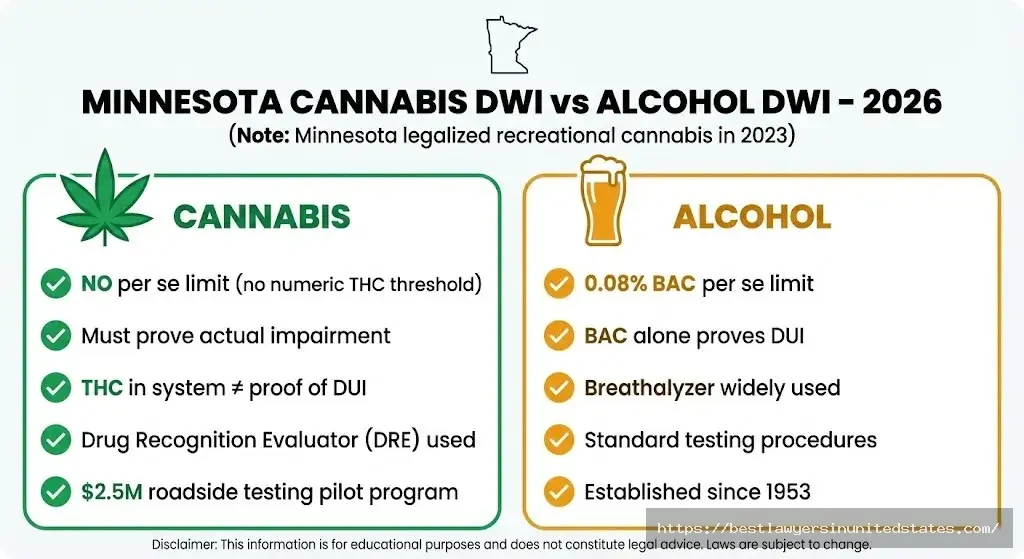
Minnesota legalized adult cannabis possession in 2023, but driving under the influence of cannabis remains illegal under § 169A.20, subd. 1(5).
Key Differences from Alcohol DWI
No per se limit: Unlike the 0.08% BAC standard for alcohol, Minnesota has no numeric THC threshold. Officers must prove you were actually impaired by cannabis, not just that you consumed it recently.
Testing challenges: THC can appear in blood/urine for days or weeks after use, long after impairment ends. Positive test alone doesn’t prove impairment at time of driving.
Detection methods: Officers use Drug Recognition Evaluators (DRE) – specially trained officers who assess impairment through physical examination and behavior evaluation.
Minnesota’s Open Package Law for Cannabis
Minnesota Statutes § 152.027 prohibits open cannabis packages in vehicles, mirroring the open bottle law for alcohol.
Legal transportation: Cannabis must be in:
- Sealed original package, OR
- Vehicle’s trunk, OR
- Area not easily accessible to driver/passengers
Exceptions: Open packages allowed in:
- Buses
- Limousines
- Pedal pubs (party bikes)
Violation penalty: Petty misdemeanor with fine up to $300.
Roadside Cannabis Testing Pilot Project
The 2023 legalization law appropriated $2.5 million for developing roadside cannabis impairment tests. Goals include:
- Create accurate field testing similar to breath tests for alcohol
- Train additional Drug Recognition Evaluators
- Study correlation between THC levels and impairment
- Develop standards for per se THC limits
Current status: As of 2026, Minnesota still relies primarily on DRE evaluations rather than roadside chemical tests for cannabis.
Drug Recognition Evaluator (DRE) Process
DREs conduct a 12-step evaluation when cannabis impairment is suspected:
- Breath alcohol test (to rule out/confirm alcohol)
- Interview arresting officer
- Preliminary examination and eye tests
- Divided attention psychophysical tests
- Examination of vital signs (pulse, blood pressure, temperature)
- Dark room eye examinations
- Examination of muscle tone
- Injection site examination
- Subject’s statements and questioning
- Evaluation of totality of evidence
- Drug category determination
- Toxicological examination
Training: DRE officers complete 72-hour classroom training plus 40-80 hours of field certification evaluations.
Commercial Drivers and Minnesota DWI
Commercial driver’s license (CDL) holders face stricter standards and harsher consequences under Minnesota Statutes § 171.165.
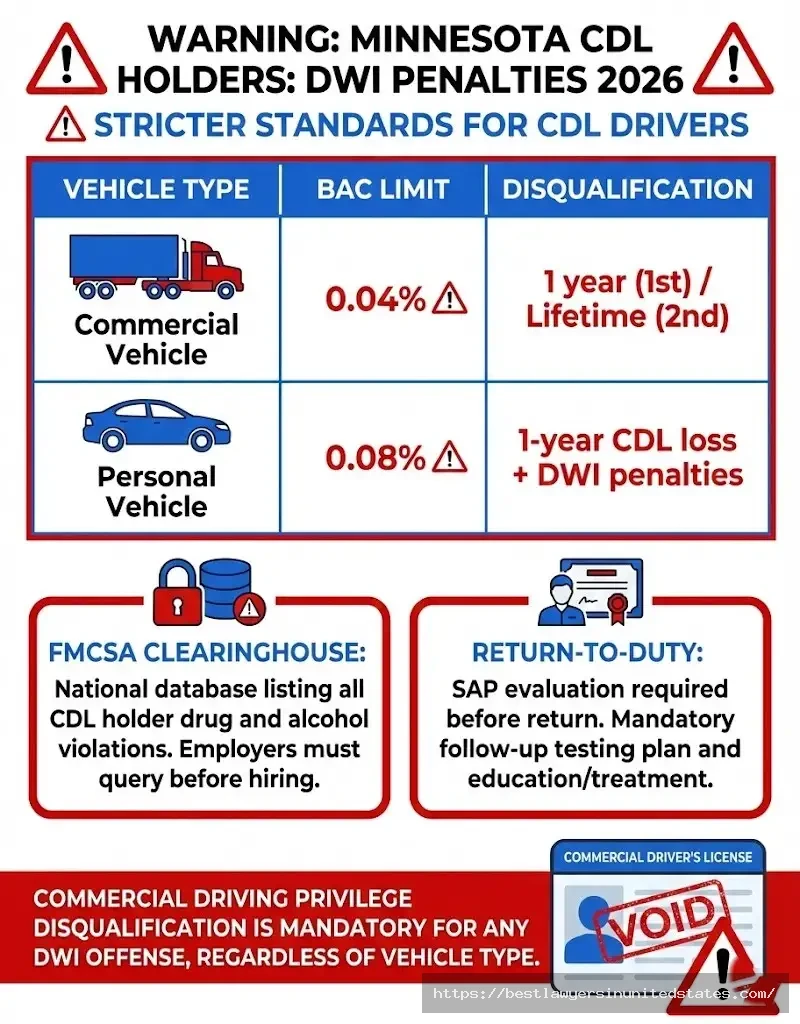
CDL BAC Limits
| License Type | BAC Limit | Statute |
|---|---|---|
| CDL operating commercial vehicle | 0.04% | § 169A.20 |
| CDL operating personal vehicle | 0.08% | § 169A.20 |
| Any driver under 21 | 0.02% | § 169A.20 |
Critical point: You can lose your CDL for a 0.08% violation in your personal vehicle even though you weren’t driving commercially.
CDL Disqualification Periods
| Offense | Disqualification Period |
|---|---|
| First 0.04%+ violation in commercial vehicle | 1 year |
| Second 0.04%+ violation in commercial vehicle | Lifetime (may apply for reinstatement after 10 years) |
| 0.08%+ in personal vehicle | 1-year CDL disqualification + regular DWI penalties |
| Test refusal in commercial vehicle | 1 year |
Federal vs. Minnesota Standards
Federal Motor Carrier Safety Administration (FMCSA) regulations impose requirements beyond Minnesota state law:
FMCSA reporting: Employers must check CDL driver’s record through the FMCSA Clearinghouse before hiring and annually thereafter.
Clearinghouse listing: Any CDL holder with a DWI violation appears in the national database, affecting employment nationwide.
Return-to-duty process: After DWI violation, you must complete:
- Substance abuse professional (SAP) evaluation
- Recommended treatment/education
- Follow-up testing program
- Employer verification
Driving Personal Vehicle During CDL Suspension
If your CDL is disqualified but your regular license remains valid, you can drive personal vehicles for non-commercial purposes. However:
- Cannot drive any commercial motor vehicle
- Cannot perform job duties requiring CDL
- Regular license may have separate DWI-related restrictions
- Must maintain SR-22 insurance for DWI violations
Employment reality: Most commercial driving employers terminate drivers after DWI, even if the offense occurred off-duty in a personal vehicle.
Minnesota DWI Records and Expungement
How Long DWI Stays on Record
Minnesota maintains DWI records permanently for licensing purposes under § 169.99:
Driving record: DWI convictions remain on your Minnesota driving record forever. The Department of Public Safety uses this permanent history to determine:
- License revocation periods
- Ignition interlock requirements
- Plate impoundment eligibility
- Vehicle forfeiture triggers
Criminal record: DWI convictions appear on Minnesota BCA criminal history indefinitely unless expunged.
Expungement Eligibility for DWI
Minnesota Statutes § 609A.02 allows expungement of misdemeanor and gross misdemeanor DWI convictions under certain conditions:
Eligible offenses:
- Fourth-degree DWI (misdemeanor)
- Third-degree DWI (gross misdemeanor)
- Second-degree DWI (gross misdemeanor)
Not eligible:
- First-degree DWI (felony)
- Criminal vehicular homicide
- Criminal vehicular operation
Waiting periods:
- Misdemeanor DWI: 2 years after completion of sentence
- Gross misdemeanor DWI: 4 years after completion of sentence
What Expungement Covers
Criminal court records sealed:
- Court file
- Prosecution records
- BCA criminal history
- Most background check databases
Not sealed:
- Department of Public Safety driving record
- License revocation history
- Administrative hearing records
- Future DWI sentencing consideration
Critical limitation: Expungement does not remove DWI from your driving record. Future DWI cases will still count this conviction as a prior under § 169A.03, subd. 22.
Background Check Implications
Even with expungement, certain background checks may reveal DWI history:
Employers can see:
- Driving record (for positions requiring driving)
- CDL clearinghouse violations (commercial drivers)
- Gaps in employment history during incarceration
Employers cannot see (after expungement):
- Criminal conviction record (for most purposes)
- Court file details
Jobs particularly affected:
- Commercial driving positions
- Jobs requiring security clearances
- Positions working with children
- Law enforcement careers
- Professional licenses (doctors, lawyers, nurses)
Special Minnesota DWI Provisions
Zero Tolerance for Drivers Under 21
Minnesota’s zero tolerance law under § 169A.33 creates separate penalties for underage drinking and driving distinct from standard DWI.
Prohibited conduct: Operating a vehicle with:
- Any alcohol consumption, OR
- Physical evidence of alcohol in body
Penalties:
- Misdemeanor criminal charge
- License suspension
- Juvenile court jurisdiction for ages 16-17
Important distinction: Zero tolerance violations do not count as “qualified prior impaired driving incidents” for enhancing future DWI charges unless the conduct also violated standard 0.08% DWI law.
Open Bottle Law
Minnesota Statutes § 169A.35 prohibits open containers of alcohol in motor vehicles on streets and highways.
Prohibited:
- Consuming alcohol while in vehicle
- Possessing open bottle/container in passenger compartment
Allowed:
- Open bottles in trunk
- Open bottles in area not accessible to passengers
- Passengers in buses, limousines, or pedal pubs
Penalty: Misdemeanor with up to 90 days jail and $1,000 fine.
DWI in Off-Road Vehicles
Minnesota applies full DWI penalties to snowmobiles, all-terrain vehicles, off-highway motorcycles, and off-road vehicles under § 169A.20.
Consequences:
- Same criminal penalties as motor vehicle DWI
- Driver’s license revocation (not just off-road privilege)
- Ignition interlock requirement applies to off-road vehicles
- Administrative sanctions (plate impoundment, vehicle forfeiture)
Critical point: A snowmobile DWI in January affects your driver’s license and ability to drive to work, not just your snowmobiling privilege.
Motorboat DWI
Operating a motorboat while impaired triggers identical DWI consequences:
- Criminal charges under § 169A.20
- Driver’s license revocation
- Boating privilege loss
- Ignition interlock requirement
Unique aspect: Police can require chemical testing based on probable cause that the operator consumed any amount of alcohol, not just impairment.
Aircraft Operation While Impaired
Federal law governs aircraft DWI under 14 CFR § 91.17, creating stricter standards than Minnesota motor vehicle law:
Prohibited:
- Operating aircraft within 8 hours of alcohol consumption (zero tolerance time limit)
- Operating aircraft with BAC 0.04%+ (lower than motor vehicle 0.08%)
- Operating aircraft while under the influence
Penalties:
- Always gross misdemeanor under Minnesota law
- Federal Aviation Administration license sanctions
- Federal criminal charges possible
Minnesota County-Specific DWI Approaches
Different Minnesota counties handle DWI cases with varying approaches, though all apply the same state statutes.
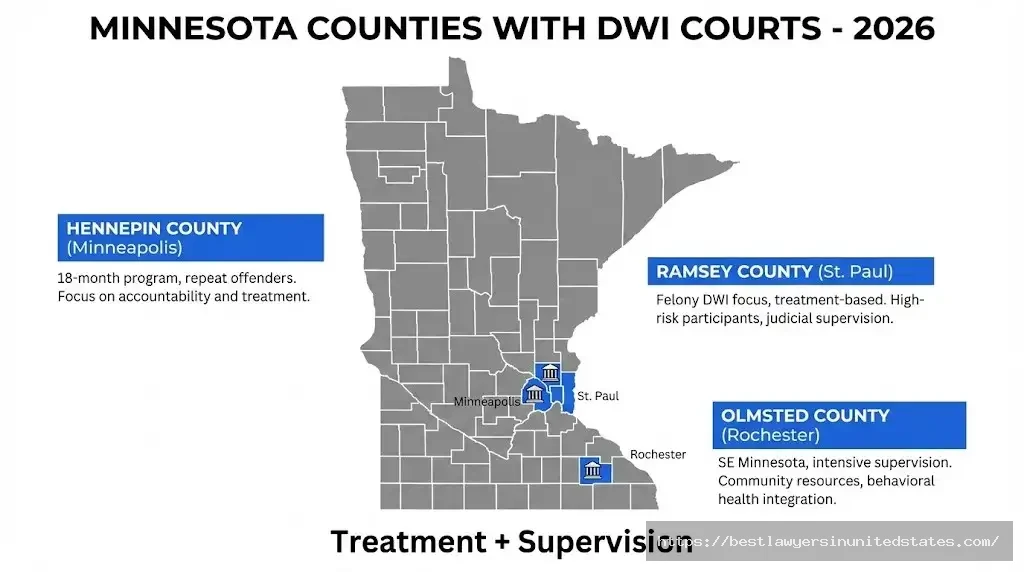
Hennepin County (Minneapolis)
Prosecution approach:
- Fourth Judicial District handles cases
- Generally aggressive prosecution
- Limited first-time diversion options
- Strong emphasis on ignition interlock compliance
DWI Court: Hennepin County operates a DWI Court program for repeat offenders in downtown Minneapolis focusing on treatment and intensive supervision.
Key courts:
- Hennepin County District Court – Minneapolis
- Hennepin County District Court – Brookly Park
- Hennepin County District Court – Ridgedale
Ramsey County (St. Paul)
Prosecution approach:
- Second Judicial District
- Treatment-focused for first offenders
- More willing to negotiate reduced charges
- Emphasis on chemical dependency assessment compliance
Court locations:
- Ramsey County Courthouse (St. Paul)
- Suburban Ramsey County courts
Dakota County
Prosecution approach:
- First Judicial District
- Balanced approach between treatment and punishment
- Diversion programs available for qualifying first offenders
- Strict on repeat offenses
Court location:
- Dakota County Judicial Center (Hastings)
Stearns County (St. Cloud)
Prosecution approach:
- Seventh Judicial District
- Greater emphasis on rural DWI enforcement
- Highway patrol cooperation
- Standard prosecution approach
Court location:
- Stearns County Courthouse (St. Cloud)
County DWI Court Programs
Several Minnesota counties operate specialized DWI Courts for repeat offenders:
Hennepin County DWI Court:
- Serves repeat DWI offenders
- Minimum 18-month program
- Intensive supervision and treatment
- Regular court appearances
Ramsey County DWI Court:
- Focus on felony DWI cases
- Treatment-based approach
- Frequent alcohol testing
- Graduated sanctions system
Olmsted County DWI Court (Rochester):
- Serves southeastern Minnesota
- Combines supervision with treatment
- Ignition interlock requirement
Eligibility: County programs typically require guilty plea to DWI charge, chemical dependency assessment, and commitment to complete treatment.
Criminal Vehicular Homicide and Operation
When DWI causes death or injury, Minnesota prosecutors typically charge Criminal Vehicular Homicide (CVH) or Criminal Vehicular Operation (CVO) under Minnesota Statutes §§ 609.2112-609.2114.
Five Severity Levels
| Offense | Injury Level | Classification | Max Penalty |
|---|---|---|---|
| CVH – Death | Death | Felony | 10 years, $20,000 |
| CVO – Great Bodily Harm | Permanent disfigurement or organ impairment | Felony | 5 years, $10,000 |
| CVO – Substantial Bodily Harm | Temporary disfigurement or bone fracture | Felony | 3 years, $10,000 |
| CVO – Bodily Harm | Physical pain or injury | Gross Misdemeanor | 1 year, $3,000 |
| CVH – Unborn Child | Death or injury to fetus | Felony | Varies |
Elements Prosecutors Must Prove
CVH/CVO requires proof that you caused the specified harm while operating a vehicle:
In a grossly negligent manner, OR In a negligent manner while violating DWI law (most common), OR While leaving accident scene (hit and run), OR Operating defectively maintained vehicle you knew was dangerous
Practical reality: Most CVH/CVO prosecutions involve simultaneous DWI violations, making the negligence element easier to prove.
CVH/CVO and Ignition Interlock
The 2025 law changes made CVH offenders eligible for ignition interlock for the first time:
Before 2025: CVH conviction meant permanent license cancellation with no ignition interlock option.
After 2025: CVH offenders can participate in ignition interlock with durations ranging from 6 years to lifetime depending on priors and harm level (see table in ignition interlock section above).
Sentencing Guidelines for CVH
Minnesota Sentencing Guidelines establish presumptive sentences:
Criminal Vehicular Homicide:
- Zero criminal history points: 48 months stayed execution
- One criminal history point: 51 months stayed execution
- Two points: 57 months stayed execution
- Three+ points: Presumptive commitment to prison
Important: CVH always carries presumptive stayed execution for offenders with low criminal history, meaning judges typically place defendants on probation rather than prison unless aggravating factors exist.
Frequently Asked Questions
How long does a DWI stay on your record in Minnesota?
Quick Answer: DWI convictions remain on your Minnesota driving record permanently and count as priors for 20 years under the 2025 law changes.
Your driving record maintained by Minnesota Driver and Vehicle Services never erases DWI convictions. Minnesota uses this permanent record to determine license revocation periods, ignition interlock requirements, and future DWI sentencing.
For criminal sentencing purposes, Minnesota now counts prior DWI convictions within the past 20 years as aggravating factors (increased from 10 years in 2025). A DWI from 2006 still counts against you in 2026.
You may expunge criminal court records after waiting periods (2 years for misdemeanors, 4 years for gross misdemeanors), but this doesn’t remove the conviction from your driving record.
Do you lose your license immediately after a DWI in Minnesota?
Quick Answer: No. You receive a 14-day temporary permit after arrest. License revocation begins on day 15 unless you request an administrative hearing.
At arrest, the officer confiscates your physical license and issues a notice of intent to revoke with a temporary driving permit valid for 14 days. You can drive legally during this period.
You must request an administrative hearing with Minnesota DVS within 14 days if you want to challenge the revocation. If you request a hearing, DVS may extend your driving privileges until the hearing concludes.
If you don’t request a hearing, your license revocation begins automatically on the 15th day after arrest.
How likely is jail time for first DUI in Minnesota?
Quick Answer: Most first-time offenders avoid jail through probation, though 48-hour minimum jail applies to second offenses within 10 years.
Fourth-degree DWI (first offense with no aggravating factors) carries up to 90 days jail maximum but has no mandatory minimum. Judges typically impose:
- Stayed execution of sentence (probation)
- Fines and costs
- Chemical dependency treatment if needed
- Possible community service
You face higher jail likelihood if you have aggravating factors like high BAC (0.16%+), a child passenger, or test refusal elevating the charge to third or second degree.
Second offense within 10 years triggers mandatory 30 days with at least 48 hours served in jail. Courts can substitute home detention or intensive probation for the remainder.
What is the penalty for DWI in Minnesota?
Quick Answer: First-offense penalties include $1,000 fine, 90-day license revocation, chemical dependency assessment, and potential probation. Costs typically total $7,000-$15,000.
Penalties depend on your offense degree:
Fourth-degree (first offense, no aggravating factors):
- Up to $1,000 fine
- Up to 90 days jail
- 90-day license revocation (30 days after conviction)
- Chemical dependency assessment required
Third-degree (one aggravating factor):
- Up to $3,000 fine
- Up to 364 days jail
- 1-year license revocation
- Possible plate impoundment
Second-degree (two aggravating factors):
- Up to $3,000 fine
- Up to 364 days jail
- Varies license revocation
- Plate impoundment likely
First-degree (felony, 4+ in 10 years):
- Up to $14,000 fine
- Up to 7 years prison
- Mandatory ignition interlock
- Vehicle forfeiture possible
All convictions require a $25 chemical assessment charge and treatment compliance if recommended by the assessment.
Can you refuse a breathalyzer in Minnesota?
Quick Answer: Yes, but refusal is a crime carrying gross misdemeanor penalties and 1-year license revocation, longer than the 90 days for failing the test.
Minnesota’s implied consent law makes test refusal a gross misdemeanor under § 169A.52. Consequences include:
- 1-year license revocation (vs. 90 days for test failure)
- Gross misdemeanor criminal charge
- Refusal adds aggravating factor to DWI charge
- Prosecutors use refusal as consciousness of guilt
Officers can require breath tests without a warrant. For blood/urine tests, officers need a warrant signed by a judge, and refusal after a valid warrant is also a crime.
Practical advice: Refusal typically brings harsher penalties than taking and failing the test.
What is the legal alcohol limit in Minnesota?
Quick Answer: The legal limit is 0.08% BAC for drivers 21+, 0.04% for commercial vehicles, 0.02% for drivers under 21, and 0.00% for school bus drivers.
Minnesota establishes different BAC limits based on driver type under § 169A.20:
Standard drivers (21+): 0.08% or higher Commercial motor vehicles: 0.04% or higher Drivers under 21: 0.02% or higher (near-zero tolerance) School bus drivers: Any detectable amount
These limits apply at the time of driving or within two hours after. You can be arrested even if your BAC only rises above the limit after you stopped driving.
Use the BAC calculator to estimate your level: BAC Calculator
How much does a first DWI cost in Minnesota?
Quick Answer: Total first-time DWI costs range from $7,000-$15,000 including attorney fees, fines, license reinstatement, insurance increases, and other expenses.
Itemized breakdown for first offense:
- Attorney fees: $2,500-$7,500
- Court fines: Up to $1,000
- Court costs: $200-$400
- Chemical assessment: $125
- License reinstatement: $680
- SR-22 insurance: $25-$50 annually
- Insurance increase: $1,000-$2,000 per year for 3-5 years
- Towing/impound: $200-$500
- DUI school (if ordered): $150-$300
Calculate your specific case: DUI Cost Calculator
Repeat offenses with ignition interlock cost significantly more: $15,000-$85,000 over the program period depending on duration (2, 6, or 10 years).
Does a DUI show up on a background check in Minnesota?
Quick Answer: Yes, DWI convictions appear on criminal background checks unless expunged. They remain on your driving record permanently even after expungement.
DWI shows up in three ways:
Criminal background check: Employers using criminal history checks will see DWI convictions for:
- 2 years after misdemeanor completion
- 4 years after gross misdemeanor completion
- Indefinitely for felony DWI (cannot expunge)
After expungement, most employer background checks won’t show the conviction.
Driving record check: DWI always appears on your Minnesota driving record permanently. Employers checking your driving history will see it indefinitely.
CDL clearinghouse: Commercial drivers’ DWI violations appear in the federal FMCSA database, affecting employment nationwide.
Jobs most affected:
- Commercial driving
- Jobs requiring security clearances
- Childcare positions
- Healthcare (doctors, nurses)
- Law enforcement
- Professional licenses
Can a DUI be dismissed in Minnesota?
Quick Answer: Yes, but dismissals are rare and usually require procedural errors by police or prosecution, not just being a first-time offender.
Minnesota DWI charges may be dismissed when:
Police violated constitutional rights:
- No probable cause for traffic stop
- No probable cause for arrest
- Illegal search and seizure
- Failure to read implied consent advisory
Testing problems:
- Breathalyzer not properly calibrated
- Blood sample chain of custody broken
- Testing procedures not followed
- Medical conditions affecting test accuracy
Procedural errors:
- Missed speedy trial deadlines
- Lost evidence
- Witness unavailability
What doesn’t dismiss charges:
- Being a first-time offender
- Having a clean record
- Not “feeling drunk”
- Small amount over 0.08%
Plea bargains vs. dismissals: Prosecutors sometimes reduce charges to careless driving or reckless driving, which is not a dismissal but may avoid DWI penalties.
What happens when you get your first DWI in Minnesota?
Quick Answer: After first DWI arrest, you face license revocation (90 days to 1 year), criminal misdemeanor charges, chemical dependency assessment requirement, and costs of $7,000-$15,000.
Timeline of events:
Day of arrest:
- Booking and chemical testing
- License confiscated
- 14-day temporary permit issued
- Released (usually) pending court
Within 14 days:
- Contact DWI attorney
- Request administrative hearing with DVS
- Temporary permit expires on day 15
Within 30-60 days:
- First court appearance (arraignment)
- Enter plea
- Court sets bail conditions
Before sentencing:
- Chemical dependency assessment required
- Assessment costs $100-$200 plus $25 court charge
Sentencing:
- Judge imposes penalties based on degree
- Fourth-degree typical: Probation, fines, treatment if recommended
- License revocation: 90 days (test failure) or 1 year (test refusal)
License reinstatement:
- Pay $680 reinstatement fee
- Provide SR-22 insurance proof
- Complete any ordered treatment
Most first-time offenders avoid jail through probation but face significant financial consequences and license loss.
Finding a Minnesota DUI Attorney
Minnesota DWI cases involve complex interactions between criminal court, administrative hearings, and license revocation proceedings. An experienced attorney can:
Challenge the traffic stop:
- Examine whether officer had reasonable suspicion
- Review dash cam and body cam footage
- File motions to suppress illegally obtained evidence
Challenge test procedures:
- Verify breathalyzer calibration records from Minnesota BCA
- Examine blood sample chain of custody
- Review officer training and certification
- Challenge implied consent advisory reading
Negotiate with prosecutors:
- Seek reduced charges to careless driving
- Argue for stayed execution of sentence
- Minimize penalties through plea bargains
Fight administrative hearings:
- Present evidence to DVS hearing officer
- Challenge probable cause for arrest
- Prevent license revocation independently
Protect your record:
- Minimize impact on employment
- Preserve CDL privileges where possible
- Advise on expungement eligibility
Attorney Costs in Minnesota
Minnesota DWI attorney fees typically range:
- Fourth-degree DWI (misdemeanor): $2,500-$5,000
- Third-degree DWI (gross misdemeanor): $3,500-$7,500
- First-degree DWI (felony): $7,500-$20,000+
- Trial cases: $10,000-$25,000+
Most attorneys offer free consultations and payment plans.
Find DUI Lawyers in Minnesota
Need legal representation for your Minnesota DWI case?
Contact: [email protected]
Free consultation available – Most Minnesota DWI attorneys offer initial consultations at no cost to evaluate your case.
Conclusion
Minnesota’s DWI laws combine administrative penalties, criminal charges, and long-term consequences that extend far beyond a single court appearance. The 2025 reforms significantly increased the look-back period and ignition interlock requirements, making repeat offenses carry harsher penalties than ever before.
Key takeaways:
- Minnesota uses a unique four-degree system based on aggravating factors
- 2025 law changes extended look-back period from 10 to 20 years
- First-time offenders face $7,000-$15,000 total costs minimum
- Test refusal brings harsher penalties than failing the test
- Ignition interlock now mandatory for nearly all repeat offenders
- DWI remains on your driving record permanently
If you’re facing DWI charges in Minnesota, contact an experienced attorney immediately. The 14-day deadline for requesting an administrative hearing leaves little time to protect your driving privileges.
