The 72 Sold lawsuit involves multiple legal actions against the real estate company over claims of misleading advertising, hidden fees, and broken promises about fast home sales. Homeowners who used the service allege they were pressured into accepting below-market offers and charged unexpected fees. As of February 2026, the lawsuits are ongoing in Arizona courts with no settlement reached yet, but affected homeowners have several legal options available.
Quick Answer: 72 Sold faces ongoing lawsuits filed in Arizona courts starting in 2022. Homeowners claim the company’s “72-hour sale” promise was misleading, fees weren’t disclosed upfront, and homes sold for less than expected. While no settlement exists yet, you can file complaints with the Better Business Bureau, contact consumer protection attorneys, or potentially join the class action if it’s certified. Take action now to protect your rights. Candace Owens Lawsuit
What Is the 72 Sold Lawsuit About?
Background of the Lawsuit
The 72 Sold lawsuit centers on a real estate company that promised to revolutionize home selling with a bold claim: sell your house in just 72 hours. Founded by Greg Hague in 2018, the company marketed itself as a faster, easier alternative to traditional real estate methods.
The problem? Many homeowners say the reality didn’t match the advertising. Instead of quick sales at top dollar, sellers report waiting weeks for offers, discovering hidden fees, and accepting prices well below what they expected.
These complaints led to multiple lawsuits starting in 2022. Homeowners, real estate agents, and even franchisees have filed legal action claiming 72 Sold engaged in deceptive business practices that cost them money and caused emotional distress.
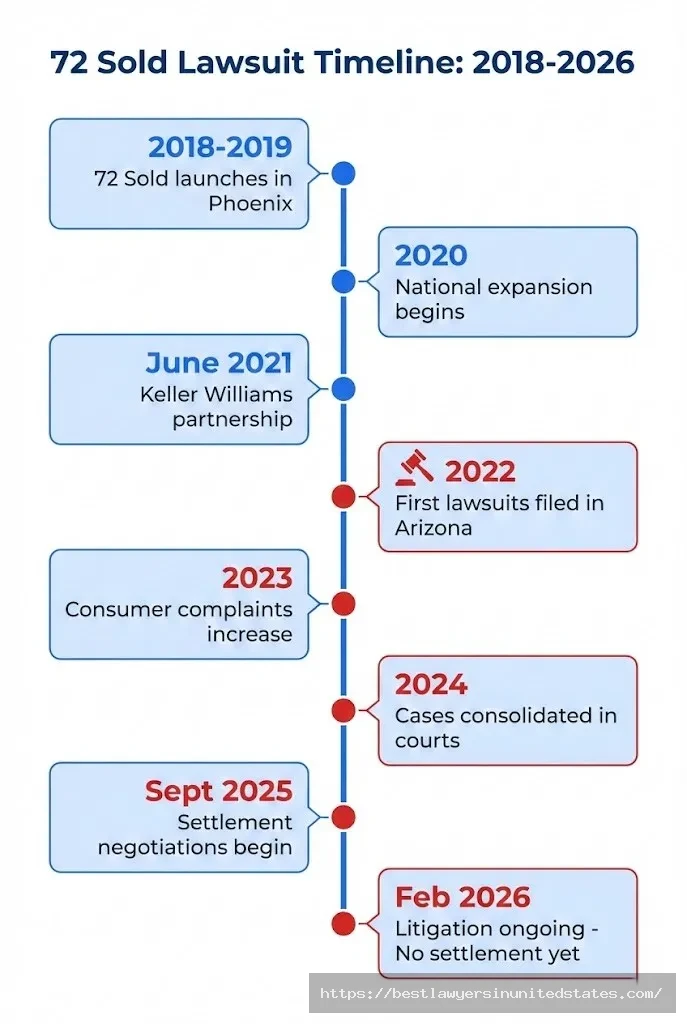
Timeline of Key Events
| Date | Event | Details |
|---|---|---|
| 2018-2019 | 72 Sold launches | Founded in Phoenix, Arizona with aggressive “72-hour sale” marketing |
| 2020 | National expansion | TV and internet advertising campaigns launch across U.S. cities |
| June 2021 | Keller Williams partnership | Strategic partnership announced, expanding national presence |
| 2022 | First lawsuits filed | Initial legal actions filed in Arizona courts for false advertising |
| 2023 | Mounting complaints | Media reports increase; regulatory oversight discussions begin |
| 2024 | Lawsuits consolidated | Cases consolidated in Arizona courts; allegations broaden |
| September 2025 | Cases progress | Some cases moving toward potential settlement; others may go to trial |
| February 2026 | Current status | Litigation ongoing; no settlement approved yet |
Who Filed the Lawsuit?
Multiple groups have filed legal action against 72 Sold:
Homeowners who used the service form the largest group. These sellers claim they lost money due to misleading promises and undisclosed fees. They’re represented by consumer protection law firms experienced in real estate litigation.
Real estate agents affiliated with Keller Williams have also filed complaints. Some agents say they felt pressured to promote 72 Sold’s services even when it wasn’t in their clients’ best interests.
Franchisees and business partners have joined the legal action, claiming they were misled about the program’s effectiveness and profitability.
What Are the Allegations?
The lawsuits make several specific claims against 72 Sold:
Misleading Advertising Claims:
- Promised homes would sell in 72 hours or 8 days, but many took weeks or months
- Advertised sale prices “10.7% above market value” that dropped to just 5.7% in actual results
- Failed to clarify whether “selling” meant receiving an offer, accepting an offer, or closing the sale
- Created unrealistic expectations through aggressive TV and online marketing
Hidden Fees and Costs:
- Marketing fees averaging $2,500 not disclosed in initial contracts
- Additional administrative charges appearing late in the process
- Commission structures that weren’t clearly explained upfront
- Cancellation fees that made it financially difficult to exit contracts
Pressure Tactics:
- Agents rushing sellers to accept offers without time to review
- Creating artificial urgency that pushed homeowners into unfavorable terms
- Sole-agency agreements that trapped sellers with specific brokers
- Difficulty switching agents even when service was unsatisfactory
Below-Market Sale Prices:
- Homes selling for less than comparable properties in the area
- Lowball offers presented as competitive
- Promised “multiple offers” that didn’t materialize
- Sale prices significantly below homeowner expectations
Who Might Be Affected by the 72 Sold Lawsuits?
Quick Answer: You might be affected if you sold or attempted to sell your home through 72 Sold (especially between 2020-2025) and experienced unexpected fees, delayed sales, below-market offers, or pressure tactics. Document your experience now, even if no settlement exists yet.
Potentially Affected Homeowners
You may have grounds to join the lawsuit or file your own complaint if you:
| Criteria | Details | Why It Matters |
|---|---|---|
| Used 72 Sold services | Between 2018-2025, particularly 2020-2024 | Peak period of operations and complaints |
| Paid unexpected fees | Marketing charges, admin fees, or other undisclosed costs | Core allegation of hidden fees |
| Sale took longer than promised | More than 72 hours or 8 days to receive offers | Contradicts main advertising claim |
| Sold below expectations | Price significantly lower than market comparables | Evidence of misleading value promises |
| Felt pressured | Rushed into accepting offers without adequate time | Supports pressure tactics allegations |
| Had difficulty canceling | High fees or obstacles to exiting contract | Contract terms transparency issue |
| Still have documentation | Contracts, emails, advertising materials, closing documents | Critical for any legal action |
Geographic Areas
The lawsuits primarily focus on these markets where 72 Sold operated:
- Arizona (especially Phoenix/Scottsdale) – Company headquarters and heaviest operations
- Texas – Major expansion market
- Florida – High-volume sales area
- California – Significant marketing presence
- Other states – Anywhere 72 Sold operated through Keller Williams partnership
Who Is NOT Affected?
You’re likely not part of the lawsuit if:
❌ You only received marketing materials but never used the service ❌ You sold through traditional Keller Williams agents without 72 Sold program ❌ Your home sale met all promised timelines and prices as advertised ❌ All fees were clearly disclosed and you had no surprises ❌ You’re satisfied with your experience and suffered no financial harm Facial Abuse Lawsuits
What Documentation You Should Gather Now
Even without a settlement, preserve these records:
| Document Type | Why It’s Important | Where to Find It | What If You Don’t Have It |
|---|---|---|---|
| 72 Sold contract | Shows what was promised vs. delivered | Your closing documents | Request copy from closing agent |
| Marketing materials | Proves what claims were made to you | Emails, mailers, online ads | Screenshot company website; save ads |
| Email correspondence | Documents pressure tactics, timeline changes | Your email inbox | Request from 72 Sold under data rights |
| Fee disclosures | Shows hidden charges | Closing settlement statement | Get HUD-1 or closing disclosure from title company |
| Comparable sales data | Proves if you got fair market value | Zillow, Realtor.com, MLS | Real estate agent can pull comps for you |
| Timeline records | Documents how long sale actually took | Calendar, emails, texts | Recreate from memory with specific dates |
What’s the Current Status of the 72 Sold Lawsuits?
Lawsuit Approval Status (as of February 2026)
No settlement has been approved. The 72 Sold lawsuits are still working through the court system. Here’s what that means:
Current Stage: Active litigation in Arizona courts Settlement Status: None reached yet Class Certification: Not yet certified as official class action Trial Dates: Some cases may go to trial in late 2026 Settlement Negotiations: Some cases reportedly in settlement discussions
What Happens Next?
The lawsuits could resolve in several ways:
Potential Outcome 1: Settlement Agreement
- 72 Sold agrees to pay compensation to affected homeowners
- Settlement fund created for eligible claimants
- Claims process established with deadline to file
- You’d receive notice by mail if you’re included
- Timeline: Could happen in 2026 if negotiations succeed
Potential Outcome 2: Class Certification
- Court officially recognizes lawsuit as class action
- All affected homeowners automatically included unless they opt out
- Stronger negotiating power for settlement
- Timeline: Court decision expected mid-2026
Potential Outcome 3: Trial
- Cases proceed to court if no settlement reached
- Jury or judge decides if 72 Sold violated laws
- Could result in larger damages or nothing
- Timeline: Trials could begin late 2026 or 2027
Potential Outcome 4: Dismissal
- Court could dismiss claims if evidence insufficient
- Homeowners would need to pursue individual cases
- Timeline: Possible but less likely given multiple pending cases
Recent Developments
What’s changed recently:
November 2023: Gary Keller (Keller Williams CEO and 72 Sold part-owner) accused of embezzlement and directing funds to businesses in which he had financial interest in updated racketeering lawsuit complaint
2024: Multiple lawsuits consolidated in Arizona courts to streamline proceedings and avoid conflicting rulings
September 2025: Reports indicate some cases progressing toward settlement negotiations while others prepare for potential trial
2026: Company has reportedly adjusted advertising language to be less aggressive, though lawsuits continue
Your Legal Options If You Were Affected
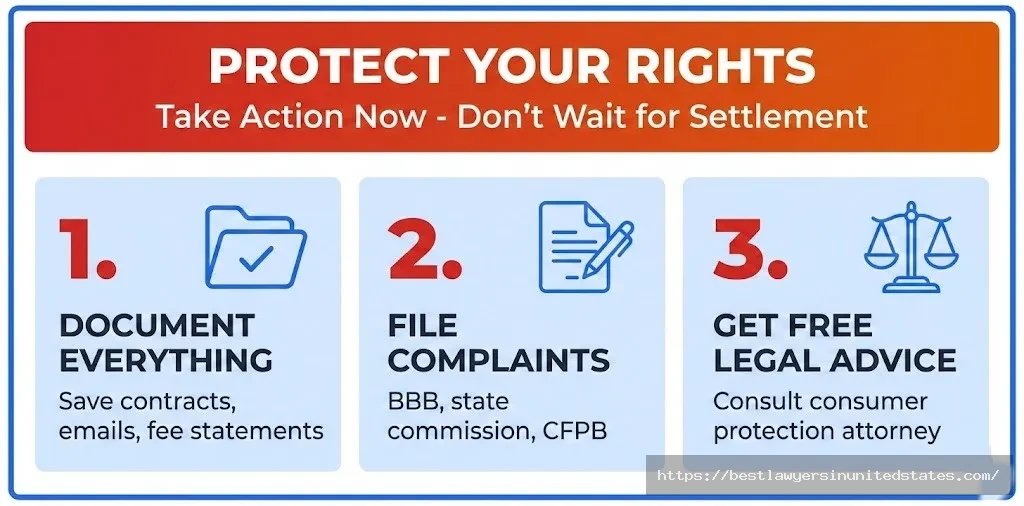
Option 1: Monitor the Ongoing Lawsuit
What to do:
- Watch for official class action notices (by mail or email)
- If lawsuit is certified as class action, you may be automatically included
- Respond to any notices you receive within stated deadlines
- Keep your contact information updated
Best for: Anyone who used 72 Sold and wants to be part of potential settlement without hiring own lawyer
Cost: Free – you don’t pay to participate in class action
Option 2: File a Complaint with Regulatory Agencies
Take action now by reporting your experience:
Better Business Bureau (BBB)
- Website: www.bbb.org
- Search for: 72SOLD (Scottsdale, AZ)
- Action: File a complaint online
- Result: Creates official record; company must respond
State Real Estate Commission
- Contact: Your state’s real estate regulatory board
- Action: File complaint about agent or brokerage practices
- Result: Investigation may lead to disciplinary action
Consumer Financial Protection Bureau (CFPB)
- Website: www.consumerfinance.gov/complaint
- Action: File complaint about real estate service
- Result: Federal record; agency may investigate
State Attorney General
- Contact: Your state’s AG consumer protection division
- Action: Report potential consumer fraud
- Result: May join investigation or refer to appropriate agency
Option 3: Consult a Real Estate Attorney
When to consider this:
You should talk to a lawyer if:
- You lost more than $10,000 due to 72 Sold practices
- Your situation involves unique circumstances
- You want to pursue individual lawsuit separate from class action
- You need advice on whether to opt out of class action
- Statute of limitations is approaching for your claim
How to find the right attorney:
Consumer Protection Lawyers
- Specialize in cases against companies for deceptive practices
- Often work on contingency (no fee unless they win)
- Can evaluate if you have individual case worth pursuing
Real Estate Litigation Attorneys
- Handle disputes involving property sales
- Understand state-specific real estate regulations
- Can assess breach of contract claims
Class Action Attorneys
- Already familiar with 72 Sold cases
- May be representing multiple plaintiffs
- Can advise on joining existing lawsuit vs. filing individual claim
Free Consultation Sources:
- Contact: [email protected] for attorney referrals
- Many consumer protection attorneys offer free case evaluations
- State bar associations provide referral services
Option 4: Join Individual Plaintiff Group
If you have substantial damages, you might:
Connect with existing plaintiff attorneys handling 72 Sold cases
- They may add you as named plaintiff to strengthen case
- You’d be more involved than typical class member
- Potentially larger recovery if successful
Requirements:
- Significant financial harm ($15,000+)
- Strong documentation of your case
- Willingness to participate in depositions, court proceedings
- Story that represents broader pattern of harm
Option 5: Arbitration (If Required by Contract)
Check your 72 Sold contract carefully. Some contracts require arbitration instead of lawsuits.
What arbitration means:
- Dispute resolved by private arbitrator, not court
- Usually faster and less formal than trial
- Decision is binding
- May limit your ability to join class action
How to proceed:
- Review your contract for arbitration clause
- Consult attorney about opting out if possible
- File arbitration demand if required
- Some contracts allow 30-60 days to opt out after signing
How to File a Complaint – Step by Step
Step 1: Gather Your Documentation (1-2 hours)
Collect these records before contacting anyone:
Must-have documents:
- Your 72 Sold service agreement/contract
- Closing settlement statement showing all fees
- Any advertising materials you received (emails, mailers, texts)
- Timeline of your sale (dates of signing, listing, offers, closing)
- Comparable sales in your area during same period
Helpful but not required:
- Email exchanges with 72 Sold agents
- Notes from phone conversations (recreate with dates if possible)
- Marketing materials from company website (screenshot now)
- Any promises made that weren’t fulfilled
Step 2: Document Your Experience in Detail
Write down answers to these questions:
Timeline Questions:
- When did you first contact 72 Sold?
- What did their marketing promise?
- How long did it actually take to get offers?
- When did your home actually sell?
Financial Questions:
- What fees were disclosed upfront?
- What fees surprised you later?
- What did you expect your home would sell for?
- What did it actually sell for?
- How much less than expected did you receive?
Pressure/Service Questions:
- Did you feel rushed into decisions?
- Were you given time to review offers?
- Could you easily contact your agent?
- Were contract terms explained clearly?
Step 3: File BBB Complaint (15 minutes)
Website: www.bbb.org Search for: 72SOLD (located in Scottsdale, AZ)
What to include in complaint:
- Brief overview (2-3 sentences): what service you purchased, when, what went wrong
- Specific issues: hidden fees, delayed sale, below-market price, pressure tactics
- Dollar amounts: what you expected vs. what you got
- What you want: refund of fees, compensation for losses, company accountability
BBB will:
- Forward complaint to 72 Sold
- Give company chance to respond
- Post complaint publicly (you can stay anonymous)
- Track patterns for consumer alerts
Step 4: Report to State Real Estate Commission
Find yours: Search “[your state] real estate commission complaint”
You can file complaint against:
- The individual agent who worked with you
- The brokerage (72 Sold or Keller Williams office)
- Both
What commission can do:
- Investigate license violations
- Impose fines
- Suspend or revoke real estate licenses
- Require corrective education
- Publish disciplinary actions
Step 5: Consider Legal Consultation (Free)
What to expect in free consultation:
- Attorney reviews your documents (bring everything from Step 1)
- Evaluates strength of your potential case
- Explains your options (join class action, individual case, or arbitration)
- Discusses costs and timeline
- Advises whether pursuing legal action makes sense for your situation
Questions to ask attorney:
- Do I have a viable case?
- Should I join class action or file individually?
- What are my chances of recovery?
- How much could I potentially receive?
- What will this cost me?
- How long will it take?
- What’s the statute of limitations for my claim?
Contact information for attorney referrals: Email: [email protected] (mention you’re affected by 72 Sold)
Step 6: Keep Monitoring for Settlement News
Stay informed:
- Check lawsuit update websites like TopClassActions.com and ClassAction.org
- Search “72 Sold lawsuit settlement” monthly
- Keep your mailing address and email current (how you’ll get notified)
- Save any notices you receive about the lawsuits
If settlement is reached:
- You’ll receive official notice by mail
- Notice will explain deadline to file claim
- Follow instructions carefully
- Don’t miss the deadline
72 Sold Lawsuit vs. Similar Real Estate Cases
How This Lawsuit Compares
| Lawsuit | Settlement/Status | Affected Parties | Payout Range | Key Issues |
|---|---|---|---|---|
| 72 Sold | Ongoing litigation | Thousands of homeowners | Not yet determined | Misleading timelines, hidden fees, below-market sales |
| NAR Commission | $208.5M settlement (May 2025 deadline) | Home sellers 2019-2024 | Varies by sale | Inflated commission requirements |
| Zillow Offers | Company shut down program (2021) | Thousands of sellers | Individual settlements | Lowball offers, program losses |
| Opendoor | $62M FTC fine (2022) | Home sellers nationwide | Limited compensation | Misleading earnings claims |
| Redfin Lawsuit | Ongoing | Home buyers/sellers | TBD | Commission practice transparency |
What Makes 72 Sold Unique
The 72 Sold lawsuits stand out because:
Speed-Based Marketing: Company built entire brand on “72-hour” promise that allegedly wasn’t consistently delivered
Hybrid Model: Combined tech platform with traditional agents, creating confusion about who was responsible
Keller Williams Connection: Partnership with major franchise raised questions about institutional knowledge of practices
Multiple Plaintiff Types: Homeowners, agents, and franchisees all filing separate claims
Pattern Evidence: Reports show only 12% received offers within 72 hours; 41% waited over two weeks
Do You Need a Lawyer to Take Action?
Quick Answer: No, you do NOT need a lawyer to file complaints with the BBB or regulatory agencies. You also don’t need a lawyer to potentially join the class action lawsuit if it’s certified – you’d be automatically included. However, free legal consultations are available and recommended if you lost significant money or have questions about your options.
When You Can Handle It Yourself
You probably don’t need a lawyer if:
- You want to file a BBB or regulatory complaint
- You’re waiting to see if class action is certified
- Your financial losses were under $5,000
- You have good documentation of what happened
- You’re comfortable following settlement instructions when/if they come
What you can do on your own:
- File BBB complaint (free, 15 minutes online)
- Report to state real estate commission (free, online or phone)
- Submit CFPB complaint (free, online)
- Monitor lawsuit news for settlement updates
- Join class action when/if certified (no lawyer needed)
When Legal Help Makes Sense
Consider consulting an attorney if:
Substantial Financial Harm:
- You lost $15,000+ compared to fair market value
- Hidden fees totaled thousands of dollars
- You had to sell quickly at loss due to 72 Sold delays
- Emotional distress caused by experience was severe
Complex Situation:
- Your contract has arbitration requirement you want to challenge
- Multiple parties involved (loan issues, title problems)
- Timeline issues affecting your next home purchase
- Tax implications from sale price problems
Statute of Limitations Concerns:
- Your 72 Sold transaction was 2-3+ years ago
- Deadline to file individual claim may be approaching
- Need advice on protecting your rights
Individual vs. Class Action:
- Trying to decide whether to opt out of class action
- Your damages may exceed typical class action recovery
- Want to pursue separate case for higher compensation
Free Legal Resources
No-cost options to explore:
State Bar Association Referrals:
- Most states offer free or low-cost initial consultations
- Search “[your state] bar association lawyer referral”
- Typically $25-50 for 30-minute consultation
Consumer Protection Nonprofits:
- National Consumer Law Center: www.nclc.org
- Consumer Financial Protection Bureau: Ask questions online
- Local legal aid societies (if income-qualified)
Attorney Websites:
- Many class action firms offer free case evaluations
- No obligation to hire after consultation
- Can provide valuable information about your options
Contact for Attorney Referrals: Email: [email protected]
What Lawyers Typically Cost
Class Action Participation: $0 – attorneys paid from settlement fund only if case wins
Individual Lawsuit:
- Many consumer protection attorneys work on contingency: 33-40% of any recovery
- You pay nothing unless they win
- Attorney fees deducted from final settlement/judgment
Arbitration:
- Some attorneys charge hourly ($200-500/hour)
- Others do contingency for arbitration cases
- Discuss fee structure upfront
Consultation: Usually free for initial case evaluation
Frequently Asked Questions
What is the 72 Sold lawsuit?
Quick Answer: The 72 Sold lawsuit refers to multiple ongoing legal actions filed against the real estate company in Arizona courts starting in 2022, alleging misleading advertising about 72-hour sales, undisclosed fees, below-market sale prices, and pressure tactics used on homeowners.
The lawsuits claim 72 Sold violated consumer protection laws by promising quick sales “in 72 hours” that often took weeks or months, failing to disclose marketing fees averaging $2,500, and pressuring sellers into accepting lowball offers. Both homeowners and real estate agents have filed claims. As of February 2026, the cases are still in litigation with no settlement reached yet.
Who qualifies to potentially join the lawsuit?
Quick Answer: Homeowners who sold or attempted to sell through 72 Sold (particularly 2020-2025) and experienced unexpected fees, delayed sales beyond promised timelines, below-market sale prices, or pressure tactics may qualify to join if the lawsuit is certified as a class action.
Currently, no official class action certification has been granted. If certification occurs, you would likely be automatically included if you used 72 Sold services during the specified time period and can be located through their records. You’d receive notice by mail explaining your options to participate or opt out.
Is there a settlement amount yet?
Quick Answer: No. As of February 2026, the 72 Sold lawsuits are ongoing with no settlement reached. There is no settlement fund, no approved payout amounts, and no claims deadline yet.
Some cases are reportedly in settlement negotiations, but nothing has been finalized or approved by a court. If a settlement is reached, affected homeowners would receive official notice by mail with details about the settlement amount, how to file a claim, and the deadline to submit claims. Monitor lawsuit update websites for news.
When is the deadline to file?
Quick Answer: There is no claims deadline yet because no settlement has been approved. However, if you want to preserve your right to join the lawsuit or file your own claim, contact an attorney soon – statutes of limitations typically range from 2-4 years depending on your state.
For example, if you used 72 Sold in 2022, your deadline to file an individual lawsuit might be 2024-2026 depending on your state’s consumer protection laws. Even without a settlement, you can file complaints with the BBB and regulatory agencies now. These create an official record and don’t have strict deadlines.
How do I file a claim now?
Quick Answer: You cannot file a settlement claim yet because no settlement exists. However, you can file complaints with the Better Business Bureau (BBB.org), your state real estate commission, and the Consumer Financial Protection Bureau (consumerfinance.gov/complaint) right now to document your experience.
These complaints create an official record of your issue and may support the ongoing litigation. If a settlement is eventually reached, you’ll receive notice explaining how to file a claim at that time. Save all your documentation now: contracts, fee disclosures, correspondence, and closing statements. Hawthorne Residential Partners Lawsuit
Do I need a lawyer to file?
Quick Answer: No. You don’t need a lawyer to file complaints with the BBB or regulatory agencies (free, can be done online). You also won’t need a lawyer to join the class action lawsuit if it’s certified – participation would be automatic unless you opt out.
However, free legal consultations are available and recommended if you lost significant money (over $10,000-$15,000) or have questions about your specific situation. Consumer protection attorneys often work on contingency (no fee unless they win). Contact [email protected] for referrals.
What documents do I need?
Quick Answer: Save your 72 Sold contract, closing settlement statement showing all fees, marketing materials you received, email correspondence, and comparable sales data for homes in your area during the same period. These prove what was promised vs. what actually happened.
Even if you don’t have everything, gather what you can. Your closing settlement statement is most critical – it shows all fees charged. Get a copy from your title company if you don’t have it. Screenshot any 72 Sold marketing materials still online. Recreate a timeline of events from memory with specific dates.
What if I don’t have receipts or contracts anymore?
Quick Answer: You can request copies from the title company that handled your closing, your lender, or 72 Sold directly (they’re required to maintain records). Your closing statement/HUD-1 form is public record and can be obtained from the county recorder’s office where the property is located.
Additionally, banks and lenders maintain copies of closing documents for several years. Contact whoever provided your mortgage for copies. If you paid for 72 Sold’s services directly, check your bank statements for transaction records. Even without perfect documentation, you can still file complaints describing your experience.
When will I receive payment?
Quick Answer: There are no payments yet because no settlement has been approved. If a settlement is reached, payments typically come 6-12 months after final court approval, which could be 2027 or later based on current lawsuit timeline.
Class action settlements typically follow this timeline: (1) Settlement negotiated, (2) Court preliminary approval (2-4 months), (3) Claims period (3-6 months), (4) Final court approval (2-4 months), (5) Appeals period (1-3 months if appealed), (6) Payment distribution (2-4 months). Total process usually takes 1-2 years after settlement is agreed upon.
How much money will I receive?
Quick Answer: Unknown. No settlement exists yet, so payout amounts haven’t been determined. Compensation typically depends on your specific losses: documented fees paid, difference between your sale price and comparable homes, and other financial harm you can prove.
In similar real estate class actions, payouts have ranged from a few hundred dollars to several thousand per claimant, depending on the total settlement fund and number of participants. Individual lawsuits sometimes recover more but take longer and involve more risk.
Has the lawsuit been approved?
Quick Answer: The lawsuits have been filed and are proceeding through Arizona courts, but no class action certification or settlement has been approved yet. Cases are in active litigation as of February 2026.
Some cases are reportedly in settlement negotiations, while others may proceed to trial. Court must still certify the lawsuit as an official class action before it can proceed as such. Until then, these are individual and consolidated lawsuits making similar claims against 72 Sold.
Can I still file a complaint if my sale was years ago?
Quick Answer: Yes, you can file regulatory complaints with the BBB and state real estate commission regardless of when your sale occurred. However, for lawsuits, statutes of limitations typically range from 2-4 years depending on your state’s consumer protection laws.
For example, if you sold through 72 Sold in 2021, your deadline to file an individual lawsuit might be 2023-2025 (already passed in some states). Consult an attorney immediately if your transaction was more than 2 years ago to check if you can still take legal action. BBB complaints have no time limit.
What if I’m happy with 72 Sold and had a good experience?
Quick Answer: If your home sold as promised, all fees were disclosed upfront, you got a fair price, and you’re satisfied, you’re not part of the lawsuit and don’t need to take any action. The lawsuits specifically involve homeowners who claim they were misled or harmed.
If a class action is certified, you might be automatically included based on using 72 Sold during certain dates. You’d receive notice and could “opt out” if you don’t want to participate. Opting out preserves your right to file your own lawsuit later, but most satisfied customers simply ignore class action notices.
Will this affect my ability to sell homes in the future?
Quick Answer: No. Participating in a lawsuit or filing complaints against 72 Sold will not affect your ability to buy or sell real estate in the future. Your participation is confidential and won’t appear on your credit report or public records unless you become a named plaintiff.
Class action participation is completely private. Even filing individual lawsuits or complaints doesn’t negatively impact your credit or ability to work with other real estate agents. In fact, holding companies accountable helps protect other consumers.
Can I join the lawsuit if I used Keller Williams but not 72 Sold specifically?
Quick Answer: Probably not, unless your Keller Williams agent specifically enrolled you in the 72 Sold program. The lawsuits target 72 Sold’s specific fast-sale program, not all Keller Williams transactions.
However, Keller Williams as a company is facing scrutiny for its partnership with 72 Sold. If you believe your KW agent pressured you into the 72 Sold program or misrepresented its benefits, document your experience and consult an attorney. You might have a separate claim against the brokerage.
What happens if 72 Sold goes out of business?
Quick Answer: If 72 Sold shuts down, lawsuits could continue against the company’s assets, insurers, or affiliated parties like Keller Williams. Bankruptcy wouldn’t necessarily eliminate your claims, though it could affect how much compensation is available.
In bankruptcy, consumer claims are typically processed through the bankruptcy court. You’d file a proof of claim to get in line with other creditors. Priority often goes to individuals over businesses. Insurance policies that covered 72 Sold’s operations might also provide a source of recovery.
Is 72 Sold the same as the NAR commission lawsuit?
Quick Answer: No, these are completely separate lawsuits. The NAR (National Association of Realtors) commission lawsuit ($208.5M settlement) involves allegations that real estate brokerages forced home sellers to pay inflated buyer agent commissions. The 72 Sold lawsuit specifically targets false advertising, hidden fees, and broken promises about 72 Sold’s fast-sale program.
However, both cases highlight transparency issues in real estate. If you sold a home through 72 Sold between 2019-2024, you might qualify for BOTH lawsuits – the NAR settlement (deadline May 9, 2025) and any eventual 72 Sold settlement.
What states are included in the lawsuit?
Quick Answer: The lawsuits were primarily filed in Arizona where 72 Sold is headquartered, but they involve homeowners from any state where 72 Sold operated – including Texas, Florida, California, and others where the company marketed its services.
Because 72 Sold operated nationwide through its partnership with Keller Williams, homeowners from multiple states could potentially be included if a class action is certified. Geographic location typically doesn’t matter – what matters is that you used 72 Sold’s services and were harmed by the alleged deceptive practices.
Can I get my money back for fees I already paid?
Quick Answer: Possibly, but only if you win in court or a settlement is reached. You cannot get automatic refunds right now. Your options are: (1) Wait for potential settlement, (2) File individual lawsuit to recover fees, (3) Pursue arbitration if required by contract, or (4) File regulatory complaints that might pressure the company to make things right.
Document exactly what fees you paid beyond standard real estate commissions. Marketing fees, administrative charges, and other unexpected costs are the focus of the hidden fee allegations. If these fees total several thousand dollars, consulting an attorney about individual action may make sense.
What should I do right now to protect my rights?
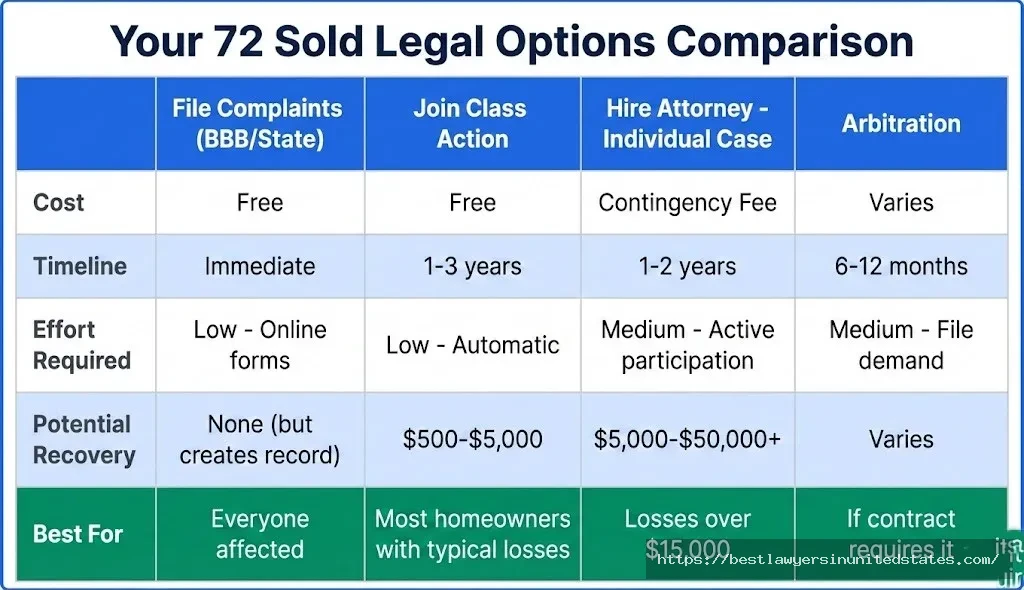
Quick Answer: (1) Gather and save all documents related to your 72 Sold transaction, (2) Write down detailed timeline and what went wrong, (3) File BBB and regulatory complaints to create official record, (4) Consult a consumer protection attorney (free consultation) to discuss your specific options and any statute of limitations deadlines.
Don’t wait. Even though no settlement exists yet, taking action now preserves your options later. Memories fade, documents get lost, and legal deadlines can pass. Spend 2-3 hours this week gathering information and filing complaints. It could save your ability to recover compensation in the future.
Conclusion: Take Action to Protect Your Rights
The 72 Sold lawsuits highlight critical issues in the real estate industry: transparency, honest advertising, and consumer protection. While no settlement has been reached yet, affected homeowners have several options to take action now.
If you used 72 Sold and experienced problems:
- Document everything – Gather your contracts, fee statements, correspondence, and sales data
- File complaints – Report your experience to BBB, state real estate commission, and CFPB
- Consider legal advice – Free consultations can help you understand your options
- Monitor lawsuit developments – Watch for settlement news and class action certification
- Act soon – Statutes of limitations could limit your ability to file claims later
The broader impact: These lawsuits serve as a reminder that if a real estate promise sounds too good to be true, it deserves serious scrutiny. Quick-sale programs aren’t inherently bad, but consumers need complete, accurate information about timelines, fees, and realistic sale prices.
For homeowners facing similar situations with other companies, this case demonstrates the power of holding businesses accountable through regulatory complaints and legal action.
Get help: For attorney referrals, contact [email protected]
Stay informed: Bookmark this page and check back for updates as the lawsuits progress.
Last Updated: February 2026. This article provides general information about ongoing litigation and is not legal advice. Consult with an attorney about your specific situation.