⚡ Quick Answer: Brighton Butler filed for divorce from Duncan Butler III on May 2, 2023, in Dallas County, Texas. The case took 827 days to finalize (through May 2025), citing irreconcilable differences. Texas operates under community property law, requiring equal division of marital assets including digital businesses. The mandatory 60-day waiting period applies to all Texas divorces.
| Detail | Information |
|---|---|
| Filing Date | May 2, 2023 |
| Court | Dallas County District Court |
| Duration | 827 days (2+ years) |
| Ground | Insupportability (no-fault) |
| State Law | Texas Community Property |
| Minimum Wait | 60 days mandatory |
The Brighton Butler divorce has become more than just another celebrity split—it’s a case study in modern family law, digital asset division, and the complexities of ending a marriage in the public eye. When fashion influencer Brighton Keller Butler filed for divorce from Duncan Butler III on May 2, 2023, in Dallas County, Texas, it sparked widespread interest not just in the personal details, but in the legal mechanisms that govern high-profile divorces involving business assets, children, and substantial social media income.

This comprehensive guide uses the Butler case as a teaching framework to help you understand Texas divorce law, whether you’re facing your own marital dissolution, curious about how courts handle influencer businesses, or simply want to understand what makes complex divorces take years to finalize. We’ll examine the legal process, custody considerations, property division rules, and practical strategies that apply to anyone navigating divorce in Texas.
Who Is Brighton Butler and Why Does Her Divorce Matter?
Brighton Keller Butler built a substantial following through her blog “Brighton The Day” and a highly curated Instagram presence featuring fashion, faith, family content, and lifestyle recommendations. With an estimated net worth in the millions and a business model centered on brand partnerships, affiliate marketing, and sponsored content, Brighton represents a new category of divorce cases that Texas courts are increasingly handling: the influencer divorce.
Duncan Butler III, her former husband, comes from a background in law and business, adding another layer of complexity to asset division and custody negotiations. The couple’s divorce, which took 827 days from filing to finalization, highlights several critical aspects of modern family law that affect not just public figures but anyone with:
- Business interests or self-employment income
- Digital assets or online revenue streams
- Young children requiring custody arrangements
- High-value marital property
- Privacy concerns during legal proceedings
Why This Case Matters Legally: Texas courts are establishing precedents for how to value social media businesses, divide future income from long-term contracts, and protect children’s privacy when parents have public platforms. The legal principles applied in high-profile cases like this one directly impact how family courts handle similar issues for everyday Texans.
Understanding Texas Divorce Law: The Legal Foundation
Texas operates under a “no-fault” divorce system with community property rules that make it distinctly different from many other states. If you’re considering divorce in Texas or trying to understand how the legal process works, these foundational principles matter significantly.
Community Property vs. Separate Property: What Gets Divided?
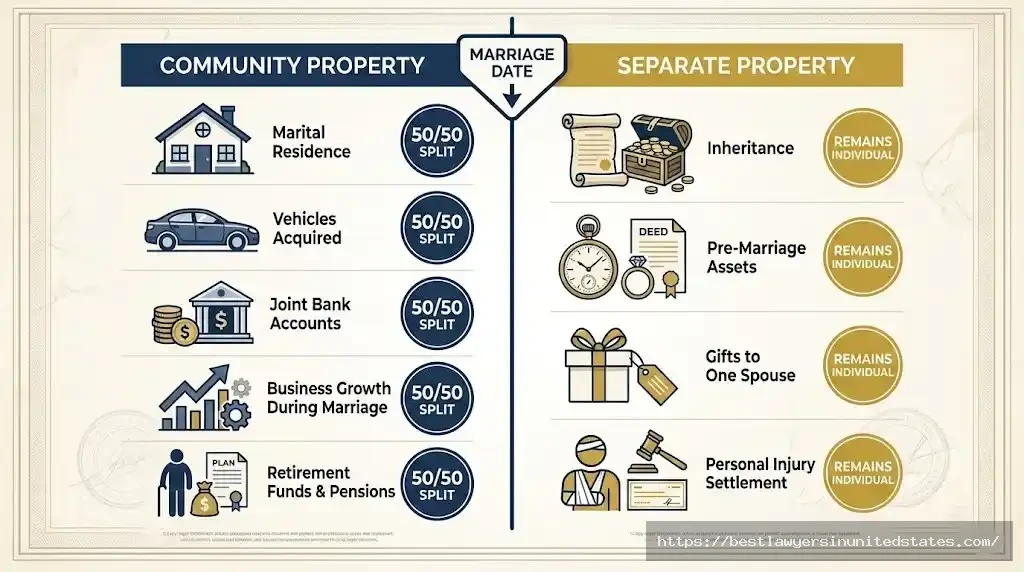
Texas law presumes that everything acquired during marriage belongs equally to both spouses—this is community property. Under Texas Family Code Section 7.001, courts must divide community property in a “just and right” manner, which typically means a roughly equal split unless circumstances justify an unequal division.
Community Property Includes:
- Income earned by either spouse during marriage
- Real estate purchased during marriage
- Business income and growth during marriage
- Retirement contributions made during marriage
- Debt incurred during marriage
Separate Property Remains Individual:
- Assets owned before marriage
- Gifts received by one spouse
- Inheritances (even during marriage)
- Personal injury settlements (with exceptions)
The Challenge in Influencer Cases: When Brighton started her blog before marriage but grew it substantially during the marriage, determining what portion is separate vs. community property requires expert valuation. Did Duncan contribute to the business growth through photography, financial support, or business advice? These contributions can convert separate property into community property or create reimbursement claims.
Understanding how your state handles property division is crucial—and how property is divided during divorce varies significantly by jurisdiction. Texas’s community property approach differs from equitable distribution states, making location a critical factor in divorce outcomes.
Calculate Your Divorce Cost in Texas with our Premium Calculator
Divorce Cost Calculator
Get an estimated cost for your divorce based on your specific situation
Your Estimated Divorce Cost
Cost Breakdown
📧 Get a Personalized Consultation
Have questions about your specific situation? Contact our legal experts for guidance tailored to your needs.
Contact Us via EmailGrounds for Divorce in Texas: What You Need to File
Texas recognizes both fault-based and no-fault grounds for divorce under Texas Family Code Section 6.001:
| Ground for Divorce | Description | Impact on Division |
|---|---|---|
| Insupportability | No-fault; marriage unsustainable | Standard division |
| Cruelty | Physical/emotional abuse | May favor victim |
| Adultery | Extramarital affair | May impact property division |
| Conviction of Felony | Spouse imprisoned 1+ year | May favor other spouse |
| Abandonment | Left for 1+ year with intent | May impact division |
| Living Apart | Separated 3+ years | Standard division |
| Confinement | Mental hospital commitment | Special considerations |
Most Texas divorces, including the Butler case, cite “insupportability”—meaning the marriage has become insupportable due to discord or conflict of personalities that destroys the legitimate ends of the relationship. This no-fault ground doesn’t require proving wrongdoing, which helps maintain privacy and reduce conflict, especially when children are involved.
The 60-Day Waiting Period: Texas’s Cooling-Off Requirement
Texas Family Code §6.702 imposes a mandatory 60-day waiting period from the date of filing before a divorce can be finalized. This means even in the most amicable, uncontested divorces, you cannot legally be divorced in less than 60 days.
Purpose of the Waiting Period:
- Allows time for reconciliation attempts
- Ensures thoughtful decision-making
- Provides time to negotiate settlements
- Protects against impulsive decisions
Exceptions to the Rule:
- Family violence situations may expedite temporary orders
- The 60-day period starts from filing date, not service date
- Courts can enter temporary orders during the waiting period
For the Butler divorce, the 827-day timeline far exceeded this minimum, indicating complex negotiations over custody, property division, or both. When divorces involve substantial assets or contested custody, divorce costs in Texas can escalate quickly, as can timelines.
The Texas Divorce Process: Step-by-Step Timeline
Understanding what happens from filing to final decree helps manage expectations and reduce anxiety during an already stressful process. Here’s how Texas divorces typically proceed:
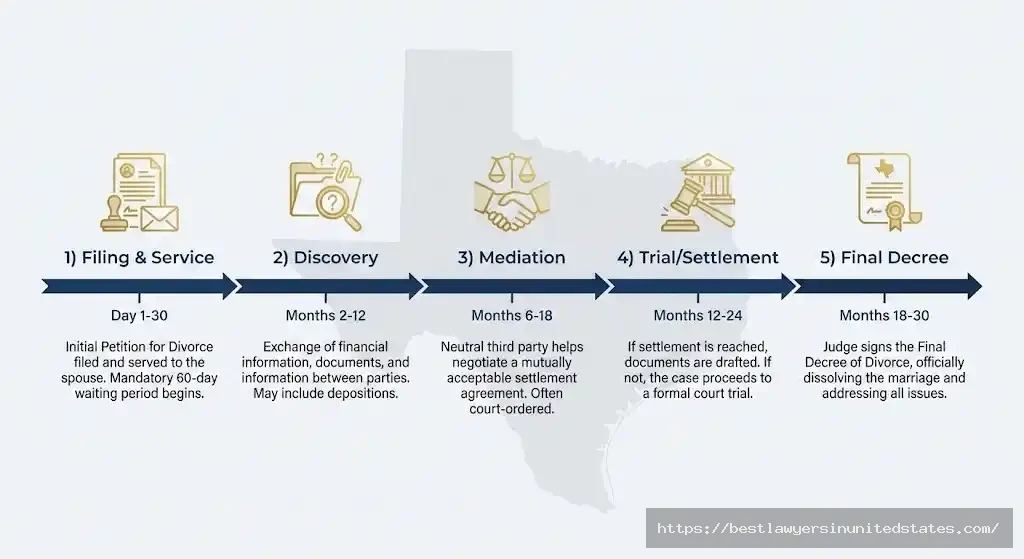
Phase 1: Filing and Service (Days 1-30)
Filing the Original Petition: One spouse (the petitioner) files an “Original Petition for Divorce” with the appropriate district court. In Dallas County, this would be one of several family district courts that handle divorce cases.
The petition must include:
- Grounds for divorce
- Identification of children (if any)
- General property information
- Requested relief (custody, property division, support)
Serving the Respondent: The other spouse must be formally served with divorce papers. Texas law requires service by a process server or constable, not the filing spouse. The respondent then has until 10 a.m. on the Monday following 20 days after service to file an answer.
Temporary Orders: Either party can request temporary orders for custody, child support, exclusive use of property, or restraining orders. These remain in effect until the final decree.

Phase 2: Discovery (Months 2-12)
Discovery is often the longest phase in complex divorces. Both parties exchange financial information, answer written questions (interrogatories), and may conduct depositions.
Standard Discovery in Texas Divorce:
| Discovery Tool | Purpose | Timeline |
|---|---|---|
| Interrogatories | Written questions requiring sworn answers | 30 days to respond |
| Requests for Production | Documents, tax returns, bank statements | 30 days to produce |
| Requests for Admission | Facts to be admitted or denied | 30 days to respond |
| Depositions | Sworn testimony before court reporter | Scheduled by agreement |
| Subpoenas | Third-party records (banks, employers) | Varies by institution |
In High Net Worth Cases: Discovery becomes extensive when valuing businesses, tracing separate property, or uncovering hidden assets. Business valuation experts, forensic accountants, and vocational evaluators may be hired, extending timelines by 6-12 months.
For influencer divorces specifically, discovery might include:
- Social media analytics and revenue data
- Brand partnership contracts and payment history
- Affiliate marketing income (LTK, Amazon Associates)
- Content creation expenses vs. personal expenses
- Intellectual property registrations
- Subscriber lists and email marketing data
Phase 3: Negotiation and Mediation (Months 6-18)
Texas courts strongly encourage mediation before trial. Many counties, including Dallas County, require mediation in contested cases.
Benefits of Mediation:
- Costs significantly less than trial
- Parties control the outcome
- Confidential proceedings
- Faster resolution
- Less adversarial than litigation
- Better for co-parenting relationships
Comparing your options early helps manage costs—understanding whether uncontested divorce costs or contested divorce costs apply to your situation affects both timeline and budget.
Mediation Process:
- Both parties and attorneys attend
- Neutral mediator facilitates discussion
- Parties negotiate in separate rooms
- Mediator shuttles offers between rooms
- If successful, draft Mediated Settlement Agreement (MSA)
- MSA is binding and enforceable
When Mediation Fails: Cases proceed to trial, which can add another 6-12 months due to court backlogs and trial preparation requirements.
Phase 4: Trial or Settlement (Months 12-24+)
If parties can’t reach agreement, the case proceeds to trial. In Texas, divorce trials are typically bench trials (decided by a judge), not jury trials, though parties can request a jury for specific issues.
Trial Process:
- Each side presents evidence and witnesses
- Expert testimony on valuation, custody evaluations
- Judge applies Texas Family Code and precedent
- Judge issues oral ruling or written findings
- Final decree drafted and signed
Settlement Alternative: Even on the courthouse steps, parties can settle. Roughly 90% of divorces settle before final trial, as the risks and costs of trial motivate compromise.
Phase 5: Final Decree and Implementation (Months 18-30+)
The Final Decree of Divorce is the court order that officially ends the marriage and divides property, establishes custody, and sets support obligations.
The decree includes:
- Property division specifics
- Custody and possession schedules
- Child support amounts and duration
- Spousal maintenance (if applicable)
- Name changes (if requested)
- Insurance requirements
- Tax filing provisions
Implementation Requirements:
- Transferring real property titles
- Dividing retirement accounts (requiring QDROs)
- Closing joint accounts
- Updating beneficiaries
- Executing property transfers
The 827-day Butler timeline suggests significant negotiations over business valuation, custody arrangements, or both. Complex divorces involving business interests, custody disputes, or hidden assets routinely take 18-36 months to finalize.
Child Custody in Texas: Protecting Children’s Best Interests
Texas doesn’t use the term “custody”—instead, the law refers to “conservatorship” and “possession.” Understanding this distinction matters because it affects how courts analyze and decide parenting arrangements.

Conservatorship: Decision-Making Authority
Under Texas Family Code Chapter 153, conservatorship refers to the rights and duties parents have regarding their children.
Types of Conservatorship:
| Type | Description | Common Scenarios |
|---|---|---|
| Joint Managing Conservators (JMC) | Both parents share decision-making | Default presumption; typical arrangement |
| Sole Managing Conservator (SMC) | One parent has exclusive decision-making | Family violence, abuse, neglect |
| Possessory Conservator | Limited rights; possession only | Non-custodial parent in SMC cases |
Texas Presumption: Courts presume that appointing both parents as joint managing conservators is in the child’s best interest unless evidence shows this would harm the child.
Decision-Making Rights Include:
- Medical and dental care
- Educational decisions
- Religious upbringing
- Psychiatric and psychological treatment
- Legal representation for the child
For parents concerned about losing custody rights, understanding what proof you need for emergency custody becomes critical when safety concerns arise.
Best Interest Factors: How Judges Decide
When determining custody arrangements, Texas judges consider multiple factors under the “best interest of the child” standard:
Key Considerations:
- Each parent’s physical and emotional needs capabilities
- Emotional and physical danger to the child
- Stability of home environment
- Plans for the child’s upbringing
- Parenting abilities and history
- Programs available to assist parents
- Level of conflict between parents
- Manipulation or coercion attempts
- Child’s wishes (if 12 or older)
Age Matters: Children 12 and older can express their preference about which parent they’d like to primarily reside with, though the judge isn’t bound by this preference.
What Courts Don’t Consider:
- Gender of the parent (no presumption favoring mothers)
- Financial resources (addressed through child support instead)
- Who filed for divorce
- Marital misconduct unrelated to parenting
The Texas Standard Possession Order: Default Schedule
When parents can’t agree on a possession schedule, courts typically order the Standard Possession Order (SPO) found in Texas Family Code §153.312.
Standard Possession Schedule:
During School Year:
- 1st, 3rd, 5th weekends: Noncustodial parent gets Friday 6 PM – Sunday 6 PM
- Thursday nights: 6 PM – 8 PM (or overnight if within reasonable distance)
- One weeknight dinner: If parents live close
Summer Possession:
- Noncustodial parent: 30 days total (can be split)
- Must give 30 days written notice by April 1
- Custodial parent: One weekend during noncustodial’s summer
Holidays (Alternate Years):
- Spring break (odd years / even years)
- Thanksgiving (defined periods)
- Christmas (divided into two periods)
Flexibility for High-Conflict Cases: When parents can’t communicate effectively, courts may order “parallel parenting” with highly detailed schedules and minimal required interaction.
Creating Effective Parenting Plans
The most successful parenting arrangements address not just the schedule, but how parents will handle the inevitable changes and conflicts that arise.
Essential Parenting Plan Components:
✅ Detailed Possession Schedule
- Regular school year schedule
- Summer vacation details
- Holiday and birthday rotation
- Spring break arrangements
- Transportation logistics
✅ Communication Protocols
- How parents will communicate (email, text, app)
- Response time expectations
- Emergency contact procedures
- Communication with children during other parent’s time
✅ Decision-Making Framework
- Day-to-day decisions (clothing, meals, bedtime)
- Major decisions requiring consultation
- Medical emergency protocols
- Educational choice procedures
✅ Modification Procedures
- How to handle schedule changes
- Notice requirements for modifications
- Makeup time provisions
✅ Dispute Resolution
- First step: direct discussion
- Second step: mediation
- Third step: court intervention
Technology Tools: Apps like Our Family Wizard, Talking Parents, or AppClose facilitate communication, document agreements, and create records admissible in court if disputes arise.
Property Division: The Digital Asset Challenge
Traditional divorce asset division focused on homes, cars, bank accounts, and retirement funds. The Brighton Butler case represents the new frontier: how do courts value and divide digital assets that didn’t exist 20 years ago?

Community Property Division Rules in Texas
Texas Family Code Section 7.001 requires “just and right” division of community property, considering:
Division Factors:
- Spouses’ capacities and abilities
- Education and earning potential
- Separate property owned by each
- Benefits the non-fault spouse would have derived from marriage
- Age and physical health
- Size of separate estates
- Nature of property being divided
Common Division Outcomes:
- 50/50 split (most common)
- 55/45 or 60/40 (when factors justify)
- Disproportionate division (in cases of fault or significant disparity)
Debt Division: Community debts are also divided. Credit cards, mortgages, car loans, and business debts incurred during marriage are typically split proportionally with assets.
Planning ahead makes a significant difference—consulting a prenuptial agreement lawyer before marriage or postnuptial agreement during marriage can clarify asset ownership and streamline divorce proceedings.
Valuing Social Media Businesses: New Territory for Courts
When one or both spouses operate as influencers, content creators, or online business owners, valuation becomes complex. Courts must determine:
What Constitutes the “Business”?
- Social media accounts and follower bases
- Blog or website traffic and content
- Email subscriber lists
- Brand partnerships and contracts
- Affiliate marketing agreements
- Intellectual property (trademarks, copyrights)
- Domain names and digital assets
Valuation Approaches:
| Valuation Method | How It Works | Best For |
|---|---|---|
| Income Approach | Capitalize past 3-5 years income; project future | Established influencers with consistent income |
| Market Approach | Compare to sales of similar accounts/businesses | Rare; few comparable sales exist |
| Asset Approach | Sum tangible + intangible assets | Growing accounts; inconsistent income |
Key Valuation Challenges:
- Personal Goodwill vs. Business Goodwill
- Personal goodwill: Tied to the individual’s personality, face, voice
- Business goodwill: Could transfer to another person
- Texas typically doesn’t divide personal goodwill
- Income Volatility
- Influencer income fluctuates dramatically
- Platform algorithm changes affect reach
- Trending topics drive unpredictable spikes
- Brand partnerships end unexpectedly
- Spouse Contribution Claims
- Did the non-influencer spouse provide photography?
- Did they handle business management or finances?
- Was childcare provided enabling content creation?
- Did they appear in content increasing engagement?
Expert Testimony Required: Courts rely on business valuation experts who specialize in digital businesses to provide opinions on value. These experts examine:
- Revenue history and trends
- Audience demographics and engagement rates
- Contract terms and duration
- Platform dependencies and risks
- Industry comparisons and multiples
Dividing Future Income: Long-Term Contracts and Residuals
What happens when an influencer has multi-year brand partnership agreements or ongoing affiliate income streams?
Options Courts Consider:
Option 1: Lump Sum Buyout
- One spouse pays the other their share of future income
- Requires present value calculation (discount future dollars)
- Clean break; no ongoing financial ties
- Risk: Overvaluing or undervaluing future earnings
Option 2: Ongoing Revenue Sharing
- Spouse receives percentage of income for set period
- Tracks actual earnings; no speculation risk
- Requires ongoing financial disclosure
- Can create continued conflict
Option 3: Allocated Division
- Certain accounts/contracts awarded to each spouse
- Works when both spouses have online businesses
- Minimizes valuation disputes
- May not achieve equal division
Tax Implications: Property transfers “incident to divorce” are generally tax-free, but ongoing income sharing may have tax consequences requiring careful structuring.
Financial complexity increases when substantial assets are involved, making divorce cost calculators helpful for budgeting, though actual costs vary significantly based on case complexity.
Intellectual Property Rights: Who Owns the Content?
Copyright law adds another layer of complexity to influencer divorces.
General Copyright Rules:
- Creator owns copyright in their work
- Photos, videos, written content are copyrightable
- Mere ideas are not copyrightable
- Work-for-hire exception: Employer owns employee creations
Marriage Complications:
- If both spouses contributed to content, who owns it?
- Can divided content be used post-divorce?
- What about joint accounts (couple accounts)?
- Who owns brand names or trademarks?
Common Resolutions:
- Non-compete agreements limiting similar content
- Territorial divisions (different platforms)
- Time-based divisions (past vs. future content)
- Licensing arrangements for shared content
Case Example Scenario: If Brighton created content but Duncan photographed 50% of it, he might claim ownership of those photos. The divorce decree could specify:
- Who can continue using existing content
- Whether content must be removed
- How jointly-created content is divided
- Rights to future derivative works
Financial Considerations: Support and Obligations
Beyond property division, divorces often involve ongoing financial obligations through child support or spousal maintenance.
Child Support in Texas: Calculation and Enforcement
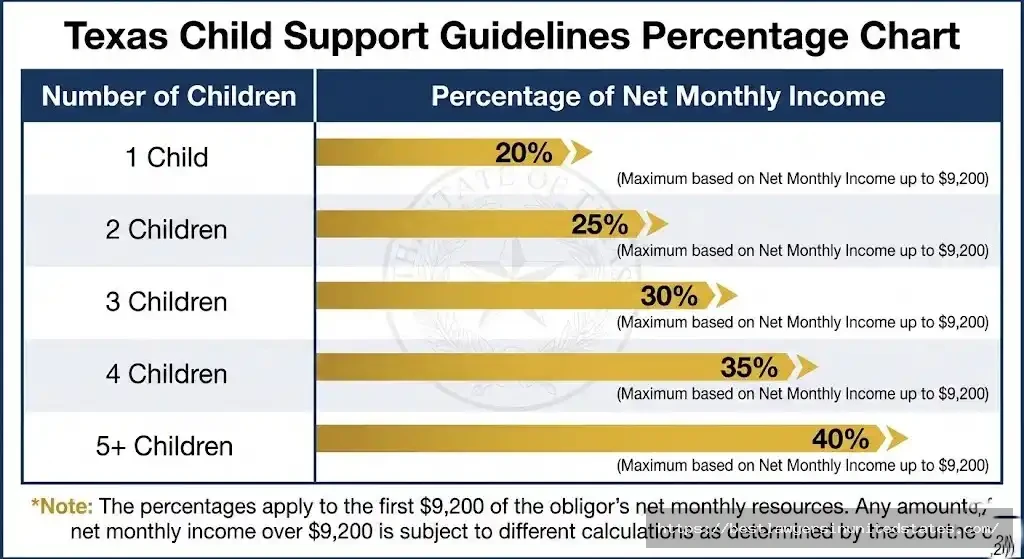
Texas child support follows statutory guidelines based on the paying parent’s net monthly resources.
Texas Child Support Guidelines (% of Net Resources):
| Number of Children | Percentage of Net Income |
|---|---|
| 1 child | 20% |
| 2 children | 25% |
| 3 children | 30% |
| 4 children | 35% |
| 5+ children | 40% |
Net Resources Defined:
- All wage and salary income
- Self-employment income
- Interest, dividends, royalties
- Rental income
- Unemployment benefits
- Disability or retirement benefits
- All other income sources
Deductions Allowed:
- Social Security taxes
- Federal income tax (standard deductions)
- State income tax
- Health insurance premiums for child
Cap on Income: Child support calculations cap at the first $9,200 in monthly net resources (adjusted periodically). Income above this amount may be considered but isn’t automatically calculated.
For High-Income Parents: When net resources exceed the cap, courts have discretion to order additional support based on the child’s proven needs—private school, travel sports, medical expenses, etc.
Duration: Child support continues until the child turns 18 or graduates from high school, whichever occurs later, but no later than age 19.
Spousal Maintenance (Alimony): Texas’s Limited Approach
Unlike many states, Texas has restrictive spousal maintenance laws. Maintenance is only available under Texas Family Code Section 8.051 when specific conditions are met.
Eligibility Requirements (Must Meet One):
- Family Violence: Spouse or child victim of family violence within 2 years before filing
- Marriage Duration + Inability to Earn: Married 10+ years AND spouse lacks ability to meet minimum reasonable needs
- Disabled Spouse or Child: Spouse has disability preventing self-support OR child with disability requiring substantial care
Maximum Amounts and Duration:
| Marriage Length | Maximum Duration | Maximum Monthly Amount |
|---|---|---|
| 10-20 years | 5 years | Lesser of $5,000 or 20% of gross income |
| 20-30 years | 7 years | Lesser of $5,000 or 20% of gross income |
| 30+ years | 10 years | Lesser of $5,000 or 20% of gross income |
Modification and Termination: Spousal maintenance ends upon:
- Death of either party
- Remarriage of receiving spouse
- Receiving spouse cohabiting with romantic partner
High Net Worth Exceptions: While statutory maintenance is limited, parties can contractually agree to higher amounts or longer duration through settlement agreements.
Understanding your financial obligations helps with planning—exploring divorce attorney fees and divorce filing fees early in the process prevents surprises.
Tax Implications of Divorce Settlements
Federal tax law changes in 2019 fundamentally altered divorce taxation.
Property Transfers:
- Generally tax-free when “incident to divorce”
- Must occur within 1 year of divorce or be required by decree
- Transferee takes transferor’s basis (no step-up)
- Retirement account divisions require QDROs
Alimony/Spousal Maintenance:
- For divorces finalized after Dec. 31, 2018: NOT deductible by payer, NOT taxable to recipient
- For older divorces: Still deductible/taxable under old rules
- Significantly changed financial dynamics of maintenance
Child Support:
- Never deductible by payer
- Never taxable to recipient
- Dependency exemptions negotiable in decree
Filing Status:
- Marital status determined on December 31
- Head of household status available if qualify
- Dependency claims can be allocated by agreement
Capital Gains Considerations:
- $250,000 home sale exclusion (single) vs. $500,000 (married)
- Timing of home sales matters
- May want to delay finalization to maximize exclusion
Privacy and Protection: Navigating Public Divorces
When personal matters become public—whether through social media, community interest, or media coverage—additional legal considerations arise.
Sealing Court Records in Texas
Texas courts generally operate under principles of public access, but exceptions exist for sensitive information.
Texas Rule 76a – Sealing Court Records: Courts may seal records upon finding:
- A specific, serious, and substantial interest outweighs public interest
- No less restrictive means adequately protect the interest
- Sealing will effectively protect the interest
What Can Be Sealed:
- Financial disclosure documents
- Business valuations and trade secrets
- Children’s psychological evaluations
- Medical records
- Settlement agreement terms (by agreement)
What Cannot Be Sealed:
- Basic case information (parties’ names, case number)
- Final decree provisions (unless special circumstances)
- Court orders affecting public rights
- Allegations of judicial misconduct
Procedure to Seal:
- File motion to seal with specific legal basis
- Notice to opposing party (unless showing would defeat purpose)
- Hearing before judge
- Findings of fact supporting sealing
Children’s Privacy: Texas law strongly protects children’s identities in court proceedings. Family Code Section 109.002 prohibits publishing identifying information about children in public court records.
For cases involving safety concerns, specialized legal help becomes essential—a restraining order lawyer can help obtain protective orders quickly when immediate danger exists.
Social Media Evidence in Divorce Cases
What you post online can and will be used in divorce proceedings. Courts regularly admit social media evidence on issues including:
Property Division Issues:
- Location tags showing travel contradicting financial affidavits
- Photos of purchases inconsistent with claimed income
- Posts about business success when claiming low earnings
- Evidence of hidden assets or income sources
Custody Issues:
- Photos showing substance abuse or dangerous behavior
- Posts demonstrating poor judgment around children
- Evidence of new romantic relationships
- Location data conflicting with claimed custody time
Credibility Issues:
- Inconsistent statements about finances or parenting
- Evidence contradicting testimony
- Mood or behavior patterns
- Relationship timeline questions
Best Practices During Divorce:
❌ Don’t:
- Post about new relationships
- Share photos showing expensive purchases
- Complain about or badmouth your ex
- Post photos with children without agreement
- Share details of legal proceedings
- Provide ammunition for opposing counsel
✅ Do:
- Set all accounts to maximum privacy
- Review and delete problematic old posts
- Instruct friends not to tag you
- Screenshot evidence of spouse’s posts
- Consult attorney before posting anything questionable
- Consider social media hiatus during divorce
Discovery of Social Media:
- Courts can order production of social media content
- Passwords generally not discoverable, but content is
- Deleted content may be recoverable
- Spoliation sanctions for intentional destruction of evidence
Temporary Restraining Orders: Automatic Injunctions
Texas law automatically imposes certain restrictions when a divorce is filed—even without requesting them.
Standing Order in Dallas County: From filing, both parties are automatically enjoined from:
- Withdrawing funds from accounts except for necessities
- Selling, transferring, or encumbering property
- Destroying or hiding property or documents
- Harming the other party or their reputation
- Making extraordinary withdrawals or expenditures
- Changing insurance beneficiaries
- Removing children from Texas without written agreement
Violations: Disobeying the standing order can result in contempt of court, fines, attorney fee awards, or even jail time.
Emergency TROs: When immediate danger exists, courts can issue emergency restraining orders within hours:
- Preventing contact between parties
- Removing a party from the marital residence
- Granting temporary possession of property
- Protecting children from removal
Protective Orders: Separate from divorce TROs, protective orders under Family Code Chapter 85 address family violence with longer duration (up to 2 years) and criminal penalties for violations.
Practical Guidance: Steps to Take Before and During Divorce
Whether you’re considering divorce or already in the process, strategic preparation significantly impacts outcomes.
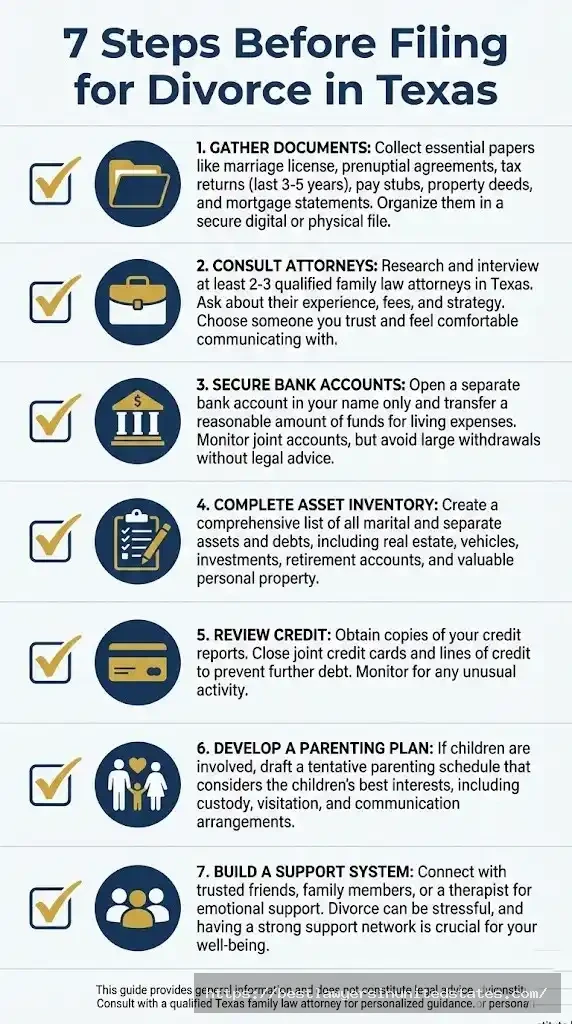
Before Filing: 7 Critical Preparation Steps
1. Gather Complete Financial Documentation
Create copies of:
- Last 3-5 years of tax returns (personal and business)
- Current statements for all bank accounts
- Investment and retirement account statements
- Credit card statements showing balances
- Mortgage statements and property appraisals
- Vehicle titles and loan information
- Business financial statements
- Insurance policies (life, health, property)
- Pay stubs or income documentation
- Debt documentation (loans, liens, judgments)
2. Document Asset Inventory
Create a detailed list including:
- Real property (homes, land, investment property)
- Vehicles (cars, boats, motorcycles, RVs)
- Bank and investment accounts
- Retirement accounts (401k, IRA, pension)
- Business interests and intellectual property
- Valuable personal property (jewelry, art, collections)
- Digital assets (cryptocurrency, online accounts)
3. Establish Financial Independence
- Open individual checking account at different bank
- Obtain credit card in your name only
- Review credit reports for accuracy
- Document your income and earning capacity
- Consider credit freeze if spouse has access to your information
4. Consult Multiple Attorneys
Interview 2-3 family law attorneys before deciding:
- What is their experience with cases like yours?
- What is their communication style and availability?
- What are their fees and billing practices?
- What is their strategic approach?
- Do they recommend mediation or litigation?
- What is realistic timeline and cost estimate?
5. Protect Your Privacy
- Change passwords on financial accounts
- Secure important documents in safe location
- Remove valuables from shared home if appropriate
- Consider separate phone plan
- Set up new email account for divorce communications
6. Consider Children’s Needs
- Research parenting plan options
- Document your parenting involvement
- Consider children’s schedules and needs
- Think about education and extracurricular costs
- Plan for how to communicate with children about divorce
7. Build Support System
- Line up therapist or counselor
- Connect with divorce support groups
- Inform trusted friends or family
- Consider financial advisor consultation
- Research community resources
Red Flags: When to Seek Immediate Legal Help
Some situations require urgent legal intervention:
🚨 Seek Immediate Help If:
- Spouse threatens to take children out of state or country
- Evidence of hidden assets or financial misconduct
- Domestic violence or safety concerns
- Substance abuse affecting children’s safety
- Spouse liquidating assets or incurring large debts
- Mental health crisis affecting parenting ability
- Allegations of child abuse or neglect
Emergency custody orders can be obtained quickly when children face immediate danger. Courts can issue ex parte orders (without notice to the other party) in genuine emergencies, though these are temporary pending full hearings.
Choosing Between Dispute Resolution Methods
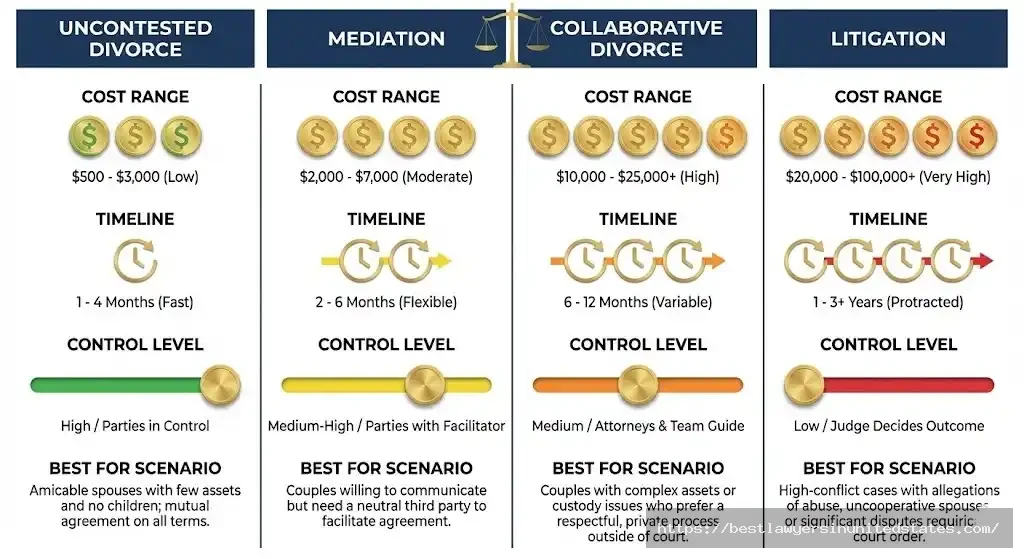
Not all divorces require litigation. Understanding your options helps make strategic choices.
Comparison of Divorce Methods:
| Method | Best For | Cost | Timeline | Control |
|---|---|---|---|---|
| Uncontested | Complete agreement on all issues | $500-$5,000 | 60-90 days | Total |
| Mediation | Willing to negotiate, minor disputes | $5,000-$15,000 | 3-6 months | High |
| Collaborative | Committed to settlement, complex assets | $15,000-$30,000 | 6-12 months | High |
| Litigation | High conflict, safety issues, major disputes | $20,000-$100,000+ | 12-36 months | Low |
Divorce mediation costs typically run significantly lower than litigation, while collaborative divorce costs fall in between, offering a middle path for complex cases.
Mediation Process:
- Voluntary and confidential
- Neutral mediator facilitates discussion
- Parties control outcome
- Typically requires 4-8 sessions
- If successful, creates binding agreement
- Attorney review recommended before signing
Collaborative Divorce:
- Each party hires collaborative attorney
- Sign participation agreement committing to settlement
- Use neutral experts (financial, child specialist)
- If fails, both attorneys must withdraw
- Focuses on interest-based negotiation
- Particularly effective for co-parenting goals
When Litigation Is Necessary:
- Domestic violence or abuse allegations
- One party refuses to negotiate in good faith
- Hiding assets or financial fraud
- Severe mental health or substance abuse issues
- Genuine disagreement about best interests of children
- Need for court-ordered discovery to uncover assets
Lessons from High-Profile Cases: What Public Divorces Teach Us
Celebrity and influencer divorces, while often sensationalized, provide valuable educational opportunities about how family law operates in complex circumstances.
Common Misconceptions Corrected
Myth 1: “The mother always gets custody” Reality: Texas law explicitly prohibits gender-based presumptions. Courts consider only the child’s best interests, and fathers frequently receive primary conservatorship or equal possession time.
Myth 2: “Adultery means losing everything in divorce” Reality: While adultery is a fault ground that courts may consider in property division, it rarely results in dramatic differences. Community property is still divided based on all relevant factors.
Myth 3: “Social media influencing isn’t a real business” Reality: Courts treat online businesses the same as any other business, subject to valuation and division as community property.
Myth 4: “Prenups always get thrown out” Reality: Properly executed prenuptial agreements are generally enforced in Texas unless unconscionable or procured through fraud, duress, or without adequate disclosure.
Myth 5: “You need to prove your spouse’s fault to get divorced” Reality: Texas is a no-fault state. “Insupportability” requires no proof beyond saying the marriage has become insupportable.
Why Case Timelines Vary Dramatically
The 827-day Butler timeline prompts the question: why do some divorces take weeks while others take years?
Factors Extending Divorce Timeline:
Asset Complexity:
- Business valuations require 3-6 months minimum
- Tracing separate property through commingled accounts
- Discovering hidden assets or offshore accounts
- Complex investment portfolios or real estate holdings
Custody Disputes:
- Psychological evaluations take 2-4 months
- Guardian ad litem investigations
- Modification of temporary orders
- Supervised visitation arrangements
- Substance abuse or mental health evaluations
Court Backlog:
- Dallas County family courts handle thousands of cases
- Trial settings may be 12+ months out
- Multiple continuances for various reasons
- Attorney conflicts and scheduling
- Judge assignments and availability
Strategic Delays:
- Waiting for financial events (business sale, IPO, tax year)
- Allowing children to reach certain ages
- Building evidence of concerns
- Depleting marital assets through legal fees
Comparison of Typical Timelines:
| Divorce Type | Average Timeline | Key Factors |
|---|---|---|
| Simple Uncontested | 60-90 days | Agreement on all issues; no children or minimal assets |
| Uncontested with Children | 3-6 months | Parenting plan needed; straightforward finances |
| Contested – Low Conflict | 6-12 months | Some disagreements; resolved through mediation |
| High Net Worth | 12-24 months | Business valuations; complex assets; expert testimony |
| High Conflict Custody | 18-36 months | Evaluations needed; trial likely; multiple hearings |
| Complex + Contested | 24-36+ months | Multiple complicating factors; extensive discovery |
Applying Lessons to Your Situation
What can you learn from the Butler divorce and similar high-profile cases?
Lesson 1: Privacy Has Value The Butlers maintained relative privacy by avoiding public statements and likely sealing portions of records. Consider whether public confrontation serves your interests or your children’s.
Lesson 2: Business Valuation Is Critical If you or your spouse owns a business, engage a qualified valuation expert early. Don’t wait for court to force the issue.
Lesson 3: Children’s Interests Come First Courts consistently prioritize children’s welfare over parents’ preferences. Demonstrating child-focused decision-making strengthens your position.
Lesson 4: Cooperation Reduces Costs Every disputed issue requires attorney time, expert testimony, and court intervention—all expensive. Compromise on less critical issues to preserve resources for what truly matters.
Lesson 5: Document Everything In modern divorces, electronic evidence matters. Emails, texts, social media posts, financial records—comprehensive documentation supports your claims.
Lesson 6: Professional Support Is Essential Complex divorces require a team: attorney, CPA, business valuator, therapist, financial advisor. The cost of expertise is less than the cost of mistakes.
Frequently Asked Questions: Texas Divorce Law
How long does a divorce take in Texas? Minimum 60 days from filing date due to mandatory waiting period. Uncontested divorces typically finalize in 60-90 days. Contested divorces average 6-12 months, while complex cases with business assets or custody disputes can take 18-36 months or longer.
What is community property and how is it divided in Texas? Community property is anything acquired during marriage, regardless of whose name is on title. Texas courts divide community property in a “just and right” manner, typically resulting in roughly equal division unless circumstances justify an unequal split based on factors like earning capacity, education, age, health, and fault in marriage breakdown.
Can I keep my business in a divorce? If you started the business before marriage with separate property, you may keep it entirely. If started or grown during marriage, the growth in value is community property subject to division. You can negotiate to keep the business by giving your spouse other assets of equal value or buying out their community interest.
How do Texas courts calculate child support? Texas uses statutory guidelines: 20% of net monthly resources for one child, 25% for two, 30% for three, 35% for four, and 40% for five or more. Net resources are calculated after deducting Social Security taxes, federal income tax, state income tax, and health insurance for the child. Calculations cap at $9,200 monthly net resources, though courts may order additional support for proven needs beyond the cap.
What factors determine custody in Texas? Texas courts determine conservatorship and possession based on the child’s best interests, considering: each parent’s physical and emotional capabilities, emotional and physical danger to the child, stability of home environments, parenting abilities and history, programs available to assist parents, level of conflict between parents, any manipulation or coercion attempts, and the child’s wishes if age 12 or older. Gender is not a factor.
Do I need a reason to get divorced in Texas? No. Texas recognizes “insupportability” as a no-fault ground for divorce, meaning the marriage has become insupportable due to discord or conflict of personalities that destroys the legitimate ends of the marriage. You don’t need to prove adultery, cruelty, or any other fault-based ground, though fault grounds are available and may affect property division.
What is the 60-day waiting period in Texas? Texas Family Code §6.702 requires 60 days from the filing date before a divorce can be finalized. This cooling-off period allows time for reconciliation attempts and thoughtful decision-making. The clock starts when the petition is filed, not when the respondent is served. Even in completely uncontested divorces with full agreement, the court cannot grant the divorce until 60 days have passed.
Can divorce records be sealed in Texas? Certain portions of divorce records can be sealed under Texas Rule 76a if the court finds a specific, serious, and substantial interest outweighs the public’s interest in access, no less restrictive means exist, and sealing will effectively protect the interest. Financial disclosures, business valuations, and children’s records are more likely to be sealed than basic case information or the final decree.
How much does divorce cost in Texas? Filing fees range from $250-$350 depending on county. Uncontested divorces with agreement on all issues cost $500-$5,000 in attorney fees. Contested divorces average $15,000-$30,000 per spouse. High-conflict or complex divorces involving business valuations, custody evaluations, and trials can exceed $50,000-$100,000 per party. Costs depend on attorney hourly rates ($200-$500/hour), level of conflict, and case complexity.
What happens if my spouse hides assets? Texas courts can impose severe sanctions for hiding assets, including awarding the entire concealed asset to the innocent spouse, assessing attorney fees, finding contempt of court, and even awarding punitive damages. Discovery tools—interrogatories, depositions, subpoenas—help uncover hidden assets. Forensic accountants can trace money through complex transactions to locate concealed wealth.
Can I move out of state with my children after divorce? Generally not without the other parent’s written consent or court permission. Texas courts typically require both parents to reside within a certain geographic restriction (often the county plus contiguous counties, or within a specific radius). To relocate outside this area, you must file a modification petition proving the move serves the child’s best interests. Courts consider: reason for move, impact on child’s relationship with other parent, child’s preference if old enough, quality of life in new location, and other parent’s objection reasons.
How is spousal maintenance determined in Texas? Texas has restrictive spousal maintenance laws. You must prove: (1) family violence within 2 years before filing, OR (2) marriage lasted 10+ years AND you lack sufficient property to meet minimum reasonable needs AND lack earning ability to support yourself, OR (3) you or a child has a disability. If eligible, maintenance is limited to the lesser of $5,000 monthly or 20% of gross income, with duration based on marriage length: 5 years maximum for 10-20 year marriages, 7 years for 20-30 year marriages, and 10 years for 30+ year marriages.
What is a temporary restraining order in Texas divorce? Texas automatically imposes standing orders when divorce is filed, preventing both parties from: withdrawing funds except for necessities, selling or encumbering property, harming the other party, making extraordinary expenditures, changing insurance beneficiaries, or removing children from Texas. Emergency TROs can be obtained within hours for immediate threats, removing a party from the home or preventing contact. Protective orders under Family Code Chapter 85 address family violence with longer duration (up to 2 years) and criminal penalties for violations.
Do I have to go to court for a divorce in Texas? Not always. In uncontested divorces where both parties agree on all terms, some counties allow the petitioner to submit an agreed final decree without appearing in court. However, Texas law requires at least one party to prove up the divorce either through court appearance or sworn affidavit. Contested divorces require court appearances for temporary orders hearings, mediation, and potentially trial. Even in agreed cases, judges may require a brief hearing to approve the decree.
Can social media posts be used against me in divorce? Yes. Courts regularly admit social media evidence on property division (photos of purchases or travel contradicting claimed income), custody (evidence of poor judgment, substance abuse, or credibility issues), and credibility generally. Posts can be discovered through formal requests, screenshots, or third-party disclosure. Privacy settings don’t prevent discovery—if posted online, assume it can be used in court. Best practice: avoid social media entirely during divorce or consult your attorney before posting anything questionable.
How are retirement accounts divided in Texas? Retirement accounts accumulated during marriage are community property. Division requires a Qualified Domestic Relations Order (QDRO) for ERISA plans (401(k), pension plans) or similar order for IRAs and government plans. The QDRO specifies what portion of the account each party receives and is submitted to the plan administrator for execution. Properly executed transfers incident to divorce are tax-free to both parties, with the receiving spouse taking their portion in their own account or rolling into their own IRA.
What if my spouse won’t sign the divorce papers? You don’t need your spouse’s signature to get divorced in Texas. After properly serving your spouse with divorce papers, if they don’t file an answer, you can request a default judgment. If they answer but refuse to agree, the divorce proceeds as contested, ultimately going to trial where the judge decides all issues. The refusing spouse can’t prevent the divorce—they can only contest the terms. Your attorney can pursue the case with or without their cooperation.
Can I date during divorce proceedings? Legally, yes—you’re still married but free to associate with others. However, dating during divorce is generally inadvisable because it: negatively impacts settlement negotiations, provides ammunition in custody disputes, may constitute adultery if dating before final decree, can be used to challenge financial disclosures (“If you can afford dating expenses, you can pay more support”), and often prolongs emotional healing. If you do date, keep it discrete and away from your children until the divorce is final.
How do I change my name after divorce? Include name change request in your original petition for divorce or in your answer/response. The final decree will include an order restoring your former name (typically your maiden name or previous married name). After the decree is final, obtain certified copies from the court clerk ($26 in Dallas County). Use these certified copies to update: Social Security card, driver’s license, passport, bank accounts, credit cards, employment records, insurance policies, property titles, and other legal documents.
What happens to our debts in divorce? Community debts incurred during marriage are divided along with assets. Credit card debt, car loans, mortgages, and other liabilities are typically split proportionally. Important: The divorce decree binds only you and your spouse, not creditors. Even if the decree assigns a debt to your spouse, if your name remains on the account, creditors can pursue you for payment. Best practice: refinance joint debts into one person’s name or pay off and close joint accounts as part of the settlement.
When should I hire a divorce attorney? Consult an attorney as soon as you’re seriously considering divorce or learn your spouse is planning to file. Early consultation provides time to prepare financially, understand your rights, develop strategy, and avoid mistakes that harm your case. If your spouse threatens to take children out of state, you notice financial irregularities, safety concerns arise, or you’re served with divorce papers, seek legal counsel immediately. Many attorneys offer free initial consultations to assess your situation.
Conclusion: Knowledge Empowers Better Outcomes
The Brighton Butler divorce, like all family law cases, ultimately reflects universal truths: divorce is simultaneously a legal process and a profound personal transition. Understanding the legal framework—Texas’s community property rules, custody standards, support calculations, and court procedures—enables more informed decision-making during one of life’s most challenging experiences.
Whether you’re a business owner concerned about protecting your enterprise, a parent focused on your children’s wellbeing, or simply seeking to understand how modern divorce law addresses digital assets and online businesses, the principles examined through this case study apply broadly across Texas family law practice.