
The Spectrum lawsuit landscape in 2026 is more active than ever. Charter Communications — the parent company behind the Spectrum brand — faces a growing class action over a deceptive $28 monthly “Broadcast TV Surcharge,” and has paid out hundreds of millions of dollars in past settlements over misleading internet speed claims. Whether you’re a current Spectrum customer or a former subscriber, you could be owed money. The active Broadcast TV Surcharge case is still working through arbitration as of early 2026, with no final settlement announced yet. But that doesn’t mean you have nothing to do — it means right now is the time to document your bills and preserve your rights. Red Bull Lawsuit
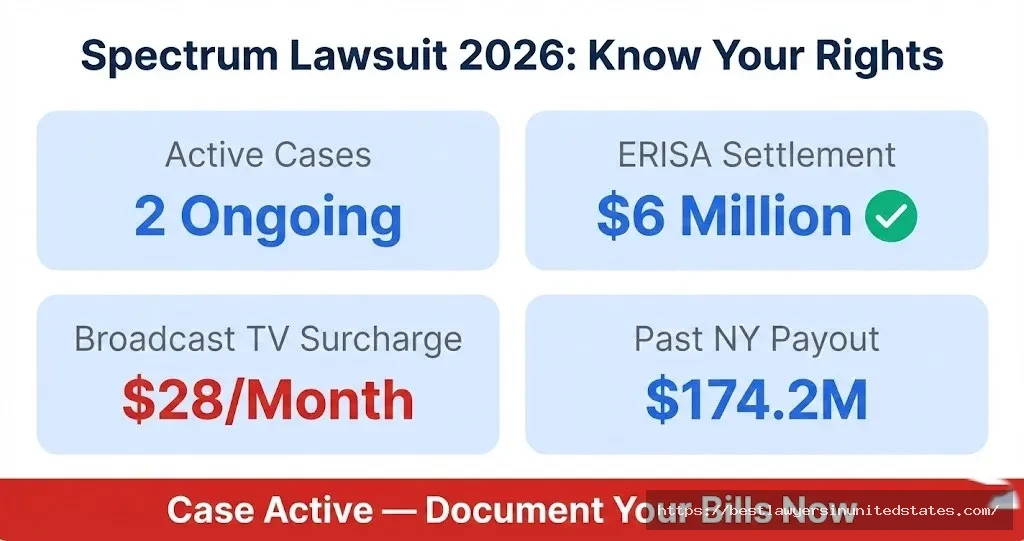
Quick Answer: The most active Spectrum class action (over the deceptive “Broadcast TV Surcharge”) was filed June 4, 2025, and is currently in arbitration. No settlement has been finalized yet. If you’re a Spectrum cable TV customer who has been charged this fee — especially in Kentucky — you may have a claim. Separately, a Spectrum ERISA retirement settlement of $6 million is open for eligible current and former employees. Past settlements have paid out as much as $174.2 million to affected customers in New York and $18.8 million in California.
This guide covers everything: what each Spectrum lawsuit is about, who qualifies, how much you could get, how to preserve your claim, and what to watch for as these cases develop.
What Is the Spectrum Lawsuit About?
There is no single “Spectrum lawsuit” — there are several, targeting different practices. The most significant active case right now involves a hidden fee that millions of cable TV customers have been paying for years without realizing what it actually was. adriana chechik lawsuit
Background: The Broadcast TV Surcharge Class Action
Charter Communications, which does business as Spectrum, charges cable TV subscribers a monthly “Broadcast TV Surcharge.” As of early 2026, that fee stands at $28 per month — up from $21 in 2022 — and it keeps climbing. On bills, Spectrum describes it as a “pass-through fee reflecting charges from local broadcast or affiliate TV stations,” language that strongly implies the charge is mandated by the government or broadcasters.
The lawsuit says that’s a lie.
According to the complaint filed by plaintiff Richard Wookey, an actual broadcaster and Spectrum subscriber, Spectrum has complete control over whether to charge this fee and how much to charge. The lawsuit alleges that real retransmission costs are far lower than $28, meaning Spectrum pockets the difference as undisclosed profit. If the surcharge were truly a pass-through, the math suggests Spectrum would be paying broadcasters over $33 million per year — a figure the complaint calls implausible.
In plain terms: Spectrum advertised one price and charged you another, burying the difference in a fee disguised to look like a government-mandated tax.
Past Spectrum Lawsuits You Should Know About
This isn’t the first time Spectrum has been taken to court over deceptive practices. Two major prior settlements resulted in massive payouts:
New York (Internet Speed Fraud): The New York Attorney General reached a historic $174.2 million settlement with Spectrum over allegations the company failed to deliver the internet speeds it advertised. Over 700,000 New York subscribers received direct refunds of $75 or $150 each, plus additional bill credits and free streaming service access. It was believed to be the largest-ever payout by an internet service provider to consumers in U.S. history.
California (Time Warner Cable / False Advertising): Following its acquisition of Time Warner Cable, Spectrum agreed to pay $18.8 million to settle California claims that Time Warner used misleading ads to sell internet speeds the infrastructure couldn’t actually deliver. Over 170,000 California customers qualified for direct restitution.
These past settlements demonstrate a pattern — and they matter when you’re evaluating whether the current surcharge lawsuit is serious. Courts have consistently found that Spectrum’s billing and advertising practices crossed the line.
Timeline of Key Events in the Spectrum Broadcast TV Surcharge Lawsuit
| Date | Event | Details |
|---|---|---|
| 2013 | Time Warner Cable complaints begin | California AG investigation opens into false internet speed advertising |
| 2016 | Charter Communications acquires Time Warner Cable | Spectrum brand is born; legacy issues continue |
| 2018 | New York AG lawsuit filed | Targets Charter’s failure to deliver promised internet speeds |
| Dec. 2018 | NY settlement reached | $174.2 million paid to 700,000+ NY subscribers |
| 2019 | California settlement | $18.8 million paid to 170,000+ CA consumers |
| 2022 | Broadcast TV Surcharge hits $21/month | Subscriber complaints begin escalating nationally |
| June 4, 2025 | Current class action filed | Wookey v. Charter Communications, Jefferson Circuit Court, KY |
| July 2, 2025 | Case removed to federal court | Assigned to Judge Rebecca Grady Jennings, W.D. Kentucky |
| July 9, 2025 | Charter files Motion to Compel Arbitration | Attempts to block class action |
| Aug. 29, 2025 | Plaintiff agrees to arbitration | Case moves out of federal court temporarily |
| Sept. 3, 2025 | Federal court stay issued | All court proceedings paused |
| Dec. 1, 2025 | Joint status report due | Next major update on arbitration progress |
| Jan. 1, 2026 | Spectrum raises prices again | TV, internet, and voice each increase by $5/month |
| 2026 | Arbitration ongoing | No settlement reached yet — case developing |
Who Filed the Spectrum Lawsuit?
The lead plaintiff is Richard Wookey, a former broadcaster and Spectrum cable TV subscriber in Kentucky. His legal team is Winton & Hiestand Law Group PLLC, based in Louisville, with attorneys Chauncey Hiestand, Zachary Taylor, and Joseph Longmeyer leading the case.
The defendants are Charter Communications (DE) Inc. and Charter Communications Operating LLC, both doing business as Spectrum. The case, Wookey v. Charter Communications Inc., Case No. 3:25-cv-00408-RGJ, is currently stayed in the U.S. District Court for the Western District of Kentucky pending arbitration.
Thousands of customers have already expressed interest in joining. Reports from Louisville alone put that figure at over 4,000 people — and the lawsuit originally sought to represent a nationwide class.
What Are the Allegations Against Spectrum?
The lawsuit lays out a specific pattern of conduct Spectrum’s attorneys will have to answer for:
- Misrepresenting the Broadcast TV Surcharge as an externally mandated fee — Spectrum’s website calls it a “pass-through fee reflecting charges from local broadcast or affiliate TV stations,” implying outside forces require it
- Using the surcharge to secretly raise prices — Spectrum advertises a base rate, then adds fees that inflate the actual monthly cost without disclosing the full price upfront
- Concealing profit within the surcharge — actual retransmission costs are alleged to be far below the $28 charged, with Spectrum pocketing the difference
- Violating the Kentucky Consumer Protection Act (KRS 367.170), which prohibits unfair, false, misleading, or deceptive trade practices
- Unjust enrichment — Spectrum benefited financially from a misrepresentation customers relied on when agreeing to service
Who Qualifies for the Spectrum Lawsuit?
Quick Answer: Right now, the active class action covers Kentucky residents who subscribed to Spectrum cable TV service and were charged the Broadcast TV Surcharge. Internet-only customers are currently excluded. If you live outside Kentucky, watch this space — the plaintiff originally sought nationwide class certification, and the case may expand.
Current Eligibility Requirements
| Requirement | Details | What You Need |
|---|---|---|
| Location | Kentucky resident (current or former) | Billing address in Kentucky during subscription |
| Service type | Spectrum cable TV subscriber | Account showing TV package |
| Fee charged | Paid the “Broadcast TV Surcharge” | Bill or account statement showing the charge |
| Time period | Within the applicable statute of limitations | Bills from the past 1–5 years |
| Purpose | Personal, family, or household use | Not business accounts |
Who Does NOT Currently Qualify?
You are likely excluded at this stage if:
- ❌ You are an internet-only Spectrum customer (the surcharge case targets cable TV)
- ❌ You live outside Kentucky (current class definition covers KY only — may expand)
- ❌ You had a business account rather than a residential subscription
- ❌ Your Spectrum service agreement contains an active arbitration clause that was not contested (this is a complex legal question — consult an attorney)
- ❌ You never paid the Broadcast TV Surcharge on your bill
What About Customers Outside Kentucky?
The original complaint sought to represent a nationwide class, but Spectrum successfully moved the case to arbitration, which complicates class certification. This doesn’t mean non-Kentucky customers have no recourse — it means the situation is evolving. Customers in all 50 states should document their bills now in case the case expands or separate actions are filed.
Documentation to Start Gathering Today
| Document | Why You Need It | Where to Find It |
|---|---|---|
| Monthly billing statements | Proof you were charged the surcharge | Spectrum online account → Billing History |
| Service agreement or contract | Shows terms you agreed to | Email confirmation when you signed up |
| Promotional materials | Shows what Spectrum advertised | Check web archives at web.archive.org |
| Customer service records | Documents complaints you made | Call logs, email correspondence |
| Bank/credit card statements | Independent proof of payments | Your bank or card issuer |
How Much Money Could You Get?
Quick Answer: Because no settlement has been reached yet, exact payout amounts are unknown. However, the math gives us a useful ballpark — and prior Spectrum settlements show these cases can be significant.
The Math on Individual Claims
A $28/month Broadcast TV Surcharge adds up fast:
| Time Period | Total Surcharge Paid |
|---|---|
| 1 year | $336 |
| 2 years | $672 |
| 3 years | $1,008 |
| 5 years | $1,680 |
| Since 2022 (approx.) | $1,344+ |
If you’ve been a Spectrum cable TV customer for several years, you could have paid well over $1,000 in this one fee alone — money the lawsuit argues was extracted through deception. Jon Gruden Lawsuit Against the NFL
How Past Spectrum Settlements Compare
| Settlement | Total Amount | Who Qualified | Average Payout |
|---|---|---|---|
| Spectrum (NY internet speeds) | $174.2 million | 700,000+ NY subscribers | $75–$150 direct refund + credits |
| Spectrum (CA internet speeds) | $18.8 million | 170,000 CA consumers | Proportional to service tier |
| Spectrum Brands Securities | $32 million | Securities investors | Proportional to losses |
| Spectrum ERISA (active) | $6 million | Charter 401(k) participants | Proportional allocation |
| Broadcast TV Surcharge (pending) | TBD | KY cable TV subscribers | TBD — no settlement yet |
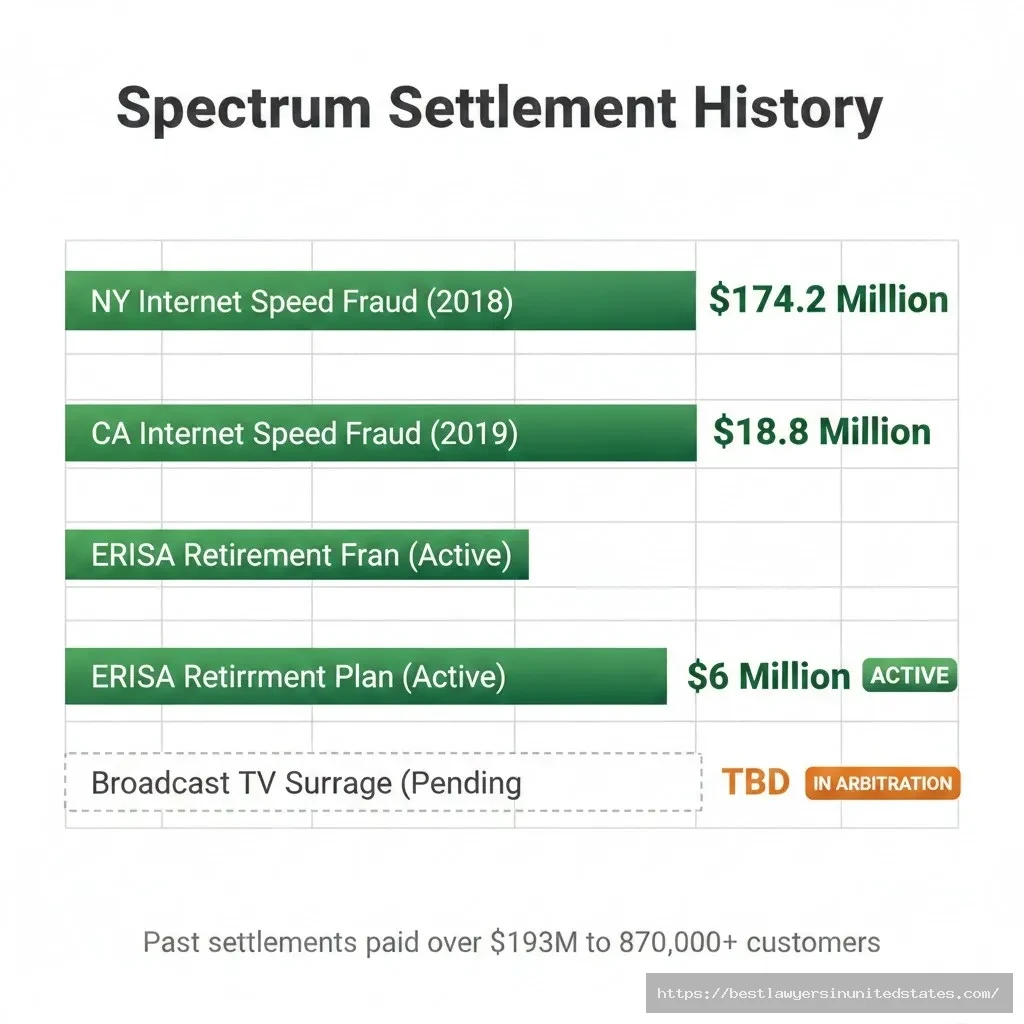
Spectrum ERISA Settlement: $6 Million Currently Available
If you are or were a Charter Communications employee with a 401(k) plan through the company, there is a separate, active $6 million ERISA settlement covering claims that the company breached its fiduciary duties in managing the retirement plan. Key points:
- The settlement covers the non-opt-out class under Federal Rule of Civil Procedure 23(b)(1)
- Active account holders do not need to file a claim — payments are deposited directly into the Plan
- If your account was closed, you may need to file to receive your share
- The settlement administrator calculates each member’s share — you don’t do this yourself
- Visit spectrumerisasettlement.com for details and FAQs
Current Status of the Spectrum Lawsuit (February 2026)
Where Things Stand Right Now
The Broadcast TV Surcharge class action is currently in a holding pattern — but that doesn’t mean it’s dead. Here’s what happened:
After the case was filed in June 2025, Spectrum’s parent company immediately moved to compel arbitration, citing arbitration clauses in customer service agreements. The plaintiff agreed to proceed through arbitration in August 2025, and a federal court stay was issued September 3, 2025.
A joint status report from both parties was due December 1, 2025, which would provide the first major update on arbitration progress. As of early 2026, no public settlement announcement has been made.
What the Arbitration Move Means for You
Spectrum’s push to arbitration is a common corporate legal tactic — individual arbitration is often harder for consumers to pursue than a class action, and it generally keeps disputes out of the public eye. However:
- Arbitration doesn’t mean you have no rights — you can still bring individual claims
- The nationwide class may still be certified if arbitration clauses are found to be unenforceable
- Watch for any court orders in 2026 that revisit the class action question
Recent Price Increases Add to Pressure
Beginning January 1, 2026, Spectrum raised prices on TV Basic, internet, and voice service by $5 each per month — a $15/month increase on top of already rising surcharges. This adds ammunition to the argument that Spectrum has been systematically hiding price hikes behind fee labels.
How to Protect Your Rights Right Now
Even without a settlement to file for today, there are concrete steps you should take immediately.

Step 1: Document Everything
Pull your Spectrum billing history going back as far as possible. Log into your Spectrum account at spectrum.net, navigate to Billing, and download statements. Look specifically for lines labeled “Broadcast TV Surcharge” or “Miscellaneous Charges.” Screenshot them.
Step 2: Note the Surcharge Amount Over Time
The fee has risen dramatically:
| Period | Monthly Surcharge |
|---|---|
| 2022 | $21.00 |
| Feb. 2023 | $22.20 |
| Aug. 2023 | $23.20 |
| Feb. 2024 | $25.75 |
| Feb. 2025 | $28.00 |
| 2026 | $28.00+ (with additional base price increases) |
This escalating pattern supports the argument that the fee isn’t a pass-through — it’s a profit center.
Step 3: Contact the Law Firm Handling the Case
Winton & Hiestand Law Group PLLC is currently representing the plaintiff class in Kentucky. If you’re a Kentucky resident with a cable TV subscription and Broadcast TV Surcharge charges, you can request an evaluation of your claim. The firm is collecting information from potential class members.
- Website: louisvillelawoffice.com/spectrum/
- Note: Submitting a form there does not create an attorney-client relationship — it’s an evaluation request only
Step 4: File an FCC or FTC Complaint
You can file a complaint with the Federal Communications Commission (FCC) at fcc.gov/consumers/guides/filing-informal-complaint or with the Federal Trade Commission (FTC) at reportfraud.ftc.gov. These complaints create an official record and support the broader case against Spectrum’s billing practices.
Step 5: Monitor Case Updates
Sign up for case alerts at classaction.org and topclassactions.com for updates on Wookey v. Charter Communications. Any movement — settlement announcement, class certification ruling, or arbitration outcome — will be reported there.
Do You Need a Lawyer?
Quick Answer: For the current Broadcast TV Surcharge lawsuit, a settlement hasn’t been reached yet, so there’s no claim form to file on your own. You should contact the plaintiff’s law firm if you’re a Kentucky cable TV subscriber. For the ERISA settlement, active employees don’t need to file at all.
When You Don’t Need a Lawyer
If a class action settlement is eventually reached in the surcharge case, the process will likely be straightforward — fill out a form online, submit bill documentation, and wait for payment. Class action settlements are designed to be accessible without legal representation.
When You Should Talk to a Lawyer
Consider getting legal advice if:
- Your arbitration clause situation is complex
- You want to pursue an individual claim rather than wait for class action resolution
- You’re a Spectrum employee with ERISA questions
- Your billing history shows unusually large overcharges you want to pursue aggressively
- You’ve already tried to resolve disputes with Spectrum and gotten nowhere
For a free initial consultation, contact the attorneys handling the active case: Winton & Hiestand Law Group PLLC via louisvillelawoffice.com/spectrum.
You can also contact [email protected] for attorney referrals if you need help finding legal representation in your state. Emotional Distress Lawsuit
Spectrum Lawsuit vs. Similar Cable Company Cases
| Case | Settlement | Affected Customers | Payout Range | Status |
|---|---|---|---|---|
| Spectrum NY (internet speeds) | $174.2M | 700,000+ | $75–$150 direct | Paid out |
| Spectrum CA (TWC speeds) | $18.8M | 170,000+ | Proportional | Paid out |
| Comcast Hidden Fees (CA) | $33M | CA subscribers | $10–$25 | Settled |
| Frontier Communications (CA) | $8.5M | CA subscribers | Refunds/credits | Settled |
| Spectrum Broadcast TV (KY) | TBD | TBD | TBD | Arbitration |
What Makes the Spectrum Surcharge Lawsuit Unique
A few things set this case apart from run-of-the-mill cable billing disputes:
The deception was baked into the fee name. By calling it a “Broadcast TV Surcharge,” Spectrum implied regulatory necessity. Most hidden fee cases involve vague charges — this one involves an actively misleading label.
The fee kept climbing. Most pass-through fees are stable because they reflect actual costs. The Broadcast TV Surcharge rose by $7/month in just three years, a 33% increase that’s hard to explain as a cost pass-through.
Spectrum has been here before. The New York and California settlements establish that Spectrum has a documented history of billing practices courts found deceptive. That history makes the current allegations more credible and any future settlement more likely.
Frequently Asked Questions
What is the Spectrum lawsuit about?
Quick Answer: The primary active Spectrum lawsuit alleges that the company charges cable TV subscribers a deceptive $28 “Broadcast TV Surcharge” disguised as a government-mandated fee when it’s actually a discretionary charge that includes undisclosed profit.
The lawsuit, Wookey v. Charter Communications, was filed June 4, 2025. It accuses Charter — Spectrum’s parent company — of misrepresenting the surcharge as externally required when Spectrum actually has full discretion over the fee. The case is currently in arbitration.
Who can join the Spectrum class action?
Quick Answer: Right now, the case covers Kentucky residents who subscribed to Spectrum cable TV service and paid the Broadcast TV Surcharge.
Internet-only customers and business customers are currently excluded. Customers outside Kentucky are not covered under the current class definition, though the lawsuit originally sought nationwide class status and the situation may change.
Is there a settlement I can claim right now?
Quick Answer: Not for the Broadcast TV Surcharge case — no settlement has been reached yet. However, the Spectrum ERISA retirement plan settlement ($6 million) is active for eligible Charter employees.
If you’re a current or former Charter Communications employee who participated in the company’s 401(k) plan, visit spectrumerisasettlement.com to check your eligibility.
How much could I get from a future Spectrum settlement?
Quick Answer: Unknown — but based on the $28/month fee and prior Spectrum settlements ranging from $75 to $150 per person, meaningful compensation is possible.
The exact payout depends on how long you were charged, how many people file claims, and the final settlement terms. Class action settlements typically pay less than the full overcharged amount after attorney fees and administration costs are deducted.
What is the current status of the Spectrum lawsuit?
Quick Answer: As of early 2026, the case is stayed in federal court while arbitration proceeds. A status report was due December 1, 2025.
The case was moved to arbitration at Spectrum’s request in September 2025, pausing all court proceedings. Watch classaction.org and topclassactions.com for updates when the arbitration process produces results.
Do I need a lawyer to file a claim?
Quick Answer: No — if a settlement is reached, you’ll be able to file a claim yourself. But right now, there’s no claim form to file.
If you’re a Kentucky cable TV subscriber and want to register your interest with the plaintiff’s law firm, visit louisvillelawoffice.com/spectrum for a free evaluation form.
What documents do I need?
Quick Answer: Your Spectrum billing statements showing the Broadcast TV Surcharge are the most important documents. Download them now while they’re available.
Billing history, service agreements, promotional materials you received when signing up, and any customer service correspondence will all be useful. The more documentation you have showing what Spectrum charged and what it promised, the stronger your position.
What if I don’t have old billing statements?
Quick Answer: You may still be able to participate. Class action attorneys often obtain billing records directly from the defendant company on behalf of class members.
Log into your Spectrum account and download whatever statements are available. If you don’t have older records, note the approximate dates you subscribed and the amounts you remember paying. The law firm may be able to pull your account history.
Can Spectrum kick me out or raise my rates for joining the lawsuit?
Quick Answer: No. Retaliation against customers for asserting legal rights is itself illegal.
Joining a class action or filing a complaint with the FCC doesn’t give Spectrum grounds to cancel your service or treat your account differently. Continue paying your bill normally to maintain service.
Why did the case move to arbitration? Does that mean it’s over?
Quick Answer: No. Arbitration is a different process for resolving disputes, not an end to the claims.
Spectrum pushed for arbitration because its customer contracts typically include arbitration clauses requiring disputes to be resolved privately rather than in court. However, arbitration clauses in consumer contracts have faced increasing legal scrutiny, and the outcome of arbitration could lead to individual settlements, a renewed class action, or other relief.
What happened with the Spectrum New York lawsuit?
Quick Answer: New York reached a $174.2 million settlement with Spectrum in 2018 over false internet speed advertising. Over 700,000 subscribers received direct refunds.
Eligible customers received $75 or $150 in direct refunds plus bill credits, making it the largest known consumer payout by an internet service provider in U.S. history at the time.
What happened with the Spectrum California lawsuit?
Quick Answer: Spectrum paid $18.8 million in 2019 to settle California claims that Time Warner Cable (which Spectrum acquired) misled customers about internet speeds.
Over 170,000 California consumers were eligible for refunds. The settlement was reached with the Los Angeles District Attorney’s office.
Will any settlement payout affect my taxes?
Quick Answer: Possibly — settlement payments that represent a refund of what you paid are generally not taxable, but portions representing damages or interest may be.
Consult a tax professional about any settlement payments you receive. The settlement administrator typically issues a 1099 form if your payment exceeds $600 and is classified as taxable income.
What is the Spectrum ERISA lawsuit?
Quick Answer: A separate $6 million settlement covering Charter Communications employees who participated in the company’s 401(k) retirement plan.
The ERISA lawsuit alleged Charter breached its fiduciary duties in selecting and monitoring the plan’s investment options and service providers. Charter denies the allegations. Active employees with positive account balances do not need to file — payments go directly into their Plan accounts.
Can I opt out of the class action?
Quick Answer: For the Broadcast TV Surcharge case, no decision on opt-out rights has been made yet since no settlement has been proposed.
For the ERISA settlement, you cannot opt out — it’s certified as a non-opt-out class under Federal Rule of Civil Procedure 23(b)(1). Most consumer class action settlements do allow opt-outs if you prefer to pursue individual claims.
What is Spectrum’s arbitration clause, and does it block my claim?
Quick Answer: Spectrum’s customer agreements typically include an arbitration clause that requires billing disputes to be resolved through private arbitration rather than in court. Whether this blocks class action participation is being litigated.
Arbitration clauses are increasingly being challenged in consumer cases, and courts don’t always enforce them. The outcome of the current arbitration process may ultimately determine whether the class action can proceed for all customers.
Where can I track updates on the Spectrum lawsuit?
Quick Answer: Follow classaction.org, topclassactions.com, and onlyclassactions.com for news as the case develops.
You can also set up a Google Alert for “Wookey v. Charter Communications” to get direct notifications of any court filings, arbitration updates, or settlement announcements.
What other lawsuits has Spectrum faced?
Quick Answer: Spectrum and its predecessor companies have faced multiple lawsuits including robocalling violations, recording customers without consent, improper cancellation billing, and employee wage theft claims.
Additional cases include a 2023 class action over billing customers for a full month after they canceled service, a 2021 robocalling lawsuit under the Telephone Consumer Protection Act, and a 2021 call recording lawsuit in California. Spectrum has a documented pattern of legal exposure across multiple business practices.
The Bottom Line: What Should You Do Today?
The Spectrum Broadcast TV Surcharge lawsuit is still working its way through the legal system. There’s no settlement check to claim yet — but there are important steps to take right now:
If you’re a Kentucky cable TV subscriber: Visit louisvillelawoffice.com/spectrum, download your billing history, and submit an evaluation request to the plaintiff’s law firm. This costs you nothing and preserves your place in line if a settlement is reached.
If you’re a Charter Communications employee: Check spectrumerisasettlement.com to see if you’re covered by the $6 million ERISA settlement and whether you need to take any action.
If you’re a Spectrum customer anywhere in the U.S.: Start collecting billing statements. Note every month you were charged the Broadcast TV Surcharge. If a nationwide class is certified — or if separate actions are filed in your state — your documentation will be ready.
File an FCC complaint now: Visit fcc.gov and report the deceptive billing. It creates an official record and costs you nothing.
The pattern here is clear. Spectrum has paid hundreds of millions of dollars in past settlements, and the current case involves the same company, similar deceptive practices, and a growing pool of frustrated customers. The legal machinery is moving — and when it delivers results, the people who documented their bills and registered their interest will be first in line.
This article is for informational purposes only and does not constitute legal advice. For advice specific to your situation, consult a licensed attorney. Case details are accurate as of February 2026 and will be updated as the case develops.

Comments