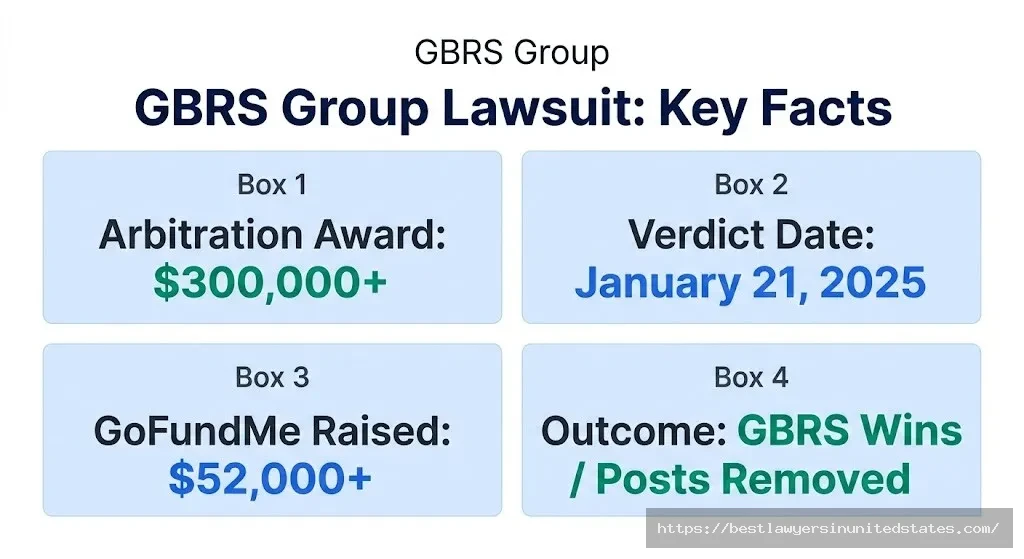
The GBRS Group lawsuit began with a missing package and a 22-day mystery — and ended with a $300,000+ arbitration verdict, a public admission of false racism claims, and lasting questions about social media’s power to destroy a company’s reputation overnight. This case gripped the tactical and firearms community throughout 2024 and reached its legal conclusion in January 2025.
Quick Answer: The GBRS Group lawsuit centers on the 2023 termination of shipping manager James Humphrey following a missing firearm package. Humphrey sued GBRS for wrongful termination and alleged racial discrimination. The case went to arbitration, where Humphrey admitted under oath that his racism allegations were false. GBRS Group was awarded more than $300,000 in damages for defamation in January 2025. ogx lawsuit
This is not a consumer class action. There is no settlement fund, no claim deadline, and no payout for the public. If you found this article looking to file a claim, that information does not apply here — this is an employment and defamation dispute between a company and a former employee. Can You Be Notified of a Lawsuit by Phone?
What Is GBRS Group?
Before getting into the lawsuit, it helps to understand who GBRS Group is and why this case resonated so deeply within a specific community.
GBRS Group is a Virginia Beach–based, veteran-owned tactical training and services company founded on September 6, 2019. Its founding members — including retired Navy SEALs DJ Shipley and Cole Fackler — are exclusively Special Mission Unit veterans. The company builds its brand around combat-tested gear, elite training programs, and a no-nonsense approach rooted in real operational experience.
GBRS built a loyal following in the tactical, firearms, and military communities through YouTube, social media, and its training offerings. That audience would become a central factor in why this lawsuit spiraled far beyond a typical employment dispute.
The Incident That Started Everything
November 2023: A Package Goes Missing
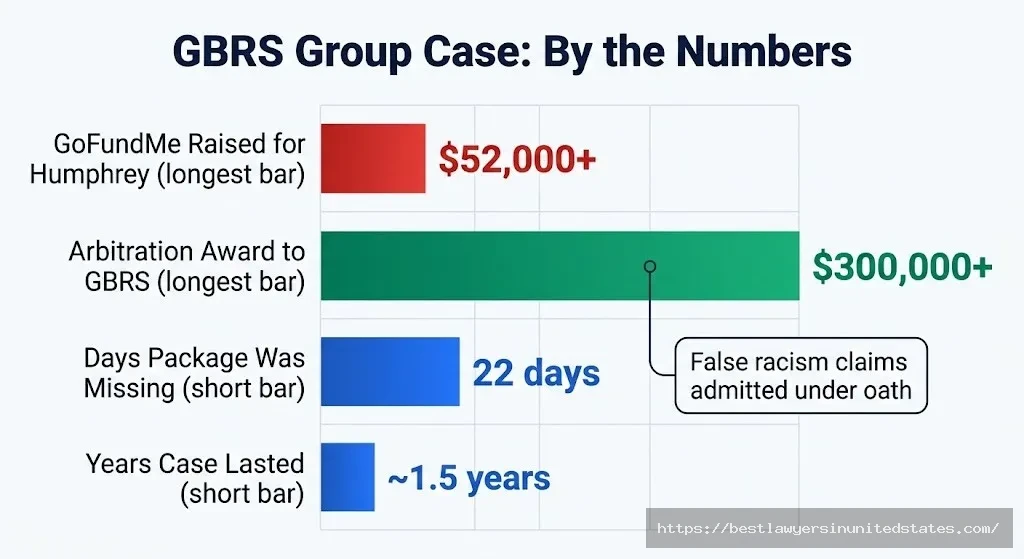
In November 2023, a UPS package containing a federally registered firearm component — specifically a BCM lower receiver, a critical part used in AR-15 assembly — went missing from GBRS Group’s facility. The package had been sitting unaccounted for 22 days.
Security footage reviewed by company staff showed shipping manager James Humphrey leaving the building carrying the package and then returning without it. Based on that footage and the federal nature of the item involved, GBRS Group did what federal firearms regulations require: they reported the missing firearm to law enforcement.
Virginia Beach Police Department launched an investigation. Officers detained Humphrey for questioning on December 4, 2023. Humphrey later shared body camera footage from his arrest on TikTok, telling his followers: “I think I just dropped it off behind the counter, didn’t get a receipt for it.”
He was right. The package had been accidentally delivered to a FedEx location rather than a UPS drop-off. A UPS driver eventually returned it to GBRS Group while Humphrey was still in custody.
The Arrest Fallout
Once the package was recovered, the theft charges were quickly dropped. But Humphrey was not reinstated. Two days after his arrest — and despite his exoneration on the theft — GBRS Group terminated his employment, citing negligent handling of a federally registered firearm as the reason.
That decision set off a firestorm.
Timeline of the GBRS Group Lawsuit
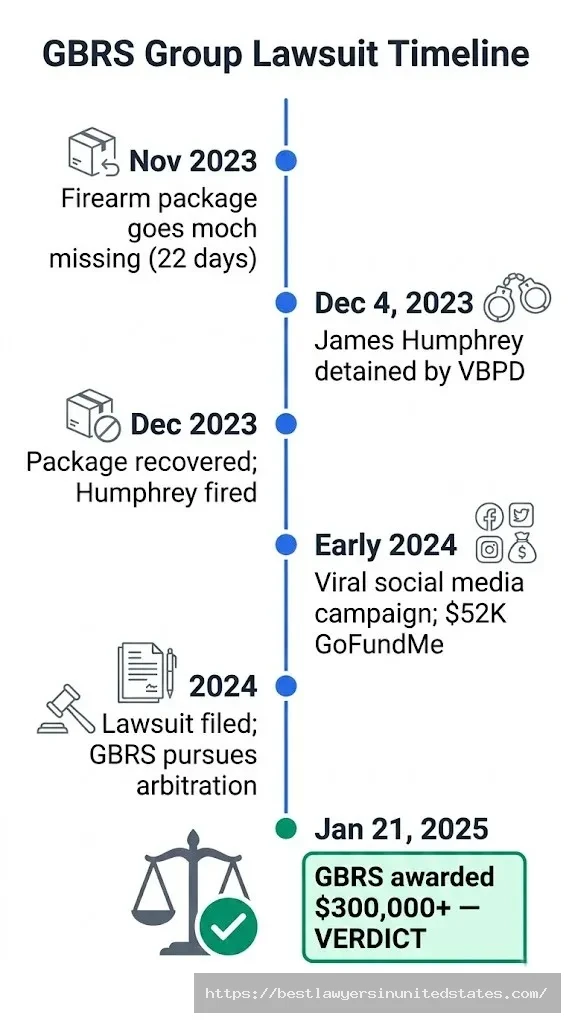
| Date | Event | Details |
|---|---|---|
| November 2023 | Package goes missing | Federally registered firearm component unaccounted for 22 days at GBRS facility |
| December 4, 2023 | Humphrey detained | Virginia Beach PD detains Humphrey for questioning; body cam footage later shared publicly |
| December 2023 | Package recovered | Returned to GBRS by UPS driver; had been accidentally dropped at FedEx |
| December 2023 | Humphrey terminated | GBRS fires Humphrey for negligent firearm handling; charges dropped |
| Late 2023 – Early 2024 | Viral social media campaign | Humphrey posts videos and content alleging racial discrimination; community rallies |
| Early 2024 | GoFundMe campaign | Tactical and firearms community raises $52,000+ for Humphrey’s legal fight |
| 2024 | Humphrey files lawsuit | Claims wrongful termination, emotional distress, defamation, and racial discrimination |
| 2024 | GBRS files counterclaims | Company pursues defamation claims in arbitration |
| 2024 | Virginia Beach PD investigation | Internal review launched into officer conduct during the incident |
| January 21, 2025 | Arbitration verdict | Humphrey admits under oath racism claims were false; GBRS awarded $300,000+ |
| January 2025 | Posts ordered removed | Arbitration panel orders Humphrey to take down all social media content related to the case |
Who Are the Parties Involved?
GBRS Group (Plaintiff in Arbitration)
GBRS Group is the tactical training and gear company based in Virginia Beach, Virginia. Founded by DJ Shipley and Cole Fackler — both retired Navy SEALs with Special Mission Unit backgrounds — the company serves military, federal, state, and local special operations units. GBRS pursued defamation claims in arbitration after Humphrey’s social media posts spread accusations of racism across the tactical community.
James Humphrey (Former Shipping Manager / Counter-Plaintiff)
James Humphrey was employed as a shipping manager at GBRS Group. After his termination, he filed a lawsuit against the company alleging wrongful termination, emotional distress, and racial discrimination. He simultaneously ran a public social media campaign sharing his account of events, which garnered massive support — and ultimately became the subject of GBRS’s defamation claims.
The Tactical and Firearms Community
While not a legal party, the tactical community played an outsized role in this case. Humphrey’s videos spread widely on TikTok, YouTube, and firearms forums. Supporters raised over $52,000 via GoFundMe for his legal defense. The community divided sharply — many initially condemning GBRS, with opinions shifting after the arbitration outcome became public.
What Did James Humphrey Allege?
Humphrey’s lawsuit against GBRS Group made several significant claims:
- Wrongful termination — He argued his firing was unjust, particularly given that he was cleared of theft. He contended GBRS dismissed him without proper cause once the package was recovered.
- Racial discrimination — Humphrey alleged that racial bias motivated both how the company handled the missing package incident and the subsequent decision to terminate him.
- Defamation — He claimed GBRS’s reporting of him to law enforcement and characterization of his conduct damaged his professional reputation.
- Emotional distress — Humphrey described the arrest, termination, and public fallout as causing significant personal and financial harm. His GoFundMe page noted he was struggling financially following the firing.
The social media campaign amplifying these allegations reached a wide audience within the tactical and firearms world — a community that represents a substantial portion of GBRS’s customer base.
What Did GBRS Group Allege?
GBRS’s position throughout was straightforward:
- The termination was based on negligent handling of a federally registered firearm — not race.
- Reporting the missing firearm to law enforcement was legally required under federal firearms regulations, not a racially motivated act.
- Humphrey’s viral social media posts falsely accused the company and its executives of racism, causing substantial reputational and financial harm.
- Physical threats were made against GBRS employees as a direct result of the online accusations.
GBRS pursued defamation claims in arbitration, seeking damages for the harm caused by what it described as a coordinated and false public accusation campaign. Mirena IUD Lawsuit
The Arbitration Proceedings
The parties resolved their dispute through arbitration rather than open court litigation — a common mechanism in employment disputes, often required by employment agreements.
The Turning Point: Humphrey’s Admission
The pivotal moment came during the arbitration proceedings themselves. Under oath, James Humphrey admitted that:
- GBRS Group and its executives were not racist
- His social media posts had led to false, racially-charged accusations against the company
- He regretted that his content had resulted in physical threats to GBRS employees
This admission fundamentally changed the trajectory of the case.
The Verdict: January 21, 2025
The arbitration panel sided with GBRS Group. The outcome:
| Outcome | Details |
|---|---|
| Award to GBRS Group | More than $300,000 in damages for defamation |
| Order against Humphrey | Required to remove all online posts related to the incident |
| Humphrey’s admission | Racism allegations against GBRS and executives were false |
| Status of Humphrey’s claims | Case effectively concluded; counter-claims not publicly upheld |
GBRS Group announced the result via PRNewswire on January 21, 2025, making the arbitration outcome a matter of public record.
Community Reaction: Divided, Then Shifting
The tactical community’s response evolved considerably across the arc of this case.
Initial reaction (late 2023 – early 2024): Humphrey’s videos gained massive traction. Many in the community saw a Black shipping manager arrested based on surveillance footage, cleared when the package turned up, and then fired anyway. The narrative of racial injustice resonated strongly, and $52,000+ was raised for his defense. Boycotts of GBRS products were called for across social media.
Virginia Beach PD scrutiny: The police department launched an internal investigation into officer conduct following public criticism of how the arrest was handled — a sign of how far the pressure extended beyond just GBRS Group.
After the arbitration verdict (January 2025): Opinion shifted significantly. The fact that Humphrey admitted under oath that his racism allegations were false reframed the entire narrative. Some community members who had supported him publicly reassessed their positions. Others continued to raise questions about how GBRS handled the initial incident, even if the racial discrimination claims didn’t hold up.
One Trustpilot reviewer, Christopher Seth, noted support for the company’s founders even during the controversy: “I highly valued DJ and Cole’s expertise.” Others maintained that regardless of the legal outcome, GBRS’s early crisis communication left much to be desired.
Legal Concepts This Case Illustrates
This dispute is a valuable real-world example of several employment and defamation law principles.
Wrongful Termination: When “Cleared” Doesn’t Mean “Reinstated”
Many people assume that if someone is cleared of criminal charges, they must get their job back. That’s not how employment law works. In most U.S. states, including Virginia, employment is at-will by default — meaning an employer can terminate someone for any reason that isn’t specifically illegal (like race, religion, sex, etc.).
GBRS’s stated reason for termination wasn’t the theft allegation. It was negligent handling of a federally registered firearm — a different basis entirely. Whether that reasoning survives legal scrutiny is a separate question, but the criminal exoneration alone doesn’t automatically equal wrongful termination under Virginia law.
Defamation and Social Media: Real Legal Consequences
Humphrey’s case is a sobering reminder that social media posts — even those that feel justified in the moment — can carry serious legal liability. For a defamation claim to succeed, the plaintiff generally must show:
- A false statement of fact (not opinion)
- Publication to a third party
- Fault (negligence or actual malice)
- Damages
When Humphrey admitted under oath that the racism allegations were false, that admission addressed the first element directly. The widespread reach of his TikTok videos established the second. The $300,000+ award reflects the real financial damage those posts caused.
Arbitration vs. Litigation
This case was resolved in arbitration, not open court. Arbitration is a private dispute resolution process — often faster and less expensive than litigation, but also less transparent. Employment contracts frequently include mandatory arbitration clauses. One consequence: the full details of proceedings and evidence typically don’t become public record the way court filings do.
The Role of Social Media in This Dispute
Perhaps the most striking aspect of the GBRS Group lawsuit isn’t the legal outcome — it’s what the case reveals about how social media can function as both a megaphone for legitimate grievances and a vector for reputational destruction.
Humphrey’s posts spread because they fit a recognizable and emotionally resonant pattern: a Black employee accused of theft, arrested on company’s say-so, ultimately cleared — then fired anyway. That story, even without the full context, activates real and justified community concerns about racial discrimination in the workplace.
The problem, as arbitration established, was that the underlying racism claim wasn’t true. The company’s reporting to law enforcement was legally mandated. The termination, while arguably harsh, was based on a stated policy rationale unrelated to race.
By the time the truth emerged through legal proceedings, the damage to GBRS — in reputation, in customer relations, in staff safety — had already been done. The $300,000+ award represents an attempt to quantify that harm, but no dollar figure fully captures it.
This case has become a reference point in discussions about:
- Employer obligations when reporting criminal conduct involving federally regulated items
- Employee rights when cleared of criminal charges but still terminated
- Social media liability for individuals and companies
- Crisis communication failures and how silence or slow response amplifies the worst-case narrative
Comparison: Similar Employment and Defamation Cases
| Case | Core Issue | Outcome | Similarity to GBRS |
|---|---|---|---|
| GBRS Group vs. Humphrey | Wrongful termination, defamation, false racism claims | GBRS awarded $300K+; Humphrey’s claims not upheld | This case |
| Gibson’s Bakery vs. Oberlin College | Defamation, racial accusation against business | $36.59M jury award to bakery (later reduced) | Business accused of racism; award for defamation |
| McDonald’s Employment Disputes | Race discrimination in termination | Mixed outcomes; varies by evidence | At-will employment, racial bias allegations |
| Covington Catholic vs. Washington Post | Defamation via media portrayal | Settled for undisclosed amount | Viral narrative vs. fuller factual picture |
The Gibson’s Bakery case is the closest parallel in spirit: a business falsely accused of racial misconduct following a confrontation with a Black individual, with the accusation spreading virally and causing significant harm. The court awarded substantial defamation damages in that case as well.
What GBRS Group Did Right — and What It Could Have Done Better
What Worked
Documenting everything. GBRS had security footage, and they used it. When the case went to arbitration, that footage was part of the evidentiary record.
Following legal protocol. Reporting the missing firearm wasn’t a choice — it’s federally required. That fact gave GBRS a defensible position on the core allegation that the police call was racially motivated.
Pursuing legal remedies. Rather than simply absorbing the reputational hit, GBRS pursued defamation claims in arbitration. The $300,000+ award validated that approach. Trulicity Lawsuit 2026
What Could Have Been Better
Crisis communication. Multiple observers noted that GBRS’s early public response was slow and poorly calibrated. In the absence of a clear, rapid statement from the company, Humphrey’s version of events filled the vacuum. By the time GBRS responded more fully, the narrative had calcified online.
The termination handling. Even if legally defensible, firing Humphrey two days after he was cleared — rather than allowing more time for internal review — created a perception problem that the company spent more than a year fighting.
Frequently Asked Questions
What is the GBRS Group lawsuit about? The GBRS Group lawsuit centers on the 2023 termination of shipping manager James Humphrey following a missing package incident involving a federally registered firearm. Humphrey alleged wrongful termination and racial discrimination. GBRS pursued defamation claims after Humphrey’s social media posts spread false racism accusations. Arbitration in January 2025 resulted in a $300,000+ award to GBRS.
Is there a class action settlement or claim I can file? No. This is not a class action lawsuit. There is no settlement fund and no claims process for the public. This was an employment and defamation dispute between a company and a former employee. Anyone suggesting you can file a claim for money from this case is providing inaccurate information.
Did GBRS Group win or lose? GBRS Group won the arbitration. The panel awarded GBRS more than $300,000 in damages for defamation. Humphrey’s counterclaims for wrongful termination and racial discrimination were not upheld in the arbitration outcome.
What did James Humphrey admit under oath? During arbitration proceedings, Humphrey admitted that GBRS Group and its executives were not racist, and that his social media posts had led to false, racially-charged accusations against the company. He expressed regret that those posts resulted in physical threats against GBRS employees.
Why was Humphrey arrested in the first place? Virginia Beach Police Department detained Humphrey for questioning after GBRS reported a federally registered firearm component missing. Security footage showed Humphrey leaving the facility with the package and returning without it. While Humphrey was in custody, the package was recovered — he had accidentally delivered it to FedEx instead of UPS. Criminal charges were dropped shortly after.
Why did GBRS fire Humphrey if he was cleared of theft? GBRS stated the termination was for negligent handling of a federally registered firearm — not for theft. In Virginia, employment is generally at-will, meaning an employer can terminate for reasons other than criminal guilt, as long as the reason isn’t itself illegal (such as racial discrimination). The arbitration outcome suggests the racial discrimination claim was not substantiated.
Was GBRS Group required to call the police? Yes, under federal firearms regulations, businesses that deal in federally regulated firearms and components are required to report missing items to law enforcement. GBRS’s legal team emphasized this point throughout the case — the police report was legally mandated, not an act of racial targeting.
How much money did James Humphrey raise on GoFundMe? The tactical and firearms community raised over $52,000 for Humphrey’s legal defense and recovery through a GoFundMe campaign after his termination. This reflected the initial community sentiment before the arbitration outcome became known.
What happened to Humphrey’s social media posts? As part of the arbitration ruling, Humphrey was ordered to remove all online posts related to the incident. The posts had been widely shared across TikTok, YouTube, and firearms-focused social media platforms.
Did the Virginia Beach Police Department face any consequences? The Virginia Beach PD launched an internal investigation into officer conduct following public criticism of how Humphrey’s arrest was handled. The full outcome of that review has not been widely reported publicly.
What is GBRS Group known for? GBRS Group is a veteran-owned tactical training and services company founded by retired Navy SEALs DJ Shipley and Cole Fackler. The company serves military, federal, state, and local special operations units, and offers training programs and combat-tested gear. Its founding and extended instructor network consists exclusively of Special Mission Unit veterans.
Does this case set any legal precedents? Arbitration decisions generally don’t set formal legal precedents the way court decisions do, since they’re private proceedings. However, the case has become a widely cited example in discussions about social media defamation liability and the real-world consequences of viral false accusations. The $300,000+ award demonstrates that courts and arbitration panels take online defamation seriously.
What’s the lesson for employees facing similar situations? If you believe you’ve been wrongfully terminated or discriminated against, the appropriate path is through legal channels — not a viral social media campaign. Public accusations of racism or other misconduct carry real legal risk if the facts don’t support them. This case shows that even a morally sympathetic narrative can expose the person telling it to significant liability if the specific claims turn out to be false.
What’s the lesson for employers? Move quickly on crisis communication. GBRS’s slow early response allowed a damaging narrative to take hold in a community that matters deeply to its business. Having the law on your side doesn’t protect you from reputational harm if the public never hears your side clearly and promptly. Document everything, follow legal protocols, and communicate transparently.
Is GBRS Group still in business? Yes. GBRS Group continues to operate in Virginia Beach, Virginia, offering tactical training and gear. The company’s official statement following the arbitration win emphasized their commitment to their mission and their veteran community.
The Bigger Picture: What This Case Says About Us
The GBRS Group lawsuit doesn’t fit neatly into a simple story of heroes and villains. A Black employee was arrested on his employer’s say-so for something that turned out to be an innocent mistake. He lost his job. He suffered real harm. A community rallied around him because the surface-level facts looked familiar and troubling.
At the same time, a company that was legally compliant — required to report the missing firearm, operating under at-will employment law — found itself the target of a viral defamation campaign that caused genuine damage: physical threats to employees, boycotts, reputational harm in the community it serves.
The arbitration found that the specific claim of racism was false. That’s an important legal fact. But it doesn’t erase the reality that the initial handling of the situation — the two-day gap before termination, the communication failures, the perception that a man was fired after being cleared — created conditions where the false narrative felt plausible to many people.
That’s the uncomfortable space this case occupies. And it’s why it generated so much heat, and why it’s worth understanding in full — not just the headline, but all of it.