
The Trump CPB board removals lawsuit is now closed. On January 14, 2026, a federal judge dismissed the case as moot after the Corporation for Public Broadcasting voted to dissolve itself entirely.
What started as a constitutional showdown ended not with a verdict but with an institution’s extinction. In April 2025, President Trump tried to fire three sitting CPB board members via email. CPB sued the same day. Then Congress pulled the plug on $1.07 billion in funding, and the whole fight became irrelevant.
This article covers every key event: the firings, the lawsuits, the failed injunction, the DOJ counter-attack, the funding rescission, and the final dissolution. You’ll find the full timeline, the exact legal arguments, and what this case means going forward. Ozempic Lawsuit 2026
What Is the Trump CPB Board Removals Lawsuit?
The Trump CPB board removals lawsuit is a federal legal case filed on April 29, 2025, after President Trump attempted to remove three sitting directors from the Corporation for Public Broadcasting’s board.
CPB filed in the U.S. District Court for the District of Columbia. The case number is 1:25-cv-01305. CPB argued that Trump had no legal authority to fire its board members.
The core dispute was about the nature of CPB itself. Is it a government agency subject to presidential control? Or is it a private nonprofit shielded from executive interference?
That question never got a definitive merits ruling. The case was dismissed as moot on January 14, 2026.
| Case Detail | Information |
|---|---|
| Case Number | 1:25-cv-01305 (D.D.C.) |
| Filed | April 29, 2025 |
| Assigned Judge | Randolph D. Moss |
| Plaintiffs | CPB, its board, Laura Ross, Diane Kaplan, Tom Rothman |
| Defendants | Donald Trump, OMB, White House Personnel Office |
| Case Status | Dismissed as moot (January 14, 2026) |
The lawsuit set off a nine-month legal chain reaction that ultimately ended public broadcasting’s primary federal funder.
Why Did Trump Fire the CPB Board Members?
Trump fired the CPB board members as part of a broader effort to defund and dismantle public media institutions he accused of ideological bias.
On April 28, 2025, the White House Office of Presidential Personnel sent emails to three CPB directors. Each email stated their positions were “terminated effective immediately.”
The administration cited presidential authority under Article II of the Constitution. White House spokesperson Taylor Rogers stated that Trump has “the power to remove personnel who exercise his executive authority.”
CPB pushed back immediately. Its legal team argued the organization was never a federal agency and was explicitly designed to resist this kind of political pressure.
Trump had also previously signed Executive Order 14290 on May 1, 2025. That order, titled “Ending Taxpayer Subsidization of Biased Media,” directed CPB to stop funding NPR and PBS. The board removals were part of the same strategic campaign.
Key Takeaway: Trump’s removal attempt was one piece of a larger strategy to end federal public media funding.
Who Were the Three Fired CPB Board Members?
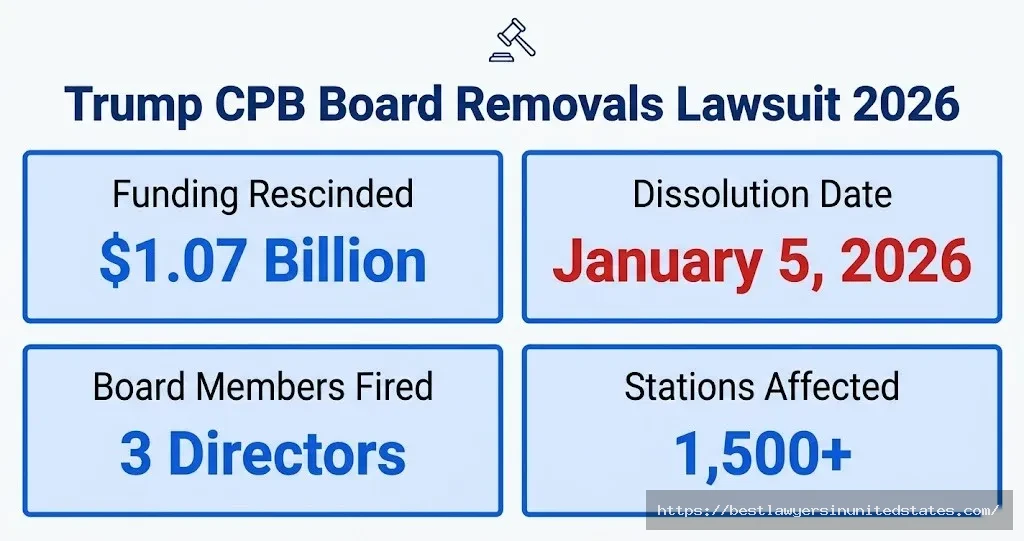
The three CPB board members Trump targeted were Laura G. Ross, Diane Kaplan, and Tom Rothman.
Tom Rothman is the chairman and CEO of Sony Pictures Entertainment’s Motion Picture Group. He was a Biden appointee. Diane Kaplan was also a Biden appointee. Laura G. Ross was originally appointed by Trump in his first term and then reappointed by Biden.
All three had fixed six-year terms under the Public Broadcasting Act. None had been accused of misconduct or failure to perform their duties.
Their terminations, if upheld, would have left CPB with only two remaining board members. That number falls below the quorum needed to conduct official business.
| Board Member | Appointed By | Party Affiliation |
|---|---|---|
| Tom Rothman | Biden | Democrat-leaning |
| Diane Kaplan | Biden | Democrat-leaning |
| Laura G. Ross | Trump (1st term), reappointed Biden | Republican |
After the case was filed, both Kaplan and one other board member later voluntarily dismissed their own claims as litigation dragged on.
How Did CPB Sue Trump in April 2025?
CPB filed its federal lawsuit within hours of receiving the termination emails on April 29, 2025.
The filing was made in the U.S. District Court for the District of Columbia. CPB’s legal team was led by Jason McElroy of Saul Ewing LLP.
CPB moved for a temporary restraining order (TRO) the same day. By agreement of both parties, the court treated it as a motion for a preliminary injunction. That gave both sides more time to argue.
The lawsuit alleged violations of three distinct legal theories:
- The Administrative Procedure Act (unlawful agency action)
- Separation of Powers (Congress’s authority over independent bodies)
- The Presentment, Appropriations, and Take Care Clauses of the Constitution
CPB’s core argument was simple: the president cannot fire the directors of a private nonprofit corporation that Congress explicitly designed to be free of executive control.
Key Takeaway: CPB moved fast and filed on multiple legal fronts, but the case would stall at the injunction stage.
What Is the Corporation for Public Broadcasting?
The Corporation for Public Broadcasting is a private, nonprofit corporation created by Congress in 1967 under the Public Broadcasting Act. It is not a federal agency.
CPB’s job was to distribute federal funding to public broadcasters across the country. It supported more than 1,500 locally operated public television and radio stations.
In fiscal year 2025, CPB’s operating budget included $535 million in federal appropriations plus roughly $10 million in interest revenue. That money went toward:
- Public television content (66.75% of funding)
- Public radio content (22.25% of funding)
- Operations (5%)
- Local journalism, royalties, and community programs (6%)
CPB funded PBS and NPR, but it did not own or operate either organization. PBS and NPR were separately incorporated nonprofits created by CPB in 1969 and 1970, respectively.
CPB was the largest single source of funding for public radio and television in the United States. Losing it was not a budget trim. It was a structural collapse.
What Does the Public Broadcasting Act of 1967 Say About Removal?
The Public Broadcasting Act of 1967 is the law that created CPB and is the legal foundation of the Trump CPB board removals lawsuit.
The Act explicitly states that CPB “will not be an agency or establishment of the United States Government.” It sets up protective layers designed to “afford the maximum protection from extraneous interference and control.”
CPB board members serve staggered six-year terms. The law allows no more than five of nine board seats to be held by members of a single political party. The president appoints board members in consultation with Senate leaders of both parties.
Critically, the Act does not include the standard government agency clause that officers “serve at the pleasure of the President.” It also prohibits officers or employees of the U.S. government from serving on the board.
The only removal provision in the Act is for repeated unexplained absences from board meetings. There is no “for cause” or “at-will” removal clause.
Trump’s lawyers argued Congress still implied presidential removal power through appointment authority. CPB’s lawyers said the statute’s silence on removal was intentional, not an oversight.
How Did Judge Randolph Moss Rule on the Preliminary Injunction?
Judge Randolph D. Moss denied the CPB’s request for a preliminary injunction on June 8, 2025.
He ruled that CPB had not adequately demonstrated it was likely to succeed on the merits of its claims. He also found that the board members failed to show they would suffer “irreparable harm” in the absence of relief.
Moss noted that any replacement board members would require Senate confirmation. That process would likely take longer than a final verdict in the case, effectively preserving the status quo without an injunction.
Importantly, Moss did not rule that Trump was right. He stated that “Congress intended to preclude the President (or any subordinate officials acting at his direction) from directing, supervising, or controlling the Corporation.”
CPB and its CEO, Patricia Harrison, claimed partial victory. Harrison signed a document affirming that all three board members “remain, and will continue to serve” on the CPB board.
| Ruling Detail | Outcome |
|---|---|
| Injunction Request | Denied |
| Irreparable Harm Found | No |
| Likely Merits Success Found | No |
| Board Members’ Status | Remained in place under CPB’s bylaws |
| Date of Ruling | June 8, 2025 |
Key Takeaway: Moss’s denial was not a win for Trump. It simply preserved the fight for later, which never came.
How Did CPB’s Bylaw Changes Affect the Board Members’ Status?
After the termination emails arrived, CPB’s board took an aggressive defensive step. It amended its bylaws under the District of Columbia Nonprofit Corporation Act.
The new bylaw stated that no board member can be removed by anyone, including the president, without a two-thirds confirming vote from the rest of the board.
Judge Moss raised this during a court hearing. He questioned why CPB had not changed its bylaws sooner if it believed the removals were unlawful. Shortly after that hearing, the board voted to add the new rule.
This move was significant. Under D.C. nonprofit law, corporate bylaws govern internal governance. Moss acknowledged in his June ruling that the D.C. nonprofit act’s bylaw provisions governed the situation.
The Trump administration pushed back hard. Its later DOJ counter-lawsuit argued that the bylaw amendment was invalid because the three directors had already been lawfully removed on April 28. They claimed the remaining board lacked the authority to change bylaws while the fired members were allegedly not valid directors.
The bylaw argument was never fully resolved by a court. The case became moot before any definitive ruling came down. DOGE Transparency FOIA Lawsuit
What Was the DOJ Counter-Lawsuit Against the CPB Board in July 2025?
The Department of Justice escalated the fight with its own lawsuit filed on July 15, 2025.
Rather than defending Trump’s original action, DOJ went on offense. It sued the three CPB board members directly in the U.S. District Court for Washington, D.C.
The DOJ demanded:
- A court declaration that Laura Ross, Diane Kaplan, and Tom Rothman “be ousted and excluded” from the board
- A ruling that all board actions they participated in after April 28, 2025, were invalid
- Repayment of any salaries or payments they received after their alleged removal
DOJ argued the three directors were “usurping” their positions. It accused them of participating in board meetings, voting on resolutions, and presenting themselves publicly as valid board members, all of which it called “manifestly unlawful.”
This created two simultaneous lawsuits running in parallel. CPB was suing to block the removals. The government was suing to force the removals and claw back pay.
| Lawsuit | Filed By | Filed Against | Key Demand |
|---|---|---|---|
| Case 1 (Original) | CPB and board members | Trump and White House | Block the firings |
| Case 2 (Counter) | U.S. DOJ | Ross, Kaplan, Rothman | Oust directors, repay salaries |
Key Takeaway: The DOJ counter-lawsuit was an escalation, not a response. It showed the administration had no intention of backing down through negotiation.
What Did the Rescissions Act of 2025 Do to CPB Funding?
The Rescissions Act of 2025 was the legislation that effectively ended the Trump CPB board removals lawsuit by destroying the organization it was fought over.
President Trump signed the Act on July 24, 2025. It rescinded $1.07 billion in previously appropriated federal funding for CPB covering fiscal years 2026 and 2027.
Congress funds CPB in two-year advance increments. CPB had already received a forward appropriation of $535 million annually. The Rescissions Act canceled that committed funding before it could be disbursed.
The House passed the bill on June 12, 2025, in a 214-212 vote. The Senate passed an amended version on July 17, 2025, in a 51-48 vote. Trump signed it one week later.
Four moderate House Republicans voted against the bill: Mark Amodei (Nevada), Brian Fitzpatrick (Pennsylvania), Nicole Malliotakis (New York), and Mike Turner (Ohio).
Critics pointed out that CPB’s total annual appropriation represented less than 0.01% of the federal budget, making the move more politically symbolic than fiscally significant.
How Much Federal Funding Did CPB Actually Lose?
CPB lost its entire federal funding base in one legislative action. The total amount rescinded was approximately $1.07 billion across two fiscal years.
In practical terms, this meant:
- $535 million for FY 2026 was eliminated
- $535 million for FY 2027 was eliminated
- Interest revenue of about $10 million annually was also effectively lost
CPB had no meaningful alternative revenue. The law capping administrative expenses at 5% of the appropriation meant CPB could not sustain operations without federal funds.
| Funding Category | Annual Amount | Destination |
|---|---|---|
| Public television (PBS-related) | ~$357 million | 66.75% of federal allocation |
| Public radio (NPR-related) | ~$119 million | 22.25% of federal allocation |
| Operations | ~$27 million | 5% of allocation |
| Local journalism / royalties | ~$32 million | 6% of allocation |
| Total Annual Federal Support | $535 million | 1,500+ local stations |
The Senate Appropriations Committee also declined to include CPB in its FY 2026 Labor, Health and Human Services appropriations bill, closing any backdoor path to restore funding.
Key Takeaway: The $1.07 billion rescission was not a budget cut. It was a kill shot. CPB had no path to continue without it.
How Did CPB Begin Winding Down Operations in 2025?
CPB announced the start of its operational wind-down on August 1, 2025, one week after the Rescissions Act was signed.
The announcement came from CPB President and CEO Patricia Harrison. CPB told employees that same day that the majority of staff positions would conclude on September 30, 2025, the end of the federal fiscal year.
A small transition team was retained through January 2026. This team focused on:
- Final compliance reviews
- Distributing any remaining community service grants to local stations
- Resolving long-term financial obligations, including music royalties still essential to public radio
Harrison initially left the door open to a scaled-back continuation. At an August board meeting, she stated clearly that a wind-down was “not a dissolution.”
But that option closed quickly. Without any federal funding on the horizon and the Senate excluding CPB from future appropriations bills, the board recognized that maintaining a “nonfunctional entity” would not serve anyone’s interests.
The wind-down affected every public station in the country. More than 1,500 outlets had to begin planning for permanent CPB funding gaps.
When Did CPB Vote to Dissolve in January 2026?
The CPB board voted unanimously to dissolve the organization on January 5, 2026, following 58 years of continuous operation.
CPB board chair Ruby Calvert described the funding cuts as “devastating.” She expressed hope that “a new Congress will address public media’s role in our country.”
Patricia Harrison framed the dissolution as a deliberate final act of protection: “CPB’s final act would be to protect the integrity of the public media system and the democratic values by dissolving, rather than allowing the organization to remain defunded and vulnerable to additional attacks.”
CPB planned to file formal articles of dissolution with the D.C. Mayor’s Office on or about January 30, 2026. A limited team continued wind-down activities after that date.
The same day the board voted to dissolve, CPB and the U.S. government filed a joint status report in both pending lawsuits. Both sides agreed: there was no longer a live legal controversy to adjudicate. Blake Lively Lawsuit Against Justin Baldoni
| Key Date | Event |
|---|---|
| April 28, 2025 | Trump fires board members via email |
| April 29, 2025 | CPB files federal lawsuit |
| June 8, 2025 | Judge denies preliminary injunction |
| July 15, 2025 | DOJ files counter-lawsuit |
| July 24, 2025 | Rescissions Act signed |
| August 1, 2025 | CPB announces wind-down |
| September 30, 2025 | Most CPB staff depart |
| January 5, 2026 | CPB board votes to dissolve |
| January 14, 2026 | Court dismisses both cases as moot |
Key Takeaway: CPB chose to dissolve proactively rather than linger as an empty shell susceptible to further political manipulation.
Was the Trump CPB Board Removals Lawsuit Dismissed as Moot?
Yes. The court dismissed the Trump CPB board removals lawsuit as moot on January 14, 2026.
Both lawsuits, CPB’s original case and the DOJ’s counter-suit, were dismissed simultaneously. The court also denied pending summary judgment motions from both sides as moot.
A case becomes moot when there is no longer a live controversy for a court to resolve. With CPB dissolving as a legal entity, its board members stepping down or dismissing their own claims, and the organization itself ceasing to exist, there was nothing left to adjudicate.
Two board members had already voluntarily dismissed their own claims earlier in the case. Diane Kaplan dismissed her claims on July 24, 2025. Another board member dismissed his claims on August 1, 2025.
Critically, no court ever issued a ruling on the merits. The central question, whether the president has the authority to remove CPB board members, was never answered definitively.
That legal gap matters. It means no binding precedent was set. Future presidents can still challenge the governance of similar federally chartered nonprofits without an existing court ruling standing in their way.
What Happens to PBS and NPR Without CPB?
PBS and NPR face serious structural funding challenges following CPB’s dissolution, but neither organization has shut down.
CPB was the largest single source of federal funding for public media. PBS stations received an average of 15% of their revenues from CPB. NPR member stations received about 10% of their revenues from CPB. NPR itself received only about 1% of its funding directly from CPB.
The bigger hit falls on local public stations, particularly those in rural areas. These stations often lack the donor base or corporate underwriting to absorb a 15% revenue loss.
NPR CEO Katherine Maher reported that individual donor contributions had increased after the defunding fight became public. However, she cautioned that donation spikes are typically not sustainable over multiple years.
Additional fallout includes:
- Reduced emergency alert communications in rural communities
- Cuts to children’s educational programming, including Ready to Learn initiatives
- Loss of local journalism support grants
- Disruption to music royalty payment systems CPB managed
In Indiana, the state government separately eliminated all state-level taxpayer funding for 17 public broadcasting stations, compounding the federal cuts. That decision put stations serving neighboring states at risk of service disruptions.
Key Takeaway: The damage spreads far beyond Washington. Rural communities and children’s programming are among the hardest hit.
What Is the Legal Legacy of the CPB Lawsuit?
The legal legacy of the Trump CPB board removals lawsuit is defined by what did not happen: no final merits ruling was ever issued.
Because the case was dismissed as moot, courts never settled whether the president can remove directors of a congressionally chartered nonprofit. That question remains open.
The case nonetheless produced two significant partial findings:
- Judge Moss’s June 8, 2025, ruling acknowledged that “Congress intended to preclude the President (or any subordinate officials acting at his direction) from directing, supervising, or controlling the Corporation.” This is not a binding precedent, but it is a persuasive judicial statement.
- The bylaw amendment tactic showed that nonprofits incorporated under D.C. law can use internal governance rules as a practical shield against executive interference. This model could be replicated by similar organizations.
The case also intersects with broader constitutional debates about presidential removal power following the Supreme Court’s decisions in Seila Law LLC v. CFPB (2020) and Humphrey’s Executor v. United States (1935). Those cases govern removal of agency heads at executive agencies. CPB was never an agency, making its legal situation distinct.
Legal scholars note that future cases involving federally chartered nonprofits will have to start from scratch. No circuit court ruled. No Supreme Court cert was sought. The entire fight evaporated when its subject ceased to exist.
Frequently Asked Questions
Did Trump successfully fire the CPB board members?
Not through the courts. Trump sent termination emails on April 28, 2025, but no court ever validated those removals through a final ruling. The three board members continued serving under CPB’s amended bylaws until they eventually stepped down or dismissed their own claims. The lawsuit was dismissed as moot before any definitive verdict was reached.
Why was the CPB lawsuit dismissed in January 2026?
The case was dismissed as moot on January 14, 2026, because CPB voted to dissolve as a legal entity on January 5, 2026. With no organization left to govern and no remaining board members contesting their removal, there was no live controversy for the court to decide. The joint dismissal request was filed by both sides together.
What was the DOJ counter-lawsuit against CPB board members about?
The Department of Justice filed its own lawsuit on July 15, 2025, against the three CPB directors. It accused them of “usurping” their positions after being validly removed on April 28. The DOJ asked the court to formally oust them, void all board actions they participated in after removal, and require them to repay any salaries received. That case was also dismissed as moot in January 2026.
How did the Rescissions Act of 2025 end CPB?
The Rescissions Act of 2025, signed by Trump on July 24, 2025, canceled approximately $1.07 billion in advance appropriations for CPB covering fiscal years 2026 and 2027. Without its annual $535 million federal appropriation, CPB had no viable operating budget. The board announced a wind-down in August 2025, laid off most staff by September 30, and voted unanimously to dissolve on January 5, 2026.
Does the CPB lawsuit set a legal precedent for future cases?
No binding legal precedent was established. Because both lawsuits were dismissed as moot, no court issued a merits ruling on whether presidents can remove board members of congressionally chartered nonprofits. Judge Moss’s June 2025 opinion offered persuasive language supporting CPB’s independence argument, but it is not binding precedent. Future challenges to similar organizations will have to relitigate the core constitutional question from the beginning.
The Trump CPB board removals lawsuit is a case study in how legislative power can outpace judicial review. The courts never settled the underlying constitutional question.
Public broadcasting stations lost their primary federal funder. Thousands of communities lost free, trusted local programming. And a 58-year-old institution created to keep politics out of public media was eliminated precisely through political pressure.
Monitor congressional developments closely. CPB chair Ruby Calvert has left open the possibility that future legislation could restore public media funding. Stay informed on any new appropriations efforts in the 2026-2027 legislative session.
